Showing posts with label controlled economy. Show all posts

Monday, July 21, 2014

Prosperity vs. Poverty


Since I first posted the Spherical Model website, back in 2010, I’ve left it pretty nearly untouched. Today I’m contemplating a change—in how I label the Economic Sphere.
Each of the spheres has a positive goal north, and a negative goal south. The Political Sphere’s north is freedom, and south is tyranny. The Social Sphere’s north is civilization, and south is savagery. I often use the term Civilization Sphere, just as a shortcut to the goal.
Up until now I’ve been referring to the Economic Sphere’s north as free-enterprise economy, and south as controlled economy. That orientation won’t change, but free-enterprise is really the “how” of getting north. What we’re really aiming at is a northern prosperity, to avoid a southern poverty. [If you’re new to the Spherical Model, the spherical orientation does not coincide with our earth; the directions refer to a visual model for ideas, policies, and practices.]
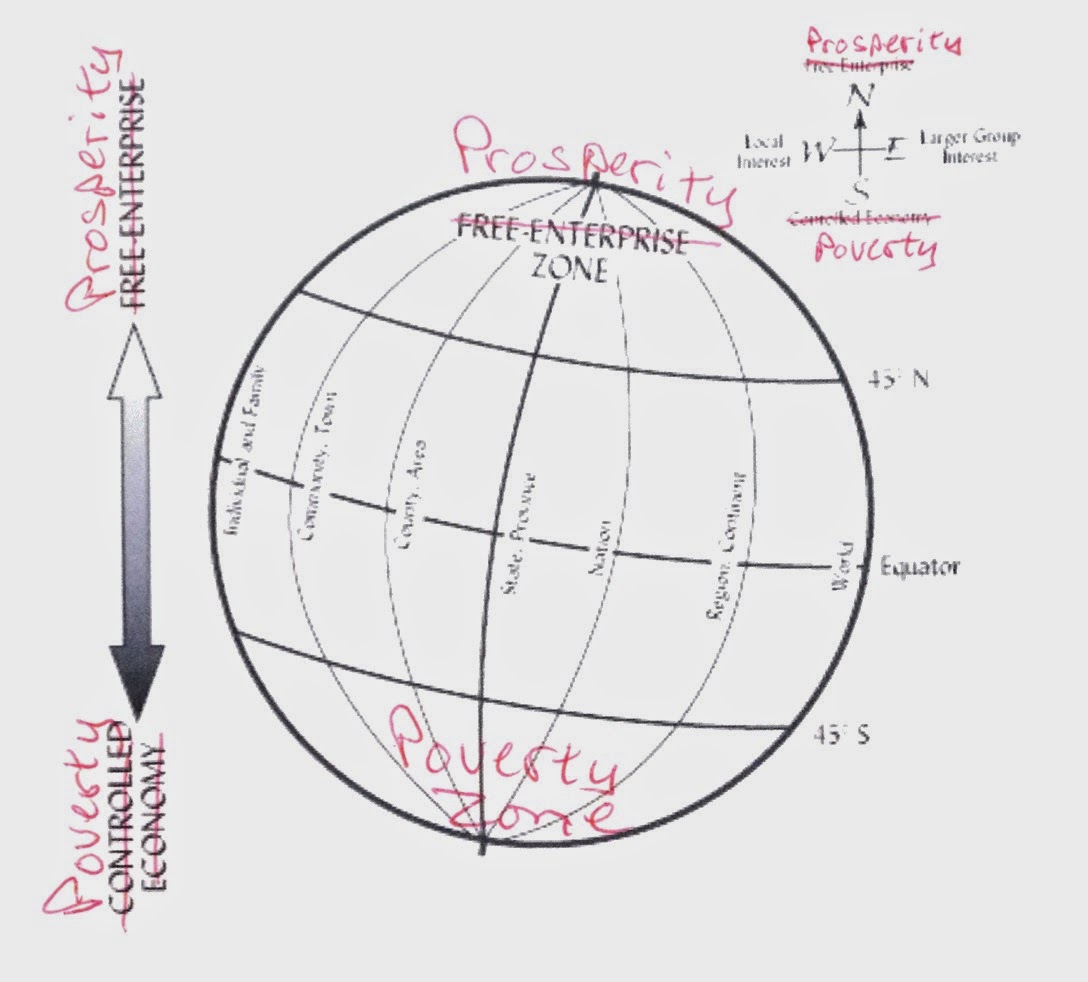
Economic Sphere, with edits
I think it has been clear, prior to this post, that we were getting freedom, prosperity, and civilization by going north in all three spheres. A quick search shows I’ve used that exact phrase in 16 different posts. But I’m getting more consistent at making it a theme. Half of those posts came in 2014; another 5 in 2013. So I’m making the change to make it unmistakable: there is no path to prosperity in a southern economic model. In the south, instead of the one who earns the wealth deciding how to spend it, someone else decides: the tyrannical state (central planners) in the eastern quadrant, the tyrannical crime lords (mafia, mob, gangs, marauders….) in the chaotic western quadrant.
Are there examples of prosperity in the south? Probably, in history, here and there, depending on how you define it. In a monarchy, under the rule of law (as opposed to arbitrary ruler’s law), where there is access to natural resources, and trade, and a lot of autonomy among individual citizens, you’re going to see some prosperity. Still, you’d be hard-pressed to find a large economic success before the United States where even the poor are so unlikely to starve or be without shelter and clothing (subsistence), and probably have what other cultures would consider luxuries.
When you take away a person’s control over the money they spend their life to earn, you take away that person’s incentive to work hard, innovate, and risk savings. An economy that discourages hard work, innovation, and capital investment cannot lead to prosperity. It can’t even maintain a lack of poverty; once the capital from a better economy is used up, poverty either creeps in or crashes in.
With each of the spheres, you have a 45th parallel line in each hemisphere. So, in the Economic Sphere, above the 45th parallel is true prosperity. People are able to overcome the state of nakedness, shelterness, and lack of experience they were born with to become self-sufficient in providing for their needs—and many of their wants. They have life, liberty, and property, and are able to accumulate wealth according to their successful use of their capital. There will likely be people who cannot, through no fault of their own, take care of their own needs—the very old, the chronically ill or disabled—but there are enough willing charitable givers to keep those people fed, clothed and sheltered better than the poor in a southern hemisphere community.
Down south, below the 45th parallel is true poverty, with a lot of subsistence living—and some dying of hunger or lack of water, basic cleanliness, clothing, and shelter from the elements. And there’s very little hope of getting out of that miserable condition. There may be a few elites with great wealth, usually the ruling tyrants and their minions, who do not give freely to alleviate the suffering of the poor. This is the condition in much of the world—throughout history, and many places today.
We know the simple economic answer to poverty: allow individuals to control the wealth they make. You tie into the political sphere by having limited government to protect life, liberty, and property. You tie into the social sphere—civilization—with honesty, respect for property, family strength, avoiding covetousness, and encouraging voluntary charitable giving.
These answers are simple, and they’re proven. But the solution isn’t easy, because the world is oriented toward the southern hemisphere. The masses of humanity seem unaware of the northern hemisphere of possibility above them, so they oscillate between statist control and mob rule control. The regular workers out there would be happy to just be left alone to do the work they want, pursue their own path, take their own risks. It’s a natural yearning of the human heart to be free to pursue happiness our own way. But the discouragement and fear mongering offered up by the controllers have left them looking only down.
The goal is to spread the message: look up. We can all have better than tyranny, poverty, and savagery. Follow the right principles, and we can move on up north to freedom, prosperity, and civilization.

Wednesday, November 6, 2013

Interference and Consequences


Last week’s Economics 101 lesson (week 6, through Hillsdale College, online for free) was on “Incentive and the ‘Information Problem.’” There were several points worth repeating.
Hillsdale Courses online
Early on, lecturer Gary Wolfram, asks the question, why can’t centrally planned systems provide wealth for the masses?
Market Capitalism, Wolfram tells us, solves a number of problems:
·        Information Problem—how can a central planner possibly know what all the Americans are going to want for breakfast tomorrow, or what they’ll want to read seven months from now? Market capitalism answers this through the price system.
·        Incentive Problem—innovation requires risk taking, and without an incentive to take risk, producers don’t innovate; they do the safe or easy thing.
One example he gives about the incentive problem, near the end of the lecture, is a caveman example—because economists like to demonstrate principles with simple societies. Suppose you’ve got a caveman, and he comes up with the idea of a stone axe. He has to form the axe head out of stone. He has to fashion some kind of handle, and figure out how to attach the axe head to the handle. All this is going to take time—time that he could have been spending grubbing for roots and berries. That’s his opportunity cost.
Suppose then, some other big ol’ caveman comes and takes it from him, because there are no property rights. It wasn’t worth the risk of time and effort, if he couldn’t guarantee that he could keep what he’d made for his use. Without property rights, there’s no incentive to innovate.
There are two types of systems that fail to protect property rights. I’ll give you a clue: on the Spherical Model, they are both southern hemisphere. There’s the anarchy side, like in the caveman example. And there’s the statist/government control side.
The pleasant alternative is the northern freedom zone. In economic terms, it’s where you find free markets. And, he agrees with the Spherical Model, that political freedom and free market systems go together.
Wolfram offers comparative examples between free market capital systems and centrally planned systems. Think about where you’d rather be planted, if you were destined to be poor. Always it’s better to be poor in a market-based economy, rather than an authoritarian ruled system. Think about, if you had to be poor, but could choose anywhere in the world to be born and live, where would it be.
As he points out, “Nobody says, ‘Send me to North Korea.’ They all say, ‘Send me somewhere that’s a market economy. Send me to Australia. Send me to the United States. Send me to Canada….’” We know centrally planned states cannot produce wealth for the poor. Only market capitalist states can do that. [31:30 into the video]
He referred to studies comparing economic freedom across the globe, done by the Fraser Institute and the Heritage Foundation—the Index of Economic Freedom, and compared countries in the to 25% of economic freedom—Hong Kong, Singapore, Australia, New Zealand, Switzerland, Canada, Chile, Mauritius, Denmark, and the United States—and the bottom 25% of countries, including Iran, Turkmenistan, Equatorial Guinea, Democratic Republic of Congo, Burma, Eritrea, Venezuela, Zimbabwe, Cuba, and North Korea.
The average per capita income of those in the top 25% countries is $36, 691. The per capita income of the bottom 25% countries is $5,188. If you’re in those top 25% countries—the ones most like market capitalism and least like authoritarian centrally planned—you’re seven times wealthier on average than those countries in the bottom 25%. [34:00]
It’s even clearer when you compare the poorest of one set of countries to the poorest in another. The poorest 10% in those freer countries make on average $11, 382 (per capita income). Or more than double the average per capita income of those in the centrally controlled countries. Worse, the poorest 10% in those controlled countries make on average $1,209. The poor in market system countries are nearly ten times wealthier than the poor in controlled economies.
Wolfram says, “It’s not a matter of theory; it’s a matter of fact. Governments that rely on central planning simply can’t produce wealth for the masses.” [35:00]
Why is that? Why are centrally controlled governments/economies such abysmal failures at providing wealth? One of the problems is the ever-increasing unintended consequences of interference. He referred to Ludwig von Mises, in his 1927 book Liberalism [a term that refers to freedom the way our founders thought of it, rather than the way the word has been co-opted by central controllers since then].
Once government begins to intervene in a system, intervenes in a market, it’s going to create these unintended consequences…. When it creates these unintended consequences, what happens is we get further government intervention, because there’s a political clamor. “Oh, now we need to deal with this problem.” So the government intervenes again. More political clamor as it creates more unintended consequences. With Mises arguing that eventually you end up with central planning. The government continually intervenes, creates more problems, intervenes again, creates more problems, intervenes again—until it’s intertwined with our economic system in such a way that markets aren’t allocating resources anymore; the political system is allocating resources. [35:30]
If we were to look at current events, and try to come up with some example of this happening, what could it possibly be? Oh yeah, Obamacare.
He gives us the  history, in more detail than I’ve done in the past. (The transcript of that section more than doubles this blog post length, so I’ll summarize, but, really, you should listen to the whole 40-minute speech, and especially this example, from about 36:00 to 44:00.)
·        There was a labor shortage during WWII, with labor resources going to the war effort.
·        Government didn’t want the price of labor to rise, so it set price controls on labor, which guaranteed greater shortages.
·        Someone who wanted to attract manufacturing labor came up with the idea of supplementing wages with employer-based health care insurance—as additional pay for labor that wouldn’t count as higher wages.
·        Employer-based health care insurance separated the receiver of care from the payment, thus causing a rise in demand for health care.
·        A rise in demand for health care increased costs of health care.
·        In 1954 the IRS ruled that employer-based health care insurance did not count as income, which was a way for employees to receive higher payment without paying the exorbitant (91% top margin) income tax.
·        This meant that employer-based health care insurance became more widely used, raising demand for health care from people who weren’t paying for it, and thus raising health care costs.
·        In 1965 government stepped in to help those who were retired or not employed, who could no longer afford to pay the artificially high health care costs without insurance, and government created Medicare and Medicaid.
·        So of course, with more people getting health care they weren’t paying for, health care costs rose further.
·        Eventually government intervenes with the Affordable Care Act, which forces employers to provide health care coverage, forces insurance companies to provide insurance for pre-existing conditions, and forces healthy young people to purchase health care insurance they wouldn’t otherwise purchase, and forces everyone to purchase a standard of plan the central planners decide, rather than the individuals making the purchases.
·        Results of the interference: higher health care costs, lower quality of service, bankruptcy for insurers, devastating costs and fines for people who can’t afford the new standards.
We have this system of health care insurance tied to employment. We don’t have that connection for car insurance, or homeowner’s insurance. The only reason health care is tied to employment is government intervention, followed by unintended consequences, followed by clamor to fix the new problems, followed by more government intervention, then more unintended consequences, and on and on.
It looks like it might be a good idea to just get rid of government. But that’s not the solution either; remember the caveman anarchy problem? What we need is just enough government to protect us—our lives, liberty, and property. In economic terms, government is there pretty much just to protect our property rights: with contract laws, police, armies, courts for settling disputes.
Wolfram gives this rule of thumb:
So when we look at a law, we ought to decide, does that law in making it easier for markets to work, or does it make it harder for markets to work? And fundamentally, is that law expanding our property rights? Is that law expanding our ability to act according to our own plan? If it is, it’s a good law. If it’s making it harder for markets to work—if it’s infringing on our property rights—if it’s making it harder for us to act according to our own plan, then that law ought not be there.
I think that’s pretty much what the writers of our Constitution had in mind when they delineated limited government.

Wednesday, June 12, 2013

Best of Spherical Model Part II

Today we celebrate the 400th Spherical Model blog post. We’re celebrating all week by collecting some of the better examples of the Spherical Model in the three categories: political, economic, and civilization. Monday we covered both the definition of the Spherical Model and the Political Sphere. Today we’ll cover the Economic Sphere. Then the next post will cover some of the Civilization Sphere.

I started having fun with economics as a freshman in college. It was a basic econ class, but specialized for honor students (which anyone willing to take on the challenge could take). That meant the teacher was actually the person who wrote the book. And it turned out he was funny and delightfully entertaining. As a result I have always thought of economics as the fun numbers science. And I continue to find my favorite economists to be fun and entertaining: Thomas Sowell, Walter Williams, Milton Friedman, and Greg Mankiw, for example. Plus I have had the advantage of a son who graduated with a degree in economics, so when I have technical questions, I can turn to him. My understanding remains basic, but adequate for looking at principles in our real world.
Separating out topics for this Best Of series has been challenging, because there is so much about economics that ties into political freedom and the kindness and honesty of a civilized society. But there are some I want to recommend reading or re-reading. Some are series or are paired together. Starred ones are among the most popular re-reads:
·         Anything Evil about Capitalism, Part I (March 29,2011), Part II (March 30, 2011), Part III (March 31, 2011), Part IV (April 1, 2011)
·         Atlas Shrugged and the Sphere, Part I (April 13, 2011); Part II (April 14, 2011); Part III (April 15, 2011)
·         Global Money Supply and Debt (July 11, 2011)
·         Making Money (August 29, 2011) and The Glooper (August 30, 2011)
·         Numbers Don’t Lie; People Do (September 5, 2011)
·         Econ Lesson (September 20, 2011)
·         The Case for the Free Market (October 17, 2011) and *In the Interest of Brevity (October 20, 2011)
·         * Parabolas (November 21, 2011) and *The Trampoline Effect (March 23, 2012)
·         * Laffer Curve Primer (November 28, 2011)
·         * Bain Basics (January 16, 2012)
·         Fun with Economics (March 21, 2012)
·         Poster Household (April 11, 2012)
·         Low Taxes Don’t Cause Recessions, Part I (July11, 2012) and Part II (July 13, 2012)
·         Dave Built That (August 22, 2012)
·         Marriage: Anti-Poverty Weapon (September 28, 2012)
·         Old Words New Again (January 9, 2013)
·         Simple Math above His Pay Grade (February 20,2013)
·         Glass Breaking Fun (March 13, 2013)
·         Lessons from Economic Sphere (April 26, 2013)

Monday, June 10, 2013

Best of Spherical Model, Part I


This is my 399th blog post. The next post is the 400th. That’s a lot of words in about 2 ¼ years. I think my son Political Sphere is probably the only person to have read every post. But there are a growing number of regular readers. For those of you who are just recently dropping in, I thought this milestone might be a good time for review, which I'll do in three posts this week.
Today I plan to review the Spherical Model idea, and cover a few favorite posts related to the Political Sphere. Wednesday I plan to cover favorite posts related to the Economic Sphere. And Friday I’ll cover favorite posts related to Civilization. Some posts can’t be separated out, so there’s likely to be some overlap.
I recognize this will be too much reading for one sitting (or several). So I suggest making a note of the posts this week for reference, to get back to when you want a little more idea food about freedom, prosperity, and thriving civilization.
If you like what your read, please share. My purpose is to offer ideas that I believe will help people. My prayer is that those who need to see these ideas will find them, and find them useful.
 

The Spherical Model
The Spherical Model is a way of looking at the interrelationships of political, economic, and social ideologies. It is an alternative to the inadequate left/right paradigm. It’s a little more complex than that oversimplification, but it is still relatively simple and easy to visualize. The ideas are presented in more detail on The Spherical Model website, where you’ll find an introduction page, and then sections for the political, economic, and social spheres. The social/civilization sphere is big enough that it is covered in two articles. The total is probably about 50 pages of reading. So that’s a good starting place. The blog is to support, and to look at how the ideas can be applied in our real world
So, to understand the Spherical Model, I suggest these:
·         SphericalModel.com (all parts)
·         First Blog Post (March 4, 2011)
·         One Hundred (July 29, 2011)
·         Political, Economic, and Social Sphere Interact Some More (November 17, 2011)
·         Year Two Begins (March 5, 2012)
·         What Is the Spherical Model (March 1, 2013)
o   Economic Sphere Basics (March 4, 2013)
o   Basics of the Civilization Sphere (March 6,2013)
o   Recognizing Savagery When We See It (March 8,2013)
·         Amplify the Love (April 29, 2013) 

The Political Sphere
The basics of the Political Sphere concern the principles put into our basic law, the US Constitution. These include limiting the role of government to its proper role as protector of God-given rights. Here are a few favorites.
·         *Role of Government (March 8, 2011)
·         Leaders vs. Power Mongers Parts I, II, III (March 11, March 12, March 14, 2011)
·         *Political Commentary from Gulliver’s Travels (September 13, 2011)        
·         Constitutionalism (September 22, 2011)
·         * The Hunger Games on the Spherical Model (March26, 2012)
·         The “Keep Us Free” Game (April 4, 2012)
·         The Proper Role of Government—Again (July 18,2012)
·         Happy 225th Birthday (September 17,2012)
·         Measuring Rulers (January 24, 2013)

·         You Might Be Living Under Tyranny If...Parts I and II (May 15, May 17, 2013)

__________________
* Among the most popular re-reads.


Monday, May 20, 2013

Running Out of Other People's Money


“The problem with socialism is that you eventually run out of other people’s money”—Margaret Thatcher

I was thinking about this quote a few days ago while conversing with a friend in Venezuela. Our friend Farida, from Uganda, who is working in Venezuela for another year or so, was in contact on Facebook. I asked her how she was doing, now that she had finished training in Houston and returned there. I was concerned because I’d read this article about shortages there, particularly toilet paper.
The article starts with this:
CARACAS, Venezuela - First milk, butter, coffee and cornmeal ran short. Now Venezuela is running out of the most basic of necessities — toilet paper.
Blaming political opponents for the shortfall, as it does for other shortages, the embattled socialist government says it will import 50 million rolls to boost supplies.
That was little comfort to consumers struggling to find toilet paper on Wednesday.
The conversation between government and economists is almost comical:
"State-controlled prices—prices that are set below market-clearing price—always result in shortages. The shortage problem will only get worse, as it did over the years in the Soviet Union," said Steve Hanke, professor of economics at Johns Hopkins University.
President Nicolas Maduro, who was selected by the dying Hugo Chavez to carry on his "Bolivarian revolution," claims that anti-government forces, including the private sector, are causing the shortages in an effort to destabilize the country.
The government has announced its intention to import 760,000 tons of food, plus 50 million rolls of toilet paper. Commerce Minister Alejandro Fleming said of this amount, "We are going to saturate the market so that our people calm down." I looked up population data, and Venezuela has a total population in 2011 of 27,635,743. We could round either up or down, but we can estimate how long 50 million rolls will last the population.
I’m an extravagant American living in plenty, who likes to be clean. I also happen to use the same bathroom most of the time, so I will do for estimating. With help of Mr. Spherical Model, we go through a roll in about two days. Let’s stretch that out, to double, for people who are trying harder to make things last. Let’s say, generously, that a person can make a roll last for a week. That means that, after a couple of weeks of ordering in 50 million rolls (assuming faster shipping and disbursement than is normal in Venezuela), the country must already have ordered another 50 million, because those are going to be gone before another order can arrive.
So I asked Farida whether she was experiencing these problems. Yes, indeed. She had been living in a hotel before her training in Houston, and now is setting up in her own little house. So she now needs products she didn’t worry about in the hotel. And no toilet paper is available. We discussed options. Amazon doesn’t ship there. Stores are empty. After two weeks of looking, she finally got some TP from “some Chinese guys.” She says, “Fortunately I always have baby wipes somewhere.” But for how long? I told her that my mother, as a young girl on a farm, used to use catalogs and other paper that was going to be thrown out anyway. She laughed, but she may be considering this.
She said, “It’s a roller coaster ride in this country. I feel like I’m doing my time…. The mentalities are worse than the struggles…. If I told you what I have had to go through in this country, you’d be shocked. There is nothing more hard to survive than a fixed state of mind. I haven’t told my family because they would be in a state of panic.”
Mr. Spherical Model has a new boss, who recently transferred from Venezuela. He lived there for some years with his family. Getting the family moved out has taken longer than planned—everything does. (This is the second boss over the years transferring out of Venezuela.) He confirmed the hardships. He met Farida briefly before leaving, and added that where she is located, near the oil fields, is really in the middle of nowhere, so it’s even harder to get needed goods.
Farida avoids bread anyway, but one of the success claims of Venezuela has been that it always provides bread to its people. It’s a kind of white “pita” called arepa, that is cut in half and then filled as a sort of sandwich. It hasn’t exactly caught on worldwide, but the people there are used to it. Except now they can’t even get their entitlement share of arepas.
Venezuelan bread, arepas, stock photo
I did the math on the food being imported by government as well. According to the US Dept. of Agriculture, the average American eats this much:
The US Dept. Of Agriculture estimates that the average person in the United States eats .5 lbs of meat, 1.6 lbs of dairy products, .2 lbs of fats and oils, .8 lbs of fruits, .7 lbs. Of vegetables, .5 lbs of grains, and .4 lbs of sugars per day for a total of 4.7 lbs. of food per day.
Let’s say that people in Venezuela are smaller, or used to less, and get by on 3 pounds of food a day. If I did the math right, the special shipment of 760,000 tons of food will last all of 18 days. By the time they can order more, again, the shipment (if it ever reaches the people) will have run out. In the US, if there’s a shortage, someone in the marketplace opens up a factory, or farm, or supply line, to sell to the waiting buyers. Seems more sensible.
Venezuela hasn’t always been this way. It may never have been as thriving as what we’re used to, but it has abundant natural resources, natural beauty, a good climate. It should be possible for people to thrive there. Socialism, among the population (exempting the elite rulers) has been a leveler. It has taken from producers, to make sure they had no more than non-producers. It has prevented innovation and success, removing incentive to produce. And it has created the mindset that government provides, so everyone will be dependent.
It is an exemplary socialist state: rulers create needs and provide just enough subsistence to maintain power over a helpless but not quite desperate people. If the goal is to provide power to a limited number of power mongers, it has met the goal. If it is, as stated, to build a utopian, perfect, productive equality society—it fails, as they all must.
The reason to bring up Venezuela, and other socialist tyrannies, is as a warning. We have power mongers, using socialist dogma and patterns, in order to remove power from us—We the people—in our Constitutional republic. We know what will happen if they are allowed to take us down that road—economic and social failure.
On the Spherical Model, only tyranny, economic deprivation, and savagery are possible when people are held down in the southern hemisphere. That is the only outcome possible. The only antidote is living the principles of freedom, free enterprise, and civilization. May we find the courage and character within ourselves to move back upward!

Monday, March 4, 2013

Economic Sphere Basics

Today is the second anniversary of the beginning of the Spherical Model blog, and we’re doing a recap of the basics of what the Spherical Model is. Friday’s summary covered the principles that lead to the northern freedom zone on the Political Sphere. Today’s summary covers the basic principles leading to the thriving free enterprise zone on the Economic Sphere. (I hope you'll read the full version of each.)

The principles themselves are simple. The preliminary discussion is basic economics, which doesn’t get taught nearly enough in schools. Here are some of the main points:
·        Wealth represents the accumulation of the results of labor.
·        Money is a representative, or symbol, of wealth, to make it easier to exchange.  
·        Problems of the economy as a whole always result from interference in the exchange of labor, or value of money.
·        There has never been a national recession or depression that wasn’t caused by interference with the money supply, or in other words dishonesty about the value of money.
·        Capitalism is a system of increasing productivity, and thereby increasing wealth.
o   Capital is extra time/work/wealth that is invested to make it possible to produce more wealth.
o   Capital in and of itself is simply never evil. Capital might be considered always good. It represents work above and beyond what is essential followed by careful use of it toward a good idea, resulting in even more surplus.
·        Government cannot create wealth; government can only spend it. Government can, however, regulate (that is, make standard) monetary units by coining money, or printing money, each unit of which represents a result of labor that can be exchanged for the results of someone else’s labor.
o   Government can cause harm by printing “money” that does not represent actual wealth.
With these things in mind, how do we identify ways to guarantee thriving free enterprise? Limit government to its proper role: protecting people and their property (wealth), and guaranteeing the value of the money. Maybe add to that some infrastructure to help facilitate commerce, and that’s about it. Every intervention by government to redistribute from those who have to those who have not causes unintended consequences that make things worse both for those being taken from and those being given to.
Capital is taken that could have been used for productive purposes, possibly that could have provided employment for those in need. Incentive is taken from those who would have freely given to the needy, taking their surplus so that they can’t decide to give, and making them resentful that they had no choice about the confiscation. And the receivers of government largesse feel entitled to the redistribution, since the faceless government, rather than a neighbor who did the earning of the wealth, has decided they deserve it. They are therefore ungrateful. If there had been a personal connection between willing giver and reluctant but grateful receiver, both could have benefitted and moved forward in a positive relationship.
The way to limit government is to recognize God-given rights and never allow government to usurp power over those things. That requires political freedom instead of tyranny, so you can see how free-enterprise overlays freedom in the north and controlled economy overlays tyranny in the southern hemisphere.
So freedom and economic thriving both require knowing what a right is. The Constitution, again, is handy for that. The first Ten Amendments were not an afterthought; they were understood clearly by the founders, so much so that they went without saying. But then some of the wiser ones wondered what would happen if these rights didn’t remain self-evident. So they were included before the Constitution was ratified.
They are in a way “negative rights”: God has given these to all men, and government shall not infringe upon them. Government, in other words, is limited, while the individual, in regard to rights, is not.
Then along come the “progressives,” who start talking about “positive rights,” things they think every person ought to have, and therefore government should have the ability to bestow upon them, things like a right to a job (regardless of skills), a right to food, a right to shelter. Are these things rights?
If it is a right, God has given it. But we all come into the world naked, impoverished, and inexperienced. It is by growth, hard work, and gaining in expertise that we try to overcome this condition throughout our life. We are born with the right to life, the right to live free (not enslaved), and the right to pursue our own path to overcome the naked impoverished state.
Do we have a right to clothing? Well, it’s sure nice to have the appropriate clothing when you live through a northern winter. But is it your neighbor’s obligation to work to provide your clothing? Or is that your own obligation? Would it be good of your neighbor to give you his surplus clothing if he saw you were in need? Yes. But his giving it to you is charity, or philanthropy, not an obligation to meet your right. If he had no surplus, but just enough clothing to keep himself from freezing, would it be his obligation to give up a coat to you? No. If he were heroic, he might work out a way to share with you and perhaps keep you both alive. But he is not obligated to do so. So, your clothing is not his obligation. Providing clothing for someone other than self is a charitable act.
At the basic level, the relationship of parent to child is charitable. The parent can clearly see that the child cannot provide his own clothing, so the parent, showing his care for the child, provides that clothing. Same with food. You might even say that the parent has an obligation to feed, clothe, shelter, and nurture the child, because the parent brought the helpless child into the world and therefore has an obligation to that child. But the obligation isn’t without limit. The parent nurtures the child to be capable of feeding, clothing, and sheltering himself. And then, at that point, the parent no longer has the obligation to provide. If the grown child has lost a job, and has a temporary need for economic help, it might be that the parent could step in and offer food, clothing, and shelter from his surplus (charity). But the parent would have no such obligation to a grown and capable child who lacked means simply because of unwillingness to work for them. And that parent would have absolutely no obligation to provide from his hard-earned supply to a lazy child of the neighbor down the road.
So, even though we need them, we do not have a right to food, clothing, and shelter. Ditto for a furnished apartment, a television, telephone, medical care, air conditioning, or a car. Nice to have. Important to have. Maybe even necessary to have in order to fulfill one’s purposes in life. But it is a capable person’s own obligation to work to provide these necessities for himself.
In a civilized society, there will be a desire to somehow provide these necessities to those who are not capable of taking care of themselves: the impoverished because of illness, accident, injury, or lowered mental capacity. But it is philanthropy that fills the need—not government taking from a producer by force to give to a non-producer.
Economic thriving, then, requires limited government, adherence to laws protecting property, and then a charitable people to care for the truly needy.

Monday, February 4, 2013

More Post-Apocalyptic Tyrannies


Lately it seems like every book I pick up (often young adult novels and series) is someone’s imagining of a post-apocalyptic tyrannical society. I read The Hunger Games a couple of years ago, but the movie came out last spring, so I revisited that series (and might again as each movie in the series comes out). Plus, Mr. Spherical Model just got around to reading them—one after another, just like the rest of us did (no one can read just one).
This past year I read the Matched trilogy, by Ally Condie. Since Christmas I’ve picked up The Mazerunner, the first in a series by James Dashner, and Incarceron, the first in a series by Catherine Fisher. And this past weekend I finished Glenn Beck’s latest (with Harriet Parke), Agenda 21.
Here’s what post-apocalyptic tyranny stories seem to have in common: Some historical event changed things—a war, an uprising, maybe a pandemic. Whatever it was (and sometimes the characters don’t know what it was), some scary chaos was “resolved” by the authority, for which everyone is required to be grateful. Allegiance to an entity other than the authority—such as God or family—is discouraged or forbidden (or forced underground).
There is an all-pervasive authority, monitoring all behaviors, and controlling most choices. Reading and writing tools are often missing or strictly controlled. Food is provided, pre-made, regardless of personal taste (or sometimes size and other nutritional need differences). Marriage choices are controlled by the authority—which has eugenic purposes. Personal belongings are discouraged or prevented. Understanding of how to subsist without the help of the government is extinguished. Schooling, if allowed, is scrupulously controlled by the authority to indoctrinate with authority doctrine, and generally weeding out any differences, innovations, or creative thinking. Beauty, art, and open-minded science are absent or strictly controlled.
Everyone is ostensibly equal. But there are always those with more power, who exert authority over the plebeians, and who also enjoy privileges—better food, better technology, better living conditions.
Life is cheap and disposable—particularly for anyone born with imperfections, anyone who has developed an illness that requires significant treatment resources, and anyone who rebels against the authority. Even when these societies appear on the surface to be “civilized,” they are, either visibly or just below the surface, savage and inhuman.
Usually the main characters begin with a lack of understanding or awareness. They’re just busy going day to day, moment to moment, without getting into trouble. Somewhere along the way, the stakes get higher—often with a threat to a loved one. Then they rise to heroism out of necessity of the higher goal of human love, to some combination of thwarting/changing the authoritarian society or escaping from it with the hope of something better outside.
Most of these stories are fictional warnings, someone’s imagination of worst-case scenarios. Glenn Beck’s book is essentially that as well, but with the hint that it is based on real possibilities. In the Afterword, he explains that Agenda 21, the title, comes from an actual UN program. The fictional story is simply a way to illustrate where such a plan could lead if followed to its logical inevitable conclusions. He lists nine basic principles that the real Agenda 21 intends to pursue, some of which we can already see evidence of in current policies:
1.      Move citizens off private land and into high-density urban housing.
2.      Create vast wilderness spaces inhabited by large carnivores.
3.      Reduce traffic congestion and slash fuel use by eliminating cars and creating “walkable” cities.
4.      Support chosen private businesses with public funds to be used for “sustainable development.”
5.      Make policy decisions that favor the greater good over individuals.
6.      Drastically reduce the use of power, water, and anything that creates “carbon pollution.”
7.      Use bureaucracies to make sweeping decisions outside of democratic processes.
8.      Increase taxes, fees, and regulations.
9.      Implement policies meant to incentivize a reduced population (i.e., “one-child” type laws). [p. 281 of Beck's book]
In "Agenda 21: The Earth Summit Strategy to Save Our Planet," Dan Sitarz gives this rather frighteningly frank goal statement:
Effective execution of Agenda 21 will require a profound reorientation of all human society, unlike anything the world has ever experienced—a major shift in the priorities of both governments and individuals and an unprecedented redeployment of human and financial resources. This shift will demand that a concern for the environmental consequences of every human action be integrated into individual and collective decision-making at every level. [quoted on p. 279 of Beck's book]
There was one quote in the Afterword that may merit an economic post of its own in the future from the 1976 Vancouver Declaration:
[Land] cannot be treated as an ordinary asset, controlled by individuals and subject to pressures and inefficiencies of the market. Private land ownership is also a principal instrument of accumulation and concentration of wealth and therefore contributes to social injustice. [quoted on p. 282 of Beck's book]
There is something terribly wrong with the idea that accumulating wealth is evil because it is unequalizing. As I’ve written in the Economic section of the Spherical Model, “Wealth, simply, represents the accumulation of the results of labor.” A person’s wealth is only limited by his personal time, talents, and energy. When you take away the results of a person’s work, you are stealing from him the results of how he spends his life; that is slavery. Helping the poor with free giving can benefit both giver and receiver, but stealing from the producer to give to the non-producer benefits neither and discourages work and innovation. Concerning land, there’s the tragedy of the commons, where commonly owned land is always overused and resources are not guarded or developed (see Thomas E. Woods, 33 Questions about American History, p. 22).
As a review, I thought the Beck/Parke book was enjoyable and well written. As a story in the post-apocalyptic tyranny genre (is there such a genre now?), it stands up well. The possible realities underlying the story give it another layer of interest.
The scariest and most evocative of the tyranny books I’ve read are not fiction; they are the biographies and histories from WWII. I recommend Bonhoeffer, Pastor, Martyr, Prophet, Spy, by Eric Metaxas, and Unbroken: A World War II Story of Survival, Resilience, and Redemption, about Louis Zamperini, by Laura Hillebrand. We don’t have to rely on imagination to see what could happen in a savage tyranny; we have recorded evidence. We need to be aware, to prevent it from happening among us her in what is left of the free world.

Friday, November 23, 2012

Liberal Twinkie Dilemma

Let me start with the childhood memory of a favorite lunchbox treat. My mom used to put Twinkies in the freezer, and then they would not only help keep the sandwich cool (before icepacks were invented for lunchboxes, as far as I know), but would thaw enough for eating just about by lunchtime. But they didn’t always totally thaw, so my preferred way—the real right way—of eating a Twinkie was to eat the outer pound cake first, and then the semi-solid creamy filling last. (I also ate Oreos the authentic way, by eating the outer cookie first and saving the creamy inside for last.) Good times.

But suddenly this long-time lunchbox standard is about to become a fading memory only. Hostess, the maker of Twinkies (and Ding-Dongs and Hostess Cupcakes, and other high preservative bakery treats) has gone under—the victim of a combination poor economy overall for too many years and outrageous demands for employees by their labor unions. The labor demands could not be met; the unions refused a reasonable pay cut to protect jobs. So the result is the total loss of 18,500 jobs. Another example of labor unions doing what’s best for employees (seriously, they would describe it that way).
Dipped Twinkies and Ding Dongs
in a chocolate shop on Cannery Row;
We asked how long they could provide these, and they
said only until the ones they have on hand are gone
So the question comes up—and I’m not making this up—about whether the federal government should step in and “bail out” the troubled bakery company. After all, isn’t Hostess too big to fail? Isn’t the public’s need for Twinkies, from the only provider, greater than any principles of economics? And, most important, shouldn’t the government back up union workers whenever it must?
This must be the liberal position, right?
Except that, pretty much simultaneously the First Lady is crusading for the federal government to gain greater control over school lunches. Not only should sweet bakery treats with creamy fillings be banned from school lunch menus and campus vending machines, in some areas school officials monitor foods sent from home. A cupcake (or, Fed forbid, a Twinkie) instead of an apple might be a big no-no, and could be confiscated, with a disciplinary note sent home to the bad parent.
So, in liberal world, there should be cheers for the demise of an evil corporation offering foods that could lead to childhood obesity. But…the way liberal world is supposed to happen is, because of the federal government’s positive influence on our food choices, the public would then pressure the company to discontinue the evil food production and turn toward making delectable veggie burgers, if they plan to continue their existence at all—which they are pretty much required to do, because their purpose is to provide employment, right?
Twinkie memorial found on Facebook
But that isn’t what’s happening. Demand for fattening bakery snacks at low prices is still fairly high—at least judging by the series of memorials I’ve seen on Facebook. Plus, the loss of those union jobs is bad optics in a campaign (oh, wait, the campaign is over—except that among liberals, the campaign is never over).
What is a liberal to do?
May we humbly suggest the full big government assault on all fronts: insisting on federal government bailout and production of a product simply to preserve union jobs—while simultaneously outlawing the product in school or in places where anyone under 18 is allowed to make purchases, while making sure the media tells this story in some relatively surreal way. Yes, that would do it.
Because the free market alternative is totally unacceptable: high demand for this particular product could lead some new enterprise to buy up the company’s assets and begin producing the product elsewhere—maybe even with the same name and packaging—but without the restraints of overpriced union labor. And the product might become even more available as a result. And this is why many of us prefer living in free market world instead of liberal-controlled world.