Showing posts with label free enterprise. Show all posts

Monday, January 2, 2017

The Basic Principles

It’s the start of a new year, so it seems like an appropriate time to review what the Spherical Model is. I’ve done the description of the model a number of times:

Condensed version here: The Political Sphere Is Round 
The whole website here: www.sphericalmodel.com
In all of these we’re changing the language from a right/left dichotomy to a three-dimensional model. The hope is that, with old language out of the way, we can discuss the principles that lead to the best outcomes: freedom (instead of tyranny), prosperity (instead of poverty), and civilization (instead of savagery).

Rather than review what the model looks like, today we’ll cover the basic principles that lead to the best outcomes—upper northern hemisphere—in the three overlying spheres: political, economic, and social.


Go North on the Political Sphere


The Political Sphere
Government must be limited to its proper role: protecting life, liberty, and property. We can ask (and insist that our government officials ask and honor) a series of questions to test whether or not a policy fits within the freedom zone:


·         Is the policy being debated something that an individual has the right to do, and therefore has the right to delegate to his/her government?  For example, a person has the right to protect his own life and property. He can, therefore, combine resources with his neighbors and hire a government entity, such as a sheriff, to do that job for him. Similarly, the several states can combine to delegate the power of defending the nation to a national government entity. Conversely, a person does not have the right to take his neighbor’s excess grain production, for example, and bestow it on himself, because his neighbor was more prosperous in a particular season. He can, of course, ask his neighbor for charity, but he cannot coerce the neighbor to give. That would rightfully be considered theft. Therefore, the person cannot delegate the redistribution of wealth to the government to do for him.
·         Does the policy infringe in any way on the rights enumerated in the US Constitution Bill of Rights? Does the policy infringe on the free exercise of religion or try to establish a particular sect as a state religion? Is political speech hindered? Does the policy infringe on the right of citizens to bear arms? Does the policy constitute an illegal search or seizure? Does the policy deprive a person of life, liberty, or property when the person has not committed a crime for which that deprivation is the just sentence? Does the policy try to claim for government a power that was not specifically granted in the Constitution? etc. If the policy infringes on God-given rights, then government cannot take that power without usurping power from the people.
·         Is the idea being debated a proper role of government; i.e., some aspect of protection (including defense, protection from interstate crime, enabling international and interstate commerce, standardized weights and measures and currency, the judiciary that guarantees the protective laws), as enumerated in the Constitution? If not, then accepting the idea is outside the Constitution and south of the freedom zone.
·         

Go North to the Prosperity Zone

The basic principle for economic prosperity is: the person who creates the wealth gets to decide how to spend it.
The Economic Sphere


The closer we get to that principle, the more prosperous the society.

Inequality of outcome is not a problem government should solve. In fact, protecting property is pretty much the only assignment of government related to the economy. We know from long experience that government interference in the economy, for whatever well-intentioned purpose, will cause negative consequences—usually the exact opposite of the stated goal of the interference.

Included in its job of safeguarding our wealth, government can be charged with coining/printing money. But whenever it prints/coins/creates money not representing actual created wealth, it devalues money, robbing earners of some portion of their wealth.

So, above all, we get prosperity in a free-enterprise society where government is limited to protecting property.

What do we do about the poor?

That is a combination of an economic question and a social question. “For ye have the poor always with you,” (Matthew 26:11). If we want to help one another, it has to be a free-will charitable gift—not a coercion of government. Government is incapable of charity; it is only an exertion of power, or coercion. So government needs to stay out of the issue of helping the poor.

If we live in a civilized society, we will care about one another. We will go through churches, organizations, and individuals to help those who need help.

There will always be a bottom 10% of earners. But the goal is to raise the standard of living so that even those lower earners have basic food and shelter, and, whenever possible, the opportunity to get out of poverty and become self-sufficient.

Respecting one another’s property rights, obeying laws, and honesty in business transactions are also necessary for economic prosperity, so the interrelationships of the spheres becomes evident. Political freedom from limited government, plus the self-government of civilized people set a background for economic prosperity.

So, economic prosperity comes when we have a free-market combined with philanthropy, and a government strictly limited to protecting property.


Go North to the Civilization Zone

The Social Sphere
In the Spherical Model, Civilization is more than a society where people write records, have a certain amount of technology, and live together in cities. It is a society free from savagery. Civilized people live peaceably among their neighbors, helping rather than taking advantage of one another, abiding by laws enacted to protect property and safety—with honesty and honor. Civilized people live in peace with other civilized people; countries and cultures coexist in appreciation, without fear.

As with the other spheres, where good people agree that freedom is better than tyranny, and prosperity is better than poverty, civilization is better than savagery. These are not close choices; they are clearly different.

A civilized society requires a critical mass of people who live a certain way.

·         A civilized society must be a religious society.
o   Not all religious societies are civilized (according to my definition), but every civilized society is a religious society. This absolutely does not mean state-sponsored religion or lack of religious freedom; in fact, the opposite is true. Freedom of religion is essential, and the flourishing of religion in general must be encouraged.
o   Rights come from God, not from government or some human grantor; so belief in God is the basis of freedom.
o   Individuals feel accountable to God in this life and the life to come, so they choose to self-govern.
·         The religious beliefs of the people must include honoring God, life, family, truth, and property (this is the summary of the Ten Commandments).
·         Because it perpetuates the civilization, family is the essential basic unit of civilization. There must be a critical mass of married mothers and fathers raising their own children to be civilized people.

So those are the basic principles of the Spherical Model.


If we can agree that we want freedom, prosperity, and civilization—as opposed to tyranny, poverty, and savagery—that’s a lot of agreement. And then we can move the conversation on to how we get those outcomes. I’ve proposed what I believe are the true principles. Most of what I write about here relates to how these principles are playing out in our world.

Monday, April 13, 2015

Economic Glossary

The other day I was listening to the radio in the car; it was a “best-of” program from a couple of years ago, so not related to specific things in the news today. But a caller was having a conversation with Michael Medved, making the assertion that when a person makes money—such as Steve Jobs at Apple—it is at the expense of others, who will be worse off. Michael Medved tried to point out that the products Steve Jobs had provided to society, for which he earned the money, actually made consumers better off, so it was an even exchange, or even an improvement for all. The caller refused to agree, and insisted that there was a set amount of wealth, and if someone got more, others got less. Which shows a glaring lack of understanding of economics.

Economics may be a challenging prognosticating social science. But there are some things that aren’t too arcane for basic understanding. It doesn’t take an expert. So, as a public service, I thought I’d share a few basic definitions—with the purpose of helping good citizens feel confident enough to assert their right to decide how they spend the money they earn. (These terms are all defined with a little more depth in the economic section of the Spherical Model website.)

Wealth: the accumulation of the results of labor. It is created with additional labor and innovation, so there is no maximum amount that can be created. Wealth includes both money and material goods and real estate—anything that could be exchanged for value.
money image found here
Money: a representative, or symbol, of wealth, to make it easier to exchange. The purpose is to preserve surplus that has been produced. The materials used may have some intrinsic value, but mainly money is of value because people who exchange it agree that it symbolizes units of the results of work. There is an estimated total amount of money in the world, called, M3, which includes currency, bank accounts, certificates representing value (stocks, bonds, etc.), or anything quickly liquidated. It goes up as word wealth goes up. If there is inflation in the type of money used to measure (dollars, for example), then the number could appear to go up even though the actual value (representation of units of labor) has not gone up. I wrote about it in 2011.
Price: the point at which buyer and seller of goods and services agree that both are better off by making an exchange. Price conveys a lot of information, allowing buyers and sellers to decide if an exchange is worthwhile to them. If a seller prices something too high, it will have fewer willing buyers. If a seller prices something too low, there will be more buyers than supply.
Supply and Demand: Supply is the amount of goods available or the availability of a service; demand is the willingness of buyers to exchange money for a good or service. Willingness to make the exchange is determined in large part by price—just as price is determined by an accurate assessment of supply and demand. If there is no interference (government regulation, taxes, tariffs, price setting, etc.), then the interrelationship of supply, demand, and price are clear to the experts—the people involved in making an exchange.
Profit: the amount of money that exceeds the costs the seller put into a good or service; it allows the seller to then count that additional money as pay for labor—or as income.
Capital: represents work above and beyond what is essential, followed by careful use of the surplus toward a good idea, for the purpose of creating even more surplus. Capital itself is always moral—surplus work is an economic and social good.
Free Enterprise (or Free Market): an economy in a society in which choices of what work to do , how to make exchanges, and what to do with earnings are decisions made by the individuals involved in the exchange. The term capitalism is sometimes used. Capitalism is actually a subset—a way of investing and making use of capital, leveraging the power of wealth to put a good idea into action in an attempt to make more wealth. Free enterprise generally means government doesn’t interfere, but only assures that contracts are kept, and wealth is safeguarded from theft. It is a system that leads to prosperity wherever it is tried. But for reasons of power being a greater priority than prosperity, it is seldom tried. The alternative to free enterprise is a controlled economy—with central planners deciding basic economic decisions, like who works in what jobs, how much people get paid, what prices are set, and how money will be spent. Central planning is a form of tyranny that always leads toward poverty rather than prosperity. 

If there is nothing else you know about economics, you should at least understand that the person who knows best how you should spend the money you earn—is you.

Thursday, August 14, 2014

Chinese Food for Thought


This past week a colleague of Mr. Spherical Model was in town from China. He is a Chinese native, but an employee of the same US-based company Mr. Spherical Model works for. Whenever he comes to town, we try to go to dinner. Usually we go to a Chinese restaurant, but this time we went Texan and had steak. (He had lobster, which we also had last time at an Asian restaurant.)
Chinese dragon medallion;
our Chinese friends always bring a gift
Much of the conversation was work related, which was necessary. But we also had enough time to learn quite a lot about China.
Many of the Chinese who come here adopt an American name, to make pronunciation easier for the rest of us, so for our purposes here, we’ll call our friend Lee. He is forty-ish, married, I’m unaware of any child. Unlike most Chinese, he is Christian. Or at least his wife is Christian. She works for an international Christian non-profit. One of the things she works to accomplish is the rescue of children with relatively small deformities, such as cleft palate, who would otherwise be disposed of (put to death). I don’t know how that works, but there must be some secretly working with hospital nurses to smuggle such children out. They send them to the US or elsewhere, where they get the surgery they need. And he didn’t spell it out, but I think they are then put up for adoption—although I suppose it’s possible their parents want them and wanted the disallowed surgery for them, and somehow arrange to get them back.
He told us about religion in China. And here I’m not certain whether all of it applies to Buddhism and Confucianism, or just to Christianity and other non-standard religions or philosophies. Anyway, most churches are public churches. The government does the hiring of clergy. The government determines much of the doctrine. Mainly, the order of priorities is loyalty first to the government, and then to God and family and community. In other words, it is dogma that government is the greatest force in the universe, but as long as you acknowledge that, then you can be allowed to believe in God if you want to.
This is an improvement, certainly, over Mao’s cultural revolution, which did away with religion entirely. And it is also a huge improvement over just a couple of decades ago when bringing a Bible into the country was illegal.
The non-public option is the family church. Technically they’re not legal. There’s no freedom of assembly, so if you have more than, say, seven people gathered, you have to report all the names and the purpose of the meeting. You might be able to call it a training meeting, but then, after not too long, the government will start interrogating all the attendees, asking why they need so much training. So it’s better to limit to just a few friends. If too many show up, you might get away with separating into two groups in separate rooms, if you’re lucky.
The difficulty with these family churches is that you can’t determine truth, or doctrine. It’s just the opinions of whoever happens to show up a specific week. It will be someone different, putting forth different opinions, the next time. Lee went with this option for a while but got frustrated with it.
He mentioned one man, a Christian, who had a practice every Friday of inviting a friend in (not someone he worked with) to come to his office and study scriptures—from 11:00 till 2:00. If you’re a good Christian, that’s not the way to show devotion; you have promised those hours to your employer, and if you do something other than work during work hours, you’re not meeting your commitment to your employer. That is clearly wrong; you should do your study on your own time, Lee said.
We talked a bit about the one-child policy. It is very real. I asked how that would affect a Chinese person who lives in the US. Lee would very much like to have that opportunity. And it doesn’t seem out of the realm of possibility. It also seems quite possible for Chinese workers at American countries, who come to work in the US, to become US citizens. For those of us who lived through the Cold War with the USSR and the stricter communist years of China past, this still seems surprising.
Lee mentioned one famous actor (not by name), who made his fame in movies in the US and in China. While in the US he had a long-time live-in girlfriend whom he eventually married, and they had three children together. But he decided not to renounce his Chinese citizenship, and to move back—Lee was still surprised by this, the only person in such a position that he knew of who chose to stay Chinese rather than choose the freedom of the US. But once he and family got back to China, he became subject to the one-child law. He was forced to pay about a million dollars per child for breaking the law. Only because he was a famous actor could he have that option.
At one point, Lee was talking about the differences between government over-control—which is frustrating but often manageable if you don’t fight it—and the chaos of lack of government control. I can’t remember the examples now, of where they were even allowed to have chaos. Maybe it was just the threat of chaos if there wasn’t enough control. Mr. Spherical Model tried suggesting that I write about such things, but I didn’t see a way to suddenly explain the northern hemisphere of freedom without taking over the conversation, so I didn't introduce him to the Spherical Model.
After dinner we brought Lee back to our house, to visit a bit longer. He said, “I love American houses!” And he said a house like ours would cost $2 million in China. For perspective, the median home price in Houston, as of a year ago, was about $185,000. Our home value is well below that. It’s the nicest house I’ve ever lived in, but there are plenty that are bigger and nicer. He was also amazed at the size of our back yard—which, we were shocked to learn when moving here, is measured in square feet, rather than portions of an acre. I think it’s around an 8th of an acre—so, a postage stamp-sized lot. But we have a few trees, a shed, and a garden.
Chinese knot,
a gift from another Chinese friend
Mr. Spherical Model pointed out that a house like this would cost nearly a couple million in downtown San Francisco as well, so location matters. But here in the US, generally a relatively successful middle-class worker can live in a comfortable house like this. In China (or the people’s republic of San Francisco) a two-bedroom apartment is about all you have to look forward to.
A couple of days after the dinner, I was flipping through channels while fixing dinner and watched a portion of the 1982 movie Night Crossing [with John Hurt and Beau Bridges], about a family that escapes from East Germany in a homemade hot air balloon. The wife of the escaping family has a conversation with her mother, whom they have not informed of their plans. She asks, “Have you ever thought about applying to emigrate?” The mother’s answer was no, not unless things got a lot worse than they were then.
There was no freedom to move about the country, nor to travel elsewhere. There was little choice about where to work, and a lot of explaining about any use of free time, or use of resources. Things we take for granted, still, were significant difficulties for the East Germans. But there was enough food to avoid starvation, there was shelter, there was work. It was hard on the human spirit, but not impossible to live through.
Most of the people in the world through history have lived in such times—dependent on the limited tyranny of the potentate.
Last week we also talked with our son stationed in South Korea, and he talked a bit about North Korea. The people there are the most isolated in the world. They are told their country is the best in the world, and no evidence to the contrary is allowed in. But people are starving and struggling in significant ways. Occasionally someone tries to escape. But if they escape into China, they get picked up and returned. If they escape to South Korea, they will probably be assumed to be a spy and summarily shot. They’re on a peninsula; there aren’t a lot of escape options. So they continue trapped by their tyrannical government.
Eventually world pressure (such as Reagan’s “Tear down this wall” speech) caused the German wall to crumble. Korea’s “wall” has held firm for almost sixty years, and the people get very little opportunity to even dream of better. I don’t know what will happen in China's future. For the sake of its economy—because no socialist state can continue economically after it uses up the capital built up during freer markets—China has allowed more free trade, better education, and therefore more exposure to the amazing (by comparison) wealth of the free world. And their people want it.
I think it is true that human nature yearns for freedom, and wants to pursue personal dreams and work of our choosing. I hope China is able to peacefully gain more and more freedom—in a violence-free revolution against tyranny. The people themselves are not our enemies; they want much of what we want, as they become familiar with what we have.
I also hope that we do not let our freedoms further erode, just because too many of us tolerate sinking into the southern tyranny sphere just because things aren’t impossible to tolerate yet.

Monday, August 4, 2014

North and South Comparison


In the Spherical Model, north on the sphere is good—where we want to be—and south is bad. But throughout history, countries that maintain freedom, prosperity, and civilization have been the exception.
I believe it is a part of our nature to want the northern good—ultimate good. But many people don’t see the possibility, and just try to get some sort of tolerable in the southern hemisphere. Evidence shows the southern hemisphere methods don’t lead to freedom, prosperity, and civilization; they lead to various levels of tyranny, poverty, and savagery. But rather than looking upward for better methods, the people just keep re-trying what doesn’t work, apparently thinking a little tweaking to bad policy will suddenly result in their envisioned perfect world. It won’t and can’t happen.
If you look at many of the stated goals, you’ll find counterfeits of the actual northern hemisphere. I wrote a two-part post [here and here] on southern hemisphere counterfeits. Many have to do with misunderstanding what a right is.
Today I thought it might be useful to list the comparisons side by side.  

Southern Hemisphere Version
Northern Hemisphere Version
Everyone deserves equality, so the government forcibly takes from those who have earned more than they need and gives to those who earn very little.
Everyone deserves equal opportunity, so laws protect a person’s right to what he earns, and all are permitted to choose their legal means of earning wealth.
 
 
Everyone needs food and shelter, and everyone should give charitably to those who can’t afford it, so government takes from those who have plenty and pays for the food and shelter of the less fortunate.
Everyone needs food and shelter, and everyone should give charitably to those who can’t afford to provide for themselves, so people who have enough and to spare freely give charitably to those who would otherwise go without.
 
 
Everyone deserves medical care, so government forces everyone to buy health insurance that the government determines is best, at the cost the government requires, regardless of specific individual needs or preferences, or ability to pay.
Everyone deserves to be able to seek medical care, and for those unable to provide payment for themselves, philanthropy can offer aid. Free market helps provide better service at better prices, which is good for everyone.
 
 
Gun violence is bad, so people shouldn’t be allowed to own guns, or ownership should be strictly controlled by government. Law enforcement personnel should be depended on in all circumstances to protect against outlaw violence.
Gun violence is bad, and cannot be completely prevented by law enforcement, so people retain the God-given right to defend themselves—as long as they are sane and law abiding. Otherwise the unarmed innocent are at the mercy of the armed perpetrators of violence.
 
 
Marriage is a statement that people are in a sexual relationship and live together at this time, and therefore deserve tax advantages and other privileges expected by any married persons. Banning anyone from marriage is bigotry and anyone with such beliefs should be prosecuted and/or ostracized.
Marriage is a permanent and exclusive commitment between a man and a woman, forming the basis for a family, and is to be protected and encouraged, since it is the basic unit of civilization—the best way to safely raise children, educate them, prepare them for productive adult life, and inculcate in them the principles of civilization. Redefining marriage as anything else damages the family.
 
 
Religion is allowed for those who think they need it, but they shouldn’t expect public policy to support religion in general, nor should they be allowed to express their religion in public places, such as on public property or in the workplace.
A religious population is essential for a free and prosperous civilization. People get their rights from God, and govern themselves in accordance with God’s laws. Religious freedom, therefore, is essential for civilization, and should be encouraged in public policy, so that the free exercise thereof shall not be infringed.
 
 
Government knows best what information it needs in order to protect everyone, so it should have free rein to gather data and use it as it sees fit; no one should have the expectation of privacy in today’s world.
People should feel secure in their persons and papers, without any illegal searches or seizures. Law enforcement officers must have legal warrants for searches, and no data not pertinent to a pending case should be retained if gathered inadvertently.
 
 
Everyone deserves to have a job that pays a living wage, so government can force employers to pay what the government deems necessary, regardless of the business’s ability to profit under those requirements. The government knows best what a minimum wage should be, and assumes all employees are in need of a wage to support themselves free of family or other help that have traditionally been provided for young workers gaining skills.
Everyone is free to exchange their work for pay as they see fit, according to their skills and value to an employer, and the employer is free to exchange pay for work, as it values the contribution of that employee. This reduces unemployment and offers employment that gives experience that may lead to better opportunities in the future for a worker who shows his worth.
 
 
Government may favor people of various races, ethnicities, or genders, because government knows best how to make up for perceived past generational disadvantages. People not meeting quotas put forth by government should be punished and labeled as bigots until they conform, and may be labeled bigots even after they conform.
People should be valued according to the content of their character, rather than the color of their skin or some other characteristic.

 We could go on. Maybe we will another day. Most of the southern hemisphere examples above relate to the statist side of tyranny (southeast quadrant), rather than the chaos side, since that relates more closely to government policy. Maybe another day we’ll do a chaos comparison with civilization.
What we do know is that, no matter how the southern hemisphere argues about people deserving this or that, as the government decides, real freedom, prosperity, and civilization can only be obtained by living the principles of the northern hemisphere.

Monday, July 21, 2014

Prosperity vs. Poverty


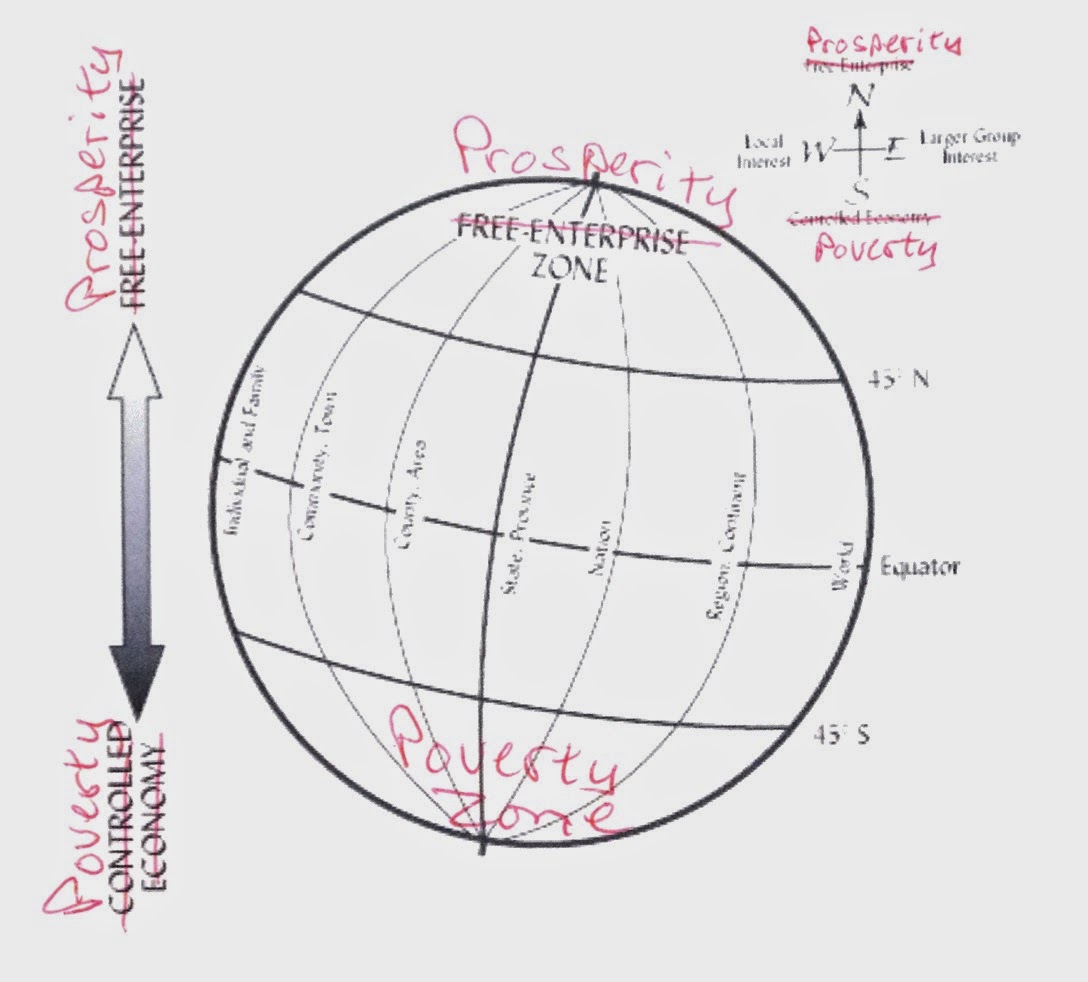
Since I first posted the Spherical Model website, back in 2010, I’ve left it pretty nearly untouched. Today I’m contemplating a change—in how I label the Economic Sphere.
Each of the spheres has a positive goal north, and a negative goal south. The Political Sphere’s north is freedom, and south is tyranny. The Social Sphere’s north is civilization, and south is savagery. I often use the term Civilization Sphere, just as a shortcut to the goal.
Up until now I’ve been referring to the Economic Sphere’s north as free-enterprise economy, and south as controlled economy. That orientation won’t change, but free-enterprise is really the “how” of getting north. What we’re really aiming at is a northern prosperity, to avoid a southern poverty. [If you’re new to the Spherical Model, the spherical orientation does not coincide with our earth; the directions refer to a visual model for ideas, policies, and practices.]
Economic Sphere, with edits
I think it has been clear, prior to this post, that we were getting freedom, prosperity, and civilization by going north in all three spheres. A quick search shows I’ve used that exact phrase in 16 different posts. But I’m getting more consistent at making it a theme. Half of those posts came in 2014; another 5 in 2013. So I’m making the change to make it unmistakable: there is no path to prosperity in a southern economic model. In the south, instead of the one who earns the wealth deciding how to spend it, someone else decides: the tyrannical state (central planners) in the eastern quadrant, the tyrannical crime lords (mafia, mob, gangs, marauders….) in the chaotic western quadrant.
Are there examples of prosperity in the south? Probably, in history, here and there, depending on how you define it. In a monarchy, under the rule of law (as opposed to arbitrary ruler’s law), where there is access to natural resources, and trade, and a lot of autonomy among individual citizens, you’re going to see some prosperity. Still, you’d be hard-pressed to find a large economic success before the United States where even the poor are so unlikely to starve or be without shelter and clothing (subsistence), and probably have what other cultures would consider luxuries.
When you take away a person’s control over the money they spend their life to earn, you take away that person’s incentive to work hard, innovate, and risk savings. An economy that discourages hard work, innovation, and capital investment cannot lead to prosperity. It can’t even maintain a lack of poverty; once the capital from a better economy is used up, poverty either creeps in or crashes in.
With each of the spheres, you have a 45th parallel line in each hemisphere. So, in the Economic Sphere, above the 45th parallel is true prosperity. People are able to overcome the state of nakedness, shelterness, and lack of experience they were born with to become self-sufficient in providing for their needs—and many of their wants. They have life, liberty, and property, and are able to accumulate wealth according to their successful use of their capital. There will likely be people who cannot, through no fault of their own, take care of their own needs—the very old, the chronically ill or disabled—but there are enough willing charitable givers to keep those people fed, clothed and sheltered better than the poor in a southern hemisphere community.
Down south, below the 45th parallel is true poverty, with a lot of subsistence living—and some dying of hunger or lack of water, basic cleanliness, clothing, and shelter from the elements. And there’s very little hope of getting out of that miserable condition. There may be a few elites with great wealth, usually the ruling tyrants and their minions, who do not give freely to alleviate the suffering of the poor. This is the condition in much of the world—throughout history, and many places today.
We know the simple economic answer to poverty: allow individuals to control the wealth they make. You tie into the political sphere by having limited government to protect life, liberty, and property. You tie into the social sphere—civilization—with honesty, respect for property, family strength, avoiding covetousness, and encouraging voluntary charitable giving.
These answers are simple, and they’re proven. But the solution isn’t easy, because the world is oriented toward the southern hemisphere. The masses of humanity seem unaware of the northern hemisphere of possibility above them, so they oscillate between statist control and mob rule control. The regular workers out there would be happy to just be left alone to do the work they want, pursue their own path, take their own risks. It’s a natural yearning of the human heart to be free to pursue happiness our own way. But the discouragement and fear mongering offered up by the controllers have left them looking only down.
The goal is to spread the message: look up. We can all have better than tyranny, poverty, and savagery. Follow the right principles, and we can move on up north to freedom, prosperity, and civilization.

Thursday, March 13, 2014

The Big 500th Celebration


Today is the 500th post at the Spherical Model blog. Yay!!! (Balloons being dropped and confetti strewn as you read this. I can always vacuum later.)
It is also, coincidentally, approximately the 3rd anniversary of the blog; that was officially March 4th, but this 500th milestone seemed close enough, I thought I’d wait and do both at the same time. The website, SphericalModel.com, is a few months older and has changed little; I’ve used the blog to add to the basic ideas.
Milestones are a good time to explain what the Spherical Model is. So here goes—again.
The Spherical Model is a different way of looking at the political world—different from the usual right-wing/left-wing model. In addition, the political world interrelates with the economic and social worlds, so the Spherical Model handles more ideas than the simple right/left arrow.
It works like this: think of a sphere, with freedom in the northern hemisphere, and tyranny in the southern hemisphere, so north is good and south is bad. (This relates in no way to actual places on our earth.) What about east and west, you ask? Good question. There isn’t a good-half/bad-half thing going on with east and west. It’s about level of interest, from the smallest unit of society, the family (furthest west longitude line), moving eastward to town/city, state/province, region, nation, multi-national allies, and reaching global interests at the far eastern longitude line. The caveat is, you need to be as local as possible for whatever issue is being addressed, or else there is loss of freedom (and therefore movement southward).
So it’s possible for there to be global issues, but they’re rare. And we tend to see a lot of national or state levels trying to usurp decision-making authority from the appropriate lower levels. Theoretically we could see a lower level insisting it is the appropriate level when a higher level actually is for fitting, but that’s more rare. And when there is such a disagreement, that’s when debate on issues should show up.
Just as you have freedom north and tyranny south for the political sphere, you have corresponding good north and bad south for the economic sphere: free enterprise economy north, and controlled economy south—which translates to prosperity north and poverty south.
You also have corresponding good north and bad south for the social sphere: civilization north, and savagery south.
All of these spheres interrelate. In other words, if you don’t do what it takes to sustain civilization, you suffer a loss of prosperity and a loss of freedom. If you strengthen civilization, that leads to greater freedom and prosperity as well. If you centralize decisions about who controls the spending of earned wealth, you affect freedom and civilization. For example, if either government or marauding gangs confiscate wealth from those who have earned it and redistribute it to those who haven’t earned it, workers are discouraged, feel enslaved, and feel hopeless.
What is the value of using this slightly more complicated model? For one thing you totally get rid of the accusation of being extremist just for wanting freedom, prosperity, and a thriving civilization. And you get rid of the notion that compromising in the middle, maybe just slightly toward the right, is sensible and logical. Because it is never a good thing to move south, and it is always a good thing to move north.
It doesn’t matter if an ideology is called socialism, communism, tyranny, dictatorship, anarchy, oligarchy, monarchy, or theocracy. All of these can be floating around below the equator. Location depends on the level of control (gang, state, nation, region—as is Axis of Evil—or global), and how much control. The more control, the further toward tyranny.
We don’t need to argue about whether “progressivism” is socialism by another name; we just need to look at how appropriate the level of interest (west/east), and how controlling the power center is.
If you’re conservative, you probably already believe much of what you’ll read here. The purpose is to give you new ways to evaluate ideas, candidates, issues, and policies—based on principles that are consistent and knowable. We can encourage policymakers to ask, “Does it lead toward more freedom, ensuring our inalienable rights?” “Does it lead to prosperity by encouraging free enterprise?” and “Does it lead to more thriving civilization by encouraging adherence to long-known good behaviors of religious people, and valuing the family as the basic unit of civilization?”
If you’d like to get a clearer understanding of the Spherical Model, I hope you’ll check out these sources:
Long Version: The Spherical Model website—a collection of long pieces describing the model and the three spheres, about 50 pages worth of writings.
Short Version: Blog post March 5, 2012: Year Two Begins, written for the one-year anniversary of the blog.
Best of the Blog: Collected links of blog posts most likely to give you additional understanding, offered as a celebration of the 400th post, June 2013.

·         Part I covers the interrelationships of the three spheres, plus the Political Sphere.
·         Part II covers the Economic Sphere.
·         Part III covers the Social Sphere, or how to get to Civilization.
Special Topic Collections: These are additions to Best of the Blog, posts on specific issues that relate to the principles of going north on the sphere, but aren’t obviously related to a single sphere.
·         The Education Collection
We’re a hundred posts beyond the Best of Blog collection. I hope there are now additional posts that should be favorites. They’re all available in the archives. I’m always honored whenever someone spends their time reading here. I hope you find the Spherical Model valuable in our joint efforts to have a world with more freedom, prosperity, and civilization.

Thursday, January 16, 2014

The Fifty-Year War, Part II


I’m still thinking about that 50-year War on Poverty. Complaining about how it has gone badly is not useful enough to end on. What would things look like if we were to actually eradicate poverty?
I found this graphic after writing the last post on the 50-Year War on Poverty
 
“The poor ye have with you always,” according to scripture (Matthew 26:11, Mark 14:7 and John 12:8). So no matter what we do, eradicating poverty entirely is unlikely to happen—because we’re living in a human condition.
But at the Spherical Model, we do have a description for a successful civilization, including the economic component:
Civilized people live peaceably among their neighbors, helping rather than taking advantage of one another, abiding by laws enacted to protect property and safety—with honesty and honor. Civilized people live in peace with other civilized people; countries and cultures coexist in appreciation, without fear.
There is a thriving free-enterprise economy. Poverty is meaningless; even though there will always be a lowest earning 10% defined as poor, in a civilized society these lowest earners have comfortable shelter and adequate food and clothing—and there’s the possibility of rising, or at least for future generations to rise.
Creativity abounds; enlightening arts and literature exceed expectations. Architecture and infrastructure improve; innovation and invention are the rule.
People feel free to choose their work, their home, their family practices, their friendships and associations. And they generally self-restrain before they infringe on the rights and freedoms of others. Where there are questions about those limits, laws are in place to help clarify boundaries of civilized behavior. When someone willingly infringes on the rights or safety of another, the law functions to protect that victim as well as society from further uncivilized behavior from the offender.
We know what successful civilization would look like. And we know, in general, the rules to get there.
Suppose, instead of government instituting controls that limit prosperity, as has happened over the past 50 years, we imagine that government had gotten out of the way and actually done what it would take to “win” such a war. Instead of news stories and commentary like we got last week, we could imagine a story more like this:

Growth Cycle Hits 50 Year Mark
Washington, DC, January 2014: The President’s economic advisory team came out with their annual report this week, marking 50 years since The Great Constitutional Society instituted reforms intended to bring about prosperity for all.
“It marks the most continuous economic growth for the nation since the period between 1780 and 1830,” remarked Prof. J. Madison of Harvard, where he has been a champion of free enterprise throughout his distinguished career.
“Our President should be honored for his deft hands-off policies concerning the economy, in the pattern of his predecessors. Low taxes and predictable rules continue to encourage entrepreneurial investment and innovation,” added Prof. B. Franklin, one of the advisory team.
The value of the dollar continues to remain steady, with near zero inflation over the past several decades, “partially due to the return to the gold standard, and partially due to matching the value of the dollar to actual economic wealth creation—something we do better now with practice, and sufficient data to prove the policies work,” explained Prof. A. Smith, author of The Wealth of the American Nation.
It does appear, in hindsight, that boom and bust cycles were never well managed by government intervention. Since the implementation of the non-interventionist policies, we have seen major recessions disappear. Individual markets occasionally overextend, but using price as the key indicator of supply and demand has allowed for quick readjustment.
With the encouragement of thrift, savings, and wise use of capital investment, individuals and organizations have seen the results of their labor grow. Typical investors plan on a steady return of between 5-10% per annum. This steady expectation over time has allowed retirement nest eggs to support a large percentage of the now-retiring baby boomers without dependence on their children and grandchildren, who are just beginning to make a comfortable living.
The long economic boom has resulted in some unexpected social benefits. For example, hospitals and charity organizations report steady donations, allowing them to care for the truly indigent.
While there continues to be a wide range of income, the lower earners are likely to view their situation as temporary. They believe that hard work, education, experience, and thrift will lead to better outcomes for themselves and the next generation. This positive expectation doesn’t eliminate the human tendency to covet; however it does mitigate negative outcomes over the population as a whole. For example, crimes involving theft and fraud are at record lows.
Misguided efforts of the past to make home ownership easier by lowering borrowing standards and controlling prices have been replaced with encouraging all citizens to live within their means. The counterintuitive result has been that overall economic health has led to the highest percentage of home ownership in the nation’s history. And with that property ownership has come the incentive to care for property and maintain property values. Our towns and cities are cleaner and more beautiful. Where people have prospered, they have also been able to encourage arts and healthy recreation.
There has been a surprising emphasis on family strength during this fifty-year experiment. Community organizations, parks, recreation, and arts tend to be family friendly, with an eye toward creating valuable family experiences. Popular culture, as well, has responded to consumer demand for better quality entertainment for all ages.
Many experts believe it has been the growing strength of families—lower divorce rates, higher birth rates, more homeschooling and alternative education based on individual family needs—that has been the key to the economic growth. Families inculcate the necessary economic values of thrift, honesty, and hard work that have supported The Great Constitutional Society. Others argue that living the principles that lead to prosperity have affected society for the better in social ways as well as economic.
The consensus of economic experts is that strictly limiting government to the specific duties outlined in the Constitution freed up wealth for economic growth and encouraged the wise economic choices that have been the hallmark of The Great Constitutional Society.
In Prof. Smith’s next book, entitled Wealth for All Nations, he outlines the successes of America over this past half century, and shows that the principles of prosperity can work wherever they are put into practice. Smith said, in his comments at the White House last Tuesday, “We have empirical evidence now of what works. We want to share that. Prosperity elsewhere in the world only adds to our abundant life here. We want that for everyone.”
 
Sigh! Would that this were the story at the end of a fifty-year War on Poverty! Implementing the right policies now could mean stories like these a half century hence. But we have to start now.

Monday, September 16, 2013

Candidate Q&A

We’re a half year away from mid-term primaries. There’s a November election coming up, but it will consist mainly of small races and issues, like school boards and bond proposals. So why talk about elections now? Because there’s time now to consider principles, so we can prepare before there’s pressure and heightened emotion.

We’re already hearing from judge candidates at all of our Tea Party meetings. We live in a decidedly conservative area of red-state Texas. Nobody’s going to get elected around here by announcing they’re influenced by liberal/progressive ideology. And it is an unfortunate characteristic of politicians that they seek approval, which is likely to translate to votes, which is what gives them power. So, while we do indeed see a number of sincerely principled, effective candidates, we also encounter some who just try to convince us they’re one of us.
So, well ahead of decision time, I thought I’d list a few questions that might reveal what a candidate truly believes, so you can be a better informed voter.
We’ll start with judges. They talk about their experience (often impressive), their families and character. And they assure us they’ve been active in local GOP politics for a long time. But among these are a number we haven’t seen at district or state GOP conventions, or at our Tea Party meetings, until they became a candidate. This doesn’t necessarily mean they haven’t been active and long-time principled. But how do we know?
A friend, active in party politics, suggested asking about their voting record, so I think I’m going to start asking this: Who did you vote for in the past two presidential and governor races—both primaries and November elections? What was your reasoning for those votes? And how do you feel about those votes now?
A vote for Obama in 2008 might not be a deal breaker, depending on the reasoning—even though those of us paying attention knew what a disaster he would be and were not taken in by the ridiculous hope-and-change blather. But they’d better be able to explain articulately what they were hoping to accomplish with that vote (“It was historic” is simply racist; preventing John McCain from being president might be an acceptable answer). And they had better be very clear at this point what a mistake an Obama vote was.
A vote for Obama in 2010 would absolutely be a deal breaker. Unawareness of just how conservative and effective Romney was might be understandable, considering the negative lying press in the pocket of the Obama campaign, but that sure wouldn’t be a plus for someone who’s trying to convince us of their discernment and wise judgment.
I would ask about primaries for governor because (besides verifying that the candidate voted in the GOP primary) it gives an idea of ideology. Not everyone loves Governor Perry, but he has done a great deal of good. If the candidate supported a Perry opponent, for example, we’d need to have an explanation much deeper than, “I just thought he/she would make a good governor.”
When we’re looking at legislative and executive offices—governor, state representatives and senators and other state offices, as well as US representatives and senators, we can probably ask some questions provided by the Spherical Model concepts on politics (limited to the proper role of government), economics (free enterprise), and civilization (support for religious freedom and strong families).
Political Sphere
·        What do you believe is the proper role of government, and what are the limits?
·        Do you have favorite portions of the US Constitution, and/or any portions that you think ought to be changed, clarified, or improved?
·        When the US Supreme Court makes a ruling that you believe is at odds with the Constitution, what do you think the executive and/or legislative branches should do in response to the ruling?
·        What do you believe is the proper balance between public safety and individual freedom, and what do you believe government needs to do to reach that balance?
·        Who are your favorite examples of a good president—since 1900—and what about them do you admire?
·        How do you define extremists, and what views do you think are examples of extreme?
Economic Sphere
·        What do you believe is the optimum percentage of GNP that should be taken in taxes?
·        What do you believe is the government’s role in contributing to economic health? For example, if there is a sudden recession (as we were hit with in 2008), how should government react?
·        What do you believe is government’s role in the distribution of income discrepancy between the poor and the wealthy?
·        What do you believe should be government’s role in charitable help to the poor and suffering?
·        What do you believe are the purposes and limits of the commerce clause of the Constitution?
·        What do you believe is the role of the Federal Reserve, and how/whether it is benefiting the economy?

Civilization Sphere

·        What do you believe about the connection between moral values and the law?
·        Which institution is most responsible for raising a generation that will benefit society, and why: schools, government, churches, nonprofit organizations, sports teams, families?
·        Which constituency’s desires is public education best accountable to, and why: US government, state government, local government, teachers, students, parents/taxpayers?
·        What do you believe should be government’s role in homeschooling, private schools, charter schools, and school choice?
·        What do you think is government’s role in defining marriage, and why? 

Additionally, asking about a few specific issues might be helpful:
·        What are your feelings concerning Obamacare, and what do you think should be done?
·        What do you believe are the motivations of people who support traditional (man/woman) marriage and family?
·        What are your beliefs about border security and immigration?
·        What do you believe is the proper role of government concerning climate?
·        What do you see as the US role in the world, and what is your view of the UN?
·        What are your opinions on national debt, national deficit, tax increases and/or cuts, and national budget? 

 
I’m sure this list isn’t exhaustive. But it’s a start. Good luck getting a candidate to answer even a few. Maybe if we divide up the list, and each ask a question or two to every candidate, we’ll be able to share responses. Because, truly, we need the best candidates we can possibly get, before any more damage is done.