Why You Should Vote NO al All 5 Cy-Fair ISD Bond-related Propositions on the Ballot

There are 5 propositions at the end of the ballot, here in NW Harris County, for the Cy-Fair ISD (Independent School District) bond election. One is to approve the VATRE (Voter-Approval Tax Rate Election), a permanent tax increase of 18%. The other four are the various categories the bond money is slated for. But NOT what the money has to be spent on; it adds up to be essentially a $1.63 billion line of credit to use for any maintenance and operations project they might come up with.
NONE of it improves
student learning in the classroom.
And the schools will not collapse if we say no to this unnecessary spending at
this time. They can wait, and then justify specific projects as they are
needed—without a permanent tax increase.
DECLINING
NUMBERS
Let’s take a look at
some numbers.
Since 2014 to now, the
district has added 10 schools. That’s 17,000 seats for students. We did not
need 17,000 new seats. There was a projection that year that we would reach
131,000 students in the district. We actually peaked at around 118,000; then we
started decreasing, by about 2000 a year. And the people deciding to take your
tax dollars haven’t adjusted.
By 2016 the writing was
on the chalkboard; kindergarten enrollment was 700 less than 2015. They didn’t
adjust. They just kept spending as though we were growing to that erroneous
projection. By now, they’re off from their projection by 15,000+ students, in a
district that is not growing and has no room to grow. The revenue they assumed
would come from those 15,000 students is not there. And since schools are
allotted funding based on students in the seats (ADA is average daily
attendance), that’s a budget deficit of around $92 million, based on a per
student allotment of $6160.
People this bad at math
should not be anywhere near the education of our kids.
They want you to
permanently raise your property taxes to pay for their bad math.
Who are they?
Ultimately the blame falls on the school board, elected by the community. Also
involved are the superintendent—the only employee hired by the school board—and
then his administrators. The administrators are the ones who put together the
package and then presented it to the Board for their vote, which was accepted
and now goes before the people as propositions on the ballot. That happened at
the August school board meeting. One Board trustee
voted against the package: Christine Kalmbach. Kalmbach is in real estate, so
she’s maybe more aware of the demographics and the decrease in students than
the others are.
 |
| Cy-Fair ISD Board votes for the bond, August 10, 2026, meeting; Dr. Killian in the center has no vote as superintendent, and Christine Kalmbach, second from right, is the lone vote against; screenshot from here |
No one else had enough understanding to question what was presented to them. But the presentation was slick, and it glosses over plenty of questions, some of which we’ll go over below. Or it could be that the “they” we mentioned, with the one exception, feel entitled to your property to do with as they please.
The state overall has
lost around 75,000 students this year, so our district is not that different.
We can’t grow out of it. The district is considered essentially fully
developed, at 91% developed land. There are 10 Texas districts facing similar
lower enrollment. Only Cy-Fair is asking for a bond, to pay for future growth
they know isn’t coming—or you might say to pay for the calculation errors
they’ve already made.
 |
| found on Facebook here |
Only a couple of schools
in the district are near capacity. Others hover around 60-85% full. We have so
many empty classrooms, we could close multiple schools next year, and lay off
the teachers and staff, and by my back-of-the-napkin math that would just about
cover our deficit. They may do that, and they just don’t want to tell you
before you’ve given them the bond money, although Dr. Killian, the
superintendent, says they’re not going to close any schools or lay off any
staff. Because, keeping staff hired is more important than sensible spending of
your property tax money.
This year we have 1,000
fewer students than planned for in the June 2026 budget for this school year,
which leads to about $8 million short in revenue. That means the known $80
million budget shortfall is already actually $88 million. So the chart below is
already off. There aren’t 112,000 students in the district this year; there are
111,100 students.
 |
| This and many of the images below come from the Cypress Conservatives group on Facebook. This image was found here |
By 2019 they knew how
far off their projections were. And yet they asked you for yet another
record-setting bond. That was $1.2 billion in 2014 (it had never been a billion
before), and another whopping $1.762 billion in 2019. They used it for that new
administration building you see along Hwy 290—seven stories high, for
administrators who DO NOT WORK IN THE SCHOOLS. It’s made of first-class
materials. It’s lovely (except for the name on the building, in huge letters,
honoring the former superintendent who helped put us in this financial mess
while simultaneously pushing a woke agenda in the district). Maybe their old
facilities were insufficient and something new was needed. But they
built this huge facility without the capacity, somehow, for some essentials
that must still be kept at the old facility on Jones Road.
 |
| image found on Facebook here |
Nothing is too good for the people in charge of spending your money. They guilt you into voting for these extravagant bonds saying, “It’s for the kids. Don’t you care about the kids?” And yet their ability to meet the educational needs of our kids is shockingly low. Around 40% can’t read on grade level. They have one task! Any progress we’re making seems to come from state-issued requirements (like returning to phonics for reading, instead of treating every student like they’re learning disabled). The previous conservative-majority board had initiated tracking of every student not reading at grade level, so they could gauge improvement and make individualized adjustments accordingly. This new board removed that tracking.
And now they’re asking
for another $1.63 billion—which isn’t going toward better educational outcomes.
Did we mention that only
27% of households have kids in our schools? So 73% of households are paying for
schools without any benefit except, hopefully, an educated next generation.
That’s already pretty generous.
This is at a time when
families are struggling. Gas and groceries are high. And Harris County just
raised our property taxes 7.6%. Emergency service districts and water boards
add to our property tax takings. But Cy-Fair thinks this is a great time to increase
our school property taxes by 18%.
 |
| image found on Facebook here |
HOW
MUCH IS IT GOING TO COST?
The current bond debt is
$3.9 billion. If you’ve ever bought a house or a car, you know that the
principal isn’t all you pay; over time you pay principal plus interest, and
depending on how long you spread out the loan, you could be paying as much in
interest as your original principal debt. So assume that $3.9 billion is
considerably higher, depending on interest rates and length of loan, something
closer to $4.9 billion, and that would jump to something more like $6.7 billion
outstanding bond debt if this passes.
A selling point they’re
using is that they’re lowering your interest payments and stretching out the
debt time, so that your payment won’t look that much higher. But holding debt
over a longer time (even at a lower rate, if they can get it) means paying more
interest over the life of the loan. It’s just hidden.
At the board meeting,
they estimated the debt at $58,000 per student. The response was that we
shouldn’t think of it that way, because the students that come along later will
also benefit. They fail to mention that the students that graduate don’t keep benefiting
from that infrastructure spending; so dividing the debt by number of students
benefitting at any given time is the right metric. And the number of
students is going down, which means the debt per student goes up.
That’s debt only, not
the cost of educating each child. Debt does nothing to educate the child. It’s
just an added cost.
If we don’t approve this
bond, then existing debt will eventually decrease (I&S is interest and
sink). Debt would be retired. But if you approve the VATRE tax increase, it
doesn’t matter whether debt is paid off; you’ll keep paying that higher rate.
They’ll tell you it’s a
minimal increase for your household. If you have a $350,000 home, it’s only
$168 a year. You just need to cut your family vacation by one night’s stay at a
low-budget motel. Or give up eating lunch out once a month all school year. If,
however, your appraisal goes up, so does that $168.
 |
| image found on Facebook here |
But actually, that’s
just the VATRE tax increase—the permanent amount of assessment from now for
forever. You have to vote for that separately, because, in Texas, if a school
district adopts a maintenance and operations (M&O) tax rate that is above
what the state calculates for the district, voters must approve the higher
rate. You’re granting that permanent tax increase so that CFISD can take in
more revenue in perpetuity, even after paying off this extravagant bond (which
it won’t do before coming to you for even more bond debt in a few years).
Back in 2011 the
district had a similar budget shortfall. They made necessary cuts and
managed—without asking for a VATRE tax increase, or threatening to take away
the LOHE (local area homestead exemption), like they’re now threatening to do
in 2028.
 |
| image found on Facebook here |
That depends on who’s
trying to convince you that they want it. And, by the way, they have unspent
tens of millions of dollars remaining from the 2019 bond, because there were
projects they decided not to do. If a project is essential now, they could use
that money from debt you already voted for.
Here are some of the
things they want the money for:
Bus seatbelts and
cameras. They
have 1000 yellow school buses. They use ±700. About 300 buses need seatbelts.
Do the math; they have enough buses with seatbelts to meet the needs. They want
bond money to retrofit 300 unused buses with seatbelts.
They also want cameras
on 300 buses—at a cost that is four times what this expense should be,
according to industry standard. They are planning to replace cameras on buses
that are too new to need replacements. Again, these are people who don’t math
well. If these items are what they call necessities, can you trust them on the
whole bond package?
 |
| found on Facebook here |
Chomebooks. They want $85 million
for new/additional ones. This includes an allotment of $18 million for K-2, who
don’t use or shouldn’t be using screens in the first place. The district gets
them for $679 each; they’re military grade. Similar ones can be bought at a
local store for $270. The more expensive ones also need replacement costs when
lost or broken, damage insurance, replacement charging cables (because they get
lost at home a lot), and a few other upgrades. BUT THESE ARE DETRIMENTAL TO
LEARNING.
I know; I’m shouting. I
will try to calm down. But school districts everywhere are removing
Chromebooks. Even LA, Seattle, and NY schools have figured this out. Student
learning has gone down significantly with the use of screens. Students need to
learn first tactilely. They need pencil and paper. The cognitive learning
doesn’t transfer as well from a screen. (Read Digital Delusion, by Dr. Jaren Cooney
Horvath. Also read The Anxious Generation: How the Great Rewiring
of Childhood Is Causing an Epidemic of Mental Illness by Jonathan Haidt.)
We’re not just talking about kids learning a bit slower than before; we’re
talking about them growing up with less cognitive ability than pre-tech
learning produced.
There could be a
discussion about using such devices in the upper grades, where students may be
learning specific computer-related skills. But that should come after the brain
has developed well enough without the tech interference.
Note that we were told
digital textbooks, such as you get on Chromebooks, would cost less; they
didn’t.
In addition, regardless
of filters, kids work around them and use their Chromebooks for gaming and
porn. Principals admit that they see students are logged in during the middle
of the night, when they should be sleeping.
We also know that the
devices are used for data mining (including voice recordings) of our children,
and are already used to track children. (Technically, the Chromebooks are what
is being tracked, to prevent loss. And they can be used to find a child who,
for example, didn’t get off the bus as expected, so for safety reasons. But,
still, tracking our kids seems a bit invasive.)
It’s also notable that a
Chromebook is not a device regular people outside of schools buy. There are
plenty of other superior tablet products. Chromebook was a failed company; but
then they turned to schools and cornered the market there.
You might want to look
into an organization called Schools Beyond Screens, which is attempting to
inform people about the dangers of screen use in schools. Note that $85 million
for Chromebooks is about equal to our deficit. I don’t think budgeting works in
a way that we can say, “Don’t buy the Chromebooks,” and we wipe out the
deficit. But a small thing like teaching kids without screens would be that
much less costly.
 |
| image from Megan Davis of School Beyond Screens Cy-Fair |
Since they don’t
know better than to claim this $85 million “need” is for the kids, say NO to
the bond if for no other reason than to protect our kids from this very real
harm.
Refurbish empty
buildings. You know those portables they put up, years ago, when
growth was faster than expected? They used them as classrooms. They don’t need them
now, because very few schools are even at capacity. There are empty classrooms
inside the schools. Most of these portables are at buildings with under 85%
capacity. This bond will spend $16 million to refurbish these empty portables,
which will remain unused. They won’t move them. They won’t sell them. They will
fix them up to sit empty. With $15.9 million of your tax dollars!
Again, if this is what
they’re calling so important that they must permanently raise your taxes by
18%, can you trust them on the rest of the bond package?
 |
| image found on Facebook here |
Rumor worth telling: a
woman (an admin person? I’m not sure who she is in this story) was worried that
this bond might not pass, and expressed concern, because the schools are not
getting the donations, for scholarships and such things, that they used to get
from the building contractors.
I’m puzzling this over.
So, the contractors were donating in order to get contracts? And with us
declining in enrollment and not building more schools, they’re not donating?
Were they only donating as a bribe? And—btw, this bond doesn’t build any more
schools, so why does it need to pass? There are those unneeded band storage
buildings, though, and maybe they’ll come up with some other construction
projects as yet unnamed. So we should all pay higher taxes, so the contractors
are more willing to make donations, so they can get lucrative contracts wherein
they receive more of our tax dollars? Should people who think this way be
involved in teaching our kids to think?
Another rumor: during
the district’s long-range planning committee meetings in which they discussed
this bond, there was never any question about whether they would put
forth a bond—only how much and for what projects they could come up with to
make the need seem convincing. They were quite proud of themselves for knocking
down the total amount from $1.7 billion or so to only $1.63 billion;
that makes them feel so frugal.
Are there any projects
on the list that ought to be done? Maybe. But this bond package—with a
permanent 18% tax hike, is not the way to get those specific things. This is an
outrageous misuse of the community’s trust. And, if you’re paying attention,
they’ve lost your trust.
SAY
NO! LOUDLY.
Say NO to this bond
package—all 5 propositions. Let them come back with something reasonable and
well justified, something that shows they comprehend the enrollment shrinkage,
something that already fits our budgets and doesn’t permanently raise our property
taxes.
Have them come to us after
2028, when they’ve taken away our LOHE, as they’ve told us they will be forced
to do—even after this 18% tax increase. Let them come to us then, when we’ve
had another sudden 20% rise in our property tax, because of their failure to
budget. Ask us then.
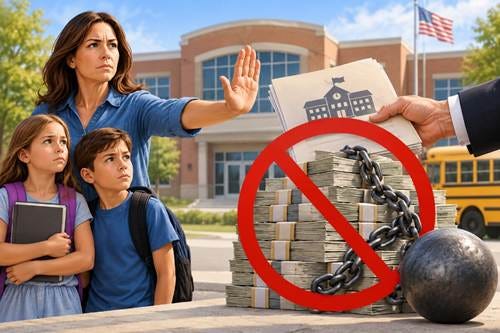
If we say no now, maybe,
just maybe, they’ll consider doing what it takes to improve educational
outcomes with the money we’ve already entrusted to them to do that very
thing. If they can prove they’re serious about educating kids, then we’ll
consider their requests. First things first.
Bonds tend to pass,
because—guilt. So, if you are now convinced to vote against this bond at this
time, make sure your neighbors know your reasons. Schools use their resources
to push for
the bond (within legal limits, we must assume, but multiple videos
and mailers, and all their online pro-bond “information,” are at our expense,
to convince us to pay even more). And PAC money is going toward pro-bond
propaganda. There isn’t money behind preventing the bond, just taxpayers saying
enough is enough.
So, you can have higher
taxes without better education. Or you can vote NO—and make sure everybody you
know understands why and votes NO with you.
_________
My name is Linda
Nuttall. I’ve been writing the Spherical Model blog since 2011, on the
interrelationships of the political, economic, and social spheres, which I
moved to Substack in June 2025. I’m a writer/editor, former homeschool mom,
grandmother, musician, devout Christian. The blog is always free, including for
subscribers, but if you’d like to support the work, you can choose to become a
paid subscriber ON SUBSTACK.


