Showing posts with label 14th Amendment. Show all posts

Friday, July 10, 2026

What Is a Citizen?


This year’s Supreme Court session ended at the end of June, which is usual. The fact that the final days of June are watched like a sporting tournament tells us the judiciary has more power than it ought to have.

We were assured, by Hamilton in Federalist 78

[T]he judiciary, from the nature of its functions, will always be the least dangerous to the political rights of the Constitution; because it will be least in a capacity to annoy or injure them. The Executive not only dispenses the honors, but holds the sword of the community. The legislature not only commands the purse, but prescribes the rules by which the duties and rights of every citizen are to be regulated. The judiciary, on the contrary, has no influence over either the sword or the purse; no direction either of the strength or of the wealth of the society; and can take no active resolution whatever. It may truly be said to have neither FORCE nor WILL, but merely judgment; and must ultimately depend upon the aid of the executive arm even for the efficacy of its judgments.

In other words, it has only the words of its opinions—and what power the society as a whole grants to those opinions.

When the opinions are good, we are pleased that they have clarified and verified the law. When the opinions are not good, we are frustrated that their opinions have the power of law, as if they had power to legislate. We were promised by our founders that we would not be put into this position. And yet here we are.

Here is what Thomas Jefferson said about such a situation:

"[T]he opinion which gives to the judges the right to decide what laws are constitutional and what not ... would make the judiciary a despotic branch. ... [T]he germ of dissolution of our federal government is ... the federal Judiciary ... working like gravity by night and by day, gaining a little today and a little tomorrow, and advancing its noiseless step like a thief, over the field of jurisdiction, until all shall be usurped. … They are construing our Constitution from a co-ordination of a general and special government to a general and supreme one alone.”

 Several of the cases this session deserve a good discussion. But for today we’ll just cover the final one. The Supreme Court rendered its decision about birthright citizenship on June 30th, the last day of the 2025 session. It deserves a post of its own. The question—still unanswered—in Trump v. Barbara is, What is a citizen?

It shouldn’t be that difficult to answer, on par with “what is a woman?” which is another question at least one of our justices cannot answer. It takes a certain obtuseness, maybe only possible by well-educated individuals lacking wisdom and moral fiber, to fail to understand such basics.

To read the full article, FOLLOW LINK TO SUBSTACK.

Thursday, November 1, 2018

What Does the 14th Amendment Really Say?


Sometimes grammar is the solution to understanding. So I’m in my element. That’s the case today for our discussion about the 14th Amendment. Here’s the first, and most pertinent paragraph:

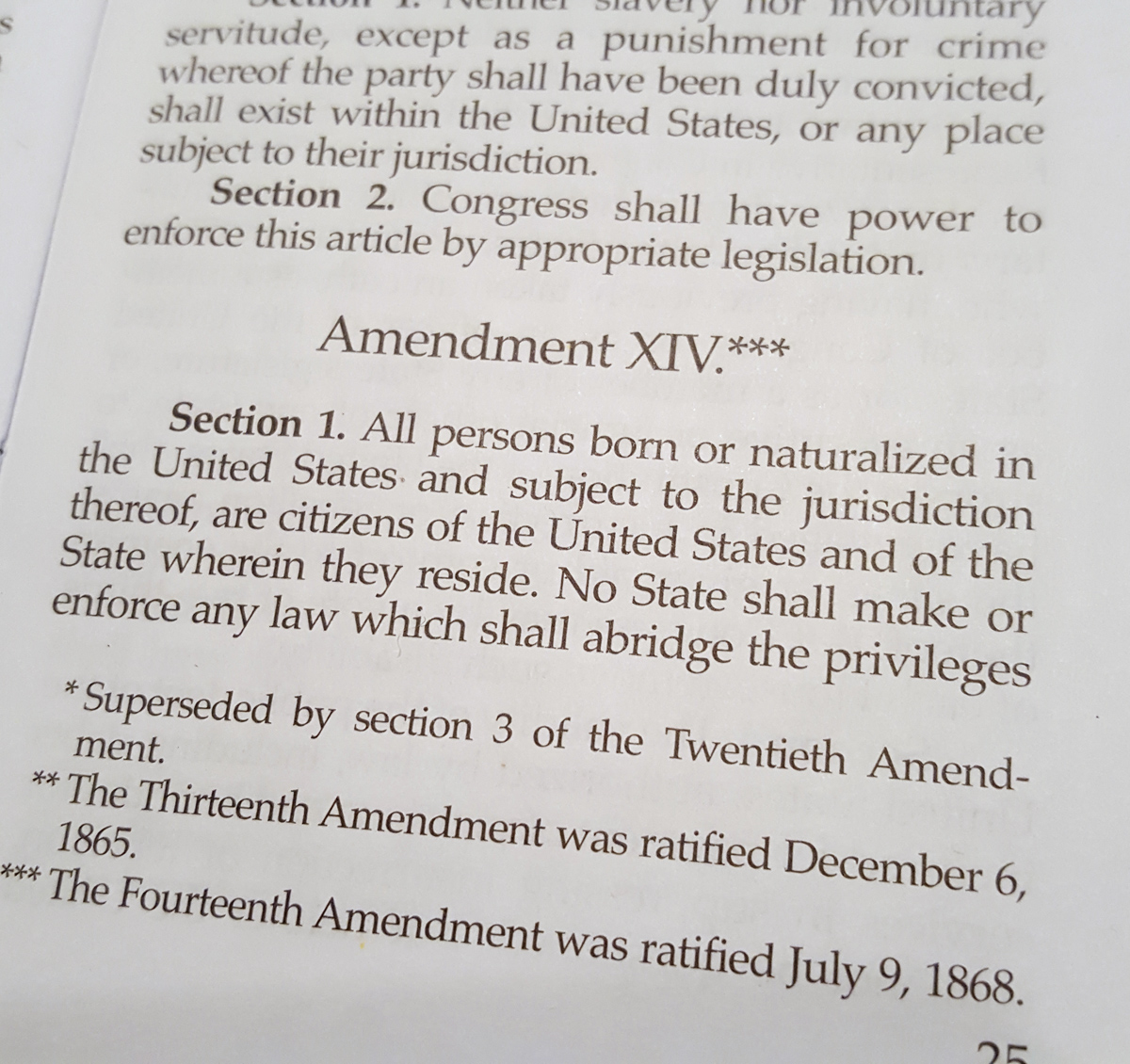
All persons born or naturalized in the United States and subject to the jurisdiction thereof, are citizens of the United States and of the State wherein they reside. No State shall make or enforce any law which shall abridge the privileges or immunities of citizens of the United States; nor shall any State deprive any person of life, liberty, or property, without due process of law; nor deny to any person within its jurisdiction the equal protection of the laws.


This amendment was ratified July 9, 1868. To understand it, it helps to know it followed what was called the Civil Rights Act of 1866, the purpose of which was to give citizenship to freed slaves. This legislation was pushed through Congress by a bloc of—of course—Republicans. Radical Republicans, they called themselves. That legislation said:

all persons born in the United States and not subject to any foreign power, excluding Indians not taxed, are hereby declared to be citizens of the United States; and such citizens, of every race and color, without regard to any previous condition of slavery or involuntary servitude, except as a punishment for crime whereof the party shall have been duly convicted, shall have the same right, in every State and Territory in the United States, to make and enforce contracts, to sue, be parties, and give evidence, to inherit, purchase, lease, sell, hold, and convey real and personal property, and to full and equal benefit of all laws and proceedings for the security of person and property, as is enjoyed by white citizens….
Putting the two together, we can see that “subject to the jurisdiction” means “subject to any foreign power.” It’s about allegiance. Aren’t visitors subject to our laws? Yes, and they also benefit from them—as people, but not as citizens. Citizens get additional privileges: the right to vote, and to receive government benefits, such as military protection from invasion, plus maybe education, welfare, or Social Security. There’s a distinct difference between being an American and simply being in America.

Let’s assume, then, the meaning of “subject to any foreign power” is not at issue. That means you must be born in the US and not subject to any foreign power, or be naturalized in the US and no longer subject to any foreign power. You don’t have to take my word for it. One of the drafters of the amendment, Senator Lyman Trumbull of Illinois defined “subject to the jurisdiction” as “not owing allegiance to anybody else.”

Why the amendment when there was already a law? There had been a prior decision by the Supreme Court, the Dred Scott case, in which SCOTUS ruled that a slave who was living in a state that prohibited slavery was nevertheless a slave and Americans were required to return him to his owner; furthermore, the case ruled that people who were racially black could never be US citizens.

In other words, it was already clear that you couldn’t trust the courts to rule correctly. Nevertheless, SCOTUS can rule a law unconstitutional, but it can’t rule an amendment to the Constitution unconstitutional; it is part of the constitution. So that is the reason the Civil Rights Act of 1866 was followed up with the 14th Amendment. They’re actually even closer than they appear. The amendment was drafted just two months after the legislation became law; the additional two years was the time for the states to ratify the amendment.

The debate about the 14th Amendment was never about granting citizenship to babies born here who were children of foreigners, visitors, or anyone whose allegiance was to some other nation (jurisdiction). That issue didn’t come up, because nobody thought, “Hey, you know what we ought to do? We ought to magically make any child of someone in the country, on vacation, say—or even illegally—a citizen. Then we can give that child of foreigners all the rights and benefits of citizenship, even if the child never assimilates or feels allegiance to our country with its principles of freedom.” Because that would have been stupid, for one thing. And for another, it had nothing to do with the purpose of the legislation and follow-up constitutional amendment.

So how did the idea of birthright citizenship come out of that pretty clear granting of citizenship to freed slaves and other black? It took a while, and some purposeful misconstruing.

Wong Kim Ark
image from Wikipedia
The first—and only—relevant Supreme Court case came up about thirty years later (1898), concerning a man born to Chinese immigrants—not naturalized as citizens, both because the Chinese Emperor did not allow renunciation of his rule, and because of the US laws at the time did not allow for Chinese naturalization, based on a belief that they were too foreign to assimilate. Wong Kim Ark took a trip to China (not his first), and when he returned to port in San Francisco, he wasn’t allowed re-entry, because of a hold on allowing entry of Chinese at the time. But he said, “I’m not Chinese. My parents are. But I’m American. I was born here.” While he was held aboard the ship for five months, the case made its way through the courts to the Supreme Court, which eventually ruled that he was a citizen, based on his being born here and his parents being permanent legal residents.


But that is a very different thing from the current interpretation that anyone who happens to be born here, whether to illegal immigrants, temporary residents, visitors, tourists, travelers, etc., would magically be granted citizenship status, with promises of welfare benefits and education. In fact, it’s hard to construe a way to be both an illegal alien and holding allegiance to the United States. The illegal status implies failure of allegiance.

There’s a rather arcane argument, where grammar really comes in, based on the precursor to the Congressional record, during the debate about the 14th Amendment. Michigan Republican Jacob Howard, who had introduced the 14th Amendment, is recorded as saying this:

This amendment which I have offered is simply declaratory of what I regard as the law of the land already, that every person born within the limits of the United States, and subject to their jurisdiction, is by virtue of natural law and national law a citizen of the United States. This will not, of course, include persons born in the United States who are foreigners, aliens, who belong to the families of ambassadors or foreign ministers accredited to the Government of the United States, but will include every other class of persons.
The person who wrote the words, then, insists that the 14th Amendment means essentially the same this that the Civil Rights legislation of 1866 meant. But today people purposely misread, not only the 14th Amendment, but Howard’s statement about it.

Take a look at the highlighted sentence again. The list of those not to be included are children born to foreigners or aliens, or children of ambassadors or foreign ministers. That seems pretty clear to me. But where misreading can occur, it does. The misreaders claim that it isn’t a list, but a restatement of the same thing, meaning that “foreigners and aliens” are just another way of saying “families of ambassadors or foreign ministers,” so everyone not of an ambassadorial or foreign ministerial family is included in “every other class of persons.”

The Congressional Globe, in which this is recorded, is neither an exact quote of the words spoken, nor is it intended to be the final say on punctuation. So, if you go by the full context of what Howard said, among others in the debate, you’ll see that “every other class of persons” cannot include Native Americans living on reservations and subject to tribal sovereignty (they were granted citizenship by legislation in 1924). So we know that the misreaders have it wrong.

So we could clarify (and people do[i]) by adding the word “or” in its appropriate place:

…who are foreigners, aliens, [or] who belong to the families of ambassadors or foreign ministers…
Grammar saves the day for truth once again!

What this means is, the 14th Amendment does not, and has not ever, granted birthright citizenship to children of parents subject to a foreign sovereignty.

Maybe we need a clearer definition of immigrant. Legal immigrants who have entered the country legally and have expressed their intention to be permanent residents—their children born here have always been considered citizens—even if they’re born before the parents become naturalized citizens. This would be different from someone working here on, say, a five-year work assignment but who still considers themselves a citizen of some other nation; their children would have the same citizenship as the parents.

If we as a people believe birthright citizenship is a good thing, we could hold the debate and amend the Constitution to say so. But we’ve never had that opportunity. We have had administrations who, for their own purposes (and those purposes are related to the same purposes that encourage illegal immigration, amnesty, non-citizen voting, and other impediments to sovereignty) granted such citizenship by fiat, but not by law.

So, can Donald Trump end the practice by executive order? Yes.

What would happen? Cases will make their way to the Supreme Court—which now leans originalist. Other than the one case, which doesn’t clearly define the issue, there isn’t reliable or clear court precedence. So they would likely look to the text and intent at the time of the writing of the 14th Amendment. I don’t know for certain how that would go, but it is likely to end the practice of “maternity hotels” and pregnant illegals purposely trying to get on American soil to birth a baby, who will then be a citizen, so they can claim, “But it would be cruel to separate families” as they plead not to be deported—even though this country has of course never forced deportees to leave their children behind simply because of a citizenship technicality; the country they would be returned to would undoubtedly accept their child as a citizen along with the returning parent.

Is this simply some bigoted conservative argument? Not unless you assume former Democrat Senate Majority Leader Harry Reid is a bigoted conservative. He said this:

If making it easy to be an illegal alien isn’t enough, how about offering a reward for being an illegal immigrant? No sane country would do that, right? Guess again. If you break our laws by entering this country without permission and give birth to a child, we reward that child with U.S. citizenship and guarantee a full access to all public and social services this society provides.
Does the United States have the right to decide its own citizenship rules? If it is a sovereign nation, then of course. If we go back to the original meaning of our 14th Amendment and end “birthright citizenship” for illegals or visitors, then we would be in line with the practice of 83% of the world’s nations, and about 6.642 billion of the world’s 7 billion people.

We don’t have to quibble about those currently granted citizenship. We can simply state what we as a nation will do going forward. As Hillsdale College lecturer and research fellow Michael Anton puts it,

Correct the issue going forward. Make clear to the world that the United States will no longer grant birthright citizenship to the children of non-citizen illegal immigrants, birth tourists, or people here on temporary work or student visas. The citizenship of those already born would forever be honored—even enshrined into law if necessary.[ii]
This would put an end to what might be called, in the insurance world, an attractive nuisance. We can stop attracting illegal immigrants, and get much better organized at allowing immigration of those who will value our laws, our freedoms, and the responsibilities of citizens who self-rule, and weed out the applicants who want to take advantage of us without becoming truly American.


[i] Michael Anton used this insertion for clarity in“Citizenship Shouldn’t Be a Birthright,” July 18, 2018, in The Washington Post. Others have used the same insertions, such as in "What Did the 14th Amendment Congress Think about 'Birthright Citizenship'?" by Mark Pulliam, August 21,2015, for Law and Liberty.

[ii] Michael Anton wrote two piece in July 2018 about birthright citizenship. The first is “Citizenship Shouldn’t Be a Birthright,” in The Washington Post. A few days later, in answer to critics, he wrote a much longer piece, “Birthright Citizenship: A Response to My Critics,” in the Claremont Review of Books. I this one he handles the grammar issues in more detail than I have, and also the historical issues. The estimates from the paragraph above about the world’s nations that do not have birthright citizenship come from his longer piece.

Monday, September 14, 2015

How Five Justices Made Marriage Unconstitutional

Guest Post By Political Sphere

The landmark decision of Obergefell v. Hodges redefined the governmental definition of “marriage” throughout the United States, ruling that all states must now recognize and promote “marriage” between two adults of the same sex as equal to marriage as it “has existed for centuries and millennia.”[i] But redefining marriage so fundamentally produces a serious unintended consequence. With the stroke of a pen, five justices on the Supreme Court of the United States have rendered unconstitutional the government recognition of "the foundation ... of society, without which there would be neither civilization nor progress."[ii]


Under the equal protection clause of the 14th amendment, when a state statute seeks to classify people, the classification is presumed to be valid, but will only be sustained if the classification drawn by the statute is rationally related to a legitimate government interest.[iii] States are responsible for developing and implementing marriage laws, and the whole point of marriage laws is to classify certain types of relationships. Marriage laws grant rights and responsibilities to spouses that are not granted equally to live-in girlfriends/boyfriends or to polyamorous relationships. These rights and responsibilities bestowed upon married couples show that the government considers marital relationships as superior over other types of relationships in the eyes of society. Therefore, under the 14th amendment, the classification must be rationally related to a legitimate government interest.


What then is the legitimate government interest in classifying some people as married and others as unmarried? The majority opinion sets forth four principles and traditions explaining why marriage is fundamental under the constitution. While these are intended to show why the definition of marriage should be fundamentally changed to include homosexual unions, perhaps these will offer insight into the legitimate government interest supporting government recognition of this cornerstone of society.


The first premise is that “the right to personal choice regarding marriage is inherent in the concept of individual autonomy.”[iv] In using this premise to justify fundamentally redefining marriage, the majority explains that the personal choice of who to marry is protected from government involvement just as other intimate choices that follow the Roe v. Wade line of cases.[v] Therefore, this premise does not provide us with a legitimate government interest in classifying people as married or not, but rather a reason that the government is prohibited, or at least limited, from intruding on marriage.


The second premise is that the right to marry “supports a two-person union unlike any other in its importance to the committed individuals.”[vi] The majority elaborates that “the right to marry dignifies couples who 'wish to define themselves by their commitment to each other.’”[vii] And continues, “Marriage responds to the universal fear that a lonely person might call out to find no one there.”[viii] While a government may have an interest in ensuring that people are more reliant on those they directly associate with than on the government when there are rough patches in their life, there must also be a rational relationship to this interest when classifying one set of roommates over another. So there must still be something more that provides the legitimate government interest for the classification of marriage over other relationships.


The third premise is that “It safeguards children and families and thus draws meaning from related rights of childrearing, procreation, and education.”[ix] This is where we finally get a reason for the classification which is rationally related to a legitimate government interest.
The Chief Justice explains more fully in his dissent:

The premises supporting this concept of marriage are so fundamental that they rarely require articulation. The human race must procreate to survive. Procreation occurs through sexual relations between a man and a woman. When sexual relations result in the conception of a child, that child’s prospects are generally better if the [biological] mother and [biological] father stay together rather than going their separate ways. Therefore, for the good of children and society, sexual relations that can lead to procreation should occur only between a man and a woman committed to a lasting bond.


Society has recognized that bond as marriage. And by bestowing a respected status and material benefits on married couples, society encourages men and women to conduct sexual relations within marriage rather than without. As one prominent scholar put it, “Marriage is a socially arranged solution for the problem of getting people to stay together and care for children that the mere desire for children, and the sex that makes children possible does not solve.” J.Q. Wilson, The Marriage Problem 41 (2002).[x]


Therefore, the government does have an interest in classifying marriage, but it is related to the procreation process. Introductory biology teaches that all organisms live, breed, and die. Thus, as a human race, we have a biologic requirement to procreate in order for our species to survive. Not only is procreation vital to the survival of the human race as a whole, but also to the individual state as a country which is declining in population is susceptible to being overthrown by more vibrant societies. Therefore, there is an interest for the government to encourage procreation in order to continue the state. And all of the rights and responsibilities associated with marriage appear to revolve around promoting procreation and the preference for biological parents to raise their children together.


But the majority states that “The constitutional marriage right has many aspects, of which childbearing is only one.”[xi] [xii] So let us consider whether the final premise offers an additional rational basis, one that would also provide a rational basis for including a homosexual relationship.


The fourth premise is that tradition makes clear that marriage is a keystone of our social order.[xiii] There are two problems with this premise. First, tradition is not a legitimate government interest that allows for classification. That is made clear by the equal protection clause of the fourteenth amendment. Traditionally, all people of color were treated as second-class citizens. But under the equal protection clause of the fourteenth amendment, that horrific tradition was abolished. Therefore, tradition is incapable of acting as a rational basis for a statutory classification under the equal protection clause.


The second problem is, while the definition of marriage has certainly had changes throughout the millennia it has existed, there has been only one common factor. Traditionally, marriage has always been limited to a union between man and woman. Even where polygamous marriage is and was allowed, all polygamous marriages have required at least one male and one female. As the Chief Justice noted in his dissent, both the majority opinion and the petitioners in the case had to concede that they are not aware of a single society which permitted homosexual “marriage” prior to 2001.[xiv] Thus, tradition both cannot and should not be a rational basis for the classification of marriage as the Supreme Court has defined it.


In conclusion, the only rational basis for government recognition of the classification of marriage that may reasonably be argued is procreation and the raising of children by that child’s biological parents. By eliminating this requirement from the definition of marriage, the Court has eliminated the sole rational relation to a legitimate government interest in classifying people by marriage.

The Court has eliminated marriage as a government institution. Therefore, when a case arises where an official refuses to grant marriage licenses, as happened in Kentucky, that official should not be compelled to issue such licenses as they purport to classify people without any rational basis related to a legitimate government interest.


[i] See Obergefell v. Hodges, 576 U.S. ___ (2015) (p. 3-4 of the Majority opinion, p.4 Roberts Dissent).
[ii] Id. at 16 of the majority opinion quoting Maynard v. Hill, 125 U.S. 190, 211 (1888).
[iii] Cleburne v. Cleburne Living Center, Inc., 473 U.S. 432, 439-40 (1985).
[iv] Obergefell, majority opinion at 12
[v] Id.
[vi] Id. at 13
[vii] Id. at 14 quoting Windsor v. U.S.
[viii] Id.
[ix] Id.
[x] Id. at 5 of Roberts dissent.
[xi] Id. at 16 of the majority opinion.
[xii] The majority also states that “it cannot be said the Court or the States have conditioned the right to marry on the capacity or commitment to procreate.” However, until the Griswold v. Conn., Roe v. Wade, and Lawrence v. Tex. line of cases, the commitment to procreate was regularly required by the states. The capacity has always been presumed, through the fertile octogenarian rule which holds that every person is irrebuttably presumed fertile from birth until death.
[xiii] Id.
[xiv] Id. at 4 of Roberts dissent.

Thursday, April 30, 2015

Millennia of Marriage, Part I


For those who consider listening to Supreme Court oral arguments a good way to spend an afternoon, Tuesday was particularly good.

This was the day of oral arguments on Obergefell v. Hodges and the consolidated cases related to same-sex “marriage.” As we reviewed recently, [here and here] they covered two questions. The first is whether the 14th Amendment requires all states to license same-sex “marriages.” The second assumes that question 1 is answered no, and then asked whether all states are required to recognize same-sex “marriages” licensed in any other state.
As I understand it, the way the Supreme Court works is, each justice studies the case individually, reads the briefs associated with the case, and develops an opinion. Quite likely those opinions are fairly well settled by the time of oral arguments.
But that is not to say the arguments are irrelevant. The arguments are intended to give each side the opportunity to voice its strongest points, and also to respond to questions the justices have—which might be intended to either show weakness in the arguments, or bolster those points with added clarity. And court watchers look at the questions and comments from the justices to give some idea about the way they’re leaning.
Our current Court is relatively set on divisive issues—as this is. We have four justices who generally read the Constitution as written and judge based on the written law; and we have four who generally look at cases according to their own personal views and then look for ways to construe those opinions as if they adhered to the Constitution. And then we have one justice, Kennedy, who is unpredictable. That means the future of marriage in the United States rests on the counsels’ ability to persuade one unelected man.
Justice Kennedy during oral arguments April 28, 2015
photo found here
I and others who know the value of real marriage have been justifiably worried about the possible outcome. While there was nothing too definitive on Tuesday, there was an awful lot that gives hope. So it surprised me when I read Wednesday’s Houston Chronicle and they (Adam Liptak of the New York Times wrote the story) seemed to have observed different oral arguments. Their news story ignored what I’m about to cover below, and opined, “On the evidence of his words, he seemed torn about what to do. But Kennedy’s tone was more emotional and emphatic when he made the case for same-sex marriage. That, coupled with his earlier judicial opinions, gave gay rights advocates reason for optimism.”
I’m doing this review to see if there’s something I missed. Buckle up. This will definitely take more than just today’s post.

Question 1
As soon as counsel for the plaintiffs, Mary Bonauto, began her introductory speech, Justice Ginsburg interrupted:
JUSTICE GINSBURG: What do you do with the Windsor case where the court stressed the Federal government's historic deference to States when it comes to matters of domestic relations?
Good question. Because, in Windsor, the Court declared that the federal government could not have a definition of marriage (despite the thousands of places in law where marriage relates to federal law and thus requires a definition) because it had to defer to states, who might have different definitions. OK, so the federal government cannot prescribe a definition because of federalism—separate sovereign states. Yet now they are being asked to force a definition on all states because of the 14th Amendment equal protection clause.
MS. BONAUTO: And here we have a whole class of people who are denied the equal right to be able to join in this very extensive government institution that provides protection for families.
Justice Roberts then pointed out that, according to longstanding definition, these people were not joining the institution, but changing it.
CHIEF JUSTICE ROBERTS: Every definition that I looked up, prior to about a dozen years ago, defined marriage as unity between a man and a woman as husband and wife. Obviously, if you succeed, that core definition will no longer be operable.
Ms. Bonauto went on autopilot, repeating the claim that state laws are preventing a class of people from participating in the institution, rather than biology and choices. Justice Roberts made sure she understood:
CHIEF JUSTICE ROBERTS: No. My question is you're not seeking to join the institution; you're seeking to change what the institution is. The fundamental core of the institution is the opposite-sex relationship and you want to introduce into it a same-sex relationship.
It wasn’t spelled out, but it was clear to me that there is a difference between preventing a person from marrying because of their belonging to a class (homosexuals) and preventing couples. There is nothing in the law related to sexual orientation (which counsel for the defense did say); homosexuals are not prevented from marrying. But that doesn’t mean they can “marry” someone who does not qualify as being a person of the opposite sex, not married to someone else, not too close a relative, or not of age to consent—the same law that applies to everyone else.
Ms. Bonauto tried to claim that the male-female relationship isn’t fundamental, and that ideas change. I get the feeling she’s not used to being challenged on her talking points. At this juncture, Justice Kennedy stepped in with what is likely to be a quoted point going forward:
JUSTICE KENNEDY: One of the problems is when you think about these cases you think about words or cases, and the word that keeps coming back to me in this case is millennia, plus time. First of all, there has not been really time, so the Respondents say, for the Federal system to engage in this debate, the separate States. But on a larger scale, it's been it was about the same time between Brown and Loving as between Lawrence and this case. It's about 10 years. And so there's time for the scholars and the commentators and the bar and the public to engage in it. But still, 10 years is I don't even know how to count the decimals when we talk about millennia. This definition has been with us for millennia. And it's very difficult for the Court to say, oh, well, we know better.
Indeed. If there is a theme for the day, that is it.

Justice Alito brings up the next point, about intent of traditional marriage laws.
JUSTICE ALITO: You argue in your brief that the primary purpose of the Michigan law limiting marriage to a man and a woman was to demean gay people; is that correct?
That is indeed the claim. Therefore, they must prove that the people of Michigan had no other purpose than to demean homosexuals when they enacted the law. That is a high bar, and unreachable.
MS. BONAUTO: The Michigan statute and amendment certainly went out of their way to say that gay people were in some sense antithetical to the good of society.
JUSTICE ALITO: And did you say in your brief that the primary purpose of that was to demean gay people?
MS. BONAUTO: I think it has that effect, Your Honor. I do. Now, at the same time
JUSTICE ALITO: Is that true just in Michigan or is that true of every other State that has a similar definition of marriage?
She had to admit that maybe not all had the precise intention, but…
MS. BONAUTO: But even if there's not a purpose to demean, I think the common commonality among all of the statutes, whether they were enacted long ago or more recently, is that they encompass moral judgments and stereotypes about gay people. Even if you think about something 100 years ago, gay people were not worthy of the concern of the government and the and and moral judgments about
JUSTICE ALITO: Well, how do you account for the fact that, as far as I'm aware, until the end of the 20th century, there never was a nation or a culture that recognized marriage between two people of the same sex? Now, can we infer from that that those nations and those cultures all thought that there was some rational, practical purpose for defining marriage in that way, or is it your argument that they were all operating independently based solely on irrational stereotypes and prejudice?
I like it when thinking people ask questions that get to the germ of an issue. He’s going to make her prove that, not only the current specific Michigan law exists only to express animus toward a class, but that the antecedents to such laws, the definition used over time and cultures, all were intended to demean homosexuals. She begins to look foolish. She stammers that, “Times can blind.” And, you know, discrimination against women, and blacks, and….
Justice Ginsburg tried to help by muddying the waters with the idea of dominant-subordinate relationships in ancient marriage. Justice Roberts halted that analogy as not useful here. Ms. Bonauto added in questions about mixed-race marriages. Justice Scalia squelched that:
JUSTICE SCALIA: Well, not all societies banned mixed-race marriages. In fact, not even all States in this country banned. But I don't know of any—do you know of any society, prior to the Netherlands in 2001, that permitted same-sex marriage?
He’s continuing his point about her insistence that all these cultures were bigoted:
JUSTICE SCALIA: For millennia, not a single other society until the Netherlands in 2001, and you're telling me they were all—I don't know what.
And then he tries to bring us back to the clarity of the question to be settled:
JUSTICE SCALIA: Well, the issue, of course, is not whether there should be same-sex marriage, but who should decide the point.
I’m pretty sure Justice Sotomayor is pro-same-sex “marriage,” but she's not done with the intent question, and introduces a question on historic discrimination that only strengthens Justice Scalia’s point:
JUSTICE SOTOMAYOR: Now, counselor, in terms of this millennium, what's been the status or the view of gay people in most of those countries? Have they been subject to the kinds of discrimination that they were subject to here? Were they welcomed into the worldwide community? Was it free of discrimination?
Ms. Bonauto says some irrelevant things about whether they had constitutional protections like ours. And then Justice Alito gives a little history lesson:
JUSTICE ALITO: But there have been cultures that did not frown on homosexuality. That is not a universal opinion throughout history and across all cultures. Ancient Greece is an example. It was well accepted within certain bounds. But did they have same-sex marriage in ancient Greece?
He summarizes: they had marriage; they had same-sex relationships that even received a fair amount of cultural approval. But they did not have same-sex marriage. So…
JUSTICE ALITO: So their limiting marriage to couples of the opposite sex was not based on prejudice against gay people, was it?
She seems flustered. And then, surprisingly, it is Justice Breyer (another I would have assumed favored same-sex “marriage”) who nails the point:
JUSTICE BREYER: And to me, it takes the form, the opposite view has been the law everywhere for thousands of years among people who were not discriminating even against gay people, and suddenly you want nine people outside the ballot box to require States that don't want to do it to change what you've heard is, change what marriage is to include gay people. Why cannot those States at least wait and see whether in fact doing so in the other States is or is not harmful to marriage?
It must be a daunting thing to face the Supreme Court—especially when you’re in the wrong. And not very well prepared for the inevitable questions.
So far we’ve looked at the likelihood that real marriage requires a man and a woman for reasons other than bigotry. We’re still in the middle of question 1 arguments. So coming up next we’ll look at rationale for changing marriage to include same-sex couples, but not include any other changes in the definition.

Monday, November 10, 2014

Splits

Thursday, November 6, the 6th Circuit Court ruled on several cases related to same-sex “marriage.” Lower courts had claimed that states’ attempts to continue to define marriage as between a man and a woman was unconstitutional. Some earlier circuit court rulings recently went that direction, claiming the 14th Amendment requires the change—even though the SCOTUS ruling on DOMA last year insisted the defining power rested with the states.

But now the 6th Circuit has stopped that court overreach and made a helpful explanation. Two things come out of this:
·        The court delineates a number of reasons that a state might choose to keep the millennia-old definition (there is a rational basis).
·        The court points out the limits of the judiciary, particularly declining to force federal law changes on states, where the Constitution hasn’t explicitly required such changes.
Now that there is a split, the Supreme Court has an undeniable reason to take up the issue. If I understand correctly, the cases for the 2014-2015 session are already on the docket. The growing list of same-sex “marriage” cases, then, cannot be taken up until the 2015-2016 session, which would probably be decided in June 2016.
In the meantime, there is a hodgepodge of states required to allow same-sex “marriages,” alongside states which are allowed to refrain from granting them or recognizing them from other states. When the Supreme Court refused to take up the cases this year, in the absence of a circuit court split, they knew such confusion would ensue. But they were willing to ignore that in favor of waiting until the most appropriate time. I hope that was the wiser decision in the long run.
This ruling says a number of helpful, hopeful things. It’s quite beautifully written. Here’s a sample from the opening:
So long defined, the tradition is measured in millennia, not centuries or decades. So widely shared, the tradition until recently had been adopted by all governments and major religions of the world.
This is, unfortunately, couched within an assumption that societal change is coming. But it declines usurping power to bring it on: 

What remains is a debate about whether to allow the democratic processes begun in the States to continue in the four States of the Sixth Circuit or to end them now by requiring all States in the Circuit to extend the definition of marriage to encompass gay couples. Process and structure matter greatly in American government. Indeed, they may be the most reliable, liberty assuring guarantees of our system of government, requiring us to take seriously the route the United States Constitution contemplates for making such a fundamental change to such a fundamental social institution. 

Of all the ways to resolve this question, one option is not available: a poll of the three judges on this panel, or for that matter all federal judges, about whether gay marriage is a good idea. Our judicial commissions did not come with such a sweeping grant of authority, one that would allow just three of us—just two of us in truth—to make such a vital policy call for the thirty-two million citizens who live within the four States of the Sixth Circuit: Kentucky, Michigan, Ohio, and Tennessee. What we have authority to decide instead is a legal question: Does the Fourteenth Amendment to the United States Constitution prohibit a State from defining marriage as a relationship between one man and one woman? 

The pertinent portion of the Fourteenth Amendment says,  

No State shall make or enforce any law which shall abridge the privileges or immunities of citizens of the United States; nor shall any State deprive any person of life, liberty, or property, without due process of law; nor deny to any person within its jurisdiction the equal protection of the laws. 

So the plaintiffs—those requiring states to throw out their traditional definition of marriage—are claiming they’re being denied equal protection. It seems obvious, to me, that they have not been denied. No one has said homosexual individuals can’t marry—enter into a marriage contract as any other American would—a permanent contract with a member of the opposite sex, who is not married to someone else, and who is not a close relative.  

Same-sex couples are not individuals who are “banned” from marrying. What is actually happening is that they are requiring all of society to throw out the definition of marriage and make some new one that includes same-sex couples—and possibly also any other coupling that any individuals desire. 

The 6th Circuit has refrained from voicing personal opinion on this redefinition debate. This restraint is too rare. And it is a great relief in the ongoing onslaught against the definition of marriage. 

Ryan Anderson, at The Heritage Institute, as always explains the issue with clarity. He pulls out the pertinent quotes, so I recommend his piece, "No ConstitutionalRight to Same-Sex Marriage, Circuit Court Rules.”

Language is important. That’s true in discussing issues, and in rulings within the written law. So, do we know what marriage is? 

For most of human history it has been a legal contract between a man and a woman, requiring permanence and fidelity—for the benefit of family, which is the basic unit of society, in which civilization is continued from generation to generation. 

Governments didn’t start marriage; God started marriage, in the Garden of Eden. A long time before any existing government. Where governments are concerned, as with other contracts, they’re concerned with the keeping of the terms. So it’s important to know the definition of the terms. The Supreme Court and various courts—now including the 6th Circuit—allow states to define the term. Regardless of the temporary confusion, marriage is a legally understood term. 

Marriage simply is what it is: a permanent promise between a man and a woman to engage exclusively with each other in heterosexual sex, which can lead to offspring and therefore form a family. Fathers know who their offspring are, and feel obligated, therefore, to stay connected and provide. Love is nice but not required in the keeping of the contract. Other sexual acts are not necessarily condemned, but are simply not at issue in marriage. Only one type of sexual act is of interest.  

So, if there is to be a debate about change, it ought to be an open discussion. It’s not about whether society is prejudiced against same-sex couples; nature has set up that prejudice. Same-sex couples simply cannot participate in the act that is required for marriage. Indeed, couples who marry and then have a spouse who fails to engage in that act can have the contract nullified. It’s fraudulent to promise to marry and then fail to consummate the marriage in the particular act. It doesn’t matter if the couple “loves” each other, or enjoys sharing a domicile, or thinks it might be a good idea to adopt a child. Failure to keep the marriage contract is grounds for annulment or divorce.  

The existence of same-sex couples who want to be honored for their current relationship certainly isn’t grounds for changing the definitions. 

Parties involved in claiming discrimination ought to be required to prove one of these things: 

·        Prove that they can and will engage in the act required in marriage, to make the contract legal.
·        Or prove that their relationship is equivalently good for civilization as marriage has been. 

They cannot do the first. They have not done the second. They cannot produce children. In every case same-sex-parented “families” have children not produced by the couple. Not because one or the other is infertile, but because same-sex coupling cannot be fruitful. This is obvious to anyone who has even a very basic understanding of biological reproduction. 

Same-sex couples try to claim their parenting is equivalently good. Individual cases may be adequate, but they have not proven equivalence as likely. Most studies compare same-sex parenting to single parented families—which are statistically inferior to married parent families in every measure. Some recent studies are showing that, additionally, same-sex parents lead to a higher likelihood of gender confusion in children. 

Additionally, unlike the vast majority of traditional marriages, same-sex marriages fail, in extremely high percentages, to be exclusive or permanent. 

There is no advantage to society leading to honor for same-sex couples. The debate must be turned from whether it’s nice or not to “ban” same-sex “marriage” [something can’t be banned if it never existed], and turned instead to whether throwing out the long-standing definition is better for society because same-sex couples make some significant civilizing contribution. 

While last week’s ruling was hopeful, it’s only a limited victory. It merely refrained from usurping authority in the redefinition, but it practically admits defeat in society’s eventual change. It’s possible that the wording is designed to give the swing vote, Kennedy, persuasion to refrain from imposing the definition change. But, personally, I prefer truth, clarity, and allegiance to ultimate good, rather than trusting to strategy.

Thursday, October 9, 2014

Supreme Disservice


Monday, October 6, 2014, goes down in history as a great sin of omission—a moment when something could have been done for the sake of civilization, and it wasn’t done.
This is part of the problem of getting ourselves into the position of trusting nine unelected lifetime appointees to determine what is law. That’s not how the writers of our Constitution set things up; that’s the result of corruption. But, since they have that power, failure to use it for good can be a significant failure.
 
The Supreme Court is more or less free to take up any case that works its way up to the SCOTUS level of appeal, or to not take up a case for any reason. In general, when they take up a case, it can be with the purpose of defining a point of dispute in the US Constitution.
In a piece at Breitbart, Senator Ted Cruz describes what was happening:
The Supreme Court is, de facto, applying an extremely broad interpretation to the 14th Amendment without saying a word—an action that is likely to have far-reaching consequences. [It is] beyond dispute that when the 14th Amendment was adopted 146 years ago, as a necessary post-Civil War era reform, it was not imagined to also mandate same-sex marriage, but that is what the Supreme Court is implying today.
The Court is making the preposterous assumption that the People of the United States somehow silently redefined marriage in 1868 when they ratified the 14th Amendment…. Nothing in the text, logic, structure, or original understanding of the 14th Amendment or any other constitutional provision authorizes judges to redefine marriage for the nation. It is for the elected representatives of the People to make the laws of marriage, acting on the basis of their own constitutional authority, and protecting it, if necessary, from usurpation by the courts.
The 14th Amendment is longer than I want to quote entirely here. Its purpose was to make sure freed slaves, nor any other citizen, did not have their citizenship rights abridged. The salient part reads:
No State shall make or enforce any law which shall abridge the privileges or immunities of citizens of the United States; nor shall any State deprive any person of life, liberty, or property, without due process of law; nor deny to any person within its jurisdiction the equal protection of the laws.
There is nothing in there saying, “no state shall define marriage in a way that meets with disapproval in some circles in 2014.” A marriage is a contract. In contracts, terms are defined. The US DOMA law, recently struck down, was simply the federal government defining the term for use in federal contracts; it was struck down, because, according to Justice Kennedy, states should retain the right to define that term for themselves.
Many states have gone out of their way to define the term marriage as a contract between one man and one woman, including placing the definition in their state constitutions (Texas did this in 2005 with an overwhelming majority of about 78%). There is nothing in the definition that prevents any citizens or group of citizens from taking part in such a contract. Any homosexual person who chooses (and some do) can marry a person of the opposite sex and enjoy all the benefits of that contract, including bearing and raising offspring.
The current rulings at issue claim that the very definition of marriage discriminates and therefore cannot be allowed. Circuit court judges have wiped out the sovereignty of a dozen states, not based on law, not based on SCOTUS precedent, but simply based on their misconstruing the 14th Amendment.
These are political (politically correct?) decisions, not law-based decisions. We need an authority to put a stop to them.
If SCOTUS had chosen to add these cases to this year’s case list, it would have left the cases in dispute, and marriage licenses would not be issued to people who did not qualify for them. With the failure to take on the cases, it means, until further notice, the most recent rulings stand—forcing the states in question to start issuing licenses to same-sex couples—or any other couple (or other multiple) that hasn’t heretofore been granted a marriage license because of not meeting the definition of the term in the contract. If states are not allowed to define the term of this contract, all comers, married already or not, close relatives or not, same or opposite sex or more than one of any such combination, must be allowed—because the circuit courts have ruled that states are not allowed to define the term since it might be construed to be discrimination.
It’s a chaotic mess.
Meanwhile, other cases are pending in other circuit courts—which indications seem to show will be logically ruled based on law, rather than on judicial whim. Then there will be a hodgepodge of licensing requirements, depending on which judge said what to which state.
Eventually the Supreme Court will have to take up the issue. Then there will eventually (assuming sanity on the final ruling) be a nullification of licenses granted from this point until the ruling shows such licenses to be invalid.
One of the best discussions I heard was on Hugh Hewitt’sWednesday show, third hour, with John Eastman, President of National Organization for Marriage, and one of Hewitt’s go-to law specialists. You can only get to the archive with subscription, so I’m providing a chunk of the transcript below. Their discussion doesn’t provide a solution, but I still found it enlightening. (HH is radio host Hugh Hewitt, and JE is John Eastman.)
HH: John, how do you read everything that has happened in the marriage cases in the last 24 hours?
JE: Yeah, we’ll extend it to 72 hours, to Monday morning, which I think we must. It’s just utter chaos. And I am deeply disappointed in the institution of the Supreme Court, for the chaos that is now following in the wake of their non-decision of Monday morning. What they had pending before them was seven different circuit decisions, in cases coming out of five different states, three different circuit court of appeals, with both sides of the cases urging the Supreme Court to take the issue and settle once and for all whether the Constitution mandates that the states redefine marriage to include same-sex relationships. The Court denied cert in all of those, and that left the lower court decisions in place. And in many of those states—Utah, Oklahoma, Virginia, Indiana, Wisconsin—marriage licenses began issuing immediately. But the Court hasn’t settled this, so there’s still pending litigation in the 8th Circuit, and the 5th Circuit down in Texas and Louisiana, and the 11th Circuit, and most imminently in the 6th Circuit cases out of Ohio and Kentucky and Tennessee and Michigan.
We expect the 6th Circuit is going to uphold those state’s laws, and I think the Court will have to take this up at that point, because there will be a very important circuit split on a fundamentally important Constitutional issue. And the chaos that has happened in the meantime will have continued for no reason.
HH: What do you make of Justice Kennedy enjoining Idaho from issuing licenses, but subsequently today apparently clearing the way for Nevada to do so?
JE: So, what happened yesterday was the 9th Circuit issued its decision, and it had pending before it cases in Idaho and Nevada. It also had a case out of Hawaii, and we haven’t heard what they’re going to do with that one yet. But it consolidated the Idaho and Nevada cases into a single order. And then Judge Reinhart issued the mandate immediately, rather than pursuing the normal procedure, which is to allow the parties an opportunity to petition for rehearing on bond or to ask the Supreme Court to review the case. And so Idaho’s governor filed an emergency application for a stay about 3:00 in the morning, because marriage licenses were ordered to start issuing at 10 AM this morning. And Justice Kennedy granted that stay. The caption on the case was the consolidated caption, which had Idaho and Nevada, and so the stay applied to both cases. But then Justice Kennedy, a few hours ago, clarified that, no, it was only in Idaho, because it was only Idaho that asked for a stay. The Nevada governor has apparently decided to throw in the towel. Now, about 30 minutes ago one of the other parties in that Nevada case filed an emergency application for stay with Justice Kennedy, and I don’t think we have word on that one yet.
HH: Now, your interpretation, John Eastman, of why the Court did what it did? I have my own. People understand me to believe that they are waiting for the split to develop, and that they did not want to grant cert prematurely to having a split. Others have a more sinister view, the Ruth Bader Ginsburg view, that it’s better not to have a replay of Roe and just allow this to be nullified. The voters’ wishes nullified by circuit judges instead of Supreme Court Justices. What do you think?
JE:  I tend to side on the cynical view. And there are several versions of the cynical view, but that’s, I think, the most prominent of them. The problem with waiting for the circuit split theory is, if all of the lower courts had upheld the state constitutional provisions at issue, then you would wait for a circuit split. If no court is going to strike down a state constitutional provision, there’s no reason that the Supreme Court needs to weigh in. But when you’re talking about the lower courts striking down very significant provisions of the state constitutions recently adopted by overwhelming majorities of the citizens of those states, you don’t normally wait for a circuit split. That is such a threat to the state sovereignty by itself that it warrants Supreme Court review. But the Court on Monday decided not to bother, and to let the dust settle as it may.
HH: Best case scenario, in your view?
JE: Best case scenario is a 6th Circuit with a very strong opinion from Judge Sutton reminds the Court of a couple of things: that this is a state issue—Justice Kennedy told us that in the DOMA case just two years ago—and the federal courts have no business being involved in it. And that circuit split, then, is ground for the Supreme Court to take it up and affirm the 6th Circuit’s well-reasoned opinion. That’s the best case scenario….
HH: John, as I was going to break, I cannot tell you how cynical I am about the courts now. And I tell my students, it’s a game. It’s just a political game, because no one can reason the way these courts did on marriage. No one can say North Carolina didn’t know what they were doing, or that the law changed, that the 14th amendment embraced…. It’s just a joke. It’s about politics. The Supreme Court could rescue us from that. And the only way to do that, though, is, they some people to come over the hill with some opinions. And they’re just not there. So I do understand reticence of Roberts, Alito, Scalia, and Thomas to do this without anyone on their side.
JE: It’s a good theory, but here’s why I disagree with you. There are very strong, well-reasoned opinions in dissent in the 10th Circuit cases by Paul Kelly, judge out of New Mexico, and in a 4th Circuit case out of Virginia by Paul Neimeyer. They’re thorough. They’re well reasoned. They take account of existing Supreme Court precedent. They deal head on with Justice Kennedy’s opinion for the Court in Windsor, the DOMA case, and point out why, on Justice Kennedy’s own terms in that decision, it doesn’t invalidate state laws. And they’re thorough. So if that’s what they’re waiting for, they already had it, albeit in dissent.
HH: But in dissent.
JE: That’s right. But they could have held onto these cases. They know that the 6th Circuit decision is coming soon. They’ve been following news accounts that everybody expects the 6th Circuit to uphold the Ohio, Kentucky, Tennessee and Michigan marriage laws, which are identical to the other ones….
In the meantime, you’ve got this utter chaos. You know, what are you going to do? Are you going to unravel…? You’ve got judges now in Utah taking these decisions, and now saying that Utah’s statues on polygamy are invalid. Because if this is just a fundamental right to marry whomever you want under whatever circumstances, which is the way these cases have been portrayed, why should I have….
HH: That’s why they have to deal with it eventually, which is why you might want to…. I remember that Churchill kept urging Eisenhower to invade Europe in ’42 and in ’43, and Ike just kept saying, “Wait. Wait. Not ready yet.” So am I persuading you to be less cynical?
JE: No. I’m still cynical. Because they took the Proposition 8 case from California without a circuit split. So they obviously thought it was important there.
I wouldn’t want a premature wrong ruling, which would essentially kill marriage, as has happened in Scandinavia. I want the right ruling, and I don’t know, politically, what must happen to get that. I prefer to read the Constitution, understand it, follow it. That’s what SCOTUS is supposed to do. I pray things work out well in the end. But in the meantime, the propaganda war that is taking away our freedoms, our state sovereignty, and the family as the basic unit of civilization is getting a lot of loud media, while the good guys are intolerantly called intolerant.