Showing posts with label illegal immigration. Show all posts

Thursday, November 1, 2018

What Does the 14th Amendment Really Say?


Sometimes grammar is the solution to understanding. So I’m in my element. That’s the case today for our discussion about the 14th Amendment. Here’s the first, and most pertinent paragraph:

All persons born or naturalized in the United States and subject to the jurisdiction thereof, are citizens of the United States and of the State wherein they reside. No State shall make or enforce any law which shall abridge the privileges or immunities of citizens of the United States; nor shall any State deprive any person of life, liberty, or property, without due process of law; nor deny to any person within its jurisdiction the equal protection of the laws.
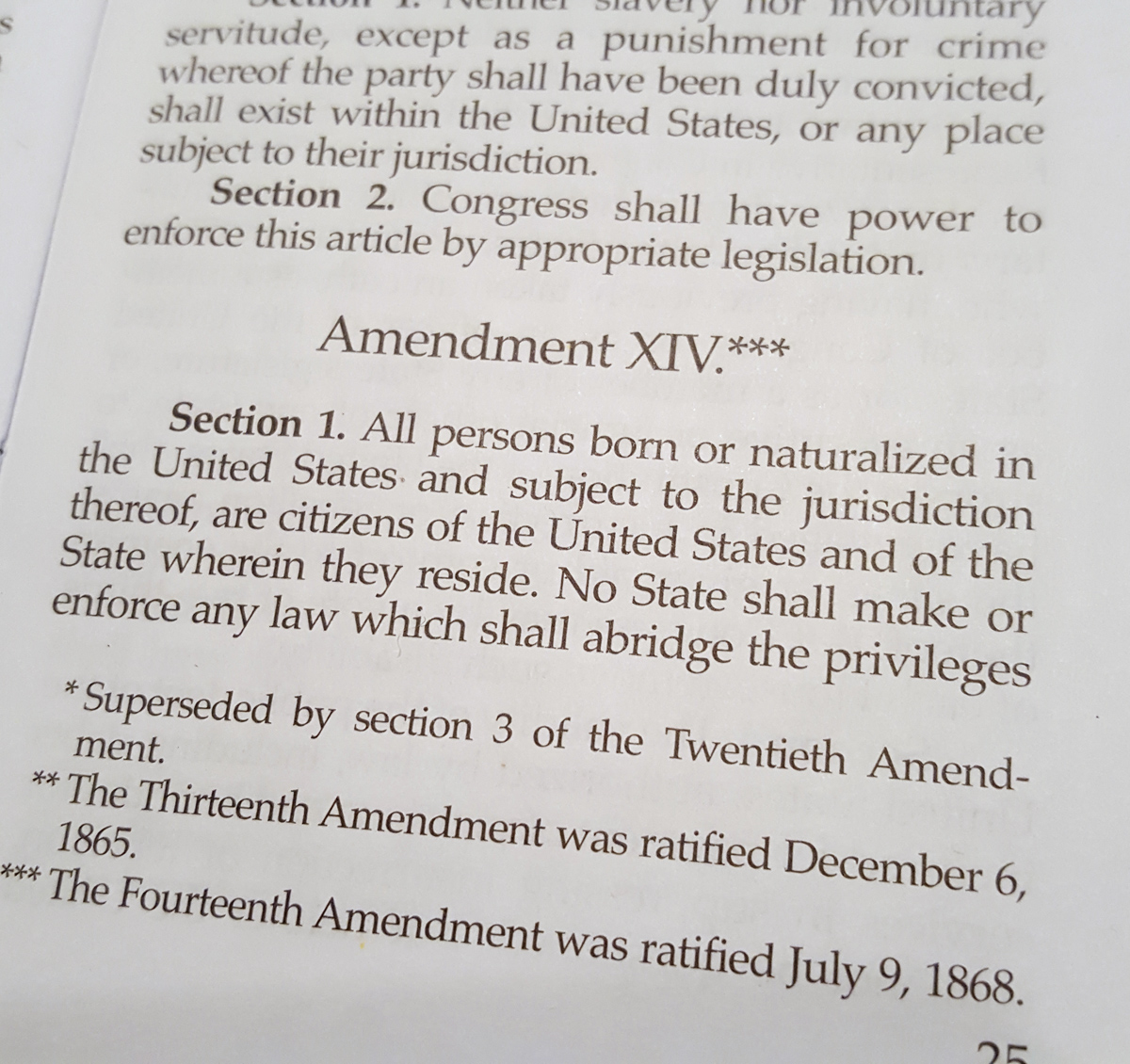

This amendment was ratified July 9, 1868. To understand it, it helps to know it followed what was called the Civil Rights Act of 1866, the purpose of which was to give citizenship to freed slaves. This legislation was pushed through Congress by a bloc of—of course—Republicans. Radical Republicans, they called themselves. That legislation said:

all persons born in the United States and not subject to any foreign power, excluding Indians not taxed, are hereby declared to be citizens of the United States; and such citizens, of every race and color, without regard to any previous condition of slavery or involuntary servitude, except as a punishment for crime whereof the party shall have been duly convicted, shall have the same right, in every State and Territory in the United States, to make and enforce contracts, to sue, be parties, and give evidence, to inherit, purchase, lease, sell, hold, and convey real and personal property, and to full and equal benefit of all laws and proceedings for the security of person and property, as is enjoyed by white citizens….
Putting the two together, we can see that “subject to the jurisdiction” means “subject to any foreign power.” It’s about allegiance. Aren’t visitors subject to our laws? Yes, and they also benefit from them—as people, but not as citizens. Citizens get additional privileges: the right to vote, and to receive government benefits, such as military protection from invasion, plus maybe education, welfare, or Social Security. There’s a distinct difference between being an American and simply being in America.

Let’s assume, then, the meaning of “subject to any foreign power” is not at issue. That means you must be born in the US and not subject to any foreign power, or be naturalized in the US and no longer subject to any foreign power. You don’t have to take my word for it. One of the drafters of the amendment, Senator Lyman Trumbull of Illinois defined “subject to the jurisdiction” as “not owing allegiance to anybody else.”

Why the amendment when there was already a law? There had been a prior decision by the Supreme Court, the Dred Scott case, in which SCOTUS ruled that a slave who was living in a state that prohibited slavery was nevertheless a slave and Americans were required to return him to his owner; furthermore, the case ruled that people who were racially black could never be US citizens.

In other words, it was already clear that you couldn’t trust the courts to rule correctly. Nevertheless, SCOTUS can rule a law unconstitutional, but it can’t rule an amendment to the Constitution unconstitutional; it is part of the constitution. So that is the reason the Civil Rights Act of 1866 was followed up with the 14th Amendment. They’re actually even closer than they appear. The amendment was drafted just two months after the legislation became law; the additional two years was the time for the states to ratify the amendment.

The debate about the 14th Amendment was never about granting citizenship to babies born here who were children of foreigners, visitors, or anyone whose allegiance was to some other nation (jurisdiction). That issue didn’t come up, because nobody thought, “Hey, you know what we ought to do? We ought to magically make any child of someone in the country, on vacation, say—or even illegally—a citizen. Then we can give that child of foreigners all the rights and benefits of citizenship, even if the child never assimilates or feels allegiance to our country with its principles of freedom.” Because that would have been stupid, for one thing. And for another, it had nothing to do with the purpose of the legislation and follow-up constitutional amendment.

So how did the idea of birthright citizenship come out of that pretty clear granting of citizenship to freed slaves and other black? It took a while, and some purposeful misconstruing.

Wong Kim Ark
image from Wikipedia
The first—and only—relevant Supreme Court case came up about thirty years later (1898), concerning a man born to Chinese immigrants—not naturalized as citizens, both because the Chinese Emperor did not allow renunciation of his rule, and because of the US laws at the time did not allow for Chinese naturalization, based on a belief that they were too foreign to assimilate. Wong Kim Ark took a trip to China (not his first), and when he returned to port in San Francisco, he wasn’t allowed re-entry, because of a hold on allowing entry of Chinese at the time. But he said, “I’m not Chinese. My parents are. But I’m American. I was born here.” While he was held aboard the ship for five months, the case made its way through the courts to the Supreme Court, which eventually ruled that he was a citizen, based on his being born here and his parents being permanent legal residents.


But that is a very different thing from the current interpretation that anyone who happens to be born here, whether to illegal immigrants, temporary residents, visitors, tourists, travelers, etc., would magically be granted citizenship status, with promises of welfare benefits and education. In fact, it’s hard to construe a way to be both an illegal alien and holding allegiance to the United States. The illegal status implies failure of allegiance.

There’s a rather arcane argument, where grammar really comes in, based on the precursor to the Congressional record, during the debate about the 14th Amendment. Michigan Republican Jacob Howard, who had introduced the 14th Amendment, is recorded as saying this:

This amendment which I have offered is simply declaratory of what I regard as the law of the land already, that every person born within the limits of the United States, and subject to their jurisdiction, is by virtue of natural law and national law a citizen of the United States. This will not, of course, include persons born in the United States who are foreigners, aliens, who belong to the families of ambassadors or foreign ministers accredited to the Government of the United States, but will include every other class of persons.
The person who wrote the words, then, insists that the 14th Amendment means essentially the same this that the Civil Rights legislation of 1866 meant. But today people purposely misread, not only the 14th Amendment, but Howard’s statement about it.

Take a look at the highlighted sentence again. The list of those not to be included are children born to foreigners or aliens, or children of ambassadors or foreign ministers. That seems pretty clear to me. But where misreading can occur, it does. The misreaders claim that it isn’t a list, but a restatement of the same thing, meaning that “foreigners and aliens” are just another way of saying “families of ambassadors or foreign ministers,” so everyone not of an ambassadorial or foreign ministerial family is included in “every other class of persons.”

The Congressional Globe, in which this is recorded, is neither an exact quote of the words spoken, nor is it intended to be the final say on punctuation. So, if you go by the full context of what Howard said, among others in the debate, you’ll see that “every other class of persons” cannot include Native Americans living on reservations and subject to tribal sovereignty (they were granted citizenship by legislation in 1924). So we know that the misreaders have it wrong.

So we could clarify (and people do[i]) by adding the word “or” in its appropriate place:

…who are foreigners, aliens, [or] who belong to the families of ambassadors or foreign ministers…
Grammar saves the day for truth once again!

What this means is, the 14th Amendment does not, and has not ever, granted birthright citizenship to children of parents subject to a foreign sovereignty.

Maybe we need a clearer definition of immigrant. Legal immigrants who have entered the country legally and have expressed their intention to be permanent residents—their children born here have always been considered citizens—even if they’re born before the parents become naturalized citizens. This would be different from someone working here on, say, a five-year work assignment but who still considers themselves a citizen of some other nation; their children would have the same citizenship as the parents.

If we as a people believe birthright citizenship is a good thing, we could hold the debate and amend the Constitution to say so. But we’ve never had that opportunity. We have had administrations who, for their own purposes (and those purposes are related to the same purposes that encourage illegal immigration, amnesty, non-citizen voting, and other impediments to sovereignty) granted such citizenship by fiat, but not by law.

So, can Donald Trump end the practice by executive order? Yes.

What would happen? Cases will make their way to the Supreme Court—which now leans originalist. Other than the one case, which doesn’t clearly define the issue, there isn’t reliable or clear court precedence. So they would likely look to the text and intent at the time of the writing of the 14th Amendment. I don’t know for certain how that would go, but it is likely to end the practice of “maternity hotels” and pregnant illegals purposely trying to get on American soil to birth a baby, who will then be a citizen, so they can claim, “But it would be cruel to separate families” as they plead not to be deported—even though this country has of course never forced deportees to leave their children behind simply because of a citizenship technicality; the country they would be returned to would undoubtedly accept their child as a citizen along with the returning parent.

Is this simply some bigoted conservative argument? Not unless you assume former Democrat Senate Majority Leader Harry Reid is a bigoted conservative. He said this:

If making it easy to be an illegal alien isn’t enough, how about offering a reward for being an illegal immigrant? No sane country would do that, right? Guess again. If you break our laws by entering this country without permission and give birth to a child, we reward that child with U.S. citizenship and guarantee a full access to all public and social services this society provides.
Does the United States have the right to decide its own citizenship rules? If it is a sovereign nation, then of course. If we go back to the original meaning of our 14th Amendment and end “birthright citizenship” for illegals or visitors, then we would be in line with the practice of 83% of the world’s nations, and about 6.642 billion of the world’s 7 billion people.

We don’t have to quibble about those currently granted citizenship. We can simply state what we as a nation will do going forward. As Hillsdale College lecturer and research fellow Michael Anton puts it,

Correct the issue going forward. Make clear to the world that the United States will no longer grant birthright citizenship to the children of non-citizen illegal immigrants, birth tourists, or people here on temporary work or student visas. The citizenship of those already born would forever be honored—even enshrined into law if necessary.[ii]
This would put an end to what might be called, in the insurance world, an attractive nuisance. We can stop attracting illegal immigrants, and get much better organized at allowing immigration of those who will value our laws, our freedoms, and the responsibilities of citizens who self-rule, and weed out the applicants who want to take advantage of us without becoming truly American.


[i] Michael Anton used this insertion for clarity in“Citizenship Shouldn’t Be a Birthright,” July 18, 2018, in The Washington Post. Others have used the same insertions, such as in "What Did the 14th Amendment Congress Think about 'Birthright Citizenship'?" by Mark Pulliam, August 21,2015, for Law and Liberty.

[ii] Michael Anton wrote two piece in July 2018 about birthright citizenship. The first is “Citizenship Shouldn’t Be a Birthright,” in The Washington Post. A few days later, in answer to critics, he wrote a much longer piece, “Birthright Citizenship: A Response to My Critics,” in the Claremont Review of Books. I this one he handles the grammar issues in more detail than I have, and also the historical issues. The estimates from the paragraph above about the world’s nations that do not have birthright citizenship come from his longer piece.

Monday, May 8, 2017

Water and Other Basic Needs

I’ve been puzzling over what appears to me an unsolvable problem, related in a way to illegal immigration.

There’s this trailer park, not that far from my neighborhood—it was a bus stop when my kids used to ride a school bus to middle school. It’s a pretty poor neighborhood, a step down from a trailer park just to the east.

This trailer park doesn’t have potable water. I thought it must be in the same municipal utilities district that I am, because it’s so close. But I looked on a map, and my neighborhood is apparently as far north as our district goes.

The trailer park has commercial businesses next door and across the street, which have potable water. But the private property on which the trailer park sits, I am told, does not. It is reportedly because the owner of the park does not want to spend the money to supply the park with municipal water.

About half a year ago, there was a news report about a retention pond right behind the trailer park. It’s green because of natural growth in the water, but it’s also filthy. So this standing water is an additional danger for trailer park residents—risk of drowning, 

The pond on the property, from news report

particularly for children, risk of disease, and greater risk of mosquito-borne illness. When this park was first brought to my attention, I think there was confusion that the pond was their source of water; I do not believe that is the case.

Under normal circumstances, no landlord could rent out a place without providing basic utility services, including water. I think the park has running water—just not clean enough for human consumption. It’s unclear to me how long this has been a problem.

I’ve been in meetings with people concerned about these people, and trying to alleviate some of their needs. My friends are working with other churches, plus the American Latino center for Research, Education, and Justice (ALCREJ). Our church has been donating some bottled water, which other churches and a food pantry are delivering, along with other needs.

But this is crisis help, not a long-term solution. The long-term solution would be to get this trailer park hooked up to a municipal water source.

In normal circumstances, government officials could be contacted, to let them know that a landlord is failing to provide clean water to his tenants. Officials could simply be requested to come out and test the water. Then they could pressure the landlord to do whatever upgrades are necessary, with the threat that they could condemn the park so that he couldn’t rent out the spaces.

But most (possibly all) of the tenants are illegal aliens. They can’t call the government; they don’t want anyone to call the government. Because they are illegal, and government “help” could result in deportation, or at the very least turning them out of homes they can more or less afford, with no place to go.

People want to help, but, as one friend said, “Nobody wants to be on the pokey end of that stick.”
So how do good, civilized people help? And should they?

In civilization, people honor God, family, life, property,and truth. In honoring God, we’re asked to love our neighbor as ourselves. There’s a wide range of what fits here. If we’re going to share our property—our wealth, including money, food, and other things—we have to supply for ourselves plus extra. So, to start with, we shouldn’t give up our livelihood or our basic needs.

We value life, so we would want to provide lifesaving supplies to our neighbors in dire need. We don’t want anyone to die of hunger. But life-sustaining supplies aren’t necessarily satisfying. They’re not meant to be. Nor are they meant to be indefinite in most cases.

It is better to do well in business to have jobs to offer than it is to give freebies.

As far as the water issue is concerned, the people in this trailer park are not seeking indefinite freebies, at least not from churches and pantries. They seem to be simply grateful for clean water. I think they drink the unclean water otherwise.

They have come here, presumably, to have better opportunities than they had in the probably third world situations they came from. Many are hard working. But, as illegals, their opportunities are limited. They’re likely doing yard work, restaurant kitchen help, house cleaning, or, if they’re lucky, construction work. Sometimes their pay is well below minimum wage, because they have no recourse if a boss treats them unfairly—except as everyone has, to quit and find other work.

There’s a question about why they come, if their poverty here is so profound. Maybe that takes some perspective. Certainly it would have been better if they had come legally; then all kinds of possibilities open up for their future. But for many of them, their level of poverty here is not greater than they came from.

Here they have running water, though unclean; they may have come from no running water, and probably unclean, whatever the source. Here they have electricity; they might not have had that. Here they have shelter—and even though it’s pretty poor, that trailer park has been there since before we moved here nearly two decades ago, and has survived hurricanes and tropical storms. It doesn’t look like much, but it’s better than nothing. Maybe better than they had.

Their children have schools here—the same schools my children went to before we pulled them out to homeschool. And they’ll be learning English. That means the next generation, while not as well off as if they had immigrated legally, or with more and better resources, is still several steps ahead of what they left behind.

So, unfortunately, there’s a logic in their minds about the decision to come here illegally. But their decision to do so likely leaves them in poverty for a generation or two—inescapable if they get into drugs or other illegal activities.

If the conditions are truly unacceptable, then it is a greater kindness to them to enforce border laws so that only legal immigrants come, which will mean better resources and opportunities for their future one they go through that difficult process.

We cannot alleviate all of the economic suffering worldwide simply with American largesse. There’s a good video that explains visually why that is:


So, what we need to offer is basic help, so that they can help themselves in their countries of origin. Some of this could be government help, but I suspect that non-governmental organizations are more likely to succeed, going to the people in need, assessing the next step, and offering help in that. It might be developing a clean water source. It might be developing a power supply. It might be upgrading their educational opportunities. It might be providing capital for micro-businesses.

The problem in the trailer park exists because there is an unscrupulous landowner. But such a person gets away with being unscrupulous because he is dealing with illegals.

When there are wrongs done, correcting them is a first step. I don’t know how these people without resources can do that, other than going back home and starting the process legally. That’s a hard thing. Maybe harder than they can even visualize. But it is certainly no kindness to make conditions even worse by inviting more of the poor around the world to sneak in illegally and try to live in the shadows.

Thursday, November 26, 2015

Come, Ye Thankful People

When God commands His children, it is for their benefit. So if we are commanded to be grateful in all things, it must be for our sake. If we are grateful, we will be happier. 
Last year's plentiful feast,
because this year's isn't photo ready yet.

Mounting social science bears that out. So does common experience. As the song says, “Count your blessings, name them one by one, And it will surprise you what the Lord has done.” And, in reference to the song in the title, "Come, ye thankful people, come. Raise the song of harvest home."

We set a day aside, to remind us of the blessings of being thankful. More important that the bounty of food are the family and friends we share it with.

We’re busy cooking, watching sports, and hanging out together as a family. But I want to express my gratitude here, just briefly, with a quote, and a few scripture verses especially meaningful today.

"Gratitude changes the pangs of memory into a tranquil joy."–Dietrich Bonhoeffer

Psalm 100
 1 Make a joyful noise unto the Lord, all ye lands.
 2 Serve the Lord with gladness: come before his presence with singing.
 3 Know ye that the Lord he is God: it is he that hath made us, and not we ourselves; we are his people, and the sheep of his pasture.
 4 Enter into his gates with thanksgiving, and into his courts with praise: be thankful unto him, and bless his name.
 5 For the Lord is good; his mercy is everlasting; and his truth endureth to all generations.

Luke 17
11 And it came to pass, as he went to Jerusalem, that he passed through the midst of Samaria and Galilee.
 12 And as he entered into a certain village, there met him ten men that were lepers, which stood afar off:
 13 And they lifted up their voices, and said, Jesus, Master, have mercy on us.
 14 And when he saw them, he said unto them, Go shew yourselves unto the priests. And it came to pass, that, as they went, they were cleansed.
 15 And one of them, when he saw that he was healed, turned back, and with a loud voice glorified God,
 16 And fell down on his face at his feet, giving him thanks: and he was a Samaritan.

Mosiah 2
19 And behold also, if I, whom ye call your king, who has spent his days in your service, and yet has been in the service of God, do merit any thanks from you, O how you ought to thank your heavenly King!
 20 I say unto you, my brethren, that if you should render all the thanks and praise which your whole soul has power to possess, to that God who has created you, and has kept and preserved you, and has caused that ye should rejoice, and has granted that ye should live in peace one with another—
 21 I say unto you that if ye should serve him who has created you from the beginning, and is preserving you from day to day, by lending you breath, that ye may live and move and do according to your own will, and even supporting you from one moment to another—I say, if ye should serve him with all your whole souls yet ye would be unprofitable servants.

Alma 34
38 … and that ye live in thanksgiving daily, for the many mercies and blessings which he doth bestow upon you.

Doctrine and Covenants 59
7 Thou shalt thank the Lord thy God in all things.

Doctrine and Covenants 78
19 He who receiveth all things with thankfulness shall be made glorious; and the things of this earth shall be added unto him, even an hundred fold, yea, more.

Monday, November 24, 2014

The Unconstitutional Executive Order


Unconstitutional: “You keep using that word. I don’t think it means what you think it means.” Apparently the president thinks it means, "Something I'm not willing or politically ready to do at this time, but is subject to change on my whim."
There are collections of video of Obama saying, at least a couple dozen times, that acting on his own to change immigration law is unconstitutional (example below). Then, of course, he did that just last Thursday, claiming this was clearly within his power. Was he lying or misinformed before? Or is he lying and misinformed now. Since the Constitution hasn’t changed in the interim, it isn’t possible for him to be right on both sides.


There is also a chart going around comparing how many executive orders each president has enacted per year. FDR was by far the most extreme, enacting around 290 per year—for more years than any other president, to boot. George W. Bush has fewer (about 36 per year) than Reagan (about 47 per year). Obama is only slightly lower than George W. Bush, at 33-ish.
But this is the wrong question. Of course it is legal for a president to give executive orders. The purpose of an executive order is to direct the people working under him as to how to execute the laws duly enacted by Congress. Executive orders are meant to be procedural. And they must be simply a way to see to the carrying out of the laws; they cannot change the laws or create new laws.
Much has been made about the executive order by Reagan to allow for amnesty back in 1981—which was a directive on how to go about executing the decision made by the democrat-led Congress. There isn’t an issue with the legality of that executive order—although plenty of people can see that the failure to close the border as promised simply invited more of the illegal immigrant problem, rather than resolving it.
The question for last Thursday’s edict isn’t whether the president has the right to give an executive order; he does. The question isn’t whether he can act on immigration policy; he can, as Reagan did. But only as Reagan did—following the law as defined by Congress, following the Constitution.
If you have a president, say Reagan, who uses executive orders liberally but perhaps not even a single time for any purpose but directing the executive branch in how to keep the law, then you have no executive order problem. Then, suppose you have another president, say Obama, who less frequently gives executive orders but often as an edict to create law rather than to follow laws set by Congress, then each of those offenses is breaking the law. Party doesn’t matter. The policy itself—along with its efficacy or intent—doesn’t matter. The color of the president matters not a whit. What matters is the breach of the law.
The president cannot act extralegally. He cannot make law. We do not live in a monarchy, dictatorship, potentate, banana republic, or any other tyranny. We live in a constitutional republic. We have a written law granting only limited enumerated powers to the federal government, so that our God-given natural rights are not infringed.
Can a president act beyond those enumerated powers? Presidents have. This president does. But not legally. Presidents have typically gotten away with exertion of power beyond what is granted depending on their popularity. That is not the case now. This president isn’t popular. His policies are not popular. His edicts are notably unpopular. He acts in the face of those negatives.
So the next question is, How do we react, to limit the damage of his acting beyond his authority in direct conflict with the limits guaranteed in our Constitution?
The constitutionally designed response is impeachment. But, despite his lack of popularity or approval, he does have media control, so the fear in the hearts of congressmen is significant. Impeachment is time consuming, and takes a sizable measure of focused energy and political capital. It’s not going to happen when this man has only two more years in office.
So, the additional steps are to stonewall the illegal acts. Defund anything that relates to executing his orders. Targeted defunding—not just refusing to agree to a continuing resolution to keep spending as the president sees fit, as an alternative to shutting down the government. One advantage of now having a GOP Senate is that we can actually pass a budget—something the democrat-led Senate has failed to do every single year. It’s easier to target spending in an actual budget, so that’s a good thing, if the Congress will have the stomach to do their job.
Additionally, Senator Ted Cruz is suggesting that no political appointments should be approved until the president rescinds his illegal orders. He should not be empowered by sycophants who will act on his orders in contrast to law. Interesting idea. I hope it works.
There are also lawsuits. Texas Attorney General (and Governor-elect) has already filed a lawsuit based on the significant damage to the state caused by the president’s insistence on a porous border. It may be that courts can suspend the immediate enactment of any illegal order. I’m also in favor of states taking on the role of border enforcement when the federal government fails—and then find ways to charge costs to the federal government for whatever it costs each border state. I don’t think such a system has been found yet. Texas is taking money out of its own budget to defend the international border.
While mostly we’re talking today about the illegality of using an executive order to make law, we can talk briefly actual immigration policy. The answer is relatively simple, if not easy. It could already have been done by an administration serious about a solution: close the border (funding was supplied almost a decade ago, but not used for that purpose); make it impossible for illegals to work here or to get social benefits here—thus ending any incentive to come here illegally. Any costs for medical care, incarceration or deportation of illegals should be billed to the home nation that the illegals will be deported to—costs could be deducted from foreign aid, or specific tariffs on imports from those nations until debt is paid. That’s a side issue, but the intent is to stop those nations from encouraging their citizens to come here and send dollars home.
There’s no need to wait to improve the bureaucracy; make it a smooth and efficient process to come here legally. There is nothing stopping the executive branch from doing its job better immediately. Resolving bureaucratic red tape would change the dynamics of the argument from the start. There is no need for “comprehensive immigration reform” in order to improve the process.
What the president and others mean by “comprehensive immigration reform” has been, and continues to be, naturalize illegals with the intent of creating more dependent citizens who will vote democrat. While there is reason to feel sympathy for those caught up in the useless-bureaucracy-combined-with-porous-border up until now, the solution for individual cases cannot be handled until the border is secure and the bureaucracy is fully functioning.
One indicator that the president isn’t persuading the public to his way of thinking is this Saturday Night Live skit, going viral, a parody of the Schoolhouse Rock “I’m Just a Bill.” Enjoy.


Friday, June 21, 2013

Border Lines

Earlier this month I got a call from an organization with “conservative” in their name, asking me my opinions on the border and the legislation being considered. It was not a money-raising call. And it wasn’t a poll. What they do is help people draft letters, possibly in ways they agree with; I don’t know. It’s a rather time/work-intensive approach.

So they took notes on what I said and then drafted a letter from that, from me. They sent me three copies of it: one for my representative, one for me, and one for them—after I had made any edits or changes. I’m not exactly in need of help in drafting a letter to my representative. But I was curious about how they would attempt to draft my opinions. I got that just a few days ago, kind of late in the process. And in the meantime, I’ve learned more and my positions are not the same. I should say I have not changed my opinion against amnesty, for border security, and for a less disastrously bureaucratic mess for people to get through to try to come legally. But I was willing to see what the bill was about, and now I know enough.
So, I’m redrafting the letter, here, as an exercise. And I may also send it (probably by email at this late date) to my representative. And if I get my printer working, I may also send the re-draft to this organization. [Note: while I was writing this, the organization called to follow up. I told them their letter had fairly well represented my stated opinions the day we talked, but my opinions on the bill have changed enough that I am redrafting the letter. They offered to write a new draft for me, but I don’t think there is time for them to get a new draft to me before my representative needs to see my opinion. So I’m not sure they will actually write me a new draft. I’m still uncertain whether their purpose was to support the bill, or whether their purpose was just to help citizens send their opinions to their representatives. I am allowing them to send me a newsletter, so I can eventually learn if they’re truly conservative.]
If you find parts of this letter useful, feel free to adapt it to send to your representative.
______________________________________
Dear Representative Poe,
I’m writing today concerning the immigration reform bill. I recognize that the immigration system needs reform; I was cautiously optimistic for a while that this bill might be a useful effort. I no longer believe that. As a sovereign nation, we must be able to control our borders. There are current laws requiring a solid wall to be built on our southern border—since 2006. Only a few dozen miles have been built so far.
This bill, in any version, seems to say, “OK, we’ll consider doing something about the border—if you give in on every other comprehensive reform we ask.” There’s a “trust us” implication; but there’s no reason to trust when the federal government has already proven that a law requiring border enforcement will be ignored.
Of course there are other immigration issues we would like to have dealt with. We should streamline the process to encourage legal immigration. I have known people who have gone through the very difficult process of being married to a foreign national that had trouble getting permanent legal status; two families I know were separated for as long as 18 months.
And then there are families like the Romeikes, a German family that sought asylum here in 2008 because they wanted to homeschool their children, which is illegal in Germany. They were given permanent asylum by a judge in 2010, and then out of the blue the Justice Department decided to overturn that ruling and deport them, which will mean a huge fine for the Romeikes, and possibly prison terms for the parents and loss of custody of their children. Our President says it’s the right of Germany to do that to this family. Yet this same President instructs his DOJ to allow illegals to live here without repercussions, and sues the state of Arizona simply for asking about legality when someone is in custody for some other reason. Our current government either cannot tell or chooses wrongly who should be allowed to come here.
We should have the ability for employers to verify the legality of employees (e-verify is probably a good idea). And at some point we may need to deal with the illegals who remain here, who drain our resources for education, healthcare, welfare, and law enforcement. But this bill doesn’t effectively deal with any of these issues. It seems to have as a singular purpose legalizing those who came here illegally, with no improvement to the overall system.
What we must do is secure the border. Until there is a will to do that in both houses of the legislature—as well as proven enforcement—nothing else can be improved.
I suggest, rather than yet another unreadable 1100-page bill, a bill with just a few words:
Inasmuch as laws are on the books requiring border security and legal immigration, those laws should be enforced. At such time as enforcement is verified, then additional legislation can be considered concerning other immigration system issues.
I am no longer naïve enough to believe that any other approach will lead to the essential beginning point we need. Please vote against any and all versions of the current immigration legislation.
Thank you for your efforts.