Showing posts with label SCOTUS. Show all posts

Monday, January 10, 2022

So Many Things They Know That Aren’t So

image found here

That Reagan quote is our theme today. We're applying it to Friday's oral arguments at the Supreme Court and Thursday's anniversary of the January 6, 2021, difference of opinions.


SCOTUS on Mandates

This past Friday the Supreme Court heard oral arguments on the vaccine mandate cases, both for OSHA and for healthcare workers at facilities receiving federal funding. The first took two hours; the second, more tailored case, was an hour and a half. You’re welcome to listen to all of it. But I’ll go over some of the highlights, and the commentary on those highlights.

Notable is the way the nine justices appear. Three do not wear masks; six do. Note that all are triple-vaxxed (two vaccine doses plus booster). Everyone had to have a clear COVID test to enter. Therefore, theoretically, there was no reason to wear a mask in a sparsely populated, well-ventilated room—unless you assume the vaccines and tests do not work and a person with no symptoms can spread the disease.

The three who don’t wear masks—Alito, Thomas, and Gorsuch—ask questions about constitutional authority. Where does the government have power to do what it’s doing?

The three Democrat appointees all wear masks—and Sotomayor was additionally tuned in remotely. I couldn’t see this; I’m using a description from Robert Barnes from the Viva & Barnes Sunday night livestream. So I’m further confounded that someone might think she could get the disease over the internet. Is this an old person misunderstanding about computer viruses?

Crankshaft comic of January 8, 2022, found in the Houston Chronicle

Anyway, these three do not seem interested in the law, or the Constitution, or authority. They simply put forward the notion that the government can do whatever it deems necessary, because—crisis! Extraordinary times; extraordinary measures.

The remaining three middling justices, with masks, asked questions that made it seem, according to Barnes, they were all focused on, “Isn’t this a little too much?”

So mask wearing—or at least lack of it—might be an indicator of constitutional understanding, just as it seems to be out in the general population.

The description of mask wearing, by the way, was different, according to Amy Howe on SCOTUS Blog, where she says all of the eight present wore masks except Gorsuch. And she noted that two of the lawyers also participated remotely. So I don’t know whether the mask is the true indicator. But the division of three segments of justices seems apt.

Politifact tweet, January 7, 2022
image found here
Sotomayor was the most embarrassing to the Court. Even Politifact rated her exaggerations as “very false.” She tried claiming:

We have hospitals that are almost at full capacity with people severely ill on ventilators. We have over 100,000 children, which we’ve never had before, in serious condition, and many on ventilators!!!!!

Exclamations points are my addition. The fact is, there have only been 83,000 children hospitalized with COVID since the pandemic began. And Fauci last week noted that we still do not differentiate between hospitalized for COVID and hospitalized with COVID. Everyone admitted to a hospital for any reason these days is given a COVID test. If they test positive (and false positives are still common), then they are listed as a COVID case, even when asymptomatic. So a child with a broken leg could be considered a COVID case. Many children, particularly during the Delta and Omicron phases, have had COVID, but most are mild and may not even be tested. So, yes, there are cases. But an illness that is milder for children that the flu ought not to cause a justice of the Supreme Court to clutch her pearls in a panic.

According to federal data, under 5,000 children with a positive COVID test were in hospitals in this country. Again, that’s “with,” not necessarily hospitalized “because of” COVID. The CDC said Friday that 4 in 100,000 children admitted to hospitals are infected with COVID—maybe that’s the factoid she twisted. The CDC’s Dr. Rochelle Walensky added, “We have not yet seen a signal that there is any increased severity in this age demographic.” She also noted that similar worries about the Delta variant had proved to be unfounded.

There was more need of fact-checking. Sotomayor also claimed, “Omicron is as deadly as Delta." Not so. South Africa got through their entire wave with possibly zero deaths from the variant, as of mid-December. Cases skyrocketed and then dropped.
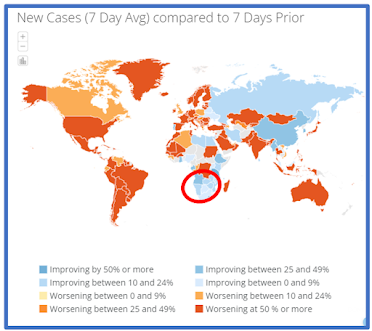
Southern Africa has been improving for weeks, meaning
its peak has passed. Data from here, January 9, 2022.

Other countries are now going through the precipitous rise in cases. In our area, so many people have been coming down with it that we closed church on Sunday. I’ve known many who have had it lately—many more lately than I’ve known during the rest of the whole pandemic. But I know no one needing hospitalization. During earlier variants I did know of several hospitalized cases. So I think we’re in the Omicron wave now. But death from COVID tends to appear late—after weeks of treatment. So current deaths could still be from the Delta variant. That data is extrapolated from spot testing; not everyone knows what variant they have. But the milder symptoms and quick spread right now mean it’s probably Omicron.

Omicron is at least as easy to deal with through early treatment as earlier variants. And that information doesn’t even appear in the SCOTUS hearings.

There’s another detail I’m wondering about: if the wave lasted about four weeks in South Africa, and is already well underway here, then getting vaccinated now would still leave you vulnerable during the coming few weeks. Getting a shot might even make you more vulnerable. So why the continued push for vaccination?

Anecdote for our times: I’m familiar with someone trying to bring his fiancĂ©e over from Ukraine. She had COVID a month or so ago. In Ukraine they seem to be aware that, while your natural antibodies are very high from just having had the disease, you shouldn’t get a vaccine; that’s not helpful and possibly dangerous. So she has to keep going back for tests until her antibodies go down (and, by the way, they go down in the current active state but remain in memory cells, so she’ll still have immunity), because the US won’t allow her in without being fully vaccinated.

Here’s what the Democrat-appointed justices seem to believe:

·         COVID-19 is as dangerous and likely to cause death as smallpox or Ebola.

·         It is just as dangerous to children as adults and elderly.

·         Nothing works against this dangerous pathogen except vaccines—and three shots are much better than two—or more if deemed necessary later.

·         The vaccines guarantee immunity and spreading. Except from the unvaccinated; you can still get it from them.

·         The unvaccinated spew the pathogen wherever they roam, killing off people in their wake, whether they have the disease or not.

·         If the justices are personally fearful of a pathogen, then certainly that is reason enough to favor granting any and all power to the federal government to take whatever measures the elite bureaucrats deem necessary.   

Of course COVID-19 has never been dangerous to most of the population. Most deaths have occurred in people over 80 with co-morbidities. Some deaths have occurred in younger people with serious co-morbidities, so it has been concerning. But this is the first time we’ve tried quarantining the healthy who are not at risk.

About 98% of the vulnerable population are vaccinated at this point. But there have been treatments available—and most effective are early treatments—at least since April 2020. The vaccines should never have gotten emergency use authorization status, because other effective treatments were available. The treatments were censored and derided—so that vaccines could be pushed. Whoever did this was content to have hundreds of thousands of people die unnecessarily so they could push a vaccine.

And the vaccine they pushed wasn’t a traditional vaccine that gives immunity; it was merely something that might somewhat increase a person’s antibodies for a time. It doesn’t prevent getting the virus, so they started saying the vax is necessary to have a milder case. But a vaccinated person can still get the virus and spread it. A person with natural immunity cannot get it or spread it (except, all bets are off with Omicron, which might be a step toward being a new virus, such as we have with other common cold coronaviruses). And yet people with natural immunity are as likely to be shunned for not also getting vaccinated as are those who have managed to stay well two years into this without contracting it (because their Vitamin D levels are high enough?) and do not want to be forced to take an emergency use vaccine.

Regardless of what those three justices think, vaccines have never been mandated without exemptions for religious or health reasons. Vaccines that are experimental have never been mandated—and should not be; it is a violation of the Nuremberg Code. And these vaccines neither prevent getting ill nor spreading the disease.

If it’s this easy for me to get all this information, why are these justices so ignorant?

Viva Frei is Canadian, so not fully aware of which judges were appointed by which party, etc. He put it this way:

But the questions and the hyperbole coming from the judges was what you would expect to hear from a bad lawyer, not from the highest decision-makers in the world, in the country. And it’s hyperbolic. And it’s grotesquely ignorant. And it’s the highest, allegedly, supposed to be the most informed, most educated people in the land, who are going to be making these decisions for the rest of the country.

Later in the livestream, Viva and Barnes were looking at a bit of Supreme Court history, treading carefully not to make the wild Nazi comparison, and then came back to the vaccine mandate discussion. Robert Barnes added this scathing assessment:

Frankly, this started in Britain and the US. The ideas for eugenics and social Darwinism were British and American ideas. The Nazis always cited British and American authorities. Particularly, like, I’m waiting for somebody in one of these vaccine mandate cases that gets to SCOTUS to just go after them on this issue. To say, “The last time you got high and mighty on when you thought public health authorities should be completely deferred to was when you said three generations of imbeciles was enough in order to force sterilizations that became the law of the land for 50 years, that led to forced sterilizations of poor women all across the country. So maybe you should be a little bit more careful, before you get up on your high horse about what you think medicine is, before you take off that black robe and put on that white lab coat and pretend that your professional class compadres are the ones who should dictate and direct public health policy in America. Because you have a long history of being atrocious at it. Abominable at it.” The ideas for eugenics came from America. The Nazis copied American laws and American policies and American principles—and their number one source of authority was the Supreme Court of the United States.

Here are some other sources related to the oral arguments:

·       Left-leaning fact-checker nails Justice Sotomayor over wildly false claim about children, COVID-19” Chris Enloe for The Blaze, January 9, 2022. 

·       ’Many on Ventilators’—Justice Sotomayor Falsely Claims Over 100,000 Children in Serious Condition Because of Covid” Jeff Rizzone for The DC Weekly, January 7, 2022. 

·       Live Q&A: Judge Refuses FDA Request, Gives 8 Months for Pfizer Data; Trump Social Network Nears” Joshua Philipp on Crossroad Highlights, January 9, 2022. 

·       30 States Oppose Biden Vaccine Mandate, Via SCOTUS Brief of Family Councils” by Joseph Menslage for Katy Christian Magazine, January 4, 2022. 

·     


January 6th Anniversary

That was enough for a full post. But the other example of ridiculous beliefs from last week was the January 6th anniversary, which deserves a mention. Alas, my resolution to write shorter posts fails already. Anyway, first enjoy this celebration from The Babylon Bee:

·         10 Fun Ways to Celebrate January 6 This YearThe Babylon Bee, January 5 2022. 

The most unlikable politician in history, VP Kamala Harris, gave the speech of lies

Certain dates echo throughout history, including dates that instantly remind all who have lived through them—where they were and what they were doing when our democracy came under assault. Dates that occupy not only a place on our calendars, but a place in our collective memory. December 7th, 1941. September 11th, 2001. And January 6th, 2021.

Let’s do a chart:

Event

Deaths

Those Who Caused Deaths

Pearl Harbor bombing

2,335 military personnel killed

1,143 wounded

Japanese declaring war against us

9/11/2001 attacks at World Trade Center and Pentagon

2,977 people were killed

6,000+ injured

Islamist terrorists continuing a war they declared against us

1/6/2021

1 protestor killed, 4 rally participants died of natural causes*

Capitol Police


Here’s what they seem to believe, or want us to believe:

·       All Trump supporters are insurrectionists, trying to overthrow the country.

·       Anyone who attended the Trump rally on January 6th participated in insurrection.

·       The reason people were at the capitol was to stop the official proceedings being carried out by Congress

·       They wanted to overturn a free and fair election of the people by staging a coup.

·       Trump instigated the insurrection and signaled people to attack the capitol.

·       Lawmakers barely escaped with their lives.

Except, of course, that’s not true. Any of it.

The hundreds of thousands of rally goers went to express their support for Trump and to express their dismay at the rampant voter fraud; it was called the Stop the Steal Rally. They were encouraging lawmakers to accept alternate slates of electors from several states. This is a constitutionally provided procedure—which Democrats often avail themselves of for no rational reason beyond partisanship.

Only a small percentage of people entered the capitol. Most of those who entered did so at the invitation of Capitol Police, where they were allowed to walk around and take photos.

A much smaller percentage caused violence. None of those causing violence was armed. No one at the Capitol that day was armed except the police. No lawmakers’ lives were threatened; they were all evacuated at the first sign of a breach of the building.

There was indeed some violence. Instigators have not been charged, oddly. As more evidence comes out, it appears this was an FBI-instigated entrapment operation. They were hoping to goad Trump supporters into violence, so they could blame Trump and his supporters. The people who were charged are being held on trespass charges and a few for vandalism. There are no insurrection charges, because there is no evidence of insurrection happening that day. None.

Recently information has come out about two of the “natural causes” deaths. One is a woman said to have overdosed on a prescription medication. There is surveillance footage of her being beaten by Capitol Police and dragged back into the building. This calls the coroner’s report into question as part of a political coverup. Story here:

·       Videos Shed Light on Death of Rosanne Boyland at US Capitol on Jan. 6” by Joseph M. Hanneman for The Epoch Times, January 7 (updated January 8), 2022. 

·       Live Q&A: Judge Refuses FDA Request, Gives 8 Months for Pfizer Data; Trump Social Network Nears” Joshua Philipp for Crossroads Highlights, January 9, 2022.  This is the same video as above; here it is linked to come up at the place of this story.

Another “natural causes” death that may also have been caused or contributed to by Capitol Police is believed to be Kevin Greeson, 55, of Alabama. He had a history of high blood pressure and reportedly died of a heart attack. But there is an eyewitness account and video showing that there was a sudden attack on a peaceful crowd by Capitol Police, with less-than-lethal tear gas, concussion grenades, rubber bullets and pepperballs. The eyewitness report is from comedian Tyler Baggins of Wisconsin, who was recording the crowd that day. His video shows the crowd singing the Lee Greenwood song “I’m Proud to Be an American” and then cuts to footage of CPR being done on Greeson.

Lauren Witzke was a reporter on scene that day for National File, reporting this:

By the time I got to the Capitol, people had already made their way up to the steps. Trump supporters were waving flags and trying to talk to the Capitol Police. Every rally-goer at that point was extremely peaceful. I then saw Capitol Police Officers with rifles appear on the balcony looking down on us. Almost immediately, the Capitol Police on the ground started throwing flash grenades into the crowds, teargassing us all.

I moved about 40 feet away from the steps, and just stood there, yet the tear gas and flash grenades continued. After being flash bombed and tear-gassed for the third time, I looked down beside me to see that a middle-aged man—Kevin Greeson—on the ground, blue in the face.

My friend Kimberley immediately began CPR and continued until her lips were bleeding. But she couldn’t get him breathing again. Men were yelling “Help we need an EMT, get this man an ambulance,” etc. We begged the Capitol police officers for help. But they ignored us, and continued macing old men who got anywhere near them.

Trump supporters were able to make a makeshift gurney out of the fencing and carry him out of there. Capitol Police continued to flash bomb and tear gas us, macing in the face anyone who came near them.

She reported that there had been absolutely no violence in the crowd prior to the assault from Capitol Police. Emergency personnel did not rush to help, as previously reported. People in the crowd carried the man to get medical help, which took about half an hour, at which time he was pronounced dead. There is some speculation that any eventual violence that happened was in response to his death and the unwarranted and unwarned assault by Capitol Police.

This information comes from a source I am not familiar with, so use your discernment. However, in other places it coincides with news I’ve heard elsewhere, such as the Ricochet report, which I wrote about and linked to here. Here's the story:

·       VIDEOS: Jan 6 Violence Sparked by Innocent Man's Death, Police Grenade Assault on Peaceful Crowd” by A. J. Cooke for National File, January 6, 2022. 

Robert Barnes also tied these two issues together, which kind of summarizes today’s post:

Well, it’s kind of parallel to the vaccine mandate hearings at the Supreme Court. You have the reality of the way things are actually shaping up, if you look at the facts on the ground, versus the narrative, the myth, that’s being propagated by the press. And just as Sotomayor had this myth of everybody’s dying, and the kids are dying, and all the rest, the mythical narrative of January 6th is still the insurrection that almost happened, that has to be remedied. We should look at it like the second coming of the Civil War and 9/11.

And the reality is, it’s none of those things. Nobody’s been charged with insurrection. There’s more people filing frivolous lawsuits against everybody. More evidence that, in fact, capitol police—some of the other people that died that day may not have been from natural causes; it may have been the capitol police killed them. And they covered it up. And thanks to the good work of Tom Fitton at Judicial Watch, they’ve used the Freedom of Information Act to uncover more evidence. Because there’s 14,000 hours of video evidence the government’s trying to hide from the world, including from the defendants themselves.

And it appears the reason for that is not only a lot of informants being part of the process, but the Capitol Police behaved in a very illicit manner, and was just violently bringing people in and beating the daylights out of them for kicks and giggles. Including women, older women, like that.

Now we’re starting to find out why they hid and covered a lot of this up. That the only really violent people that day were actually the capitol police, not the people who are accused of being the insurrectionists.

This is not the America we know and love. God help us. Here’s a New Year’s wish: May all their crimes be shouted from the rooftops; may all the corruption be rooted out of our government; may we return to the thriving civilization that happens when a free and good people are allowed to live their lives without tyranny.

Tuesday, September 29, 2020

Try Reading the Constitution, Part IV

This is the fourth, and probably final, part in our series celebrating the US Constitution. We started this on Constitution Day, our intro celebration in Part I. Then we’re going through the first three articles of the Constitution, covering Article I, the legislative branch, in Part II; and Article II, the executive branch, in Part III.

Pull our your pocket Constitution and join us today, when we’re covering Article III, pertaining to the judicial branch, laying out the powers vested in the Supreme Court and lower federal courts. It’s a brief three sections. Afterward we’ll cover some of what’s not in there that maybe you thought was there. And we’ll talk about the current Supreme Court nomination, providing us a live history lesson.


Article III, on the Judicial Branch

Article III

Section 1 covers judicial service. It says judges serve “during good Behaviour,” meaning they can be removed if they do illegal or unethical acts. It also says they get paid for their service—an amount that won’t be diminished during their service. That is, they can base their decision on whether to accept an appointment to be a judge knowing what the pay will be, and not worry that they’ll have to later adjust to a lower amount—a worry that might influence judgment.

Section 2 covers which cases are handled by the federal judiciary. It says these will include cases relating to laws under the Constitution, which includes US laws and treaties. Also, they handle cases related to maritime law, and cases in which the United States is one of the parties. They’ll handle disputes between two or more states, disputes between a state and a citizen of another state, disputes between citizens of different states, disputes between citizens of the same state who claim lands under grants of different states, and disputes between a state or its citizens and foreign nations or their citizens.

For ambassador cases (including public ministers and consuls) and also cases in which a state is one of the parties, the Supreme Court is the court of original jurisdiction. For all other cases, it is considered an appellate court. And it is the highest court of appeal. Once they rule, that case is over.

Criminal trials require a jury, and they will be held in the state in which the crime was committed. In cases where the crime wasn’t committed within any state (e.g., in another country, on the seas), the trial takes place where Congress directs by law.

Section 3 defines treason against the United States. It “shall consist only in levying War against them [the United States], or in adhering to their Enemies, giving them Aid and Comfort.” This is the only definition of a particular crime given in the Constitution. That phrase “giving them Aid and Comfort” means it doesn’t have to require actually picking up a weapon of war to use against the US; it can include passing along secret information or supplying weapons, or in some other way helping the enemy in its goal of overpowering the United States. It doesn’t include speaking out in opposition to US policies, however, even when speaking that opinion helps the enemy; that is a freedom of speech right.

There’s a high bar for convicting a person of treason, requiring two witnesses to the same overt act, or an open confession in Court.

Congress gets to determine punishment. But, unlike tyrannies of the past, it cannot allow punishment of family or friends who weren’t involved in the crime; only the actual traitor can be punished.


What Else

That covers the entirety of Article III. It doesn’t say that the court gets to determine whether there are hidden meanings, or penumbras of meaning, in the Constitution. It doesn’t say it’s up to the courts to determine when life begins. It doesn’t say the courts get to determine policy surrounding abortion—or policy surrounding any other issue for that matter. It doesn’t say it’s up to the courts to change the definition of marriage from what it’s been for several thousand years. It doesn’t say the courts have the right to re-write a badly written law to make it better, or better able to accomplish a desired outcome.

What else doesn’t it say? Surprisingly, it doesn’t even say it is up to the Supreme Court to determine whether a law is constitutional. That didn’t become a thing until Marbury v. Madison.

It is emphatically the province and duty of the Judicial Department to say what the law is.—Marbury, 5 U.S. at 177.

This happened even though Thomas Jefferson warned against it:

[T]he opinion which gives to the judges the right to decide what laws are constitutional and what not... would make the judiciary a despotic branch.... [T]he germ of dissolution of our federal government is... the federal Judiciary... working like gravity by night and by day, gaining a little today and a little tomorrow, and advancing its noiseless step like a thief, over the field of jurisdiction, until all shall be usurped.—Thomas Jefferson

The Marbury case was good in that it declared that the Constitution had the force of law, not just a nice set of principles to set on a shelf and refer to as desired. But, the downside was that it gave the Supreme Court powers beyond just settling judicial cases; it empowered the Supreme Court to essentially judge the work of the legislature. As the saying goes, with great power comes great responsibility. The founders (was it Hamilton? Yes, in Federalist #78) assured us that the judicial branch was the weakest branch, and we should not worry about it becoming too powerful.

And what else doesn’t Article III say? How many justices there should be. We’ve traditionally had nine. It started in 1789 with 6. The court can function with fewer; for example, when a judge must recuse him/herself, or when one has died or stepped down and has yet to be replaced. When the court ends up with an even number, that does make it feel less settled, although in practice such an even split decision would sustain the lower court’s ruling, going against whichever side appealed.

Back in FDR’s day, he wanted the Supreme Court to rule a certain way on an issue, which they had pointed out was not something the Constitution gave the president the right to do. So he threatened to “pack the court,” which meant to add to its numbers, putting multiple people on the Court that he could count on to rule his way. It would have undermined the separation of powers and made the Court seem illegitimate. In order to prevent that, the Court cowed and ruled his way, favoring big government power (this included upholding the internment of Japanese citizens in Korematsu v. United States). I always think it’s unfortunate when decisions are made out of expediency, rather than truth and law (heads up to Chief Justice Roberts). I wonder what would have happened if everyone had acted with integrity.

What if the Court had ruled according to the Constitution? Then FDR follows through on his threat, but the Senate does its actual job of not consenting to any appointment determined to rule against the Constitution? Then FDR does not get to continue his social experiments, which kept the US in the Great Depression an unnecessary extra decade. Plus, we would have had a pattern for standing up to tyranny within the government, rather than acquiescing to it. Wouldn’t that have been better all along?

We’ve had a court packing threat come up again recently. Again by Democrats.

We have a current vacancy. The timing is unfortunate. Eighty-seven-year-old Justice Ruth Bader Ginsburg passed away September 18, within a couple of months of the presidential election. The Democrats insist that it’s wrong, and against the law, and disrespectful of the justice’s dying wish, to appoint a replacement to the Court before the election. And they threaten that, if the Republicans go ahead and do that, they will grant statehood to Washington, DC, and to Guam and Puerto Rico, with the intention of adding Democrat senators, and then they will add numbers to the Supreme Court, and they will prevent Republicans from ever gaining power again. In other words, they are threatening tyranny—because they say the Republicans are wielding their power in a less than courteous way. Hmm.

Is it wrong for a president to make an appointment to the Supreme Court in an election year? What has been done historically?

The SCOTUS Blog identifies all appointments arising in presidential election years since 1900. Each time the president made an appointment to fill the opening. 

Senator Ted Cruz on his podcast
screenshot from here


Senator Ted Cruz, on his podcast, says out of 27 times (or 29—he says 29 in a recording Ben Shapiro uses, and the math adds up to 29, so he may have misspoken in his podcast) that it has happened, each and every time the president has made an appointment. Here’s what he says: 

Ted Cruz: What does the Senate typically do? What does the President typically do? It turns out there’s an answer. This is not the first time this has happened. In our nation’s history… 27 times there has been a Supreme Court vacancy that has occurred during a presidential year. And presidents have nominated a justice to fill that vacancy 27 times. It’s what presidents do. It’s actually an easy decision for President Trump’s decision.

By the way, a total of 44 people have been presidents of the United States; half of them have faced this decision. Twenty-two. Half of the people who have served as President have faced this decision, and every single one has nominated.

Now, what has the Senate done? And this is where it’s important to understand why 2016 and 2020 are very different. What the Senate has done is very very different, depending on whether the Senate is of the same party as the President or a different party from the President. Those are radically different. So, of the 27 times there have been vacancies, 19 of them have occurred when the Senate is the same party as the President. Of those 19, the Senate has confirmed 17…. When the President and the Senate are of the same party, the Senate confirms them. On the other hand, what about when they’re different parties? That has happened 10 times in our nation’s history. That happened with Merrick Garland. Barack Obama was a Democrat. There was a Republican Senate. Of the 10 times that has happened, the Senate has confirmed the nominee only twice. 

So there’s a pattern that goes back two centuries.

So, the parties were different in 2016, when Barack Obama appointed Merrick Garland to replace Antonin Scalia after his death, about half a year ahead of the presidential election. In that year, there were two significant differences from this year’s situation: 1) Obama was not running; it was the end of his second term, so he was a “lame-duck” president at that point. 2) The Senate had a Republican majority; Obama did not have the votes to push through that appointment.

So, since it has been traditional and common, even expected that the President will appoint a replacement Supreme Court Justice, why are the Democrats this time claiming the Republicans are breaking the rules? Because they’re partisan, is the short answer. Add to that the rationale given by Senate Majority Leader Mitch McConnell at that time, saying it ought to be up to the voters to decide, by way of the election, since neither candidate was the one making the appointment. He may have meant it was because the parties were different, but it was interpreted as some new rule—a rule proposed, incidentally, by Joe Biden some decades earlier.

I thought that line of rationale was unfortunate in 2016. I was glad they didn’t actually confirm Garland; that would have added tragedy to the loss of Antonin Scalia. But Republicans should have been more honest about it. I would even have been OK with holding hearings and rejecting the nominee, although that wasn’t realistic, considering Kagan and Sotomayor had been accepted almost without opposition.

I believe a justice should only be allowed onto the Court if he/she understands the Constitution and abides by the actual law. We don’t live in an ideal world, however, so we have to use whatever power we have in order to preserve our Constitution and our constitutional republic form of government.

It would make absolutely no sense for a President who has a Senate in his favor to fail in his required duty to appoint just because the opposition says he’s disrespectful to do so. That’s ridiculous. It would be equally ridiculous for a Senate of the same party as the President to hobble themselves because the other side is calling them names—including hypocrite, because of the Garland situation and what was said then.

Can you imagine for a moment that a Democrat president, in his first term’s presidential election year, with a Democrat-led Senate, faces a SCOTUS opening and holds off on making an appointment because he/she might not be reelected? I can’t either. That would never happen. So they’re being disingenuous, at best. Remember, these are the people who called Kavenaugh a serial rapist, not to mention the pain they put Clarence Thomas through, and Robert Bork. These people have no right to determine etiquette among actual civilized people.

Funny thing about the threats to pack the court and expand the Senate: they made those threats months ago. They’re not the result of President Trump's appointing a justice at this time. That is their plan if they win the election, regardless of any action by Trump or other Republicans.

I don’t know much about the actual appointment, Amy Coney Barrett. Almost everything I’ve heard by conservatives is that she’s exceptional, bright, and a textualist (one who reads the actual meaning of the text of the law, rather than making up or construing its meaning), which was Scalia’s philosophy. One exception to that is Robert Barnes, who does a joint livestream with law vlogger Viva Frei on Sunday evenings; he sees her as less exceptional and more attached to stare decisis than constitutional conservatives would hope for. He thinks she’s a plant by the status quo types. I hope he’s wrong. Many people whose judgment I trust (Ted Cruz, Mike Lee, Ben Shapiro) say she is an excellent pick. I think she’s worth praying for, since she does appear to be religious and intending to live a life guided by God.

The Supreme Court should not be this crucial to our freedoms. A particular appointment to the Court should not feel like a matter of life and death for our constitutional republic. Something has gone very wrong that things are the way they are. But it’s one of those messes you just have to go through; keep appointing better judges who actually read and abide by the law, so that they will by definition limit their power.


May We Long Celebrate Our Constitution

There’s more to the Constitution. There are four more Articles. But they are brief and procedural. Then there are the Amendments; there are 27. The first 10 are considered the Bill of Rights—not rights granted by the Constitution, but rights spelled out so that, if the people ever forget what is self-evident, they are written in law. (Hint: You can take away our right to self-defense by “repealing” the Second Amendment.) We may talk about those things another day. Our four-part series has been a good celebration of our Constitution for now.

As other nations may say, “Long live the king!” we should be saying, “Long live our constitutional republic!” If we just keep reading our Constitution, to make sure at least some of us understand it, it may yet survive.

Monday, June 29, 2020

Another Bad Abortion Ruling


Everything the Supreme Court has not yet ruled on comes out today or tomorrow, since their end of term is the end of June.

It’s the divisive cases that get the attention. Today’s is an abortion case: June Medical Services v. Russo. Russo is the Interim Secretary of the Louisiana Department of Health, so we could call it June Medical Services v. Louisiana Dept. of Health.

The case is very similar, according to the plurality (not majority) opinion, to the case from Texas in Whole Woman’s Health v. Hellerstedt. The essence is that each state legislated a law requiring doctors at abortion services to have admitting privileges at a nearby hospital, for the sake of women’s health.
That part of the Texas law was overturned in 2016, based on the possibility that too many abortion facilities would close, which, using the Casey standard (Planned Parenthood v. Casey in 1992), was deemed to have placed an undue burden on women seeking abortions.

Justice Roberts dissented in that case. But, now that it has been precedent for a whole four years, he concurs with the plurality (winning) opinion because of stare decisis:

I joined the dissent in Whole Woman’s Health and continue to believe that the case was wrongly decided. The question today however is not whether Whole Woman’s Health was right or wrong, but whether to adhere to it in deciding the present case.

Chief Justice John Roberts
image: Leah Millis/Associated Press, found here

The dissents explain his error, but it’s notable that, of the most controversial cases this session, he as sided with the conservatives only once—on the Seila Law decision, splitting with constitutional textualism on Bostock, DACA, and now June Medical Services. Because of personal interest? 

I wrote several times on the Whole Woman’s Health case, since it was pertinent here in Texas.

·         Texas Abortion Ruling (November 1, 2013)
·         Angels of Death (November 4, 2013)
·         Admitting Bias, Part I (August 7, 2014)
·         Admitting Bias, Part II (August 11, 2014)
·         About That Wrong Abortion Ruling (June 30, 2016)

Here’s some background on the Texas case, from my 2016 piece, which applies also to the Louisiana case:

It was a reaction to the Gosnell case, in which an abortion clinic was filthy, grisly, and engaged in late-term and post-birth abortions (i.e., murder of newborns). There were two basic requirements to make sure Gosnell-like conditions wouldn’t risk the lives of the women receiving abortions. One was that clinics would be required to have doctors with admitting privileges at a relatively nearby hospital (the miles were far enough to offer flexibility in all cases). The other was that the facilities would have to meet the same standards as other ambulatory surgical centers.
So let’s be clear: the abortion industry fought all the way to the Supreme Court to avoid securing basic health care for women.
Both states faced similar infractions in their states. Louisiana, however, wrote the legislation carefully considering the requirements the Court decided to make law following the Texas case. While the evidence below was dismissed by the plurality, Justice Gorsuch, in pointing out why legislatures are better suited to deciding these things, shares with us some of what the Louisiana legislature heard:

The legislature heard, too, from affected women and emergency room physicians about clinic doctors’ record of abandoning their patients. One woman testified that, while she was hemorrhaging, her abortion provider told her, “‘You’re on your own. Get out.’” Eventually, the woman went to a hospital where an emergency room physician removed fetal body parts that the abortion provider had left in her body. Another patient who complained of severe pain following her abortion was told simply to go home and lie down. When she decided for herself to go to the emergency room, physicians discovered a tear in her uterus and a large hematoma containing a fetal head. The woman required an emergency hysterectomy. In another case, a clinic physician allowed a patient to bleed for three hours, yet a clinic employee testified that the physician would not let her call 911 because of possible media involvement. In the end, the employee called anyway and emergency room personnel discovered that the woman had a perforated uterus and a needed a hysterectomy. A different physician explained that she routinely treats abortion complications in the emergency room when the physician who performed the abortion lacks admitting privileges. In her experience, that situation “puts a woman’s health at an unnecessary, unacceptable risk that results from a delay of care… and a lack of continuity of care.”
The dissents agree on this: the plaintiffs lack standing. (The dissents, by the way, are all written singularly, although Justice Kavanaugh concurs with most of Justice Alito’s dissent.) The law is in place to protect the health of women who seek abortions—that is the state’s interest. If there is an undue burden placed on women in order to accomplish that interest, then those women are the damaged party and entitled to be plaintiffs against the state. But there are no such women. Nor were there, I might add, in Texas.

This is a third-party complaint—from abortion providers, whose interest is in avoiding regulation on them that could cost them money or inconvenience.

Justice Gorsuch, in his dissent, points out,

The plaintiffs before us are abortion providers. They do not claim a constitutional right to perform that procedure, and no one on the Court contends they hold such a right. Instead, the abortion providers before us seek only to assert the constitutional rights of an undefined, unnamed, indeed unknown, group of women who they hope will be their patients in the future.
The Court’s granting of standing in these circumstances is extraordinary in its wrongness. Justice Alito, in his dissent, does not mince words about the political reason:

And the idea that a regulated party can invoke the right of a third party for the purpose of attacking legislation enacted to protect the third party is stunning. Given the apparent conflict of interest, that concept would be rejected out of hand in a case not involving abortion.
There are three Louisiana abortion providers in the suit, claiming to be the only providers available, comprising six doctors. And yet, even as the suit was underway before the Court, two additional providers made themselves known—but their existence was ignored in the plurality’s ruling on the case.

The doctors at these clinics were required to get admitting privileges at nearby hospitals. They claimed they made an effort but couldn’t.

Figure 1 from the SCOTUS ruling, page 32.
The numbers in parentheses are the estimation of abortions
done by that abortion doctor annually. 

As Justice Alito points out in his dissent, the plurality depended on the testimony of people who had an interest in not getting privileges:

[T]he factual finding on which the plurality and THE CHIEF JUSTICE rely—that the Louisiana law would drastically reduce access to abortion in the State—depends on the District Court’s finding that the doctors in question exercised “good faith” in their quest for privileges, but that test is woefully deficient….
[I]t primarily rests on the anecdotal testimony of June Medical’s administrator. Neither the plurality nor THE CHIEF JUSTICE explains why it should be accepted….
[T]he doctors had everything to lose and nothing to gain by obtaining privileges….
If these doctors had secured privileges, that would have tended to defeat the lawsuit….
[T]hey had an incentive to do as little as they thought the District Court would demand, not as much as they would if they stood to benefit from success.
I notice in the Texas case as well, the determination wasn’t on whether the law placed an undue burden on women, but on whether it placed a burden on abortion providers, who would then of their own volition stop providing services. The law didn’t shut down the clinics; it required an improved standard, which the providers could choose to meet or not. It they chose not to, then was it incumbent on the state to go out and help recruit providers who would meet the standard? That seems ludicrous. And yet, here we are.

The Whole Woman’s Health case added a burden on states to do some kind of balancing act that was not required in Casey. Justice Alito suggests,

The Court should remand this case for a new trial under the correct legal standards. The District Court should apply Casey’s “substantial obstacle” test, not the Whole Woman’s Health balancing test. And it should require those challenging Act 620 to demonstrate that the doctors who lack admitting privileges attempted to obtain them with the same zeal they would have exhibited if the Act were in effect and they stood to lose by failing in those efforts.
To summarize,

·         The case should never have come forward, because the plaintiffs lack standing.
·         The dependence on the anomalous Whole Women’s Health balancing standard was incorrect, as it overrode the longer-standing Casey test.
·         The case overlooked the benefits of the law for women’s health, a state interest.
·         The case assumed, without question, as fact that the doctors in question could not meet the requirements, and therefore no doctor could be found who could.

There are more. But what fascinated me was Justice Thomas’s dissent, which was very frank:

The plurality and THE CHIEF JUSTICE ultimately cast aside this jurisdictional barrier to conclude that Louisiana’s law is unconstitutional under our precedents. But those decisions created the right to abortion out of whole cloth, without a shred of support from the Constitution’s text. Our abortion precedents are grievously wrong and should be overruled. Because we have neither jurisdiction nor constitutional authority to declare Louisiana’s duly enacted law unconstitutional, I respectfully dissent.
And,

But today’s decision is wrong for a far simpler reason: The Constitution does not constrain the States’ ability to regulate or even prohibit abortion. This Court created the right to abortion based on an amorphous, unwritten right to privacy, which it grounded in the “legal fiction” of substantive due process. As the origins of this jurisprudence readily demonstrate, the putative right to abortion is a creation that should be undone.
He’s not finished. He lays out a pertinent history lesson for us—and for his apparently ignorant colleagues in the plurality:

The Court first conceived a free-floating constitutional right to privacy in Griswold v. Connecticut (1965). In that case, the Court declared unconstitutional a state law prohibiting the use of contraceptives, finding that it violated a married couple’s “right of privacy.” The Court explained that this right could be found in the “penumbras” of five different Amendments to the Constitution—the First, Third, Fourth, Fifth, and Ninth. Rather than explain what free speech or the quartering of troops had to do with contraception, the Court simply declared that these rights had created “zones of privacy” with their “penumbras,” which were “formed by emanations from those guarantees that help give them life and substance.” This reasoning is as mystifying as it is baseless….
Just eight years later, the Court utilized its newfound power in Roe v. Wade (1973). There, the Court struck down a Texas law restricting abortion as a violation of a woman’s constitutional “right of privacy,” which it grounded in the “concept of personal liberty” purportedly protected by the Due Process Clause of the Fourteenth Amendment. The Court began its legal analysis by openly acknowledging that the Constitution’s text does not “mention any right of privacy.” The Court nevertheless concluded that it need not bother with our founding document’s text, because the Court’s prior decisions—chief among them Griswold—had already divined such a right from constitutional penumbras. Without any legal explanation, the Court simply concluded that this unwritten right to privacy was “broad enough to encompass a woman’s [abortion] decision.”…
In 1868, when the Fourteenth Amendment was ratified, a majority of the States and numerous Territories had laws on the books that limited (and in many cases nearly prohibited) abortion. It would no doubt shock the public at that time to learn that one of the new constitutional Amendments contained hidden within the interstices of its text a right to abortion. The fact that it took this Court over a century to find that right all but proves that it was more than hidden—it simply was not (and is not) there.
You go, Justice Thomas!

Justice Clarence Thomas
image: J. Scott Applewhite/AP Photo, found here

In the Texas platform this year, our district is proposing a plank to simply outlaw abortion, in one single bill. No skirting around limits that, on their face, concede the “right” to murder some innocent life under some circumstances. We’ll see how that goes at the convention. But it’s time to stop compromising with evil and boldly go where we should have gone all along.

I’ve already written too much. But I want to add with this opening statement from Justice Gorsuch’s dissent:

The judicial power is constrained by an array of rules. Rules about the deference due the legislative process, the standing of the parties before us, the use of facial challenges to invalidate democratically enacted statutes, and the award of prospective relief. Still more rules seek to ensure that any legal tests judges may devise are capable of neutral and principled administration. Individually, these rules may seem prosaic. But, collectively, they help keep us in our constitutionally assigned lane, sure that we are in the business of saying what the law is, not what we wish it to be.
Today’s decision doesn’t just overlook one of these rules. It overlooks one after another. And it does so in a case touching on one of the most controversial topics in contemporary politics and law, exactly the context where this Court should be leaning most heavily on the rules of the judicial process. In truth, Roe v. Wade (1973), is not even at issue here. The real question we face concerns our willingness to follow the traditional constraints of the judicial process when a case touching on abortion enters the courtroom.