Thursday, January 10, 2019

Forcing Evil

Counties of Ireland
image from Wikipedia

The first of this year abortion became legal in the highly Catholic country of Ireland. That “victory” is apparently not enough for those who promote the killing of unborn human babies. Right now 95% of Irish doctors refuse to perform abortions. That still leaves 179 doctors willing to perform them (although 30 of these ask that their names not be included on a national government list). There are four counties left without any abortionists.

How far does someone have to go, then? The maximum length of the country is just over 300 miles, and width is 170 miles. The whole length is about what we would drive to Baton Rouge, just outside Texas, into Louisiana. Or a tad further than from Houston to Dallas. But you’d never have to go that far. The four counties are spread out, all of them near counties with an abortionist. So the furthest drive is probably an hour (depending on road conditions).

But that isn’t good enough for the promoters of baby killing. The new law (through their Parliament in December and almost immediately enacted)

·         Forces taxpayers to pay for abortions.
·         Forces Catholic hospitals to provide abortions.
·         Limits conscience protections for doctors and nurses.
·         Allows girls 15 and under to have abortions without parental consent or notification.


Also, because there have been peaceful pro-life protests, the promoters of abortions are calling for government to censor pro-life speech and set up no-protest buffer zones around abortion facilities.
All this is in a faraway country. We would certainly find protection of life and liberty (including free speech) here in America, right?

Convincing black women that killing their babies
is self-care, which would have delighted PP founder
Margaret Sanger intended; billboard image found here
Next story. In New York City, more black babies are aborted than are born, 42% of all abortions in the city. Including all races, one in every three pregnancies is aborted. That’s not enough for New York Governor Andrew Cuomo. Earlier this week he promised to veto a budget that doesn’t make getting an abortion easier. Abortion is already legal in that state up to 24 weeks. [My first child was born alive at 23 ½ weeks. I wrote about that story here. And there's another sad story of a 24-week birth here.] Cuomo wants that expanded. He—along with pal Hillary Clinton—wants abortion legal up to birth for casually undefined “health of the mother” reasons, and to guarantee “abortion on demand” if there should come a time that Roe v. Wade were overturned, returning abortion decisions to the states. Pro-life groups, such as the New York State Catholic Conference, are already admitting that fighting this bill in New York is fruitless.

They’re making sure common-sense limitations, such as parental consent or limits on taxpayer funding of abortions, are squelched. Limit the opposition; allow no limits to killing babies—their tacit motto.

Here are the latest stats, which they wish to “improve”:

In 2016, 82,189 unborn babies were aborted in New York, with about half being taxpayer-funded, according to the local news. Of those babies, 1,763 were at least 20 weeks, meaning they may have been viable outside the womb.
Earlier this week, the new Planned Parenthood president clarified their mission, in a rare moment of candor, on Twitter: 

image of tweet found here

First, our core mission is providing, protecting and expanding access to abortion and reproductive health care. We will never back down from that fight—it’s a fundamental human right and women’s lives are at stake.
What is a mission? A special quest, or core purpose, often carried out to propagate the faith. The core purpose of Planned Parenthood is not to plan parenthood, but to prevent it—even after parenthood is underway, with a new person alive and growing.

Meanwhile, Facebook—a supposedly nonpartisan platform—has been censoring pro-life messages for being “hateful, threatening or obscene.” The Warriors for Christ page was one such target. While they do not promote anything hateful, threatening, or obscene, they have received death threats for their pro-life and pro-purity messages. Facebook hadn’t, at the time the story was written, explained what their specific violation was. Meanwhile, the group tried using their former youth ministry page, but when that also became inaccessible, it wasn’t clear whether that was a technical or censorship problem.

As with other conservative messages, pro-life advocates are noticing more online censorship on various social media platforms—which only have platform status because they do not censor based on political or religious views, but only speech that would be illegal, such as defamation or calls for violence.

Congresswoman Marsha Blackburn was prevented from placing an ad on Twitter in October, because she mentioned Planned Parenthood’s sales of aborted baby body parts—a decision Twitter had to reverse when news outlets reported on that issue.

Live Action, a youth-centered pro-life organization that has done undercover investigations of Planned Parenthood, found in September that Twitter had been censoring its ads. Founder Lila Rose said they were told to change information on their website before they could get their ads accepted—not content of the ads or on the platform where advertising was being placed, but content they supported in greater detail on their website, which Twitter workers apparently had time to comb through before accepting ad money. Hmm.

The Susan B. Anthony List used the phrase “killing babies,” not of course in favor of such a heinous crime, but against it. But Twitter objected and refused to run their ad.

It’s hard to prove that a platform is actively suppressing certain viewpoints, because they don’t always tell the person or group what they supposedly did wrong. But Facebook employees in 2016 admitted that they were suppressing conservative messages and favoring liberal ones. 

There’s a new movement to “shout your abortion,” to praise yourself for killing your offspring—killing the living being growing inside you. This is a movement started by Amelia Bonow. There’s a book, aimed at children, I believe. And a video, in which she tells children (with children sitting in her presence being told this) that abortion is just a doctor appointment, “like a crappy dentist appointment”—sort of uncomfortable but not that bad, in other words: “You go to the doctor, and they put this little straw inside of your cervix, and then inside of your uterus, and then they just suck the pregnancy out,” she explains. Easy peasy. This ghastly page is easy to find on Facebook.   Now that I’ve checked that fact, I’m a bit concerned Facebook’s algorithm will start marketing pro-abortion messages to me. What is most disgusting is the propagandizing of children in service of, ironically, killing children.

How do you know which side to be on?

One side is about life, perpetuating the species, civilization, persuasion, helping people who are in the position of taking accountability for their actions, and affirming the miraculous life-giving power of women.

One side is about killing, coercing, censoring, savage disregard for human life, refusing to take responsibility for their actions, and denigrating women for their feminine power of life.

It’s a stark difference.

Monday, January 7, 2019

Citizen Lobbying


Tomorrow is the day legislators take their oaths of office, and then the biannual legislative session can get underway here in Texas. It seems early to me. I was aiming to think about that later in the month. But I’ve gotten underway.

I was asked to speak at our local Tea Party meeting this past Saturday on how to do citizen lobbying, and specifically how to follow bills during the legislative session. So I thought maybe I’d share some of that here. Even though the specifics apply to us here in Texas, the ideas can be true anywhere.

There are essentially four ways citizens can participate in government:

·         Voting
·         Political parties
·         Campaigning
·         Legislative lobbying

If you’re reading this, chances are you’ve been voting ever since you had the chance. Another step up is to participate with a party—by voting in a primary, attending a precinct meeting (usually on the day of a primary election, held afterward), becoming a delegate at a convention, or maybe even becoming a precinct chair. I’ve done all these. Campaigning is fairly new to me. But you may have done that if you knew a good candidate, or if you got inspired by one. Maybe you’ve just put out yard signs, or put a bumper sticker on your car; that’s part of campaigning.

Today we’ll mostly talk about lobbying our representatives. Lobbying simply means seeking to influence or persuade. You’re entitled to do that with your elected officials; they represent you, and they can only do that effectively if they know what your views are.

Citizen lobbying is different from paid lobbying. You don’t have to do any reporting to government about what you do. You’re just doing your civic duty by expressing your opinions to your elected lawmakers.

As they say, “When the legislature is in session, your freedoms are at risk.” You’d better let them know you’re watching, and you have certain expectations of them.

Even though it’s your right—and obligation—not everybody does it. There’s sort of a formula for figuring out how many constituents hold a view, based on how many express their opinion. It used to be that a letter had a greater impact than a phonecall, but after the powdered poison in the mail scare of the early 2000s, they’d prefer something other than a letter, although you’re still entitled to send one. Anyway, a letter, phonecall, or email is estimated to represent somewhere between four and ten constituents with that opinion.

If you do a phone, email, or letter contact, you’ll want it to be brief and focused:

·         Cover a single specific issue (with bill number, if there is one).

·         Make a specific request (support this bill or issue, oppose this bill, amend this bill).
·         Give 1-3 brief, clear reasons supporting your opinion.
Your request and opinion will be logged in a system and counted, so the elected official will have it as a reference.

There’s one more way to make contact, and that’s what we’re mostly talking about today: an in-person visit.

An in-person visit represents about a hundred constituents with that opinion. If you are willing to show up at your legislator’s office, he’s going to assume you take the issue seriously. And if you feel that strongly about it, so will many others who didn’t have the time or resources to make the trip to the legislator’s office.

There’s going to be an office at the capitol, and also in the local area. That’s true for US Congressman and Senators as well as for state representatives and senators (or whatever those positions are in your state). A capitol visit is bolder—and therefore maybe more persuasive—than a local office visit. But if you can’t make that trip, the local office visit still has about a ten-fold impact over an email. Also, you can visit about just a single issue, or about multiple bills or issues at the same time, since it’s obvious you’ll want to make the most of your time during the visit.

About four legislative sessions ago (Texas legislature is in session for about half a year every odd year), I was talking at a Tea Party meeting about contacting legislators with your opinions, mostly referring to what to do if you visit the capitol. And someone said, “But couldn’t we visit their local offices?” And then somehow I got assigned to set up those visits, and have a bill list we were following. And I’ve been the de facto legislative liaison for our Tea Party group ever since.

I was surprised that interest in these visits is even bigger this year than in the past. I feel anxious to do my part well. So far I’ve listed what I think will be our legislative priorities—based on what we’ve worked for in the past, and what we settled on last year at the district and state conventions. Platforms are a good source of possible legislation, which is why they tend to be longer and more detailed than most of us would prefer. But legislators do actually refer to them.

We’ve had a couple of innovations in the Republican Party of Texas. One is that we hold an up or down vote on each plank of the platform. (After discussion and acceptance of the platform language, we fill out a scantron sheet saying yes or no to each plank. Pretty much no plank gets removed at this point, but you can see varied strength of support.) We’ve done this for two conventions now.

This year another innovation was to organize the platform according to the state senate committees, making it easier to identify legislative possibilities. Also, we had a new committee for Legislative Priorities. They went through the platform and the ideas from the various local conventions around the state, and then determined what they thought were the top priorities for the upcoming legislative session, which the whole body at the convention discussed and approved. So we’ve got those to go by as well.

I’m looking at the priorities, and then identifying bill numbers. Many bills have already been filed, but it’s a matter of identifying the ones we think will do the job we hope for—or are at least a good starting point from which amendments can be added. So I’m building our bill list.

I expect to start scheduling visits with legislative offices by late January or early February. And then we’ll be making a visit about every other week. For most of those we’ll meet with the local staffer, rather than the legislator. But occasionally a legislator will be in town. Even visits to the capitol, unless you’ve made a specific appointment, you will probably meet with staffers rather than legislators.

Staffers are trained to take note of what we say, and our reasons, and put the information into the system. They do not, as a rule, express the representative’s opinion—unless that opinion is widely known and very clear, such as if the representative authored the bill. So don’t expect agreement when you make your visit. But that also means, if they’re not of your party or not in agreement with you, they will still listen respectfully and log your views.

Here in Texas we have a pretty good online system for tracking bills, and for finding other information about the legislators and legislative session. So, at our Tea Party meeting on Saturday I shared some of that.

The Texas Legislature Online home page.
Notice the My TLO tab, for following your bill list.
You can go to the Texas Legislature Online (https://capitol.texas.gov/) and set up an account (My TLO), and then set up bill lists and alerts, so you can follow the bills you’re interested in throughout the session. That means you can know when a bill is moving, or when a committee is hearing testimony on a bill, or when a vote has been taken and how that turned out.

You can follow a bill through all the stages—which includes several stages in the House or Senate, wherever it originated, followed by similar stages in the other house when it gets there, and then sometimes reconciliation when changes were made in the second house. The final stage is the governor’s signature.

Most bills die somewhere along the way. (Watch Schoolhouse Rock’s “I’m Just a Bill” for a refresher on that.) Last session there were a few of the bills we watched that made it through. Many more didn’t, so we’ll be working on those issues again this session. We have better leadership in the House this session, so that could help, although the majorities are smaller.

The point is, there is something you as a citizen can do to make a difference. I’m just a regular citizen. Any knowledge I have is just what I’ve gotten along the way, by giving it a try and learning as I go.

A citizen has a role to play in the government. A subject does not. I much prefer being a citizen, rather than a subject. That’s why I do what I do.

This has been a "how to" informational post. Another day (or several separate days) I may cover what the actual issues are this legislative session.

Thursday, January 3, 2019

Interrelated Spheres


I started the Spherical Model blog in March 2011, to support and expand on the ideas on the website, which remain there pretty much unchanged since fall 2010. While I still stand by the original ideas, I continue to practice better ways of saying things.

The Spherical Model
Political Sphere

The Spherical Model itself is still pretty obscure. So, I occasionally explain the model. The start of a new year seems like a good time. I’ve been doing this the last several years.

I usually start with links to the model:

Condensed version here: The Political Sphere Is Round 
The whole website here: www.sphericalmodel.com
In that condensed version—which is the last post of 2014—I give this reason:

Next time someone suggests you are (or an idea is) far-right extreme, check to see whether their position is more accurately some level of southern statist tyranny. Missing the possibility of the entire northern hemisphere of freedom is common. Most of world history shows an oscillation between statist tyranny and anarchic tyranny, or from one statist tyranny to another. Change the discussion by changing the terms and then dealing with principles. Then move north to freedom.
In January 2018 I talked more about why the Spherical Model is needed, what misunderstandings it resolves. And then I linked to some of the collections and “best of” posts of the previous year of 2017. I recently did a “best of” list for 2018.

Back in January 2017 I covered the principles that will lead to north on the sphere for political freedom, economic prosperity, and civilization. As I concluded then,

If we can agree that we want freedom, prosperity, and civilization—as opposed to tyranny, poverty, and savagery—that’s a lot of agreement. And then we can move the conversation on to how we get those outcomes.
In January 2016, we defined freedom and some other terms basic to understanding the model. 
In March of that year I did a “Review of the Proper Role of Government,” one of the model’s basic principles.

In other words, I’m not trying to keep this a secret. I really believe people would be better off thinking in terms of the Spherical Model, rather than the more common error-ridden left/right model.
The Political, Economic, and Social Spheres
of the Spherical Model


As I say in the subheading of the blog, the political, economic, and social spheres are interrelated. Evidence for that comes up frequently. Several evenings ago we had dinner with a friend from Uganda, who was visiting Texas during the holidays. (Unfortunately, it was cold while she was here.) She had lived in Venezuela for a while—while things were bad but not as horrendous as they are now. She loves her native Africa, but her country and others, she admits, can’t move forward quickly because of rampant corruption. Even when a new leader comes in and tries to make things better, the same people who were corrupt before go on to get similar jobs, based on their previous experience, and continue their corruption. The social sphere affects the economic sphere.

Another example was a radio broadcast I heard earlier this week on the economic talk show that comes on at noon daily here (STA Money Hour)[i]. The financial planners were talking with a lawyer who offers advice on financial planning for families—wills, trusts, etc. One thing he said was that it was rare to get the various experts hired to help the same family business in a room at the same time: the accountant, the investment banker, the financial planner, the lawyer. Their tasks interrelate, and they could do a better job if they communicated.

But one other point he made was that successful family businesses differ widely in their ability to sustain their wealth. And the difference has more to do with family strength and cohesion than any business/economic ability. Two hypothetical families could grow identical-sized businesses, creating wealth they hope will help the family for generations. This could be true whether or not the next generation actually wants to work in the business. One could go on generation after generation, while the other could lose everything by the second or third generation.

The qualities required for long-term success are working together, recognizing one another’s strengths, being honest, and having integrity. Those that don’t have these qualities tend to lose the wealth. It gets squandered with profligate spending or unwise attempts for growth, losing sight of the company’s mission and how that affects the family. Sometimes it gets squandered by spoiled rich kids, who were lavished with the wealth without being taught how to earn it and value it. But, any way you look at it, the main cause of loss of wealth to a successful family-owned or closely held company is weakness in the family.

Family is the basic unit of civilization. And economic prosperity is closely tied with civilization.
Graphic found here


That is also true in the larger world. A nation that ignores the requirements of honoring God, life, family, property, and truth engender corruption rather than wealth. A nation where a critical mass of people do honor those things—which happen to be the basics of the Ten Commandments—are likely to prosper in personal freedom, economic prosperity, and thriving civilization.

I’m not just saying you have to be a social conservative as well as an economic conservative; I’m saying you can’t get north, to freedom, prosperity, and civilization, unless you abide by the principles of all three of those spheres—because they all interrelate.


[i] This was New Year’s Day. I’m guessing it was a “best of” rebroadcast, because that date wasn’t available as a podcast.

Thursday, December 27, 2018

Sampling the Spherical Model 2018


For the last post of the year, I thought maybe I ought to do another “best of” collection. When I checked, it looks like I haven’t done one since 2015. I’ve done the occasional “what is the Spherical Model?” type of post—which I’ll probably do for the first post of 2019, if you’re wondering. Anyway, I don’t think I want to go back further than just 2018 for this “best of” post.

Jordan Peterson
screen shot from here
It was January 2018 when I learned who Jordan Peterson was. My studying his speeches and book started with the interview he did with Cathy Newman, which got so much media attention, because she seemed so incapable of understanding what he was saying:


“So, what you’re saying is…”
“No, I didn’t say that at all.”
Several dozen times. Anyway, that got my attention, and I started listening to his talks on YouTube. Eventually I bought and read his recent book, 12 Rules for Life: An Antidote to Chaos, which I think ranks as my favorite read of the year.

A quick search shows I mentioned him in 19 posts, or about 20%. That’s a lot of influence on my thinking. Thomas Sowell gets more mentions on this blog, but I started referring to him from the beginning. This year I only found seven Thomas Sowell mentions.

There were some themes—ideas that came up multiple times, sometimes with some crossover:

·         Truth, Reality, and Civilization
·         Feminism
·         LGBT Issues
Thomas Sowell
screen shot from here
Other issues pop up as well. So, what I’ll do is list the most-read pieces of the year—plus maybe a couple I thought should be. I’ll organize loosely by subject, and I’ll highlight some of the Jordan Peterson or Thomas Sowell influenced posts, and other bits of information about some of the pieces. There’s more here than you’re like to wade through. But I hope you’ll enjoy sampling some of what was going on in 2018 at the tiny think tank that is the Spherical Model.


Truth, Reality, and Civilization

Telling the Truth   May 24, 2018  (Jordan Peterson; this is also on LGBT issues) 
Who Is Telling the Truth?   September 27, 2018  (on Kavanaugh hearings/Ford accusations) 
Truth before It’s Too Late  October 4, 2018  (Jordan Peterson) 
Speak the Truth and Play Fair  February 12, 2018   (Jordan Peterson) 
Pareto Distribution  January 29, 2018  (Jordan Peterson; most read piece this year) 
Diversity Where It Matters  February 5, 2018  (Thomas Sowell) 
Malevolence   February 15, 2018  (Jordan Peterson is briefly mentioned; Florida shooting) 
Basic Building Material for Civilization   April 16, 2018  (some Spherical Model basics) 
Class, Culture, and Moving Upward   May 3, 2018   (on JD Vance’s Hillbilly Elegy) 
Population, Urban Thinking, and the Vote    May 14, 2018   (on the Electoral College) 


Feminism

Feminism Does Women Wrong  January 18, 2018  (Jordan Peterson) 
Long Bending Arc   January 22, 2018   (abortion) 
Feminism Turns Women into Bad Men   January 25, 2018   (Jordan Peterson)  
Mature Conversation    April 5, 2018    (Jordan Peterson) 


LGBT Issues

Reality Is Kinder    March 15, 2018    (Ryan T. Anderson’s When Harry Became Sally
The Virtue Signaling Religion    March 19, 2018    (Gordon B. Hinckley’s Standing for Something
Normalizing Has Already Crossed a Line  July 30, 2018   (normalization of sexual perversion)        
Normalizing Has Already Crossed a Line, Part II: Heteromorphism   August 2, 2018 
Normalizing Has Already Crossesd a Line, Part III: Change Is Possible   August 6, 2018 
Change Is Possible   September 24, 2018   (Dr. Joseph Nicolosi, Jr. on reintegrative therapy) 
Which Is It?    November 29, 2018   (Jordan Peterson; gender pronouns) 


Other Subjects
Linda Nuttall
Spherical Model writer

Scary Guns   February 19, 2018            
Where They’re Planted     February 1, 2018   (immigration) 
About Me     April 2, 2018    
Scouts and Honor    May 10, 2018   (Girls in Boy Scouts)
Self-Hatred Isn’t Virtuous     August 16, 2018   (love of country) 
Disparate Impacts     May 7, 2018    (Thomas Sowell’s book Discrimination and Disparities
Economic Schools    November 26, 2018 (Thomas Sowell is mentioned, among other economists) 
Sowell Food for Thought    December 6, 2018 (updated version of Discrimination and Disparities


Monday, December 24, 2018

Wise Men Seek the Light


Two thousand years ago, wise, learned men searched the skies until they saw the long-awaited star. And then they followed it to the source of all light and wisdom. Wise men today still seek the light and follow the star.

That was the theme of this year’s Christmas card. Since my first grandbaby was born, I have been using the grandkids as part of a nativity scene for the Christmas card. Some years are more challenging than others. For example, the year I wanted Mary and Joseph to have a real donkey. The donkey we were able to use was feral; he held still only with bribes of many carrots. To be honest, Mary nor anyone else could have ridden that donkey to Bethlehem.

This year I wanted wise men and a camel, but I had no idea how to accomplish that.Then, a few months ago Mr. Spherical model obtained a green screen for some videos he’s making for the business. And that opened up possibilities.

Mr. Spherical model had traveled to Saudi Arabia about five years ago for business, and had done the tourist thing of riding a camel. There was a good snapshot of him with the camel kneeling down to let him off. I thought if we staged him, in thobe (Saudi clothing he got while there) and added the grandkids visiting at Thanksgiving in kingly outfits bearing gifts, in such a way that it would look like PaPa was still on the camel, and the children were in front of it, we could use the green screen and photo editing.


Mr. Spherical Model on camel in Saudi Arabia


I don’t really know how to do photo editing, beyond a few very basics. But I figured I could learn. I had planned to use Mr. Spherical Model’s lighting set up and my camera. But he insisted his camera was high resolution and would work—and would have the advantage of showing us pretty immediately afterward on his computer if we had everyone placed the right way.

I took just a few photos with my camera, from right next to his, just to say I did it. Because the project is supposed to be my effort, and it turned out I wasn’t doing anything but dressing the kids and trying (a very big job) to get them to focus on the task long enough to get it done. Son Economic Sphere was manning the computer, so they could take multiple shots one after another as Mr. Spherical Model came to sit on the chair that was a bit too low. That way they could choose the shot that turned out to be just the right height.

Unfortunately, since he had used that camera mainly for video, and wasn’t very experienced with still photos, he made a mistake in setting the resolution. It had plenty of pixels, but the final looked pixelated to me. And the royal wise men didn't look very happy about reaching their destination.

This was now a week after Thanksgiving, with no chance to re-shoot. I wondered if the resolution would be good enough when printed as a small snapshot for the card, but I didn’t like it.

So I took a look at what was on my camera. There was a single photo in which no one had a tongue sticking out. I thought I’d give it a try. 

This is the best we had to start with.

I used various online tutorials to learn how to turn the background into an even green screen, separate the image I wanted, and combine that image with another photo—and then get them to be sized to match. I’m sure it’s pretty basic stuff for someone who does this all the time, but I’m a novice.

Anyway, despite the panic I felt about all my plans going awry, we got something acceptable. The original snapshot isn’t quite as clear as the three wise men I added to the scene. But it will do for our very amateur purposes.


The thing about life is, there are a lot of things beyond our control, no matter how well we plan. I’m learning, maybe more this season than ever, to just do what I can and then trust. God smiles on me when I am trying to do something good and giving.

The other message with this card is, “May you find the light you seek.” And I send that message to you this Christmas as well.

Thursday, December 20, 2018

On the Side of Reason and Science

In Canada, the courts ruled that protecting the wishes of LGBT people is more important than protecting the inalienable God-given right to religious freedom. 

Trinity Western University
image from here
It was about accreditation of a Christian university, Trinity Western University, which has students sign an honor code that they will not have sex outside of marriage. (The Christian university I attended, BYU, here in the US has that in its honor code.)  And they define marriage as between a man and a woman. So, homosexuals who aren’t married are treated the same as heterosexuals who aren’t married. It’s unclear whether any “married” same-sex couples wanted to attend the Christian school but felt excluded by that honor code.


Lower courts supported the school’s right to set its behavior code according to the religious beliefs of the institution. But the high court disagreed. Here’s how the high court stated its reasoning:
"The [law society of British Columbia, which denied the accreditation] has an overarching interest in protecting the values of equality and human rights in carrying out its functions. Approving or facilitating inequitable barriers to the profession could undermine public confidence in the (law society's) ability to regulate in the public interest."

Meanwhile, remember Jack Phillips, the cake baker who refused to make a cake for a same-sex wedding, whose case went to the Supreme Court? Even though SCOTUS ruled in his favor, the state of Colorado is after him again. This time it’s for refusing to make a cake celebrating a person’s “transition” from male to female. 

Jack Phillips
screen shot from here

The first ruling was narrow—about the state’s stated prejudice against him for his religion, quite specifically. So, they’re at it again, and this time claiming it’s about him discriminating against a person. Granted, that’s what they said the last time. He didn’t actually discriminate against anyone; all comers could buy what he was willing to sell. But he was unwilling to make and sell a product that celebrated something against his religious beliefs. This was in character for him; he also refused to make Halloween-themed products and a variety of other messages he found offensive.

So, the Supreme Court spent an inordinate amount of time talking about what was a cake  and what was a message. It was twisting what he was doing to be about the people—whom he served in every other way—instead of about the message. A cake that celebrates a same-sex “wedding” is not the same thing as a cake that celebrates a traditional, real wedding. It was always about the event.

So how are things different this time? The Court says he’s discriminating against people. As First Assistant Attorney General LeeAnn Morrill said in court: "If you make product 1 for customer 1, you must make product 1 for customer 2."

But Jack Phillips didn’t refuse to serve the customer, who was transgendered; he would have sold any product on hand, or products for other purposes. He only refused the particular request for a cake that celebrated changing genders. Again, a cake celebrating a birthday or a graduation is not the same as a cake celebrating what can be seen, quite literally, as body mutilation.

In other words, the state is attacking Jack Phillips again for his religious beliefs. The only difference might be if they refrain more carefully from saying so.

In both of these cases, there’s an assumption being pushed on society, using the courts as well as media, to insist that religious freedom is a “license to discriminate.” 

But when you get the emotional hand-wringing out of the way, the discrimination is decidedly against religious people. And activists for the LGBT etc. group are not looking for equality; they are looking for special prominence, promotion, and power.

A few months back, Tucker Carlson interviewed a woman who was pressing for parents to stop having boy or girl babies, and just have “theybies,” non-gendered until the child is four years old or so when the child then decides what it is. Carlson says, “We acknowledge biology and nature as real. Right?” The woman doesn’t actually respond to reality; she just keeps insisting it’s irrelevant: “It’s just a little human.”

Tucker Carlson (left)
screenshot from here


Yes, it is a little human. But humans, as other species of mammals, come in two sexes, biologically determined. Maybe the reason (and let’s use that word in its full sense) the woman looks foolish is because she denies reality and claims that will make society better.

In all these cases, someone is denying science and nature. And the side recognizing the common sense of science and nature is being vilified as bigoted. Those claiming to ask for “fairness for all,” through SOGI (sexual orientation and gender identity) laws penalize people who believe in biology—and common sense.

And, let's be clear, religious believers are on the side of science and reason.

Monday, December 17, 2018

Inborn Love of Freedom


In a conversation earlier today, a friend posited the idea that wanting freedom might be an inborn trait. His story was about the Reivers, a border people between Scotland and England, mainly from around the 1300s for several centuries, who were among his ancestors. These people didn’t like being beholden to distant monarchs—who often used them, one against the other, in border disputes. Instead, these people claimed the right to rule themselves.

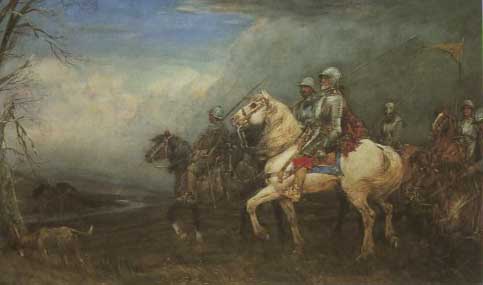
The painting "Auld Wat of Harden" by Tom Scott
image from Wikipedia


And later, a number of their posterity—including my friend’s ancestors—came to America seeking freedom. As he tells it, about half the warriors in the Revolutionary War were of Scottish heritage, many from this border area of the Reivers. So they naturally understood and wanted freedom--and maybe those who came from them do too.

I hadn’t heard this little bit of history before, so I came home and looked them up on Wikipedia.  Sometimes referred to as Border Reivers, they were a somewhat unruly bunch. Some monarchs encouraged and supported them; others tightened rules on them.

Either way, the term reivers means raiders; they raided and stole cattle and other property wherever they felt entitled or thought they could get away with it. But there had to be some order, so they set up their own laws, called March law or Border law. These were tribal people, divided by family, or clan—the terms family and clan were used interchangeably until around the 19th Century when convention gave to term clan to Highlanders and family to Lowlanders. Every clan, or family, was represented by a chief, or warden. They felt family loyalty much more strongly than they felt loyalty to king or country.

19th-Century print of "Reivers at Gilnockie Tower"
image from Wikipedia

My friend had mentioned that many family names of our Revolutionary War fighters show up again and again, such as Armstrong—as in astronaut Neil Armstrong. So I looked up some of the names. Here’s a partial list.

Armstrong
Elliot
Nixon
Crozier
Scott
Bates
Little
Thomson
Irvine
Carruthers
Bell
Graham
Moffat
Hume
Forster
Selby
Gray
Dunn
Kerr
Young
Douglas
Maxwell
Hodgson
Routledge
Hunter
Wilkinson
Stapleton

I’ve known people by most of these surnames. My own heritage is well over 50% Scandinavian, but the next biggest portion is probably Scottish. I didn’t find my direct line there, however. Still, if I did, I’d feel like it partially explains the seemingly inborn drive for freedom I have.

Back in 2003, George W. Bush gave a speech about believing all people long to be free and rule themselves. And it rang true to me. Seeing circumstances play out, however, it looks as though many people in the world value other things—power, status, security, ethnic loyalty—more than they value freedom. I don’t know if it’s because they aren’t accustomed to it, or aware of what it feels like or how it must be tied to personal responsibility. How could a person prefer to have someone else rule them, to make decisions about their life, and how they’ll spend it—and how they’ll spend the fruits of their labors? Aren’t there “huddled masses yearning to breathe free”?

I know far more about what I am good at, what I want to do with my life, and how I want to spend my money than anyone else—let alone a faraway bureaucrat who hasn’t even met me. That seems so self-evident to me that I’m puzzled when it isn’t obvious to others.

But maybe there are two types of people:

·         Those who want freedom to ________________.
·         Those who want freedom from ______________.
The first want freedom to do, to live, to spend, to decide. Those are the real freedom lovers. And maybe it is inborn; I’m exploring that as at least an influence. There may be some credence to it. Malcolm Gladwell has a chapter (chapter 6) in his book Outliers on people from honor societies—and how they behave even centuries after being taken out of that milieu. There’s good and bad about them. And J. D. Vance talks about the Scottish heritage people who settled in middle America, often in Rust Belt states, mentioning some of the same good and bad. But along with whatever else, there’s a stubborn independent streak. The Trump campaign understood and tapped into that worldview.

And then there are those who want “freedom” from want, from worry, from risk, from hunger, from need. And those are the ones who look to some ever-present nanny-type entity, such as a monarch, a dictator, an expert, to govern and decide in such a way that they don’t have to think about it or worry about how to solve their own problems.

This second type are the ones falling prey to the socialists—who are offering free stuff. Relief from worry about healthcare costs, or education costs, or getting a job, or consequences from bad choices.
Where do these people, of this non-freedom-loving type, come from? Is the lack of longing for freedom inborn in them? Or do they develop that out of fear and occasional failure? I don’t know. When they show up in Texas, we don’t look at their family name so much as where they came from—and we can probably see them coming from California, New York, Washington, DC, or some other enclave of socialistic tyranny.

My guess is that there is some nature and nurture involved in the love of freedom and independence. Even among those who have it, it can be lost—by losing hope, and giving in to fear, self-pity, and indulgence. But I also think it can be gained by people who experience the misery of being controlled and find that they do indeed “yearn to breathe free.”

I would rather we awaken people to their longing for freedom without all of us having to go through the deprivation of it that socialism makes inevitable to every people who give in to it.