Monday, July 9, 2018

First Amendment Theme for the Session


The Supreme Court’s term ended at the end of June. That means it’s a good time of year to take a look at their recent rulings. There was something of a theme this first term with Justice Gorsuch on the bench. There were a number of rulings related to the First Amendment. And mostly it turns out the majority, by a thin—and stretched—line, supports what our Founders thought of as God-given, self-evident rights.

image from here

Remember, the Bill of Rights wasn’t included in the original Constitution, not because those were afterthoughts, but because they were so well accepted as obvious that they didn’t require being spelled out. But some of them, including George Mason, Governor of Virginia, who had been a major contributor to much of the Constitution, decided they’d better include that Bill of Rights—in case there came a time when the people didn’t have the same understanding as the Founders.

That was prescient. Now it’s hard to come up with Supreme Court justices, let alone a majority of people on the street, who are aware of natural rights, and recognize they are bestowed by God, not by government. Now we have people positing we should “repeal” the Second Amendment, as if that would take away our God-given right to defend ourselves. You can’t “repeal” a God-given right; but you can have a tyrannical government that not only fails to protect that right, but also infringes on it—or even stomps on it.

So, back to the list of First Amendment rulings:

·         National Institute of Family and Life Advocates (NIFLA) v. Becerra
·         Masterpiece Cakeshop v. Colorado Civil Rights Commission
·         Janus v. American Federation
·         Rowan County v. Lund


National Institute of Family and Life Advocates (NIFLA) v. Becerra

“A government that tells you what you can’t say in dangerous, but a government that tells you what you must say—under threat of severe punishment—is alarming.” Those are the words of Michael Ferris, President of Alliance Defending Freedom (ADF), following oral arguments in this case. This case is out of California, where people think differently from freedom-loving Americans. There are some freedom-loving Americans in California, as there probably are in all tyrannical regimes, but they’re outnumbered there.

image from here


NIFLA, a crisis pregnancy center, offering free services and followup care in service of their pro-life beliefs, were ordered by the state to advertise, on their walls, abortion services. Other similar service centers had joined NIFLA in the suit. Becerra is California’s Attorney General, who was enforcing the state’s reproductive FACT Act (reproductive Freedom, Accountability, Comprehensive Care, and Transparency).

Let’s put this in some other terms. Say there’s a fast food chain, Chick-fil-A, which sells chicken sandwiches, rather than hamburgers. Suppose government insisted that they must advertise nearby hamburger fast food restaurants on their walls: McDonald’s, Burger King, Whataburger. Their mission is to provide non-beef food. Wouldn’t it go against their mission to advertise other restaurants that do other things?

Maybe we can get the analogy even closer to home. Suppose there’s a vegan restaurant, whose mission is to sell non-meat foods. But the meat lobby convinces government that they need to force vegan restaurants to advertise, on the walls of their establishment, nearby meat-providing restaurants. Should government be allowed to make and enforce such a law?

That’s the kind of question we’re looking at in the NIFLA case. It’s a bit more complex, because of arguments about professional speech (which, it turns out, is still protected speech), and that these nonprofits are being coerced to advertise the government’s services that go against their beliefs and mission.

The ruling, reversing the Ninth Circuit Court of Appeals, was a 5-4 decision. Justice Thomas wrote the majority opinion, joined by Justices Roberts, Kennedy, Alito, and Gorsuch. Justice Kennedy also wrote a concurring opinion, joined by Justices Roberts, Alito, and Gorsuch. Justice Breyer wrote a dissent, joined by Justices Kagan, Sotomayor, and Ginsburg.

It’s a bare win. Which shows how very important it is to get yet another judge who will follow the Constitution, rather than try to argue for a political goal and pretend they’re arguing for the Constitution. [The announcement came as I was writing.]

After the ruling, ADF’s Michael Farris said this: 

No one should be forced by the government to express a message that violates their convictions, especially on deeply divisive subjects such as abortion. In this case, the government used its power to force pro-life pregnancy centers to provide free advertising for abortion. The Supreme Court said that the government can’t do that, and that it must respect pro-life beliefs. Tolerance and respect for good-faith differences of opinion are essential in a diverse society lie ours. They enable us to peacefully coexist with one another. If we want to have freedom for ourselves, we have to extend it to others.

Masterpiece Cakeshop v. Colorado Civil Rights Commission

I wrote about this case when the ruling came down in early June. In short, the case pits public accommodations laws against First Amendment freedom of religion rights.

Jack Phillips of Masterpiece Cakeshop
image from here


The Court drew up short in finalizing that decision, saying that courts could not show prejudice against religious beliefs, which the Colorado commission had done. So the actual question—Can the government force a cake artist to design a wedding cake that celebrates a same-sex marriage? Or, more broadly, Can the government force a person who provides a creative service to use those talents/abilities in direct opposition to the person’s religion?—that question will have to be settled another time. There are pending cases.

One of those cases awaiting the answer to the questions was Barronelle Stutzman’s case, Arlene’s Flowers v. Washington State. It was on the docket for ruling, but in light of the Masterpiece Cakeshop ruling, on June 25th the judgment was vacated, and the case was remanded to the Supreme Court of Washington for further consideration. 

That means the state court will have to consider whether it’s decision was biased against religious beliefs. They may claim that it was not, even though we know that it was—the persecution against her is pretty obvious, since she never denied service to anyone, and her client wasn’t even miffed with her, let alone injured. If the state supreme court rules the same again, it goes to a Circuit Court of Appeals again, with the same possible results. But in the Masterpiece Cakeshop case, the Colorado Commission actually spoke its prejudice aloud.

But, if it comes before the Supreme Court again—with another conservative judge replacing Justice Kennedy—then the outcome is highly likely to go in her favor. And the real question is much more likely to get answered: no, the government cannot coerce a person into servitude against that person’s religion. As the Founders though, that should go without saying.

Anyway, additional cases awaiting that answer are still in lower court jurisdictions:

·         Joanna Duka and Breanna Koski, owners of art studio Brush & Nib, asking Arizona’s Supreme Court to protect them from the threat of jail time or burdensome fine for claiming the right not to be forced to create art that conflicts with their beliefs. 

·         Blaine Adamson, a promotional printer, with a business called Hands On Originals, asking Kentucky’s Supreme Court to prevent him from being forced to print messages that conflict with his faith.
·         Atlanta Fire Chief Kevin Cochrane, whose case has not been heard by a jury and ruled on, but who is suing for wrongful firing, after being terminated for religious writings he wrote in his spare time and shared never shared during office hours or to professional colleagues. The terrible thing he wrote? That marriage is between one man and one woman—which is the very thing Barak Obama and Hillary Clinton were both claiming to believe in 2008 and beyond.     
Masterpiece Cakeshop and others have this “et al.” in their titles, meaning there are other parties involved. I’m not sure of all the individual other parties. There was a family-owned bakery in  Oregon, Melissa's Sweet cakes, who were fined $135,000 and lost their family business due to the persecution over the religious freedom issue. There’s a farm that used to host weddings at their farm/home, until they refused to be forced to host same-sex “weddings” in what is their actual home, where their children reside. There are  photographer cases as well.

So the question will probably be answered eventually. And, if the choice for SCOTUS is a good one, it is likely to go in favor of religious freedom.


Janus v. American Federation

In this case, the state of Illinois has had a law requiring workers in public sector jobs to pay union dues, regardless of membership in a union, even when they disagree with the union’s efforts, both political and in collective bargaining.  

The syllabus, the brief summary before the written opinions in the ruling, offers this explanation (I’ve skipped over the citations).

The State’s extractions of agency fees from nonconsenting public sector employees violates the First Amendment. Abood [previous similar case] erred in concluding otherwise, and stare decisis cannot support it. Abbod is therefore overruled…. Abood’s holding is inconsistent with standard First Amendment principles…. Forcing free and independent individuals to endorse ideas they find objectionable raises serious First Amendment concerns…. That includes compelling a person to subsidize the speech of other private speakers…. In Knox and Harris v. Quinn…, the Court applied an “exacting” scrutiny standard in judging the constitutionality of agency fees rather than the more traditional strict scrutiny. Even under the more permissive standard, Illinois’ scheme cannot survive.
This was an incremental ruling. Past cases allowed employees to object to their dues being spent for political purposes. The Janus case extends that to other purposes. The union was speaking for the employee, saying things in the bargaining process on his behalf that he did not want to have said. But he was compelled to pay for the union to say those things against his will.
In summary, this is what the case rules:

The First Amendment is violated when money is taken from nonconsenting employees for a public-sector union; employees must choose to support the union before anything is taken from them. Accordingly, neither an agency fee nor any other form of payment to a public-sector union may be deducted from an employee, nor may any other attempt be made to collect such a payment, unless the employee affirmatively consents to pay.
It was another 5-4 decision, along the usual lines, this time with Kennedy going in favor of First Amendment speech rights.

In other words, four of the justices believe it is acceptable to compel speech—or agreement by forced payment of dues—of employees in order to avoid the free ride issue.

We need to talk sometime about the use of the word “liberal” in relation to those who are not in favor of “conserving” the Constitution. The Constitution is about freedom, and protecting that freedom. The opposition to that, therefore, is anti-freedom, which is anti-liberty—or illiberal. Coerced behavior is what the four dissenting judges favor.


Rowan County v. Lund  

The case of Rowan County v. Lund was denied a writ of certiorari—in other words, the Supreme Court didn’t rule on it after all.

In this case, the legislators in Rowan County, North Carolina take turns offering prayers at the beginning of their meetings. There is no paid or invited clergy. No one dictates the content of the prayer. This has been done historically since such meetings in this county began. But some citizens decided to sue the legislators for establishing a religion. The citizens won their suit up through the Fourth Circuit Court of Appeals, and the Fourth Circuit said Rowan County must bring in paid sectarian chaplains to offer the prayers.

Justice Thomas dissented from the denial, and was joined by Justice Gorsuch. As Justice Thomas put it, 

This Court’s Establishment Clause jurisprudence is in disarray. Sometimes our precedents focus on whether a “reasonable observer” would think that a government practice endorses religion; other times our precedents focus on whether a government practice is supported by this country’s history and tradition…. Happily, our precedents on legislative prayer tend to fall in the latter camp…. Yet the decision below did not adhere to this historical approach. In ruling that Rowan County must change the prayers it uses to open its board meetings, the Court of Appeals for the Fourth Circuit emphasized that the county’s prayers are led by the legislators themselves, not by paid chaplains or guest ministers. This analysis failed to appreciate the long history of legislator-led prayer in this country, and it squarely contradicted a recent decision of the Sixth Circuit. I would have granted Rowan County’s petition for certiorari.
Of the direction given by the Fourth Circuit, to bring in paid clergy, Justice Thomas adds this footnote:

In addition to having little basis in history, the Fourth Circuit’s decision has little basis in logic. It is hard to see how prayers led by sectarian chaplains whose salaries are paid by taxpayers—a practice this Court has upheld…, could be less of a government establishment than prayers voluntarily given by legislators.
He offers this final point about conflicting rulings:

The Sixth Circuit, also sitting en banc, recently surveyed this history and upheld a municipal prayer policy virtually identical to Rowan County’s…. The Sixth Circuit acknowledged that its decision was “in conflict with the Fourth Circuit’s” but found the latter “unpersuasive,”… not least because the Fourth Circuit “apparently did not consider the numerous examples of [legislator-led] prayers” in our Nation’s history…. Thus, the Sixth and Fourth Circuits are now split on the legality of legislator-led prayer. State and local lawmakers can lead prayers in Tennessee, Kentucky, Ohio, and Michigan, but not in South Carolina, North Carolina, Virginia, Maryland, or West Virginia. This Court should have stepped in to resolve this conflict.
Indeed, conflicting circuit court decisions are a usual reason for the Supreme Court to take on a case.
This one shouldn’t be so difficult. There seems to be a misunderstanding of what establishing a religion means. It is a far cry from allowing, or even encouraging, religion or religious behavior. To establish a religion is to make a particular set of beliefs the state-endorsed and state-enforced religion. Not stepping in to prevent free Americans to behave in religious behaviors of their choice ought to always be the default choice of a government protecting the free exercise of religion—the first of the First Amendment rights.

What is the best remedy for Rowan County, North Carolina, now? To continue doing what it is doing, assert its Tenth Amendment rights to decide issues not enumerated as powers given to the federal government, and assert its First Amendment rights to both exercise their religion freely, but to prohibit the federal government from making any law (including by judiciary, which has no lawmaking powers in the first place) prohibiting the free exercise of religion.

If all of us, in every state, had that reaction to Supreme Court overreach, we could breathe easier over whomever the President appoints to that bench.

Thursday, July 5, 2018

Pascal, Camus, and God-given Rights


There’s a quote I frequently come across by Camus:

I would rather live my life as if there is a God and die to find out there isn't, than live as if there isn't and to die to find out that there is.—Albert Camus 
I’m not sure he actually lived that way, but it’s an interesting theory. It’s related to a philosophical argument presented by French mathematician Blaise Pascal, referred to as Pascal’s Wager. He proposes that humans bet their lives on whether or not God exists. As Pascal argues, it’s rational to live as though God exists, and to seek to believe in God. If a person is wrong, his loss is finite (current pleasures, luxuries, etc.), but he stands to receive infinite gains (eternity in heaven) while avoiding infinite eternal losses (eternity in hell).
Blaise Pascal
image from Wikipedia


What if we try a similar wager on the related idea of God-given rights? Our nation was founded on an idea—rather than a geography or a tribal connection, like most other nations. The idea is that we are endowed by our Creator with certain unalienable rights, among which are “Life, Liberty, and the Pursuit of Happiness.” And, did we mention, God created us as equal—not the same, but with the same rights before the law. No one is born royal, or noble, while others are born as something less than human.

If God made us equal, with those unalienable rights, then we have a right to govern ourselves, rather than an inborn obligation to be subject to rulers.

Those who don’t believe in God are left with man-given rights. Who chooses what rights you’ll be granted? Who decides? Whoever is in the position to rule—which is likely to be whoever is the biggest, strongest, and meanest. That’s true whether there’s anarchy or a statist tyranny.

You don’t get freedom, prosperity, and civilization if you don’t have a government that is just powerful enough to protect your God-given rights but limited enough that it does not infringe on your rights. Such a government is simply the best way.

Even if people didn’t believe in God, it would still be better for them if they set up a system as if they were protecting God-given rights.

It’s better to live in a society where everyone practically takes it for granted that they can think and express their opinions, meet with others who share their beliefs, choose their own ways of making a living, or seeing to the care and upbringing of their own children. It’s better not to fear government spying and imprisoning you for your beliefs and opinions and pursuits.

Now that we’ve had America for a couple of centuries as an example—even non-believers want those freedoms, and even expect them and demand them.

But there’s no rationale for that expectation, because nonbelievers by definition have no more rights than what their ruler sees fit to allow them.

Using Spherical Model language, those who don’t believe in God-given rights are living below the equator, in the southern hemisphere of tyranny, just trying to get the best balance between chaos and control—all under the banner of some flavor of tyranny.

To them, it’s just a matter of forcing others to go along with the direction they want. They don’t look up and find freedom, prosperity, and civilization. They might think that the most we can hope for is some level of non-misery, if we’re lucky, and maybe we can find the right formula of statist tyranny to give us the impression of freedom, prosperity, and civilization—or at least some imaginary idea of fairness.

When they’re arguing with us, it’s against what they view as a stripe of tyranny they do not prefer. They do not even know they are arguing against freedom, prosperity, and civilization—and asserting a preference for tyranny, poverty, and savagery.

A Facebook friend, T. F. Stern, wrote a piece about a conversation he had with a socialist friend:

While exchanging ideas my friend boasted about how much better some socialist countries in Europe treated their citizens (subjects) and how Americans should consider moving in that direction.
My response, omitting his name out of respect for his privacy, “…there is no such thing as a socialist country that respects individual God-given inalienable rights.  While there are some that infringe on them less than others, the constitutional republic established by our founders with Divine intervention is by far much more desirable.  How about we, as individuals, how about we work at restoring that ‘more perfect union’ rather than seeking a replacement.”
He’s right. None of those countries has a guaranteed right to free speech, for example. Things go along fine—unless and until you disagree with what the government allows you to believe.

So, the question is, how do you enlighten someone in that much darkness? I’m not sure. They’re arguing against all the forms of tyranny except the one they prefer, and they assume we’re doing the same—except that they think our flavor of tyranny is certainly worse than theirs, so they dig in their heels.

Founding documents
image from here


If only we could get them to recognize the value of the experiment. As Pascal and Camus suggest: try living as if God does indeed exist. Let’s try living as if God-given rights do indeed exist. And therefore, let’s live as if our law—our Constitution—intentionally limits what government can do, so we can all live free. There’s been a world of history of their way, the no-God-given-rights way, the ruler-tyranny way.

It’s just possible that the Constitution works every time it’s tried. The possible benefits are immense and unlimited. On the other hand, the misery of tyranny—with the poverty and savagery that go hand-in-hand with it—is just as immensely negative. And the key difference is whether it should be a tyrant bestowing rights, or God. I choose God.

Monday, July 2, 2018

Seven Conservative Victories


There’s one more thing I wanted to cover from the Republican Party of Texas convention a couple of weeks ago. On Saturday morning Senator Ted Cruz spoke. He detailed a list of seven victories in the first 18 months of the Trump presidency.

Ted Cruz's speech at the Republican Party of Texas Convention,
view from the crowd


If you’ve been reading here long, you know I was not a Trump supporter. I was a Cruz supporter in the primaries. And after that, I believed I had no reason to trust that Trump was telling the truth when he promised to do conservative things. Ted Cruz, I believed, also had many reasons not to trust Trump. He didn’t initially offer his endorsement, but when Trump personally promised to put forth a constitutionalist to replace Justice Scalia, Cruz went ahead and endorsed him and campaigned for him. There may have been additional promises and proofs in their private conversation. I wasn’t privy to those assurances. And I was not willing to give him my vote.

But the way to convert me is with actions in line with the promises. In other words, earn my trust. I’m not quite at the point of promising my vote in the next election; there are still character issues that bother me. But, unlike those with “Trump derangement syndrome,” I do not believe he is the things on this list, in a New York Post piece about the man who refused to serve a customer wearing a MAGA cap:

Darin Hodge, the former manager of the Teahouse in Stanley Park, told Global News he stood by his decision to ask the man to take off the cap, saying the hat represented “racism, bigotry, Islamophobia, misogyny, white supremacy, (and) homophobia.”
I don’t believe there is actual, business-world/real-world evidence that Trump is racist, bigoted, Islamophobic, misogynistic, white supremacist, or homophobic.

He is other things related to character: willing to lie and malign opponents; unfaithful to multiple wives; careless about hyperbole and sometimes unaware of facts; sometimes temperamental and reactionary in responding to criticism. And he is a relative newborn as a conservative. But he is not what he is defined as. There is no need to stand up to either Trump, or his voters, or Republicans, or conservatives based on that list. That is a straw man. It is what is being used to stir people up to a frenzy, but there is no there there.

So, as I was saying, while there may still be reasons not to dive in with my full support just yet, I do very much support President Trump on these victories, as listed by Ted Cruz. I’m willing to cheer and get the word out.

So, here we go, mostly in Senator Cruz’s words:

Number 1: An historic tax cut. In December of last year Republicans managed to come together and pass a tax cut, cutting taxes on Texas farmers, on Texas ranchers, on small businesses, on manufacturers, on families. Cutting taxes across the board. Doubling the standard deductible. Which means, starting next year 90% of Americans will fill out their taxes on a postcard. Personally, I think that should be 100%. We should pass a simple flat tax and abolish the IRS. But 90% is a very good start….
Editorial comment here. I generally cringe at the use of “an” before “historic,” which is not a silent “h.” However, you should know that Cruz did not pronounce the “h” in “historic.” It’s a Houston thing. We put the “h” in Houston, but not in Humble, a suburb directly north of Houston. So it wasn’t actually pretentious when Cruz said “an historic.”

Second major victory: Regulatory reform—across the board, every agency, pulling back, repealing job-killing regulations. If you’re a Texas farmer or rancher, the Waters of the United States Rule, Obama’s oppressive rule, gone.
And I spent 45 minutes with President Trump on Air Force One urging him to pull out of the Paris climate deal, saying this is a disaster for Texas. This kills thousands of jobs across the country. He did it.
The President pulled out of the climate deal on a Thursday. The next morning, Friday morning, he calls me on my cell phone. He said, “Well, Ted, I did it. What do you think?”
And I said, “Mr. President, let me tell you what Heidi told me this morning. When she picked up the Wall Street Journal, she read the headline—it quoted from your speech, where you said, ‘I was elected by the people of Pittsburg, and not the people of Paris.’ Heidi said, ‘That is absolutely right.’” I said, “Mr. President, everyone who hates you is ticked off right now, and everyone who loves you is thrilled.”
He added that those two victories have had a significant result already, which you probably haven’t seen on the 6:00 news:

We’ve seen over 3 million jobs created just in a year and a half. We have the lowest unemployment in almost 20 years. We have the lowest African-American unemployment since we began collecting unemployment data. We have the lowest Hispanic unemployment since we began collecting unemployment data. We have, today, more job openings, more help wanted signs, than we have people actively seeking employment.

Third big victory: We repealed the Obamacare individual mandate. That was a big, big deal. When I led the fight in the Senate to do that, I’ll tell you, back in October nobody thought we had a prayer…. We made the case both privately and publicly. We brought Republicans together, unified the party, and in December of last year all 52 Republicans stood together, and we repealed the Obamacare individual mandate.
That means that 6 ½ million Americans getting fined every year by the IRS because they can’t afford healthcare, including 1 million Texans getting fined every year—all of those fines go away.
Not all of Obamacare is history yet, unfortunately. And the individual mandate penalty isn’t actually lifted until 2019, which means that this year, because we were without insurance for half a year, we’re going to have to use money from our 401K to pay the penalty when the next Tax Day arrives. Still, glad to know that’s ending.

Number four major victory: School choice. A method I introduced on the tax bill, that takes College 529 plan, savings plans, tax advantage plans—incredibly popular across the country—and expands it to include K-12 education, to include public school, private school, parochial school, religious school—up to $10,000 per child per year….
[It’s] the most significant federal school choice legislation that has ever passed Congress. It passed after midnight, nearly 2:00 in the morning, with a 50-50 Senate, and Vice-President Pence breaking the tie. An incredible victory for Texas school children and up to 50 million school children all across the country.
Here’s one that seems even more significant this week, following the retirement of Justice Kennedy:

Number five major victory: Judges. Neil Gorsuch on the US Supreme Court. Principled constitutionalists up and down the federal bench. You know, last year, in 2017, we set a record for confirming the most court of appeals judges in the first term of a president. Right now, today, one eighth of the federal appellate judges in this country were appointed by Donald J. Trump. One out of eight, in just a year and a half to date.
For every one of us that values the Constitution and the Bill of Rights, who values life, who values religious liberty, who values free speech, who values the Second Amendment, it is the judges who are at the crossroads of preserving those rights or taking them away.
I wrote about this next one recently:

Number six. Just a few weeks ago I was blessed to be in Israel for the opening of our embassy in Jerusalem. The embassy opened on the 70th anniversary of the creation of the modern state of Israel. Seventy years ago David Ben Gurion declared the modern state of Israel in existence. Eleven minutes later Harry S. Truman recognized Israel. I’m embarrassed that it took us eleven minutes….
I’m thankful I was in Jerusalem for the opening. There were Americans there. There were Israelis there. Particularly there were men and women who were holocaust survivors, who were reduced to tears, who simply said, “I never thought I would live long enough to see this.” This is another major victory.
Wait, there’s more!

Number seven: Ending the disastrous Obama Iranian Nuclear deal. The Obama Iran nuclear deal was one of the most catastrophic national security steps ever taken by the United States. We sent literally billions of dollars to the world’s leading state sponsor of terrorism. We flew in cash—$1.7 Billion dollars in unmarked bills, on pallets in airplanes in the dark of night…. You’d ask… “Who exactly is this person I’m dealing with?” Well, sadly, that person was the president of the United States, and he was sending billions of dollars to an ayatollah who pledged “Death to America!” and “Death to Israel!”
And, once again, in the Trump administration there was a vigorous argument, a vigorous debate about what to do. You had major voices of the administration saying stay in the deal. I tell you, I spent hours and hours and hours making the case to the president, making the case to the administration, that this agreement is a disaster. We need to cut off their money. We need to cut them off diplomatically. We need to use every force we have economically, diplomatically, and even militarily to ensure that the ayatollahs never ever, ever get nuclear weapons.
Before he went ahead with his senatorial campaign, which was good stuff, and also his ribbing of late night host Jimmy Kimmel, who was playing him that evening in a one-on-one basketball game (Cruz won, by the way), Cruz offered this summary:

One or two of those would have been big major victories in a year and a half. Three or four of those would have been astonishing. All seven is an incredible testament to delivering results.
I have to admit that’s true.

After the speech and some business, I went to look for my son,
Political Sphere, and his wife. And I came upon the photo ops booth for
Senator Cruz. I snapped this photo of him, with people I don't know,
because I was so close. Then I tried to get in line for a photo,
but they cut it off two people ahead of me. So I called Political Sphere;
they had just gotten their photo taken. I had missed them
by going the wrong way to get to the end of the line. Bad timing.
Anyway, they have a photo with Sen. Cruz, but I haven't seen it yet.


Back in 2016, when Cruz stepped out of the race, my thought was, “There’s the end of our constitutional republic.” I was in mourning. I was horrified at the possibility Hillary Clinton—the worst major candidate in the history of presidential races—could take over our country. But at that point I really had no evidence that a President Trump would be measurably better.

I’m so very glad to be wrong. There is hope. Trust is building. It turns out that tyrannical infrastructure built on executive orders and legislation-by-judiciary crumbles pretty quickly, once someone determinedly moves back toward constitutional law.

Like Samson in the Old Testament, Trump is an unlikely champion for good.

But, as surprising as it seems, in between cringe-worthy tweets and threats of authoritarianism (that truly frighten the real authoritarians), we conservatives are having some major victories. And, if President Trump keeps listening to wise conservative counsel, we’ll keep getting more of these victories.

Friday, June 29, 2018

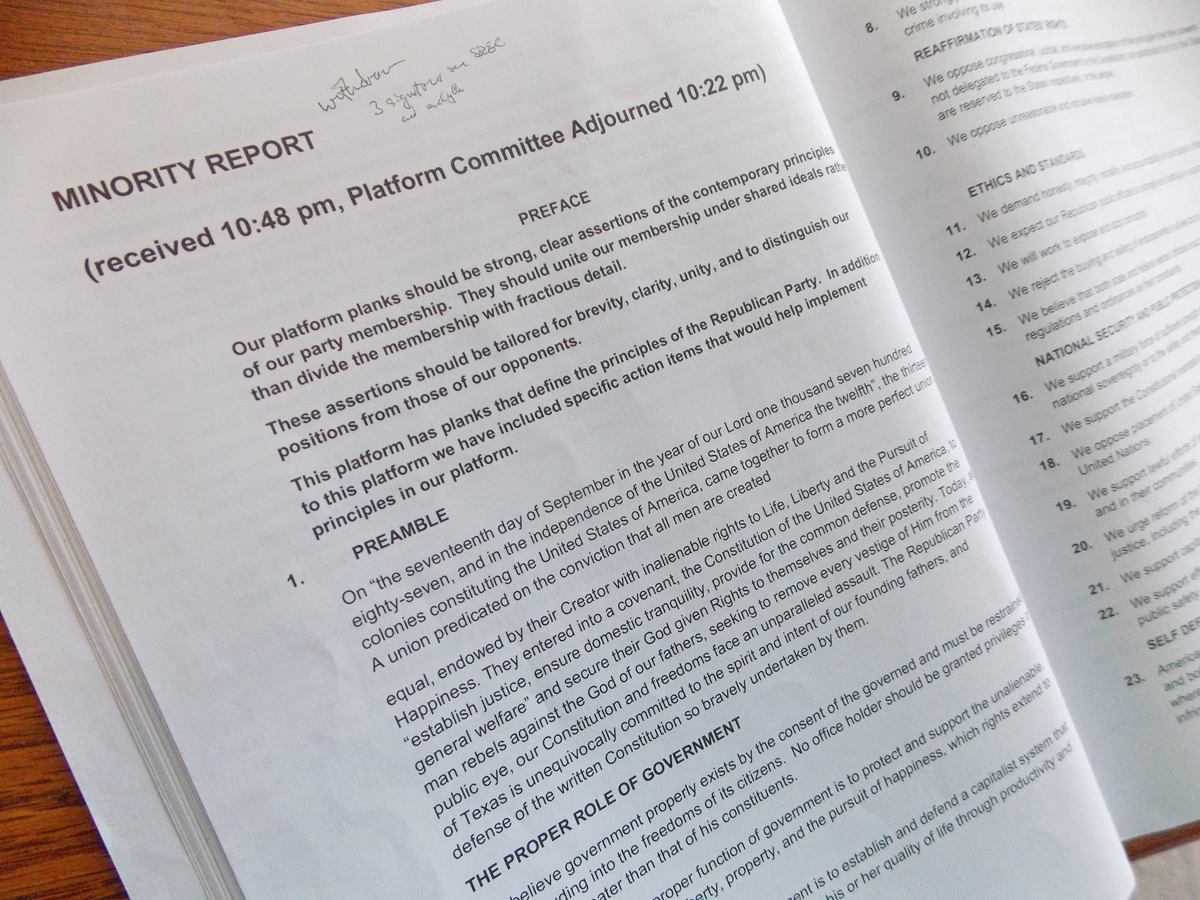
Platform and Minority Report, Part IV


This is part IV, the final part, of our discussion of the Platform and Minority Report, from the Texas State Republican Convention. Here are the subjects in order:

·         Part I: Cannabis 
·         Part III: School Choice
·         Part IV: The Minority Report


The Minority Report

We mentioned the idea of minority reports the other day. That was about the Nominations Committee, which took up a lot of time on Friday afternoon of the convention.


A minority report isn’t all that rare on the Platform Committee. But usually it is related to a particular issue. Maybe a single plank. If I’m remembering right, a few years ago there was a push for outright legalizing marijuana, which failed, but there was a minority report on that issue. That meant that a sizable number disagreed with the committee’s decision, so they brought their alternative up to the main body at the convention. (It usually fails there, as it did that time.)

The minority report this year was different in many ways. Its intent wasn’t on a single issue; it was aimed at the size of the platform. The premise is that it should be shorter.

I’ve thought that before as well. I really like the Preamble and Principles on the first page of the platform. Isn’t that enough?

If you’re looking at the basics that we almost entirely agree on, then that’s a good platform. But I’ve learned, over the past few years, working on the district platform committee, and now behind the scenes at the state level, that the platform really is used to advance legislation, particularly in the state legislature. Sometimes that has to be specific.

And there are people who come to the convention—are active politically in the first place—because of a particular issue that is very important to them. Without that issue, they’ll let someone else do the activist work.

So there are a lot of platform planks: 332 this year (including the preamble and principles, which are also numbered as planks). That’s more than in past years. However, some previous planks were split into multiple planks. The platform isn’t really a lot more issues—or words—than previous years. There are between 3,000 and 6,000 bills proposed in a legislative session. Only a portion of our planks, maybe 250, will be used to direct them. So maybe we don’t have too many.

But there’s an understandable fear that we can’t all agree on the whole platform.

However, that fear has been addressed. In 2016 we started having a plank-by-plank vote to accept or reject, which we did again this time. That shows stronger agreement or lesser agreement, and it’s clear we don’t all agree on every issue. (I voted against maybe half a dozen. None got voted down by a majority.)

We try to hold our representatives accountable to the platform. But they aren’t required to agree on every plank any more than we are. They are required to vote in accordance with the Preamble and Principles. Failure to do so multiple times can bring sanctions against them (which is what happened with the one resolution at the end of the platform this year).

Also, the new arrangement into categories related to the state senate, and the section-by-section debate, allowed us to cover more issues more fully in the whole body of delegates at the convention. To do that, we had the latest version available online all week, and the printed version a day earlier than previous years.

One of the common conversations after plank-by-plank voting was, “I guess I need to read it and make my choices ahead of time.” Yes. That’s the idea. The debate before the body is not the time to learn what’s in it—which has been practice in the past, and very frustrating. Now it’s on the delegate to do some preparation. That’s better all around.

Would shorter be better? Maybe. But every plank was supported by someone. And in the past those urging for a shorter platform did it as a maneuver to avoid accountability on specific issues. The less specific, the more wiggle room a politician has. However, I don’t believe that was the intent of this year’s Minority Report signers. Anyway, if it’s going to be shorter, that should happen through the natural debate process.

View from my computer, shortly before
the Permanent Platform Committee convenes

The Minority Report signers had their own version. Much of it was taken from our platform—even a last-minute title. And then there are some things that were their own. It was still 81 planks long, which is ironically not all that short. The preface and preamble were different. The principles, as a section, are missing. Then come 15 categories of issues (more like former platforms, rather than our current legislature-oriented categories), followed by action items in 22 categories. Individual planks under the category headings do not have titles.

 It was written mainly by one committee member. He shared it with other committee members that he thought might side with him, but he never shared it with the whole committee.

Let me repeat that: he never shared it with the whole committee. Debate was complete. Our platform was accepted by the Permanent Committee. And then he asked to reopen debate to present his minority report. The parliamentarian probably should have squelched it at that moment; instead, he asked the indulgence of the chair to allow it, in order to avoid more parliamentary difficulty during floor debate.

The committee hadn’t seen it, hadn’t discussed it. There was no public testimony concerning it. The author, pretty much single-handedly, decided what to keep and what to toss, and what to do differently.

It turned out that three of the signers were also elected as SREC committeemen/women (State Republican Executive Committee, a man and woman from each senatorial district in the state), which disqualified them. This came out during floor debate. I didn’t understand the technicality that led to that decision. I guess they hadn’t understood it either, or they wouldn’t have signed. Anyway, without their signatures, there weren’t enough signers for a minority report, and it was withdrawn.

The author did get his allotted few minutes to present his reasons for wanting a shorter platform, which plants the idea for another year. That may be all he wanted.

The point of all this discussion about the platform—and about the convention entirely—is to show just how grassroots the party is here in Texas. I think that’s the way it should be.

We’ll have just one more post about the convention, which is a big more nationally relevant. I’d like to share some of Senator Ted Cruz’s speech. So that will come next.

Thursday, June 28, 2018

Platform and Minority Report, Part III

This is part III of our discussion of the Platform and Minority Report, from the Texas State Republican Convention. There will be four parts total. Here are the subjects in order:

·         Part I: Cannabis 
·         Part III: School Choice
·         Part IV: The Minority Report


School Choice

You would think that school choice would be an area of wide agreement for Republicans, but the “belief in public schools,” as though that were a religion, in American society as a whole, runs deep. There’s been a steady campaign for about a century equating public schooling to caring for our children. So that attitude is part of the debate.

But there’s another segment that’s kind of surprising: a homeschooling schism. There’s the side that looks for more choice, more alternatives, and more free market—not just for homeschoolers, but for everyone. And there’s the side that is afraid that any movement away from total hands off by government is a slippery slope from total freedom for homeschoolers directly to government reaching out and controlling homeschoolers.
We hung out at the convention with some really smart
 young freedom loving Texans (our grandkids).

I’m on the freedom to choose side of this issue. I believe the other side is needlessly fearful. And their refusal to consider any possibilities means they are refusing to allow choice for public schoolers stuck in failing schools as well.

A friend of mine said, “You homeschoolers just need to find a few of you, on both sides, that are reasonable, and sit down in a room and talk this through.” In theory I think that is what’s needed. In reality, the leaders of the no choice people side with HSLDA, a national legal defense organization. The pro-choice people side with Tim Lambert of THSC (Texas Home School Coalition). National leaders aren’t really present in Texas to have such a debate.

There are some truly innovative ideas. Education Savings Accounts are one that came before the legislature last year, but failed to pass. The year before, the Heritage Foundation came to Houston to present the idea and talk with a large roomful of us. Right away I caught the value of injecting some free-market into education. [I first wrote about this here, but also here and here.] During conversations I asked one of their people whether they’d made contact with Tim Lambert yet. She wasn’t as yet aware of him, so I sent her to him. I’m sure they’d have found him without me, but he did get on board.

Free market always leads to better quality at lower prices. When our schools are failing with lower quality for higher prices, it seems to me that is a natural solution.

Debate was intense, but this is the plank that finally made it in:

School Options: Texas families should be empowered to choose from public, private, charter, or homeschool options for their children’s education, using tax credits or exemptions without government restraints or intrusion.

It will do for our purposes, as long as we can get the legislature to actually put through some real choices.

There was another plank of interest to homeschoolers:

Extracurricular Opportunities: We encourage nonpublic school parents to create extracurricular opportunities for their children where they are not readily available and in a manner that they can be free from discriminatory testing, intrusive government oversight, or harmful school policies regarding mixed-gender students in bathrooms and locker rooms. We encourage the Legislature to find ways to allow nonpublic school students’ participation.[i] Any homeschool student that does not participate will be unaffected.  


The footnote there refers to an idea that was accidentally deleted. The last sentence should read:

We encourage the Legislature to find ways to allow nonpublic school students’ UIL participation.


I believe the accidental deletion happened when the Google system, which was livestreaming both the video but also the document, shut down late Wednesday evening, causing the staffer who was manning the computer at that time to have to take handwritten notes on the last few decisions. I wasn’t on duty, but it was a regrettable error, but difficult to have avoided.

It was noticed by a committee member before the Permanent Committee met. He offered to propose it as an amendment. But it had been heated enough that, when given the opportunity to leave it out, the committee did.

Tim Lambert wrote about this part of the platform debate here. And he includes one brief testimony that I thought was convincing, which I’ll include below.

There were several legislative sessions while we were still homeschooling, and several since, that we’ve worked for this. UIL was instituted when the vast majority of Texas students were homeschooled, and most of those that weren’t were private schooled. This was, I think, 1913, before public schools became a monopoly. In the 1960s UIL decided to exclude anyone not in public schools—against the original charter. Recently one or two large private schools were allowed to participate. The world didn’t fall down, it should be noted.

During testimony some people from west Texas pointed out that, sometimes communities aren’t big enough to have any extracurricular activities outside of schools. They can’t start their own leagues, or join in private community extracurricular opportunities. There are none.

Public schools claim to fear that non-public schoolers could spend more time on the skills needed for extracurricular activities, since they’re not constrained by school hours. There’s no evidence for that. Basketball teams, for example, have won competitions with just a couple of practices and a game a week, rather than the daily practice public school teams get.

It’s claimed they draw from a wider area, which is true, but they do not draw from a larger number of students.

Public schools have even been offered to receive a full day attendance allotment for a student there only for an hour, and yet they refuse. This isn’t true in all states. Thirty-four other states have worked out ways to allow UIL participation (and none of those states have increased regulations over homeschooling as a result, refuting the argument of the fearful homeschoolers). But Texas public schools like having a stranglehold on any power and money they can. And they prefer forcing non-public schoolers to not only pay their own way, but to subsidize public schools while they’re doing it.

Here's the truth: If it’s beyond the proper role of government, there will be unintended consequences, and they will likely be exactly the opposite of the state goal.

So, if you want to educate children, and you want lower costs and higher quality, government schools are not the way to go. Inject the free market. Offer choice. Encourage homeschooling, and online innovations, and any other creative way of learning. It doesn’t have to be like this.

But right now, even conservatives can’t seem to stick a toe in the water of choice to make it happen.


Tuesday, June 26, 2018

Platform and Minority Report, Part II


This is part II of our discussion of the Platform and Minority Report, from the Texas State Republican Convention. There will be four parts total (I’m doing them on consecutive days. So, part I was yesterday. Here are the subjects in order:

·         Part I: Cannabis 
·         Part II: Marriage, Homosexuality, and Other LGBTQ Issues
·         Part III: School Choice
·         Part IV: The Minority Report


Marriage, Homosexuality, and other LGBTQ Issues

Another issue that occupied a lot of testimony time at the convention was homosexuality. Those issues ended up mainly in State Affairs. The main concern, since the Obergefell ruling, is about religious freedom, balancing that with tolerance. The 2016 plank said this:

Homosexuality: Homosexuality is a chosen behavior that is contrary to the fundamental unchanging truths that has been ordained by God in the Bible, recognized by our nation’s founders, and shared by the majority of Texans. Homosexuality must not be presented as an acceptable alternative lifestyle, in public policy, nor should family be redefined to include homosexual couples.  We oppose the granting of special legal entitlements or creation of special status for homosexual behavior, regardless of state of origin.  We oppose any criminal or civil penalties against those who oppose homosexuality out of faith, conviction, or belief in traditional values.  
There was a rewrite, hotly debated, that lasted until a compromise, late Thursday evening, which became acceptable to all, containing many of these same ideas (I’ve highlighted in both where the words are identical):

Homosexual Behavior: We affirm God’s biblical design for marriage and sexual behavior between one biological man and one biological woman, which has proven to be the foundation for all great nations in Western civilization. We oppose homosexual marriage, regardless of state of origin. We urge the Texas Legislature to pass religious liberty protections for individuals, businesses, and government officials who believe marriage is between one man and one woman. We oppose the granting of special legal entitlements or creation of special status for homosexual behavior, regardless of state of origin. We oppose any criminal or civil penalties against those who oppose homosexuality out of faith, conviction, or belief in traditional values.

The changes take a bit of concentration to discern. While God and Bible are cited in both, the new plank is more about affirming marriage, rather than condemning the sinfulness of homosexuality, which may make it less controversial while still concentrating on what we want to accomplish: protect marriage, and protect religion freedom. I like the connection of marriage to civilization; that's part of the Spherical Model formula for civilization.

That's us, in front of the Civilization wall
in the Henry B. Gonzalez Convention Center


The testimony against the plank was mainly of the variety that homosexuality ought to be seen as just another acceptable lifestyle choice. That is definitely not the view of the Republican Party of Texas. It is gaining ground with younger people, mainly because of the indoctrination from media and academia—along with their inherent (but maybe not obvious) anti-religious bias.

During testimony during the Permanent Platform Committee, on Thursday afternoon/evening of the convention, there was a particular pro-homosexuality witness who was called back for a question by an older woman on the committee. The witness was flippant. The committee member took offense at that. And there was a rather unpleasant interchange that got terminated as not really questioning the witness, so it should be saved for committee discussion later.

Over time, it’s been my observation that Log Cabin Republicans, who agree with Republicans on 90% of issues, and just diverge on these particular social issues, have generally been good members of the party, agreeing to disagree without being disagreeable. I hope that attitude can continue.

There were several other planks that are related more specifically to defense of marriage—which is the appropriate way to look at the position of Republicans generally. It is not about hate; it is about preserving marriage in order to preserve civilization. Here are some of the additional planks:

Definition of Marriage: We support the definition of marriage as a God-ordained, legal, and moral commitment only between one natural man and one natural woman.
State Authority over Marriage: We support withholding jurisdiction from the federal courts in cases involving family law, especially any changes in the definition of marriage.
Spousal Benefits: We shall not recognize or grant to any unmarried person the legal rights or status of a spouse, including granting benefits by political subdivisions.
No-Fault Divorce: We urge the Legislature to rescind no-fault divorce laws and support covenant marriage.
Overturn Unconstitutional Ruling: We believe this decision, overturning the Texas law prohibiting same-sex marriage in Texas, has no basis in the Constitution and should be reversed, returning jurisdiction over the definition of marriage to the states. The Governor and other elected officials of the State of Texas should assert our Tenth Amendment right and reject the Supreme Court ruling.

There are additional LGBTQ issues, mainly related to transgender indoctrination:

Gender Identity Facilities in Businesses: We support enacting legislation in the State of Texas ensuring that no government entity in the state be allowed to take it upon itself to define for any private business or private entity how it must segregate its restrooms, changing facilities, or showers; nor may any government agency be allowed to require businesses to profess, espouse, or adopt specific views on sex, sexuality, gender, or gender identity, other than to guarantee that views and positions on these matters are not used as a basis to deny access to public accommodations, as defined by the Civil Rights Act of 1964, nor to deny employment, or discriminate in employment decisions, solely on the basis of a person’s views on these matters.
Child Rights: We call on the Texas Legislature to pass legislation to protect privacy in public schools and government buildings as allowed by Title IX of the Education Amendments of 1972, by ensuring that multi-use facilities, including showers, changing rooms, and bathrooms, are designated for and used only by persons based on the person’s biological sex.
No Sexuality Indoctrination: We call on the State Legislature to pass legislation so that no public school or other educational institution may force, require, or pressure any child or student to profess, espouse, or adopt, or otherwise be indoctrinated without explicit parental consent, specific views on sex, sexuality, gender, or gender identity.
Gender Identity Pronouns: We oppose any attempt to criminalize and/or penalize anyone for the wrong use of pronouns.

The opposition will call these hateful. But we resist nonetheless. Because, while we’re quite willing to be tolerant, we’re not willing to give up our freedom, privacy, safety, or beliefs just to avoid being called hateful, homophobic, and bigoted. And we all know they’ll call us that regardless of reality, so it’s just better, always, to stand for truth.