Showing posts with label education savings account. Show all posts

Thursday, August 1, 2024

Real Education Choice

Back in the 1990s we had neighbors who homeschooled; this was in another state that is not the bastion of homeschooling freedom that Texas is. In that state they were required to meet regularly with a certified teacher. They had a homeschooling family friend with a teaching certificate, so they got together regularly to meet the state requirement. There’s no such requirement here in Texas.

But those parents were able to put a child (or two or three) into a public school classroom—just for a particular class. Math, or music. I don’t remember what classes they used the schools for. I do remember that they were able to do it with one child in two different high schools—in two adjacent but separate districts.

Here we are, nearly 30 years later, in the “free state of Texas,” and that option is completely off the table, never considered, and impossible. We have had problems getting even UIL participation for anyone but public school students—even though UIL was created at a time (1913 or so) when the vast majority of Texas students were homeschooled and/or private schooled. Public schools came in later and took over control, which is what government institutions do.


school choice advocates at the state capitol, image from Texas Scorecard

Currently the state conversation (by that I mean the resulting language in the Republican Party of Texas Platform) about school choice is limited to public, charter, private, or homeschool. For any given child, it’s one of these four choices, and one choice only. Two of these, public and charter schools, are already paid for with taxpayer dollars. Charter schools, however, are not available to all; they are usually provided by lottery. Private school means a family pays full tuition out of pocket, so that’s not available to anyone who can’t afford the tuition, unless they find a private scholarship. Homeschool means, usually, that at least one parent gives up income opportunities to handle the education of their children. Out-of-pocket expenses for homeschoolers are considerably lower. A refund of that family’s tax going to education would cover it. But, again, this isn’t available to families that can’t sacrifice a parent’s income. So the choice conversation has been about expanding “free” education to families whose needs are not met by public or charter schools to include using a voucher for a seat in a private school or to homeschool (although there’s not really a good description of how a voucher could be used for homeschooling).

Why are the options that limited? Why not various combinations of the four options? And why not add in a whole lot of other options: private tutors, online courses, private lessons, therapies (equine therapy comes to mind), apprenticeships, skills certification programs?

The first time I heard about Education Savings Accounts (ESAs), back in 2016, they included all of these options. Very much like a health savings account—which can only be used for healthcare purposes—an ESA would be a fund attached to the child (meeting thereby the state requirement to provide free education to all) that could be used for any combination of those educational purposes. Families have an incentive for getting a good deal, because the money could be rolled over to the next year for that child, or eventually toward college tuition.

It would require an involved parent. But a parent who is aware that their child is being underserved and is looking for a way out and not finding it—that is a parent who’s already involved and is motivated. It’s not going to be enough to endanger the monolithic government institution.

So, our battle for school choice continues in Texas. And it’s divided into multiple battles; there's a battle between school choice and no school choice, as well as essentially between school vouchers and ESAs.

If it were up to the parents, we would have school choice already. And ESAs are the preferred way for the money to follow the child. I believe it would also be the best way of introducing the free market into the otherwise socialist public school monopoly—giving us better quality at a lower cost, as the free market does. But it would also have the bonus of being the best way to prevent government intrusion and indoctrination, which is one reason conservative opponents give against money following the child.


from UH and TSC study on school choice

A recent study done by University of Houston’s Public Administration program and Texas Southern University’s masters program in Public Affairs, shows that every demographic and party affiliation favors school choice—and particularly ESAs—with the lowest support among white Democrats, who come in at 58%. The highest proponents were black Republicans, at 86%. [Full report here.] Texas Scorecard has a story here. The Houston Chronicle has a story here

With numbers like these, you’d think it would be a slam dunk to get legislation passed. It has been a governor’s priority, with multiple special sessions in 2023 to get it done, after it didn’t pass in the regular session. But it was never even given a vote. As a result, the obstructionist House Speaker, nominally Republican Dade Phelan, was challenged and nearly beaten in the Primary (it is believed Democrat crossover voters kept his candidacy alive, just barely). It looks likely he will not get the speakership again, we can hope.

While Texas was an early leader in homeschooling freedom, it lags badly behind many other states in school choice. Right now—well ahead of the 2025 legislative session—is the time for bills to get written. We didn’t get what we wanted in any bill last time. This time, with maybe more chance for debate and passage, we ought to insist on a bill that offers real education choice, not a nominal choice between public school or a seat in a better nearby public school, or failing that a seat in a private school. We want a bill that offers any and all combinations of educational options, all chosen by the parents for their individual child.


This is from a 2022 Hoover Institution article on school choice.
The original is interactive. They identify the various types of choices
available in each state, and a glossary defining the terms.

Then comes the question of how to fund it. There are people who spend all their time on this question, deem it impossible, and therefore oppose school choice, even for low-income students trapped in failing schools. That’s not acceptable. Let’s just note that, adding health savings accounts to a person’s insurance benefits didn’t have the outcome of bankrupting insurance companies. And, as an even more apt example, we have multiple states who have tried ESAs, and we can learn from them.

No more excuses. This year needs to be the year the power of education gets put back into the hands of parents.

Thursday, March 23, 2023

Real Parental Choice in Education

Whose responsibility is it to educate the children of the rising generation? The parents. That is the most local level—the family, the basic unit of civilization.

It is not the responsibility of the state, and certainly not of the nation. It is not even the responsibility of the school district. Letting those other levels grasp responsibility has caused the problems our schools are in.

Let’s start with making sure we're talking about the same thing. What is the finished product when we educate a child?

Aristotle says we educate a person to produce a great soul. That’s still pretty vague. Joe Harless, in his book The Eden Conspiracy, is a bit more specific. He says we are producing an accomplished citizen. We should teach the knowledge, skills, and information relevant to becoming accomplished members of society. The attributes of such a person include:

             Being obedient to the law.

             Making informed voting decisions.

             Contributing to stability.

             Resolving interpersonal conflict.

             Contributing to community improvement.

These are what an accomplished member of society does regardless of how that person makes a living.

Do we need to teach ways to make a living? Yes, but that is incidental. What we’re doing is providing the knowledge, skills, and information a good citizen will need in order to work out their own way to make a living that sustains themselves by making a contribution of worth to someone willing to pay for it.

So producing that civilized person, that contributing member of society, is the mission. That is the mission of the parents.
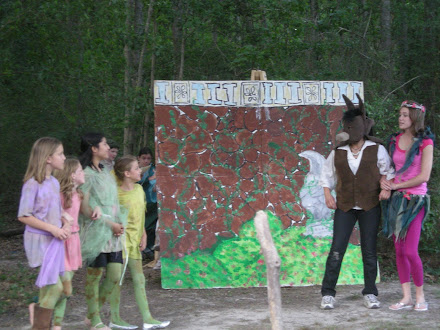

Back in 2008 a bunch of us homeschoolers put on Shakespeare's
A Midsummer Night's Dream, in a park. We did a Shakespear play annually.

But what options—parent choices—are available to do that? In theory, the choices today are wide open. Information is everywhere. Much of it is free. You could guide your child through a series of elementary through high school-level learning with resources available for free or very low cost. Excellent resources. Better than you got when you were a student.

You could even guide your child through college level learning through online mostly free resources. You can give them great opportunities for learning, if you and the child are willing to put in the effort. You can do everything but give them the college diploma.

In reality, however, there is a monopoly. It is the public school system, controlled by the teachers’ unions, which are about making money for the teachers’ unions, not about improving teaching for teachers, and certainly not for improving the education of students.

There are a couple of basic things in the way of breaking free from the monopoly: availability of the parent, and money. And they are related. If a family can make enough money while allowing at least one of the parents to be with the student, overseeing the education, then total homeschooling is an option. But it is very difficult to homeschool while committing an eight-hour day to an employer—even working from home. You can’t sit down to do math with your child while you’re writing a report for your boss.

And private school is expensive, while public school is “free.” It isn’t really “free,” though. That has always been a trap.

The providers of whatever is “free” always want something. In the case of schools, it is money and control—control of how your children are raised and what kind of citizen—or subject—they are formed into.

If we and those providers of “free” education were of the same mind, this wouldn’t be so bad. But we are not of the same mind. And that has become abundantly more clear in the past few years. Parents are waking up. They’re expressing their disapproval with what has been going on. And they’re being insistent that they are not abdicating their God-given role as decision-maker in the care and upbringing of their children.

We’re seeing that play out in school board meetings, in school board races, and in legislation.

And one big way we’re seeing it is in the debate over school choice.


Stephanie Lambert, speaking at Cypress Texas Tea Party, March 16, 2023
screenshot from here

Last week at our Tea Party meeting we heard from Stephanie Lambert, daughter of Tim Lambert, founder and head of Texas Home School Coalition, talking about their two prongs: educational choice and parental rights. And we got some interesting statistics concerning school choice, particularly Education Savings Accounts, or “the money follows the child”:

·        There are currently 72 such programs in 32 states, some of them with long years of data we can look at.

·        Whether in high-regulation or low-regulation states, these programs have not led to increased regulation.

o      In fact, regulation for homeschooling has plummeted.

o      In no state has regulation of homeschooling increased in the past two decades.

o      Also, here in Texas we saw a three-fold increase in homeschooling since the pandemic shutdown.

·        71% of Texas homeschoolers support ESAs. Only 20% oppose.

So let’s take a look at that opposition. Last year, at the state GOP convention, testimony from these opponents of school choice lined up and took the public comment slots before the Platform Committee. They seemed a much stronger force than they actually are, and very nearly got the Committee to strike the language “money follows the child” from the platform plank. A good speech from a Committee member rescued it at the last moment.

I have noticed a fair amount of pressure from these opponents on social media sites where conservatives communicate. They’re forceful and insistent. I’ve collected some of the arguments to try to understand them and possibly express the choice side better.

One early clue was their accusation, “Look where the money is coming from.” They claim the choice side is funded by people who really want to gain control over homeschooling families. Since I’m one of these pro-choice people, and I know that my voice is independent and absolutely not connected to any money, that does not ring true.

And since I have been a member of THSC while homeschooling, and continue to follow them, particularly during the legislative session, I’m also aware that THSC is very grassroots, not a big money outfit, nor is it controlled by some nefarious higher elites. I have reason to trust them. So that first opponent argument doesn’t fly with me.

They linked to this article in the past week: “School Choice: Are We Willing to Sell Our Children for a Pittance?” by Tiffany Boyd, a Tennessee homeschooler opposed to school choice. This is from the article:

She [Charlotte Thompson Iserbyt, author of The Deliberate Dumbing Down of America] predicted that all types of “school choice” will eventually be tax-supported, with the tax money following each child.

“Each child, regardless of type of ‘choice’ education, will have an individual education plan (IEP). This will be determined by decisions made by the school/business partnerships (for which kind of workforce training they have determined your child’s intelligence/talents are best suited, for their own profit-seeking purposes). This is the failed communist/socialist job quota system from which millions of foreigners escaped. These immigrants, the backbone of our nation, made enormous sacrifices to come to the United States of America in order to enjoy the upward mobility guaranteed by our free (unplanned) economic system.”

I haven’t read the book quoted from, written originally in 1999. But we can look at this quote with some hindsight now—and the data we mentioned above. Do you know where you will have an individual education plan (IEP)? In a public school. Any student with a special need will have one. It isn’t determined by the parents, although the parents may be pressured to comply with the school’s plan.

You know where you don’t have one imposed by any outside entity? A homeschool. You, as a parent, plan or go by the seat of your pants as you see fit, and as seems to fit your particular child. Our family had a moderate amount of structure (I needed it, and so did the kids), but we bristled at anything beyond our plans being messed with by anyone. We got to decide everything—except these particular requirements: we had to teach reading, math, spelling, and good citizenship, all of which we were glad to do. I can attest that we did all of those things—and quite a lot more—better than the public schools we pulled them from when they were failing us.

My experiences are anecdotal. But the data about the various places that have implemented ESAs is telling: regulation of homeschooling plummets, and no increased regulation of homeschooling is even tried.

ESAs, by the way, are similar to a medical savings account. You get to choose the doctor and the service that you want. But the money can only be used for medical purposes. There are some purposes that might be excluded from your account—certain alternative therapies, for example—but you’re free to pay out-of-pocket for those extras. There isn’t a huge amount of oversight; you simply can’t use your HSA for a vacation (for your mental health, you claim) or something most people would see as quite a stretch to call it a medical service.

ESAs would be limited to educational purposes. But that can be a lot broader than tuition or textbooks. This is the point at which people worry, however. Someone makes the decision of whether a service applies or not. But, again, that hasn’t been a big issue with HSAs; they provide greater freedom, not less. And they are similar to a GI bill, which is used for any type of education, at any institution, including religious, that the veteran chooses to use it for.

Did I mention, ESAs can roll over the money to the following year, so there's incentive for the parents to find cost-effective resources. In some programs the leftover upon graduation can be used for college tuition.

Here’s another part of the article—about those evil, selfish parents who resent having to pay taxes for a school system that doesn’t serve them:

I often hear parents say, “It’s my money and I want it back.” My retort to that statement is, “What is more important to you, your freedom or your money? What is more important to you, your child or the money?”

That is usually met with the following: “I want freedom to choose.”

The truth is, parents already have the freedom to choose. They can choose public school, private school or home school. With school choice, you are simply choosing more of the same. It’s still the same system parents insist is failing, funded by government. The teachers are still all trained the same and the state controls the curriculum. So, what would they be choosing that is any different?

This is where the catch is: the choice shouldn’t be between two forms of public school, regular or private; and two forms of private school, high-tuition classrooms or homeschools. What a bogus limitation!

There was a video these opponents on social media linked to of how “school choice” ruined education in New Orleans following Hurricane Katrina. The hurricane had devasted entire areas, so many schools were literally wiped out. So they created a Recovery School District, which they claimed was completely free choice for all parents. Since there was no local school to choose, it allowed the parents to send their child to any other school they wanted. But the parents had plenty to complain about: the schools they wanted didn’t always have openings; the schools they wanted didn’t always provide transportation; they schools they wanted ended up being whatever they could scramble to get, of whatever quality, at whatever location. Some parents ended up sending each of their kids to a different school, with all the transportation and confusion that would entail. What these parents wanted to choose was a free school down the street that actually educated their child—like the parents had had growing up. But that wasn’t an option.

Let’s just point out that this wasn’t exactly putting the free market to work in education. It was a shoddy approach to dealing with a catastrophe.


image found here

What does real choice look like? How about if that ESA can go to multiple different approaches and places for each child. Maybe the local school has a good drama program—fine, put the student there for those hours. Maybe the local community college is a better fit for math. Maybe a nearby private school has a really good history teacher. Maybe private music lessons are worth using part of the allotment for. There could be online courses for special interests of the student. Part of the allotment could go to that.

Homeschoolers have been finding these sorts of combinations for decades. Before we moved to Texas—so, well before we homeschooled—we had homeschooling neighbors who sent their kids to an hour for one subject in one school district and an hour for another subject in the next school district over, and then did some other subjects at home. While there were more regulations for homeschoolers there than here in Texas, the schools themselves were actually more flexible. Here the public schools are all or nothing.

The image I've painted, with all those options, looks like it would be parent intensive, just providing transportation. Until you’ve got a student who drives and has a spare car, that’s true. But what if the local public school allowed private vendors to use their rooms, perhaps for a fee to cover maintenance costs, etc., and parents could have their child at the same general location all day, but with multiple educational opportunities there?

In an actual free market, where there’s a need, an entrepreneur steps in to fill it. Transportation between educational locations could become a thing. Maybe there could be an educational "mall," a general location with lots of options, and you can easily walk from one to another, like you walk from class to class on a college campus.

There seems to be a fear that, if you allow any money to go beyond the current status quo public school, you’re harming public schools—and by extension putting the education of all children in jeopardy. Gasp! But is maintaining public schools—at the expense of the students they are failing—the ultimate goal?

Public schooling is a relatively new experiment. In 1910, when UIL was established for extracurricular competitions, private schools and homeschools were the norm, the vast majority, while public schools covered only a relatively small percentage of children. By the 1940s, compulsory education laws were put in place, not for improving education, but for controlling thought, using a uniform factory model. 

Since public schools have already failed, I would indeed like to see public schools as we know them done away with. But that does not mean I want there to be no teachers or opportunities for educating our next generation. I want ALL the choices to be available to ALL the children. The only ones stuck in the monopoly then would be those whose parents won’t take responsibility for even the decision-making.

Some of the opportunities, of course, are going to depend on location. In Houston, we can find plenty of resources. In a small town with one public school and no private school, choice might need to include options that homeschoolers do and have done for millennia: teach them yourself; combine with others to pay for a private school, or hire private tutors, which today includes access to the internet, so it’s pretty unlimited, depending on availability of the parents and some common technology.

Educating our children will require a new way of thinking. Public schooling as it is done now has failed to meet the mission and has subjected kids to indoctrination of things parents absolutely oppose. ESAs might not be the final solution. I think a fully free-market education, with scholarships provided by local businesses (and maybe willing taxpayers) could do an even better job. But ESAs would be a step toward injecting actual free market choice into schooling.

And we know what we get from a real free market: better quality at lower cost.


Legislation This Session


Texas Senate Committee on Education, March 22, 2023
screenshot from here

This legislative session in Texas, we have a number of bills trying to protect children, regain parental rights, and allow school choice. There are two I’m looking at: SB 8, Bettencourt, Creighton, et al (including Middleton); and SB 176, Middleton (with Bettencourt as a co-author). Both bills are long and attempt to accomplish a lot. I trust both Senators Bettencourt and Middleton; both have a record of being pro-school choice. Bettencourt is my state senator. Both bills do two main things: codify a Parents Bill of Rights and implement an ESA program. They are not, however, considered companion bills.

Friends tell me Senator Middleton and crew have spent 18 months carefully crafting the wording of their bill, SB 176. My friends were disappointed to have Bettencourt’s bill come in and seem to replace all their work. But I didn’t get from my friends any specific problems with SB 8. I’ve only just scanned both of them. SB 8 is 50+ pages, and SB 176 is around 36 pages. There may be very similar sections. The low bill number on SB 8 means it is a high priority and is more likely to see movement.

If you click on the bill numbers above, I’ve linked to the Bill History page for each. From there you can see what movement the bill has had so far, and you can click on Text to get the wording of the bill and any amendments that may come.

Public testimony was heard in committee for both bills on Wednesday, March 22, and both were left pending in committee. That means there will likely be another day of public hearings before they take a vote.

It will take more time for me to determine what to recommend or amend. But I do hope we get a bill passed here in Texas that will do what parents have been calling out for.

Thursday, March 18, 2021

The Family Educational Relief Program

How do you lower costs while improving quality? Use the free market.

That is a straightforward, easy to understand concept. We’ve seen it work with phones, computers, and other technologies. It’s true for various services and products as well.

Combine that concept with this one we often say, about government’s role and its interference:

Whenever government attempts something beyond the proper role of government (protection of life, liberty, and property), it causes unintended consequences—usually exactly opposite to the stated goals of the interference.

Today we’ll apply the free market and getting government out of the way to education. If we can allow the free market to do its thing and innovate, we’ll get better quality education at lower cost—guaranteed better than government has been doing.


from the cover of Waiting for 'Superman'

We need to let go of the fear that says, “We can’t trust the free market with something so important to us.” No. We can’t trust government interference with something so important to us.

Isn’t education, though, a basic responsibility of government? Definitely not at the federal level; it isn’t an enumerated power in the Constitution and was never granted to the federal government. The fact that there is a federal Department of Education is a usurpation—a seizure of power not granted.

At the state level, at least in Texas, for better or worse it is written in the state constitution that the state will provide a free education to all students up through high school. So that means it has to be done.

How much did school closures due to
COVID-19 set Texas student's back?
Infographic from FamiliesEmpowered.org
But, if you lived through 2020, you know, better than you did before, that government doesn’t actually follow through on its promise to educate your children. And, when it doesn’t, it makes you pay for it anyway. For parents who have used an alternative method of educating their children—private school, homeschool, charter school—they’ve been aware of that inequity for a long time.

The Texas legislature is in session. That means (besides that our freedoms are in jeopardy), if we’re going to do something about this—following a year when public schools failed pretty spectacularly—this is the time.

My State Senator, Paul Bettencourt, filed bill SB 1968  last Friday, and later that day Representative Mayes Middleton filed the identical House companion bill, HB 4537. It is called the Family Educational Relief Program.

The bill looks to me to be similar to an Education Savings Account (ESA), although there are some differences. Arizona is noted for doing ESAs several years ago, limited to special education students. The parent would have the option of taking 90% of the amount allotted for the child, to be used in any combination of ways the parent sees fit. It’s similar to a medical savings account in that way. Only approved expenses could come out of the account. But the person manages their own funds.

The Texas bill isn’t aimed at special education students, but at special needs; namely low income. While it could be expanded in future years, as a pilot it is aimed at those whose incomes qualify them for federal free or reduced-cost lunches. Lack of choice harms low-income families’ children most.


There’s a Need

Texas educates approximately 5.5 million K-12 students, roughly 10% of the children in the US’s 50 states. 

A few years ago, we heard from Colleen Dippell, founder of FamiliesEmpowered.org, which specialized in helping families get access to charter schools. She told us in 2017 that there are 900,000 Texas students (almost 1 in 5) attending over 1,000 failing Texas schools—meaning the school didn’t meet the minimal yearly progress (a pretty low bar) for three years in a row.

One approach to solving that deficiency has been charter schools, which are growing ever more prevalent. But her estimate at that time was that there were 130,000 students on wait lists for charter schools. Charter schools simply can’t meet the demand. You might also note that there are multiple bills we have to oppose this session aimed at making it harder for a charter school to start or expand.

Meanwhile there are 100,000 empty seats in private schools.

There’s a demand. And there’s a supply. But they aren’t getting together.

Maybe it’s because the pent-up demand is coming primarily from low-income families who can’t afford to pay private school tuition, and the private schools can’t exactly provide education for free.

This bill uses money already being spent on those students and allows them to use it for private school tuition. It could also be used for online courses—of the parents’ choice, rather than what has been inflicted on them by their school districts during closed schools this past year. It can be used for curriculum, or therapies, or other materials as well.


What Are the Details?

If we use round numbers, we can say $10,000 is allotted per student per school year. Of that $10,000, 90% means $9,000 put into a trust for the student, with the parents as trustees, instead of the school district’s board of trustees.

The remaining 10% stays with the school district to pay maintenance and operations costs and loan interest. In other words, for every student in the program, the school district gets $1000 for a student they don’t have to educate. That means, the more students use the program, the higher per pupil spending the school district has. There’s incentive to let the students go into the program.

There are limitations. One is that the payments can’t go to a household member or relative (within three degrees of consanguinity). In short, homeschoolers can’t use it to pay one parent to teach, for example. But a homeschooling family can use it for curriculum, online programs, therapies, etc.

We homeschooled for ten years. Our total costs added up to much less than that for the entire decade, including field trips and camps. That was for all three children. In other words, all our expenses, barring of course loss of income from a second parent working, would be easily covered under this program.

If the account has money remaining at the end of the school year, it rolls over in the child’s account for the following year. That means there’s incentive for the parent to shop around and get a good deal—free market at work.

The Arizona version was arranged to roll over yearly and could eventually be used for college tuition. This Texas version also rolls over to each next year but is only available as long as the child is eligible for public school. That means it could be used for dual-credit courses at a community college, as we did with our kids by age 15 or 16. Or it could be used for university courses—in person or online. But, unlike the AZ plan, once the child graduates and is no longer eligible, any funds remaining return to the program fund for other students to use. That means there’s even incentive for the state to hope families use the fund, because the state educates those students with a possible rebate at the end.

What about parochial schools? Is that a problem? No, it isn’t. The Supreme Court recently ruled in a Montana case that money used by parents for the education type of their choice is not an establishment of religion when it goes to a parochial school; in fact, it would be an infringement on freedom of religion to bar that educational choice only for religious reasons. So that is now settled law.


What about Accountability?

Service providers and vendors must get pre-approval according to rules set by the Comptroller to participate (i.e., to get paid by a parent out of the child’s fund).

Private schools have to show notarized documentation related to following the rules, including the number that can be accommodated, safety measures at the location, etc., and would need to be accredited. Actually most private schools in Texas are unaccredited, so this is a limitation. Or it is incentive to get accredited. (Note: there is no correlation between accreditation and education quality.)

Private tutors, therapists, or teaching services must provide notarized documentation of their qualifications, licensing, current employment (when applicable), and criminal history.

Online course or program providers must show notarized documentation of their qualification to serve the students, accreditation, etc. Services and vendor types not listed must also provide evidence of qualification to serve.

In other words, it’s on the service providers to apply, and the Comptroller’s office to verify their validity, so the parent doesn’t have to.

Theoretically, if a parent wanted to use something not on the list, they could let that service provider about the program and suggest they apply. But otherwise the parents simply use those services already verified by the Comptroller. The state’s agent would post a list of approved service providers and vendors for parents to use.

While an education service provider may not charge a child participating in the program an amount greater or less than the provider’s standard amount charged for that service, a parent can choose to pay out-of-pocket for anything either not on the list or any cost beyond the limits of the student’s allotment. For example, in a market where this program is well established, it is likely private schools would work to make costs fit within the allotment; however, more expensive private schools can still be used, but the parent would pay anything over and above the allotment. This is still better than having to pay the full tuition over and above the taxes the parents pay the state without receiving any educational service from the state.


Where Does Funding Come From?

image found here
The Comptroller allots money for the program. The amount allotted is the only limitation on how many students could participate. Funds come from the state's education funding and also from grants, gifts, and donations as well as from additional general funds the Comptroller may put toward the program.

About those grants, gifts, and donations: A company wishing to donate could make a tax-deductible gift to the program. Even better, it could apply for a tax credit—up to half the entity’s estimated tax payment could be allotted to this program. (This comes under Chapter 230, Subsection B, which is longer and more technical than I want to go into here.) This would actually increase funds going to education without raising more tax revenue to do so.

A small percentage of the student’s allotment (no more than 3% of any of four payments or a total of 5% annually) goes to the Comptroller’s office for administering the program.

No Curriculum Interference: Another good feature is that the Comptroller’s office has a hands-off approach to curriculum; it only handles the funding. If the TEA or Commissioner of Education were handling the fund, they would no doubt attempt to control what is taught and how, which kind of defeats a main purpose of school choice.

There’s no federal money used, which means there’s no federal control over what is taught or how, or anything else to do with the program. That’s a definite plus. I think it also means, any education block grant to the state is divided up among students still in public schools, leaving more of any such funding to spread among fewer students—another incentive for public schools to support this program.


Any objections?

The people who have drafted this bill have decades of work and experience behind them, working toward school choice. They have addressed every objection opponents have voiced.

·         It particularly helps low-income students.

·         It does it without causing public schools to lose funding; it even increases their per student amount.

·         Vendors, service providers, and private schools are all held accountable—as are the parents serving as trustees of their child’s accounts.

It doesn’t address the opponents’ unvoiced objections—that they want to maintain control over what is taught, and that’s more important to them than actually providing an education to every student.

It’s voluntary. This is only for parents who are interested and involved in their children’s education. Uncaring parents don’t have to bother with it; they can leave their children right where they are.


It Introduces the Free Market

The most valuable thing about this program is that it introduces the free market into this tiny corner of what has been a failing government monopoly. Free market, once introduced, is likely to grow. That is likely to lead to innovation, which means better education at lower cost, something people have been saying couldn’t be done, even by adding obscene amounts of money. It can’t be done by government. But when government gets out of the way, and allows caring parents and the free market to see to education, the possibilities are unlimited.

If you’re in Texas, let your state senator and representative know you support the Family Educational Relief Program. If you’re outside of Texas, let your representatives know about it and ask them to do something similar in your state.

Thursday, June 28, 2018

Platform and Minority Report, Part III

This is part III of our discussion of the Platform and Minority Report, from the Texas State Republican Convention. There will be four parts total. Here are the subjects in order:

·         Part I: Cannabis 
·         Part III: School Choice
·         Part IV: The Minority Report


School Choice

You would think that school choice would be an area of wide agreement for Republicans, but the “belief in public schools,” as though that were a religion, in American society as a whole, runs deep. There’s been a steady campaign for about a century equating public schooling to caring for our children. So that attitude is part of the debate.

But there’s another segment that’s kind of surprising: a homeschooling schism. There’s the side that looks for more choice, more alternatives, and more free market—not just for homeschoolers, but for everyone. And there’s the side that is afraid that any movement away from total hands off by government is a slippery slope from total freedom for homeschoolers directly to government reaching out and controlling homeschoolers.
We hung out at the convention with some really smart
 young freedom loving Texans (our grandkids).

I’m on the freedom to choose side of this issue. I believe the other side is needlessly fearful. And their refusal to consider any possibilities means they are refusing to allow choice for public schoolers stuck in failing schools as well.

A friend of mine said, “You homeschoolers just need to find a few of you, on both sides, that are reasonable, and sit down in a room and talk this through.” In theory I think that is what’s needed. In reality, the leaders of the no choice people side with HSLDA, a national legal defense organization. The pro-choice people side with Tim Lambert of THSC (Texas Home School Coalition). National leaders aren’t really present in Texas to have such a debate.

There are some truly innovative ideas. Education Savings Accounts are one that came before the legislature last year, but failed to pass. The year before, the Heritage Foundation came to Houston to present the idea and talk with a large roomful of us. Right away I caught the value of injecting some free-market into education. [I first wrote about this here, but also here and here.] During conversations I asked one of their people whether they’d made contact with Tim Lambert yet. She wasn’t as yet aware of him, so I sent her to him. I’m sure they’d have found him without me, but he did get on board.

Free market always leads to better quality at lower prices. When our schools are failing with lower quality for higher prices, it seems to me that is a natural solution.

Debate was intense, but this is the plank that finally made it in:

School Options: Texas families should be empowered to choose from public, private, charter, or homeschool options for their children’s education, using tax credits or exemptions without government restraints or intrusion.

It will do for our purposes, as long as we can get the legislature to actually put through some real choices.

There was another plank of interest to homeschoolers:

Extracurricular Opportunities: We encourage nonpublic school parents to create extracurricular opportunities for their children where they are not readily available and in a manner that they can be free from discriminatory testing, intrusive government oversight, or harmful school policies regarding mixed-gender students in bathrooms and locker rooms. We encourage the Legislature to find ways to allow nonpublic school students’ participation.[i] Any homeschool student that does not participate will be unaffected.  


The footnote there refers to an idea that was accidentally deleted. The last sentence should read:

We encourage the Legislature to find ways to allow nonpublic school students’ UIL participation.


I believe the accidental deletion happened when the Google system, which was livestreaming both the video but also the document, shut down late Wednesday evening, causing the staffer who was manning the computer at that time to have to take handwritten notes on the last few decisions. I wasn’t on duty, but it was a regrettable error, but difficult to have avoided.

It was noticed by a committee member before the Permanent Committee met. He offered to propose it as an amendment. But it had been heated enough that, when given the opportunity to leave it out, the committee did.

Tim Lambert wrote about this part of the platform debate here. And he includes one brief testimony that I thought was convincing, which I’ll include below.

There were several legislative sessions while we were still homeschooling, and several since, that we’ve worked for this. UIL was instituted when the vast majority of Texas students were homeschooled, and most of those that weren’t were private schooled. This was, I think, 1913, before public schools became a monopoly. In the 1960s UIL decided to exclude anyone not in public schools—against the original charter. Recently one or two large private schools were allowed to participate. The world didn’t fall down, it should be noted.

During testimony some people from west Texas pointed out that, sometimes communities aren’t big enough to have any extracurricular activities outside of schools. They can’t start their own leagues, or join in private community extracurricular opportunities. There are none.

Public schools claim to fear that non-public schoolers could spend more time on the skills needed for extracurricular activities, since they’re not constrained by school hours. There’s no evidence for that. Basketball teams, for example, have won competitions with just a couple of practices and a game a week, rather than the daily practice public school teams get.

It’s claimed they draw from a wider area, which is true, but they do not draw from a larger number of students.

Public schools have even been offered to receive a full day attendance allotment for a student there only for an hour, and yet they refuse. This isn’t true in all states. Thirty-four other states have worked out ways to allow UIL participation (and none of those states have increased regulations over homeschooling as a result, refuting the argument of the fearful homeschoolers). But Texas public schools like having a stranglehold on any power and money they can. And they prefer forcing non-public schoolers to not only pay their own way, but to subsidize public schools while they’re doing it.

Here's the truth: If it’s beyond the proper role of government, there will be unintended consequences, and they will likely be exactly the opposite of the state goal.

So, if you want to educate children, and you want lower costs and higher quality, government schools are not the way to go. Inject the free market. Offer choice. Encourage homeschooling, and online innovations, and any other creative way of learning. It doesn’t have to be like this.

But right now, even conservatives can’t seem to stick a toe in the water of choice to make it happen.


Monday, July 10, 2017

Texas Special Session

Here in Texas, the legislature meets mid-January to early June every other year, so we finished up last month. But the Governor can call the legislature back any time for a limited time. Usually this happens shortly after the end of the regular session, when the governor wanted something to happen that didn’t happen during the session. That’s the case now.

Governor Abbott has scheduled the special session to begin July 18th, and he has listed twenty items for the legislature to deal with. That’s a lot of items. Among them are some bigger priorities. (The full list can be found here.) 

There’s a main reason that these things didn’t get handled in the special session: Speaker of the House Joe Strauss is not on the same side as Governor Abbott. He’s the same party. But the way the speaker is chosen now is slanted toward the liberal side, at least when the Republicans are in power.
The speaker comes from the majority party, but the Democrats in the House will support whichever candidate is most aligned with them. So the speaker gets 100% of the Democrat vote. Then the speaker just needs a relatively small percentage of Republicans.

He can totally ignore the strong conservative masses that have elected Republicans to every statewide office, and a robust majority in the House; he can curry favor with the more “moderate,” i.e., less conservative, House members, offer them their choice of committees and chairmanships, and he locks up the vote. And he’ll get some of the conservative votes too, because anyone who opposes him gets relegated to committees where they can do the least good for their constituents.

So, until we figure out a way to have Republicans do the electing of the House Speaker (as in the US House, where a caucus of each party chooses a speaker, and the one chosen by the majority party wins—so the minority party doesn’t do the choosing), we’re stuck with this roadblock to important legislation.

This past Saturday at the local Tea Party meeting, we heard from State Senator Paul Bettencourt and State Representative Mike Schofield, to talk about the upcoming special session.
Senator Paul Bettencourt


Sen. Bettencourt says there are three possibilities for how the session will go:

1)      The legislature will pass the sunset legislation and go home.
2)      The legislature will pass sunset plus a few items, but leave the big ones undone.
3)      The legislature will handle pretty much the whole list.
The sunset bill is to keep some state agencies from shutting down; it’s assumed to be necessary.

Option 1 would start a House meltdown. There are risks to failing to do what they’re supposed to do. If they do the bare minimum and vote to go home, that will lead to a roll call vote. That puts everyone on record as going against the Governor or not. It won’t go well for them at re-election time if they claim to be conservative but flout the governor’s agenda. Option 2 would be minimal, but still might lead to yet another special session.

There are three main issues among those twenty items:

·         Property tax relief.
·         School choice.
·         Privacy protection.

Property Tax Relief

The bills are not always written the same as for the regular session; sometimes we’ll get something that considers what failed in the regular session, but sometimes we’ll get something better.

Senator Bettencourt has been working for property tax reform. During the session he was asking for a cap of 3% plus inflation; during the special session the cap is lowered to 1% plus inflation. And in the special session he’ll only need 16 or 30 senators to pass it, (50% plus 1) instead of 20 (2/3 of the Senate).

There’s a swath of the state from Dallas-Ft. Worth to San Antonio (not including Austin, this time) with ridiculous property tax hikes. The current cap has been a percentage of home value plus inflation plus economic growth. Since the term “economic growth” is unmeasurable and totally meaningless, caps have been meaningless.

Chip and Joanna Gaines, of HGTV's Fixer Upper
image from here
Senator Bettencourt gave an example of why a real cap is needed. You know the HGTV show Fixer-Upper, with Chip and Joanna Gaines, of Waco, Texas? They take the worst house in the best neighborhood, and they turn it into the buyers’ dream home, right? Well, bureaucrats who assess property values have been following the show and purposely reassessing the value of the fixed-up homes. Homes have had as high as 1000% increases in their property taxes.

People are being punished for using their resources to make their homes nicer to live in; they’re being taxed for creativity and hard work. Those obscene property tax increases can put the cost of living in a house beyond the budget of those buyers—who were making a positive contribution to their neighborhood. That’s not the Texas way.

School Choice

Neither Senator Bettencourt and Representative Schofield were optimistic about school choice—even though they both favor the Educational Savings Account idea. Rep. Schofield says, “There’s too much fear of competition.” That’s fear among teachers unions—which have much more interest in wages for their union members that in education for children. 

We don’t know yet how the bills will read exactly, but the likelihood is that the ESA bill will be aimed at special needs students. While I’d prefer more market forces in every aspect of education, it’s tough to argue against meeting the needs of special needs students at lower cost per student. [Among several PragerU videos on school choice, is "Why Special Needs Students Want School Choice."]

The way it is working in Arizona, the family of the student is given a sum that is something like 90% of the cost of educating that student. It can be used only for education purposes (sort of like how a health savings account is used only for healthcare purposes), but the parents get to decide what is best for their child.

This is different from a voucher, which is a ticket, essentially, that can be spent as a whole at one alternative education place, such as a private school. The ESA can be used in part for a chosen form of therapy, in part for a tutor, in part for a block of a school week at a public or private school, or in part for homeschool curriculum—or any combination.

As they start looking for options, the market responds. And the market always eventually responds with better quality and lower prices.

If the family gets their student’s needs met without spending all the money in a given year, that money stays in the account for use in a later year, when maybe a more expensive program might be needed. If the money doesn’t get spent by high school graduation, the student can use it toward higher education. 

The program is optional, so no students would be forced into it. Any family can choose to stay in public school.

So ESAs are a win-win for special ed students and their families, and for school districts, which have trouble meeting the needs of these students anyway. And that 10% that the family doesn’t get stays in the school budget.

But the public school monolith sees it as the camel’s nose under the tent. If that camel is competition, then it is just barely the nose, but wouldn’t it be great if we had that whole camel in the education tent?

They absolutely don’t want competition. They want a public school monopoly, subsidized by people so frustrated that they pay out of pocket to meet their children’s needs elsewhere.

Opponents are misnaming the ESA option, lumping it in with vouchers, a term that causes a knee-jerk reaction in educators who get their information mainly from their unions.

Anyone who really knows about ESAs would likely vote for this bill, but fear of the overbearing unions will probably block it this time, leaving the special ed students with their critical needs unmet.

Privacy

The third big issue, privacy, is what we sometimes refer to as the bathroom bill, and which the media mischaracterizes as transphobic.

As Rep. Schofield said, “We didn’t make an issue of it; Anise Parker did.” Transgendered people have been quietly using whatever restroom made them comfortable, from the invention of public restrooms up until 2015, when Houston’s mayor decided to make it an issue by forcing it on the city—including not just public city buildings, but private business properties. She tried to thwart the will of the people by throwing out their petitions, and she really stepped over the line when she tried to subpoena every speech or communication given by churches, so she could search through them for things she might find objectionable.
image found here


Once the courts slapped her down—several times—the people got their say, and this very urban, majority-liberal city, which had twice elected a lesbian mayor, soundly voted against her proposal.

Then Obama got on the bandwagon and decided, by fiat, to force a private space rule on the whole country. To be clear, he said high schools (and of course other facilities with locker rooms, bathrooms, or dressing rooms) must, because of his insistence only, allow any anatomical male who wants to say he is a female (for any purpose—can’t be questioned for actual intent; and note that a male claiming to be transgendered to female is still likely to be sexually attracted to females) to shower naked in front of and with female high school students. No regard for the discomfort this would cause high school girls or their parents would be considered. End of subject. Anyone who objects would be labeled a bigoted, transphobic troglodyte who should be publicly shamed, fired, and never allowed to work or function in society again.

Compromises, such as private showers or bathrooms for transgendered students, were dismissed as insensitive to the transgendered—meanwhile, overruled as not worth considering are the sensitivities of the 99.7% majority.

Obama’s overreaching executive order has been repealed, but many school districts and businesses around the country have kept the rule change to appear “tolerant.” That is why Texas is taking the step of protecting citizens by returning to separate gender private spaces as a rule of law.

I think the bill will pass, because this is Texas, and we don’t like fools telling us we have no right to privacy in our private places. If Strauss fails to bring it for a vote again, it will mean coming back for another special session.


During this special session, expect the media to do its thing against anything good for freedom, prosperity, and civilization. But, if the people send their support to their representatives in Austin, we might get the work done that should have already gotten done.