The first special session of the Texas Legislature ended Friday, August 6, and a new special session was called to begin Saturday at noon.
No bills got passed in the first special session—because the
House Democrats fled the state to prevent a quorum. There is a Republican
majority in both chambers, but the House requires 2/3 to be present. That would
be 100 of the 150 members. Some of those 50 or so who fled for the first
special session have returned to the state, but 27 are remaining in Washington,
and a total of 50 have committed not to attend the session. They can be
compelled to attend (called being arrested, but not the same as a criminal
arrest). Well, they could have been compelled, except that a Democrat judge said they couldn’t, at least for 14 days, during which time that ruling will be
appealed.
 |
| Texas Democrats boarded a bus to their chartered flight to Washington, DC, on July 11, 2021, where they claim to have suffered deprivation of their rights somehow by the Governor. Image from here. |
There’s an oddity about that ruling today. Judge Brad Urrutia,
who made the ruling, is a criminal court judge. The case is a civil court case.
The civil court it was filed in was expected to have a visiting judge today,
but it was a judge named Todd Blomerth, not Urrutia. There’s probably nothing
to see here, just some perfectly reasonable explanation clear to people in the
know in Travis County. But to someone out here just wondering, it deserves a “What
the heck?”
The bill the Democrat escapees were most intent on
preventing was an omnibus election integrity bill intended to clarify existing
law and prevent ad hoc procedures, many of which suspended safeguards against
fraud, that were implemented in 2020 using the pandemic as pretext.
But Dems don’t call it election integrity, of course; they
claim it’s intent on preventing their constituents from voting. That would only
be true if their “constituents” included the dead, those moved to other
jurisdictions or otherwise ineligible to vote here, those with fake IDs, and
those whose votes are trafficked by vote harvesters.
No eligible votes are harmed in the making of this law.
We can cover those details later. But let’s have a fun time looking at the lawsuit filed by 22 Texas House members on Friday. The lawsuit, naming Governor Greg Abbott, House Speaker Dade Phelan, and House member James White, alleges that these three officials’ collusion “to bring [the Democrats] home for a special legislative session infringed on their constitutional rights to free speech and to petition the government for redress of grievances.” There has been no attempt to stop these Democrats from speaking; in fact, they have been speaking in both public and private settings since they fled to Washington, DC, on July 11th. Nor has there been any attempt to apprehend them, or even approach them, by any Texas official while they were out of the state—which is why they purposely exited beyond state boundaries, as they well know.
If there had been an attempt to silence them by not allowing them to participate in their elected responsibilities, then you’d have something. But, no, no one has even attempted to shut them up. And as for the right to petition the government for redress of grievances, that’s what this lawsuit is, so clearly they weren’t prevented from filing even this frivolous suit.
It’s unclear what Rep. White might have done to cause them to bring him into the suit. He is a Republican from East Texas. He’s black. He announced in June he will not seek reelection, after a decade in the House. He is planning to run for Texas Agriculture Commissioner. But what power the Dems think he had to infringe on their constitutional rights is unclear. When asked, he seemed mystified as to why he was named in the lawsuit. White was one of many coauthors on the election integrity omnibus bill in the regular session, but not on the first special session bill—although he did put out a mythbusting infographic debunking the most common Democrat accusations:
 |
| Infographic by Rep. James White on the election integrity omnibus bill during the first special session. |
While the lawsuit doesn’t mention it, the Dems may be put
out that Rep. White filed a request for a ruling from the Texas Attorney General
asking, “Does any Texas legislator have a constitutional right to break quorum?”
and, at what point can you consider their position vacated if they refuse to
fulfill their oath of office by refusing to attend a legislative session?
The lawsuit itself does not clear things up—the lawsuit which also didn’t happen to use Speaker Phelan’s legal name of
Matthew McDade Phelan, nor Rep. White’s full legal name of James Earl White.
(Governor Abbott’s name is included in full.) And the suit does not include any
specifics regarding the alleged discriminatory acts, nor does it provide
evidence that any such acts happened. They seem to be inventing the idea that,
if they return to Texas, they will be required to do their elected duty, and
that somehow, in their minds, constitutes depriving them of free speech and
petition rights. But no dots are connected. Indeed, the lawsuit fails to
identify any facts or any causes of actions based on those missing facts. Does
it even count as a real lawsuit? Well, technically, it will have to be dealt
with—dismissed as frivolous. So, it’s real. But really?
The suit appears to claim the three officials acted together
under color of law—a legal term meaning “the appearance of an act being
performed based upon legal right or enforcement of statute, when in reality no
such right exists,” according to one online dictionary, or “a mere semblance of legal right; something done with the apparent authority
of law but actually in contravention of law” according to another. A common example would be a police officer handing out phony traffic tickets
in order to raise revenue from fines or maybe to extort payoffs to forget the
ticket. The suit doesn’t claim the three did anything harmful other than making
public statements, however. So it’s unclear how those public statements were
either against the law or caused any actual harm—and no actual harm is listed
anyway.
The three working together, it is alleged, is a conspiracy
of some sort. However, if you followed the Trump witch (er, uh, impeachment) trials,
you are aware that even liberal scholars recognize that conspiracy is not in and
of itself unlawful; it is only when the conspirators conspire to do an unlawful
act that it becomes a problem. Seems that this lawsuit suffers from the same incompetence
as those witch trials. Finding the actual Republican crime is more than Dems
can bother with; they assume just thinking conservative thoughts ought to be
illegal.
Because of the unidentified actions of the three Republicans, the plaintiffs claim they were “deprived of liberty for substantial periods of time, suffered much anxiety and distress over separation from their families, and much discomfort and embarrassment.” It is unclear how their leaving the state voluntarily, and staying away, so as not to fulfill their oaths of office, is an action coerced or caused or even encouraged by those three. I would say the Dems have inflicted themselves with some of those things—particularly embarrassment. I wish they were suffering actual embarrassment, enough to spur them to come back to Austin to do what they were elected to do. But it is my experience that such individuals are immune to embarrassment, or shame. However, if their constituents call them out for their failure to show up, the threat of getting voted out of office might “shame” them into going to Austin.
 |
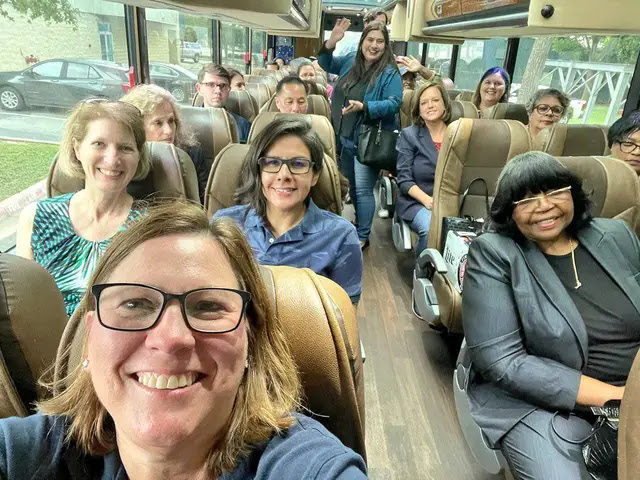
| The Texas House Democratic Caucus, in Washington, DC, July 13, 2021, suffering "anxiety and distress" as they show how deprived they were of their free speech rights. Photo by Shuran Huang for the Texas Tribune, found here. |
All of them were vaccinated, but six, at last count, nevertheless came down with COVID (they stopped reporting on testing after those six), so
the group had to quarantine, which must have caused some anxiety and
stress—although, again, not caused by Governor Abbott, Speaker Phelan, nor Representative
White.
If you were wondering who would represent plaintiffs in such a lawsuit, read
on.
The lawyer for the suit is Craig Anthony Washington. He’s a former Democrat lawmaker, currently practicing law with a probationally
suspended license. That is, his license was suspended, but he can practice now,
as long as he complies with the conditions of probation. He has had his license
suspended multiple times, for both ethics violations and incompetence.
The morning after the filing of the suit, two of the
plaintiffs, Reps. Shawn Thierry and Nicole Collier, announced that they were
not part of the suit; their names were used without their consent. Hmm. Who is
filing the complaint seems like a detail a half-way competent lawyer wouldn’t
miss.
While they’ve been gone, “suffering damages,” by traveling
to Washington, DC, they have repeatedly asked for care packages to be sent to them—containing items easily purchased at any corner store in the city. Except
for those two who traveled on to Portugal for a much-needed vacation; maybe
they couldn’t find their preferred toiletries and snacks there.
A group of Texans were in Washington for a Concerned Women
for America conference, and happened to be outside the Democrat lawmakers’
hotel as they were boarding a bus to go to dinner. And they called out to them
by name—something the Democrats weren’t expecting in the faraway capital. Word
is they turned tail and went back inside the hotel. So maybe they “suffered” a
dinner delay that day. Again, hard to see how that was the fault of the three
accused.
So, was this all about protecting voter rights?
It started in the regular session, which ended on Memorial
Day. The Democrats in the House walked out just early enough to avoid a
procedural vote on the omnibus election integrity bill, which had already passed both chambers and reconciliation except for that final
procedural vote in the House. They could have avoided both of these special sessions—and all
that time and suffering in Washington—if they had simply done their duty in
May. Failing that, they could have done their duty in July, instead of
absconding. And now they could do their duty in August instead of filing a
baseless lawsuit. But I guess that is not the Democrat way.
Back in May, during multiple public hearings, the Democrats
were able to voice their views. They made some unfounded claims—pretty much the
same claims Democrats have been making at the federal level—that the very idea
of election integrity is racist. Because that is intended to wound the most,
but not because there is evidence of racism. In fact, blacks find it offensive
that Dems claim they’re too incompetent to get a photo ID. There’s nothing
quite like the racism of low expectations from elites toward those they consider
lesser beings.
Republicans, meanwhile, have the election integrity motto “Easy to Vote;
Hard to Cheat.” Makes sense.
Here’s another infographic from Rep. White on what makes the election integrity bill "Easy to Vote; Hard to Cheat." (Was there a conspiracy to make informative graphics? And did that trigger the lawsuit?) HB 3, by the way, is the bill number for the first special session. New session, new bill numbers. So far in special session 2 we have SB 1, an omnibus election integrity bill, already passed out of committee, but it doesn’t yet have a companion bill in the House.
 |
| Another infographic from Rep. James White, found here. |
Anyway, for the next 30 days, we’ll see if a quorum ever shows up in the House to do business. And then for 30 days after that. There’s plenty of other business that could be done, including dealing with that little detail of the Governor vetoing their pay in the budget, which the Republicans would likely join the Dems to alter—as the last item of business in a special session.
 |
| A state rep reads news about walkout, April 12-13, 2003. Image by Bob Daemmrich/CapitalPressPhoto, found here. |
At some point, they have to do yet another special session to deal with redistricting. And, if you’ll recall, in 2003 the Democrats ran off to Ardmore, OK, to keep from completing that constitutionally required duty. So, more fun to come.


