Showing posts with label Texas Republican platform. Show all posts

Sunday, June 28, 2026

Conservative Partying, Part III: Platform & Resolutions


This is the third of three posts reporting on the Texas State Republican Convention, held in Houston June 8-13. Part I covers festivities, election of officers, and Rule Committee. Part II covers Legislative Priorities.

This post we’ll cover Platform & Resolutions Committee, from the perspective of an editor, which you’re probably not going to get anywhere else (not that the world is clamoring for such a perspective). Anyway, I’m afraid it’s still long, but it’s all in this post anyway. No more splitting into parts.

As I was reporting some arcane detail to my husband, with great enthusiasm, he commented that I sure am passionate about this. And that’s true. I love the words and the ideas—a whole lot more than the politicking. Anyway, here we go.

The Platform Is Conservative

Let me start with something positive. I had a conversation with one of the Committee members, someone for whom this is not her first rodeo either. And she asked me my impression of how the platform is doing. I don’t remember the exact wording of her question, but I was happy to report that, from my viewpoint, our platform is getting more conservative over time, and the grassroots are getting more unified.

To read the full article, FOLLOW LINK TO SUBSTACK.

Monday, June 27, 2022

Convention Debrief—Platform and Resolutions

This is Part III of my debriefing of the Republican Party of Texas Convention, which ran Monday, June 13, through Saturday, June 18. (Part I was on the editing adventure; Part II was on Rules and Legislative Priorities.)

Finally I’m getting to Platform, plus Resolutions, which probably require some explaining. 


Platform Committee taking a vote, screenshot from here.
The middle section, with Chairman Matt Patrick in the center, is upper left;
right side is upper right; left side is below. I am handling the file, seated next to the Chair.

Just a word, first. If you’ve been looking online for the final version, it is not there yet. I have not yet received the end-of-convention file from RPT, which handled it during floor debate. In the meantime, we’ve worked on taking care of editing issues, noticing repeated titles in different sections, and creating an index. Maybe we’ll get the file tomorrow. My hope is to get it completed and turned in by Friday so I can enjoy a nice holiday weekend. I’m not sure why I didn’t get the file right away. The person handling the file got sick, so we pushed our deadline back a week. But I really just need it sent as an attachment, so it shouldn’t require much work on their part.

They may want to delay until they get the scantron done. That’s the counting of the up-or-down votes on each plank. The machine was delivered to them last Friday; it was the wrong machine. The replacement should come on Tuesday (tomorrow), so they should be able to set it up and do the counting on Wednesday. Again, I don’t need that information before I do my editing. If a plank, or planks, gets under 50% approval, then deleting that plank is a very simple matter. But it has never happened. In fact, I don’t think there’s ever been a plank that got under 2/3 approval. But getting a higher approval (90% or higher) is used to convince the legislators to support an issue.


Resolutions

The platform gets created out of resolutions that get set to state from district and county conventions, which got them from precinct conventions. A resolution has a format, typically with explanations of reasoning with each paragraph worded, “Whereas….” Then comes the statement part, often worded as “Therefore, be it resolved that….” When it comes to writing the platform, we take the wording in the “be it resolved statement” and reword it as a platform plank—something like, “We urge the Legislature to…” or “We support…” or “We proclaim that….” The Whereas statements might get referred to on rare occasions for clarity. But our process would be simpler if submissions came in closer to platform wording, which some of them do. My senatorial district sends them all in as platform wording.

But there is another type of resolution that is not part of the platform. These resolutions are statements proclaimed by the body. I didn’t understand about these different resolutions until I became a precinct chair, and we started dealing with resolutions as part of our quarterly meetings. In those cases, the Harris County Republican Party Executive Committee, made up of precinct chairs and officers, would vote on acceptance and wording of such proposed resolutions. Those that were accepted by the body would be posted on the website, and sent to the appropriate people, such as officeholders and media.

Some years at the state convention there are no such resolutions for the Platform & Resolutions Committee to deal with. Last time there was one, and it did not pass. This year there are two; both passed. And they have gotten some media attention, which might have been a goal of some people. But the media—even thorough media like The Epoch Times—has misunderstood. The resolutions are not part of our platform, but they are part of the Platform & Resolutions Committee Report. They show up below the platform in the report. And they become, if approved, statements made by the body of delegates.

Both resolutions came up late in the process, on the day of Permanent Committee, if I’m remembering right. They are considered separately from the sections of the platform, and are required to be handled in floor debate.


The first one proclaims that election fraud changed the outcome of the 2020 presidential election. It’s bold to say so, but it’s a fact, provable if we would ever get a court to look at the evidence (the movie 2000 Mules was shown in various discussion sessions during convention week), and the majority of the delegates hold this view.

As with all platform planks and resolutions, this does not have the force of law. It is a statement; that is all.  But a very loud majority felt like it was worth saying.

The second one was a response to the Senate vote that week on gun control, signed onto by Texas’s Senator John Cornyn and a number of others. They were called out and condemned for going against the Constitution and the will of the people of Texas.


Platform

I talked about our process in the first post. Today is finally about platform content—which I did not affect, other than as a delegate. Editors are there to facilitate the work of the Committee, not to influence it. I had my chance to do that at the senatorial district level.

The sections still relate broadly to Senate committees in the Texas Legislature, but order was changed somewhat this year. Rather than the sections being alphabetical, they’re laid out in ways that seem to flow logically. Constitutional Issues is the first section after Preamble & Principles, since it states overriding purposes. Business then flows into Finance, which deals with funding, so Education follows and then Health & Human Services. Then we get into governing, local on up to national, with Criminal & Civil Justice, State Affairs, Government & Election Integrity, and finally National Defense and Foreign Affairs.

The names of the last two were changed. Election Integrity was always in Government, but parts of it were also in State Affairs; now they’re together. Government used to contain Foreign Affairs, but that seemed like a more logical fit with National Defense.

All of this is to say, if you’re trying to track the changes from the previous platform, good luck with that. After subcommittees do their work, the Committee of the Whole is creating a whole new document, to be used for the next two years.

There are seldom changes to the Preamble and Principles. Two years ago we added a single word: “equally.” But this year there is a sentence added within the Preamble: “We recognize that human nature is immutable.” I believe this is referring to attempts to change gender or some other characteristic we’re born with. There was a suggested amendment about repudiating socialism and asserting national sovereignty, but it failed. Those ideas, however, show up elsewhere in the document.


Parents’ Rights

Parental rights, as you saw from Legislative Priorities, was a big issue this year. It comes up in Constitutional Issues, subsection Citizen Rights, and again in Education, subsection Parents’ Rights, with several planks. The one in Constitutional Issues was amended on the floor to add language about transparency and a Parental Rights Amendment to the state constitution. That issue was covered and detailed in one of the Education planks. But I guess it doesn’t hurt to say it in more than one place. I’d just like the floor to know, that issue was not neglected by the Committee.


Convention of States

One of the contended issues was Article V Convention of States. Texas passed the call for an Article V convention several years ago. But that hasn’t stopped opposition from trying to get rid of it every year. They did that last year during Temporary Committee, and it had to be brought back during Permanent Committee. This year it was there at the end of subcommittee, but got struck during Temporary Committee of the Whole. I missed that debate, doing other duties across the hall. But it was first order of business for Permanent Committee on Thursday, and it got reinstated with slightly different wording, asking the Legislature to extend the call.

Important public testimony came from the Chair of Legislative Priorities, who pointed out that COS was one of the 15 priorities of that committee, and it would be more than awkward to have a legislative priority that was struck from the platform.

One committee member, Tom Glass, had voted to strike in Temporary Committee, but changed his mind the next day. He had been thinking, since we’ve passed the legislation, it didn’t still need to be in our platform. But because there is a time-sensitive sunset clause, we need it in the platform to make sure it doesn’t disappear. He did, however, amend to keep only the last sentence, which related to that clause.

Bill Ely, the committee member from my SD, and another board member of our local Tea Party with me, is a COS champion. He gave an excellent speech in the Permanent Committee, bringing in data from the resolutions across the state, which he had studied after setting up our spreadsheet for us. I wanted to link to that here (it cues up here), but the sound cuts out almost as he starts, I was disappointed to find. Anyway, he rebutted some of the previous night’s testimony, which claimed a majority of senatorial districts were opposed to a Convention of States. Bill showed that wasn’t accurate. Even in those districts that put forth resolutions against an Article V COS, most of those districts also put forth resolutions in favor. And there were many districts who sent resolutions in favor that did not also have resolutions opposing. So if you look at the state overall, and the resolutions overall, the picture is quite different from what convinced the committee to strike the plank the night before.

The plank is back in, in shortened form, preserving what is necessary.


School Choice

There’s a moment here to talk about how important testimony can be. As we saw at our SD level, and as we prepared documents for the state platform, people are pretty upset with our schools. Parents want choice, transparency, and removal of anything that even hints at indoctrination. In the Education subcommittee, the room was cavernous. It was supposed to be divided but hadn’t been, so another committee got moved. What was left was bigger than the room we used for Committee of the Whole. People were lined up out the door for testimony. They took four hours of testimony, which placed them getting their work done and turned in to me around midnight, several hours later than scheduled. But it was important that the people got heard.

There is an ongoing split in the school choice world. A small but vocal minority of homeschoolers (homeschoolers as a whole are a small minority; this is a much smaller sub-minority) fear school choice, because they fear government might step in and regulate them. While I understand their arguments, I do not agree with them. We have to be vigilant against government intrusion regardless of what choices are offered to people who feel stuck in public schools. Fear of some nebulous possibility is no reason to deprive all those families trapped in the public school monopoly. If we introduce choice, we get the possibility of improvement.

This small minority is vocally active. They took part in the subcommittee debate, but they were outnumbered there with so much other testimony, much of it about breaking that monopoly somehow. But in testimony for permanent committee, where there is limited time for each section, they managed to fill all the slots, probably six or so individuals.

As they had hoped, they gave the impression that there was a huge outcry against the phrase “and the funding should follow the student,” claiming that isn’t possible without strings attached. Even if that were so—it is not—it wouldn’t attach strings to them if they’re not taking the money, so they’re really just interfering with other people’s decisions. Anyway, a committee member did bring up such an amendment. Subcommittee Chair Will Lutz spoke strongly against taking those words out. I looked forward to relistening to his speech in the livestream. It is here. He reminded people of the testimony they’d received from across the state. And he reminded them that every year school choice planks get watered down in committee, and then when the body of delegates see it, they put the strong school choice language back in—with loud acclamation. We should follow what the people in the state are telling us.


screenshot from here

I took a look at the starting document for education, which contains all the education resolutions from the 31 senatorial districts in the state. In addition to resolutions with wording in favor of school choice, there were 31 resolutions specifically stating that the money needs to follow the child. There were I think three resolutions in opposition to funding following the child. Chairman Lutz was right.

There were a couple of other speeches for and against the amendment. There was a committee member who homeschools, who spoke out well in favor of the money following the child.

And there was another committee member who pointed out that, when he got a GI bill, he could use it for education at a religious seminary, and the government had no say in that. They couldn’t tell him where he could study or what he could study; they could only insist that the money was spent on education. I appreciate that comparison. It’s how I’ve been seeing it. That is the freedom we want to give parents. Since the very next plank reiterates that government will not be allowed to regulate curriculum for homeschoolers or private schoolers, that ought to do. Again, we’re not writing law; we’re telling the legislature what we want and saying, “You figure it out.”

The amendment failed. But it was a close call—because of those final testimonies. It would have been such a sad day for all those who testified in subcommittee, if those final voices had gotten the last word.


Homosexuality and Gender Issues

There was an amendment that has gotten undue attention. A sentence was added at the beginning of the Homosexuality plank: “Homosexuality is an abnormal lifestyle choice.” The rest was about not granting special legal entitlements or special status based on homosexual behavior or other LGBTQ identification. I was satisfied with the plank the way it was. The new language states basic fact, but it did cause an uproar on the committee, where we had one committee member who is a gay man—unknown to most of us, because he didn’t press for those issues and was overall pretty conservative and helpful. (I had suspected, because I'd heard him give reports from Log Cabin Republicans before.) So he felt personally hurt. I don’t believe that was the intention. You can hear the discussion starting here. If the purpose had been intended to provoke while being factual, it could have been, “Homosexuality is a perversion of normal human sexual reproduction,” perhaps. It wasn’t that inflammatory. But it did draw attention that the original might not have. And you can decide whether that is a good thing or not.

screenshot from here


Election Integrity

Election Integrity was a huge issue. There’s debate about whether paper ballots ought to be the solution or not. I believe they are not; there’s a “long and glorious tradition[i]” of voter fraud using paper, well established before machines were brought into the picture. That aside, there was a lot of agreement that we need better and stronger election integrity laws. We got what people are calling an A-Z plank, with bullet points covering most of the alphabet.  That was amended with one addition during floor debate that is probably also useful. Now we just need the legislature to go at it.


And that, actually, is what we need to do for the whole platform. Set it before the legislators, get their attention, remind them of the platform—which their constituents support. Train their staff to recognize the platform and refer to it continually. So, the platform, in tandem with Legislative Priorities, is kind of a blueprint for the Legislature. To quote my friend Terri again, “This is what we want done. Get busy. You figure it out.”


[i] Princess Bride reference.

Monday, June 6, 2022

The People Really Mean It: No More Tyranny

I’m back. I didn’t really stop writing this blog. For the past month I’ve been inundated with work on the state platform. Got subcommittee files sent out last night. So today I vacuumed, which I hadn’t done for some weeks, so that we were practically swimming in dog hair. And I did some grocery shopping and other things I’ve put off.

I’m a little bit compulsive about details, things like formatting and consistency. But much of this long effort just has to do with the overwhelming amount of work—done by me and other volunteer/unpaid editors. This is the first year we’ve done the file preparation; in past years RPT staff did it. But we hadn’t been satisfied (some senatorial districts—mine included—had not been included, so that was a serious problem). We now have better ideas for process, for next time. Ways that I thought were going to be done this time, since we had done it at our district level, but I guess what was in my head did not coincide with others. Anyway, it takes a lot of tedious work, regardless of process. But we do have plans for a better process in the future.

There were more than 3500 resolutions that came in from the 31 senatorial districts across Texas. There were duplicates of many of them; several SDs submitted the exact same wording. And there were additional near duplicates, where just some of the wording was different. And there were many more resolutions of the same ideas but that were expressed in different wording. And here and there are unique ideas, also worth noticing.

We have a huge platform—over 330 planks, before adding more this year. People are very concerned about ideas they’ve worked on in the past being lost, so they insist that we start with the previous platform. If no resolutions come in related to a particular plank, that doesn’t mean it goes away; it means it probably didn’t generate strong concerns this year. It may not even get talked about. So it stays. And the issues garnering attention this year get added. Most of the time, the committees don’t disagree with what was put in the platform the year before—unless it’s an idea that still stirs up emotion—so they leave those ideas alone. So, alas, it will probably always be long.

What has gotten my notice this year are the themes. And these are repeated from what I saw at our district convention.

The people of Texas are against tyranny. They’ve seen too much of it—from the federal government and state and local. The platform is a way to express that. The ideas come up from precinct conventions to district and county conventions, and now on up to the state convention.

Some of the resolutions are minutely specific and detailed. Some just express a broad sentiment in a sentence.

Two years ago we were already expressing concern about pandemic response being used as an excuse for tyranny. There’s even more on that this year. But that concern has broadened—because the government overreach, attempting to control our lives, is even greater, with more invasive tentacles.

We do not want tyranny in our healthcare choices. We also do not want tyranny in our media—social media, news media, entertainment. We think more open discussion is better. And we’re really sick of truth being labeled “disinformation” by people who are lying to us. And, by the way, we don’t want the government surveilling us and keeping that data—just in case they can come up with probable cause someday.

Parents have the inherent right to the
care and upbringing of their children. That's
Mr. Spherical Model doing that job with
two of our now-grown kids.
A huge part of the pushback this year is related to families. It goes way beyond school choice, which is becoming a main Republican theme that legislators better listen to. But it’s bigger than that. Parents have the inherent right to the care and upbringing of their children. Parents—and taxpayers in general—aren’t going to tolerate sexualized and racialized indoctrination of our children.

If this were not a real issue, if this were something that is just a rumor with no real life examples, we would not be hearing the uproar from across the state.

Think about numbers. Most people do not attend a precinct convention, let along write a resolution to put forward at one. So that person who writes the resolution probably represents several hundred people in his or her precinct who feel the same way but aren’t involved. Maybe they don’t know how to get involved or express that idea.

So this person writes a resolution on a topic of concern—like Social Emotional Learning, and anything under that umbrella, being taught in our schools. We get similar resolutions on the same topic from maybe dozens of local precincts, meaning it’s widespread here. It means several thousand people have the same concern.

And then you get together at a district convention and find out tens of thousands of people have the same concern. You can extrapolate at the state level, when the same idea comes up in maybe 20 out of the 31 districts, that there are hundreds of thousands of people with the same concern, probably millions.

People want sex out of the schools. Let’s just remove sex ed entirely, since the public schools have already proven they can’t be trusted—and because that’s not the basic function of schools. We want NO LGBT-plus-any-other-letters-or-symbols agenda being foisted on young people. Parents resent schools doing sneaky things like leaving parents out of the information loop, or telling kids not to tell their parents about something.

When schools fail to meet the needs of families, the parents feel stuck. They want school choice. Here we are paying taxpayer money, and it goes to this failing monopoly—actually preventing parents from getting the kind of education their children need. We want our legislators to hear this: we want the money to follow the child WITHOUT government strings attached.

Related to that is the horror people feel about permanently mutilating minors for the sake of “affirming” a confusion that most of them will grow out of.

First and Second Amendments
People care about their First Amendment rights—religion and speech mentioned mostly. And people care about their Second Amendment right to keep and bear arms. What part of “shall not be infringed” does the government not understand?

During the 2018 convention season—it was May—there was a school shooting in Texas, in Santa Fe. As a result, people were concerned about the same type of conversation going on now, following the Uvalde school shooting. The pro-tyranny crowd tries to use such tragedies to gain power. Pro-freedom Texans want to make sure the over-emotional “we’ve got to do something” crowd that gets all the media attention doesn’t take away our rights.

Do we or do we not have a God-given, inherent right to defend ourselves? Texans know we do. And none of the hue and cry gives us a reason for law-abiding citizens to stop defending themselves against the criminals/crazies. It’s not the guns that are evil; it is those who wield those weapons in the perpetration of crime that are evil. Taking away the means for good people to defend themselves from such evil does not make anyone safer. In fact, we argue that it makes us less safe. Schools are targeted because they lack defenses.

And, no, we can’t wait for government officials to show up after a crime is underway to protect us. In Uvalde, we still can’t understand all that happened. But we know the shooter was inside the school for most of an hour, continuing to kill, before an official came in and took him down while other officers waited safely in the hallway. An armed teacher might have made a huge difference. An armed security officer actually on campus and doing his job might have helped.

We can’t trust elected officials to respect our right to self-defense. So there’s a lot being voiced on that in the platform resolutions. And, I should mention, the resolutions were turned in weeks before the Uvalde shooting. But, because of the tyrannists going for our guns, these resolutions should get attention in platform committees.

Can you think of other ways the government has been overreaching? They’re probably mentioned here.

The detentions related to January 6th come up a few times. Detention of citizens without charges is wrong on so many levels.

Election integrity is a huge issue. I’ll be writing more about 2000 Mules soon—you and everyone you know should definitely watch it. Catherine Engelbrecht is from here. True the Vote started here in Harris County. We’ve been paying attention to these issues longer than most—but still come up against the same wall of frustration. “Here’s the evidence. Do the prosecution.” And nothing happens. So the cry comes up, through the platform, to the legislature to do something about it.

People have many ideas and specifics they’re offering that they think will help. People are concerned about the machines that do the counting and think paper ballots might help (there are arguments against that as well, because there’s a long history of cheating with paper ballots). People are calling for forensic audits—which are expensive but probably necessary if we’re ever going to regain trust in our election system. People want voter rolls cleaned up—and they don’t want some outside company, like the ERIC system [Electronic Registration Information Center], meddling in the process.

Here’s a pretty good general list, from one resolution:

New Election Law Bills:  The New Election Law Bills provide:

a.     Voter Registration database with restricted input/output access.

b.     Limit voting to precinct or adjacent precinct only voting.

c.      Paper Ballots that are sequentially numbered, hand marked, & watermarked.

d.     Paper Poll Books for voters to sign.

e.     Basic Optical Scanner/Vote Counter only to tally vote results.

f.       Printed Vote Result Tapes – Early Voting and Election Day.

g.     Limited Early Voting with no gap between Early Voting and Election Day.

h.     Hand Counts are allowed at the judges' discretion.

i.       No wireless, Lan, cellular, or computers in voting sites.

j.       Third party verification and audit.

k.      Unique identifiable seals on ballot boxes.

l.       Vote results delivered to central count on paper.

m.    Vote results tabulated from paper record with calculator.

n.     Chain of custody from start to finish.

o.     Unofficial results called into SoS and media.

p.     Poll watcher protection: Standing to sue, and ability to use video surveillance.

q.     Lawsuits can be filed in adjacent counties.

What all this tells me is, the people mean business. They’re waking up. They’re taking action in ways they believe are both effective and civilized. I hope the next legislative session responds. But I don’t place my trust there. When a large group of people are declaring their love of God and family, and are doing all they know to do to make things right in a world gone very wrong—that is when we can expect to see God step in to protect us in ways that are miraculous.


Good people of Texas standing together
might be able to do some good in the world.
This is a University of Texas class photo, found online in 2015,
link no longer active.

There may be more appalling things before that end comes, as the opposition ripens in iniquity. But that end will come. When it does, I will be very glad to be on the side of freedom, family, and truth—on God’s side. He can win His battles without us; but we cannot win these battles without Him.

Friday, June 29, 2018

Platform and Minority Report, Part IV


This is part IV, the final part, of our discussion of the Platform and Minority Report, from the Texas State Republican Convention. Here are the subjects in order:

·         Part I: Cannabis 
·         Part III: School Choice
·         Part IV: The Minority Report


The Minority Report

We mentioned the idea of minority reports the other day. That was about the Nominations Committee, which took up a lot of time on Friday afternoon of the convention.


A minority report isn’t all that rare on the Platform Committee. But usually it is related to a particular issue. Maybe a single plank. If I’m remembering right, a few years ago there was a push for outright legalizing marijuana, which failed, but there was a minority report on that issue. That meant that a sizable number disagreed with the committee’s decision, so they brought their alternative up to the main body at the convention. (It usually fails there, as it did that time.)

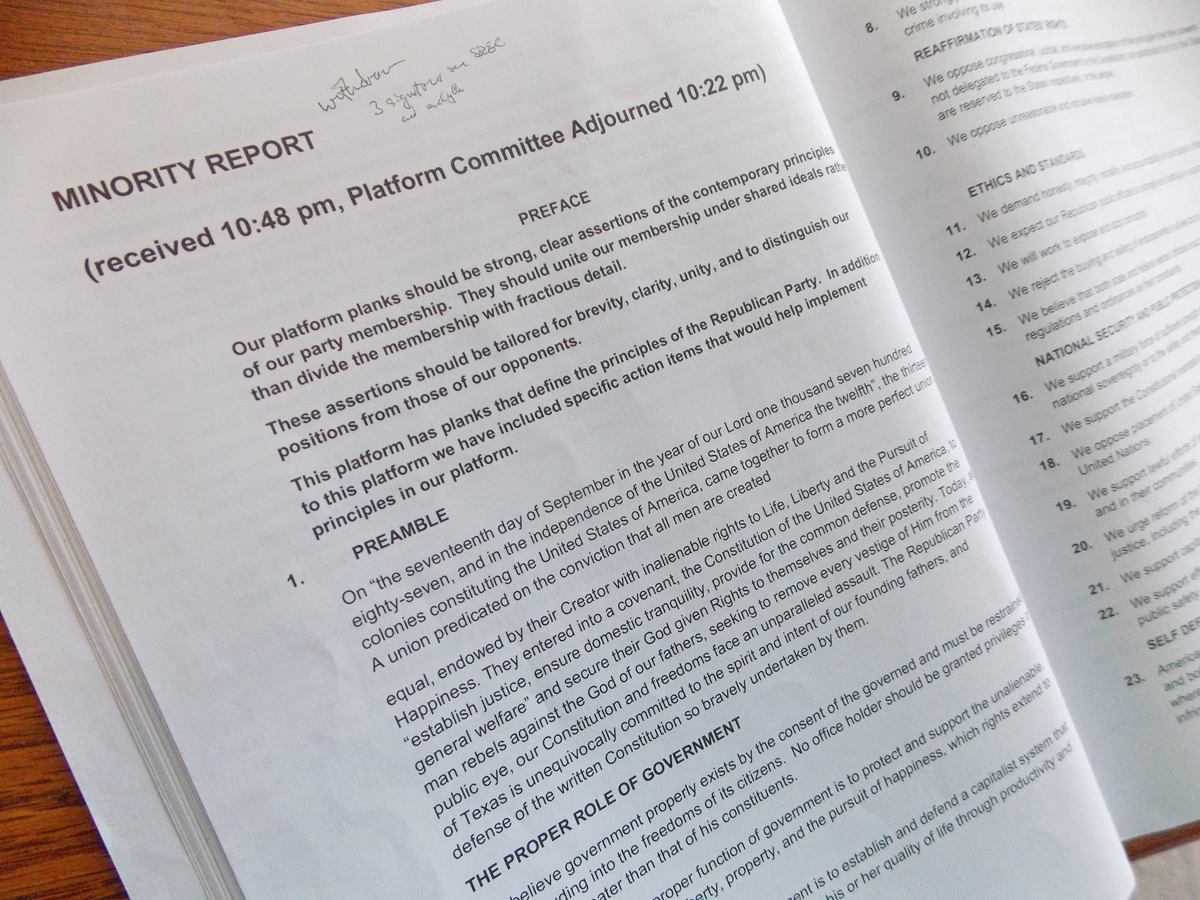
The minority report this year was different in many ways. Its intent wasn’t on a single issue; it was aimed at the size of the platform. The premise is that it should be shorter.

I’ve thought that before as well. I really like the Preamble and Principles on the first page of the platform. Isn’t that enough?

If you’re looking at the basics that we almost entirely agree on, then that’s a good platform. But I’ve learned, over the past few years, working on the district platform committee, and now behind the scenes at the state level, that the platform really is used to advance legislation, particularly in the state legislature. Sometimes that has to be specific.

And there are people who come to the convention—are active politically in the first place—because of a particular issue that is very important to them. Without that issue, they’ll let someone else do the activist work.

So there are a lot of platform planks: 332 this year (including the preamble and principles, which are also numbered as planks). That’s more than in past years. However, some previous planks were split into multiple planks. The platform isn’t really a lot more issues—or words—than previous years. There are between 3,000 and 6,000 bills proposed in a legislative session. Only a portion of our planks, maybe 250, will be used to direct them. So maybe we don’t have too many.

But there’s an understandable fear that we can’t all agree on the whole platform.

However, that fear has been addressed. In 2016 we started having a plank-by-plank vote to accept or reject, which we did again this time. That shows stronger agreement or lesser agreement, and it’s clear we don’t all agree on every issue. (I voted against maybe half a dozen. None got voted down by a majority.)

We try to hold our representatives accountable to the platform. But they aren’t required to agree on every plank any more than we are. They are required to vote in accordance with the Preamble and Principles. Failure to do so multiple times can bring sanctions against them (which is what happened with the one resolution at the end of the platform this year).

Also, the new arrangement into categories related to the state senate, and the section-by-section debate, allowed us to cover more issues more fully in the whole body of delegates at the convention. To do that, we had the latest version available online all week, and the printed version a day earlier than previous years.

One of the common conversations after plank-by-plank voting was, “I guess I need to read it and make my choices ahead of time.” Yes. That’s the idea. The debate before the body is not the time to learn what’s in it—which has been practice in the past, and very frustrating. Now it’s on the delegate to do some preparation. That’s better all around.

Would shorter be better? Maybe. But every plank was supported by someone. And in the past those urging for a shorter platform did it as a maneuver to avoid accountability on specific issues. The less specific, the more wiggle room a politician has. However, I don’t believe that was the intent of this year’s Minority Report signers. Anyway, if it’s going to be shorter, that should happen through the natural debate process.

View from my computer, shortly before
the Permanent Platform Committee convenes

The Minority Report signers had their own version. Much of it was taken from our platform—even a last-minute title. And then there are some things that were their own. It was still 81 planks long, which is ironically not all that short. The preface and preamble were different. The principles, as a section, are missing. Then come 15 categories of issues (more like former platforms, rather than our current legislature-oriented categories), followed by action items in 22 categories. Individual planks under the category headings do not have titles.

 It was written mainly by one committee member. He shared it with other committee members that he thought might side with him, but he never shared it with the whole committee.

Let me repeat that: he never shared it with the whole committee. Debate was complete. Our platform was accepted by the Permanent Committee. And then he asked to reopen debate to present his minority report. The parliamentarian probably should have squelched it at that moment; instead, he asked the indulgence of the chair to allow it, in order to avoid more parliamentary difficulty during floor debate.

The committee hadn’t seen it, hadn’t discussed it. There was no public testimony concerning it. The author, pretty much single-handedly, decided what to keep and what to toss, and what to do differently.

It turned out that three of the signers were also elected as SREC committeemen/women (State Republican Executive Committee, a man and woman from each senatorial district in the state), which disqualified them. This came out during floor debate. I didn’t understand the technicality that led to that decision. I guess they hadn’t understood it either, or they wouldn’t have signed. Anyway, without their signatures, there weren’t enough signers for a minority report, and it was withdrawn.

The author did get his allotted few minutes to present his reasons for wanting a shorter platform, which plants the idea for another year. That may be all he wanted.

The point of all this discussion about the platform—and about the convention entirely—is to show just how grassroots the party is here in Texas. I think that’s the way it should be.

We’ll have just one more post about the convention, which is a big more nationally relevant. I’d like to share some of Senator Ted Cruz’s speech. So that will come next.

Thursday, June 28, 2018

Platform and Minority Report, Part III

This is part III of our discussion of the Platform and Minority Report, from the Texas State Republican Convention. There will be four parts total. Here are the subjects in order:

·         Part I: Cannabis 
·         Part III: School Choice
·         Part IV: The Minority Report


School Choice

You would think that school choice would be an area of wide agreement for Republicans, but the “belief in public schools,” as though that were a religion, in American society as a whole, runs deep. There’s been a steady campaign for about a century equating public schooling to caring for our children. So that attitude is part of the debate.

But there’s another segment that’s kind of surprising: a homeschooling schism. There’s the side that looks for more choice, more alternatives, and more free market—not just for homeschoolers, but for everyone. And there’s the side that is afraid that any movement away from total hands off by government is a slippery slope from total freedom for homeschoolers directly to government reaching out and controlling homeschoolers.
We hung out at the convention with some really smart
 young freedom loving Texans (our grandkids).

I’m on the freedom to choose side of this issue. I believe the other side is needlessly fearful. And their refusal to consider any possibilities means they are refusing to allow choice for public schoolers stuck in failing schools as well.

A friend of mine said, “You homeschoolers just need to find a few of you, on both sides, that are reasonable, and sit down in a room and talk this through.” In theory I think that is what’s needed. In reality, the leaders of the no choice people side with HSLDA, a national legal defense organization. The pro-choice people side with Tim Lambert of THSC (Texas Home School Coalition). National leaders aren’t really present in Texas to have such a debate.

There are some truly innovative ideas. Education Savings Accounts are one that came before the legislature last year, but failed to pass. The year before, the Heritage Foundation came to Houston to present the idea and talk with a large roomful of us. Right away I caught the value of injecting some free-market into education. [I first wrote about this here, but also here and here.] During conversations I asked one of their people whether they’d made contact with Tim Lambert yet. She wasn’t as yet aware of him, so I sent her to him. I’m sure they’d have found him without me, but he did get on board.

Free market always leads to better quality at lower prices. When our schools are failing with lower quality for higher prices, it seems to me that is a natural solution.

Debate was intense, but this is the plank that finally made it in:

School Options: Texas families should be empowered to choose from public, private, charter, or homeschool options for their children’s education, using tax credits or exemptions without government restraints or intrusion.

It will do for our purposes, as long as we can get the legislature to actually put through some real choices.

There was another plank of interest to homeschoolers:

Extracurricular Opportunities: We encourage nonpublic school parents to create extracurricular opportunities for their children where they are not readily available and in a manner that they can be free from discriminatory testing, intrusive government oversight, or harmful school policies regarding mixed-gender students in bathrooms and locker rooms. We encourage the Legislature to find ways to allow nonpublic school students’ participation.[i] Any homeschool student that does not participate will be unaffected.  


The footnote there refers to an idea that was accidentally deleted. The last sentence should read:

We encourage the Legislature to find ways to allow nonpublic school students’ UIL participation.


I believe the accidental deletion happened when the Google system, which was livestreaming both the video but also the document, shut down late Wednesday evening, causing the staffer who was manning the computer at that time to have to take handwritten notes on the last few decisions. I wasn’t on duty, but it was a regrettable error, but difficult to have avoided.

It was noticed by a committee member before the Permanent Committee met. He offered to propose it as an amendment. But it had been heated enough that, when given the opportunity to leave it out, the committee did.

Tim Lambert wrote about this part of the platform debate here. And he includes one brief testimony that I thought was convincing, which I’ll include below.

There were several legislative sessions while we were still homeschooling, and several since, that we’ve worked for this. UIL was instituted when the vast majority of Texas students were homeschooled, and most of those that weren’t were private schooled. This was, I think, 1913, before public schools became a monopoly. In the 1960s UIL decided to exclude anyone not in public schools—against the original charter. Recently one or two large private schools were allowed to participate. The world didn’t fall down, it should be noted.

During testimony some people from west Texas pointed out that, sometimes communities aren’t big enough to have any extracurricular activities outside of schools. They can’t start their own leagues, or join in private community extracurricular opportunities. There are none.

Public schools claim to fear that non-public schoolers could spend more time on the skills needed for extracurricular activities, since they’re not constrained by school hours. There’s no evidence for that. Basketball teams, for example, have won competitions with just a couple of practices and a game a week, rather than the daily practice public school teams get.

It’s claimed they draw from a wider area, which is true, but they do not draw from a larger number of students.

Public schools have even been offered to receive a full day attendance allotment for a student there only for an hour, and yet they refuse. This isn’t true in all states. Thirty-four other states have worked out ways to allow UIL participation (and none of those states have increased regulations over homeschooling as a result, refuting the argument of the fearful homeschoolers). But Texas public schools like having a stranglehold on any power and money they can. And they prefer forcing non-public schoolers to not only pay their own way, but to subsidize public schools while they’re doing it.

Here's the truth: If it’s beyond the proper role of government, there will be unintended consequences, and they will likely be exactly the opposite of the state goal.

So, if you want to educate children, and you want lower costs and higher quality, government schools are not the way to go. Inject the free market. Offer choice. Encourage homeschooling, and online innovations, and any other creative way of learning. It doesn’t have to be like this.

But right now, even conservatives can’t seem to stick a toe in the water of choice to make it happen.


Tuesday, June 26, 2018

Platform and Minority Report, Part II


This is part II of our discussion of the Platform and Minority Report, from the Texas State Republican Convention. There will be four parts total (I’m doing them on consecutive days. So, part I was yesterday. Here are the subjects in order:

·         Part I: Cannabis 
·         Part II: Marriage, Homosexuality, and Other LGBTQ Issues
·         Part III: School Choice
·         Part IV: The Minority Report


Marriage, Homosexuality, and other LGBTQ Issues

Another issue that occupied a lot of testimony time at the convention was homosexuality. Those issues ended up mainly in State Affairs. The main concern, since the Obergefell ruling, is about religious freedom, balancing that with tolerance. The 2016 plank said this:

Homosexuality: Homosexuality is a chosen behavior that is contrary to the fundamental unchanging truths that has been ordained by God in the Bible, recognized by our nation’s founders, and shared by the majority of Texans. Homosexuality must not be presented as an acceptable alternative lifestyle, in public policy, nor should family be redefined to include homosexual couples.  We oppose the granting of special legal entitlements or creation of special status for homosexual behavior, regardless of state of origin.  We oppose any criminal or civil penalties against those who oppose homosexuality out of faith, conviction, or belief in traditional values.  
There was a rewrite, hotly debated, that lasted until a compromise, late Thursday evening, which became acceptable to all, containing many of these same ideas (I’ve highlighted in both where the words are identical):

Homosexual Behavior: We affirm God’s biblical design for marriage and sexual behavior between one biological man and one biological woman, which has proven to be the foundation for all great nations in Western civilization. We oppose homosexual marriage, regardless of state of origin. We urge the Texas Legislature to pass religious liberty protections for individuals, businesses, and government officials who believe marriage is between one man and one woman. We oppose the granting of special legal entitlements or creation of special status for homosexual behavior, regardless of state of origin. We oppose any criminal or civil penalties against those who oppose homosexuality out of faith, conviction, or belief in traditional values.

The changes take a bit of concentration to discern. While God and Bible are cited in both, the new plank is more about affirming marriage, rather than condemning the sinfulness of homosexuality, which may make it less controversial while still concentrating on what we want to accomplish: protect marriage, and protect religion freedom. I like the connection of marriage to civilization; that's part of the Spherical Model formula for civilization.

That's us, in front of the Civilization wall
in the Henry B. Gonzalez Convention Center


The testimony against the plank was mainly of the variety that homosexuality ought to be seen as just another acceptable lifestyle choice. That is definitely not the view of the Republican Party of Texas. It is gaining ground with younger people, mainly because of the indoctrination from media and academia—along with their inherent (but maybe not obvious) anti-religious bias.

During testimony during the Permanent Platform Committee, on Thursday afternoon/evening of the convention, there was a particular pro-homosexuality witness who was called back for a question by an older woman on the committee. The witness was flippant. The committee member took offense at that. And there was a rather unpleasant interchange that got terminated as not really questioning the witness, so it should be saved for committee discussion later.

Over time, it’s been my observation that Log Cabin Republicans, who agree with Republicans on 90% of issues, and just diverge on these particular social issues, have generally been good members of the party, agreeing to disagree without being disagreeable. I hope that attitude can continue.

There were several other planks that are related more specifically to defense of marriage—which is the appropriate way to look at the position of Republicans generally. It is not about hate; it is about preserving marriage in order to preserve civilization. Here are some of the additional planks:

Definition of Marriage: We support the definition of marriage as a God-ordained, legal, and moral commitment only between one natural man and one natural woman.
State Authority over Marriage: We support withholding jurisdiction from the federal courts in cases involving family law, especially any changes in the definition of marriage.
Spousal Benefits: We shall not recognize or grant to any unmarried person the legal rights or status of a spouse, including granting benefits by political subdivisions.
No-Fault Divorce: We urge the Legislature to rescind no-fault divorce laws and support covenant marriage.
Overturn Unconstitutional Ruling: We believe this decision, overturning the Texas law prohibiting same-sex marriage in Texas, has no basis in the Constitution and should be reversed, returning jurisdiction over the definition of marriage to the states. The Governor and other elected officials of the State of Texas should assert our Tenth Amendment right and reject the Supreme Court ruling.

There are additional LGBTQ issues, mainly related to transgender indoctrination:

Gender Identity Facilities in Businesses: We support enacting legislation in the State of Texas ensuring that no government entity in the state be allowed to take it upon itself to define for any private business or private entity how it must segregate its restrooms, changing facilities, or showers; nor may any government agency be allowed to require businesses to profess, espouse, or adopt specific views on sex, sexuality, gender, or gender identity, other than to guarantee that views and positions on these matters are not used as a basis to deny access to public accommodations, as defined by the Civil Rights Act of 1964, nor to deny employment, or discriminate in employment decisions, solely on the basis of a person’s views on these matters.
Child Rights: We call on the Texas Legislature to pass legislation to protect privacy in public schools and government buildings as allowed by Title IX of the Education Amendments of 1972, by ensuring that multi-use facilities, including showers, changing rooms, and bathrooms, are designated for and used only by persons based on the person’s biological sex.
No Sexuality Indoctrination: We call on the State Legislature to pass legislation so that no public school or other educational institution may force, require, or pressure any child or student to profess, espouse, or adopt, or otherwise be indoctrinated without explicit parental consent, specific views on sex, sexuality, gender, or gender identity.
Gender Identity Pronouns: We oppose any attempt to criminalize and/or penalize anyone for the wrong use of pronouns.

The opposition will call these hateful. But we resist nonetheless. Because, while we’re quite willing to be tolerant, we’re not willing to give up our freedom, privacy, safety, or beliefs just to avoid being called hateful, homophobic, and bigoted. And we all know they’ll call us that regardless of reality, so it’s just better, always, to stand for truth.