Showing posts with label minority report. Show all posts

Monday, July 27, 2020

The Neverending Convention, Part III


About the neverending Texas State Republican Convention, (see part I and part II) I don’t know whether the report of the Platform Committee will ever happen. It would normally happen on Friday and Saturday of a convention weekend—usually the last major piece of business. But this year’s convention was anything but normal.

The Eventual Schedule

Thursday was a full day of delay because of technical difficulties related to doing a planned in-person convention suddenly online. All contingency plans that had been underway for months turned out to be inadequate, especially when you add denial-of-service attacks into the mix. Thursday evening an emergency meeting of the State Republican Executive Committee—the SREC: two representatives from each of the 31 senatorial districts—made the decision to postpone all business until Saturday morning and try to do all that would have happened Thursday through Saturday instead on Saturday and Sunday.

That might have worked, if everything had gone smoothly. But online issues continued. Even people who had been able to participate in earlier meetings were shut out of later meetings. Congressional District (CD) and then Senatorial District (SD) caucus meetings went late into the night.

The Permanent Platform Committee would normally have met on Thursday. Instead, most committee members drove home that day. And Friday we were on hold. Then we had to be ready to go all day Saturday, adjusting each time the schedule got pushed back. We eventually met at 9:00 AM, under a tight timeline; we were supposed to present the final report at noon on Sunday.

The online meeting of the Platform Committee was livestreamed.
Screenshot from here


Online meetings are difficult to begin with. There was the added difficulty that SD caucuses met late Saturday night—at which time they elected permanent committee members. During mine, my computer froze and I was unable to vote, although we made all temporary committee members permanent, so I didn’t feel disenfranchised. That was a personal technical issue not caused by the convention’s typical issues, most of which did not affect me.

Anyway, not all of the SD reports got to the committee chair in time. So invitations for the Sunday morning Zoom meeting went out to the temporary committee members—without the knowledge that some of them had been replaced for the permanent committee. Three people showed up who shouldn’t have been there, and three people didn’t immediately get the invitation when they should have. When that was straightened out, we hadn’t gone much beyond roll call. There was debate about a plank, with amendments proposed by a temporary committee member who did not belong there—and she knew she did not belong but acted as if she had authorization.

There was a need for a break for technical reasons—because the livestream wasn’t yet working. During the break, that huge membership issue was corrected, new members were welcomed, and business backed up to the debate of that plank. The original plank was proposed again; the friendly amendment was proposed again and accepted. And the amendment, by the unauthorized committee member who was attempting to infuse LGBT sensibilities to the plank—insisting that the Republican Party was leaving her out—was not proposed. I suspect it was her push for LGBT issues throughout the process that got her replaced by her SD.

There were only a handful of planks and amendments that got handled in permanent committee, and then testimony was taken. The committee had been told there would be no time for testimony, but then complaints about that being against the rules pressed for inviting testimony. I’m glad. I think testimony is an essential element of the process, although it’s not nearly as easy to accomplish online as in person. Time was supposed to be limited to 20 minutes. With getting started, plus additions to the time added, testimony took up about 45 minutes.

Much of the meeting looked like this, with the document shared on the screen.
Screenshot from here


At that point we were already supposed to be getting ready for the report in the general session. And at that point, my challenge is to make the document ready for floor debate (strikes and edits removed, make the document clean—and we still hadn’t had the opportunity for a full careful edit).

Anyway, the meeting handled maybe one more proposed amendment before the meeting was called to close. There were issues people felt strongly about and wanted to handle (an issue I’ll talk about below) that may end up in a minority report—an alternate platform version—which is a fairly rare thing usually handled during floor debate.

General session was postponed from noon until around 4:00 PM. Eventually all committees except Rules and Platform were able to give their reports. And then an hour or more was spent on a proposal to postpone all except the essential business of another SD caucus to some future day, to be determined by some ad hoc committee chosen by the body. (I never saw the choosing happen. While I was watching, the RPT people were handling an onslaught of suggested names—nearly as many as there were delegates—which was yet another denial-of-service attack. How and when that got resolved, I did not see.)

Technical problems were disenfranchising too many in my SD, so we did not gavel in that night; we met around 10:00 AM Monday, getting our voting for State Party Chair and Vice Chair done hours after the vote was in (from the SDs that met Sunday night, and all the way up until 5:00 AM, I heard) and the winners declared. So our vote was irrelevant. But we did get to choose our SREC members, which was important business.

That left Platform and Rules on hold. Yesterday we got word that the ad hoc committee has recommended that these two reports will be approved “pending 60% line-by-line voting by the delegates.” This will be done by a “Survey Monkey-style” survey to delegates and alternates, allowing three days for completion. This will include the proposed language of the Minority Report.
There will be no floor debate. No ability to amend. No ability to add any planks or language. I don’t know if this can be done without a legal challenge, but it might be the best reasonable compromise, since there’s no guarantee that a newly scheduled online meeting won’t meet with the same denial-of-service attacks and resulting credentialing issues that caused the original delay. Any way you look at it, people have been disenfranchised
.
Now, on to the content discussion.

Pandemic Response

The pandemic is on everyone’s minds. There are several new planks related to lockdowns and pandemic response. It was my impression, reading through the resolutions that came in, that just about every subcommittee got proposed ideas related to pandemic response. But two new planks came out of Constitutional Issues and three came out of Health and Human Services. I think you can tell Texas Republicans really don’t like our inalienable rights to be alienated. Platform planks of course do not have the power of law; they are intended to direct our elected officials in what we want the law to say.

Constitutional Issues

Lockdowns Never Again: The Republican Party of Texas calls upon our elected officials to never again implement mass lockdowns on the people, our businesses, and churches in the name of communicable disease response; nor should Texas officials ever again presume they know better how to treat or prioritize the medical treatment of Texans and to make command and control edicts that dictate to healthcare providers how to do their job. We oppose funding or implementation of any form of contact tracing.
Limit Executive Power: In the event the State Executive Branch activates the emergency powers for a disaster, the Legislature will automatically be convened two weeks later for a session to take up whatever matters deemed necessary for the Legislature.

Health and Human Services

Contact Tracing: We strongly oppose contact tracing, tracking, or surveillance, and we also strongly oppose any action similar to the federal TRACE Act. Contract tracing, tracking, or surveillance or not core functions of public health. No government entity, nor private entity, nor combination thereof, nor the Texas National Guard, shall ever be employed to violate the natural rights of Texans.
Pandemic Release: The Republican Party Texas opposes the release of convicted felons from prison due to a risk of infection within the prison system during a pandemic.
Pandemic Business Fines: The RPT supports prohibiting fines or imprisonment of business owners for operating their business during pandemics and call for the legislature to pass these protections into law.

Convention of the States

The Minority Report, which I haven’t seen, I believe will relate to the Convention of States plank. This has been a plank for some time. But the Texas Legislature accomplished its call for an Article 5 Convention of States two sessions ago (if I’m right, it was in 2017). Our platform is long, and one thing that can be done is remove planks that are no longer needed, because the legislature wrote it into law. That’s on a case-by-case basis, because sometimes the law only accomplishes in part, and sometimes the party wants to keep proclaiming the idea, even though it is law in Texas. For example, I think we’ll always say that we want Texas free from any state income tax, even though that is the law—just in case some future legislative body isn’t aware of our absolute declaration against it. But sometimes we can delete a plank. For example, in 2018 we had a plank called Abby’s Law, referring to a woman who testified at convention about the need for swift processing of sexual assault evidence (rape kits). The law was passed in 2019, so this year’s platform doesn’t include it.

About the Article V plank: in 2018, even though the legislation had been passed, it was recent, and the platform committee didn’t want to delete the idea that the Republican Party supported it. So the wording was changed from calling for it to reaffirming our support for it:

Article V Convention of States: We reaffirm our support for our Texas State Legislators’ call for a limited Article V Convention of States for the specific purpose of reducing the power of the federal government, including fiscal responsibility, balanced budget, and term limits. Any proposed amendments must be ratified by three-fourths of the states.
This time around an odd thing happened. It was expected that there would be a decision about whether to still keep this reaffirming language or not, since it wasn’t necessary to say this many years after it was accomplished. Either in or out, Texas is one of the states calling for a convention of the states.

But in subcommittee it got turned around entirely. Some temporary committee members were against the Convention of States and were attempting to convince everyone of its danger, to call for the Texas legislature to undo—rescind—their call for it. While I know people of goodwill on both sides of this issue, I would not say that the rescind side actually represents the will of a strong contingent of Republican voters, let alone a majority. In other words, the call to rescind was the opinion of a relatively small faction. Here’s their wording:

Article V Convention of States: We support the rescission of the State of Texas application to Congress for a convention under article V for proposing amendments to change the current limits on federal spending, jurisdiction, and terms of office. Our Constitution is the firewall guarding our unalienable rights – but it is a document, not self-enforcing. We petition our elected officials at all levels to support, enforce, and give effect to the Constitution and to Interpose between The People and the federal government, as required under Article VI, and resist any efforts to enforce it via changes. This is the remedy espoused by James Madison to “runaway government.”

Article VI is added in, and various other things. Here’s where politics comes in. What I believe happened was this: the temporary committee people who favored the rescind idea planned, got themselves appointed (usually this happens by volunteering to whoever handled the platform at the SD level), and then expressed interest in the Constitutional Issues subcommittee, where they could put forth their ideas and persuade the rest of the subcommittee.

Their SDs were made aware—because the Convention of States people were paying attention—and those temporary committee members were replaced Saturday night at their respective SD caucuses. Then, in the Sunday morning meeting, the debate was to delete the plank—the rescind version above. That passed, meaning no Article 5 plank remaining. But there was confusion by some on the committee, because they thought that this would automatically mean it would revert to the 2018 wording. With more time for debate, that could have happened. A proposal could have been made to add a plank containing the 2018 wording. But the motion to delete happened just before the break to begin testimony. And the short time before close of meeting after testimony didn’t allow for it.

Again, with or without, Texas has already expressed its favor for a Convention of States by passing the legislation. And we haven’t changed that in any official expression. Removal of that plank from the 2020 platform can be seen as just housekeeping. But I believe the Minority Report is asking to restore the 2018 wording.

I was concerned that, bringing it up during floor debate would open an opportunity to the rescind people to express their message to the whole crowd, and it might do more harm than good to the Convention of States cause. (Personally, I lean slightly in favor of COS, but with some reservations. I have experts to turn to, but I don’t know for certain that it is safe. Mark Levin’s book on this issue is on my reading list. There’s time while we wait for additional states to make their call.)

However, the way it stands, being able to bring it up in a survey, without floor debate, may just accomplish what Convention of States people want without the downside of a floor debate.

Notes I scribble to myself to document each
editorial change as I make it permanent,
collaborating with the committee chair.
Glamorous work, I know.

As for my work, it’s nearly done. I was finally able to do a careful edit this week, and go through each and every jot and tittle with the committee chair. There are still a few questions outstanding, where I’m waiting for feedback. Meanwhile that latest edited version is available for viewing on the convention website, as it has been all along (with some formatting problems inherent in Google Docs that look perfectly fine in the master document in Word). I hope when/if they do the survey, it is using the post-careful-edit version, instead of the quick and dirty one the RPT has had in hand since Sunday afternoon in anticipation of floor debate.

What I thought was going to be a week-long commitment has eaten up much of my month. And that was with the help of a good team. So I’d like this neverending convention to be over. If you still find errors in the final product, please forgive me. But I think it’s worth reading. And, if you find an issue you’re passionate about, consider doing some citizen lobbying when we get to the next legislative session, just a half a year away.

Friday, June 29, 2018

Platform and Minority Report, Part IV


This is part IV, the final part, of our discussion of the Platform and Minority Report, from the Texas State Republican Convention. Here are the subjects in order:

·         Part I: Cannabis 
·         Part III: School Choice
·         Part IV: The Minority Report


The Minority Report

We mentioned the idea of minority reports the other day. That was about the Nominations Committee, which took up a lot of time on Friday afternoon of the convention.


A minority report isn’t all that rare on the Platform Committee. But usually it is related to a particular issue. Maybe a single plank. If I’m remembering right, a few years ago there was a push for outright legalizing marijuana, which failed, but there was a minority report on that issue. That meant that a sizable number disagreed with the committee’s decision, so they brought their alternative up to the main body at the convention. (It usually fails there, as it did that time.)

The minority report this year was different in many ways. Its intent wasn’t on a single issue; it was aimed at the size of the platform. The premise is that it should be shorter.

I’ve thought that before as well. I really like the Preamble and Principles on the first page of the platform. Isn’t that enough?

If you’re looking at the basics that we almost entirely agree on, then that’s a good platform. But I’ve learned, over the past few years, working on the district platform committee, and now behind the scenes at the state level, that the platform really is used to advance legislation, particularly in the state legislature. Sometimes that has to be specific.

And there are people who come to the convention—are active politically in the first place—because of a particular issue that is very important to them. Without that issue, they’ll let someone else do the activist work.

So there are a lot of platform planks: 332 this year (including the preamble and principles, which are also numbered as planks). That’s more than in past years. However, some previous planks were split into multiple planks. The platform isn’t really a lot more issues—or words—than previous years. There are between 3,000 and 6,000 bills proposed in a legislative session. Only a portion of our planks, maybe 250, will be used to direct them. So maybe we don’t have too many.

But there’s an understandable fear that we can’t all agree on the whole platform.

However, that fear has been addressed. In 2016 we started having a plank-by-plank vote to accept or reject, which we did again this time. That shows stronger agreement or lesser agreement, and it’s clear we don’t all agree on every issue. (I voted against maybe half a dozen. None got voted down by a majority.)

We try to hold our representatives accountable to the platform. But they aren’t required to agree on every plank any more than we are. They are required to vote in accordance with the Preamble and Principles. Failure to do so multiple times can bring sanctions against them (which is what happened with the one resolution at the end of the platform this year).

Also, the new arrangement into categories related to the state senate, and the section-by-section debate, allowed us to cover more issues more fully in the whole body of delegates at the convention. To do that, we had the latest version available online all week, and the printed version a day earlier than previous years.

One of the common conversations after plank-by-plank voting was, “I guess I need to read it and make my choices ahead of time.” Yes. That’s the idea. The debate before the body is not the time to learn what’s in it—which has been practice in the past, and very frustrating. Now it’s on the delegate to do some preparation. That’s better all around.

Would shorter be better? Maybe. But every plank was supported by someone. And in the past those urging for a shorter platform did it as a maneuver to avoid accountability on specific issues. The less specific, the more wiggle room a politician has. However, I don’t believe that was the intent of this year’s Minority Report signers. Anyway, if it’s going to be shorter, that should happen through the natural debate process.

View from my computer, shortly before
the Permanent Platform Committee convenes

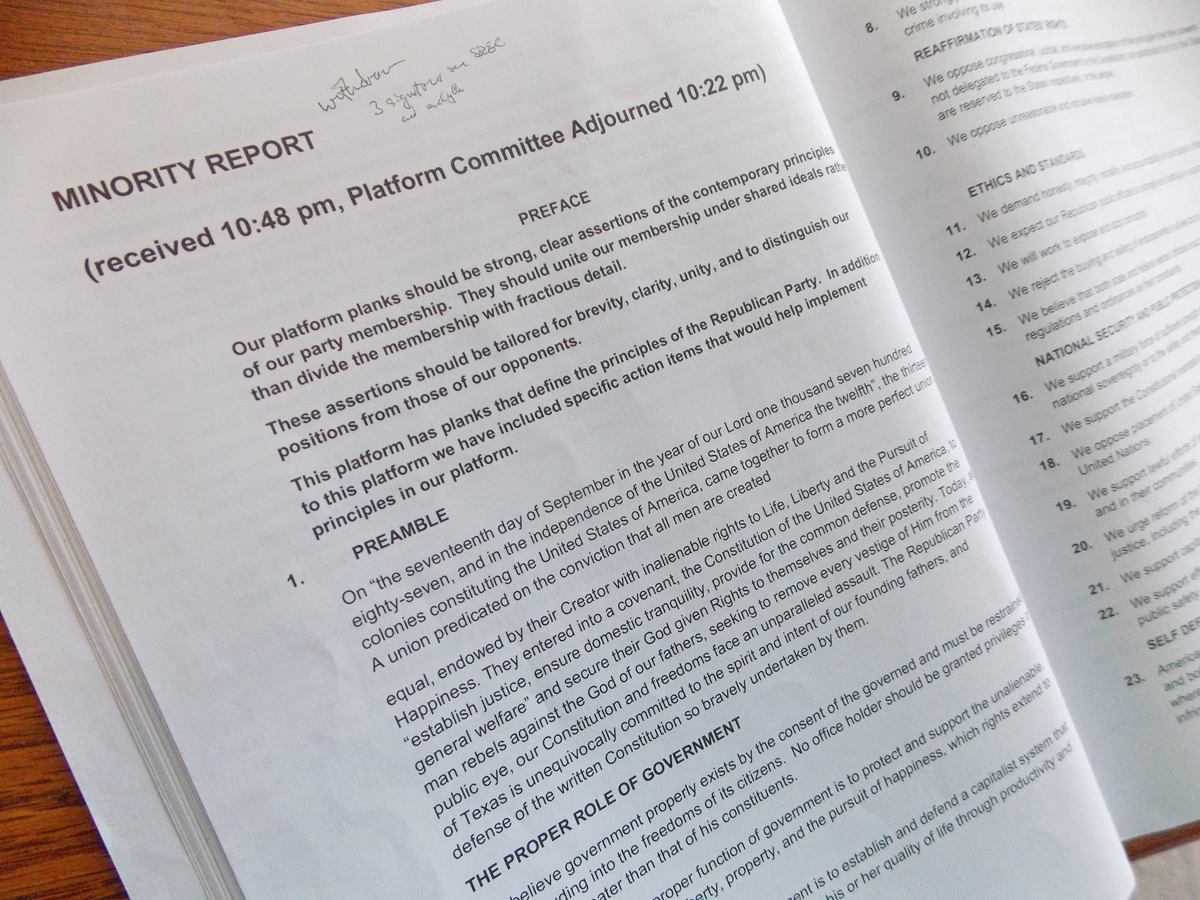
The Minority Report signers had their own version. Much of it was taken from our platform—even a last-minute title. And then there are some things that were their own. It was still 81 planks long, which is ironically not all that short. The preface and preamble were different. The principles, as a section, are missing. Then come 15 categories of issues (more like former platforms, rather than our current legislature-oriented categories), followed by action items in 22 categories. Individual planks under the category headings do not have titles.

 It was written mainly by one committee member. He shared it with other committee members that he thought might side with him, but he never shared it with the whole committee.

Let me repeat that: he never shared it with the whole committee. Debate was complete. Our platform was accepted by the Permanent Committee. And then he asked to reopen debate to present his minority report. The parliamentarian probably should have squelched it at that moment; instead, he asked the indulgence of the chair to allow it, in order to avoid more parliamentary difficulty during floor debate.

The committee hadn’t seen it, hadn’t discussed it. There was no public testimony concerning it. The author, pretty much single-handedly, decided what to keep and what to toss, and what to do differently.

It turned out that three of the signers were also elected as SREC committeemen/women (State Republican Executive Committee, a man and woman from each senatorial district in the state), which disqualified them. This came out during floor debate. I didn’t understand the technicality that led to that decision. I guess they hadn’t understood it either, or they wouldn’t have signed. Anyway, without their signatures, there weren’t enough signers for a minority report, and it was withdrawn.

The author did get his allotted few minutes to present his reasons for wanting a shorter platform, which plants the idea for another year. That may be all he wanted.

The point of all this discussion about the platform—and about the convention entirely—is to show just how grassroots the party is here in Texas. I think that’s the way it should be.

We’ll have just one more post about the convention, which is a big more nationally relevant. I’d like to share some of Senator Ted Cruz’s speech. So that will come next.

Thursday, June 21, 2018

Politics of People, Ideas, and Minority Reports


I mentioned the other day that I prefer talking about ideas, and persuading people toward ideas, much more than persuading people toward people or groups of people—which is what people usually think of as politics.

There were some examples from last week’s Republican Party of Texas Convention in San Antonio.
There was a vote for the state party chair. A year ago James Dickey was appointed to replace the previous chair midterm, voted in by the SREC Committee (two representatives from each of the 31 state senatorial districts). He’s been big on transparency, to involve the grassroots. And his fundraising has gone fairly well too.

It’s an important year. After the US president is elected, the midterm election tends to lose seats in that party. We don’t want that to happen. Here in Harris County, despite the Republican win for president and every statewide race, the Democrats swept Harris County. That means every judge position that was on the ballot, the county tax assessor, the DA—all went Democrat. This election, all those positions that weren’t on the ballot in 2016 are on the ballot this time. With very few exceptions, that would mean judges who make law from the bench, build up a tremendous backlog of cases, and more voter fraud. Not good.

We’re doing what we can here in Harris County. But having a statewide party that runs well is important. We really would prefer to reclaim some of those losses, rather than have more. Life is just better that way—economically and socially.

The campaign literature was piling up.
So the question was, is James Dickey doing well enough? I thought so, but I was willing to hear from the challenger, Cindy Asche. I was unable to attend a forum where they both presented their views and took questions. But I watched two of those forums online. Asche seemed to be saying, “Sure, the numbers look like we’re breaking records, but they should be better.” That’s not a great argument for change. And then, when that didn’t work, “He’s the most corrupt we’ve ever seen,” without any evidence that I could take seriously. He quoted a data point wrong at one point, and then corrected it publicly as soon as he became aware of it.

So I had decided on Dickey before the convention. It helped that he and Alma Jackson, candidate for Vice-Chair, came and met us personally at our Tea Party meeting the Saturday before the convention. But, with as much advertising as there was, especially on Asche’s part, I couldn’t tell how close the race was going to be.

The caucus vote took place Friday morning. Each senatorial district held a vote, and then the Committee representative took that weighted result (based on size of the delegation, rather than single votes—SD 7, where I live, is I believe the biggest delegation in the state) to a committee meeting, where they tallied everything and presented a report to the body later that day.

This is a somewhat indirect process. The Nominations Committee Report tells what the caucuses voted, which is a recommendation. That means their recommended person’s name is automatically nominated on the floor for the whole body of delegates to approve. And the floor is open to any other nomination (depending on who met certain paperwork criteria by a set time). Because Cindy Asche was already running, she was eligible to be nominated from the floor.

That happened—but not until after a minority report form the Nominations Committee. A minimum of 9 of the 31 senatorial districts’ representatives is required to sign a minority report, which signifies that a significant minority felt different from the majority.

The weighted vote was shown on the big screen.
But, remember, the report was just what was recommended. It’s just a tally—which was, by the way, around 66% for Dickey and 34% for Asche, so not a close race. Anyway, to sign a minority report to the Nominations Committee Report means, essentially, that this minority feels strongly that the report is wrong—as in counted in error, or fraudulent. Of course they didn’t make that claim; they just wanted to say a significant minority had a different preference. So they really had no business making a minority report.

So there were objections on the floor. And then there was vote after vote on procedural issues. The acting chair for this set of procedures was Amy Clark, State Party Vice-Chair (up until the convention—she wasn’t running for reelection). There was a voice vote that appeared pretty clearly to me to go to the nays. But, if it isn’t clear on a voice vote, the Vice-chair has the prerogative of requesting an actual count—a paper vote handed in and counted.

She did this to avoid any appearance of preferential treatment for Chairman Dickey. But this was objected to, with a series of procedural things that failed. The objections took more time than simply taking the yea/nay vote by silent ballot would have taken.

During the shenanigans, someone yielded her time to another older woman who announced she was stepping down from her position as an accountant, which was clearly out of order and was halted immediately. But that was weird.

Then one signer of the minority report offered to remove his signature from the report, if it could be guaranteed that Asche’s name could be put into nomination from the floor—without his signature, there would be too few signatures, so it was a withdrawal of the minority report. That wasn’t actually a deal; her name could always have been placed into nomination from the floor. But people were glad to have the minority report taken off the table.

Eventually the two candidates got, I think it was 5 minutes each, to talk. When James Dickey came on stage, a large number of state representatives stood on stage behind him, backing him up. And his speech was upbeat and called attention to the good things underway.

Asche came up alone, and angry, and said, even though she’d been accused of mudslinging, etc., this was really about… after which came more mudslinging. She brought up the accountant who stepped down. She claimed that this woman thought Chairman Dickey was the most corrupt she’d ever worked with. The proof? He wanted the data in Excel, a spreadsheet, rather than a PDF format. She claimed this meant he could change the data at will.

But it would not change the report as sent in. That would be time stamped. There would be the original report, and copes would be made for working with. Chairman Dickey actually uses Google Docs, Google Sheets, etc., which automatically back up—and you can go back to each and every version. So, really all he was asking for was a format that would make the data more usable than in a PDF. He wouldn’t have to have staff retype the data into a spreadsheet, possibly incorporating typos. And that was the essence of Asche’s accusation. In other words, the older accountant woman had issues with modern technology, and I suspect she was taken advantage of.

Chairman Dickey handling convention
business the day after his reelection
So Asche used a full four hours of 8000+ people—time that had been intended for the Rules Committee Report and the beginning of platform debate. She thought her five minutes of accusation—following many weeks of campaigning and after all those hours of parliamentary procedure pain—would be enough to sway more than 16% of the voters to change their caucus-cast vote from Dickey to Asche.

It turned out she lost votes, even in districts she had carried. As a certain spouse of mine quipped, the delegates “kicked her in the Asche.”

The more we saw of her. The less we liked her. If there’s one thing for certain, it’s that we don’t want someone like her leading the party.

So what was that all about? Just extreme narcissism on her part? Probably partly that. But it was also a fight between the grassroots, transparent approach that Dickey has been championing and the older party boss type of GOP, as it was when Asche’s father, Bill Crocker, had been our national committeeman, in the early 2000s. There are some people who would rather have a party elite lead the party, rather than go the way of the grassroots. They didn’t say that outright in their campaigning, because of course that would fail. So they had to make other claims. But they just didn’t have much going for them.

So Friday afternoon at the convention was pretty much wasted on some unnecessary people politics.
I’d like to contrast that with the debates we had on the platform, which were about ideas rather than people. Some of the more heated topics were medical marijuana, school choice, and homosexuality along with what have become related First Amendment freedoms. And another minority report.

As with that Asche floor debate, this has already taken too long. So we’ll do the platform discussion as a part II another day.