Showing posts with label wealth. Show all posts

Thursday, February 13, 2020

Capital Is the Way Out of Poverty


At the Spherical Model, we define a few terms related to the economy:

definitions from SphericalModel.com


Wealth isn’t evil; it represents valuable labor. Money isn’t evil; it’s simply a way to make exchanges of labor easier. Price isn’t evil; it represents a willing agreement to exchange labor. And capital isn’t evil; it represents a way to put surplus to good use.

Economists often use simple societies to explain these concepts. On the Spherical Model website, we use Robinson Crusoe on an island, which is how it was taught to me in a basic econ class.

Recently I had a conversation with a friend that I thought would be a good illustration.

My friend is from an African country that is currently in a lot of turmoil because of corrupt and probably incompetent leadership. Economic conditions are serious enough there that missionaries from my Church have been temporarily transferred out of the country. 

My friend has been living here in America for about a decade; her husband, also from her native country, immigrated to the US much earlier and became a citizen. Nevertheless, getting her permanent residency with full work privileges has been difficult.

Add to that, her husband has a record, from something long ago that I do not know the details of, but which interferes with his getting employment here. This has made for a hard life for them. My friend does caregiving that requires a lot of physical labor at relatively low pay. But she is nevertheless one of the most faithful, optimistic people I know.

The question has been whether they should return to their country. Some months ago, nearly a year, her husband decided to return and try to get a job there. He found someone willing to hire him to work at a college, doing work he is qualified for, as soon as funding becomes available. The problem is, the corrupt government is months behind in meeting payroll for government employees. So he waits, living with his mother, who doesn’t have much to spare. And my friend continues to work here, combining resources with their young adult son, who is working and attending community college.

oil palm trees
image from Wikipedia
They would like to reunite, in whichever country God leads them to. But to return to their country, she tells me, she needs capital—not just to get there, but to have a way to make a living there. She knows where to contact people, up in the hills, who harvest palm oil. The oil needs to be extracted from the palms, and she knows how to either do that or hire that to be done. Then she could bottle it and sell it. I think she may have done a business like that when she last lived there, before she got married and moved to the US.


Capital, to her, I'm guessing means no more than a few thousand dollars. But, how to get that is the challenge.

Capital comes from a few main sources:

1.      Savings—which means building up a surplus over and above basic living costs.

2.      Loans—which means someone else has a surplus they are willing to be used with an expectation of a return plus interest.
3.      Investment—similar to a loan in that someone with surplus is willing to have it be used, and they have an expectation of return. But rather than a simple interest rate, there is some other arrangement.
a.      There could be a partnership arrangement—ongoing sharing of duties and profits.
b.      There could be a stock investment arrangement—sharing the profits as long as the money remains invested.

There are probably other ways, but those are typical. People with surplus want their money to not just sit there, but to be put to use in a way that will make more money.

The personal savings route is going to be a long slog for my friend, unless she and her husband can come up with better/additional income sources than they currently have. But she presses on, expecting no one to just give them something they haven’t earned.

The thing about loans is, you need collateral; you need to have a way to pay back the loan in case the expected returns from the business don’t happen. In general, you need to not really need the loan except for convenience.

oil palm fruits on the tree
image from Wikipedia
But there are some investors in very small businesses like what my friend envisions. It’s called micro-capitalism. (I wrote about this here and here.) The examples I’ve read about, however, work with people in their own countries, where they’re connected with people who can advise them and hold them accountable as they work through the challenges of starting a business. Living half a world away from where my friend would set up a business means getting connected to these sources is an additional challenge. Still, capital is what she needs.

There are steps out of abject poverty. And capital—surplus above subsistence that can be used to produce more surplus—is key.


Sometimes there’s an immediate need to give a man a fish. But that is never a long-term solution to his hunger. You teach a man to fish, and he has the skill to take care of himself. But maybe he also needs the means to make or otherwise get hold of a fishing pole or net.
Capital is the source of the fishing pole or net. I has to come either from personal ingenuity, or from using surplus money for materials or outright purchase.

Getting the capital into the hands of those who can use it—that’s a challenge. But capitalism is the natural solution. No other system can compare.

There may be times when we give a fish—to get someone by. That’s charity, when given freely. But it’s not a permanent solution. Even then, charity requires the production of surplus that can be willingly shared. But the step that moves a person into happy self-sufficiency requires their producing something of value themselves.

I think my friend is capable of producing something of value. If I had the surplus, I would consider investing in her. I hope she is eventually able to obtain what she needs somehow—although I’d prefer for her to stay here and find better opportunities than to move across the globe. One thing is certain, though, she’s smart enough to know that capital is the answer. That’s why it hasn’t occurred to her to complain and protest that no one is giving her a handout.

I pray for her. I tell her and she says, “I know. I can feel it. God is so good to me.” Her life looks very tough to me, but she inspires me with her happiness and perseverance.

Monday, October 28, 2019

Why Put Capitalism on Trial?


This past Friday, the STA Money Hour economists talked about Capitalism on Trial. Usually their radio show is about managing your investments and retirement, so this seemed different and caught my attention.

Luke Patterson was doing most of the talking; along with him was Max Gaines. Patterson started this segment by pointing out that we have nearly 16 million new eligible young voters, who were not old enough to have voted in 2016, the last presidential election. What is on the mind of these new voters?

Not the stock market, not tax cuts, and not deregulation, but rather things like climate change, and income inequality, and forgiving of student loan debt, and more free stuff.
If even half of these voters show up to vote, that could be a problem for Donald Trump. And the alternative—all of them: Warren, Sanders, Biden, even Buttigieg—are extreme (what he calls left, and what is southern statist tyranny on the Spherical Model) and open about their socialist plans.

The economic sphere is the center of the discussion this election. As he puts it,

Profiteering, capitalism, free markets are absolutely on trial—I think fundamental this election. The way of life in the United States I think is also on trial—what we want, and how we want to do things.
So, Patterson goes ahead and makes the case for capitalism. He sets up the defense with this information about what capitalism has done for the United States:

There are now 46.8 million millionaires around the world. That’s up 1.1 million from mid-2018. That’s according to a report released this week by the Credit Research Institute. Thanks again to the value of both financial, like stocks, and non-financial, like real estate assets. The report reveals that there are a lot more millionaires—again totaling 46.8 million millionaires around the world.
From the Credit Suisse Research Institute
Global Wealth Report 2019, p. 11
You’ve got the United States that’s a big part of that. About 25% of the global market capitalization, and the United States is the millionaire capital of the world, according to this report. This year the United States extended its unbroken spell of wealth gains, which they say began after the global financial crisis of 2008. The country now accounts for 40% of dollar millionaires worldwide and 40% of those in the top 1% of global wealth distribution.
The United States, and its system, makes a lot of millionaires. A lot of wealthier people.
This is just the beginning point. The opposition might even say this is a bad thing—creating more inequality, because they don’t understand wealth creation and they think someone gaining wealth means they’re taking it from someone poorer. So there’s more education to do to defend capitalism. Here’s more from the radio broadcast on how US wealth creators compare to other countries:

Luke: And on a per capita basis, there is no country even close. Not even China. Not even close to the United States. They are so distant in second, they’re not even second.
logo found here

What’s more, the biggest gain in the number of millionaires this year comes from—I’ll give you two guesses, Max. Is it Denmark, Switzerland, someplace in Western Europe, China? Gaining the most millionaires this year, with all those people, with a 6% annual GDP growth? Is it China that is creating the most millionaires? Who do you think it is? Western Europe? China? Gaining the most millionaires this year? With all those people, with a 6% annual GDP growth? Is it China that is creating the most millionaires? Who do you think it is?
Max: You’re putting me on the spot.
Luke: I think you know the answer. Give it to us.
Max: I’m not going to say Denmark.
Luke: No. No, you won’t. But it’s the economic system that’s being, I think, promoted by many on the left, as sort of the system to aspire to, the Western European style system.
He’s tells us the answer eventually. But first he’s making clear how the opposition is characterizing capitalism:
Again, capitalism, profit taking, and corporations, and billionaires especially are evil, and our system broken, and so it should be eliminated and rebuilt under a socialist system. That’s what they’re advocating for.
They don’t even apologize for it anymore. It’s not something that they’re saying, well, you know, it just needs to be tweaked around the edges, improve the capitalist system, or make better the things that need improving. They’re not saying any of those things. They’re saying, Listen, this thing is broken. It’s rotten from the inside. It has to be eliminated and criminalized, called out for being evil—to rise up, squash it, and rebuild under a socialist system.
Here’s the essential information, and the answer to his quiz question:
But, as it stands, according to this data, the biggest gain in the number of millionaires this year comes from none other than the United States, which added 675,000 new millionaires in the past year. 675,000 of the 1.1 million.
Hear me on this. This exceeded the extra newcomers in the next nine countries combined.
So, the United States created, this year, 675,000 new millionaires. This exceeded the next nine countries combined: Japan, China, Germany, The Netherlands, Brazil, India, Spain, Canada, Switzerland.
Let’s let that set for a moment. And repeat it. The number of millionaires created in the US this past year exceeds the number of millionaires created in the next nine countries combined. That’s not a small difference.
But, so what if capitalism creates millionaires? Shouldn’t they just feel guilty for that? Don’t we need fewer billionaires and millionaires? Unfortunately, the opposition believes that.
As Patterson says,
So capitalism is on trial. You’ve got Elizabeth Warren. She proposed the Accountable Capitalism Act (nice word), which obliges large corporations to obtain a federal charter requiring directors to consider the interests of all stakeholders—not only shareholders and customers, but also groups representing societies, such as their employees, local communities, civil society, including non-representative anti-business NGOs.
The Chief Justice of the Supreme Court of Delaware—where, by the way, more than two-thirds of the Fortune 500 corporations have their legal home—has written a book arguing that corporations should be run for the benefit of their workers. The Financial Times also launched a new agenda: “Capitalism: Time for a Reset. Business must make a profit, but should serve a purpose too.”
People are buying into this nice-sounding irrationality. He adds,
In a recent letter by the Business Roundtable, 181 corporate CEOs disavow the profit motive. The corporate directors, accountability shareholders, the CEOs champion a new view now widely held by them. It says that profit could only be justified for virtuous conduct, that profit should merely be a byproduct of making certain contributions to society. It’s a proposition that the Business Roundtable already implicitly accepts.
So there’s the central debate question: shouldn’t making contributions to society be a higher value than making a profit? Patterson makes this assertion:

In fact, the profit that a business earns is a pretty good approximation of its contribution to society. One might think of it in terms of a simple equation: revenue (what people pay in a competitive market) minus cost (the value of resources used to provide a product or service) equals profit—which is a first order indicator of a business’s contribution to society.
Here's the equation more visually:
revenue – cost = profit

Profit isn’t bad. As Patterson says, “profit is one of the most powerful signaling devices in the free market.”

Back in 2013 I was taking an online Hillsdale College class on economics, and also reading Poverty of Nations. So I wrote a number of economics pieces, for example, herehere, and here. Professor Gary Wolfram, the Economics 101 teacher at Hillsdale, had pointed out that the decentralized free market system makes it possible for the market to prepare and provide what he wants to buy his wife for her birthday even before he has thought about it. It’s amazing. The wide variety of choices, at costs we’re willing to pay (exchange for the fruits of our labor) are far beyond what is available practically anywhere else in the world. He also said—and I’ve heard others point this out as well—capitalism is based on providing goods or services to people—to serve others. The only way to make a valuable exchange is to think about what will make the customer so pleased that they are willing to exchange their own profits (the fruits of their labors) for whatever it is you’re offering them.

Back to the defense of capitalism. Here’s Luke Patterson again:

In their search for profit, businesses create the dynamic for economic growth and prosperity, rising living standards. Is this not a contribution to society of the most dramatic kind imaginable? The contribution to society, the profits making people wealthier, bringing more people out of poverty? Is that not a contribution to society?
He later goes into some detail about estimates of costs surrounding Medicare-for-all, which is just one of the promises of “free stuff” that Elizabeth Warren fails to show how she will pay for. She says she’ll never take from the middle class. But studies show there isn’t enough wealth in the upper class to take from to pay for this giveaway, which takes profits, and even prices, out of the equation.

Here’s what we can know for sure: the free market creates wealth. It doesn’t just move money from some people and place it in the hands of others; it creates actual wealth—new surplus resulting from work. The free market has indeed lifted more people out of poverty than any other system.

It’s not just luck. It’s not just “Well, things are going OK for now, but that can’t continue.” It’s not just, “Sure, socialism has failed every time it’s been tried, but it just wasn’t ever done right.”

I know, for certain, that I am a better expert on what kind of healthcare I am willing to pay for, what foods I’m willing to buy, what kind of transportation will meet my personal needs—or anything else we make payment exchanges for—than some bureaucrat in a faraway office.

Prosperity requires the freedom to make those exchange decisions for ourselves. The person who earns the wealth should be the one to decide how, when, and whether to spend it, save it, or invest it. Any path that allows anyone else to make that decision leads to poverty.

So, when we’re talking economics with young people, we need to make sure that, if they insist that they care about the poor (which they think might include them), we let them know the way to lift the poor is more free market, combined with careful philanthropy—not more government control.

Thursday, October 17, 2019

What Does Warren Mean by a Wealth Tax?


Elizabeth Warren said in Tuesday night’s debate that she’s shocked, “shocked!” that anyone thinks she’s punitive. Ben Shapiro responded on Wednesday,

Elizabeth Warren (left) from debate October 15, 2019
screenshot taken from clip on the Ben Shapiro Show, episode 878


She’s shocked people think she’s punitive? She is punitive. She’s deeply punitive. And by the way, she’s not just punitive; she’s immoral. There was one point during this debate where Elizabeth Warren actually suggested, during the debate, that the rich are “not like you and me.” Elizabeth Warren is worth $10 million.
What was it she said?

So, understand, taxing income is not going to get you where you need to be, the way taxing wealth does. That the rich are not like you and me. Really really billionaires are making their money off their accumulated wealth, and it just keeps growing. We need a wealth tax in order to make investments in the next generation.
There’s a logic leap here. If wealth keeps accumulating, that means the economy is growing; it doesn’t mean a particular person keeps getting more of a finite economic pie. The more a rich person accumulates, the more gets invested—now and in the next generation.

It’s time for a lesson on economics and on government.

Let’s start with where in the Constitution the federal government is granted power to tax: Article 1, Section 8.

The Congress shall have Power To lay and collect Taxes, Duties, Imposts and Excises, to pay the Debts and provide for the common Defence and general Welfare of the United States; but all Duties, Imposts and Excises shall be uniform throughout the United States.
Before we go on, let’s define terms.

Article I, Section 8 of the US Constitution, on taxes


·         Tax—a compulsory payment, usually a percentage, levied on income, property value, sales price, etc. for the support of a government
·         Duty—a payment due to the government, esp. a tax imposed on imports, exports, or manufactured goods
·         Impost—a tax, esp. a duty on imported goods
·         Excise—a tax or duty on the manufacture, sale, or consumption of various commodities within a country, as liquor, tobacco, etc.; a fee paid for a license to carry on certain occupations
There’s one other part of the Constitution granting power to tax. It’s the 16th Amendment, ratified in 1913:

The Congress shall have power to lay and collect taxes on incomes, from whatever source derived, without apportionment among the several States, and without regard to any census or enumeration.
When it was added, people were promised it would only affect the very rich, and even for the rich it would never go beyond 7%. That lasted about three years; it about doubled to 15% in 1916. Not enough, the government decided. Woodrow Wilson more than quadrupled it to 66% by 1917 and then to 77% by 1918%. (I wrote about this starting here.)

If you have made any income above the poverty rate in your lifetime, then you know it isn't just the very rich who are taxed. And obviously the government does not keep its promises. To boot, it does not limit its taxing purposes to paying debts and providing for the common defense and general welfare (i.e., things that benefit all of the states at once, such as coining money, having a postal system, or possibly infrastructure such as an interstate highway system—nothing to do with charitable giving to the poor).

As practically unlimited as the 16th Amendment made taxing authority to the federal government, it is still limited to income or to specific circumstances—such as imports or the other things listed. Income wasn’t taxable in the original list. Government revenue had to come through tariffs (import fees) or the other listed ways.

We don’t have a state income tax in Texas, which is a boon to the economy. Governments have to get revenue from other sources, property tax being a primary source, also sales and other local taxes. Up until 1913, the federal government was similarly limited.

But the 16th Amendment does not grant the right to tax wealth.

Let’s define another term, from the Spherical Model website:

·         Wealth is not some mystical entity endowed by either government or birthright. Nor is it something that the haves enjoy by depriving the have nots of their fair share. Wealth, simply, represents the accumulation of the results of labor.
And one more:

·         Capital is always a representation of surplus work that is invested to find ways to produce more wealth.
To summarize, wealth is the accumulation of surplus—working to create more than is needed for subsistence, and storing it (saving it) for later use. Rather than simply storing it, the wealth can be used to invest in ways that produce more wealth.

Most wealth is not stashed in a jar buried in the back yard. It is put to use. It is either spent—used to buy goods and services, which thus brings wealth to the providers of those goods and services, who then use that income to either spend or invest elsewhere. Or it is saved. One of the least productive ways would be in a low-interest savings account. This keeps it liquid—available for use at short notice—but while it sits there, it brings additional income. Where does that come from? Investing. The bank is loaning money to home buyers, businesses, and others who contract to repay with interest.

Another way wealth is invested is in stocks and bonds. These are slightly larger risks than keeping the money in a bank savings account. But they have the potential to bring in greater returns, greater income.

A more direct way would be to invest capital directly in a company with the hope of having the business become a success and bring a greater reward to the investor. Higher risk, but also higher potential returns.

You have probably heard this aphorism: what you subsidize, you get more of, and what you tax, you get less of.

So, if—as Elizabeth Warren suggests—you tax wealth, you get less of it. Obviously. You would directly confiscate money for which income tax has already been paid. So you’re essentially taxing savings. You directly diminish savings. Which means you directly diminish the uses for those savings: capital investment. Economic growth.

What gives the federal government the right to “tax” your savings? So far nothing. The Constitution does not grant that power—not even the 16th Amendment does that.

That didn’t stop Obamacare from “taxing” us by forcing us to buy medical insurance (at exorbitant rates), which they could get away with only by insisting (at times) that the penalty for not purchasing it was a tax and not a coercion to purchase a service. What was being taxed—and thus discouraged? Breathing. Being alive. That had never been done. It isn’t accommodated for in the Constitution. But that didn’t stop the government—with the support of a wobbly Supreme Court—from asserting it as a power.

So, when we have Elizabeth Warren, Democrat candidate for president, saying she wants to “tax” wealth, let’s be very clear on what she’s saying. She is saying the federal government can come to any person in the country who holds savings and take whatever part of that savings or property that it wishes. She is saying you do not have a right to either your income or your savings or maybe any property. If she decides you have “too much,” she can take whatever portion she wants and can do with it as she—in her infinite wisdom—sees as a better use than however you were going to spend it or invest it or enjoy it.

She says it will not affect any but the very rich. Just as Woodrow Wilson said. (They both were college professors, labeling themselves progressive capitalists—but without the progress or the capitalism.)

The only legal mechanism for the government to confiscate wealth is by constitutional amendment. Except for the very limited eminent domain power, which requires just compensation, the federal government cannot confiscate real property. And there has never been a mechanism for confiscating savings.

But those who ignore the Constitution in all other things are just as likely to ignore this lack of power and reign tyrannically any chance they get.

However, they don’t actually get the money they say they will take.

Just as we know no one in their right mind ever paid the ridiculously high top income tax rates imposed by the progressives in the last century, no one in their right mind would pay the wealth-tax-only-on-the-very-wealthy that Warren “has a plan for.” 

Government gains revenue when it lowers tax rates to more reasonable levels. When they’re too high, people don’t make the income, or they move and make the income elsewhere, putting it out of reach of the government’s clutches. Similarly, if Warren were to attempt to take any chunk of wealth held by those “evil” billionaires, they would move their wealth out of the country. The US would then have less tax revenue, a more sluggish economy overall from lack of investment capital, and essentially no revenue from the “wealth tax.”

But she would have made the covetous poor feel so much better by pretending to stick it to the rich.

That’s what it’s about. Not about gaining revenue for ridiculous unconstitutional projects she has a plan for, not even for paying current debts and obligations. It’s about saying what it takes to get voters to give her power—which she is so very willing to assert the moment she gets it.

As are all of the Democrat candidates.

If we value the freedom, prosperity, and civilization guaranteed us by our brilliant Constitution, we must prevent those who trample it from ever holding the reins of power.

Monday, February 25, 2019

What Is Property?


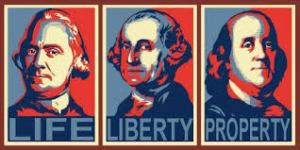
What is property? And why does it rank up there in importance with life and liberty?

image from here

First, we start with the premise that we value life. If there’s one entitlement we can agree on, it should be that we are each entitled to our right to life. The only way to forfeit that is voluntarily, as in war, or stepping in to protect someone being harmed. Or, if we take some other innocent person’s life, then the law can allow society to take our life. So we start with valuing life.

If we can’t agree to the right to life, then it’s hard to find any common ground. As I write, there’s a bill in Congress to protect the life of children born alive—particularly in a failed abortion procedure (failure to kill the infant before birth). [The bill failed. All Democrat presidential candidates and other likely candidates just voted that murdering newborns is fine with them. Remember that when it’s time to vote and someone tries to tell you Trump is the worst president ever.] The anti-life people, who like to euphemistically call themselves pro-choice, are finally admitting that there’s no difference between a baby just before birth and just after—and if they’re willing to kill just before birth, then they have no reason not to extend that willingness to kill a child after birth. What ought to go without saying—that an innocent baby is a life worth protecting from murder—is something we now have to spell out.

If we were to exemplify savagery, killing innocent babies would be on the poster.

So, let’s start with valuing life.

And then we can move on to how we spend our life. Freedom, or liberty, means we get to choose how we go about living, which will include doing work to sustain ourselves. Because we’re all born naked, shelterless, and ignorant—so much so that we really need a family to provide the necessities until we grow and learn to provide them for ourselves, which can take close to a couple of decades. Once we’ve become capable, liberty is how we pursue overcoming our original state of poverty and ignorance, and then enjoy the fruits of those endeavors.

In short, liberty is freedom to spend our lives, portion by portion. We may exchange our time and energy in exchange for money, which is a symbol for exchange of labor—or for a portion of our lives. Money makes it easier to exchange a piece of our labor that results in, say, a chair we built, with a person who fished for some food for dinner, if we have a common rate of exchange. Then you can get fish for dinner—or the several dinners a chair would be worth—from someone who doesn’t need another chair, but who does want something someone else produced, who does need a new chair. It’s just an easier means of exchanging our work for what we could use beyond simply the fruits of our own labors.

It’s a free exchange.

What is it when your work is required, but it’s not a free exchange? That’s slavery. Someone uses your time and energy—a portion of your life—and takes the fruits of your labor, instead of leaving you those fruits for your use. If you value life, you can see that stealing a portion of a person’s life is also wrong.

image from here
That covers life and liberty. Then, what is property? It is the result of your labor, above and beyond what you need to survive, that you can continue using. It’s another word for wealth, which simply means the accumulation of the results of your labor beyond what you need to subsist.

There’s another word for that: capital. It means that you have acquired wealth—results of labor beyond subsistence, that you can then use to invest in tools or other ways of creating more wealth. Or just keep it on hand until such an opportunity arises. It’s not evil; it exists only from successful work—or successful spending of a portion of your life.

Capital isn’t bad. Property isn’t bad. In fact, your property is just a way to enjoy the fruits of your labor over time—and possibly to help produce more fruits of labor. It’s evidence of a life well spent.
What happens when someone acquires far more property than someone else? That’s evidence that the person has offered something other people value enough to exchange the fruits of their work for. That person has benefited a lot of people. He then has an opportunity to spend that money, to the benefit of other workers. Or he might invest it in ways that provide work—and income wealth—to multiple workers. Or he might stuff a mattress with it so it benefits no one. But it’s his choice, because it’s his property.

Owning more property than someone else, then, isn’t wrong; it’s just evidence of serving society in a way that society appreciates.

What about those whose work doesn’t result in enough to subsist? That’s a social issue we can choose to care about, and do something about. It might be that we have enough surplus to offer a portion to the needy. That’s called charity. On a larger scale we might call it philanthropy. It’s a voluntary gift. Or, you could say it’s the exchange of the results of our labor—or wealth—for the sense of well being that comes from helping out another human being.

A righteous, caring people will want to do enough for a needy person to meet their needs without discouraging them from trying to get themselves to a more self-reliant state. You don’t want to create dependence. You don’t want to discourage someone from trying. You’ll want a person to feel valued and encouraged to contribute as much as they can to society. That takes actual caring, and often close acquaintance with a person’s situation, such as in a church community.

As long as a person in need is helped out by caring people, it simply doesn’t matter that there are large differences in property ownership.

If you think you’re entitled to the fruits of someone else’s labor, you’re a thief at heart. And let’s spell that out even more clearly: you’re a slaver. To take the fruits of someone else’s labor is to take the portion of their life that went to producing that wealth.

When government takes the fruits of your labor to “redistribute” it to someone who didn’t work for it, then government is the slaveholder and you’re the slave. This is true of anything government does beyond the proper role of government: protection of life, liberty, and property.

The way things are right now, government enslaves us for a pretty large chunk of the year. 

Entitlements—the euphemism for redistributing wealth, or pretending to do charity by coercive theft—make up a larger part of the federal budget, and most state and local budgets, than the necessities of protection.

And, as we know here at the Spherical Model,

Whenever government attempts something beyond the proper role of government (protection of life, liberty, and property), it causes unintended consequences—usually exactly opposite to the stated goals of the interference.
We make better use of our money—our property—than government can.

If there’s any person thinking about leaning toward socialism, ask, sincerely, who has the right to enslave you by taking away the fruits of your labor? It doesn’t matter if other countries, or other states, do it. Taking property away from those who paid for it with the fruits of their labor is taking a portion of their life. It isn’t fair. It’s wrong. As wrong as slavery has always been.


Thursday, September 29, 2016

More on Wealth, Poverty, and Politics

image from Amazon
Economist Thomas Sowell has a new edition of his classic book Wealth, Poverty, and Politics, and talked about it in the latest Uncommon Knowledge interview.

Peter Robinson starts the interview with a quote from the book, which serves as a theme:

It is not the origins of poverty which need to be explained. What requires explaining are the things that created and sustained higher standards of living.
In explaining what he means by that, Dr. Sowell says,

There are actually books with titles and subtitles about the origins of poverty. Well, the entire human species began in poverty. So I don’t know why we say, what is the origin? Perhaps the Garden of Eden or someplace. But more than that, you’re trying to explain why some countries are poor rather than trying to explain why other countries are more prosperous. There’s no explanation needed for poverty. The species began in poverty. So what you really need to know are what are those things that enable some countries, and some groups within countries, to become prosperous.
He further explains that there are unstated assumptions about income inequality that are false, but are left unexamined. To use another quote from the book,

One of the key implicit assumptions of our time is that many economic and social outcomes would tend to be either even or random, if left to the natural course of events, so that the strikingly uneven and non-random outcomes so often observed in the real world imply some adverse human intervention.
So, there’s this idea being promulgated that, because people are equal, their outcomes should be equal. But people aren’t equal. They are equal before the law—no class of humans more deserving of justice than any other—but people are different in intellect, drive, learning, creativity, desires, preferences, and circumstances.

Dr. Thomas Sowell
image from Uncommon Knowledge
And people are located in different places. Dr. Sowell talked about the Zaire River in Africa, which carries more water than the Mississippi. But it is full of falls and cascades that make it mostly non-navigable, while the Mississippi smoothly changes elevation by only about four inches per mile. People living by the Mississippi, then, have a water route that people living by the Zaire River do not.
He also talked about isolation, such as caused by mountains. People living in isolated Afghan mountain villages live at approximately the same level of poverty as people in isolated Appalachian mountain villages. And people who live discovered on isolated islands are found living very little different from stone age people. Isolation means less trade, less learning from others, less benefiting from others.

So it isn’t some rich person taking away from a poor person; it is a rich person doing what it takes to escape from poverty.

We basically know what those things are. One of the main sources of wealth is human capital. Here’s another quote from the book:

The welfare state reduces the incentives to develop human capital. And receiving the products of other people’s human capital is by no means as fundamental as developing one’s own human capital.” [18:30]
Following the quote, Peter Robinson asks “What is human capital, and why does the welfare state suppress the incentives to develop it?” Dr. Sowell answers, “Well, human capital is the ability to create the material things that constitute wealth.”

A classic example. In the 1970s, Uganda decided that the Gujaratis of India were just too wealthy and controlled too much of the economy. They sent them out, and they wouldn’t let them take their wealth with them. So the Gujaratis arrived mostly in England, destitute. And the Ugandan government has taken over all this material stuff. Over a period of a relatively few years, the Gujaratis were prosperous in England, and the Ugandan economy collapsed, because they didn’t have people who could do what the Gujaratis were doing. And so they no longer had the same production.
It's also one of the problems with trying to solve things by confiscating the wealth of the wealthy. All you can confiscate is the material wealth. You cannot confiscate the human capital.
Confiscating wealth from those who created it and giving it to those who didn’t create it only moves things around, not wealth-generating capabilities.

And income redistribution is wrong-headed in other ways. Talking about the concern that the top 10% have undue influence over society, Dr. Sowell says,

TS: 53% of American households are going to be in the top 10% at some point or other in their lives. You talk about these percentages as if these are ongoing, the same set of people in this bracket, and that bracket. Most Americans do not stay in the same 20% bracket for more than one decade.
PR: So it’s largely a life cycle: you’re poor when you’re young, and doing well when you’re old.
TS: Yes. And there’s nothing mysterious about that. Probably most people in this country, when they started out at entry level jobs were not making what they’re making when they’re forty years old. Heaven knows, I was making $2 a day to deliver groceries, and depended on tips for the rest. [17:20]
He later added,

Somebody said the other day that they want to ease the pain of people in poverty. The pain of poverty is what got many people out of poverty. [35:23]
Peter Robinson ended the interview by having Dr. Sowell read a passage from the book, which summarizes the fallacy of economic equality as a goal:

It is by no means obvious why we should prefer trying to equalize income to putting our efforts into increasing output. People in general, and the poor in particular, seem to vote with their feet, by moving to where there is greater prosperity, rather than where there is greater economic equality.
Rising standards of living, especially for those at the bottom economically, have resulted not so much from changing the relative sizes of different slices of the economic pie as from increasing the size of the pie itself, which has largely been accomplished without requiring heady rhetoric, fierce emotions, or bloodshed.
Does it not matter if the hungry are fed, if slums are replaced by decent and air conditioned housing? If infant mortality rates are reduced to a tenth of what they were before? Are invidious gaps and disparities all that matter? In a world where we are all beneficiaries of enormous windfall gains that our forebears never had, are we to tear the society that created all this apart because some people’s windfall gains are greater or less than some other people’s windfall gains? [40:34]
Thomas Sowell always offers up truth with good humor and common sense. So even when he says what he has said before, we enjoy it. Let’s summarize with a couple of basic economic principles:

·         Thou shalt not covet. [I wrote about this April 26, 2013]

·         Live the principles that build social capital. [I wrote about this February 24, 2012]

Thursday, June 18, 2015

Disparity

Some people have more money than others. Some people have a lot more than others. Is there something wrong with that? Something evil that requires correction?

First of all, what is wealth, again? At the Spherical Model, this is the definition:

Wealth is not some mystical entity endowed by either government or birthright. Nor is it something that the haves enjoy by depriving the have nots of their fair share. Wealth, simply, represents the accumulation of the results of labor.
There is a total amount of wealth in the world—at this current moment. But that is an accounting detail, not a limit. There is no upper limit to wealth in the world. It is producible by every productive human individual.

There’s a section of The Lessons of History, by Will and Ariel Durant, on money, and disparity of wealth:

Since practical ability differs from person to person, the majority of such abilities, in nearly all societies, is gathered in a minority of men. The concentration of wealth is a natural result of this concentration of ability, and regularly recurs in history. The rate of concentration varies (other factors being equal) with the economic freedom permitted by morals and the laws. Despotism may for a time retard the concentration; democracy, allowing the most liberty, accelerates it….
We conclude that the concentration of wealth is natural and inevitable, and is periodically alleviated by violent or peaceable partial redistribution.
So, what we know is, there will always be differences, disparity of wealth. Because people are different. But the problem isn’t that wealth disparity exists; it is that poverty exists. As the Gospels say, “For ye have the poor with you always” (Mark 14:7, see also Matthew 26:11 and John 12:8).

It would be helpful to look at real root problems, rather than imagined problems.

Does a rich person’s wealth prevent a poorer person from generating wealth? Not in a free market. In a true free market, wealth is developed by producing more than the minimum necessary for survival. In the language of money, it’s when you earn more than you spend, and you accumulate the extra. And you might accumulate more if you invest it—low amounts in a savings account, possibly more with other investments—along with the risk of loss.

But what about the person who spends everything he can earn, and can hardly get by? What if he can barely cover his food, clothing, and shelter needs, with nothing left over for education, entertainment, or greater comfort? Is it fair that he works hard and lives this way, when another person works maybe only as many hours—and maybe at less physically taxing work?

Isn’t it evil for the rich person to accept so much money—way beyond what he needs—for work that is in many ways equivalent to a regular worker?

The Good Earth
That’s the kind of question that leads to discontent and sometimes to violence. 

In Pearl Buck’s novel The Good Earth, there’s a point where the poor are starving and growing daily more desperate, squatting along the walls of the wealthy, until things get so heated, the poor rise up and raid the property of the wealthy, looting and killing. That was a book of fiction, but the Durants’ book describes that as a typical cycle.

It might look like the problem is too much wealth at the top, but it’s really about too little at the bottom. When people are starving and suffering while the wealthy ignore their needs, that is an injustice that won’t stand indefinitely. Usually in that kind of situation, there are interferences going on that protect the position of the wealthy at the expense of the poor. There are class systems that keep people down. Or there are limits to who can do what work, or enter into certain businesses.

It is interference with liberty that leads, not simply to disparity, but to suffering by the poor with no apparent way out. More interference, even with the intention of making up for the injustice, will never solve the problem.

The problem isn’t that some people make more; the problem is that there are actual poor—those who, for no fault of their own, cannot earn enough to meet their needs—that aren’t being taken care of.

A Democrat friend (whom I am quoting without identifying, because I value the friendship, if not the ideas) recently posted this Jimmy Carter quote:

If you don’t want your tax dollars to help the poor—then stop saying that you want a country based on Christian Values, because you don’t.
And then he commented,

We are the government. We choose where the money is spent. If you hate government, then work to change it. A society is known for how it treats people. I choose to live in a society where we feed the poor and provide great education for people to succeed. I believe we should provide healthcare to all people regardless of what country of birth or ability to pay. These people are our brothers and sisters. If you want to turn away your brother and sister then send them to me. If you want to blame government for everything bad in this country, then blame your forefathers for setting up this system. I choose to work harder to make a difference.
I guess we need to mention that this is not the system of forefathers set up. I've read the Constitution. But this is an example of how many Democrats think. They would never vote for a Republican, because Republicans are mean and stingy, and out to make money for themselves and let the poor starve. But they’re wrong. Republicans, or conservatives in general, because they don’t assume that government has relieved them of responsibility, are much more likely to give freely, and are likely to find charitable organizations that make a real difference in the lives of those in need. need.[i]

Government is coercion. There is no charity in coercion, so government charity is a lie; it is the despotism of redistribution. In short, that means we are voting to allow government to take earnings from whomever it chooses and to give that confiscated money to whomever it chooses. In our individual lives, that is called theft. When our government does it, it doesn’t suddenly become noble; it is still theft.

The “we are the government” claim is a fallacy. We, the people, are sovereign, and grant to government only what we must, to perform specific security and infrastructure roles. When government takes our money to give to the poor, we aren’t being charitable; we are being robbed. And too often the poor aren’t helped out of poverty; they are lured into dependency on government, which is about government power much more than about helping people. If you assume that, once robbed by government you have no more responsibility to the poor, you might be making yourself feel good, but you’re not actually engaged in charitable giving.

Follow that “we are the government” idea to its logical conclusion, and it means any majority can do anything it wants: confiscate wealth, take businesses from those who own them (ask GMC dealers under threat of Obama), control what you produce and sell, control what you are allowed to do with your own property, decide whether you are a preferred person to get various opportunities, decide how you raise your children, decide whether you get health care and within what limits, and on endlessly.

The solution to poverty isn’t theft from earners. It has to be actual charity. People with enough to meet their needs need to feel compassion in their hearts and give freely, in ways that will help the poor, whenever possible, to move out of their situation and become self-sustaining, and on the way to building their own wealth.

Name calling about whether someone is Christian or not isn’t helpful. Start with tithes and offerings. A tithe is 10% of your gross income (you figure that out, if you’re a business; it can be after reinvestment in the business for future income). Then, on top of that, consider going without something, such as a meal or two while you fast, and giving that to the poor. If your church isn’t a good outlet for the entire amount of your charitable giving, then find the charities that work for you.[ii] If you’re not doing this minimal amount that God asks for, then don’t go pretending you’re more giving because you let government take your money for its purposes. [Note: the Democrat friend actually is a rare one who pays tithes, so at least he's not hypocritical on this point.]

Baby Social Sphere helps by making friends
at a nutrition screening in Peru
If you’re at the lower end but getting by, you can still give that percentage; the widow’s mite was the greatest gift left at the altar that day (Luke 21;1 and Mark 12:14). Seeing yourself as someone with extra to give can be mind-changing in ways that lead to wealth. You feel gratitude instead of covetousness. You recognize the value of what you have and take care of it. You feel generosity to care for the less fortunate. You cease to feel entitled to what others have earned and begin to feel confident in your own ability to meet your needs and offer value to the world.

Inculcating real charity, instead of resentment and covetousness, would get us closer to solving the poverty problem.


The problem isn’t disparity, so let’s not even worry about that. The problem is that some people are in need and really need help. The political solution isn’t more government control; it is more liberty. The economic solution isn’t forced redistribution and control, but free market with its opportunities. The real solution is something you need for civilization—real charity and voluntary giving.


[ii] I suggest Liahona Children’s Foundation, which offers nutrition-dense resources for poor children, a project daughter Social Sphere is helping with in South America the past couple of months.

Monday, June 8, 2015

Habits and Thoughts of Prosperity

There’s a formula for escaping poverty in America, and entering the middle class, which we’ve repeated here a number of times: here, here, here, here, here, here, and here
  •        Don’t have sex before age 20.
  •        Don’t have sex until after marriage.
  •        Stay married.
  •        Obtain at least a high school diploma.
The economic problem is solved with social/civilization solutions.

A couple of contrasting articles came to my attention recently. The first, “Telling Poor, Smart Kids That All It Takes Is Hard Work to Be as Successful as Their Wealthy Peers Is a Blatant Lie,” explains why the poor are so disadvantaged that no amount of hard work can overcome their disadvantage. The other, “Will Your Child be Rich or Poor? 15 Poverty Habits Parents Teach Their Children,”  explains the difference in ways of thinking between the poor and the wealthy.

The formula above is pretty minimal. Out of poverty means you’ve got housing, clothing, and food handled. But it might require a lot of hard work, lifelong struggle, and lack of the perks of wealth: travel; additional education; art and music for pleasure; luxuries and comforts; enjoying better foods, clothing, and housing.

Is that fair? People who think it is wrong for some people to enjoy things that all can’t enjoy are different from people who enjoy those things without guilt. And our beliefs determine a lot about our lives. So maybe those thoughts are worth looking at.

The you-can’t-get-out-of-poverty beliefs revealed in the first article are something like, “No one gets wealth just from hard work, good ideas, and social connections; they get that on the backs of the disadvantaged,” and “The deck is stacked against the poor, so no matter how hard they work, they’ll never get ahead.” The beliefs are self-fulfilling.

Changing thoughts can change the outcome.

There’s something to be said for social capital; it can make up for lack in a limited number of households. But if the larger community doesn’t have enough social capital, the disadvantages of social-capital-lacking families can be devastating.

The disadvantages can’t be overcome with money. Certainly they can’t be wiped out by taking money from the wealthy and giving it to the disadvantaged. Money is useful as economic capital, but it isn’t moral—it’s neutral.

The second article shows there's a difference in habits and ways of thinking that overcome the disadvantages, using a couple of lists. The first list contrasts habits of the wealthy and the poor. And the second describes what parents can do to teach the right ways of thinking that allow for wealth.
Here are a few of the contrasts (some of these I’ve paraphrased):
  •         80% of the wealthy are focused on at least one goal vs. 12% of the poor.
  •          83% of the wealthy attend/attended back-to-school night for their kids vs. 13% of the poor.
  •          67% of the wealthy watch 1 hour or less of T.V. per day vs 23% of the poor.
  •          9% of the wealthy watch reality T.V. shows vs. 78% of the poor.
  •          73% of the wealthy were taught the 80/20 rule vs. 5% of the poor (live off 80% save 20%).
  •          8% of the wealthy believe wealth comes from random good luck vs. 79% of the poor.
  •          79% of the wealthy believe they are responsible for their financial condition vs. 18% of the poor.
The wealthy have different habits, and think different thoughts. They live their lives differently.

So what is on the list of what to teach? All of it assumes teaching them the minimal formula of escaping poverty, listed above; that goes without saying. Then, some of it is clearly economic, but much of it is social (again, somewhat paraphrased).
  •          Limit TV, social media, and cell phone.
  •          Require educational reading, in addition to recreational reading.
  •          Get kids to physically exercise every day.
  •          Limit junk food.
  •          Teach goal setting—short-term and long-term.
  •          Expect children to work to earn money, and to volunteer.
  •          Teach children to save a large portion of their earnings and gifts of money.
  •          Teach manners, and gratitude.
  •          Encourage children to risk making mistakes, which can be used for learning.
  •          Teach children to manage their anger and negative emotions appropriately.
  •          Encourage sports and additional extracurricular interests.
  •          Spend time talking together as a family every day.
  •          Teach principles of good time management.

The poor need to learn that poverty can be a temporary place, and that within themselves lie great possibilities. Nothing keeps them in poverty more than thinking they’re stuck there, and then making decisions as though nothing they do matters.

Changing thinking would work better than taking all the money from all the top 1% of earners, and redistributing it to the poor. Those wealthy who are newly made poor are likely to recover, probably within their own lifetime, and certainly within an additional generation. Those given sudden wealth would remain in poverty, or return to it within a generation.

Prosperity requires certain economic practices, but it also requires living the principles of civilization. We don’t need ways to take wealth from those who have made it; we need ways to teach those who don’t have it what it takes to earn it. Teach them the habits and beliefs of prosperity.