Showing posts with label money. Show all posts

Thursday, February 13, 2020

Capital Is the Way Out of Poverty


At the Spherical Model, we define a few terms related to the economy:

definitions from SphericalModel.com


Wealth isn’t evil; it represents valuable labor. Money isn’t evil; it’s simply a way to make exchanges of labor easier. Price isn’t evil; it represents a willing agreement to exchange labor. And capital isn’t evil; it represents a way to put surplus to good use.

Economists often use simple societies to explain these concepts. On the Spherical Model website, we use Robinson Crusoe on an island, which is how it was taught to me in a basic econ class.

Recently I had a conversation with a friend that I thought would be a good illustration.

My friend is from an African country that is currently in a lot of turmoil because of corrupt and probably incompetent leadership. Economic conditions are serious enough there that missionaries from my Church have been temporarily transferred out of the country. 

My friend has been living here in America for about a decade; her husband, also from her native country, immigrated to the US much earlier and became a citizen. Nevertheless, getting her permanent residency with full work privileges has been difficult.

Add to that, her husband has a record, from something long ago that I do not know the details of, but which interferes with his getting employment here. This has made for a hard life for them. My friend does caregiving that requires a lot of physical labor at relatively low pay. But she is nevertheless one of the most faithful, optimistic people I know.

The question has been whether they should return to their country. Some months ago, nearly a year, her husband decided to return and try to get a job there. He found someone willing to hire him to work at a college, doing work he is qualified for, as soon as funding becomes available. The problem is, the corrupt government is months behind in meeting payroll for government employees. So he waits, living with his mother, who doesn’t have much to spare. And my friend continues to work here, combining resources with their young adult son, who is working and attending community college.

oil palm trees
image from Wikipedia
They would like to reunite, in whichever country God leads them to. But to return to their country, she tells me, she needs capital—not just to get there, but to have a way to make a living there. She knows where to contact people, up in the hills, who harvest palm oil. The oil needs to be extracted from the palms, and she knows how to either do that or hire that to be done. Then she could bottle it and sell it. I think she may have done a business like that when she last lived there, before she got married and moved to the US.


Capital, to her, I'm guessing means no more than a few thousand dollars. But, how to get that is the challenge.

Capital comes from a few main sources:

1.      Savings—which means building up a surplus over and above basic living costs.

2.      Loans—which means someone else has a surplus they are willing to be used with an expectation of a return plus interest.
3.      Investment—similar to a loan in that someone with surplus is willing to have it be used, and they have an expectation of return. But rather than a simple interest rate, there is some other arrangement.
a.      There could be a partnership arrangement—ongoing sharing of duties and profits.
b.      There could be a stock investment arrangement—sharing the profits as long as the money remains invested.

There are probably other ways, but those are typical. People with surplus want their money to not just sit there, but to be put to use in a way that will make more money.

The personal savings route is going to be a long slog for my friend, unless she and her husband can come up with better/additional income sources than they currently have. But she presses on, expecting no one to just give them something they haven’t earned.

The thing about loans is, you need collateral; you need to have a way to pay back the loan in case the expected returns from the business don’t happen. In general, you need to not really need the loan except for convenience.

oil palm fruits on the tree
image from Wikipedia
But there are some investors in very small businesses like what my friend envisions. It’s called micro-capitalism. (I wrote about this here and here.) The examples I’ve read about, however, work with people in their own countries, where they’re connected with people who can advise them and hold them accountable as they work through the challenges of starting a business. Living half a world away from where my friend would set up a business means getting connected to these sources is an additional challenge. Still, capital is what she needs.

There are steps out of abject poverty. And capital—surplus above subsistence that can be used to produce more surplus—is key.


Sometimes there’s an immediate need to give a man a fish. But that is never a long-term solution to his hunger. You teach a man to fish, and he has the skill to take care of himself. But maybe he also needs the means to make or otherwise get hold of a fishing pole or net.
Capital is the source of the fishing pole or net. I has to come either from personal ingenuity, or from using surplus money for materials or outright purchase.

Getting the capital into the hands of those who can use it—that’s a challenge. But capitalism is the natural solution. No other system can compare.

There may be times when we give a fish—to get someone by. That’s charity, when given freely. But it’s not a permanent solution. Even then, charity requires the production of surplus that can be willingly shared. But the step that moves a person into happy self-sufficiency requires their producing something of value themselves.

I think my friend is capable of producing something of value. If I had the surplus, I would consider investing in her. I hope she is eventually able to obtain what she needs somehow—although I’d prefer for her to stay here and find better opportunities than to move across the globe. One thing is certain, though, she’s smart enough to know that capital is the answer. That’s why it hasn’t occurred to her to complain and protest that no one is giving her a handout.

I pray for her. I tell her and she says, “I know. I can feel it. God is so good to me.” Her life looks very tough to me, but she inspires me with her happiness and perseverance.

Monday, February 25, 2019

What Is Property?


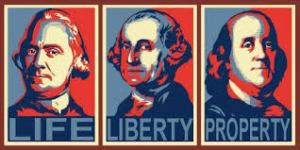
What is property? And why does it rank up there in importance with life and liberty?

image from here

First, we start with the premise that we value life. If there’s one entitlement we can agree on, it should be that we are each entitled to our right to life. The only way to forfeit that is voluntarily, as in war, or stepping in to protect someone being harmed. Or, if we take some other innocent person’s life, then the law can allow society to take our life. So we start with valuing life.

If we can’t agree to the right to life, then it’s hard to find any common ground. As I write, there’s a bill in Congress to protect the life of children born alive—particularly in a failed abortion procedure (failure to kill the infant before birth). [The bill failed. All Democrat presidential candidates and other likely candidates just voted that murdering newborns is fine with them. Remember that when it’s time to vote and someone tries to tell you Trump is the worst president ever.] The anti-life people, who like to euphemistically call themselves pro-choice, are finally admitting that there’s no difference between a baby just before birth and just after—and if they’re willing to kill just before birth, then they have no reason not to extend that willingness to kill a child after birth. What ought to go without saying—that an innocent baby is a life worth protecting from murder—is something we now have to spell out.

If we were to exemplify savagery, killing innocent babies would be on the poster.

So, let’s start with valuing life.

And then we can move on to how we spend our life. Freedom, or liberty, means we get to choose how we go about living, which will include doing work to sustain ourselves. Because we’re all born naked, shelterless, and ignorant—so much so that we really need a family to provide the necessities until we grow and learn to provide them for ourselves, which can take close to a couple of decades. Once we’ve become capable, liberty is how we pursue overcoming our original state of poverty and ignorance, and then enjoy the fruits of those endeavors.

In short, liberty is freedom to spend our lives, portion by portion. We may exchange our time and energy in exchange for money, which is a symbol for exchange of labor—or for a portion of our lives. Money makes it easier to exchange a piece of our labor that results in, say, a chair we built, with a person who fished for some food for dinner, if we have a common rate of exchange. Then you can get fish for dinner—or the several dinners a chair would be worth—from someone who doesn’t need another chair, but who does want something someone else produced, who does need a new chair. It’s just an easier means of exchanging our work for what we could use beyond simply the fruits of our own labors.

It’s a free exchange.

What is it when your work is required, but it’s not a free exchange? That’s slavery. Someone uses your time and energy—a portion of your life—and takes the fruits of your labor, instead of leaving you those fruits for your use. If you value life, you can see that stealing a portion of a person’s life is also wrong.

image from here
That covers life and liberty. Then, what is property? It is the result of your labor, above and beyond what you need to survive, that you can continue using. It’s another word for wealth, which simply means the accumulation of the results of your labor beyond what you need to subsist.

There’s another word for that: capital. It means that you have acquired wealth—results of labor beyond subsistence, that you can then use to invest in tools or other ways of creating more wealth. Or just keep it on hand until such an opportunity arises. It’s not evil; it exists only from successful work—or successful spending of a portion of your life.

Capital isn’t bad. Property isn’t bad. In fact, your property is just a way to enjoy the fruits of your labor over time—and possibly to help produce more fruits of labor. It’s evidence of a life well spent.
What happens when someone acquires far more property than someone else? That’s evidence that the person has offered something other people value enough to exchange the fruits of their work for. That person has benefited a lot of people. He then has an opportunity to spend that money, to the benefit of other workers. Or he might invest it in ways that provide work—and income wealth—to multiple workers. Or he might stuff a mattress with it so it benefits no one. But it’s his choice, because it’s his property.

Owning more property than someone else, then, isn’t wrong; it’s just evidence of serving society in a way that society appreciates.

What about those whose work doesn’t result in enough to subsist? That’s a social issue we can choose to care about, and do something about. It might be that we have enough surplus to offer a portion to the needy. That’s called charity. On a larger scale we might call it philanthropy. It’s a voluntary gift. Or, you could say it’s the exchange of the results of our labor—or wealth—for the sense of well being that comes from helping out another human being.

A righteous, caring people will want to do enough for a needy person to meet their needs without discouraging them from trying to get themselves to a more self-reliant state. You don’t want to create dependence. You don’t want to discourage someone from trying. You’ll want a person to feel valued and encouraged to contribute as much as they can to society. That takes actual caring, and often close acquaintance with a person’s situation, such as in a church community.

As long as a person in need is helped out by caring people, it simply doesn’t matter that there are large differences in property ownership.

If you think you’re entitled to the fruits of someone else’s labor, you’re a thief at heart. And let’s spell that out even more clearly: you’re a slaver. To take the fruits of someone else’s labor is to take the portion of their life that went to producing that wealth.

When government takes the fruits of your labor to “redistribute” it to someone who didn’t work for it, then government is the slaveholder and you’re the slave. This is true of anything government does beyond the proper role of government: protection of life, liberty, and property.

The way things are right now, government enslaves us for a pretty large chunk of the year. 

Entitlements—the euphemism for redistributing wealth, or pretending to do charity by coercive theft—make up a larger part of the federal budget, and most state and local budgets, than the necessities of protection.

And, as we know here at the Spherical Model,

Whenever government attempts something beyond the proper role of government (protection of life, liberty, and property), it causes unintended consequences—usually exactly opposite to the stated goals of the interference.
We make better use of our money—our property—than government can.

If there’s any person thinking about leaning toward socialism, ask, sincerely, who has the right to enslave you by taking away the fruits of your labor? It doesn’t matter if other countries, or other states, do it. Taking property away from those who paid for it with the fruits of their labor is taking a portion of their life. It isn’t fair. It’s wrong. As wrong as slavery has always been.


Monday, November 9, 2015

Commerce and Philanthropy--Two Sides of the Same Coin

Hillsdale College has an economic symposium going on right now (Sunday through Tuesday), on “Money: History and Controversies.” They have two speakers each evening, with live streaming, and apparently viewable later, because I didn’t get to it until late Sunday evening.

The lecture series is found here.

The one I watched already was Steve Forbes, “How the Destruction of the Dollar Threatens the Global Economy,” which is also the title of a book by Forbes. It was 45 minutes on monetary policy, followed by Q&A. Forbes suggested that, if you ever feel trapped between other passengers on an airplane and want a little extra room, just start a conversation on monetary policy—people will give you a wide berth. It’s not the most enthralling of topics. Nevertheless, he managed to keep it pretty interesting.

There was a large segment in favor of returning to the gold standard, and how that would work. Son Economic Sphere has told me in the past that gold is subject to market forces, and therefore not an ideal basis for money. However, I found Forbes’ logic fairly compelling. I don’t know enough to be able to reproduce the arguments both ways, but I do realize that monetary stability depends on the money supply exactly matching the creation of wealth, which it represents.

Forbes’ thinks that, while not ideal, gold is as stable as anything we have. If we set the price at, say, $1100 per ounce, then when it rises above that, we know money should be slightly looser (more dollars printed). If it goes under the price, then it should be slightly tighter (fewer dollars printed). Maybe so.

He pointed out that, since gold is an element, we don’t lose it. Whatever has been mined up to this point in history is still gold. It can be reforged, reformed. You might have bits of gold in a ring that was first used by ancient Egyptians. Gold is firm but malleable. It’s compact. In other words, there are reasons it has so frequently been used as money.

But what most got my attention was the final question and answer, which I’ve typed up below. It was positive and hopeful, which I think we can use.

Q: When Carter became president, inflation shot up to 18%. We thought we had joined the ranks of the banana republics. Then Reagan became president, and I thought, finally we have turned a corner; we are no longer on the road to serfdom. Now, 20, 30 years later, we are still firmly on the road to serfdom[i]. So even if we get a Reagan again, will it make any difference? Because, afterwards we’ll still go back to walking down the road to serfdom?
A: Steve Forbes: Question about how, after Reagan, could we be in the mess that we’re in today? And part of the answer is, we did not have then what you might call the base of intellectual understanding and ideas and advocates that we have today, that we did not have 35 years ago. And in terms, even among Republicans 35 years ago, there was sort of the feeling that government should play a real big role. And, yeah, we shouldn’t have inflation; we should cut tax rates. But they didn’t take it to the next step.
I think now, morally, people are beginning to realize that if you believe in free markets, you can’t just say they work. You also have to make the moral case for free markets. And that’s still a big task in front of us. That’s why I wrote a couple of books on it. Others are doing it. Numerous have done it for a number of years.
In essence, you succeed in free markets by meeting the needs and wants of other people. Even if you lust for money, you don’t get it unless you provide something that someone else wants.
Now, sometimes, as Steve Jobs said, when he was asked once, “Do you do marketing surveys?” and he famously replied, “No, because people don’t know what they want until we show them.” That’s part of entrepreneurship. You’ve tried something new; you don’t know if it’s going to work. People suddenly may discover they couldn’t live without it.
But, meeting the needs and wants of other people. And just keep in mind, philanthropy and commerce are often portrayed as polar opposites: you succeed in commerce; you make up for your sins by giving it away to philanthropy. They’re not polar opposites; they’re two sides of the same coin—meeting the needs and wants of other people. Different ways to do it, but same objective, which is why the US, the most commercial nation ever invented, is also the most philanthropic nation in the world.
Two sides of the same coin. We have to make that moral case.
There’s a lot more understanding of economics. There’s a lot more understanding about free markets today than there was 35 years ago, 60 years ago, 80 years ago. Now we know, more and more, that when you get these big economic crises, it’s not a sudden failure of free market or outbreak of greed. It is massive government policy error.
Now, I just want to say, it doesn’t excuse wrongdoing in free markets, or wrongdoing by bankers or anybody else. But, human nature hasn’t changed in thousands of years. People’s ability to do bad things preceded Adam Smith. Believe me, just look at the Bible, this is something that predated Adam Smith.
So, it’s a very good question. But now I think we are setting the foundation where, we get a good president, good. But what we want is understanding, as Hillsdale has tried to do, where even if you get a total mediocrity, the accepted wisdom is: Constitution, free markets, having a moral basis of a free society. When that happens, you don’t have to depend on a Reagan. When you have that kind of consensus. So we’ve got to get the consensus right, and not be dependent on particular outstanding individuals.
I highlighted that section near the end, because that got my attention. It coincides with my Spherical Model theory, that the political, economic, and social spheres interrelate. The goals are freedom, which we get from abiding by the US Constitution; prosperity, which we get from free markets (not to be confused with crony capitalism); and civilization, which we get from a moral people living moral lives, which includes strong families to pass along the way to civilization.

I like seeing evidence that we can make progress toward these things. Economically speaking, I think he is right that the understanding is getting through. When I was in college, I was blessed with free market teachers; they were somewhat rare in the late 70s. But now, with so much data to back it up, free market is the most likely kind of economic education you get in college. I’ve observed that change over the past decade and a half. So the hope seems real.

Our freedom, prosperity, and civilization are in trouble, but there’s reason to hope we can make the changes necessary to get them back. He’s right that we’ll need to defend the morality of free markets, that economy depends on meeting the needs and wants of people both through commerce and philanthropy—which requires a morally good people.

We need to express that viewpoint better. My writing here is an attempt toward that end. (See “Anything Evil about Capitalism, Part I, Part II, Part III. For the longer list of my economic posts see Best of Spherical Model Part II and More of the Best Part III.) 


[i] He is referring to the classic book The Road to Serfdom, by Friedrich Hayek, which details the dangers of attempting to control the economy.

Monday, April 13, 2015

Economic Glossary

The other day I was listening to the radio in the car; it was a “best-of” program from a couple of years ago, so not related to specific things in the news today. But a caller was having a conversation with Michael Medved, making the assertion that when a person makes money—such as Steve Jobs at Apple—it is at the expense of others, who will be worse off. Michael Medved tried to point out that the products Steve Jobs had provided to society, for which he earned the money, actually made consumers better off, so it was an even exchange, or even an improvement for all. The caller refused to agree, and insisted that there was a set amount of wealth, and if someone got more, others got less. Which shows a glaring lack of understanding of economics.

Economics may be a challenging prognosticating social science. But there are some things that aren’t too arcane for basic understanding. It doesn’t take an expert. So, as a public service, I thought I’d share a few basic definitions—with the purpose of helping good citizens feel confident enough to assert their right to decide how they spend the money they earn. (These terms are all defined with a little more depth in the economic section of the Spherical Model website.)

Wealth: the accumulation of the results of labor. It is created with additional labor and innovation, so there is no maximum amount that can be created. Wealth includes both money and material goods and real estate—anything that could be exchanged for value.
money image found here
Money: a representative, or symbol, of wealth, to make it easier to exchange. The purpose is to preserve surplus that has been produced. The materials used may have some intrinsic value, but mainly money is of value because people who exchange it agree that it symbolizes units of the results of work. There is an estimated total amount of money in the world, called, M3, which includes currency, bank accounts, certificates representing value (stocks, bonds, etc.), or anything quickly liquidated. It goes up as word wealth goes up. If there is inflation in the type of money used to measure (dollars, for example), then the number could appear to go up even though the actual value (representation of units of labor) has not gone up. I wrote about it in 2011.
Price: the point at which buyer and seller of goods and services agree that both are better off by making an exchange. Price conveys a lot of information, allowing buyers and sellers to decide if an exchange is worthwhile to them. If a seller prices something too high, it will have fewer willing buyers. If a seller prices something too low, there will be more buyers than supply.
Supply and Demand: Supply is the amount of goods available or the availability of a service; demand is the willingness of buyers to exchange money for a good or service. Willingness to make the exchange is determined in large part by price—just as price is determined by an accurate assessment of supply and demand. If there is no interference (government regulation, taxes, tariffs, price setting, etc.), then the interrelationship of supply, demand, and price are clear to the experts—the people involved in making an exchange.
Profit: the amount of money that exceeds the costs the seller put into a good or service; it allows the seller to then count that additional money as pay for labor—or as income.
Capital: represents work above and beyond what is essential, followed by careful use of the surplus toward a good idea, for the purpose of creating even more surplus. Capital itself is always moral—surplus work is an economic and social good.
Free Enterprise (or Free Market): an economy in a society in which choices of what work to do , how to make exchanges, and what to do with earnings are decisions made by the individuals involved in the exchange. The term capitalism is sometimes used. Capitalism is actually a subset—a way of investing and making use of capital, leveraging the power of wealth to put a good idea into action in an attempt to make more wealth. Free enterprise generally means government doesn’t interfere, but only assures that contracts are kept, and wealth is safeguarded from theft. It is a system that leads to prosperity wherever it is tried. But for reasons of power being a greater priority than prosperity, it is seldom tried. The alternative to free enterprise is a controlled economy—with central planners deciding basic economic decisions, like who works in what jobs, how much people get paid, what prices are set, and how money will be spent. Central planning is a form of tyranny that always leads toward poverty rather than prosperity. 

If there is nothing else you know about economics, you should at least understand that the person who knows best how you should spend the money you earn—is you.

Wednesday, September 4, 2013

Prices

I’m still reading Poverty of Nations, as I mentioned in the last post. So I’m tuned in to some basic economic concepts right now. A couple of times this week I came upon the concept of prices as a shortcut to a lot of truthful information.

For background, let’s take from the Spherical Model definition of money, and a few other terms. (I also wrote about basic money terms here and here.)
Wealth
Wealth is the accumulation of the results of work above what is needed for subsistence. Let’s quickly review the Robinson Crusoe (simple world) example:
Robinson Crusoe illustration
from the first edition of
Daniel Dafoe's book
At first, whatever Crusoe has, it’s a matter of what he is able to obtain for himself. He fishes. He gathers. He hunts. He plants, irrigates, and harvests. And barring a catastrophic hurricane or some such disaster, he is free to enjoy the fruits of his labor. This is his wealth—the results of his capacity to recover from the shelterless, foodless situation he finds himself in right after a shipwreck.
But his wealth is limited by his personal time, talents, and energies. It might be that, once he discovers another person on the island, Friday, they commiserate about their limitations. And somewhere along the way they discover differences in abilities. Crusoe is pretty good at farming, but fishing is tedious and frustrating, so he often goes without that protein source. Friday, on the other hand, finds fishing easy, but he’d sure like his garden to yield more veggies and rice to go with it.
Specialization and Exchange
An idea finally dawns on them. How would it be if Crusoe gave up fishing altogether and spent more of his time farming, expanding his garden to provide for the entire population of the two of them? And at the same time, instead of struggling to farm without success, Friday would spend even more hours fishing. Then he would trade his surplus fish for Crusoe’s surplus harvest. They try this, and it works so well, they both have more to eat than they had before, and they both have more spare time for climbing coconut palms or hunting—necessary tasks which neither one is particularly good at.
But this trade thing is working out so well that, when they meet a native who has no trouble at all shinnying up those palm trees, they make exchanges with him. And another native is very handy with a spear and can easily take down a wild boar, which is much too big to use up by himself before it spoils, so he’s glad for the exchange, and the others are very glad not to have to face those wild boars any more.
They specialize. They all work mostly at what they are best at. The result of their total labor is now considerably greater than the total would be without specialization. This leaves them all more actual wealth (results of labor) and even more time to enjoy the wealth.
Money
Money is a more convenient means of exchange than bartering goods; a unit of money represents a particular value, equivalent to a standard unit of work. Money is used for convenience,
When it becomes convenient for the laborers making the exchanges. It’s up to the society. If Crusoe wants more coconuts, but the palm tree climber doesn’t happen to want more veggies right now, but he would like more fish—and it turns out Friday wants more veggies, not coconuts, but he already checked with Crusoe, who didn’t need more fish. They can make a three-way deal. Bring in more if you want. But it gets more complicated to barter without some standard of exchange. Money, to symbolize that standard value, can be useful.
It’s also up to the society to decide what the symbol of exchange (money) will be. On this island, they might use clam shells, as some primitive societies have (bringing us the slang term “clams” for money). Some societies have used salt, which has some intrinsic value to everyone; that’s where the term salary came from. Early Central American societies used cacao beans, which were easy to carry, measure, and trade, and also useful for their own properties. These people also had incremental units based on a measure of grain; their units of gold and silver could always be exchanged for a measure of barley, so they had a standard value. More societies have used gold than any other single commodity as money. It’s usable as a decoration, because of its luster, and it’s easily malleable, making it easy to form into coins. It’s relatively rare, beautiful, and fairly heavy, which makes it natural as a representative of wealth. Silver, with many similar qualities, is next to gold in common use as money, most often used for smaller monetary units….
If Crusoe saved himself enough rice to last through a famine, he could safely exchange the rest of his surplus into clam shells, or gold. And that would even preserve his work, since his produce other than the rice is quickly perishable. In an ideal economy wealth would be represented by something that always exactly equals a standard amount of accumulated work-value. 
Price
Price is an agreement from the seller to the buyer regarding how much money (representing effort put into obtaining the good being sold) he is willing to exchange for the item/service being sold.
Do Robinson Crusoe and friends need a government bureaucrat stepping into their little island world and passing edicts about what would be a fair exchange? No. The price is set by the worker willing to exchange his labor. If it isn’t worth it to Crusoe to exchange a basket of veggies for a mended net, he is free not to make the exchange. But if Friday, who needs nets for fishing, prefers to spend his time fishing without having to stop and mend his own nets, he can figure out what a fair exchange is and offer it to the net mender. If his offer of fish is too low, the net mender is free not to make the exchange with him, until a bargain can be reached with a number of fish that will satisfy him. The price is set, then, by the experts on what they value—those willing to make the exchange.
 
OK, that’s enough background to help you appreciate these quotes on price that I came across this week.
This first is from Poverty of Nations:
Nothing conveys information faster than prices.
Prices convey objective information on the subjective attitudes and feelings of buyers and sellers. As relative prices change, options are altered and decisions are made. Perceived benefits and costs are continuously affected by changing circumstances, including many important variables that are never constant. In other words, not a person in the world knows how to make a market work or how to make even a simple thing like a pencil. But it still happens, because enormous complications are simplified when decentralization and prices take charge. In these ways, prices serve as an amazing, worldwide source of instant economic information [Kindle location 3495-3500].
So, price is what gives us accurate truth as buyers and sellers.
This next is from a Mises introduction of a new book by global investor and blogger Hunter Lewis, called Free Prices Now! I think the words are from the press release about the book:
The most reliable barometer of economic honesty is to be found in prices. Honest prices, neither manipulated nor controlled, provide both investors and consumers with reliable economic signals. They are the foundation for a successful economy.
A corrupt economic system does not want honest prices, honest information, or honest results. The truth may be unprofitable for powerful government leaders, private interests allied with them, or economic “experts” whose careers have been devoted to price manipulations and controls….
Can it really be this simple, that economic prosperity and job growth depend on allowing economic prices to tell the truth, free from the self-dealing and self-interested theories of powerful special interests?
Yes.

What do prices do? Tell the truth, in the most efficient way, about the value of a commodity to both the seller and the buyer—the experts involved in the exchange. No interference in price (particularly including manipulating the value of the monetary unit) can help convey that truth. Truth surrounding these exchanges helps economies prosper.