Showing posts with label capital. Show all posts

Thursday, February 13, 2020

Capital Is the Way Out of Poverty


At the Spherical Model, we define a few terms related to the economy:

definitions from SphericalModel.com


Wealth isn’t evil; it represents valuable labor. Money isn’t evil; it’s simply a way to make exchanges of labor easier. Price isn’t evil; it represents a willing agreement to exchange labor. And capital isn’t evil; it represents a way to put surplus to good use.

Economists often use simple societies to explain these concepts. On the Spherical Model website, we use Robinson Crusoe on an island, which is how it was taught to me in a basic econ class.

Recently I had a conversation with a friend that I thought would be a good illustration.

My friend is from an African country that is currently in a lot of turmoil because of corrupt and probably incompetent leadership. Economic conditions are serious enough there that missionaries from my Church have been temporarily transferred out of the country. 

My friend has been living here in America for about a decade; her husband, also from her native country, immigrated to the US much earlier and became a citizen. Nevertheless, getting her permanent residency with full work privileges has been difficult.

Add to that, her husband has a record, from something long ago that I do not know the details of, but which interferes with his getting employment here. This has made for a hard life for them. My friend does caregiving that requires a lot of physical labor at relatively low pay. But she is nevertheless one of the most faithful, optimistic people I know.

The question has been whether they should return to their country. Some months ago, nearly a year, her husband decided to return and try to get a job there. He found someone willing to hire him to work at a college, doing work he is qualified for, as soon as funding becomes available. The problem is, the corrupt government is months behind in meeting payroll for government employees. So he waits, living with his mother, who doesn’t have much to spare. And my friend continues to work here, combining resources with their young adult son, who is working and attending community college.

oil palm trees
image from Wikipedia
They would like to reunite, in whichever country God leads them to. But to return to their country, she tells me, she needs capital—not just to get there, but to have a way to make a living there. She knows where to contact people, up in the hills, who harvest palm oil. The oil needs to be extracted from the palms, and she knows how to either do that or hire that to be done. Then she could bottle it and sell it. I think she may have done a business like that when she last lived there, before she got married and moved to the US.


Capital, to her, I'm guessing means no more than a few thousand dollars. But, how to get that is the challenge.

Capital comes from a few main sources:

1.      Savings—which means building up a surplus over and above basic living costs.

2.      Loans—which means someone else has a surplus they are willing to be used with an expectation of a return plus interest.
3.      Investment—similar to a loan in that someone with surplus is willing to have it be used, and they have an expectation of return. But rather than a simple interest rate, there is some other arrangement.
a.      There could be a partnership arrangement—ongoing sharing of duties and profits.
b.      There could be a stock investment arrangement—sharing the profits as long as the money remains invested.

There are probably other ways, but those are typical. People with surplus want their money to not just sit there, but to be put to use in a way that will make more money.

The personal savings route is going to be a long slog for my friend, unless she and her husband can come up with better/additional income sources than they currently have. But she presses on, expecting no one to just give them something they haven’t earned.

The thing about loans is, you need collateral; you need to have a way to pay back the loan in case the expected returns from the business don’t happen. In general, you need to not really need the loan except for convenience.

oil palm fruits on the tree
image from Wikipedia
But there are some investors in very small businesses like what my friend envisions. It’s called micro-capitalism. (I wrote about this here and here.) The examples I’ve read about, however, work with people in their own countries, where they’re connected with people who can advise them and hold them accountable as they work through the challenges of starting a business. Living half a world away from where my friend would set up a business means getting connected to these sources is an additional challenge. Still, capital is what she needs.

There are steps out of abject poverty. And capital—surplus above subsistence that can be used to produce more surplus—is key.


Sometimes there’s an immediate need to give a man a fish. But that is never a long-term solution to his hunger. You teach a man to fish, and he has the skill to take care of himself. But maybe he also needs the means to make or otherwise get hold of a fishing pole or net.
Capital is the source of the fishing pole or net. I has to come either from personal ingenuity, or from using surplus money for materials or outright purchase.

Getting the capital into the hands of those who can use it—that’s a challenge. But capitalism is the natural solution. No other system can compare.

There may be times when we give a fish—to get someone by. That’s charity, when given freely. But it’s not a permanent solution. Even then, charity requires the production of surplus that can be willingly shared. But the step that moves a person into happy self-sufficiency requires their producing something of value themselves.

I think my friend is capable of producing something of value. If I had the surplus, I would consider investing in her. I hope she is eventually able to obtain what she needs somehow—although I’d prefer for her to stay here and find better opportunities than to move across the globe. One thing is certain, though, she’s smart enough to know that capital is the answer. That’s why it hasn’t occurred to her to complain and protest that no one is giving her a handout.

I pray for her. I tell her and she says, “I know. I can feel it. God is so good to me.” Her life looks very tough to me, but she inspires me with her happiness and perseverance.

Monday, February 25, 2019

What Is Property?


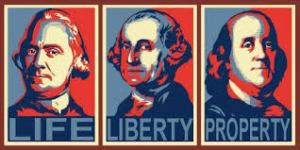
What is property? And why does it rank up there in importance with life and liberty?

image from here

First, we start with the premise that we value life. If there’s one entitlement we can agree on, it should be that we are each entitled to our right to life. The only way to forfeit that is voluntarily, as in war, or stepping in to protect someone being harmed. Or, if we take some other innocent person’s life, then the law can allow society to take our life. So we start with valuing life.

If we can’t agree to the right to life, then it’s hard to find any common ground. As I write, there’s a bill in Congress to protect the life of children born alive—particularly in a failed abortion procedure (failure to kill the infant before birth). [The bill failed. All Democrat presidential candidates and other likely candidates just voted that murdering newborns is fine with them. Remember that when it’s time to vote and someone tries to tell you Trump is the worst president ever.] The anti-life people, who like to euphemistically call themselves pro-choice, are finally admitting that there’s no difference between a baby just before birth and just after—and if they’re willing to kill just before birth, then they have no reason not to extend that willingness to kill a child after birth. What ought to go without saying—that an innocent baby is a life worth protecting from murder—is something we now have to spell out.

If we were to exemplify savagery, killing innocent babies would be on the poster.

So, let’s start with valuing life.

And then we can move on to how we spend our life. Freedom, or liberty, means we get to choose how we go about living, which will include doing work to sustain ourselves. Because we’re all born naked, shelterless, and ignorant—so much so that we really need a family to provide the necessities until we grow and learn to provide them for ourselves, which can take close to a couple of decades. Once we’ve become capable, liberty is how we pursue overcoming our original state of poverty and ignorance, and then enjoy the fruits of those endeavors.

In short, liberty is freedom to spend our lives, portion by portion. We may exchange our time and energy in exchange for money, which is a symbol for exchange of labor—or for a portion of our lives. Money makes it easier to exchange a piece of our labor that results in, say, a chair we built, with a person who fished for some food for dinner, if we have a common rate of exchange. Then you can get fish for dinner—or the several dinners a chair would be worth—from someone who doesn’t need another chair, but who does want something someone else produced, who does need a new chair. It’s just an easier means of exchanging our work for what we could use beyond simply the fruits of our own labors.

It’s a free exchange.

What is it when your work is required, but it’s not a free exchange? That’s slavery. Someone uses your time and energy—a portion of your life—and takes the fruits of your labor, instead of leaving you those fruits for your use. If you value life, you can see that stealing a portion of a person’s life is also wrong.

image from here
That covers life and liberty. Then, what is property? It is the result of your labor, above and beyond what you need to survive, that you can continue using. It’s another word for wealth, which simply means the accumulation of the results of your labor beyond what you need to subsist.

There’s another word for that: capital. It means that you have acquired wealth—results of labor beyond subsistence, that you can then use to invest in tools or other ways of creating more wealth. Or just keep it on hand until such an opportunity arises. It’s not evil; it exists only from successful work—or successful spending of a portion of your life.

Capital isn’t bad. Property isn’t bad. In fact, your property is just a way to enjoy the fruits of your labor over time—and possibly to help produce more fruits of labor. It’s evidence of a life well spent.
What happens when someone acquires far more property than someone else? That’s evidence that the person has offered something other people value enough to exchange the fruits of their work for. That person has benefited a lot of people. He then has an opportunity to spend that money, to the benefit of other workers. Or he might invest it in ways that provide work—and income wealth—to multiple workers. Or he might stuff a mattress with it so it benefits no one. But it’s his choice, because it’s his property.

Owning more property than someone else, then, isn’t wrong; it’s just evidence of serving society in a way that society appreciates.

What about those whose work doesn’t result in enough to subsist? That’s a social issue we can choose to care about, and do something about. It might be that we have enough surplus to offer a portion to the needy. That’s called charity. On a larger scale we might call it philanthropy. It’s a voluntary gift. Or, you could say it’s the exchange of the results of our labor—or wealth—for the sense of well being that comes from helping out another human being.

A righteous, caring people will want to do enough for a needy person to meet their needs without discouraging them from trying to get themselves to a more self-reliant state. You don’t want to create dependence. You don’t want to discourage someone from trying. You’ll want a person to feel valued and encouraged to contribute as much as they can to society. That takes actual caring, and often close acquaintance with a person’s situation, such as in a church community.

As long as a person in need is helped out by caring people, it simply doesn’t matter that there are large differences in property ownership.

If you think you’re entitled to the fruits of someone else’s labor, you’re a thief at heart. And let’s spell that out even more clearly: you’re a slaver. To take the fruits of someone else’s labor is to take the portion of their life that went to producing that wealth.

When government takes the fruits of your labor to “redistribute” it to someone who didn’t work for it, then government is the slaveholder and you’re the slave. This is true of anything government does beyond the proper role of government: protection of life, liberty, and property.

The way things are right now, government enslaves us for a pretty large chunk of the year. 

Entitlements—the euphemism for redistributing wealth, or pretending to do charity by coercive theft—make up a larger part of the federal budget, and most state and local budgets, than the necessities of protection.

And, as we know here at the Spherical Model,

Whenever government attempts something beyond the proper role of government (protection of life, liberty, and property), it causes unintended consequences—usually exactly opposite to the stated goals of the interference.
We make better use of our money—our property—than government can.

If there’s any person thinking about leaning toward socialism, ask, sincerely, who has the right to enslave you by taking away the fruits of your labor? It doesn’t matter if other countries, or other states, do it. Taking property away from those who paid for it with the fruits of their labor is taking a portion of their life. It isn’t fair. It’s wrong. As wrong as slavery has always been.


Monday, April 11, 2016

Spherical Model Quotes

The Political Sphere
of The Spherical Model
I’ve done posts in the past of quotes from various people that relate to the Spherical Model (for example, here, here, and here). And I’ve done posts collecting links to some of the “best of” the Spherical Model blog posts. But I haven’t done a post quoting from the Spherical Model website and blog. That’s what we’re doing today—quoting myself. I’m hoping this will encourage you to read more about the Spherical Model, an alternative to right and left in describing interrelating ideas from the political, economic, and social spheres.


From “Fact or Opinion,” March 12, 2015. The piece was about the distortion of the definitions of fact and opinion in a way that removes morality and makes truth harder to ascertain. This is the final summary:

Truth exists separate from us. Seeking truth is a work for a lifetime. It takes a good mind, and a good heart, and spiritual strength to know truth. Seeking God is more likely to lead to truth than leaving out the Omniscient One and going at it on our own.

From “Wealth, Poverty, and Politics,” December, December 10, 2015. This piece reviewed an interview with Thomas Sowell on Uncommon Knowledge, following Sowell’s book by the same title. I noticed connections with the Spherical Model idea of interrelationships of political freedom, economic prosperity, and civilization. This is one of the basic axioms of the Spherical Model and the role of government:

Whenever government attempts something beyond the proper role of government (protection of life, liberty, and property), it causes unintended consequences—usually exactly opposite to the stated goals of the interference.

From “Commerce and Philanthropy—Two Sides of the Same Coin,” November 9, 2015. The piece covered a Q&A with Steve Forbes at a Hillsdale College economic symposium. Forbes mentioned the importance, morally, of turning to the Constitution for economic thriving, which sounds like the Spherical Model, with the interrelating spheres. I followed with this:

The goals are freedom, which we get from abiding by the US Constitution; prosperity, which we get from free markets (not to be confused with crony capitalism); and civilization, which we get from a moral people living moral lives, which includes strong families to pass along the way to civilization.

From “What We Conserve,” October 1, 2015. In this piece, we go over the enumerated powers of the Constitution, based on God-given rights. Because this is the Spherical Model, we cover what we conserve in each of the spheres: political, economic, and social. So we’ll have a quote or two from each of those:

Political Sphere:
If we’re going to conserve our liberties, that means government does nothing to infringe on our God-given rights. So government has no business involving itself in what we believe or what we say, with the specific exceptions of when something we do infringes on the God-given rights of others. What we need is to conserve our Constitution, in its real form, not some penumbras invented by unelected judges.
Economic Sphere:
Every dollar government spends is a societal expense. Government can’t spend more money to help the economy. When we have downturns in the economy, and everyone says government has to do something—that something should be to get out of the way and let the recovery happen.
Charity isn’t a duty of government; charity isn’t even possible by government. Government charity is better labeled coercive taking of income from some to give to others—or theft. Charity includes various helps for the poor: welfare food and housing, health care, student grants, social security, and more.
Conservatives don’t mean for these helps to be eliminated. But in a civilized society, those in need receive help mainly locally, by those in contact with them, such as churches and local nonprofits, from those who freely give. Charity means love; it is entirely unrelated to forced income redistribution. If there is one thing conservatives need to speak more clearly on, it is this better way to help those in need. Our way is better for giver and receiver, and leads to greater prosperity, rather than more poverty at the cost of lost freedom.
Social Sphere:
Civilization requires a people accountable to God. Such people value family, innocent human life, property rights, and truth. Such people respect one another and generally live together in peace despite differences in belief and culture.
A conservative leader recognizes that religion is not just a tolerated quirk of some minority of the population; religion is an essential institution helping us understand what our rights are, and what our obligations to one another are. The question about forcing Little Sisters of the Poor, or Hobby Lobby, or bakers, florists, and photographers to act against their conscience would disappear, if our leaders appreciated the religious view of family, life, property, and truth.

From “The Political World Is Round,” on The Spherical Model website, in the section “US Parties in Relation to Freedom Zone.” This was written, in its current form, in 2010. It’s probably more positive than the party is today:

The Democrats are a symbiotic mix of people demanding that government provide for their needs—health care, education, housing, redistribution of wealth, regulating use of resources, even making jobs: the demanding needy, we could call them—along with the elites who are willing to pander to the demanding needy in order to increase their personal power: the would-be dictators. When Republicans engage in the debate, they often try to deal with the demanding needy by saying, “We’ll give you those things too, but we’ll be more responsible about it and cost you less in taxes,” to which the reply is, “You hate children and old people; you’re trying to kill them!” and other absurdities. It’s not a reasonable debate approaching even the lowest borders of the freedom zone.
I don’t mean to imply that everyone in the Democratic Party is consciously socialist. Many simply focus on needs and wants as problems, with government as the only logical problem solver. Many on the would-be dictators’ side of the party, those in academia, media, entertainment, and other areas controlling wealth, are well-intentioned. They think of themselves as the fortunate (and often therefore guilty) elite who believe it’s their moral obligation to force society to provide for the needy—unwilling or unable to see the immorality in taking substance from one person for their own purposes—what we call theft when anybody but the government does it. One troubling thing about elites who seek power is that, when the people don’t elect them, they see that as just more evidence that the people aren’t capable of choosing what’s good for them, and so they see their power seeking as even more justified.

From “Free Enterprise vs. Controlled Economy,” on The Spherical Model website, in the section on “Capitalism.”

Capital in and of itself is simply never evil. Capital might be considered always good. It represents work above and beyond what is essential followed by careful use of it toward a good idea, resulting in even more surplus. Those who hate capitalism are those who don’t produce it. They don’t have either the discipline or the drive to produce more than is necessary, and then to find ways to have that wealth work for them. They are jealous of those who have produced capital and use it. They insist it’s unfair that some have advantages that they don’t.


If you’re interested in more collected words from The Spherical Model, try the links found in “Spherical Model Review,” December 31, 2015. 

Monday, April 13, 2015

Economic Glossary

The other day I was listening to the radio in the car; it was a “best-of” program from a couple of years ago, so not related to specific things in the news today. But a caller was having a conversation with Michael Medved, making the assertion that when a person makes money—such as Steve Jobs at Apple—it is at the expense of others, who will be worse off. Michael Medved tried to point out that the products Steve Jobs had provided to society, for which he earned the money, actually made consumers better off, so it was an even exchange, or even an improvement for all. The caller refused to agree, and insisted that there was a set amount of wealth, and if someone got more, others got less. Which shows a glaring lack of understanding of economics.

Economics may be a challenging prognosticating social science. But there are some things that aren’t too arcane for basic understanding. It doesn’t take an expert. So, as a public service, I thought I’d share a few basic definitions—with the purpose of helping good citizens feel confident enough to assert their right to decide how they spend the money they earn. (These terms are all defined with a little more depth in the economic section of the Spherical Model website.)

Wealth: the accumulation of the results of labor. It is created with additional labor and innovation, so there is no maximum amount that can be created. Wealth includes both money and material goods and real estate—anything that could be exchanged for value.
money image found here
Money: a representative, or symbol, of wealth, to make it easier to exchange. The purpose is to preserve surplus that has been produced. The materials used may have some intrinsic value, but mainly money is of value because people who exchange it agree that it symbolizes units of the results of work. There is an estimated total amount of money in the world, called, M3, which includes currency, bank accounts, certificates representing value (stocks, bonds, etc.), or anything quickly liquidated. It goes up as word wealth goes up. If there is inflation in the type of money used to measure (dollars, for example), then the number could appear to go up even though the actual value (representation of units of labor) has not gone up. I wrote about it in 2011.
Price: the point at which buyer and seller of goods and services agree that both are better off by making an exchange. Price conveys a lot of information, allowing buyers and sellers to decide if an exchange is worthwhile to them. If a seller prices something too high, it will have fewer willing buyers. If a seller prices something too low, there will be more buyers than supply.
Supply and Demand: Supply is the amount of goods available or the availability of a service; demand is the willingness of buyers to exchange money for a good or service. Willingness to make the exchange is determined in large part by price—just as price is determined by an accurate assessment of supply and demand. If there is no interference (government regulation, taxes, tariffs, price setting, etc.), then the interrelationship of supply, demand, and price are clear to the experts—the people involved in making an exchange.
Profit: the amount of money that exceeds the costs the seller put into a good or service; it allows the seller to then count that additional money as pay for labor—or as income.
Capital: represents work above and beyond what is essential, followed by careful use of the surplus toward a good idea, for the purpose of creating even more surplus. Capital itself is always moral—surplus work is an economic and social good.
Free Enterprise (or Free Market): an economy in a society in which choices of what work to do , how to make exchanges, and what to do with earnings are decisions made by the individuals involved in the exchange. The term capitalism is sometimes used. Capitalism is actually a subset—a way of investing and making use of capital, leveraging the power of wealth to put a good idea into action in an attempt to make more wealth. Free enterprise generally means government doesn’t interfere, but only assures that contracts are kept, and wealth is safeguarded from theft. It is a system that leads to prosperity wherever it is tried. But for reasons of power being a greater priority than prosperity, it is seldom tried. The alternative to free enterprise is a controlled economy—with central planners deciding basic economic decisions, like who works in what jobs, how much people get paid, what prices are set, and how money will be spent. Central planning is a form of tyranny that always leads toward poverty rather than prosperity. 

If there is nothing else you know about economics, you should at least understand that the person who knows best how you should spend the money you earn—is you.

Wednesday, March 30, 2011

Anything Evil about Capitalism? Part II

Then What Is Capital?

Yesterday we defined wealth. If you need to catch up, it’s here: Part I. Today, in Part II we’re going to define capital and capitalism. Tomorrow, in Part III, we’ll use those definitions to determine whether capitalism is an evil system of depriving the poor in order to enrich the already rich, as you may have been led to believe, or whether it’s a system of increasing productivity and thereby increasing wealth.

Let’s look at Crusoe on his island again. Crusoe has some good ideas about farming. He understands that, with some tools, he can greatly increase the productivity of his bare hands. The first thing to do, then, is to spend some time making a plow. It’s not easy. Without ore and a forge, he has to make do with supplies at hand. He makes a plow out of coconut shell and some sturdy bamboo, which he has lashed together with the fiber he also uses for fishnets. It’s pretty crude, but it’s a lot more effective than digging with his hands. He is able to accomplish more. The plow he has made is capital.

Capital comes from surplus work. In addition to the farming he was doing by hand to subsist, he took extra time to work on this capital project. It wasn’t easy, but it was worth it. Because with that capital (i.e., extra time/work/wealth invested), he is able to produce more with his garden.

With the surplus he is able to produce with his plow, he finds himself with more time above and beyond what it takes to subsist, and he can use this time for more capital investment. He spends many spare hours gathering large sections of bamboo, which he connects together in a rickety but effective pipeline from the spring. He has invested in an irrigation system. The capital comes from his extra work, the actual building of equipment—which will greatly save his labor in the future so he can produce more.

Capital is always a representation of surplus work that is invested to find ways to produce more wealth. A society of hard workers without capital may remain as third-world agrarian subsistors for thousands of years. But bring in some capital investment for invention, and quite suddenly you have the makings of an industrial revolution.

There are two ways to get capital. The original and best way is to work more than necessary while spending less than you’re making. That is what Crusoe does in the irrigation example.

Another way is by borrowing capital. Debt is, of course, spending money yet to be made on the assumption that it will be made. So debt means it’s going to take longer before those future earnings feel like wealth. But sometimes the expectation is that, with capital, so much more can be accomplished that the debt will be paid off and then some.

Suppose Friday wanted to do fishing from a boat, because he knows he would have access to more fish to catch out away from shore. But building a boat is a big capital investment. If he takes time out from his fishing to build a boat, he will be without food for maybe a month—not really an option. Or he could build the boat slowly, but in his spare time it would take him maybe a year to get it finished. But suppose another native already has a boat (he used it to try to leave the island once, but then decided he preferred the island as home, and the boat has sat unused since). The boat is capital for the other islander—his surplus.

Friday makes a deal with the boat owner: “You let me use the boat now, and I will make payments to you for the cost of the boat plus a percentage more, to compensate you for letting me use the boat before I could pay for it.” This deal is a loan, with the cost plus interest being returned. But it is also a use of the boat owner’s surplus. He is able to put his capital to work, to increase his own wealth, by investing in Friday’s plan. So loaning capital is one part of capitalism.

There is some risk. Friday might be wrong about there being more fish out away from shore, so he might have a hard time repaying with interest. Or he might crash, causing the loss of investment, which would mean taking a very long time to repay the loan plus interest (and maybe defaulting and never being able to repay).

Another way Friday might make the deal is like this: “You could become part owner in my business. I will do all the work and all the fishing, but because I use your boat, I will give you an agreed on percentage of my profits.” Friday makes the boat owner an investor in his business. This arrangement is a partnership, but there are various other arrangements for a person with capital to put his money to work in someone else’s business. The stock market is a complicated mechanism, but it’s really just about finding ways people can take their capital (their surplus wealth) and put it into projects that they believe will help them make more wealth, benefiting both the owner of the capital and the user of the capital.

In this system, there is never a time when someone gets something for nothing. The capital investor has worked beyond necessity to earn the capital, and he tries carefully to place this wealth where it can do more wealth creation (and wealth is created by work, remember, so he is facilitating productive work). The entrepreneur who uses the capital does not receive it for free; he must use it to make a business productive enough to provide wealth for himself as well as the investor.

In short, what is capital? The accumulation of work above and beyond what is essential followed by careful use of it toward a good idea intended to result in even more surplus.

And what is capitalism? A system for using accumulated wealth to invest it in more wealth creation.

Keep these definitions in mind tomorrow as we look at the morality of capitalism.