Monday, November 10, 2014

Splits

Thursday, November 6, the 6th Circuit Court ruled on several cases related to same-sex “marriage.” Lower courts had claimed that states’ attempts to continue to define marriage as between a man and a woman was unconstitutional. Some earlier circuit court rulings recently went that direction, claiming the 14th Amendment requires the change—even though the SCOTUS ruling on DOMA last year insisted the defining power rested with the states.

But now the 6th Circuit has stopped that court overreach and made a helpful explanation. Two things come out of this:
·        The court delineates a number of reasons that a state might choose to keep the millennia-old definition (there is a rational basis).
·        The court points out the limits of the judiciary, particularly declining to force federal law changes on states, where the Constitution hasn’t explicitly required such changes.
Now that there is a split, the Supreme Court has an undeniable reason to take up the issue. If I understand correctly, the cases for the 2014-2015 session are already on the docket. The growing list of same-sex “marriage” cases, then, cannot be taken up until the 2015-2016 session, which would probably be decided in June 2016.
In the meantime, there is a hodgepodge of states required to allow same-sex “marriages,” alongside states which are allowed to refrain from granting them or recognizing them from other states. When the Supreme Court refused to take up the cases this year, in the absence of a circuit court split, they knew such confusion would ensue. But they were willing to ignore that in favor of waiting until the most appropriate time. I hope that was the wiser decision in the long run.
This ruling says a number of helpful, hopeful things. It’s quite beautifully written. Here’s a sample from the opening:
So long defined, the tradition is measured in millennia, not centuries or decades. So widely shared, the tradition until recently had been adopted by all governments and major religions of the world.
This is, unfortunately, couched within an assumption that societal change is coming. But it declines usurping power to bring it on: 

What remains is a debate about whether to allow the democratic processes begun in the States to continue in the four States of the Sixth Circuit or to end them now by requiring all States in the Circuit to extend the definition of marriage to encompass gay couples. Process and structure matter greatly in American government. Indeed, they may be the most reliable, liberty assuring guarantees of our system of government, requiring us to take seriously the route the United States Constitution contemplates for making such a fundamental change to such a fundamental social institution. 

Of all the ways to resolve this question, one option is not available: a poll of the three judges on this panel, or for that matter all federal judges, about whether gay marriage is a good idea. Our judicial commissions did not come with such a sweeping grant of authority, one that would allow just three of us—just two of us in truth—to make such a vital policy call for the thirty-two million citizens who live within the four States of the Sixth Circuit: Kentucky, Michigan, Ohio, and Tennessee. What we have authority to decide instead is a legal question: Does the Fourteenth Amendment to the United States Constitution prohibit a State from defining marriage as a relationship between one man and one woman? 

The pertinent portion of the Fourteenth Amendment says,  

No State shall make or enforce any law which shall abridge the privileges or immunities of citizens of the United States; nor shall any State deprive any person of life, liberty, or property, without due process of law; nor deny to any person within its jurisdiction the equal protection of the laws. 

So the plaintiffs—those requiring states to throw out their traditional definition of marriage—are claiming they’re being denied equal protection. It seems obvious, to me, that they have not been denied. No one has said homosexual individuals can’t marry—enter into a marriage contract as any other American would—a permanent contract with a member of the opposite sex, who is not married to someone else, and who is not a close relative.  

Same-sex couples are not individuals who are “banned” from marrying. What is actually happening is that they are requiring all of society to throw out the definition of marriage and make some new one that includes same-sex couples—and possibly also any other coupling that any individuals desire. 

The 6th Circuit has refrained from voicing personal opinion on this redefinition debate. This restraint is too rare. And it is a great relief in the ongoing onslaught against the definition of marriage. 

Ryan Anderson, at The Heritage Institute, as always explains the issue with clarity. He pulls out the pertinent quotes, so I recommend his piece, "No ConstitutionalRight to Same-Sex Marriage, Circuit Court Rules.”

Language is important. That’s true in discussing issues, and in rulings within the written law. So, do we know what marriage is? 

For most of human history it has been a legal contract between a man and a woman, requiring permanence and fidelity—for the benefit of family, which is the basic unit of society, in which civilization is continued from generation to generation. 

Governments didn’t start marriage; God started marriage, in the Garden of Eden. A long time before any existing government. Where governments are concerned, as with other contracts, they’re concerned with the keeping of the terms. So it’s important to know the definition of the terms. The Supreme Court and various courts—now including the 6th Circuit—allow states to define the term. Regardless of the temporary confusion, marriage is a legally understood term. 

Marriage simply is what it is: a permanent promise between a man and a woman to engage exclusively with each other in heterosexual sex, which can lead to offspring and therefore form a family. Fathers know who their offspring are, and feel obligated, therefore, to stay connected and provide. Love is nice but not required in the keeping of the contract. Other sexual acts are not necessarily condemned, but are simply not at issue in marriage. Only one type of sexual act is of interest.  

So, if there is to be a debate about change, it ought to be an open discussion. It’s not about whether society is prejudiced against same-sex couples; nature has set up that prejudice. Same-sex couples simply cannot participate in the act that is required for marriage. Indeed, couples who marry and then have a spouse who fails to engage in that act can have the contract nullified. It’s fraudulent to promise to marry and then fail to consummate the marriage in the particular act. It doesn’t matter if the couple “loves” each other, or enjoys sharing a domicile, or thinks it might be a good idea to adopt a child. Failure to keep the marriage contract is grounds for annulment or divorce.  

The existence of same-sex couples who want to be honored for their current relationship certainly isn’t grounds for changing the definitions. 

Parties involved in claiming discrimination ought to be required to prove one of these things: 

·        Prove that they can and will engage in the act required in marriage, to make the contract legal.
·        Or prove that their relationship is equivalently good for civilization as marriage has been. 

They cannot do the first. They have not done the second. They cannot produce children. In every case same-sex-parented “families” have children not produced by the couple. Not because one or the other is infertile, but because same-sex coupling cannot be fruitful. This is obvious to anyone who has even a very basic understanding of biological reproduction. 

Same-sex couples try to claim their parenting is equivalently good. Individual cases may be adequate, but they have not proven equivalence as likely. Most studies compare same-sex parenting to single parented families—which are statistically inferior to married parent families in every measure. Some recent studies are showing that, additionally, same-sex parents lead to a higher likelihood of gender confusion in children. 

Additionally, unlike the vast majority of traditional marriages, same-sex marriages fail, in extremely high percentages, to be exclusive or permanent. 

There is no advantage to society leading to honor for same-sex couples. The debate must be turned from whether it’s nice or not to “ban” same-sex “marriage” [something can’t be banned if it never existed], and turned instead to whether throwing out the long-standing definition is better for society because same-sex couples make some significant civilizing contribution. 

While last week’s ruling was hopeful, it’s only a limited victory. It merely refrained from usurping authority in the redefinition, but it practically admits defeat in society’s eventual change. It’s possible that the wording is designed to give the swing vote, Kennedy, persuasion to refrain from imposing the definition change. But, personally, I prefer truth, clarity, and allegiance to ultimate good, rather than trusting to strategy.

Thursday, November 6, 2014

Giving until It Hurts

Tuesday was a good day. The American people spoke pretty loudly in favor of more conservative principles and less liberal/progressivist/socialist policies. Yay! I wanted reassurance that America hadn’t gone as far astray as the last presidential election indicated. It is my belief that when the truth is presented accurately, people are likely to choose wisely.

So it’s a matter of finding ways to express truth accurately.
Some of what we conservatives need to do is understand how the other side thinks, because we probably both want freedom, prosperity and civilization, but for some reason the words don’t translate into their minds. They say we’re racist, bigoted, hard-hearted, violent—and a host of other epithets that we know are not true. What do they get out of telling those lies about us? Or believing those mischaracterizations?
Except for maybe some clinically mentally ill, people tend to do what they think will make them happy. They want to feel good. So let’s go with the assumption that those who choose more government intervention do it out of interest in living better lives.
William Voegeli wrote the Hillsdale College Imprimis piece for October: “The Case against Liberal Compassion.” He gives an excellent, and probably accurate, description of the opposition mindset. He starts by pointing out, as we all know, the War on Poverty has failed. Government social programs are an utter failure. And yet the big-government set keeps asking for more of that failure.
I think he’s asking some very good questions:
All along, while the welfare state was growing constantly, liberals were insisting constantly it wasn’t big enough or growing fast enough. So I wondered, five years ago, whether there is a Platonic ideal when it comes to the size of the welfare state—whether there is a point at which the welfare state has all the money, programs, personnel, and political support it needs, thereby rendering any further additions pointless. The answer, I concluded, is that there is no answer—the welfare state is a permanent work-in-progress, and its liberal advocates believe that however many resources it has, it always needs a great deal more.
That’s a starting point for understanding. But the next question is, since there can never be enough, and programs actually fail, and waste money, why is that OK? He doesn’t assume it’s because liberals are bad people. He says,
Readers could have concluded that liberals are never satisfied because they get up every morning thinking, “What can I do today to make government a little bigger, and the patch of ground where people live their lives completely unaffected by government power and benevolence a little smaller?” …
If we make that effort—an effort to understand committed liberals as they understand themselves—then we have to understand them as people who, by their own account, get up every morning asking, “What can I do today so that there’s a little less suffering in the world?”
He quotes President Obama as saying, “Kindness covers all of my political beliefs. When I think about what I’m fighting for, what gets me up every single day, that captures it just about as much as anything. Kindness; empathy—that sense that I have a stake in your success; that I’m going to make sure, just because [my daughters] are doing well, that’s not enough—I want your kids to do well also.”
If the president wants to be believed, he ought not use the IRS and NSA to target anyone who has a non-liberal/progressive/socialist approach to bettering the interrelated causes of freedom, prosperity, and civilization. To us conservative targets, he seems a lot more tyrannical than kind. But back to Voegeli’s explanations.
Compassion, he says, is used as a political weapon against anyone who disagrees, because that works:
Arguments and rhetoric that work—that impress voters and intimidate opponents—are used again and again. Those that prove ineffective are discarded. If conservatives had ever come up with a devastating, or even effective rebuttal to the accusation that they are heartless and mean-spirited: a) anyone could recite it by now; and, b) more importantly, liberals would have long ago stopped using rhetoric about liberal kindness versus conservative cruelty, for fear that the political risks of such language far outweighed any potential benefits.
But here’s the important thing: using the compassion claim as a political weapon—to gain power—is the end; actually accomplishing compassionate ends do not matter. In fact, getting to that end would eliminate the powerful political weapon, and that isn’t even desirable. That’s a pretty damning accusation, so we’d better look at the rest of Voegeli’s reasoning. He uses the recent Obamacare website debacle as an example. He quotes liberal columnist, and then makes his observation:
A sympathetic columnist, E. J. Dionne, wrote of the website’s crash-and-burn debut “There’s a lesson here that liberals apparently need to learn over and over: Good intentions without proper administration can undermine even the most noble of goals.” That such an elementary lesson is one liberals need to learn over and over suggests a fundamental defect in liberalism, however—something worse than careless or inept implementation of liberal policies.
That defect, I came to think, can be explained as follows: The problem with liberalism may be that no one knows how to get the government to do the benevolent things liberals want it to do. Or it may be, at least in some cases, that it just isn’t possible for the government to bring about what liberals want it to accomplish….It may also be, as conservatives have long argued, that achieving liberal goals, no matter how humane they sound, requires kinds and degrees of government coercion fundamentally incompatible with a government created to secure citizens’ inalienable rights, and deriving its just powers from the consent of the governed.
So we are, possibly, at an impasse. Liberals want to be compassionate, and conservatives see that their efforts are fruitless, as well as dangerous to our freedoms. Liberals think we should just keep pushing toward the goal—living out a definition of insanity by doing the same thing over and over, more and more, and expecting different results. Conservatives think we we’ve tried the bad policies long enough to prove to everyone that they don’t work. It’s a $3 Trillion going concern. We’re spending $10,000 per American per year, much of it on people are not, by any stretch, impoverished, insecure, or suffering.
Liberals think conservatives are evil for not continuing the failing “compassionate” policies. But there’s the error. Conservatives want to actually relieve suffering, not just relieve their own conscience by expressing compassion pointlessly.
Voegeli quotes Rousseau on compassion, and then explains:
As Jean-Jacques Rousseau wrote in Emile, “When the strength of an expansive soul makes me identify myself with my fellow, and I feel that I am, so to speak, in him, it is in order not to suffer that I do not want him to suffer. I am interested in him for love of myself.”
We can see the problem. The whole point of compassion is for empathizers to feel better when awareness of another’s suffering provokes unease. But this ultimate purpose does not guarantee that empathizees will fare better.
Sometimes altruism actually causes harm to the target of sympathy. But that doesn’t seem to matter. Sometimes failure to help is part of the equation: “This is why so many government programs initiated to conquer a problem end up, instead, colonizing it by building sprawling settlements where the helpers and the helped are endlessly, increasingly co-dependent.”
He quotes political theorist Jean Bethke Elshtain as saying, “Pity is about how deeply I can feel. And in order to feel this way, to experience the rush of my own pious reaction, I need victims the way an addict needs drugs.”
So, what we have with all these compassionate liberals, then, is a large segment of the population addicted to the self-satisfaction of “caring,” not to help, but to feel better about themselves. Simply put,
Because compassion gives me a self-regarding reason to care about your suffering, it’s more important for me to do something than to accomplish something. Once I’ve voted for, given a speech about, written an editorial endorsing, or held forth at a dinner party on the salutary generosity of some program to “address” your problem, my work is done, and I can feel the rush of my own pious reaction. There’s no need to stick around for the complex, frustrating, mundane work of making sure the program that made me feel better, just by being established and praised, has actually alleviated your suffering.
I think Voegeli is right in his assessment of the liberal mind. He is also accurate about the insanity of squandering more and more money on programs essentially designed to fail.
What we as conservatives need to do, then, is not simply deny the accusation that we’re hard-hearted. We need to clarify the truth of the situation. We need to connect the dots between government welfare and increased pain. We need to make it clear that, any time an American tax dollar is spent on something extra-Constitutional, it has the unintended consequence of causing harm in place of alleviating suffering.
There are times when charitable giving is appropriate—but never through government coercion. It’s not even possible for government to coerce charitable giving; its not logically, by definition, possible. We want to actually alleviate suffering. We will do it by following the principles of freedom, prosperity, and civilization. That’s what works.
Let's speak the truth clearly. Government “giving” hurts people, and mostly hurts the very people designated to be helped. So if you’re in favor of government welfare, you’re in favor of hurting the most vulnerable among us. If you want to think of yourself as kind, you need to change your ways.

Monday, November 3, 2014

That Decision Mothers Make

Our president said something better not said—no surprise. But sometimes these misspeaks (accidentally) reveal what he truly believes, so they’re worth looking at. Here’s what he said last week at Rhode Island College on women and the economy: 

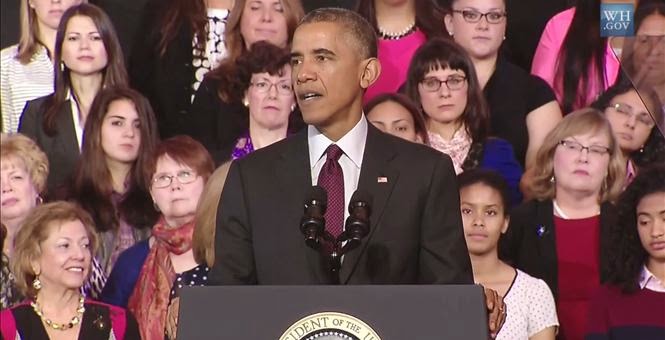
Obama speech on women and the economy
at Rhode Island College


Sometimes, someone, usually Mom, leaves the workplace to stay home with the kids, which then leaves her earning a lower wage for the rest of her life as a result. That’s not a choice we want Americans to make. [full speech here]
We could get rid of some of the indignation here if we assume he misspoke and meant to say, “That’s not a choice we want Americans to have to make.” In other words, if you take some years off to care for children, you face the reality of a lower wage, and he thinks that’s unfair.

That does in fact seem to be what he means, because he goes on to offer the solution of governmental institutional daycare—to solve the problem of women having to leave the workforce at all, which leads to what looks like uneven pay.

But he is, in fact, saying it’s a bad decision to choose to stay home and raise your kids. It’s bad because it could cost you the wage level rise you would presumably get if you didn’t take time off to raise those bothersome children. He doesn’t want you to make that wrong choice. That’s revealing.

We might be better off if we had a president who offered this in a speech instead:

The homemaker has the ultimate career. All other careers exist for one purpose only—and that is to support the ultimate career.—C. S. Lewis
Or there’s this, from the last paragraph of historians Will and Ariel Durant’s The Lessons of History about perpetuating civilization:

If a man is fortunate he will, before he dies, gather up as much as he can of his civilized heritage and transmit it to his children. And to his final breath he will be grateful for this inexhaustible legacy, knowing that it is our nourishing mother and our lasting life.
And let’s add this bit of wisdom:

Women who make a house a home make a far greater contribution to society than those who command large armies or stand at the head of impressive corporations.—Gordon B. Hinckley
The president seems to misunderstand what life is about. Certainly he misunderstands what civilization is and how to get there and then stay there.

The purpose of life is not to achieve some arbitrarily defined world equity by earning money for yourself that is equal to whatever anyone else can earn. It is not even to earn a valuable life by doing paid work. A mother, who dedicated her career years to raising children who have grown into successful contributing members of society and gone onto provide her with grandchildren to love—can you imagine this woman, in the wisdom of age, on her deathbed saying, “If only I’d spent more time at the office! If only I hadn’t wasted my career years on children—the government could have handled them, and then I would have made an equivalent amount to the men in my career!”

Life is bigger than that. We want to live a life we can enjoy with those we love and want to be with, through the good times and trials. There isn’t a better way to live than in a marriage and family, raising children in love. Family is the basic unit of civilization—in which people thrive, and in which social capital is built and passed on. It is possible to live a life otherwise, but civilization only happens when a critical mass live in functional families.

There is an interrelated economic component. We need income for housing, food, shelter, and all the other things needed for raising and educating our children. But the most economically sound way for that to happen is in a family with a mother and a father. No government program works as well. It isn’t a matter of tweaking policy, or getting the right leaders. It is a matter of allowing families to do the work of caring, providing, and civilizing—work that families are brilliantly designed by God to do.

If you care about civilization, you will consider the value of a parent, probably the mother, doing the long-term daily work of caring for them. Anyone who has done it knows it’s a lot more than feeding, clothing, and managing the children in a way that keeps them from wandering into the street or other dangers. It’s about loving them, responding to them as valuable human beings with their own personalities, gifts, and potentials. No daycare—no matter how well run—can offer a child what an abundance of time with a loving mother offers.

Not all women get to offer that. Some can’t make it financially without working. Some feel called to do a specific life’s work in addition, and choose to balance the mothering and other career. I do not want to demean any woman who makes a choice to work when she has children. But it is absolutely unconscionable to shame women for choosing to mother at home. It is especially wrongheaded to demean her choice by turning it into a math equation about earnings she’s expected by the state to work for.

It’s also wrong to blame natural economic laws that reward continuous years of work in a particular career more than fewer disconnected years in that career. And it’s more than wrong to claim government can or should override this economic natural consequence by taxing people more to institutionalize our children at younger and younger ages.

Did the president make yet another speaking gaffe? Yes. But we can make good progress even with a president who lacks speaking skills. Moses lacked speaking skills and still managed to free the Israelites from enslavement. Speaking skills are helpful (see Reagan for many examples). But what is better is good thinking—and believing the right and true things.

What we need is not a president who manipulates power to control women’s choices. We need a president, along with the rest of government, who appreciates the value of mothers and fathers working together to raise their own children—and gets out of their way.


Stop holding us down with variations of tyranny, poverty, and savagery. And let us move up to freedom, prosperity, and civilization.

Thursday, October 30, 2014

Character Trumps Tribe, Part III


We’ve spent a couple of posts so far talking about “tribes.” I’m using this term to mean group, or identity, such as race or ethnicity. But it can be other things, whatever is part of an identity grouping. In part I we covered Houston Mayor Annise Parker and her LGBT tribal loyalty overriding principles important to the larger population. In part II we talked about the tribalism in the black community, standing in the way of freedom, prosperity, and civilization.
Another “tribe” that’s being put forward to get “firsts” is women, which we’ll cover in today’s part III, along with some conclusions.
Wendy Davis, running for Texas Governor, is an example of the “tribe” of women. She claims there is a war on women, and voting for her puts you on the right side of the war. But that’s tribal. What is she saying that would lead to freedom, prosperity, and civilization for men in Texas? Or for women? Because the same principles apply if you want to go north on the sphere.
Other than our age and gender, I find nothing in Wendy Davis that puts us in any similar group. We agree on almost nothing, and I would never want a person with her lack of character and capability to represent or lead me. I certainly would not give her my vote just because of her gender. Especially when a man of great character and capability, Greg Abbott, is our blessed alternative.
Hillary Clinton will not be the first female to run for president; but she is pressing the “tribalism first” goal of getting the vote because she is nominally a woman. Her lack of character and capability are almost legendary. The only thing she thinks will work for her is tribalism—“Vote for me to prove you don't hate women.”
What does this "feminist tribe" stand for? Sex without consequence. “Right” to kill unborn babies at any point (and leading to even after birth in some cases). Disdain for motherhood, and especially for stay-at-home motherhood. Pushing to ignore physiological differences between men and women. Claiming that there’s still a pay difference between men and women (outlawed decades ago, when you’re comparing apples to apples situations). Pretending to be men, while pretending men are evil and inconsequential. There's nothing in there that even shows an understanding of women, let alone a love and appreciation for divine womanhood.
The feminist tribe pushes for power to be men, to replace men. It’s illogical. It’s ugly. It’s hate-filled. And because it’s so anti-family, it can only lead to tyranny, poverty, and savagery.
That is not to say women can’t be good in government, leadership, or just about any profession they choose. But it has to be based on the character and capability of individual women—nothing to do with the feminist tribe.
You can't assume goodness based on tribal association. So the next question is, how do you tell when a person is likely to promote their tribe over the common good?
In Harris County right now there is an interesting race for District Attorney. Both party’s candidates are women. The incumbent, Devon Anderson, was appointed a little over a year ago, upon the death from cancer of the very capable Mike Anderson, who had not been in that job long enough. He was her husband. She is a former prosecutor and was serving effectively as a judge. And she has been effective thus far, just a little over a year into the job.
But her opponent, Kim Ogg, also a woman, is fairly impressive. She is tough on crime, has some good data to show how things have been (up to 2012, when Mike Anderson was elected, so no data on how things are currently being done). One of the issues is about prosecution of minor drug offenses. I don’t agree with Ogg, but she did support her stance fairly well, and got some support at our Tea Party, where we have some libertarian leanings.
I got the chance to ask her this question: “We seem to agree with being tough on crime and fiscally responsible. Those aren’t things we usually go to the Democratic party for. So what attracts you to the Democrats?”
I give her credit for coming to a Tea Party in the first place; more Democrats should. And she was forthright and honest in the Texas way. I appreciate that. But her answer essentially was that she couldn’t get elected in a Republican primary. She thinks of herself as an old-time conservative democrat, like her father. She voted Republican in the 1990s, and has now gone back with the democrats. Yes, she did vote for Obama, but only once.
But here’s the telling detail: she voted for McCain in 2008; she liked him a lot. And then she voted for Obama in 2012. So, after four years of evidence against Obama, she thought he was a better option than Romney. (If you missed the contrast, start here.) She has revealed a severe lack of judgment. And she added to that by admitting without being asked that she supports Wendy Davis for Governor. In other words, even though we agree on a couple of principles, she identifies with a party that I simply don’t relate to. She's not about conserving the Constitution; she may not even know what the word means.
So maybe the most important detail is party—which is another tribe.
This may not have always been so, but today I find it very difficult to find a Democrat with character—the values that lead to freedom, prosperity and civilization. They tend to want power over others. Often power for their tribe (their group, their identity, their coalition of groups) trumps the good of all. Democrats, in Spherical Model terms, live in the southern hemisphere, with no awareness that there’s a better alternative.
So, regardless of tribe, let’s start with the agreement that the Democrat party right now is wrong for America, and their principles are wrong anywhere else in the world that might want freedom, prosperity, and civilization.
That doesn’t necessarily mean being part of the Republican tribe is the answer. Same is true for libertarians, or any party. You might get a little further by looking at someone’s religious affiliation. But even then, if it’s a tribal affiliation rather than connecting on principles, it’s misplaced loyalty.
So, in a party where you find a number of like-minded people, keeping the Constitution in mind, find candidates with character and capability. And once you find those things, look at agreement with the principles that lead to freedom, prosperity, and civilization. You can find a good list of questions to ask here.
Connect with others to influence and support one another with love. But be loyal only to God and to your soul. Any other tribe is an incidental connection, unworthy of unquestioned loyalty.

Monday, October 27, 2014

Character Trumps Tribe, Part II

In "Character Trumps Tribe, Part I" we started talking about the difference between loyalty to tribe and loyalty to goodness. This is a bigger discussion than race, but we have some examples in racism to describe the problem. So today’s Part II is about that particular type of tribe.

In Obama’s first term, a Boston area professor caused a kerfuffle at his doorstep when police arrived to follow up on a tip from a neighbor of what looked like a break-in. The police did nothing but come to the door and ask questions, and learn that the professor indeed lived at the residence and was not an intruder. But the professor decided the police had no right to follow up at his house, because he was a black man, and that meant the complaint came because of his race. When this hit the news, it should have been a non-story. But the president inserted himself, saying the police acted foolishly—without even checking to find out the police had done nothing amiss. The president has a knee-jerk racism reaction. He’s for tribe over character.

This showed up again with the Trayvon Martin case. The president decided, before all the facts were known, that a black teen had been killed because of his race, when he was just innocently walking through the neighborhood. And he announced that, if he had a son, he’d likely look like Trayvon Martin. He failed to wait for evidence that the “innocent” teen had beaten up the (Hispanic) man (with a non-Hispanic name) who shot him in self-defense. It was a tragedy. But it would have been avoided if the “innocent black teen” had not attacked the man to whom he looked like a hood-wearing black teen unknown in the neighborhood.

Then, recently there was the situation in Ferguson, MO. It was immediately purported to be a white cop shooting an unarmed young black man, Michael Brown, for no reason beyond race. Stories were even told that Brown was fleeing and was shot in the back. Based on this invention, race riots were instigated. The president apologized to the UN that racist tensions such as in Ferguson happen in the US, comparable to human rights violations like beheadings elsewhere in the world.

Except that the “black man murdered by cop” story differed from the story of the injured police officer and some other witnesses. Almost right away there was evidence the “victim” had just robbed a convenience store. Immediate evidence showed the victim was not shot while fleeing. And the eventual autopsy report matched the police officer’s original story, that the first shot came inside the car, with the man trying to attack the officer and get his gun, and that he seemed to be rushing the officer when the final shots were fired. Witnesses corroborating the officer’s story are afraid to allow their identities to be revealed, because their disagreement with the racism story makes them enemy targets of those pushing that story.

The victim was a very large, very strong nearly 300 pounds of muscle, judgment impaired by drugs, who had just committed a crime, refused to follow directions to get out of the middle of the street, and instead attacked a police officer in his car. He was shot because of his race? Really?
In each of these instances, the appropriate response from a civilized person (not to mention a person in a powerful position such as president) should be to stand back, wait for the facts, and say and do whatever is needed to further truth and justice. Instead, in each instance we got people putting forward their tribe—as though belonging to the tribe equates to rightness, regardless of behavior, regardless of facts.

This isn’t a singular problem with our president; it’s a problem with the overall “tribe.” Think back to the O. J. Simpson trial. It was constantly in the news, so simply waiting to observe the outcome was hardly allowed as an option. But, really, it was a murder trial little different from other trials—except that it involved a famous person. And the famous person—wildly successful in sports, media, and even movies, so not what you'd call oppressed—happened to be black. So there was a tribal defense of him—as though his actual guilt or innocence didn’t matter; what mattered was his color. Because there was perceived unfairness toward that “tribe” somewhere historically, he should be acquitted—for the sake of the tribe.

The tribe called that justice. But civilization does not.

There’s a conversation going on lately about “white privilege.” [I'm curious about the movie Dear White People, which I won't see, because I choose not to see R-rated movies. But some reviews say it is an intelligent, nuanced view, instead of just an attack on all of us as racists.] I don’t feel privileged. But I do have the advantage that, when people see me, they don’t grab their purses and fear I might be a criminal. But some of that has more to do with how I place myself in society—a law-abiding, modestly dressed, educated, middle-aged woman. Women in like categories—differing only in race—get treated pretty much the way I do.

What do we do when we meet blacks at Tea Party meetings, or Republican rallies? We welcome them. Their very being there separates them out from the 90% of their tribe who value tribal identity above character. Just by showing up and joining with those who think like we do, they have declared their preference for freedom, prosperity, and civilization. That puts them in the American greater society, even though it probably causes them ostracism from their race tribe. Their statement is a show of character. And to those of us who value character, we’re glad to welcome them.

So let’s consider behavior and choices. Think back to times when western settlers faced various native tribes. If you found yourself surrounded by natives dressed in the clothing and symbols of Apaches, you’d feel more fearful than you would in a group of peaceful Pueblos. The difference is not because you know the individuals involved; it’s from experience with those particular tribes.

In some urban centers, where the black “tribe” is a large segment of the population, you get a lot of crime, a lot of poverty. But it may relate more to the 70% of children being born without fathers in the home than with outside oppression. When families fail, in large numbers, you get savagery.

But if people escape the trappings of the tribe, dress as though they respect themselves, and follow the formula for success in America, they’re a lot less likely to strike fear in their neighbors as they walk down the street.

What is the formula? Again, it is:

• Don’t have sex before age 20.
• Don’t have sex until after marriage.
• Stay married.
• Obtain at least a high school diploma.

In Charles Murray’s book Coming Apart, he claims that part of the problem is that the successful fail to share this secret. There’s probably more to getting into the elite neighborhood Murray talks about, but this formula works so well that it practically guarantees getting out of poverty and into the middle class. And it builds social capital for the next generation. This formula works for any tribe—any group.

Character—living according to principles of ultimate good—brings about civilization. Squabbles between and among tribes can do no more than change the flavor of tyrannical power.

That is the main point of this discussion. But there’s another “tribe” in the ongoing intertribal war worth covering—the gender war. So we’ll take Part III to look at the so-called “war on women” and what that really means.

Thursday, October 23, 2014

Character Trumps Tribe, Part I

The attack on freedom of religion by Houston Mayor Annise Parker brought to mind a point about identity politics. Or, to frame it from a better position, character trumps tribe.

Martin Luther King, Jr., gave his speech on the steps of the Lincoln Monument.
His dream was that we would judge each other by the content of our character,
rather than the color of our skin.

I mentioned last week that, when Annise Parker was running for mayor, she downplayed her connection to the LGBT community. She ran as a sensible businessperson with skills the city needed. And she just happened to be a lesbian, but that didn’t affect her skills. That, however, was a lie to get elected. She did not have adequate skills to overcome her tribal connection.
She has reigned as the first openly homosexual mayor of a major American city. Ah, the glory! And she has used the power of her position, time and again, to press the agenda of her tribe, rather than the overall needs of all the citizens. She may even believe that putting forward her tribal agenda is best for all. But it isn’t. She’s blinded by that overriding agenda.
She can’t see that pressing her agenda at the risk of giving sexual predators legal, unquestioned access to women’s bathrooms is not good for the community as a whole. She can’t even hear the huge outcry from the community who see that obvious danger. And she’s so sure she’s right that she arbitrarily throws out the 55,000 signatures of the people who want to put the question on the ballot. When she’s called on that illegality and must defend her actions in a lawsuit, she uses that opportunity to intimidate churches for speaking on this moral issue.
So, now that we have had a first openly homosexual mayor of a major US city, what do we know? The agenda of the tribe trumps the character of the candidate. Will that always be true? Perhaps not, but she has given us reason to beware. If her actual goal was to move members of her tribe into acceptance among the broader community, she set back that work a generation or more.
We have a similar situation with our first black president. [Style note: I do not know which changing term is best to use for the race previously referred to as black. Referring to it as African-American is inaccurate, since not all Africans are of the black race, nor are all blacks from Africa, nor are all people of that race Americans. So, for simplicity, I use the term black, meaning no disrespect or offense.]
He ran as post-racial. Many people succumbed to that. It’s a positive thing to show what so many of us already felt—race doesn’t matter; character and capability matter. Unfortunately, he was voted in because of his race, regardless of lack of character and capability. And, six years in I think it’s safe to say that his is the most racist administration we have had since Woodrow Wilson (who separated blacks serving in the military and encouraged eugenics that have led to a higher percentage of blacks being aborted than any other race—possibly more being aborted than being born).
Almost immediately after his election, he appointed a racist Attorney General, Eric Holder, who refused to prosecute Black Panthers for voter intimidation, because they were black. And it was his policy that anything racist that blacks do is fair, and only non-blacks will be prosecuted for racist (or perceived racist) offenses. See J. Christian Adams’s book Injustice.
The president has tried to construe disagreement with him and his policies as racism—just as Mayor Parker has tried to construe disagreement with her as being homophobic. He uses his tribalism as a power tool against numerous other segments of the people: Constitution respecters, religious people, people who assert their second amendment rights, people who respect the military….
Now that we have had a first black president, what do we know? The agenda of the tribe trumps the character of the candidate. With blacks, this may set things back even further than you might think. We have the additional data that more than 9 out of 10 blacks voted for this man—because of his race. In other words, we have clear evidence that an overwhelming majority of the black “tribe” identify with the tribal connection more than with the American connection. This is where stereotypes come from—a probable truth. Most of the blacks we meet failed to vote in favor of American freedom and constitution, because they had a chance to vote for someone of their color. Most blacks, we can conclude safely from the overwhelming data, are racist. Tribal.
This means racism is a bigger issue than before the Obama elections. I’m expanding this discussion to “tribalism,” because race isn’t the only group with an agenda. Tribalism isn’t a good thing.
Think back to high school. Your school had a cross-town rival. Were all the people in your school better than all the people in the rival school? No. Was your school better than theirs because you had a better football team? Or even because you had more graduates go on to college? There might be some useful measures, but chances are you rooted for your school team out of loyalty. You went there; you belonged. And that’s all that matters.
But in grown-up world, loyalty by happenstance isn’t a good enough reason for supporting a person or policy.
There’s more to cover here, to fully understand our divisions, and possibly to find some way out. So we’ll continue this in part II.

Monday, October 20, 2014

Century of Civilization Training


We take a break today from commenting on painful decay and problems in the news, and instead look at some positive signs of civilization.
Mr. Spherical Model recently volunteered as a district commissioner for one of the 27 districts in the Sam Houston Area Council of the Boy Scouts of America. So that put us on the invitation list for the gala in celebration of the 100th anniversary of the Council—which began a few years after the original founding of BSA in 1910. It is the largest Boy Scout council in America (maybe in the world). And a lot of good has been going on during this century.
I’m usually a compulsive note taker when I hear speeches, but I hadn’t prepared with a large notebook in my bag. Nor was it convenient to pull out writing materials in the relative dark at our dinner table. So I missed a lot I wish I could share and have to depend mostly on memory.
There were three recent Eagle Scouts who spoke, all impressive young men. They talked about service and family, mainly. The keynote speaker was the current national president of BSA, Dr. Robert Gates. Yes, you’ve heard that name before. He was an Air Force officer early in his career, recruited by the CIA during the Johnson administration. He served in government for 26 years, including the National Security Council, and as head of the CIA during George W. Bush’s administration. After that he served as president of Texas A&M University (there was a “whoop” that arose from the audience every time that school was mentioned; I guess it’s a Texas thang). And now, in his “retirement,” he has taken on the biggest organization in the world for building civilized men.
Robert Gates, President of BSA
photo from Wikipedia
Despite his serious demeanor, he was a fun speaker. He had a couple of funny anecdotes about Washington, DC. One quip was, “The road of humility is not well traveled there; you can take that road and never meet another soul.” And he told a couple of stories about LBJ’s legendary self-regard, in which he needed reminding that he was not God. In one, during a prayer breakfast, LBJ interrupted the person giving the prayer (a name I recognized but can’t recall now) saying he should speak up, because he couldn’t hear. And the quick answer was, “That’s because I wasn’t talking to you.”
Gates talked about a particular campout with his son, what was supposed to be a primitive camp. But the atmosphere was interrupted somewhat by the several security vans that surrounded him, because they were tasked with protecting him as a high ranking CIA official.
He said that his many busy years of government service did interfere with his getting more involved in Scouting in those days. But the real reason was that no one asked him. I thought that was an important point. This is true for much of the volunteer work that gets done in society; people step up and do the work when someone asks them to, letting them know their service is needed and will be appreciated. What a bonus if the service is done in an organization with such a record of success!
The Sam Houston Area Council now has about 58,000 scouts, plus about 20,000 adult volunteers. Many of these (most) come from church congregations that sponsor troops. In our church most of the volunteers are asked to serve. Expressing interest usually leads to being asked, but it’s expected that, if you’re asked and you can serve, you will. Training follows. The latest position for Mr. Spherical Model, as commissioner, though, was not through the church, but through district leadership. It’s an honor, but also a challenge. Something years as a scout master and scout committee chair for the local troop has prepared him for.
This crazy troop are all grown now, most are married
and graduated from college, and four serve in the US Military.
There are plenty of ways to serve, as an adult. I’ve done a number of them. I spent three years as a den leader. I’ve been a merit badge counselor—something practically everyone could do to help. I’ve also been the mom who helps monitor advancement for boy scouts, through cub scouting, and on through Eagle. Our family produced one Life Scout (second highest level), and one Eagle Scout, by the age 18 deadline.
Then there’s the service as needed, like when a scout is doing his Eagle project and is recruiting help. And sometimes there are bigger opportunities. November 15, for example, is a community-wide Day of Service the Boy Scouts are sponsoring. Don’t wait to be asked.
There are various places I’ve listed the qualities individuals need to develop for civilization to thrive. The Boy Scout Law is one of those, worth repeating:
A Scout is trustworthy, loyal, helpful, friendly, courteous, kind, obedient, cheerful, thrifty, brave, clean, and reverent.
A Scout, or any person, who develops those characteristics becomes a civilized human being. We need more of those. The best way to grow a boy into such a man is to have a dad and mom who show the way. Scouting can be a tool those parents can use to help them.