Monday, March 11, 2019

Socialism on the Sphere


Earlier today I was listening to the STA Money Hour on radio (it comes on at noon weekdays on KPRC 950 AM), and one of the hosts mentioned he’d had a conversation with his young adult son about socialism, what it means, what’s being taught in schools and elsewhere, what the young man’s friends thought. And the answer was kind of scary. There’s so little knowledge among young people, who are being taught that socialism is about “fairness” and “sharing the wealth” so that these young people get free education, free healthcare, and other free “stuff.” So the host said it was his plan to post the video of Milton Friedman on the Phil Donohue Show, from decades ago, that so clearly explains the economics of it. I’ve shared that video before, but I’m including it again at the end of today’s post.

Later today I heard Larry Elder mention on his show, that there’s a recent poll showing that large numbers of young people in their 20s and 30s favor socialism—this in the face of Venezuela. They don’t seem to make the connection.

Last week economist Thomas Sowell was asked about the growing approval of socialism in America; would we resist it? He said he hoped so, but he wouldn’t bet on it.

Socialism, in red, overlaps with other -isms,
but they're all down into tyranny.
So today I’m doing my little part of educating the world on socialism, using what we know from the Spherical Model.

How do we know where socialism is on the sphere?


The same way you know about any government type or -ism: you see how it answers the questions for reaching north on the political, economic, and social spheres.

So let’s try it. We’ll try this one sphere at a time, but be warned that the spheres interrelate.


Political Sphere

Question 1: Is socialism something that an individual has the right to do, and therefore has a right to delegate to his/her government?

Answer: Depending on how we’re defining socialism, there’s some range here. Socialism could mean that government takes over various sectors of the economy, or maybe the entire means of production for a country. It’s a matter of degree, but socialism implies that government has the right to take private property without due compensation.

Socialism defines property “rights” as “whatever the government allows you to control as if you own it,” but government is ultimately the actual owner of whatever it decides to take ownership of.

But in real life—what we call natural law—we don’t have the right to take someone else’s property, which essentially means taking the fruits of labor from someone’s life, thus enslaving them; therefore we don’t have the right to delegate that right to our government.

This means socialism doesn’t pass the freedom test on this question. Socialism is southern hemisphere. The more power that government takes that the people do not have the right to grant to government, the more tyrannical the government.

Question 2: Does socialism infringe in any way on the rights enumerated in the Bill of Rights?

Answer: Let’s remind ourselves of those God-given rights—just the ones listed in the Bill of Rights. (There are, of course, others.)

·         Freedom of religion, speech, press, peaceable assembly, petition government for redress of grievances.
·         Right to bear arms.
·         Right to security in our homes and papers, and from illegal searches and seizures.
·         Right to a fair and speedy trial, by jury.
·         Freedom from excessive bail, excessive fines, or cruel and unusual punishments.
The final two amendments of the original Bill of Rights add that government is limited to the enumerated powers granted in the Constitution, and that any rights not enumerated are retained by the States or the individual people.

In theory, socialism wouldn’t have to infringe on all these rights; it would only need to infringe on property rights. However, in practice, in order to enforce the coercive taking of property, in all the countries that have tried it, we’ve seen many more rights infringed. The right to bear arms gets lost early on. So do free speech rights—and all the rest of the First Amendment. The judicial system gets corrupted, and “fairness” becomes whatever the government says it is, no matter how unjust.
So, socialism falls into the southern hemisphere on this question.

Question 3: Is socialism within the proper role of government, some aspect of protecting life, liberty and property? These include national defense, protection from interstate crime, enabling (not controlling) international and interstate commerce, standardized weights and measures and currency, and the judiciary that guarantees the protective laws?

Answer: Socialism isn’t about protecting life, liberty, or property. It purports to be about fairness, and “protecting” people from poverty. But, as we know, whenever government interferes in a way that is beyond the proper role of government, there will be unintended consequences, which are usually the exact opposite of the stated goal. So, if socialism intends to get people out of poverty, you can expect the unintended consequences to include putting people into poverty.

That’s what we’ve seen happening in Venezuela. The richest nation in South America fell into abject poverty in about a decade. In some countries the fall has taken longer, 30 to 50 years. But it has happened every time. China, Soviet Union, Cuba, North Korea, Cambodia. Everywhere it’s been tried. As it forces the people into deprivations while taking away their ability to rebel, tyranny reigns
.
screenshot from Stuart Varney report on Venezuela August 2018
Socialism is designed to fall into tyranny.


Economic Sphere

Question: Who decides what will be done with the fruits of your labors?

Answer: There’s only that single question for the Economic Sphere. Does the person who produced something through his labors get to decide how the fruits of his labors are used? Or should someone else decide? In socialism, it’s someone else. Government. Probably a distant bureaucrat, who decides that, if someone produces quite a lot—far more than the person needs for subsistence, so that the producer accumulates wealth—then government should take a portion of that wealth and distribute to someone who was not as successful at producing surplus fruits of labor.

Socialism ignores how hard a person works, how valuable a person’s work is to society, or how careful a person is to accumulate his wealth rather than quickly spend it. Socialism is only concerned that the outcomes should be equalized.

Socialism fails to take into account that, if a person doesn’t get to keep the fruits of his labors, and the government promises to give enough to everyone regardless of effort, socialism has taken away the incentive to work. And the result, before long, is that those who would have produced more will no longer bother to do so.

Socialism, therefore, not only takes what has been produced from the producers, but it leads the producers to produce less in the future—which means there’s less to take, to redistribute. That’s how poverty results.

Another option for producers is escape. Those who want to keep more of what they’ve produced will leave a place where a government takes their earnings. Even if government were to confiscate all their wealth, those producers who escape would still have their human capital, which they would take with them to produce more wealth in a less hostile environment. That’s one reason socialist countries have historically prevented their people from leaving. And you’re hearing complaints from New York's governor about the wealth producers leaving, just when they had so many uses for the exorbitant taxes they were charging.

Socialism doesn’t lift people out of poverty; it sinks entire societies (except for a few ruling elite) into poverty.


Social Sphere

Question 1: Does socialism allow for and encourage the flourishing of religion?

Answer: There’s an essential reason for this question. Rights come, logically, from either a greater than human source or a human-given source. If rights are God-given, then a person is entitled to them simply by virtue of being human. No human can rightfully deprive you of them. But if rights are not God-given, then there is no guarantee the human giver will not take them away.

Say, as in so-called “Democratic Socialism,” a majority votes that you should be deprived of your property simply because you have more than the majority (or its appointed bureaucrat) deems that you need or qualify for. You’re deprived of your property rights because you worked harder or smarter than someone else. Put another way, the majority has enslaved you to work for the majority’s benefit, rather than your own. The majority is a human tyrant.

And since the actions of a socialist government are tyrannical—i.e., go against your God-given rights—coercion will be necessary to do the enslaving, so you’ll lose additional rights.

But here is the crux of the matter: socialism claims to be a way to alleviate the unfairness of unequal outcomes, those terrible inequalities, or disparities. Without socialism, how do you deal with the fact that some people are starving or homeless while others enjoy mansions and private jets? Socialism claims to be moral and charitable.

But is it? Is it charitable for you to go on your neighbor’s property, steal the apples he has grown and was going to pick and sell at a market, and instead take those apples and distribute them to some hungry people down the road?

If your neighbor finds out and decides—voluntarily chooses—to allow for this theft for the sake of the hungry people, that says something about the charitable (and also merciful) feelings of your neighbor. But it says nothing about you except that you disrespect your neighbor’s property. You didn’t give anything of your own to feed the hungry. So you should stop smugly calling yourself charitable.

We can’t delegate our ability to give charity to government to do for us, because we don’t have the power to give someone else’s property charitably. We only have power to give our own property.

But isn’t that what we do when we pay our tax money to government to distribute to the poor?

The simple answer is no. You give tax money to government to carry out government responsibilities, of which charity is not one. When you vote (or have your representatives vote) to take tax money for charitable purposes, you’re giving your money and your neighbors’ to government bureaucrats to make decisions about who deserves what, which opens up all kinds of possibilities for favoritism and corruption.

If you donate your charity directly, not only is that actual charitable giving, rather than coerced “giving,” there’s no portion of it going to a government bureaucrat, so more money goes to the charitable cause. If you give to an organization, you can do your research to know who they serve, how they decide who’s deserving, and how much of your donation goes directly to charitable purposes rather than overhead.

So there’s a free choice way to take care of the poor, and socialism isn’t it.

But that real way does require a righteous people—a religious people, most likely—who feel the personal obligation to help out their fellow human beings.

Earlier today, the Heritage Foundation linked a piece well worth reading by historian Lee Edwards, “What Americans Must Know about Socialism.” The piece ends with this:

This is the reality of socialism—a pseudo-religion grounded in pseudo-science and enforced by political tyranny. This is the case against socialism—a god that failed, a science that never was, a political system headed for the ash heap of history
Socialism is a religious perspective, but it places government in the role of God. And instead of seeing theft and coveting as sins, it exalts them as basic principles.

Question 2: Does socialism promote the family as the basic unit of civilization?

Answer: No. Socialism tries to replace the family. It tries to be the source of rights, provider of needs, educator and inculcator of ideology, controller of messages, controller of behaviors. It assumes that people would not do what government calls “good,” left to their own devices. So it steps in, where the family used to be, to provide and teach its ways, and to coerce and punish any disagreement or disobedience. And it punishes much more severely than a loving parent would. Violence against dissent isn’t a mistake in how it has been implemented; it is an inherent practice.

Socialism is not intended to grow civilized adults, as a family is intended to do; rather, it is intended to grow submissive minions to allow the ruling elite unlimited power.

Ahead of a story on Venezuela posted on Facebook on March 8, the Heritage Foundation summarizes with this:

Socialism always promises progress, but it inevitably delivers scarcity, corruption and decay.
Rather than empower the common man, socialists believe in empowering bureaucracy. In their minds, bureaucrats will always make decisions based on science and dispassionate reason—and make sure those decisions are implemented and enforced efficiently.
It’s an elitist, intellectually arrogant belief, and it’s dangerous.
Capitalism is the economic engine of freedom, prosperity, and civilization. Socialism sinks us into tyranny, poverty, and savagery.

Here is the Milton Friedman video again: 


Thursday, March 7, 2019

Remembering the Past to Appreciate What We Have

image from Rep. Valoree Swanson's facebook page

This is the season for Texas history. March 2, 1836, was the signing of Texas Declaration of independence from Mexico. While that was going on, a tiny force was holding out against an overwhelmingly large Mexican army—for thirteen days—at the Alamo, which finally fell on March 6th. While things were looking pretty bleak, it was only a little over a month later, April 21st, at the Battle of San Jacinto, that Texas won its war for independence.


Last Saturday I played music as part of the festivities at Washington-on-the-Brazos, where the Texas Declaration of Independence was signed. That location is about halfway between us and the grandkids, so we talked their parents into bringing them. When I was done playing, we still had some look around time, and took a few photos.

Washington-on-the-Brazos, where Texas declared independence from Mexico
The building, at Washington-on-the-Brazos, where the Texas Declaration of Independence was signed, was a lot more rough frontier than the original US colonists signed their declaration.

re-enactors of the signing

Re-enactors gave us an idea of the people who signed the Texas Declaration. Weather was good, but chilly. It's unpredictable this time of year. The signers in 1836 did it as quickly as they could, to get out of that drafty building.

inside the building where the Texas Declaration was signed

They had a good model for a Declaration of Independence, since they had the US as a model.

Grandddaughter Little PS 1

The kids got to make things: a cornhusk doll, some tooled leather.

demonstrating an old-time potter's wheel

We got to watch a potter at work.

demonstrating an old-time weaving loom

And a weaver.

I’m amazed at the ingenuity of what people figured out to do before electricity. The machines are involved and detailed, but foot-powered.

a protestor

I took a picture of this guy because of his costume and swinging the flag. But then I heard what he was saying. He was located in a protest zone, declaring his First Amendment right to express his views. All good. But his view was that Mexicans had been mistreated here in Texas, and it was their land. I think he stopped short of saying we ought to give it back; I didn't keep listening.

But this is curious. He’s at the place where Texans—including both Spanish-speaking and English-speaking—fought and won a war for independence from Mexico, because their dictator, Santa Anna, had taken away their rights, and all efforts to peacefully seek redress were thwarted. Stephen F. Austin had spent 18 months imprisoned, without charges, just for seeking a peaceful solution. He returned to Texas saying the only option left was war.

This painting of the Battle of San Jacinto
hangs in the Texas Capitol, but I got this image from History.com


After the Battle of San Jacinto, a brief and decisive victory for Texas, which included capturing Santa Anna, Texas was free of that tyranny. It’s the same way the United States became free from the tyranny of the British king following the Revolutionary War. The argument to give Texas back to Mexico makes no more sense than giving back the thirteen original American colonies to Britain. Once a war is fought for freedom, you don’t give your land back just to be nice.

It’s ironic that this man was making his argument in a place made safe for him to make it—because we won freedom from tyranny. And he’s complaining about that?

Our US Constitution is the best document ever created for allowing people to have freedom, prosperity, and civilization.

This is a good time to be alive. Innovation that has come out of a free market over the past couple of centuries is phenomenal. We live in relative peace. People all over the world are now more likely to have their basic needs of food, shelter, and clothing met than at any time in history.
It’s good to take a look at history now and then to help us appreciate how very good things are in the present.

Monday, March 4, 2019

Another Anniversary


balloon image found here
I started the Spherical Model blog on March 4, 2011, so it’s now eight years old. Usually on an anniversary day, I recap some of what the Spherical Model is, or maybe offer some best-of collections. But I want to put that off for a couple of weeks, because I’m also about to hit the mile marker of 1000 posts.

In the first year and a half I wrote five times a week. Posts were shorter, but that meant there were frequent multiple-part posts. For the last several years I’ve been posting twice a week, usually Monday and Thursday. I tend to do longer posts now (sorry). I end up putting out about the same number of words per week. That adds up over time. For however many posts you’ve read, I thank you.

Today I’d like to take a second look at a chart I created for a piece called “North and South Comparison,” in August 2014, and handle the examples piece by piece. The original comparisons are in blue; today’s added commentary is in the white space beneath each comparison.

Southern Hemisphere Version
Northern Hemisphere Version
Everyone deserves equality, so the government forcibly takes from those who have earned more than they need and gives to those who earn very little.
Everyone deserves equal opportunity, so laws protect a person’s right to what he earns, and all are permitted to choose their legal means of earning wealth.

When equality is defined as “equality of outcome,” that’s a red flag. And when there’s coercion involved, that’s another red flag.  Then that coercive government decides how much is too much for someone to have earned, takes that “surplus,” and gives it to someone the government decides they’d like to have it—such as someone who can vote to keep power in their hands. That’s corruption.

Equal opportunity means there’s a level playing field for everyone. But there will be unequal outcomes, because people will put different levels of work, and produce differently valued products and services.

Everyone needs food and shelter, and everyone should give charitably to those who can’t afford it, so government takes from those who have plenty and pays for the food and shelter of the less fortunate.
Everyone needs food and shelter, and everyone should give charitably to those who can’t afford to provide for themselves, so people who have enough and to spare freely give charitably to those who would otherwise go without.

Coercion is the red flag again. It’s a mistake to think government has feelings. Government is simply power; it can’t be charitable. Whenever government takes from producers to give to non-producers, they disincentivize production. That eventually leads to not enough surplus for the ever larger body of non-producers.

Charity has to be voluntary, or it isn’t charity at all. If a people care about the poor, then the solution is for people to give freely. Voting for government to take from someone else and redistribute isn’t charity at all.

Everyone deserves medical care, so government forces everyone to buy health insurance that the government determines is best, at the cost the government requires, regardless of specific individual needs or preferences, or ability to pay.
Everyone deserves to be able to seek medical care, and for those unable to provide payment for themselves, philanthropy can offer aid. Free market helps provide better service at better prices, which is good for everyone.

Coercion shows up here again. Plus, you have government deciding what everyone “deserves,” which is dangerously subjective. Add to that, health insurance isn’t medical care; it’s a method of payment that separates the patient from the costs, which leads to increased costs.

The free market always leads to better products and services at better prices. If better and more affordable medical care—or any other good or service—is the goal, then searching for more free market approaches is the solution.

Gun violence is bad, so people shouldn’t be allowed to own guns, or ownership should be strictly controlled by government. Law enforcement personnel should be depended on in all circumstances to protect against outlaw violence.
Gun violence is bad, and cannot be completely prevented by law enforcement, so people retain the God-given right to defend themselves—as long as they are sane and law abiding. Otherwise the unarmed innocent are at the mercy of the armed perpetrators of violence.

Law enforcement—or protection of life, liberty, and property—is actually a proper role of government. Government has been granted that right from a people who have the right to protect themselves. They don’t give up that right when they hire government to help. Claiming that a person no longer has the right to protect themselves looks like (and has historically proven to be) government trying to increase its power over the people. The Second Amendment, at heart, has always been about the people being able to protect themselves from a tyrannical government.

Marriage is a statement that people are in a sexual relationship and live together at this time, and therefore deserve tax advantages and other privileges expected by any married persons. Banning anyone from marriage is bigotry and anyone with such beliefs should be prosecuted and/or ostracized.
Marriage is a permanent and exclusive commitment between a man and a woman, forming the basis for a family, and is to be protected and encouraged, since it is the basic unit of civilization—the best way to safely raise children, educate them, prepare them for productive adult life, and inculcate in them the principles of civilization. Redefining marriage as anything else damages the family.

Changing the definition of marriage does not eliminate the reason for the original definition of marriage—to raise children within the basic unit of civilization. Adding coercion to change the definition just makes worse the failure to meet the basic civilizational need. In this case, not only does the southern hemisphere redefinition fail to sustain civilization, it fails to even perpetuate the species.

Religion is allowed for those who think they need it, but they shouldn’t expect public policy to support religion in general, nor should they be allowed to express their religion in public places, such as on public property or in the workplace.
A religious population is essential for a free and prosperous civilization. People get their rights from God, and govern themselves in accordance with God’s laws. Religious freedom, therefore, is essential for civilization, and should be encouraged in public policy, so that the free exercise thereof shall not be infringed.

Notice coercion again. Instead of government protecting the rights of free people to believe as they see fit, government controls, with its coercive powers what the people are allowed to express and where.

Freedom to think and believe and express are essential for a free people to choose civilization and all that comes with it. Government interference, rather than strengthen civilization, can only erode it.

Government knows best what information it needs in order to protect everyone, so it should have free rein to gather data and use it as it sees fit; no one should have the expectation of privacy in today’s world.
People should feel secure in their persons and papers, without any illegal searches or seizures. Law enforcement officers must have legal warrants for searches, and no data not pertinent to a pending case should be retained if gathered inadvertently.

Government is intended to serve the people; people aren’t intended to be the subjects of a ruling government. Any time government steps on the rights of the people, claiming “government knows best,” that is a step into tyranny.

Everyone deserves to have a job that pays a living wage, so government can force employers to pay what the government deems necessary, regardless of the business’s ability to profit under those requirements. The government knows best what a minimum wage should be, and assumes all employees are in need of a wage to support themselves free of family or other help that have traditionally been provided for young workers gaining skills.
Everyone is free to exchange their work for pay as they see fit, according to their skills and value to an employer, and the employer is free to exchange pay for work, as it values the contribution of that employee. This reduces unemployment and offers employment that gives experience that may lead to better opportunities in the future for a worker who shows his worth.

Government decides what people “deserve”; again, that’s a red flag. And coercion—forcing businesses to make decisions that are bad for business—is another red flag. This kind of government interference exemplifies this principleWhenever government attempts something beyond the proper role of government (protection of life, liberty, and property), it causes unintended consequences—usually exactly opposite to the stated goals of the interference.

Government may favor people of various races, ethnicities, or genders, because government knows best how to make up for perceived past generational disadvantages. People not meeting quotas put forth by government should be punished and labeled as bigots until they conform, and may be labeled bigots even after they conform.
People should be valued according to the content of their character, rather than the color of their skin or some other characteristic.

Again with the government “knows best” about anything. Then add the coercion. The tyranny way may try to disguise itself as kind, giving, and fair. But it’s really about favoritism and unfairness enforced by coercion.

Justice needs to be blind for a reason—because we’re all created equal before the law. Anything else, and "fair" is up to an unreliable ruler.


Coercion, in some form, shows up every time the southern hemisphere way is tried. And governmental authorities claiming that government “feels,” and has positive human traits such as generosity or wisdom is just a cover for those governmental authorities to take more power—with the goal being they don’t even need to hide their motives anymore. They’ll just wield power.

Whatever government claims is a beneficence they want to grant, you can look at the goal; if it’s worthwhile, there’s a better northern hemisphere way to actually get it, free from government interference and its unintended consequences.

Thursday, February 28, 2019

A Baby Born Alive Is a Human Being


As a people, we’re polarized. In the Spherical Model, that means some of us prefer freedom, prosperity, and civilization, while others surprisingly prefer tyranny, poverty, and savagery. This is not an exaggeration.

This week Democrats in the Senate voted against protecting the life of babies after they are born. 

Ben Sasse, screen shot from here


There’s a history here for Democrats. The Born-Alive Infants Protection Act has been law since 2002. It had been debated since 1999 or earlier. It says what law and most people already agreed on: a baby born alive is a human being, with all the rights and dignity of any other human—regardless of an intention to kill that baby before it was born. It didn't change existing law; it just defined "born alive" to mean a human person.

In 2002 it was a bi-partisan bill. Rep. Jerrold Nadler, D-NY, called it unnecessary, but would support it anyway. He said, “The courts have been clear. There is no such thing as a right to a live-birth abortion. A baby born alive is a baby, a human being under the terms of the law in all 50 states and the District of Columbia. This bill merely restates that, so we have no problem with it.”

The term “live-birth abortion,” referred to by Nadler, was a term used for a procedure in which labor was induced, typically before viability, to cause the birth and subsequent inevitable death of the infant. Because this involved an actual born-alive infant, the preferred procedure became “partial-birth abortion.”

The Born-Alive Infants Protection Act, 2000 version, describes the history and necessity of the bill in the “Purpose and Summary” section:

It has long been an accepted legal principle that infants who are born alive, at any stage of development, are persons who are entitled to the protections of the law. But recent changes in the legal and cultural landscape have brought this well-settled principle into question.
In Stenberg v. Carhart,[i] for example, the United States Supreme Court struck down a Nebraska law banning partial-birth abortion, a procedure in which an abortionist delivers an unborn child’s body until only the head remains inside of the womb, punctures the back of the child’s skull with scissors, and sucks the child’s brains out before completing the delivery. What was described in Roe v. Wade as a right to abort ‘‘unborn children’’ has thus been extended by the Court to include the violent destruction of partially born children just inches from complete birth.
The Carhart Court considered the location of an infant’s body at the moment of death during a partial-birth abortion—delivered partly outside the body of the mother—to be of no legal significance in ruling on the constitutionality of the Nebraska law. Instead, implicit in the Carhart decision was the pernicious notion that a partially born infant’s entitlement to the protections of the law is dependent upon whether or not the partially born child’s mother wants the child.
Following Stenberg v. Carhart, on July 26, 2000, the United States Court of Appeals for the Third Circuit made that point explicit in Planned Parenthood of Central New Jersey v. Farmer,[ii] in the course of striking down New Jersey’s partial-birth abortion ban. According to the Third Circuit, under Roe and Carhart, it is ‘‘nonsensical’’ and ‘‘based on semantic machinations’’ and ‘‘irrational line-drawing’’ for a legislature to conclude that an infant’s location in relation to his or her mother’s body has any relevance in determining whether that infant may be killed. Instead, the Farmer Court repudiated New Jersey’s classification of the prohibited procedure as being a ‘‘partial birth,’’ and concluded that a child’s status under the law, regardless of the child’s location, is dependent upon whether the mother intends to abort the child or to give birth. The Farmer Court stated that, in contrast to an infant whose mother intends to give birth, an infant who is killed during a partial-birth abortion is not entitled to the protections of the law because ‘‘[a] woman seeking an abortion is plainly not seeking to give birth.’’[iii]
The logical implications of Carhart and Farmer are both obvious and disturbing. Under the logic of these decisions, once a child is marked for abortion, it is wholly irrelevant whether that child emerges from the womb as a live baby. That child may still be treated as a non-entity, and would have not the slightest rights under the law—no right to receive medical care, to be sustained in life, or to receive any care at all. And if a child who survives an abortion and is born alive would have no claim to the protections of the law, there would, then, be no basis upon which the government may prohibit an abortionist from completely delivering an infant before killing the infant or leaving the infant to die. The ‘‘right to abortion,’’ under this logic, means nothing less than the right to a dead baby, no matter where the killing takes place.
Back when this was being debated, the arguments were little different from today. Even though this Act concerns only babies born alive, opponents argued either that it was irrelevant, because nobody wanted to kill live babies, and/or the bill was intended to curtail women’s rights by limiting Roe v. Wade.

Roe never concerned itself with viable fetuses. At the time, that was roughly considered the third trimester of pregnancy. So, according to Roe, states were always allowed to set restrictions on third-trimester abortions. The third trimester begins around 28 weeks. However, with improved technology and treatments, babies born at 24-25 weeks survive at much higher rates than they used to. And there’s a story of a baby born at 21 weeks who is now doing well at age 4.

That means states often base their abortion restrictions not on the strict date given in Roe, but on the general principle of viability. And further, many have recognized that the growing fetus experiences pain by 20 weeks, so that is a frequent line used in state abortion laws.

Roe was never intended to deal with live-born infants who survive abortions, so it has nothing to say about that.

The other argument, that it was irrelevant, wasn’t so then, and it isn’t so now.

There’s an exchange in the Senate, back in 1999, between Republican Senator Rick Santorum, who had sponsored the bill that year, and Democrat Senator Barbara Boxer. He is trying to get her to define “born,” and where that line is. What about if there’s still a foot inside the birth canal? She refuses to define, saying it’s obvious when a baby is born or not. After stonewalling multiple times and repeating that she supports Roe v. Wade, which was irrelevant, she finally claims to support a born-alive baby’s right to life:

Santorum: Good! All I am asking you is, once the baby leaves the mother’s birth canal and is through the vaginal orifice and is in the hands of the obstetrician, you would agree that you cannot abort, kill the baby?
Boxer: I would say when the baby is born, the baby is born, and would then have every right of every other human being living in this country. And I don’t know why this would even be a question, to be honest with you.
It was a question, and continues to be a question, because abortionists, regardless of the law, go ahead and kill born-alive babies. That was brought to our attention with Virginia Governor Northam’s description last month. While he has attempted to clarify, his clarifications do nothing to convince listeners that he wasn’t talking about infanticide; he seems tone deaf to the idea that people might object to killing a baby after birth that was intended to be killed before birth.

Senator Sasse referenced Governor Northam’s statement when proposing the new version of the law. His bill proposed rules and penalties, to define what care should be given and what penalties should ensue if care is not given. Because, how can a doctor who was moments before trying to kill a baby be trusted to give the newborn the utmost care?

As it was two decades ago, opponents insistently repeat that they support Roe v. Wade, which is still irrelevant to born babies. And they claim this is a non-issue that never comes up.

Except that testimony comes from actual survivors. One survivor, Melissa Ohden, now age 41, survived a saline abortion—in which there’s an injection of saline intended to burn the unborn baby inside and out, to kill it within 24 hours, after which the dead fetus is to be expelled from the body. Ohden survived that attempt to kill her. She is the founder of Abortion Survivors Network. There are many.

Melissa Ohden, abortion survivor
screen shot from here


If Northam is any clue, there would be many more, if they weren’t killed.

In a Fox News interview with Ben Sasse, interviewer Martha MacCallum referenced a young man she had interviewed a week or so earlier. He was born without arms. The doctor turned to the parents and said, “What do you want us to do?” meaning, should they go ahead and put him down, like you would a dog. The parents wanted him alive, and he lives a productive life today.

The question is, how much has this killing of live babies been done behind closed doors, without anyone speaking up? The Gosnell case was supposed to be an anomaly; Northam speaks about the things Gosnell was prosecuted for as simply a day’s work.

Senator Sasse said those who argued against the bill claimed it eroded a woman’s “right” to abortion and stood between her and the doctor. But, as with the 2002 Born-Alive Protection Act, it did nothing to touch abortion, because it was about born babies. The original 2002 bill defined “born alive,” and this bill defined penalties for failing to care for babies born alive.

While this was a pro-life bill, it was not an anti-abortion bill. But pro-abortionists are the ones who fear it. Everyone can see that the moment of birth doesn’t actually change the fetus into a baby, except by legal definition. That means the pro-abortionists have been pro-baby-killing all along.

The bill was defeated in the Senate in a 53-44 vote against cloture, which was short of the 60 votes needed to move the bill along.

Whatever the excuses, those voting against it were voting in favor of infanticide. They want a woman and her doctor to have the power to put to death an infant that has already been born and is alive. That idea was horrifying to both Democrats and Republicans back in 2002. Now the Democrats openly fight protecting infants who are born, alive, and breathing.

If there is something about the Democrat party philosophy that insists on baby killing as a basic tenet, then it is not possible to be a good person and be a Democrat. If any good people are still voting Democrat, they’d better step up and change their party, or leave it for good.


[i] 120 S. Ct. 2597 (2000).
[ii] 220 F.3d 127 (3rd Cir. 2000).
[iii] Id. at 143.

Monday, February 25, 2019

What Is Property?


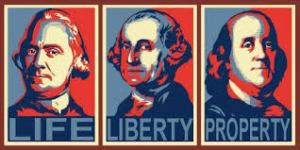
What is property? And why does it rank up there in importance with life and liberty?

image from here

First, we start with the premise that we value life. If there’s one entitlement we can agree on, it should be that we are each entitled to our right to life. The only way to forfeit that is voluntarily, as in war, or stepping in to protect someone being harmed. Or, if we take some other innocent person’s life, then the law can allow society to take our life. So we start with valuing life.

If we can’t agree to the right to life, then it’s hard to find any common ground. As I write, there’s a bill in Congress to protect the life of children born alive—particularly in a failed abortion procedure (failure to kill the infant before birth). [The bill failed. All Democrat presidential candidates and other likely candidates just voted that murdering newborns is fine with them. Remember that when it’s time to vote and someone tries to tell you Trump is the worst president ever.] The anti-life people, who like to euphemistically call themselves pro-choice, are finally admitting that there’s no difference between a baby just before birth and just after—and if they’re willing to kill just before birth, then they have no reason not to extend that willingness to kill a child after birth. What ought to go without saying—that an innocent baby is a life worth protecting from murder—is something we now have to spell out.

If we were to exemplify savagery, killing innocent babies would be on the poster.

So, let’s start with valuing life.

And then we can move on to how we spend our life. Freedom, or liberty, means we get to choose how we go about living, which will include doing work to sustain ourselves. Because we’re all born naked, shelterless, and ignorant—so much so that we really need a family to provide the necessities until we grow and learn to provide them for ourselves, which can take close to a couple of decades. Once we’ve become capable, liberty is how we pursue overcoming our original state of poverty and ignorance, and then enjoy the fruits of those endeavors.

In short, liberty is freedom to spend our lives, portion by portion. We may exchange our time and energy in exchange for money, which is a symbol for exchange of labor—or for a portion of our lives. Money makes it easier to exchange a piece of our labor that results in, say, a chair we built, with a person who fished for some food for dinner, if we have a common rate of exchange. Then you can get fish for dinner—or the several dinners a chair would be worth—from someone who doesn’t need another chair, but who does want something someone else produced, who does need a new chair. It’s just an easier means of exchanging our work for what we could use beyond simply the fruits of our own labors.

It’s a free exchange.

What is it when your work is required, but it’s not a free exchange? That’s slavery. Someone uses your time and energy—a portion of your life—and takes the fruits of your labor, instead of leaving you those fruits for your use. If you value life, you can see that stealing a portion of a person’s life is also wrong.

image from here
That covers life and liberty. Then, what is property? It is the result of your labor, above and beyond what you need to survive, that you can continue using. It’s another word for wealth, which simply means the accumulation of the results of your labor beyond what you need to subsist.

There’s another word for that: capital. It means that you have acquired wealth—results of labor beyond subsistence, that you can then use to invest in tools or other ways of creating more wealth. Or just keep it on hand until such an opportunity arises. It’s not evil; it exists only from successful work—or successful spending of a portion of your life.

Capital isn’t bad. Property isn’t bad. In fact, your property is just a way to enjoy the fruits of your labor over time—and possibly to help produce more fruits of labor. It’s evidence of a life well spent.
What happens when someone acquires far more property than someone else? That’s evidence that the person has offered something other people value enough to exchange the fruits of their work for. That person has benefited a lot of people. He then has an opportunity to spend that money, to the benefit of other workers. Or he might invest it in ways that provide work—and income wealth—to multiple workers. Or he might stuff a mattress with it so it benefits no one. But it’s his choice, because it’s his property.

Owning more property than someone else, then, isn’t wrong; it’s just evidence of serving society in a way that society appreciates.

What about those whose work doesn’t result in enough to subsist? That’s a social issue we can choose to care about, and do something about. It might be that we have enough surplus to offer a portion to the needy. That’s called charity. On a larger scale we might call it philanthropy. It’s a voluntary gift. Or, you could say it’s the exchange of the results of our labor—or wealth—for the sense of well being that comes from helping out another human being.

A righteous, caring people will want to do enough for a needy person to meet their needs without discouraging them from trying to get themselves to a more self-reliant state. You don’t want to create dependence. You don’t want to discourage someone from trying. You’ll want a person to feel valued and encouraged to contribute as much as they can to society. That takes actual caring, and often close acquaintance with a person’s situation, such as in a church community.

As long as a person in need is helped out by caring people, it simply doesn’t matter that there are large differences in property ownership.

If you think you’re entitled to the fruits of someone else’s labor, you’re a thief at heart. And let’s spell that out even more clearly: you’re a slaver. To take the fruits of someone else’s labor is to take the portion of their life that went to producing that wealth.

When government takes the fruits of your labor to “redistribute” it to someone who didn’t work for it, then government is the slaveholder and you’re the slave. This is true of anything government does beyond the proper role of government: protection of life, liberty, and property.

The way things are right now, government enslaves us for a pretty large chunk of the year. 

Entitlements—the euphemism for redistributing wealth, or pretending to do charity by coercive theft—make up a larger part of the federal budget, and most state and local budgets, than the necessities of protection.

And, as we know here at the Spherical Model,

Whenever government attempts something beyond the proper role of government (protection of life, liberty, and property), it causes unintended consequences—usually exactly opposite to the stated goals of the interference.
We make better use of our money—our property—than government can.

If there’s any person thinking about leaning toward socialism, ask, sincerely, who has the right to enslave you by taking away the fruits of your labor? It doesn’t matter if other countries, or other states, do it. Taking property away from those who paid for it with the fruits of their labor is taking a portion of their life. It isn’t fair. It’s wrong. As wrong as slavery has always been.