Showing posts with label ideology. Show all posts

Friday, July 18, 2014

SCOTUS Annual Review


The past two years, I have put together data comparing the conservative vs. liberal tendencies on the court. The first time was in 2012, ahead of rulings, to see if there was any way to predict the outcome of the Obamacare ruling. In 2013 I gathered the data (Part I, Part II, Part III) after the session. It turned out that there wasn’t a lot of predictive power, although there’s a fair amount of predictable sticking together of voting blocks. There was a surprising amount of agreement on the Court, more than expected.
I considered repeating the exercise this year. But I came upon a data source that goes well beyond what I was doing. I haven’t seen a chart of making the exact comparison I did, but the data is in there. So, for now, we’ll turn to that data, and sum up a bit.
That data source is StatPack from SCOTUSBlog. (SCOTUSBlog is not an official news source of the Supreme Court; it is a law blog that looks at the Court, and is handy to turn to.)
Page 18 (of 63 pages of data), titled "Strength of the Majority," charts some useful totals. There were 73 cases decided during the October 2013 Term (which ended in June 2014).  Of those, 48 were unanimous. That’s agreement among all 9 justices 66% of the time. They were unanimous on two out of every three cases. By comparison, last year there were 74 cases, and 35 were unanimous—a little under 50%. So we saw greater agreement overall this term.
There were two cases with a majority of 8 and minority of 1. (The average single-dissent cases between 2006 and 2012 was 6.4, so there was less going alone this year.) There were seven cases with a majority of 7 and a minority of 2. There were six cases with a majority of 6 and minority of 3. And there were ten cases with a majority of 5 and a minority of 4.
Our interest tends toward the cases with more disagreement. The ten 5-4 cases this year, is below the average of 17 between 2005-2013. It matches 2013, however. Of those ten decisions, four were decided with the usual conservative block: Alito, Thomas, Scalia, Roberts, and Kennedy (the swing vote). Two were decided in favor of the usual liberal block: Ginsburg, Breyer, Sotomayor, Kagan, and Kennedy.
Then there were four that had mixed ideological blocks.
·        Navarette v. CA                       Roberts, Kennedy Thomas, Breyer, Alito (conservative block missing Scalia, adding Breyer)
·        Scialabba v. Cuellar de Osorio             Roberst, Scalia, Kennedy, Ginsberg, Kagan (even split)
·        Michigan v. Bay Mills              Roberts, Kennedy, Breyer, Sotomayor, Kagan (liberal block missing Ginsburg, adding Roberts)
·        Paroline v. US              Kennedy, Ginsburg, Breyer, Alito, Kagan (liberal block missing Sotomayor, adding Alito)
So, if we were scoring the blocks, conservatives led 5 times; liberals led 4 times, and there was one ideological tie. Another detail is to notice how often some predictable justices were in the majority on the 5-4 divided cases. Scalia and Thomas were in the majority 50% of the time. Breyer and Kagan were in the majority 50% of the time. This year's 50% conservative victory is slightly better than usual. The average between 2005-2013 is 46%, and only in 2006, 2009, and 2010 did the conservatives have the majority on 5-4 cases 50% of the time or higher. So, it wasn’t a terrible year for the Constitution. But again, I say the Court is balanced on a knife edge.
On July 11th, I mentioned there were 19 cases concerning the HHS mandate within Obamacare, so far. And every single time the decision went against HHS and for the plaintiff. That’s an extraordinary score. You would think that the attorney general, defending the executive branch’s position, would be demoralized with such a score. But that doesn’t appear to be true for Eric Holder; he seems as unyielding and free of self-reflection as ever. So I was thinking about that.
You’ve probably heard the Thomas Edison quote, in which he says, “I have not failed. I have just found 10,000 ways that won’t work.” Maybe Eric Holder has that kind of attitude.
We feel strong having thwarted the assault on our rights each of these times so far. But we are required to win 100% of the time; the Constitution’s enemies only have to win once.
Great Wall of China
Mr. Spherical Model took this photo in 2013
Think of the Constitution as a high wall protecting our liberties—visualize the Great Wall of the Constitution. Eric Holder is among the enemy Radical Socialist Hordes trying to invade. Picture Eric Holder, with grappling hook and long rope in hand. He throws the hook time after time. Each time, the metal hits the wall and falls to the ground. He picks it up and throws it again. Nineteen times so far. But he’ll keep throwing. All he has to do is throw it hard enough to catch one time. Then he can climb the rope, secure it further, and allow one invader after another to follow him. And they can bring additional ropes up, and secure them when they get to the top, so more invaders can come at the same time.
The failed throws aren’t evidence that he’s a failure and should stop trying; to him it is just part of the process of the invasion effort.
The wall is vast. It’s hard to monitor every single span of length. We don’t know where the enemy will try its throw without our awareness. We just maintain the wall as best we can. Is it inevitable that the enemy will breach the wall? Not necessarily. So far we’ve been blessed by people standing up for their rights, which strengthens the wall. But fighting for justice is expensive in time and treasure. We need to thank those who have taken on the fight, and let them know we support them.
If there is any lesson in the balance in split cases, it is that we absolutely need the next appointment to the Court to be a person who loves and understands the Constitution, and the rights it was written to protect.

Monday, July 8, 2013

Ideology vs. Politics


I am more ideological than political. I recognize that participation in the political world is necessary in order to prevent those with opposing ideologies from imposing them on me. But I do not enjoy the political game. I am much more content to talk about ideas, and I would like to trust that wording things well so that everyone can make informed decisions will lead to the right outcome. That is, in large part, my mission here at the Spherical Model.
Meanwhile, what politically minded people know is that ideology only wins if the politics win—if the movement of public opinion is handled like a well-advertised business. Not enough people are thinkers. Not enough people pay attention. Yes, it’s important that I explore the ideas and think clearly, for my own sake and for sharing with others. But that is not enough.
This is an off-election year, so I don’t feel as pressed to engage politically. But maybe that makes it a good time to explore a discomfort zone without undue pressure.
I came across a discussion of this dichotomy over the weekend. The spelling (and bio of the author, Stephen Masty) show a British or beyond-American perspective, but the conversation applies to America nevertheless. The overall piece makes a few main points:
·        Progressives don’t engage in truthful ideological discussion; instead, they claim a desire to serve mankind and other untruths that sell.
·        Politicians, whether they claim progressive or conservative ideologies, are about building power; that is the profit they seek in their peculiar market-view.
·        Because growth of their circle of power is the goal, cutting back big government isn’t going to get done by politicians.
But the piece ended with the challenge I find I face:
Real conservatives, noble and reflective for the most part, usually debate an idea on its merits and avoid stooping to conquer. They ought to reconsider. It is not to say that conservatives should stop dissecting the misdirections and false hopes of the Progressives, but they must also engage in real-politik and expose the political agendas behind the platitudes; some groups do this already. How the bureaucracy and politicians benefit by department and function and overall, will reveal their greed for their own kinds of profit.
But exposure requires research, which is harder work than sitting in the study with Aristotle, Jefferson and even Russell Kirk. Both tasks are essential; one to provide cultural bearings and civilisational direction, the other to sell the product to a cynical multitude that is already suspicious of politicians.
It might be true, then, that we need to learn or discover ways to “sell” the truths of freedom, free enterprise, and civilization, rather than just “convey” them.
If we were to look at the last presidential election, we’d find this challenge laid out. Romney conveyed conservative ideology—always. He had done so consistently for many years before even his first run. You can’t find non-conservative ideas, unless you parse a phrase here and there during his challenging effort to convey the ideas to people who don’t understand conservative principles. The enemy portrayed him, successfully and completely untruthfully, as privileged and out of touch with real people, to build class envy against someone who knew, through experience, how to fix complicated problems—in business, in government, in volunteer organizations; combining brilliant business sense, strong use of data, and unerring integrity. Everything I knew about Romney before the election, and what I have continued to see since, is that no candidate has ever been better qualified, while also being a completely honorable individual, to be our president in our times. The difference between him and our current president is stunningly stark. [I wrote about Romney here, here, here, here, here, here, here, here, here, here, here, here, here, here, here, here, here, here, and here.]
But on the conservative side, he is still spoken of as the wrong candidate, because he wasn’t conservative enough—according to the arguments of only his enemies (primary opponents, followed by final election opponents) instead of actual known facts about the man.
I don’t think he ran a bad campaign. But I think there may be some truth in the assessment that honorable conservatives go into the debate assuming it’s about ideas. The enemy goes in assuming it’s about grabbing power, any and every way possible, and any means to that end are justified in their minds.
I don’t know the answer to how truth tellers can move the masses. When we look at Reagan, that is what he seemed to
President Ronald Reagan 1981
official portrait
have—an ability to cut through the ideologically leftist-controlled media and speak directly to people in a way that resonated. He was clear. He was direct. He rendered complicated matters uncomplicated: “Here’s my strategy on the Cold War: We win; they lose.” Diplomats cringed. But the boldness and directness translated into the principle of “peace through strength.” Using bold words was leadership.
I don’t think you’ll find significant ideological differences between Reagan and Romney. I think in Romney you would see peace through strength as a guiding principle, and limited government as designed by the Constitution a guide for economic recovery. Both men can be described as resolute and consistent in their conservatism. But Reagan had power over the message in ways we haven’t seen since.
I don’t know why Reagan had power over the message. I believe there are many today who articulate the message well, and often with similar plainness and boldness. It is the selling of the ideas to the masses that I fail to understand.
I don’t think we’ll find a candidate more perfect than Romney was. A more experienced and better human being is unlikely to appear again in a generation. So what we will need is someone conservative enough, resolute enough, articulate enough—surrounding by an army of people who not only understand and believe in ideological truth, but also know how to connect that truth to an attention deficit public. We need honorable idea salesmen.

Friday, July 20, 2012

Still Dancing the Backward-Step-Pivot-Forward

One thing we learned about Romney during the primary debate season was that he was good under attack. Better than when he’s not under attack. When everybody starts to worry that he can’t handle it, something magical happens, and he comes out ahead and stronger.

We talked about this back in January. Somebody who knows a lot more about debate than I do described it as the Backward-Step-Pivot-Forward move. He defends himself (the backward step), then turns (pivots) and makes what looked like a weakness into an offense on his own terms (forward). I think that’s what we saw this week. (Jennifer Rubin used the word “pivot” in this piece Tuesday, which clued me in to what we were seeing.)
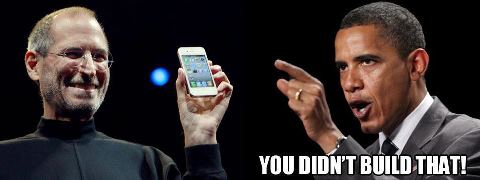
Everyone was so concerned about Romney under attack for being rich and successful. How was he going to defend against the onslaught of “Bain Capital outsourced jobs” and “Why doesn’t he give us several decades of tax returns? What is he hiding?” Then, fortuitously, Obama goes off teleprompter and says the offensive “You didn’t build that” line.

Without even knowing what hit him, Obama was on defense in a big way. Some of it would have happened regardless of the opponent; Obama is just tone deaf about how to talk to actual business builders. But what Romney and campaign have done is point out that, “this wasn’t a gaffe; it’s his ideology.” That is the defense, pivot, and offense answer to "He made money at a capital investment firm."
The problem isn’t, as Obama seems to believe, that he hasn’t been able to “tell the story.” The problem is that his way of thinking, his belief system, is harmful to America and Americans. All that needs to happen for him to be defeated is for his beliefs to be revealed.
Romney hasn’t had to say (as others have with conviction, energy, and accuracy) that Obama is a socialist. As they tell you in writing classes: show, don’t tell. He doesn’t have to use a label when Obama accommodatingly announces that he believes government is the all-powerful grantor of privileges that has allowed some hard workers to become successful, and they should be beholden to him as government’s icon. All Romney has to do is call attention to what Obama admits he believes, while contrasting that with what real American workers believe.
Romney came back with this response: “President Obama attacks success, and therefore under President Obama we have less success. And I will change that.” (A good 4-minute video of his response is here.)
And the message has connected. The Romney campaign has made good use of it with new video ads (like this one, titled “These Hands”) and other materials. But plenty of volunteers are carrying the message widely. People start asking, “If I didn’t build my business, who did?” When the president brushes away all their blood, sweat and tears—all the risk and dedication over years of sacrifice on the way to modest but deserved success—as insignificant compared to the advantage they got from government, they’re not going to take kindly to that.
I’ve been entertained by some of the visual representations. I found about two dozen on Facebook in the last couple of days. Below are a few of my favorites. (Some identify sources, but I’m sorry I can’t identify original sources for all of them. The most prolific source was Kevin Jackson’s The Black Sphere page.)