Showing posts with label Israel history. Show all posts

Monday, May 17, 2021

Wars and Rumors of Wars

Earlier this month an offensive started against Israel, requiring reprisal. In just days there had been hundreds of bombs launched at Israel. They have the Iron Dome, a defense system designed to take out missiles in the air, but there have been more than air attacks.

In the town of Lob, the mayor has asked for an emergency declaration and calls this a Kristallnacht-type event. Rioting has broken out. Synagogues have been burned, their Torahs taken from their arks and burned. Homes have had Molotov cocktails thrown through the windows. Hundreds of cars have been set on fire. Some Jews are removing mezuzahs from their doors to avoid being targeted.


Images of attacks in Jerusalem (top right) and Lob
screenshots from the Mark Levin Show

Mark Levin talked about the situation in Israel in a recent show. He gave it this perspective:

Now, think about that. These Israeli Arabs get to vote; they have due process rights; they have property rights. They have all the rights of Israelis. What do they do? They turn on the Israelis. They turn on the Jews. As if they’re Nazis, in this particular neighborhood and community. Burning down synagogues. Trying to hunt down the Jews in their homes. It’s almost instinctive. And these are mostly young Arab gangs that have coalesced and that are marauding through the streets of this town. And it’s become a problem, not only in this town, but in other towns, we’re told.

What would we do if we had attacks from over the border on our country? We would put a stop to it with force.

What if we had riots from among our citizens, looting and setting cars and businesses and homes on fire? Well, I would have thought we would send in troops to quell the emergency as Israel is doing. But the experience of the last year shows that, in some cities, they just call it the “summer of love” and tell the people not to complain and the media not to report on it. But in a sane world, we can see why New Jersey-sized Israel, surrounded by Arab countries, some of whom are aligned with Iran, would take action to defend themselves.

Levin started his show with this:

The Israeli government I have no doubt told them [the US], “Butt out; we’re going to handle this.” Because they know that Biden doesn’t have their back. And they know that the enemy, the Palestinian terrorists, Hamas, which is on our list as a terrorist organization—it works with Islamic Jihad. It works with Hezbollah. It works with Iran. All of our enemies.

Israeli Prime Minister Benjamin Netanyahu said this in a speech this week (translated):

We are in the midst of a major campaign—Operation Guardian of the Walls. Yesterday and today the IDF [Israeli Defense Force] attacked hundreds of Hamas and Islamic Jihad terrorist targets in the Gaza Strip. We have eliminated dozens of terrorists, including senior commanders. We have bombed Hamas command centers and toppled buildings that serve the terrorist organizations. We will continue to attack with full force. We have just finished a consultation and assessment of the situation with heads of the security establishment, and we made decisions. Hamas and Islamic Jihad have paid and—I tell you here—will pay a heavy price for their aggression. I say here this evening—their blood is on their heads.

Do we know what this suddenly upscaled civil war is about?

The immediate reason is probably because Israel's enemies can, because the weak US administration is not likely to fully support Israel—unlike the last administration, which brought multiple Middle-Eastern countries to sign peace deals with Israel.

Levin said this:

The Biden administration helped provoke this, as I said earlier, by giving hundreds of millions of dollars to the Palestinian Authority without strings attached. President Trump had cut it off, because he said they’re not willing to give up terrorism, among other things; they’re not willing to negotiate with the State of Israel over anything.

The Trump position was, Look, let’s make peace in the Middle East without the Palestinians, then. And that’s what happened. He said the Palestinians can’t be the trigger on whether or not there’s peace, because, if that’s the case, they’re always going to be able to blackmail; they’re always going to be able to resist; they’re always going to be able to slow down the process and make demands and so forth—when in fact there are Arab countries, Muslim countries, and Israel that can make peace. And want to make peace. And many of them did. And, but for Biden being president of the United States, it was felt that Israel was going to have a peace treaty with Saudi Arabia—because they have a common enemy in Iran.

Things are very different under a Biden administration than under a Trump administration. Popping up as if they have a right to are these faces of evil:


Known as "the squad" in Congress, Rashida Tlaib (left),
Ayanna Pressley, Ilhan Omar, and Alexandria Ocasio-Cortez
Getty image, as screenshot on the Mark Levin Show

Levin says,

Have you listened to Rashid Tlaib? Have you listened to Omar? Have you listened to AOC and the things that they’re saying? They are a disgusting disgrace: Israel is an apartheid country, that they’re trying to kill and evict the Palestinians, and so forth and so on.

The Democrat Party has this cancer, this poison, within it. And rather than confront it, and rather than extinguish it, like with a fire extinguisher. What does it do? It pampers it, or pretends it doesn’t exist. It also exists within the Biden administration, which is really quite appalling. Not just Jen Psaki, the spokesperson for Joe Biden, but the National Security Advisor, the Secretary of State, the spokespeople at the Department of State, others who are leaking to the media—and the media’s doing it’s usual reprehensible job in turning Israel into the perpetrator and the terrorists into the victims. The terrorists know how to play our media. And the media want to be played.

One of them, probably Tlaib, complained that we are helping to arm Israel with the Iron Dome, but Hamas doesn’t have an Iron Dome, so to be fair we should provide them one. Hmm. How unfair is that? We don’t arm the aggressors of our allies? That's so evil of us it's no wonder the squad hates this country they claim to represent while speaking treason against us.

There was a tall building Israel knocked down in Gaza, in response. It housed the Associated Press office. It also just happened to house Hamas—and had for, oh, 15 years or so. The Associated Press was “Shocked! Shocked!” to learn Hamas was in the building—even though they acknowledged in 2014 that they knew it, and seemed to have no problem with that either before or after. So, maybe you’re not going to get honest reporting from AP.

The AP noted that lives could have been lost; they had many employees in the building, but were able to evacuate them in time. They don’t say how they accomplished that rescue.

Ahead of the return attack on Hamas, Israel sent out a message, repeated for half an hour, telling people to evacuate, because they were going to bomb the building. Israel, unlike practically any other fighting force in world history, goes out of its way to prevent loss of civilian life—hard to do since Hamas places itself in hospitals, elementary schools, and densely populated areas for the purpose of causing loss of life among their own people so that they can blame Israel.

When Hamas and Islamic Jihad choose a target, they don’t aim at military or strategic targets; they aim at high population centers.

The IDF put out this map. Note that Tel Aviv is the highest population center.

IDF shows where missiles are aimed at Israel.
Image found as screenshot on the Mark Levin Show.

Levin spent some time describing the Iron Dome defense system, including a video clip about that, where the narrator said:

It took just 3 years and about $200 million to develop this defense system. It relies on a radar that instantly detects when a missile has been fired. Algorithms quickly try to determine what type of projectile is in the air, and whether it’s heading for a populated or strategic area. If so, Iron Dome launches a missile of its own. It’s said that Iron Dome has taken down more than 1,000 missiles since it turned on in 2011.

I heard a report last week that the count of missiles launched at Israel since this siege began just days before was over 600. That was several days ago. In a week the Iron Dome has been up against an attack amounting to the sum total of its use during the past ten years. Israel fought off a fairly large attack in 2014, but this dwarfs that one. Later in that video they mention that it successfully wards off 90% of incoming missiles. That means somewhere beyond 60 missiles probably landed in Israel this week.

Levin interrupted the video here and pointed out that the Iron Dome technology was a legacy of Ronald Reagan:

President Ronald Reagan, Mark Levin
screenshot from the Mark Levin Show

Some of you who are my age, or even younger—this was the brainchild of Ronald Reagan. It’s called the Strategic Defense Initiative. And it was brought to the President at the time. People in his own party were skeptical. People at the Pentagon were skeptical. The media hated the idea, and we had article after article about how it was technologically impossible for a missile to hit another missile. And the Democrat Party tried to block it.

But Reagan was—if anything, he was steadfast. And he pushed the project. It wasn’t fully funded, but he pushed it throughout his eight years as president. It was pushed somewhat after that. And we now have this defense system. They called it Star Wars to mock him. “Oh, sure, sure, we can do this.” And I remember reading in the New York Times and other publications how you simply didn’t have the technology; it was impossible.

And, of course, as you’re developing technology, you have to try it out. They tried it out, and there were several failures. Again, the were mocked for the amount of money that was being spent. I want you to think about this. This is a defensive system that could knock a nuclear missile out of the sky that’s aimed for one of our cities. Democrats never supported it. The media never supported it. That’s insanity.

Now it exists.
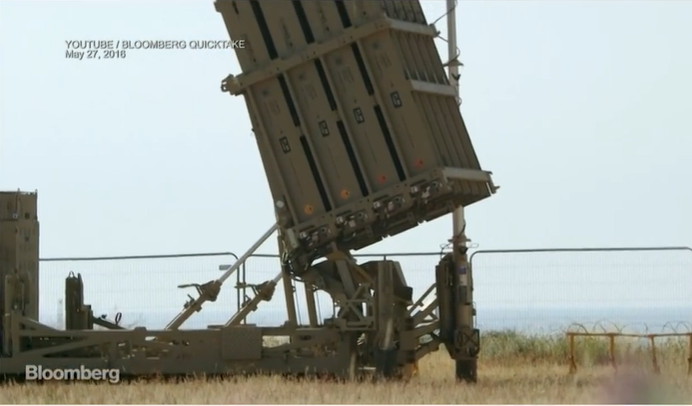

Iron Dome mobile missile launcher
screenshot from Bloomberg video shown on the Mark Levin Show

Levin added:

A good chunk of the funding Israel gets it uses to advance their technology. Not for bullets. Some. But, to advance their technology, which they then turn around and give to the United States. So it’s really a two-way street. The Israelis can develop this stuff faster, because their bureaucracy and their people understand this is life and death. There’s an immediacy to it. Whereas, in our own country we have obstacle after obstacle after obstacle to getting these things done—including in the bureaucracy, but also the Democrat Party and the media.

So, US weakness has contributed to the current upheaval. But the longer-term excuse goes back to Israel’s birth and beyond.

If you need a review of Israel’s basic history—because you probably weren’t taught this in school—I wrote a 6-part series (each part relatively short) back in 2011:

·       Israel, Part I: Ancient History 

·       Israel, Part II: Zionism and Migration 

·       Israel, Part III: Conflict and Violence 

·       Israel, Part IV: Holocaust and Statehood 

·       Israel, Part V: Refugees and 1967 War 

·       Israel, Part VI: Continued Unrest 

Since that series, I’ve written occasionally on Israel, based on what was happening at the time. Here are a few:

·       Obama Bent on Stopping Israel, but Not Iran, March 12, 2012 

·       Civilization vs. Savagery in Israel, July 24, 2014 

·       Historic Day in Israel, May 17, 2018 

Besides Mark Levin’s show,  which is “Chaos in the Holy Land,” Ep. 814, on The Blaze, you might also want to see these:

·       Israeli Airstrikes in Syria as Rockets Target U.S. Troops in Iraq AGAIN” Erick Stakelbeck, Watchman Newscast, May 5, 2021 

·       Hamas is PUSHING Israel Into A Ground Invasion; Iran Using Onslaught as Dry Run?” Erick Stakelbeck, Watchman Newscast, May 13, 2021 

·       The War on Israel Ramps Up; Celebrities and the Left Melt Down” Stu Burguirre (on Facebook), The Blaze, May 17, 2021. 

I don’t know how exactly how this latest onslaught from Israel’s enemies will go. Either Israel will be able to quell the uprising, or it’s time to start watching for two prophets, who will hold off Israel’s enemies for three and a half years, just before things get really exciting (see Revelation 11). 

Monday, August 17, 2020

The Abraham Accord

A major historic event took place last Thursday, August 13, 2020. It eclipses post office funding or mask wearing to “fight” COVID-19 by so many orders of magnitude that you should have been hearing about it nonstop all weekend. Instead, by Friday afternoon the story was waning. By Saturday it was no longer included in the top dozen stories on MSN or CNN online. Hmm.

What was this historic event? President Trump, along with Israel’s Benjamin Netanyahu and the United Arab Emirates’ Crown Prince Mohammed bin Zayed of Abu Dhabi, signed a Middle East peace accord—the first one since 1994—referred to as the Abraham Accord, bringing together different branches of Abrahamic peoples.

Jared Kushner discusses the Abraham Accord on Fox News Sunday
screenshot from here

President Trump said,

This is a truly historic moment. Not since the Israel-Jordan peace treaty was signed more than 25 years ago has so much progress been made toward peace in the Middle East, by uniting two of America’s closest and most capable partners in the region—something which it was said could not be done. This deal is a significant step towards building a more peaceful, secure, and prosperous Middle East.

Ambassador Robert O’Brien said this about the accomplishment: “I think history’s going to remember the President as a peacemaker. It’s really something special that he was able to put together.”

It is worth noting that actual peace deals that are accomplished get no Nobel Peace prizes, but politically “correct” do-nothings do get awarded (for example, Obama, his first year in office before doing anything, and 17-year-old Greta Thunberg, who was nominated, for scolding the world for driving cars, but had to settle for a humanitarian award).

After Thursday’s announcement, when it became evident that denigrating President Trump for a verifiable good accomplishment was fruitless, former VP Joe Biden tried to take credit—for laying the groundwork, along with Barack Obama, some five years ago.

In a twisted way, Biden is right. That administration’s anti-Israel/pro-Iran actions made other Middle Eastern countries aware of their vulnerability to Iran and its anti-freedom tyranny. So, while they may still have some disagreements with Israel, they are willing to set those aside to unite against a common enemy that had been strengthened by Obama/Biden.

The timing was good for the accord—because of President Trump. He undid some of the damage caused by Obama’s ship-pallets-of-cash-to-Iran-while-allowing-them-to-proliferate-nuclear-weapons agreement that was the worst negotiated deal in the history of the world. And he moved our embassy to Jerusalem. He has been a solid and reliable friend both to Israel and to the UAE and other Arab entities that would rather not be subject to Iranian mullahs.

The description of the president and the process are not what you’re likely to hear in mainstream media sources. In an interview with Hugh Hewitt on Friday, Ambassador O’Brien said this: 

One of the things that the President has, one of the great attributes, and I’ve talked about this before publicly without getting into the details of any specific call, he really has an incredibly good manner with foreign leaders. He gets along with them. He’s cordial with them. He’s civil with them, all the things you’d expect from a diplomat. And he’s very persuasive with them. So what had happened is that over the past three years, the President had developed a great deal of trust with Prime Minister Netanyahu and with the Crown Prince. And it’s that reservoir of trust that allows you to bring folks together to push them over the line, to negotiate with them, to mediate with them, to encourage them and to persuade them…. And I think Americans would be very proud of their president if they’d watched how he’d handled these negotiations with a lot of dignity, but also with a lot of goodwill and friendship and good humor with these two leaders.

There was a team working on the deal, “quarterbacked” by the president’s son-in-law Jared Kushner, who was also instrumental in moving the embassy to Jerusalem. But the entire team, even down to lowly staffers, got invited into the Oval Office to listen in on the historic moment. President Trump knew it was historic and wanted them to experience the moment with him. And, to their credit, no one had leaked information about the delicate negotiations, which could have derailed them. At the end of the phonecall, spontaneous applause broke out in the room.

I don’t know yet how this will play out in world history, but it’s definitely a good thing. And it’s likely to spread to other enemies of Iran in the Middle East.

Ben Shapiro noted,

By the way, it is also evident that Oman and Bahrain are going to follow the UAE in normalizing Israeli ties. And Saudi Arabia cannot be far behind. So this means a complete opening of the Middle East…. It is a very very good day for peace in the Middle East.

And the New York Times predicted that the accord “could presage a broader realignment in the region as the two agreed to ‘full normalization of relations’ in exchange for Israel suspending annexation of occupied West Bank territory.” 

One thing I hadn’t been aware of was a sort of tacit agreement already in play. Even though the UAE had policies against trade with Israel, they made exemptions on a case-by-case basis whenever it suited them. So often, in fact, that you can find the occasional Israeli grocer in a city, purportedly for business travelers. I’m told Saudi has such tacit agreements as well.

News media is talking about what Israel was forced to give up in order to come to this deal. That’s not the real story.

The UAE was already willing to agree with Israel. But they needed something in return. Israel offered up a pledge not to annex portions that, if it had declared them Israeli land, would not likely have been recognized anyway, not even by the United States. It would have been a declaration without effect on the ground. However, it’s land that, if there are future negotiations, is likely to go to Israel. Ben Shapiro describes it as Israel giving the UAE a fig leaf. He said,

The UAE wanted to normalize relations with Israel. They said, “We need something in return to make it look like we give a crap about the Palestinian Authority, which we actually kinda don’t.” And Israel said, “OK, well, we just won’t formally annex all this territory we know is going to end up in Israeli hands under any peace deal in the future anyway.” And the UAE was like, “Good. Done.”

If we’re adding the Abraham Accord to the history books, maybe we ought to review some of the history.

While the United Nations voted to give Israel statehood in 1947, with a two-state solution, the Arab nations surrounding it refused to recognize the decision. So there never was a recognized Palestinian state. Ever. In all history. Israel then declared its independence May 14, 1948, and that is the official beginning of the modern nation of Israel. Its war for independence ensued, fought from May 2018 through July 1949. At this point, in the cease fire agreement, the West Bank of the Jordan River was allotted to Jordan, and the Gaza Strip was allotted to Egypt, and they allowed Israel to exist for the time being.

In 1967, Egypt attacked, along with Jordan and Syria, in an attempt to wipe Israel into the sea. In what can only be called miraculous, Israel won that war in six days—thus the name of the Six-Day War. I remember my dad talking about this miracle, as a sign of nearing the last days, back when I was just old enough to pay attention. So I’ve spent half a century believing it is worth watching what happens to Israel. Anyway, in that conflict, Israel won back the West Bank and Gaza, but the Palestinian refugees from that area continue to claim land. Much of that has since been ceded by Israel. But, it turns out land for peace has never been a good strategy for Israel.

If you’re in need of a primer or refresher, I go into more detail in a 6-part series from 2011:

·         Part I: Ancient History 

·         Part II: Zionism and Migration 

·         Part III: Conflict and Violence 

·         Part IV: Holocaust and Statehood 

·         Part V: Refugees and 1967 War 

·         Part VI: Continued Unrest 

While several US presidents had claimed Israel’s right to name its capital as Jerusalem, and promised to move the US embassy there—starting with Clinton in 1999, waiting through Bush and Obama—President Trump actually made the move. The dedication happened on May 14, 1948, exactly 70 years after Israel became a modern nation.


US Embassy in Jerusalem dedication
screenshot from here

In Hebrew, I am told, various numbers have certain meanings.

7 = perfection

10 = completeness

70 = perfection and completion, or perfect order, with all power and perfect judgment

In other words, 70 is significant, and symbolic. To have it happen on that date—not a year earlier or later, not a month or two earlier or later—makes it more striking than just a very fine accomplishment by human world leaders.

Commemorative Temple Coin
image is a screenshot from here

To commemorate the embassy move, Israel minted a commemorative coin, with the heads of President Trump and Cyrus, who was non-Israelite king who was instrumental in the rebuilding of the temple 70 years after the captivity that ensnared Daniel, Shadrach, Meshach, and Abednego back around 600 BC. Besides honoring President Trump, the commemorative coin is being used as a fundraiser for eventually rebuilding the temple in Jerusalem. You can go online and see the progress at TempleInstitute.org. They have acquired all the building materials, as well as the vessels, vestments, and other things needed. They’re in the process of raising a red heifer that is to be sacrificed.

Illustrations of the ancient Jerusalem Temple
from TempleInstitute.org


Some prophecy watchers suggest next spring will be the time the temple construction gets underway. An impediment has been that the Dome of the Rock, the top of the Temple Mount, has been under Arab control for a long time. Just recently there was an archaeological discovery of a foundation of what appears to match the temple specs—not directly under the Temple Mount, but very close nearby, already under Israeli control. I don’t think there’s full agreement on which location is to be used for building the temple, but it’s an interesting story to follow.

I ended my six-part series on Israel with some words from Benjamin Netanyahu, and tied that in with the Spherical Model. Those words seem to still fit with this week’s added piece of history, if we include all those willing to honor our friendship with Israel along with us. We welcome the UAE into that circle:

I believe Knesset Chairman Benjamin Netanyahu was right when he said, “If Palestine were to lay down their guns tomorrow, there would be no more war. If Israel lays down theirs, there would be no more Israel.” I’ve kept that quote for some years. But in that speech, he went on to say, “Israel must create treaties with the countries of the world based on values, interests, and strength. We must nurture our military, diplomatic and political, and spiritual strength—that is the key to our future.”

At the Spherical Model, we can judge the success of civilization, economics, and freedom based on specific principles. It isn’t surprising that terrorists who advocate a mixture of savage chaos followed by tyrannical rule are far into the southern hemisphere, not only politically but also economically and socially. The Muslim people who most adhere to the rules of civilization also enjoy better economics and less oppressive government. Israel may not be perfect, but as a democratic friend that strives for civilization, we do well to honor that friendship.


Thursday, July 24, 2014

Civilization vs. Savagery in Israel


If you think there is an Israeli occupation of Palestine, you need a primer. If you think both sides are equally culpable in their conflict, you lack information. If you think maybe it’s a good idea to support Israel, maybe for Biblical reason, but you don’t know how to describe your reasons, this might be a good time to get some useful facts.
Back in 2011 I wrote a six-part post on the history of Israel. It’s a pretty good primer.
·         Israel, Part I: Ancient History
·         Israel, Part II: Zionism and Migration
·         Israel, Part III: Conflict and Violence
·         Israel, Part IV:  Holocaust and Statehood
·         Israel, Part V: Refugees and 1967 War
·         Israel, Part VI: Continued Unrest
In Part VI I link a video that describes the history with animated maps—about six minutes. Worth seeing. This past week I saw a video by Jewish conservative radio host Dennis Prager, which also gives a brief history, posted on YouTube in June 2014, shortly before the recent missile out of Gaza began. It gives a 5-minute summary of the situation, reminding us that there has never been any state in that region that wasn’t a Jewish state; this is the third Jewish state. There has never been an Arab state, a Palestinian state, a Muslim state, or any other state.


As I mention in my Part VI, the terrorists fighting Israel are more Marxist than religious Muslim. Potential PLO leaders were trained in Moscow, East Germany, and Cuba, where they were specifically trained in subversion, propaganda, explosives, and terror tactics. They continue these tactics still. One of the PLO’s tactics was disinformation—lying propaganda. Repeating the lies over and over, through decades, in schools and in every news broadcast, has left a large part of the world unaware of the truth of events in the Middle East. The PLO is named less in media since the loss of Soviet support in the early 1990s. Now the entity in the forefront—still using those tactics—is the terrorist organization Hamas.
Steven Bucci, former Army Special Forces officer and top Pentagon official, now with The Heritage Foundation, offered perspective in a piece July 17, 2014, “The Moral Difference between Israel and Hamas,” The Daily Signal July 17, 2014:
What most Americans—and the world—hear about the ongoing conflict between Israel and Hamas goes something like this: “125 Palestinians, most of them civilians, have been killed by Israel’s relentless assault on Gaza. No Israelis have yet been killed.” This may be true, but there is absolutely no context to it. One must look at the methodologies of the two sides.
Hamas sets up rocket launchers—as well as supply dumps and command-and-control sites—in the midst of apartment buildings, mosques and schools. From these sites, its fighters launch dozens of rockets in salvos, targeting population centers with no discrimination at all. They have been firing almost continuously of late. But normally, they fire when Israeli school children move from their homes, which have safe shelters, to their schools, which also have shelters. They do this deliberately to try and catch the kids in the open. They don’t seek to minimize collateral damage – they seek to maximize it.
Israel, on the other hand, fires only at specific, intelligence-derived military targets. Since these targets are deliberately intermixed with the civilian population by Hamas, Israel must take steps to minimize the collateral casualties.
Before the Israelis strike a building, every home in it gets a call on its landline phone, as do all the cell phones associated with the inhabitants of the building—the cells additionally get text messages—telling them that in a few minutes the building will be targeted. Finally, to make sure everyone gets the message, Israel drops a dud bomb—one containing no explosives—onto the roof of the structure. Minutes later, the building is destroyed. There is no instance in modern military history where a force has taken greater measures to give the innocents as much chance to get out of the way.
Similar information was shared in interviews with Israeli Ambassador to U.S. Ron Dermer. He was interviewed on Face the Nation July 13th TheWashington Post July 15th,  and CBS News July 18th.  Here’s a quote from the Washington Post interview:
As we’re trying to people out of harm’s way, Hamas is telling people to go into harm’s way. They’re actually telling their population to ignore the warnings of our military, as we drop flyers, we make phonecalls, we send text messages. We do things I’m not sure there’s another country in the history of the world, in warfare, that have gone to such great lengths to keep the civilians of the other side’s population out of harm’s way. We’re doing what we have to, to take the action to defend our people.
Israeli Prime Minister, Benjamin Netanyahu, was quote this past week, saying, “The difference between us is simple: We develop missile-defense systems to protect our citizens, while they use their citizens to protect their missiles.”
The Prime Minister did an impressive interview on Fox  News, with Bret Baier, on July 21st. All six minutes are clear and informative, but here’s a sample:
We asked these civilians before we went in, “Please leave.” We text them on cell phones. We drop leaflets. We tell them where to go. And those who left were safe. Now those who didn’t leave, you know why they didn’t leave? Because Hamas told them to be there. Because Hamas, while we try to avoid Palestinian civilian dead, Hamas wants Palestinian civilian dead. The more the better, so they can give you telegenic fodder. So this is the cruelest, most grotesque war that I’ve ever seen…. Civilian deaths are caused because they want them to be caused.
My daughter, Social Sphere, has a friend she met some years ago, as a teen in Texas, still in touch on social media. Danielle moved to Israel to serve in the IDF (Israeli Defense Forces). Here are some of her recent posts [ID info removed]:
Of the 13 Israeli soldiers killed yesterday, one is a Texas boy—who moved to Israel with two of his best friends to join the IDF, giving him a “lone soldier” status. This means that even though he and his family did not live in Israel and he did not have to serve, he decided at a young age (in his case, 16) to move to Israel by himself so he can serve in the IDF. So he is alone in Israel. According to our friend—“These kids get most respect in Israel.” We are as honored that he came from Texas as Israel is to have received him.
Another day Danielle said, “The indoctrination of hate is one of the primary tactics Hamas uses to teach violence to children. This is child abuse. Hamas is a dangerous terrorist organization for Israelis, but they are toxic for Palestinian children and civilians as well.”
Another of Social Sphere’s Texas friends traveled to Israel recently to learn more about her ancestry. Rachel quoted US Secretary of State John Kerry, saying one of the few things he has said that rang true: “No country could sit by and not take steps to try to deal with people who are sending thousands of rockets your way. The fact is that Hamas uses civilians as shields and they fire from a home and draw the fire into the home.”
Using human shields is a violation of the rules of warfare. So is targeting of civilians, as Hamas does, seeking to kill as many civilians as possible in Israel, while also delighting in any of their own people killed, because they use that in their propaganda.
I was thinking the word was getting out this time, but apparently not much beyond those who already know the truth. Despite the moral clarity between the two sides, the UN just decided to investigate possible crimes against humanity in this conflict—but will ONLY investigate Israel.
Israel deserves the support of the civilized world, not condemnation for keeping itself alive.
There’s one other video you ought to watch, new yesterday, July 23rd, from Bill Whittle: “The Case for Israel.”  He compares the two sides, one civilized and one barbaric (in the Spherical Model we use the word savage, but I think we can conclude they have the same meaning). In case you missed it, Hamas recently referred to the Jews as a little bit worse than Hitler. This quote responds to that ironic accusation:
The instant that Hamas or Hezbollah get their hands on a nuclear weapon, they will do with it what they do every day with their rocks and mortars and missiles. They will use it. On Israel. The Israelis have an estimated 500 nuclear weapons and could destroy the Arabs any time they chose. They don’t.
Those are not Nazis. Those are moral, civilized people.
Israel is an island of civilization in a sea of barbarity, and that is why it is being targeted. Uncomfortable with those words, “civilization” and “barbarity?”
He then gives a long list of evidences of Israel’s civilization status. The differences are stark, and ought to be noticeable by any civilized person. But disinformation, over time, has done its dirty business.
Anyone who thinks the Israelis keep all the goods and wealth for themselves and deprive their neighbors doesn’t know the history. Also, anyone who claims this attack from Gaza is caused by Israeli “occupation” is buying the propaganda. Israel left Gaza in 2005, leaving behind infrastructure, hospitals, schools, even greenhouses with plants growing. The response was to destroy everything and subject the people to poverty, and then blame the Israelis for their misfortune. Toward the end of the video, Whittle covers this bit of history, and refers to another concept we talk about when striving for civilization—“Thou shalt not covet.”

But you cannot understand Israel’s actions without understanding the pervasive, unrelenting, hate that surrounds that outpost of civilization. From Hezbollah rockets made in Iran, to BDS [boycott, divestment, and sanctions] sanctions made in Berkeley and Santa Monica, the attacks on this country and its people cannot be understood without getting to the bedrock essence of the nasty, petty, small and mean-spirited emotion that drives anti-Semitism.
And that emotion is Envy.
Genesis, Chapter 26, verses 12 through 16:
And Isaac sowed in that land and reaped in the same year a hundredfold. The LORD blessed him, and the man became rich, and gained more and more until he became very wealthy. He had possessions of flocks and herds and many servants, so that the Philistines envied him. (Now the Philistines had stopped and filled with earth all the wells that his father’s servants had dug in the days of Abraham his father.) And Abimelech said to Isaac, “Go away from us, for you are much mightier than we.”
That was thousands of years before there was a religion called Islam. And when the Israelis, as a gesture of peace and goodwill, turned over the Gaza Strip in 2005 the first thing these modern-day philistines did was smash the windows of the greenhouses that had been handed to them by other people’s labor. Once again, they filled wells in the desert with sand.
Israel has survived miraculously in the past. I expect it to survive now. I want to be clear that I side with civilization, not savagery. And the differences right now couldn’t be clearer.


.

Friday, August 26, 2011

Israel, Part VI: Continued Unrest

This is the 6th (final) part of a series on Israel. For the full series, see Part I, Part II, Part III, Part IV, Part V.


Boundary Maps
I need to correct something from yesterday. Israel gained a significant amount of land when defending themselves in the 1967 War. I showed a map of what the boundaries looked like a year later, when they had ceded much of it back. But as I began reading about the Yom Kippur War, one of the reasons for that war was for Egypt and others to regain territory lost (specifically the Sinai Peninsula for Egypt). What the Israelis did do in the occupied territories, however, was allow the conquered peoples to continue self rule. They sharply put down any rebellion, but where there was cooperation, Israel was generous and mostly hands-off. I’m not certain why the source for my map was incorrect, unless it was using this self-rule policy as a limit to the actual boundaries of the state of Israel. So my apologies for the confusion. 

There’s a video I came across recently, dealing with the changes in boundaries. I found it helpful. It’s about six minutes long, worth watching for clarity: http://www.youtube.com/watch?v=XGYxLWUKwWo


Sources
I should maybe talk a bit about my sources, since it is information sources in the Middle East that accounts for so much of the difference of opinion. I am reading sources that have always been friendly to Israel, but who have spent a lot of time in the Middle East and developed relationships with many local Arabs as well. I trust the sources for point of view generally. You can make your own decisions. 

I mentioned at the beginning of this series that much of my information came from the history texts we used for homeschooling. These were self-published, and last I looked were no longer available for distribution. The books are Understanding Middle East and European History, Volumes 1 and 2, from The Center for Educational Restoration, © 1997 and 2000 respectively. I used basic information from these books, but analysis is mine.  

A good chunk of the information, especially up to WWII, is cited as coming from Zionism—The First One-Hundred Years, distributed by the Embassy of Israel, Washington, DC. Some later information comes from David Ben-Gurion’s Israel: A Personal History, © 1970 as well as The Jews in Their Land © 1974. The texts also quoted at length from writings by W. Cleon Skousen, including speeches, government reports, and his definitive work on the 1967 War, Fantastic Victory (I also used a student edition of this book, from CER, © 2001). Skousen was a prolific author; you might know him for The 5000-Year Leap, The Real Benjamin Franklin, and possibly his Bible history series, The First Two Thousand Years, The Third Thousand Years, and The Fourth Thousand Years. 

The reason for this talk about sources today is more than to make up for yesterday’s error; it is to get at the heart of why there is so much confusion there. How do we know what the situation really is, and who are the injured parties and the oppressors? Some of my trust comes from familiarity with the sources. Some comes from observing the countries and people, and gauging how closely they adhere to principles of civilization. 

PLO
Yesterday we covered some of the Palestinian refugees—the Arabs in Israel who fled their homes when surrounding Arabs refused to recognize the newly created state of Israel and went to war to eliminate Israel and the Jews. I need to add a detail about this. After the brief war that failed to eliminate Israel, the Israeli government set up a trust to handle the property of the refugees, to hold it for them. All they asked was recognition of their statehood and a permanent peace treaty. These requests were never met. 

Eventually the land was purchased using a price structure set up by the UN. Israel never simply went in and took over private property; they lawfully acquired the land. Meanwhile, however, it does not appear the refugees were personally paid for their properties. If that is so, it was not because of any evil attributable to Israel. 

Among the refugees, as we noted yesterday, were a number of hotheads, tending toward terrorism and war, and refusal to meet any Israeli demands. In addition, we also looked yesterday at the Soviet Union’s efforts to fill a power vacuum left by a retreating Britain. 

Now, for the Palestinian Liberation Organization. By the early 1950s, this was a loose organization of many factions, brought together under this umbrella that was supported and trained by the Soviets. Methods, structure, and ideology were more Marxist than Muslim. Potential leaders were trained in Moscow, East Germany, and Cuba, where they were specifically trained in subversion, propaganda, explosives, and terror tactics. In every war against Israel up to the fall of the USSR, the Soviets provided massive arms to Israel’s enemies. 

While among the refugees, the PLO attempted the assassination of Jordan’s king, causing the refugees to be ousted from that country in the 1970s. In the early 1980s, in Lebanon, they attempted a government takeover; the PLO was ousted, but refugees were allowed to stay. The PLO remained infiltrated, therefore, and often used innocent refugees as human shields.  

Among PLO atrocities are hijackings of passenger jets, assassinating the Israeli Olympic team in Munich, killing Egypt’s diplomatic corps in Cyprus, assassinating US diplomats and ambassadors, and many many attacks on innocent Israeli citizens in their own country. All these events they boast of as “revolutionary victories.” 

One of the PLO’s tactics was disinformation—lying propaganda. Repeating the lies over and over, through decades, in schools and in every news broadcast, has left a large part of the world unaware of the truth of events in the Middle East. 

Since the loss of Soviet support in the early 1990s, the PLO itself is both more accepted as legitimate and less in the news, but terrorism and disinformation tactics are at least as prominent as ever. 

During lectures I attended last week, Middle East expert Victor Ludlow talked about the people there. He has visited Israel some fifty times, lived there four times. He used the analogy of salt and pepper. Among Arabs, Jews, and Christians he knows there, most are the salt of the earth—good people, hard working, family oriented, the kind of people you want as your neighbors. But scattered among the salt are the pepper, the hotheads who make trouble for all. 

Over here in the US, that is also my perception. Most of the Jewish people I’ve known are good, decent people not too different from me and my family. Lately we’ve become acquainted with a number of Arab Muslims, mostly who have come here from Iraq and Saudi Arabia for training in the oil industry. Mostly young men between 20-35, they are nevertheless salt of the earth, not the pepper.  

Ludlow, an American who truly understands the Middle East, said he was very glad not to be asked to come up with some partition plan. He showed us a map of the controversial West Bank area. Jewish settlements are mostly many small dots, and a few larger settlement blocks. And Palestinian cities and towns are fewer but larger, mostly among the various Jewish settlements. There is no way of partitioning without uprooting a majority of probably both parties. 

There are serious problems that may not be solvable either by war or peace treaty. Population per square foot, for example. In the US we have about 30 people per square kilometer. Israel has 300. The West Bank has 400. Gaza (refugee area attached to the Sinai Peninsula) has 4000—only parts of India and Bangladesh are more crowded.  

In the US the GDP per person is about $47,200. In Israel it’s $29,800. They are hard-working and successful, but you can see their work doesn’t translate into as much prosperity as we enjoy. The West Bank GDP per person is only $2,900, and in Gaza it is $1000—extreme poverty. 

The larger Middle East can be divided into Big Four (Egypt, Turkey, Saudi, Arabia, and Iran), with 70% of population and, I believe, production/income. Seven Middle countries (Syria, Iraq, Jordan, UAE, Oman, Yemen, and Israel) have 25%. Then there are Six Small countries, dividing up the remaining 5%. As one of these small countries, Palestine (the partitioned country recognized with leadership from the PLO) continues as a hot spot for poverty, politics, and terrorists. (Similar problems exist in middle-sized Yemen and Syria and larger Egypt and Iran.) 

Israel’s government is much more socialist than we tolerate in the US (so far). But they are hard working and rights oriented, with elected representation. Despite the necessary outgo for defense, they are among the most prosperous in the Middle East. Logic alone tells us the 7.5 million Israelis, on their New Jersey-sized plot of land, are incapable of oppressing the surrounding hundreds of millions of Arab peoples.  

I believe Knesset Chairman Benjamin Netanyahu was right when he said, “If Palestine were to lay down their guns tomorrow, there would be no more war. If Israel lays down theirs, there would be no more Israel.” I’ve kept that quote for some years. But in that speech, he went on to say, “Israel must create treaties with the countries of the world based on values, interests, and strength. We must nurture our military, diplomatic and political, and spiritual strength—that is the key to our future.” 

At the Spherical Model, we can judge the success of civilization, economics, and freedom based on specific principles. It isn’t surprising that terrorists who advocate a mixture of savage chaos followed by tyrannical rule are far into the southern hemisphere, not only politically but also economically and socially. The Muslim people who most adhere to the rules of civilization also enjoy better economics and less oppressive government. Israel may not be perfect, but as a democratic friend that strives for civilization, we do well to honor that friendship.

Monday, August 15, 2011

Israel, Part III: Conflict and Violence

This is the third part of a series on Israel, to cover some basic history and how we got where we are. For Part I on Ancient History and Part II on Zionism, see last Thursday and Friday’s posts. Today we cover the conflict and violence that marked the decades prior to WWII. 

At the end of WWI, when the Palestine area came under British care, and Syria was placed under France, the local Arabs, rather than seeing this as a step toward independence and freedom, felt the world had betrayed them, eliminating the “protection” they had gotten under Turkish rule. 

Britain allowed the basically separated Jewish and Arab communities to essentially rule themselves. The Jewish community elected a self-governing representative body called the National Council, which implemented policies. And in 1922 they constituted a Jewish Agency to represent the Jewish people to the British authorities, and also to other foreign governments and organizations.  

City view taken by my niece during
this summer's semester abroad
During the next three decades, they developed agriculture, factories, roads, hydroelectric power, and tapped mineral resources. Cultural life abounded. Universities were formed. Art galleries and performance venues popped up, and there was lively discussion wherever people met to socialize. Also notable, the Hebrew language was revived as a living language, eventually developing vocabulary necessary for the modern world. Hebrew became one of three official languages, along with English and Arabic. 

Meanwhile, the Arabic people of the region resisted progress and felt threatened by both the influx of Jewish people and also the progress they instigated. 

Britain had additionally made commitments to the Arabs, simultaneous to the Balfour Declaration. Jewish leaders visualized a bi-national population, never meaning to limit the Arabs living in Palestine, but insisted that migration of Jews should never be restricted. The Jews put great effort into preserving Arab autonomy. In fact, at this beginning time, Arab leader Emir Feisal referred to Dr. Chaim Weizmann as “a great helper in our cause,” adding that he hoped “the Arabs may soon be in a position to make the Jews some return for their kindness.” 

World history would be different if this early working relationship had continued. Unfortunately, it didn’t last. The first anti-Jewish riots broke out on April 4, 1920, and continued igniting steadily over the next two decades. 

From what I can ascertain, this date could identify the introduction of terrorism into the world. Also, from what I can find, every riot was instigated by Arabs against Jews, never the reverse. Nor was there retribution beyond trying to quell the violence and hold perpetrators accountable. 

Yesterday we mentioned a couple of the reasons: Palestinian Arabs wanted to return to the older status quo. And they were upset that the malarial swampland and wilderness they had sold got turned into valuable farmland—and was no longer in their hands. But there were additional reasons. While Arab Muslims viewed the Bible as a sacred book, they did not accept as fact that the Jews had any divine right to the area Palestinian area. 

And then there’s the Dome of the Rock, one of the most sacred shrines in the Muslim world. It happens to be located on the site the Jews recognize as the historic location of Solomon’s temple—which they intend to rebuild. Muslims consider this a threat to their sacred site. 

The Zionists continued efforts to discuss the problems and reach an understanding with the Arabs, but they were unsuccessful. The British, as guardian of the region, first recommended in 1937 a two-state solution, one of Jews and one of Arabs. Jewish leadership considered the idea and decided to allow the Jewish Agency to negotiate for the proposal with the British government. The Arabs, however, absolutely and completely rejected any plan for partition. 

During this period, underground movements developed among the Jews, a kind of defense militia: Haganah (founded 1920), Etzel (1931), and Lehi (1940). Some of their acts included retaliation for Arab attacks and sabotage, as well as demonstrations against British restrictions on immigration. The least restrained of these was Etzel. All were disbanded at the founding of the Israel Defense Forces in May 1948. 

How to quell the continuing riots and attacks was an annoying concern to Britain. The most notable response was the series of directives issued in May 1939, called the White Papers, which severely restricted Jewish immigration to Eretz Israel—coinciding with the desperate need for Jews escaping from German Nazis to have a place of refuge. Nor did these restrictions appease the Arabs. 

Zionists remained consistent on two fronts: continue Zionist goals without compromise, and continue loyalty to Britain and the free world, despite what appeared to be a lack of loyalty in return. At the onset of WWII, David Ben-Gurion (who later became Israel’s prime minister,” put it this way: “We will fight the war as if there were no White Paper, and the White Paper as if there were no war.”

Tomorrow, in Part IV, we should get to the forming of the state of Israel.

Friday, August 12, 2011

Israel, Part II: Zionism and Migration

This is part II of a several part series on Israel, to give background to the conflict there today. For part I, see Thursday's post here.


Zionism

Somewhere during the 19th Century, there began to be a worldwide desire among individual Jews to return to their homeland. Several influences caused this feeling to grow, mainly to escape the nationalism and anti-Semitism in Western Europe, and, even worse, the violent persecutions (pogroms) of Eastern Europe. 

Jericho Market *
In 1956 the first group of Jews tried to set up a Jewish-owned orange grove near Jaffa. This first wave of migration to Palestine (the Roman name for this Ottoman territory, not a Palestinian state) included about 25,000. But it didn’t work out well. These weren’t experienced farmers, and they were just about done in by malaria, the typical plague of swampland. But during this time the idea of Zionism grew around the world, thanks in large part to a mane named Theodore Herzl. 

During this period, freedom loving liberals in France (liberal in the classic sense, in favor of Republicanism instead of monarchy, with guaranteed individual rights) recognized persecution against Jews as wrong. A spy case against a man named Dreyfus was a catalyst; Dreyfus was falsely accused and twice convicted, when the actual traitor was liberated. The people recognized the wrong, replaced the leaders, and reinstated Dreyfus. It was the biggest issue of its day, and led to the end of state religion in France in 1905. 

Herzl dedicated his life to raising funds from Jews around the world to buy land in Israel to be settled by Jews. He died in 1904, but his influence had multiplied greatly to a worldwide movement, and others continued to seek an independent secular Jewish state in the area of Palestine. 

In Basel, Switzerland, August 1897, the First Zionist Congress set out the following formula: 

Zionism seeks to establish a home for the Jewish people in Eretz-Israel [land of Israel] secured under public law. The Congress contemplates the following means to the attainment of this end: 

  1. The promotion by appropriate means of the settlement in Eretz-Israel of Jewish farmers, artisans, and manufacturers.
  2. The organization and uniting of the whole of Jewry by means of appropriate institutions, both local and international, in accordance with the laws of each country.
  3. The strengthening and fostering of Jewish national sentiment and national consciousness. Preparatory steps toward obtaining the consent of governments, where necessary, in order to reach the goals of Zionism.
Jewish communities all over the world lit up over this idea, including in the US. Rabbis around the country became strong leaders in the movement. Supreme Court Justice Louis Brandeis said, “This is a cause to which I will give my life.” He eventually stepped down from the bench and lobbied for the Jewish cause. He set up the Palestine Land and Development Company, the Palestine Economic Corporation, and the American Zion Commonwealth. He evidenced a rather new idea, ethnic American Jews, with the idea that “to be a good American meant that local Jews should be Zionists.” 

Migration

The Second aliyah—wave of immigration--was made up of several segments. The first was from Russia, escaping pogroms (bloodbaths), from about 1904 to 1914. These people were intrigued by some of the socialist ideas taking root at that time in Russia. They were interpreted in Israel as the kibbutz, a collective farm where everyone did manual labor. The people benefited from a natural willingness to be industrious. By the outbreak of WWI in 1914 there were 85,000 Jews in the Palestine region, compared to a mere 5,000 when the Ottoman Empire took control. 

Balfour Declaration

During WWI, the Zionists supported the Allied Powers, including the Jewish Legion under the British Army, and served in intelligence for the British. 

If you’ll recall, the Palestine region had been under the Ottoman Turks for 400 years or so. When there was finally hope that the British would be able to overcome the Turkish forces in Palestine, the Zionists sought reassurance that the British would commit to supporting Zionist goals. This was successfully done in the Balfour Declaration. In a letter from Lord Balfour representing the British Cabinet sent to Lord Rothschild representing the Zionists in Eretz Israel, the November 1917 declaration said this:  
“His Majesty’s Government view with favor the establishment in Palestine of a national home for the Jewish people, and will use their best endeavors to facilitate the achievement of this object, it being clearly understood that nothing shall be done which may prejudice the civil and religious rights of existing non-Jewish communities in Palestine, or the rights and political status enjoyed by Jews in any other country.”
Following the Balfour Declaration, the aliyah (immigration waves) came in three segments: 1919-1923 mainly from Russia, about 35,000, mostly manual laborers, continuing the establishment of rural settlements. The next was from Poland between 1924-1932, adding small businesses and light industry in cities, mainly Tel Aviv, Haifa, and Jerusalem.  The last segment came mainly from Germany during the 1930s, about 165,000, in response to Hitler’s rise to power. This group included professionals and academics, contributing significantly to education and intellectual culture. 

The significant cultural development in Eretz Israel is one of the main sources of conflict in the region. The native Arab peoples willingly sold land to Jewish immigrants; they were selling swamplands and worthless rocks. But then the Jewish communities drained the swamps, planted orange groves, and developed farmland—so it looked to the former owners that they were deprived unwittingly of valuable land. 

As the cities began to develop, there was the additional conflict between developing civilization and the nomadic Arabs, who preferred the simpler way things had been for millennia.  

That leads us to Part III next time, as conflict led to violence.
_______________________________
* The photo of the oranges in the Jericho Market comes from a beautiful photo book called, The Way, the Truth, and the Life: Images of the New Testament, text by S. Michael Wilcox, photos by Floyd Holdman and Don O. Thorpe, 2002, Covenant Communications. This photo is from p. 64, taken by Thorpe. This is merely a photograph of the page, which doesn't do it justice.