Showing posts with label Israel. Show all posts

Friday, November 3, 2023

Brief History of Gaza

Earlier this week a friend, who has been learning Hebrew in an online class with an Israeli man named Netanel Y. Barak, invited me, among others, to join in on a call from her teacher. He would be talking about the history of Gaza, mainly. So I tuned in at the appointed time on Tuesday. It turned out we were an hour off; Israel had a time change last weekend, which hadn’t been calculated in. I tuned in a couple of times during the hour. Some participants stayed on the whole time. Eventually, I tuned back in, about 7 minutes before top of the next hour, and Netanel had already given a bit of update on the situation there, which I missed. But I heard all the presentation part.

Netanel Y Barak, a Hebrew teacher, and now soldier in Israel,
giving a presentation on the history of Gaza,
screenshot from his presentation

Netanel is in the reserves and has been called up, as of October 7. He feels pretty safe, personally. He’s old enough that, as he put it, “I’m not Rambo.” He’s doing things from a command center. His home, I believe he said, is within the 40 km perimeter of Gaza, but they haven’t had rocket attacks there for two weeks now. He gets to go home to his family fairly often, which helps. The family has been worried, and locking themselves in a safe room at night, so things are not what you’d call normal. But they have housing and food, for which they are grateful. And he says they’ve all gained weight, because caring people have showered them with baked goods and snacks.

Most political questions he would brush away. He is a teacher, and the purpose was to talk about the history of Gaza. So we’ll cover what he shared, plus a bit more about the current situation.

First, to review, back in 2011 I wrote a 6-part series on Israel, summarizing the history and situation. I think they hold up pretty well, although I do not focus there on Gaza. After the Gaza discussion, I may add some more about Hamas and other parties.

·        Israel, Part I: Ancient History 

·        Israel, Part II: Zionism and Migration 

·        Israel, Part III: Conflict and Violence 

·        Israel, Part IV: Holocaust and Statehood 

·        Israel, Part V: Refugees and 1967 War 

·        Israel, Part VI: Continued Unrest      


Gaza History

Netanel starts his discussion talking about the word Gaza. It’s a Greek sounding work. The Hebrew sounds like Azzah (ah-zah). Arabic he describes as sounding something like Raza, with a guttural rolled r or h in the throat, not a sound we do in English.


Screenshot from Netanel Y. Barak's presentation,
showing various versions and a possible meaning;
the banner at the top is from his military division.

Some say the gauze that we use comes from the city of Gaza, where they used to make that kind of weaving.

The first book of the Bible, Genesis, mentions Gaza. It comes up in part of chapter 10, which is known as the Tablet of Nations, portraying the people that have come forth from the three sons of Noah: Shem, Ham, and Japheth. One of the sons of Ham is Canaan. Genesis 10:19 describes the territory of Canaan, which runs from Sidon in the north to Gaza in the south. So Gaza is the southernmost part of the Canaanite territory.

It was an important city, being on the edge. The Egyptians referred to that city as The Canaan. It was important, because, if you notice on a map, the Egyptians couldn’t get to the rest of what we call the Middle East, but was then termed Asia, without passing through Israel, and there are limited ways you can go. There’s this area called the Sea Road, the Path of the Sea, and Gaza is on that path. It was the gateway city.

But it’s more than just a gateway to Canaan. It’s also the gateway to a larger area, with a Hebrew name I couldn’t understand or spell, but it means “the other side of the river.” There’s a broader meaning here, concerning Abraham. All the world was on one side of the river, theologically speaking, and Abraham was on the other. All the world was polytheistic, and Abraham was monotheistic, worshipping the One True God.

The geographic river intended here is the Euphrates. The Nile dwellers didn’t have what the people on the other side of the Euphrates had, so they had to pass through this Gaza gateway city and through Abraham’s land to get to the rest of the world, as they viewed it. Abraham’s land included what we would now call Syria, Lebanon, Jordan, and more.

Many centuries later, in 1 Kings 4:24-25, King Solomon is describing the greatness of his lands, “from Tiphsah even to Azzah” [Gaza], essentially everything trans-Euphrates, or west of the Euphrates, with Azzah, or Gaza, being more or less the southern boundary.

So Gaza was the entrance point to the original inhabitants of the larger unit of Abraham’s land.

The original inhabitants of the area of Gaza were the Avim. We don’t know much about them. The people later were called Caphtorim, the people from Caphtor. In modern Hebrew it means button, which Netanel tells us is humorous to them. There’s an assumption that these people were driven out by the Dorians into other parts of the Aegean and Egypt—basically Greek tribes who came through Crete. We know this from the Bible and from Egyptian texts. This was around the 13th Century BC.


Deuteronomy 2:23, screenshot from Netanel's presentation


There were many skirmishes with these people, known later as the Philistines.

There’s more detail, but basically these people were the invading colonizers that Abraham’s descendants dealt with fairly regularly. These were the enemy the Israelites were fighting off in the story of David and Goliath. (Goliath, specifically, was from Gath, south on the map near Gaza.)

Note: There is no connection between these Philistines and the modern-day Palestinians. The ancient Greek-descended Philistines, or Caphtorim, were wiped out of existence by the Assyrian invaders some seven centuries BC. No such people existed when the Romans took over the area. But the Roman ruler Hadrian had a difficult time with the Jews, who revolted against him, so he wanted to wipe out anything Jewish. He renamed the area Palestine (or the ancient Latin version of that name).

The modern Palestinians definitely did not exist a hundred years ago. They started with the national Arabic movement of the last century, in response to the Jews in Israel.

Netanel gave several biblical examples of the ancient Hebrews/Israelis dealing with Gaza. Some of the time they conquered and settled that land; other times the invaders, the Philistines, conquered and held it. It would be hard to draw borders, because they were less precise about borders back then.

There’s a mention of Joshua. Remember, Joshua led the people of Israel back into the promised land after the 40 years in the wilderness. The land had been theirs during Israel’s time, but then the famine had led the family to Egypt, where they reconnected with Joseph, and they stayed there with his protection. But later Pharaohs enslaved them until Moses led them out. Anyway, Joshua was the leader who led them in reconquering the land given to Abraham by covenant. One of the last places to conquer was Gaza, mentioned briefly.

The most famous Bible story involves Samson, with several mentions. There is a time the Philistines plot to capture Samson, lying in wait for him to arise in the morning. But, as Netanel puts it, Samson was not your everyday Israelite. During the night he takes the city gates off their hinges, posts and all, and carries the gates all the way to Hebron. He has gone all the way into Philistine territory to mess with them. And he doesn’t carry the gates just up a hill, or even to a nearby Philistine city. He carries them all the way to Hebron, miles away and higher in elevation; the capital center of Israelite power at the time.
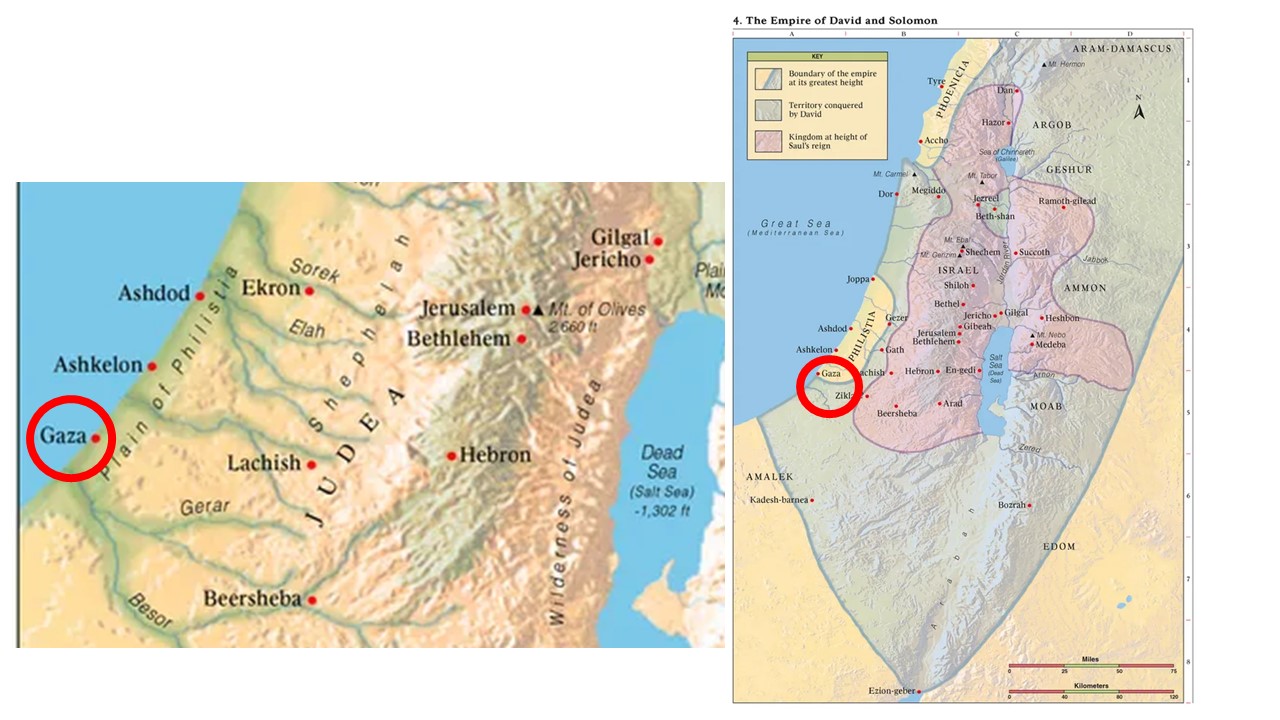

close and larger view of Gaza, southern Mediterranean portion of Israel,
maps from Church of Jesus Christ of Latter-day Saints, Bible maps

Samson would also meet his fate in the city of Gaza, when the Philistines are eventually able to capture Samson, after the ordeal with Delilah. Whether Delilah is Philistine is in question. She may be Canaanite., People guess she was Philistine, because the other women, Samson’s first wife and the harlot he went to, were. Delilah could even be Israelite. She had to be bribed with a lot of money to work with the Philistines. Anyway, when they were able to incarcerate Samson, they have blinded him (one of the gory Bible stories; they have gouged out his eyes) they took him to Gaza, where he met his fate. Granted great strength once again, he pushes the pillars and collapses the place, taking his captors down with him. With this event, Samsom kills more Philistines as he dies than he did in his life, which had been quite a body count.

Another Gaza story involves the Assyrian siege that would come upon Judean King Hezekiah. During the Assyrian siege, the governor of Gaza was not willing to play ball with rebellion against Assyrians, which included the people of Israel. So Hezekiah conquered the Gaza region. Later on Assyrian king gave Gaza back to Israel.

We could tell more stories about the people of Israel—which, after 720 BC entailed mainly the Jews—from the Bible, and from the Second Temple Period, which is Herod’s Temple, rebuilt close to the time of Christ, and then destroyed in 70 AD.

So, even after the dispersion around 600 BC by the Babylonians, there were Jews living in the land of Israel. Many returned, and rebuilt and rededicated the temple, 70 years later, with prophets Ezra and Nehemiah. Then after the destruction of the temple in Jerusalem in 70 AD, there were still Jews living there.

They maintained a presence there throughout the centuries. Netanel tells of a favorite poet of his, a rabbi, who lived in Gaza about 400 years ago. He is buried in Gaza. There was a Jewish community in Gaza until around 1929.

The Jews from the diaspora (wherever they were dispersed around the world) began moving to the ancient land of Judea by the late 1800s. They never fought and ousted anyone. They bought any land that was owned, and settled it and turned it from swamp or desert into productive farms and orchards. But as they gained numbers, and success, there was concern by the Arabs living in and around the area that the Jews could become a majority, so they began terrorist attacks on them, even in the 1910s and 1920s. Britain, a major world power at the time, after control of the area fell from the Ottoman Empire, offered protection with the Balfour Declaration, which they didn't completely adhere to. The Jews still got pelted.

After the holocaust in World War II, there was sympathy for the Jews, and the United Nations set up the nation of Israel in their homeland. Their Arab neighbors protested. Within the year, the Jews faced war—and won. Again in 1967 they faced all their Arab neighbors trying to take them over—and won. Miracles were involved.

At this point there are a couple of details to repeat, because they are seldom repeated. This is from my Part V:

One thing you might not be aware of is that, in surrounding countries Jews were forced to flee to Israel, many of them in poverty. Israel solved the issue by training the refugees and putting them to work. If the Arab nations that pressed the Palestinian people to become refugees had behaved similarly, these refugees would have been a short-term problem that would have disappeared about 60 years ago. [add another decade to that now].


Meme found on Facebook, attached was a useful timeline, but when
I tried to save it, it saved a video, which I gather this came from.

The Israelis aren’t the oppressors. They are the indigenous people, being attacked by the world. I wouldn’t say they are perfect, but they have a right to their sovereign state, and they have a right to defend themselves. They have a record of defending themselves by avoiding innocent casualties probably more than any warring nation in history. But the enemy uses its innocents as shields, placing their strategic equipment in or beneath schools and hospitals. When Israel has warned people to evacuate Gaza in these recent weeks, Hamas—the elected government in Gaza—has forced the people to stay put, even threatening their lives if they try to flee.

Yet the world sees Israel as the aggressor. This is also from my Part V:

Since the UN continued ineffectual, Israel began to retaliate—hard. Jewish planes and tanks struck in the Golan Heights, north of the Sea of Galilee, both causing and suffering heavy casualties. Now, at last, the UN acted—by immediately condemning Israel. This became the pattern in and around Israel: Palestinian refugees and others attack Israel; Israel suffers in patience and then strikes back; and international condemnation of Israel ensues.

That pattern has continued pretty consistently since 1967.

There was a podcast I heard, informative, and fairly positive toward Israel. But the guest also said he understood the position of the Palestinians. He told of one Palestinian who had been a child refugee in 1967. Their house is still standing, still visible to them, just over the border, but they are forced to live as refugees, without their home—because of Israel, so the hatred runs deep. Yes, it does. Especially when you don’t know what really happened to you and your people. I feel sorry for this Palestinian as well, but Israel is only protecting it's borders; the imprisonment in refugee camps for 60 years is being done by the Arab World and a complicit UN.

This is from Part VI: Continued Unrest

[In Part V] we covered some of the Palestinian refugees—the Arabs in Israel who fled their homes when surrounding Arabs refused to recognize the newly created state of Israel and went to war to eliminate Israel and the Jews. I need to add a detail about this. After the brief war that failed to eliminate Israel, the Israeli government set up a trust to handle the property of the refugees, to hold it for them. All they asked was recognition of their statehood and a permanent peace treaty. These requests were never met.

Eventually the land was purchased using a price structure set up by the UN. Israel never simply went in and took over private property; they lawfully acquired the land. Meanwhile, however, it does not appear the refugees were personally paid for their properties. If that is so, it was not because of any evil attributable to Israel.

I wonder about a duplicitous UN, which invited the Jews to create their sovereign nation of Israel and then, almost from the first year, sided with its enemies. Israel has been sanctioned more than any other nation—by several orders of magnitude—in the United Nations. Usually only the US and sometimes Britain or another single nation will side with Israel. And, except during Trump’s administration, US support has often been less than reliable. Oddly, those who attack Israel—including Hamas, which shared video of its murderous spree proudly online—is not sanctioned. Instead Israel is told not to overreact.

Hamas didn’t exist until 1988. In its charter, as other similar groups, it calls for jihad against Zionism. The goal to destroy Israel, to wipe it into the sea. The current phrase “from the river to the sea” refers to the Jordan River to the Mediterranean Sea—all of Israel to be wiped out. That means genocide. They don’t mean to conquer the people and rule over them; they mean to annihilate them. They are, by the way, Marxist tyrants; that seems to echo the last century, which we proclaimed we would never forget.

Netanel avoided politics generally in this discussion. But near the end, when asked what we could do, he suggested that we pass along what we know—we who would sit through an hour discussing Gaza when we could be doing many other things.

Again your support and you talking with your communities, talking with the youngsters, guys, with the youth, talking with the youths, explaining to the youth this information.

Sometimes people lose track, even if their world of values, try to talk to them and in in their own way, you know. If people are supporting the—I'll take something that is not my go to like regular activity—people who are talking about LGBTQ rights and support the Palestinian cause. I don't know if you've seen it; it's like chickens for KFC.

You should explain to these people that there are no rights for anyone who is not, like, a Muslim of that type, and definitely not for gays or women's right or anything like that. So you should talk with them. You should educate them. Because sometimes the knowledge is not there. And sometimes what they see, it's like, 20-second TikTok videos…. I don't know if they have the patience to sit for more than an hour by now and listen to a discussion about Gaza in the Bible and—okay, so you should educate them in the way, you know, they may listen to you.


A billboard seen in New Jersey, since taken down,
found on Facebook

I rather doubt such short attention span people are reading this blog. But it is my attempt to help educate. Education may lead to understanding, and understanding may lead to peace.

At one point Netanel said, quoting an old saying I am supposing, “It's really hard to prophesy, especially about the future.” I don’t know how this current siege will turn out. If it turns into the final battle, I know the ending of that story. But in the meantime, I’m praying for Israel and all the suffering people.


Glenn Beck updates current status in Israel, Wednesday, November 1, 2023.

Here are a few additional resources:

·        Israel, Palestine, and the Latter-day Saints,” CWIC Media, November 3, 2023, with guest Jason Olson, a Jewish and Ancient Near East scholar and a Naval Officer and diplomat with numerous Jewish and Israeli relationships. It’s an interesting conversation. 

·        Israel Palestinian Conflict: The Truth About the West Bank” Danny Ayalon, July 12, 2011.  I cited this video in my Part VI in August 2011. It still holds true, yet another 12 years later.

·        Why Isn't There a Palestinian State?” David Brog for PragerU, March 27, 2017.  This goes through the 5 times (up until 2017) that the two-state solution was rejected by the Arabs.

·        Exposing Iran's Trap to Trigger Global War | EP 316” Glenn Beck, November 1, 2023. On BlazeTV  or on YouTube

Monday, August 17, 2020

The Abraham Accord

A major historic event took place last Thursday, August 13, 2020. It eclipses post office funding or mask wearing to “fight” COVID-19 by so many orders of magnitude that you should have been hearing about it nonstop all weekend. Instead, by Friday afternoon the story was waning. By Saturday it was no longer included in the top dozen stories on MSN or CNN online. Hmm.

What was this historic event? President Trump, along with Israel’s Benjamin Netanyahu and the United Arab Emirates’ Crown Prince Mohammed bin Zayed of Abu Dhabi, signed a Middle East peace accord—the first one since 1994—referred to as the Abraham Accord, bringing together different branches of Abrahamic peoples.

Jared Kushner discusses the Abraham Accord on Fox News Sunday
screenshot from here

President Trump said,

This is a truly historic moment. Not since the Israel-Jordan peace treaty was signed more than 25 years ago has so much progress been made toward peace in the Middle East, by uniting two of America’s closest and most capable partners in the region—something which it was said could not be done. This deal is a significant step towards building a more peaceful, secure, and prosperous Middle East.

Ambassador Robert O’Brien said this about the accomplishment: “I think history’s going to remember the President as a peacemaker. It’s really something special that he was able to put together.”

It is worth noting that actual peace deals that are accomplished get no Nobel Peace prizes, but politically “correct” do-nothings do get awarded (for example, Obama, his first year in office before doing anything, and 17-year-old Greta Thunberg, who was nominated, for scolding the world for driving cars, but had to settle for a humanitarian award).

After Thursday’s announcement, when it became evident that denigrating President Trump for a verifiable good accomplishment was fruitless, former VP Joe Biden tried to take credit—for laying the groundwork, along with Barack Obama, some five years ago.

In a twisted way, Biden is right. That administration’s anti-Israel/pro-Iran actions made other Middle Eastern countries aware of their vulnerability to Iran and its anti-freedom tyranny. So, while they may still have some disagreements with Israel, they are willing to set those aside to unite against a common enemy that had been strengthened by Obama/Biden.

The timing was good for the accord—because of President Trump. He undid some of the damage caused by Obama’s ship-pallets-of-cash-to-Iran-while-allowing-them-to-proliferate-nuclear-weapons agreement that was the worst negotiated deal in the history of the world. And he moved our embassy to Jerusalem. He has been a solid and reliable friend both to Israel and to the UAE and other Arab entities that would rather not be subject to Iranian mullahs.

The description of the president and the process are not what you’re likely to hear in mainstream media sources. In an interview with Hugh Hewitt on Friday, Ambassador O’Brien said this: 

One of the things that the President has, one of the great attributes, and I’ve talked about this before publicly without getting into the details of any specific call, he really has an incredibly good manner with foreign leaders. He gets along with them. He’s cordial with them. He’s civil with them, all the things you’d expect from a diplomat. And he’s very persuasive with them. So what had happened is that over the past three years, the President had developed a great deal of trust with Prime Minister Netanyahu and with the Crown Prince. And it’s that reservoir of trust that allows you to bring folks together to push them over the line, to negotiate with them, to mediate with them, to encourage them and to persuade them…. And I think Americans would be very proud of their president if they’d watched how he’d handled these negotiations with a lot of dignity, but also with a lot of goodwill and friendship and good humor with these two leaders.

There was a team working on the deal, “quarterbacked” by the president’s son-in-law Jared Kushner, who was also instrumental in moving the embassy to Jerusalem. But the entire team, even down to lowly staffers, got invited into the Oval Office to listen in on the historic moment. President Trump knew it was historic and wanted them to experience the moment with him. And, to their credit, no one had leaked information about the delicate negotiations, which could have derailed them. At the end of the phonecall, spontaneous applause broke out in the room.

I don’t know yet how this will play out in world history, but it’s definitely a good thing. And it’s likely to spread to other enemies of Iran in the Middle East.

Ben Shapiro noted,

By the way, it is also evident that Oman and Bahrain are going to follow the UAE in normalizing Israeli ties. And Saudi Arabia cannot be far behind. So this means a complete opening of the Middle East…. It is a very very good day for peace in the Middle East.

And the New York Times predicted that the accord “could presage a broader realignment in the region as the two agreed to ‘full normalization of relations’ in exchange for Israel suspending annexation of occupied West Bank territory.” 

One thing I hadn’t been aware of was a sort of tacit agreement already in play. Even though the UAE had policies against trade with Israel, they made exemptions on a case-by-case basis whenever it suited them. So often, in fact, that you can find the occasional Israeli grocer in a city, purportedly for business travelers. I’m told Saudi has such tacit agreements as well.

News media is talking about what Israel was forced to give up in order to come to this deal. That’s not the real story.

The UAE was already willing to agree with Israel. But they needed something in return. Israel offered up a pledge not to annex portions that, if it had declared them Israeli land, would not likely have been recognized anyway, not even by the United States. It would have been a declaration without effect on the ground. However, it’s land that, if there are future negotiations, is likely to go to Israel. Ben Shapiro describes it as Israel giving the UAE a fig leaf. He said,

The UAE wanted to normalize relations with Israel. They said, “We need something in return to make it look like we give a crap about the Palestinian Authority, which we actually kinda don’t.” And Israel said, “OK, well, we just won’t formally annex all this territory we know is going to end up in Israeli hands under any peace deal in the future anyway.” And the UAE was like, “Good. Done.”

If we’re adding the Abraham Accord to the history books, maybe we ought to review some of the history.

While the United Nations voted to give Israel statehood in 1947, with a two-state solution, the Arab nations surrounding it refused to recognize the decision. So there never was a recognized Palestinian state. Ever. In all history. Israel then declared its independence May 14, 1948, and that is the official beginning of the modern nation of Israel. Its war for independence ensued, fought from May 2018 through July 1949. At this point, in the cease fire agreement, the West Bank of the Jordan River was allotted to Jordan, and the Gaza Strip was allotted to Egypt, and they allowed Israel to exist for the time being.

In 1967, Egypt attacked, along with Jordan and Syria, in an attempt to wipe Israel into the sea. In what can only be called miraculous, Israel won that war in six days—thus the name of the Six-Day War. I remember my dad talking about this miracle, as a sign of nearing the last days, back when I was just old enough to pay attention. So I’ve spent half a century believing it is worth watching what happens to Israel. Anyway, in that conflict, Israel won back the West Bank and Gaza, but the Palestinian refugees from that area continue to claim land. Much of that has since been ceded by Israel. But, it turns out land for peace has never been a good strategy for Israel.

If you’re in need of a primer or refresher, I go into more detail in a 6-part series from 2011:

·         Part I: Ancient History 

·         Part II: Zionism and Migration 

·         Part III: Conflict and Violence 

·         Part IV: Holocaust and Statehood 

·         Part V: Refugees and 1967 War 

·         Part VI: Continued Unrest 

While several US presidents had claimed Israel’s right to name its capital as Jerusalem, and promised to move the US embassy there—starting with Clinton in 1999, waiting through Bush and Obama—President Trump actually made the move. The dedication happened on May 14, 1948, exactly 70 years after Israel became a modern nation.


US Embassy in Jerusalem dedication
screenshot from here

In Hebrew, I am told, various numbers have certain meanings.

7 = perfection

10 = completeness

70 = perfection and completion, or perfect order, with all power and perfect judgment

In other words, 70 is significant, and symbolic. To have it happen on that date—not a year earlier or later, not a month or two earlier or later—makes it more striking than just a very fine accomplishment by human world leaders.

Commemorative Temple Coin
image is a screenshot from here

To commemorate the embassy move, Israel minted a commemorative coin, with the heads of President Trump and Cyrus, who was non-Israelite king who was instrumental in the rebuilding of the temple 70 years after the captivity that ensnared Daniel, Shadrach, Meshach, and Abednego back around 600 BC. Besides honoring President Trump, the commemorative coin is being used as a fundraiser for eventually rebuilding the temple in Jerusalem. You can go online and see the progress at TempleInstitute.org. They have acquired all the building materials, as well as the vessels, vestments, and other things needed. They’re in the process of raising a red heifer that is to be sacrificed.

Illustrations of the ancient Jerusalem Temple
from TempleInstitute.org


Some prophecy watchers suggest next spring will be the time the temple construction gets underway. An impediment has been that the Dome of the Rock, the top of the Temple Mount, has been under Arab control for a long time. Just recently there was an archaeological discovery of a foundation of what appears to match the temple specs—not directly under the Temple Mount, but very close nearby, already under Israeli control. I don’t think there’s full agreement on which location is to be used for building the temple, but it’s an interesting story to follow.

I ended my six-part series on Israel with some words from Benjamin Netanyahu, and tied that in with the Spherical Model. Those words seem to still fit with this week’s added piece of history, if we include all those willing to honor our friendship with Israel along with us. We welcome the UAE into that circle:

I believe Knesset Chairman Benjamin Netanyahu was right when he said, “If Palestine were to lay down their guns tomorrow, there would be no more war. If Israel lays down theirs, there would be no more Israel.” I’ve kept that quote for some years. But in that speech, he went on to say, “Israel must create treaties with the countries of the world based on values, interests, and strength. We must nurture our military, diplomatic and political, and spiritual strength—that is the key to our future.”

At the Spherical Model, we can judge the success of civilization, economics, and freedom based on specific principles. It isn’t surprising that terrorists who advocate a mixture of savage chaos followed by tyrannical rule are far into the southern hemisphere, not only politically but also economically and socially. The Muslim people who most adhere to the rules of civilization also enjoy better economics and less oppressive government. Israel may not be perfect, but as a democratic friend that strives for civilization, we do well to honor that friendship.


Thursday, May 17, 2018

Historic Day in Israel

US Embassy in Jerusalem Dedication
May 14, 2018 (image from screen shot)

Israel is a country with a capital city—like pretty much every other country in the history of countries. Except that in Israel’s case, people in various countries have been trying to tell them they can’t have their capital there, where it has historically always been (including thousands of years ago). Our country and others have given lip service to recognizing Jerusalem as their capital, and promised to put our embassy in their capital. But then, on second thought, just left it in Tel Aviv, even though the government buildings and officials and their meetings are in Jerusalem.

So, when President Trump promised to move the embassy, as at least the past three presidents have promised, we just sort of say, “We’ll see.” But he said it would happen in six months. That means putting a plan of action in place.

And it happened.

If you’ve read here for long, you know I did not support Donald Trump in the election. (I, of course, did not vote for Hillary either; that was unthinkable.) His personality and character are not what I would prefer. And his record as a Democrat, and no particular ideological shift to conservatism, meant I had no particular reason to trust him to do right things for our country. So every time he does something really right, I’m pleasantly surprised. I hope that keeps happening.

Anyway, respecting our strong ally Israel by recognizing their capital by our actions is a good thing.
I watched the full ceremony, and I’m including that recording below. There are good things said there, and there’s a sense of goodness and honor about the whole thing. I felt respect for those involved, including the president’s daughter and her husband, because they were so respectful toward our Israeli friends. (The ceremony starts about 22 minutes in.)


If you followed the news, then you know there were protesters at the gates. The media would have you believe these were unarmed protesters, appearing in response to the embassy dedication. Not really true. There were protesters as there always are. There may have been more at this time of heightened media attention. Also, they were not exactly unarmed. Some were trying to send airborne fires in hopes of burning down the city. These Hamas-led terrorists (a more apt word for them than protesters) were despicable enough to place someone in a wheelchair in the line of fire in their ongoing effort to make the Israelis look like the bad guys.

My guess is that there has never been a country that went so fully out of their way to keep their enemies safe while they were defending themselves from those enemies.

If you need a refresher, there many PragerU videos; here are three.

·         Do You Pass the Israel Test? 
Also, I wrote a series on Israel in 2011 that might be good to review, plus another piece in 2014:

·         Israel, Part I: Ancient History 
·         Israel, Part VI: Continued Unrest  


Monday, March 28, 2016

Being the Arbiter


ar∙bi∙ter  noun  1. A person selected to judge a dispute; umpire; 2. a person fully authorized or qualified to judge or decide
There are two sides to every disagreement. Not necessarily equivalent sides. Sometimes one side is in the right and the other is in the wrong.

If we are in the position of being the arbiter, we do harm if we dismiss the differences. All of us at some point are the arbiter—the authority needed to make a just ruling among disputing parties. So today’s post is about learning to be a good one.

Example 1: You are the parent of two children who are quarreling—at least at the point you arrive on the scene. Both kids are giving you their side.
found here


Sister: “He took my cookie.”
Brother: “No, I didn’t.”
Sister: “He did. Look. He’s still eating it.”
Brother: “It was my cookie, not hers.”
Sister: “He took his already. I was going to eat it right after I finished my lunch.”
Brother: “It was just sitting there; everyone was done. One cookie left—I took it.”
Sister: “He knew it was mine.”
At some point you get tired of hearing the complaints. You stop listening to the details, and just want it to stop.

Parent: “No more cookies for either of you the rest of the day. You don’t deserve any if you’re going to fight over them.”

Parent sees the argument has been silenced and breathes a sigh of relief. Brother smirks at sister; he’s finishing his second cookie, and she gets none. Sister gets no cookie, because hers was stolen. And she has learned that she cannot trust the arbiter to deal with the injustice to make things right for her.

Example 2: Big guy walks down the school hallway, bumps into little guy, knocks him aside, gives a little extra nudge and causes him to drop his books. This is the third time in a week this exact thing has happened.

Little guy: “Hey! Cut it out, you jerk!
Big guy (stops): “You talking to me.”
Little guy (stands up after picking up mess—says nothing, just glares).
Big guy: “You need help with those things?” (knocks books again, blocks a punch from Little guy, then tries to punch him.)
Fight ensues. Other students surround them in a growing circle. A teacher steps out of a classroom. Tries to step between them to break up the fight.
Teacher: “Hey. Stop! No fighting allowed.”
Big guy: “He started it.”
Little guy: “He started it. He knocked my books to the floor—twice.”
Big guy: “He punched me.”
Little guy: “After he’s been shoving me around.”
Teacher: “I don’t want to hear it. No fighting allowed at school. Both of you—straight to the principal’s office.” (Walks them there.)
The teacher stopped the fight; he’s satisfied. Big guy and Little guy will both get reprimanded equally by the principal, because of the “no fighting” rule. So the Big guy has done additional damage to Little Guy without much effort or risk. The Little guy gets punished because he stood up to a bully after being victimized several times.
What would a just arbiter do in these circumstances?

·         Pay attention.
·         Hear both sides.
·         Weigh the evidence.
·         Make a wise judgment.
·         Base consequences on what actually happened.

That may be more challenging than it looks, since judging whether a person is lying is a somewhat rare skill. But these are kids. You ought to be able to ascertain some truth, if you’re attentive and caring.

Some years ago I read about a family (too long ago for me to know how to cite the story) that held court. If a contention came up during the day, Mom could ask if this was something they wanted to take before the court of Dad. When Dad got home on these days—maybe after dinner—he would hold court around his desk. Each child in turn would present his side, including evidence, and possibly testimony from witnesses. Sometimes the true wrongdoer just gave up. But just about without fail, the Dad court could tell, after hearing both sides and paying attention to the evidence presented, what really happened. And then he could mete out consequences.

He did those five steps. And the result was that whoever was in the wrong (like the cookie stealer) would be held accountable. The one who got her cookie stolen would feel vindicated and supported. Right and wrong are put safely in their places. Both kids are better off for it.

At school it’s a little more challenging—yet another reason to homeschool. Still, a lot depends on what the teacher does, and follow that with what the principal does. If the principal assumes both are equally guilty, because of the no fighting rule, then she has been unfair to the victim of the bully, and she hasn’t done anything to reform the bully.

Wouldn’t it be better if the principal heard both sides—possibly separately—and heard from witnesses when possible? Maybe look at the record (chances are a bully, in a school with a just arbiter, would have a record). Then the bully might even learn what kind of behavior is unacceptable among civilized people—which ought to be an important part of education.

So, what about bigger, grown-up challenges?

Example 3: Israel exists in a country about the size of New Jersey, surrounded by enemies, subject to frequent, continual attacks. The “Palestinians” have been refugees since 1948, when they joined with the enemies of Israel to annihilate Israel—but they lost. They think they should be let back in to the country they tried to do away with. Generations pass with them failing to assimilate anywhere and continuing to blame Israel.

So you have one side that attacks innocent civilians, then sets up circumstances to make it nearly impossible to fight back without harming innocents, by using schools and hospitals and population centers as their military attack points. And the other side is totally defensive, and goes beyond what anyone should expect to avoid harming civilians.

Anyone who says the two sides are equivalent and ought to just learn to get along hasn’t taken the steps to be a just arbiter.

Who is the arbiter? In this case, it is individuals, like us, as well as the nation we belong to. The current leader of our country is not a just arbiter. That does damage to the small country in the Middle East that has heretofore been our ally. Without paying attention, hearing both sides, and weighing the evidence, there’s not much chance of making a wise judgment, let alone leading to a just consequence.

Example 4: A political candidate (Trump) makes personal, untrue attacks on all of his opponents in turn, as each one seems to become a threat. Another candidate (Cruz) consistently stays on the message of issues, comparing plans, persuading based on law and principle. Trump sees the comparison, using his own words along with video of himself saying things, as an attack. And he attacks back—without truth, without shame, without limits (admittedly, so far no murder that we’re aware of).

This past week there was an exchange that included the candidates’ wives. Trump’s current wife worked as a model. Back before they were married she did a nude photo shoot for GQ Magazine—the essential bikini parts are covered, but it’s obvious she’s unclothed, and it’s meant to be provocative. She made a living that way back then. It’s available out there on the internet, but I’m not linking to it. (I heard that the shoot took place on Trump’s jet, with his approval. Don’t know how to verify that.)

If it’s in print, it still exists. That’s what published means. Besides back issues available online, libraries out there keep back issues of practically everything. So it’s not surprising that the photo surfaced. It was used in an anti-Trump ad—a single-frame internet picture with words over it, saying something like, “Is this who you want as First Lady?” If Trump is so proud of his sexual exploits, and his wife’s body, then he should be expected to just say, “Yeah,” and shrug his shoulders. But he didn’t. He used it as a political media opportunity.

He accused Ted Cruz of running the ad. He didn’t—it was an anti-Trump PAC (political action committee). Then Trump said they did it because Cruz told them to. Cruz couldn’t—besides it not being a Cruz committee, law prevents any interaction between a candidate and a PAC.

Before blaming Cruz, Trump immediately retaliated with a threat of bad news he was ready to spill about Heidi Cruz. Shortly after that turned out to be a photo of Heidi, taken mid-sentence and mid-blink, side-by-side with a professional head shot of Melania. Trump not only implied that Heidi was ugly by comparison, he stated it bluntly. 

And then, a day or two later, suddenly there are accusations that Ted Cruz has had, count ‘em, five affairs with women. In my opinion, the accusation is laughably false. No woman will verify. The story comes through the National Enquirer, purveyor of lies for profit, which happens to be owned by a Trump friend.
Cruz's response to the attack; it looked at the time
Trump was involved, which may prove true. But little
has been said by Cruz about it since. Found here.


Trump immediately says it wasn’t him, but that “Lyin’ Ted Cruz” will have to deal with it himself. Stories are starting to build the case against Trump on this, but it may be that someone who supports him or simply hates Cruz put out the accusation without Trump’s direct involvement—in which case Trump would see himself as innocent, even though he insists Cruz was responsible for the actions of an unrelated Super Pac. Hmmm. 

And on radio Monday in Wisconsin,  Trump reiterated his reason for the escalation of personal attacks to include family: “He started it.”

So it has been frustrating to hear multiple media sources, typically supposed conservatives, complain about all the bickering—and that it’s both sides’ fault. They should just get together and get along.

That, to me, sounds like an unjust arbiter. They have not paid attention. They have not noticed the overwhelming evidence that one side is a lying, manipulative narcissist whose campaign is based on, “Vote for me; I’ll make America great again, but don’t ask for details, just believe me that I will do it,” while belittling women, talk show hosts, all of his opponents, and anyone who disagrees with him. And the other is an expert on the issues related to our constitutionally protected freedoms and how returning to the Constitution will bring us a return to the freedom and prosperity we expect in America—a promise given while being scrupulously against personal attacks on his opponents—up until the attack on his wife.

If you’re a Republican voter, you’re an arbiter in this case. You need to pay attention, hear both sides, weigh the evidence, and make a wise judgment. If you do that, you will definitely know better than to send a crude, vulgar, self-obsessed bully to the White House. You might instead consider sending a very smart, very accomplished and principled man there.


If you’re in a position to judge—and you are, in many circumstances in your life—then be a just arbiter.