Showing posts with label Gaza attacks. Show all posts

Saturday, December 23, 2023

A Tree, a House, and Why There Is No Peace

It’s almost Christmas Eve. I wrote a bit about Christmas a couple of weeks ago. This piece isn’t as joyful. But it is also about that little part of the world we think about this time of year, because it is where our Savior was born.

This is something of a book review. A friend recommended the book The Lemon Tree, An Arab, a Jew, and the Heart of the Middle East, by Sandy Tolan. There’s a house, with a lemon tree, that has a complicated history. It is a real place. The version I read was a young reader’s edition of an award-winning adult book. This one was 228 pages, so I didn’t realize it qualified as a “children’s book,” until well into it. Or maybe during the afterword. But this one will do.


book cover from Amazon

The original book was published in 2006, which started out in the form of a 43-minute radio documentary on NPR’s Fresh Air, in 1998, at the occasion of the 1948 Arab-Israeli war. The afterword of this version shows events up through 2013, and it was published in 2020.

The purpose of the story, I think, is intended to show that a friendship can exist between two natural enemies, when the people are willing to really listen to one another.

That’s the first impression of the story. But there were several niggling details that didn’t seem right. And an ending that didn’t coincide with that message. So I’d like to take a look at this story, particularly in light of what is happening in that place now.

The house was originally owned by the Khairi family, Palestinian Arabs. Their son Bashir is one of the two main people in the story. The house is later inhabited by the Eshkenazis, a Jewish family relocated from Bulgaria. Their daughter Dalia is the other main person in the story.

There’s a fair amount of history told at the beginning of the book. The book claims to be nonfiction in every way. Well-researched, we are told. There are maps at the beginning, showing various plans.

Left map is from the book. Upper right is from this Danny Ayalon video, and
lower right is from this Prager U video. These both show that the original
protectorate welcoming Jews to Israel was considerably larger than any later boundaries.

The maps match the history, but some details do not coincide with the history I know of this region. It’s a difficult thing to understand one another and come to some sort of agreement when we are dealing with “facts” that simply don’t match.

According to the book, the Israelis—the Jews—are always the aggressors. They are brutal and unfeeling, and aim for civilians. That is the story people tell when they want you to hate the Jews. In reality, it is hard to find a people anywhere in history who have gone more out of their way to avoid civilian casualties in their wars. And the wars on their part have always been defensive—including the one that started October 7, 2023.

Whenever you have someone referring to Israel as “occupying” the land, you know you are reading a biased, anti-Jewish source. No amount of pretending to be thoughtful passes the smell test.

So, what is the story of this house with the lemon tree? According to the family story, this is 1948, the war Israel had to fight one year into its existence following its creation by the United Nations, following the end of WWII and the holocaust. Jews, who were already living in Israel (some Jews had lived there throughout the centuries, but in growing numbers in the 20th Century), were joined by refugees from many parts of Europe, where it was no longer safe for them to live.


Left map from the book. Upper right from Danny Ayalon video
Lower right from PragerU video. While the maps are essentially the same,
the book fails to note that these boundaries, while greatly shrinking
Israeli land, were accepted by Israel but rejected by the Arabs,
who went to war within the year to wipe out Israel. Israel won, but
the Arabs never accepted these nor any other boundaries.

They did not come to a nation called Palestine; they came to an area, given that name anciently by the Romans. After the defeat of the Ottoman Empire, this area was a protectorate of Great Britain. Much, but not all, was uninhabited. The Jews, coming from the diaspora, did not oust any current residents. They came and settled, building their own communities—buying land whenever it had an owner. The Arabs living among them started protesting their presence with terrorist attacks at least as early as the 1920s. But there wasn’t always animosity. Jews and Arabs mainly did business together, as they have done in other Mediterranean areas over the centuries.

But when Israel was made a state, with worldwide agreement and treaty, in 1947, the Arabs surrounding the newly birthed tiny nation rebelled. And started a war. Which Israel miraculously won.

During this war—as with others since then—the Arabs call for the Jews to be removed from the nation that has been their homeland for more than three millennia. Every time Israel has been willing to negotiate a partition—always with Israel giving up land—the Arabs have refused, insisting instead on Jewish annihilation.

So our story with Bashir’s family begins during this 1948 war. In the book, a Jewish neighbor rides into their fields and warns them the army is coming, and they need to get out or be killed. They grab what they can, as do their neighbors, and they flee. While they are concerned, they are certain the Palestinian Arabs will quickly win the war, and then they can return to their homes.

I have read about this before. I can’t verify that a neighboring Jew didn’t call out to them. But in general the Arab aggressors were the ones calling for the people to clear out, so they could go through the streets without having to separate out the enemy; they could just indiscriminately kill. The Jews were telling people, “You don’t have to leave. If you want to live peacefully with us, we will not harm you.” They kept their word to those who stayed.

But those who left—think about what they have done; and this includes Bashir and family. They have declared allegiance to the enemies of the nation. They have declared their desire for the annihilation of the people granted nationhood. Their side loses. And they have not changed their designs, but they think their enemies should let them back in, to fight them from within another day.

Refugees went several directions. They continued terrorist attacks from wherever they were. The neighboring nations that took them in could tolerate them only so long, and then they ousted them. So there are pockets of Palestinian Arabs, mainly in Gaza, west and south of the rest of Israel, and another portion to the north. You might notice that there were Jewish refugees at that time as well—who fled into Israel from neighboring countries. They aren’t still refugees, of course; they are Israeli citizens. I don’t know of another incidence in history where refugees have been kept in refugee settlements—temporary, subsistence level—without being allowed to become permanent anywhere, for decades on end. They are not held in these settlements by the Israelis; the Israelis only police their own borders, not the rest of the world, which is keeping those people trapped in poverty.

This point is important, because it’s what the story turns on.

After 20 years, Bashir, now in his mid-twenties, returns, along with his cousins, to visit their former homes. At Bashir’s home Dalia Eshkenazi decides to overcome her fear and open the door to them. They note that the lemon tree Bashir’s family had planted is still surviving. Something of a friendship ensues. Dalia believes the way Bashir tells it—that the Israelis forced his people out and then wouldn’t let them return after the war. Dalia is horror struck. She had always understood that the people had simply abandoned their houses, although she couldn’t understand why. This changes many things, she believes. Her people were in the wrong, although after all these years, what is there to do? She in fact does many things. After inheriting the house in adulthood, she turns it into a school for Arab children. And she continues a long correspondence with Bashir, and later with his family.


Left map from the book. Upper right from Danny Ayalon video
Lower right from PragerU video. The story of Bashir's first visit to Dalia's family
is about a year after the 1967 war, during which all the surrounding Arab nations
attacked, but Israel miraculously won. The Arabs continued to refuse to accept any borders
that acknowledged Israel as a nation.

Bashir, for his part, while supposedly trying to deeply understand, also tells Dalia that the Jews should all return to where they came from. He simply doesn’t hear, or understand, that there is nowhere but Israel for the Jews to return to. He thinks he is being generous to exempt those Jews who were born in Israel prior to 1947. But, of course, they shouldn’t have any right to rule in the land the Palestinians now claim to own—and accuse the Israelis of “occupying.”

Despite this peacemaking friendship, Bashir is a member of the Popular Front for the Liberation of Palestine, or PFLP—a terrorist group intent on ousting the Israelis and “returning” all the land to the Palestinian Arabs. Over the years he is arrested multiple times. I forget how long he spent in prison, but I think the longest stint was 15 years. In the afterword, in 2011, he is arrested and interrogated for several days, at age 69, following an attack a few weeks earlier in which an Israeli family was brutally murdered, and which had been linked to PFLP members in the vicinity. Up through this time, he answers as he always has: “I am a Palestinian who believes in the Palestinian cause. And I despise the occupation. The crux of the Palestinian cause is the right of return. Otherwise there will be endless bloodshed.”

By this time he has stopped his correspondence with Dalia, because she did not follow through with his demand—that she “petition the city of Ramla to return the old Arab houses to their original Palestinian owners.” This was not something she had either the power or ability to do. So he has shunned her.

As I look at the story, Dalia is the peacemaker. The Jewish peacemaker. Bashir is the violent, angry, demanding Arab, who never does understand either what really happened, or what is reality after all the decades. There can be no peace, because people like him do not want peace; they want the Jews disposed of.

The book doesn’t tell the story the author intended. It is, rather, a metaphor for the larger conflict. A Jew opens the door to peace; a Palestinian Arab makes unreasonable and irrational demands that cannot and should not be met.

In the afterword, the book gives this account of casualties:

Since Dalia and Bashir last saw each other, in 2005, multiple wars have devastated Gaza, killing more than 3,200 Palestinian civilians, including more than one thousand children, mostly killed by Israeli air strikes. During that same time, twenty-nine Israeli civilians died from Hamas rocket attacks launched from Gaza. None of those were children. Yet, despite the dramatic disparity in casualties, throughout Israel, and in the media, Palestinians are often portrayed as the aggressors, and Israelis, the victims.

The author fails to note that it was Palestinians who began every war, every attack. Every Israeli air strike was in defense, not offense. And Jewish leaders went to great lengths to warn civilians to get safely away from where the air strikes were targeted to land. Meanwhile, Palestinian leaders placed civilians in harm’s way, on purpose, to be able to blame Israelis. And their attacks have always aimed at civilians. The disparity in deaths is attributable almost entirely to Israeli military strength, including the Iron Dome defenses—not attributable to some gentle kindness by the Palestinian attackers.


The left map is from the book. The right is from a presentation by Victor Ludlow
that I attended in 2011. The point Ludlow made here was that this area has
numerous small pockets of the different ethnicities. Dividing lines to partition
Palestinians from Jews aren't really possible. This land is actually Judea and 
Samaria, part of Israel since the beginning. But this is where Palestinians cry out
that no Jews should be allowed to live in this disputed territory.

In a follow-up to the last time I talked about the war, I wondered what the casualty count is at this point. Oddly, it isn’t that easy to ascertain. There are a number of articles detailing casualties in Gaza. Getting an updated count of casualties in Israel, which has been under continual rocket attacks—except for a brief cease fire around November 21, in which there were negotiations for prisoner exchanges—has not been easy.

When the attack first happened, horrifying the world, we learned, “On 7 October 2023, 1,139 Israelis and foreign nationals, including 764 civilians, were killed, and 248 persons taken hostage during the initial attack on Israel from the Gaza Strip.”[i] Note that the Israeli casualties on that day equal a third of the Palestinian count recounted in the book that stretched over a couple of decades.

It took until about the first weekend of the war before the concern turned from the savagery of the terrorist Palestinians to concern that Israel might use its military might to stop their enemies—which might, as it turns out, cause casualties, including civilian casualties, despite Israel’s efforts to avoid them.

Let’s use an analogy, something like that house in the story, but here in Texas. Suppose there’s a house that is broken into; the intruders intend to take whatever they can get hold of, and they have no compunctions about killing any residents who might stand in their way. But, while they should be aware that homeowners are well-armed in Texas, they seem shocked, Shocked! that the homeowner pulls out a gun and shoots at them. One of the intruders is killed; another is wounded. The wounded thief calls on the media to condemn the homeowner who protected himself, his family, and his home. He had greater firepower—a hunting rifle, as it turned out—which overpowered the mere handguns carried by the intruders. Not fair! The homeowner valued his own life and property as more valuable than the thieves', who were only breaking into his home and threatening him, and hadn’t yet succeeded in killing him and his family.

That kind of argument might work in California or New York—places where people aren’t allowed to own guns to protect themselves. But it doesn’t make sense in Texas. We have what is called the Castle Doctrine, meaning a person has the right to protect himself—with lethal force if necessary—on his own property when under threat.

Do we feel bad for the intruders? One was killed. Another wounded. We would rather that hadn’t happened—but it was entirely preventable by the thieves; all they had to do was not to break into the home to rob and plunder.

We can feel bad for Palestinians, many of whom are trapped in poverty and bad circumstances—and yet are not terrorist aggressors. But they live among such aggressors. They vote them into power. And they continue to claim the Israelis have no right to live in their own country and to protect themselves.

There might be two points of view. But it might be that one side is completely in the wrong—and they are the ones who have the power to cause peace in the Middle East. If only they were willing.


[i] "Israel social security data reveals true picture of Oct 7 deaths." France 24. 15 December 2023. Archived from the original on 17 December 2023. Retrieved 18 December 2023.  The quote and citation were found on Wikipedia December 22, 2023.

Friday, November 3, 2023

Brief History of Gaza

Earlier this week a friend, who has been learning Hebrew in an online class with an Israeli man named Netanel Y. Barak, invited me, among others, to join in on a call from her teacher. He would be talking about the history of Gaza, mainly. So I tuned in at the appointed time on Tuesday. It turned out we were an hour off; Israel had a time change last weekend, which hadn’t been calculated in. I tuned in a couple of times during the hour. Some participants stayed on the whole time. Eventually, I tuned back in, about 7 minutes before top of the next hour, and Netanel had already given a bit of update on the situation there, which I missed. But I heard all the presentation part.

Netanel Y Barak, a Hebrew teacher, and now soldier in Israel,
giving a presentation on the history of Gaza,
screenshot from his presentation

Netanel is in the reserves and has been called up, as of October 7. He feels pretty safe, personally. He’s old enough that, as he put it, “I’m not Rambo.” He’s doing things from a command center. His home, I believe he said, is within the 40 km perimeter of Gaza, but they haven’t had rocket attacks there for two weeks now. He gets to go home to his family fairly often, which helps. The family has been worried, and locking themselves in a safe room at night, so things are not what you’d call normal. But they have housing and food, for which they are grateful. And he says they’ve all gained weight, because caring people have showered them with baked goods and snacks.

Most political questions he would brush away. He is a teacher, and the purpose was to talk about the history of Gaza. So we’ll cover what he shared, plus a bit more about the current situation.

First, to review, back in 2011 I wrote a 6-part series on Israel, summarizing the history and situation. I think they hold up pretty well, although I do not focus there on Gaza. After the Gaza discussion, I may add some more about Hamas and other parties.

·        Israel, Part I: Ancient History 

·        Israel, Part II: Zionism and Migration 

·        Israel, Part III: Conflict and Violence 

·        Israel, Part IV: Holocaust and Statehood 

·        Israel, Part V: Refugees and 1967 War 

·        Israel, Part VI: Continued Unrest      


Gaza History

Netanel starts his discussion talking about the word Gaza. It’s a Greek sounding work. The Hebrew sounds like Azzah (ah-zah). Arabic he describes as sounding something like Raza, with a guttural rolled r or h in the throat, not a sound we do in English.


Screenshot from Netanel Y. Barak's presentation,
showing various versions and a possible meaning;
the banner at the top is from his military division.

Some say the gauze that we use comes from the city of Gaza, where they used to make that kind of weaving.

The first book of the Bible, Genesis, mentions Gaza. It comes up in part of chapter 10, which is known as the Tablet of Nations, portraying the people that have come forth from the three sons of Noah: Shem, Ham, and Japheth. One of the sons of Ham is Canaan. Genesis 10:19 describes the territory of Canaan, which runs from Sidon in the north to Gaza in the south. So Gaza is the southernmost part of the Canaanite territory.

It was an important city, being on the edge. The Egyptians referred to that city as The Canaan. It was important, because, if you notice on a map, the Egyptians couldn’t get to the rest of what we call the Middle East, but was then termed Asia, without passing through Israel, and there are limited ways you can go. There’s this area called the Sea Road, the Path of the Sea, and Gaza is on that path. It was the gateway city.

But it’s more than just a gateway to Canaan. It’s also the gateway to a larger area, with a Hebrew name I couldn’t understand or spell, but it means “the other side of the river.” There’s a broader meaning here, concerning Abraham. All the world was on one side of the river, theologically speaking, and Abraham was on the other. All the world was polytheistic, and Abraham was monotheistic, worshipping the One True God.

The geographic river intended here is the Euphrates. The Nile dwellers didn’t have what the people on the other side of the Euphrates had, so they had to pass through this Gaza gateway city and through Abraham’s land to get to the rest of the world, as they viewed it. Abraham’s land included what we would now call Syria, Lebanon, Jordan, and more.

Many centuries later, in 1 Kings 4:24-25, King Solomon is describing the greatness of his lands, “from Tiphsah even to Azzah” [Gaza], essentially everything trans-Euphrates, or west of the Euphrates, with Azzah, or Gaza, being more or less the southern boundary.

So Gaza was the entrance point to the original inhabitants of the larger unit of Abraham’s land.

The original inhabitants of the area of Gaza were the Avim. We don’t know much about them. The people later were called Caphtorim, the people from Caphtor. In modern Hebrew it means button, which Netanel tells us is humorous to them. There’s an assumption that these people were driven out by the Dorians into other parts of the Aegean and Egypt—basically Greek tribes who came through Crete. We know this from the Bible and from Egyptian texts. This was around the 13th Century BC.


Deuteronomy 2:23, screenshot from Netanel's presentation


There were many skirmishes with these people, known later as the Philistines.

There’s more detail, but basically these people were the invading colonizers that Abraham’s descendants dealt with fairly regularly. These were the enemy the Israelites were fighting off in the story of David and Goliath. (Goliath, specifically, was from Gath, south on the map near Gaza.)

Note: There is no connection between these Philistines and the modern-day Palestinians. The ancient Greek-descended Philistines, or Caphtorim, were wiped out of existence by the Assyrian invaders some seven centuries BC. No such people existed when the Romans took over the area. But the Roman ruler Hadrian had a difficult time with the Jews, who revolted against him, so he wanted to wipe out anything Jewish. He renamed the area Palestine (or the ancient Latin version of that name).

The modern Palestinians definitely did not exist a hundred years ago. They started with the national Arabic movement of the last century, in response to the Jews in Israel.

Netanel gave several biblical examples of the ancient Hebrews/Israelis dealing with Gaza. Some of the time they conquered and settled that land; other times the invaders, the Philistines, conquered and held it. It would be hard to draw borders, because they were less precise about borders back then.

There’s a mention of Joshua. Remember, Joshua led the people of Israel back into the promised land after the 40 years in the wilderness. The land had been theirs during Israel’s time, but then the famine had led the family to Egypt, where they reconnected with Joseph, and they stayed there with his protection. But later Pharaohs enslaved them until Moses led them out. Anyway, Joshua was the leader who led them in reconquering the land given to Abraham by covenant. One of the last places to conquer was Gaza, mentioned briefly.

The most famous Bible story involves Samson, with several mentions. There is a time the Philistines plot to capture Samson, lying in wait for him to arise in the morning. But, as Netanel puts it, Samson was not your everyday Israelite. During the night he takes the city gates off their hinges, posts and all, and carries the gates all the way to Hebron. He has gone all the way into Philistine territory to mess with them. And he doesn’t carry the gates just up a hill, or even to a nearby Philistine city. He carries them all the way to Hebron, miles away and higher in elevation; the capital center of Israelite power at the time.


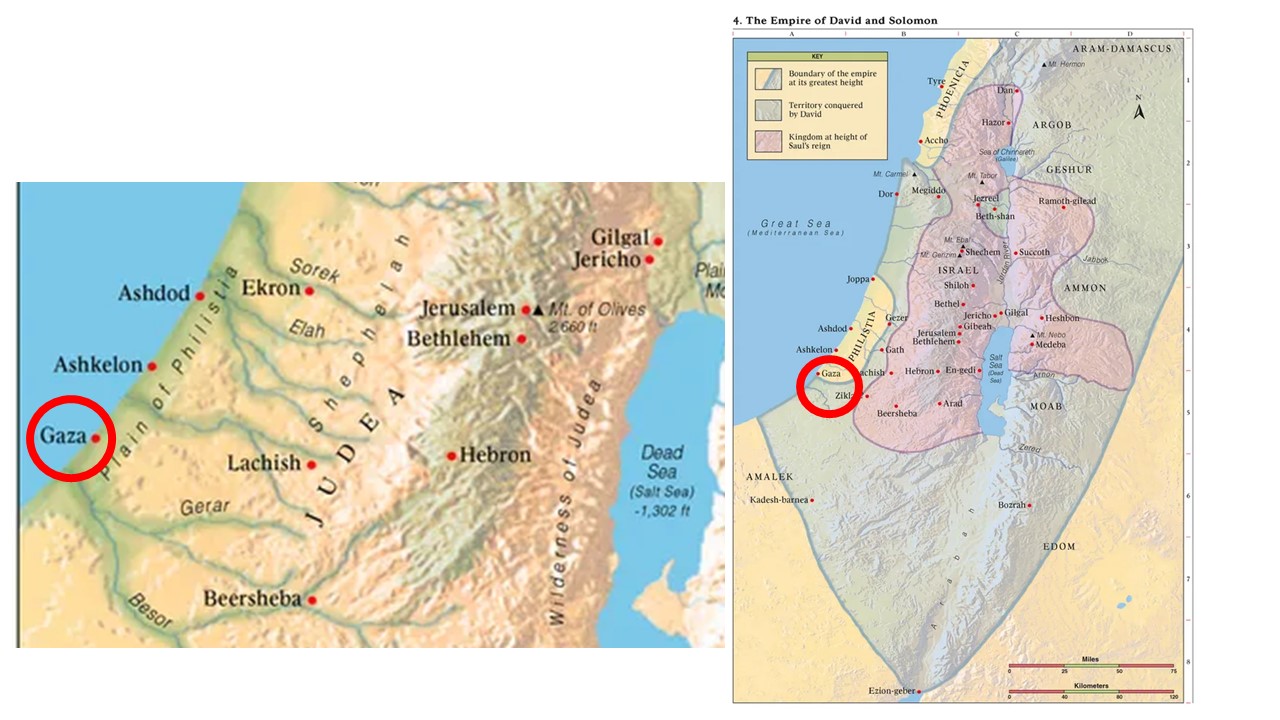
close and larger view of Gaza, southern Mediterranean portion of Israel,
maps from Church of Jesus Christ of Latter-day Saints, Bible maps

Samson would also meet his fate in the city of Gaza, when the Philistines are eventually able to capture Samson, after the ordeal with Delilah. Whether Delilah is Philistine is in question. She may be Canaanite., People guess she was Philistine, because the other women, Samson’s first wife and the harlot he went to, were. Delilah could even be Israelite. She had to be bribed with a lot of money to work with the Philistines. Anyway, when they were able to incarcerate Samson, they have blinded him (one of the gory Bible stories; they have gouged out his eyes) they took him to Gaza, where he met his fate. Granted great strength once again, he pushes the pillars and collapses the place, taking his captors down with him. With this event, Samsom kills more Philistines as he dies than he did in his life, which had been quite a body count.

Another Gaza story involves the Assyrian siege that would come upon Judean King Hezekiah. During the Assyrian siege, the governor of Gaza was not willing to play ball with rebellion against Assyrians, which included the people of Israel. So Hezekiah conquered the Gaza region. Later on Assyrian king gave Gaza back to Israel.

We could tell more stories about the people of Israel—which, after 720 BC entailed mainly the Jews—from the Bible, and from the Second Temple Period, which is Herod’s Temple, rebuilt close to the time of Christ, and then destroyed in 70 AD.

So, even after the dispersion around 600 BC by the Babylonians, there were Jews living in the land of Israel. Many returned, and rebuilt and rededicated the temple, 70 years later, with prophets Ezra and Nehemiah. Then after the destruction of the temple in Jerusalem in 70 AD, there were still Jews living there.

They maintained a presence there throughout the centuries. Netanel tells of a favorite poet of his, a rabbi, who lived in Gaza about 400 years ago. He is buried in Gaza. There was a Jewish community in Gaza until around 1929.

The Jews from the diaspora (wherever they were dispersed around the world) began moving to the ancient land of Judea by the late 1800s. They never fought and ousted anyone. They bought any land that was owned, and settled it and turned it from swamp or desert into productive farms and orchards. But as they gained numbers, and success, there was concern by the Arabs living in and around the area that the Jews could become a majority, so they began terrorist attacks on them, even in the 1910s and 1920s. Britain, a major world power at the time, after control of the area fell from the Ottoman Empire, offered protection with the Balfour Declaration, which they didn't completely adhere to. The Jews still got pelted.

After the holocaust in World War II, there was sympathy for the Jews, and the United Nations set up the nation of Israel in their homeland. Their Arab neighbors protested. Within the year, the Jews faced war—and won. Again in 1967 they faced all their Arab neighbors trying to take them over—and won. Miracles were involved.

At this point there are a couple of details to repeat, because they are seldom repeated. This is from my Part V:

One thing you might not be aware of is that, in surrounding countries Jews were forced to flee to Israel, many of them in poverty. Israel solved the issue by training the refugees and putting them to work. If the Arab nations that pressed the Palestinian people to become refugees had behaved similarly, these refugees would have been a short-term problem that would have disappeared about 60 years ago. [add another decade to that now].


Meme found on Facebook, attached was a useful timeline, but when
I tried to save it, it saved a video, which I gather this came from.

The Israelis aren’t the oppressors. They are the indigenous people, being attacked by the world. I wouldn’t say they are perfect, but they have a right to their sovereign state, and they have a right to defend themselves. They have a record of defending themselves by avoiding innocent casualties probably more than any warring nation in history. But the enemy uses its innocents as shields, placing their strategic equipment in or beneath schools and hospitals. When Israel has warned people to evacuate Gaza in these recent weeks, Hamas—the elected government in Gaza—has forced the people to stay put, even threatening their lives if they try to flee.

Yet the world sees Israel as the aggressor. This is also from my Part V:

Since the UN continued ineffectual, Israel began to retaliate—hard. Jewish planes and tanks struck in the Golan Heights, north of the Sea of Galilee, both causing and suffering heavy casualties. Now, at last, the UN acted—by immediately condemning Israel. This became the pattern in and around Israel: Palestinian refugees and others attack Israel; Israel suffers in patience and then strikes back; and international condemnation of Israel ensues.

That pattern has continued pretty consistently since 1967.

There was a podcast I heard, informative, and fairly positive toward Israel. But the guest also said he understood the position of the Palestinians. He told of one Palestinian who had been a child refugee in 1967. Their house is still standing, still visible to them, just over the border, but they are forced to live as refugees, without their home—because of Israel, so the hatred runs deep. Yes, it does. Especially when you don’t know what really happened to you and your people. I feel sorry for this Palestinian as well, but Israel is only protecting it's borders; the imprisonment in refugee camps for 60 years is being done by the Arab World and a complicit UN.

This is from Part VI: Continued Unrest

[In Part V] we covered some of the Palestinian refugees—the Arabs in Israel who fled their homes when surrounding Arabs refused to recognize the newly created state of Israel and went to war to eliminate Israel and the Jews. I need to add a detail about this. After the brief war that failed to eliminate Israel, the Israeli government set up a trust to handle the property of the refugees, to hold it for them. All they asked was recognition of their statehood and a permanent peace treaty. These requests were never met.

Eventually the land was purchased using a price structure set up by the UN. Israel never simply went in and took over private property; they lawfully acquired the land. Meanwhile, however, it does not appear the refugees were personally paid for their properties. If that is so, it was not because of any evil attributable to Israel.

I wonder about a duplicitous UN, which invited the Jews to create their sovereign nation of Israel and then, almost from the first year, sided with its enemies. Israel has been sanctioned more than any other nation—by several orders of magnitude—in the United Nations. Usually only the US and sometimes Britain or another single nation will side with Israel. And, except during Trump’s administration, US support has often been less than reliable. Oddly, those who attack Israel—including Hamas, which shared video of its murderous spree proudly online—is not sanctioned. Instead Israel is told not to overreact.

Hamas didn’t exist until 1988. In its charter, as other similar groups, it calls for jihad against Zionism. The goal to destroy Israel, to wipe it into the sea. The current phrase “from the river to the sea” refers to the Jordan River to the Mediterranean Sea—all of Israel to be wiped out. That means genocide. They don’t mean to conquer the people and rule over them; they mean to annihilate them. They are, by the way, Marxist tyrants; that seems to echo the last century, which we proclaimed we would never forget.

Netanel avoided politics generally in this discussion. But near the end, when asked what we could do, he suggested that we pass along what we know—we who would sit through an hour discussing Gaza when we could be doing many other things.

Again your support and you talking with your communities, talking with the youngsters, guys, with the youth, talking with the youths, explaining to the youth this information.

Sometimes people lose track, even if their world of values, try to talk to them and in in their own way, you know. If people are supporting the—I'll take something that is not my go to like regular activity—people who are talking about LGBTQ rights and support the Palestinian cause. I don't know if you've seen it; it's like chickens for KFC.

You should explain to these people that there are no rights for anyone who is not, like, a Muslim of that type, and definitely not for gays or women's right or anything like that. So you should talk with them. You should educate them. Because sometimes the knowledge is not there. And sometimes what they see, it's like, 20-second TikTok videos…. I don't know if they have the patience to sit for more than an hour by now and listen to a discussion about Gaza in the Bible and—okay, so you should educate them in the way, you know, they may listen to you.


A billboard seen in New Jersey, since taken down,
found on Facebook

I rather doubt such short attention span people are reading this blog. But it is my attempt to help educate. Education may lead to understanding, and understanding may lead to peace.

At one point Netanel said, quoting an old saying I am supposing, “It's really hard to prophesy, especially about the future.” I don’t know how this current siege will turn out. If it turns into the final battle, I know the ending of that story. But in the meantime, I’m praying for Israel and all the suffering people.


Glenn Beck updates current status in Israel, Wednesday, November 1, 2023.

Here are a few additional resources:

·        Israel, Palestine, and the Latter-day Saints,” CWIC Media, November 3, 2023, with guest Jason Olson, a Jewish and Ancient Near East scholar and a Naval Officer and diplomat with numerous Jewish and Israeli relationships. It’s an interesting conversation. 

·        Israel Palestinian Conflict: The Truth About the West Bank” Danny Ayalon, July 12, 2011.  I cited this video in my Part VI in August 2011. It still holds true, yet another 12 years later.

·        Why Isn't There a Palestinian State?” David Brog for PragerU, March 27, 2017.  This goes through the 5 times (up until 2017) that the two-state solution was rejected by the Arabs.

·        Exposing Iran's Trap to Trigger Global War | EP 316” Glenn Beck, November 1, 2023. On BlazeTV  or on YouTube

Thursday, July 24, 2014

Civilization vs. Savagery in Israel


If you think there is an Israeli occupation of Palestine, you need a primer. If you think both sides are equally culpable in their conflict, you lack information. If you think maybe it’s a good idea to support Israel, maybe for Biblical reason, but you don’t know how to describe your reasons, this might be a good time to get some useful facts.
Back in 2011 I wrote a six-part post on the history of Israel. It’s a pretty good primer.
·         Israel, Part I: Ancient History
·         Israel, Part II: Zionism and Migration
·         Israel, Part III: Conflict and Violence
·         Israel, Part IV:  Holocaust and Statehood
·         Israel, Part V: Refugees and 1967 War
·         Israel, Part VI: Continued Unrest
In Part VI I link a video that describes the history with animated maps—about six minutes. Worth seeing. This past week I saw a video by Jewish conservative radio host Dennis Prager, which also gives a brief history, posted on YouTube in June 2014, shortly before the recent missile out of Gaza began. It gives a 5-minute summary of the situation, reminding us that there has never been any state in that region that wasn’t a Jewish state; this is the third Jewish state. There has never been an Arab state, a Palestinian state, a Muslim state, or any other state.


As I mention in my Part VI, the terrorists fighting Israel are more Marxist than religious Muslim. Potential PLO leaders were trained in Moscow, East Germany, and Cuba, where they were specifically trained in subversion, propaganda, explosives, and terror tactics. They continue these tactics still. One of the PLO’s tactics was disinformation—lying propaganda. Repeating the lies over and over, through decades, in schools and in every news broadcast, has left a large part of the world unaware of the truth of events in the Middle East. The PLO is named less in media since the loss of Soviet support in the early 1990s. Now the entity in the forefront—still using those tactics—is the terrorist organization Hamas.
Steven Bucci, former Army Special Forces officer and top Pentagon official, now with The Heritage Foundation, offered perspective in a piece July 17, 2014, “The Moral Difference between Israel and Hamas,” The Daily Signal July 17, 2014:
What most Americans—and the world—hear about the ongoing conflict between Israel and Hamas goes something like this: “125 Palestinians, most of them civilians, have been killed by Israel’s relentless assault on Gaza. No Israelis have yet been killed.” This may be true, but there is absolutely no context to it. One must look at the methodologies of the two sides.
Hamas sets up rocket launchers—as well as supply dumps and command-and-control sites—in the midst of apartment buildings, mosques and schools. From these sites, its fighters launch dozens of rockets in salvos, targeting population centers with no discrimination at all. They have been firing almost continuously of late. But normally, they fire when Israeli school children move from their homes, which have safe shelters, to their schools, which also have shelters. They do this deliberately to try and catch the kids in the open. They don’t seek to minimize collateral damage – they seek to maximize it.
Israel, on the other hand, fires only at specific, intelligence-derived military targets. Since these targets are deliberately intermixed with the civilian population by Hamas, Israel must take steps to minimize the collateral casualties.
Before the Israelis strike a building, every home in it gets a call on its landline phone, as do all the cell phones associated with the inhabitants of the building—the cells additionally get text messages—telling them that in a few minutes the building will be targeted. Finally, to make sure everyone gets the message, Israel drops a dud bomb—one containing no explosives—onto the roof of the structure. Minutes later, the building is destroyed. There is no instance in modern military history where a force has taken greater measures to give the innocents as much chance to get out of the way.
Similar information was shared in interviews with Israeli Ambassador to U.S. Ron Dermer. He was interviewed on Face the Nation July 13th TheWashington Post July 15th,  and CBS News July 18th.  Here’s a quote from the Washington Post interview:
As we’re trying to people out of harm’s way, Hamas is telling people to go into harm’s way. They’re actually telling their population to ignore the warnings of our military, as we drop flyers, we make phonecalls, we send text messages. We do things I’m not sure there’s another country in the history of the world, in warfare, that have gone to such great lengths to keep the civilians of the other side’s population out of harm’s way. We’re doing what we have to, to take the action to defend our people.
Israeli Prime Minister, Benjamin Netanyahu, was quote this past week, saying, “The difference between us is simple: We develop missile-defense systems to protect our citizens, while they use their citizens to protect their missiles.”
The Prime Minister did an impressive interview on Fox  News, with Bret Baier, on July 21st. All six minutes are clear and informative, but here’s a sample:
We asked these civilians before we went in, “Please leave.” We text them on cell phones. We drop leaflets. We tell them where to go. And those who left were safe. Now those who didn’t leave, you know why they didn’t leave? Because Hamas told them to be there. Because Hamas, while we try to avoid Palestinian civilian dead, Hamas wants Palestinian civilian dead. The more the better, so they can give you telegenic fodder. So this is the cruelest, most grotesque war that I’ve ever seen…. Civilian deaths are caused because they want them to be caused.
My daughter, Social Sphere, has a friend she met some years ago, as a teen in Texas, still in touch on social media. Danielle moved to Israel to serve in the IDF (Israeli Defense Forces). Here are some of her recent posts [ID info removed]:
Of the 13 Israeli soldiers killed yesterday, one is a Texas boy—who moved to Israel with two of his best friends to join the IDF, giving him a “lone soldier” status. This means that even though he and his family did not live in Israel and he did not have to serve, he decided at a young age (in his case, 16) to move to Israel by himself so he can serve in the IDF. So he is alone in Israel. According to our friend—“These kids get most respect in Israel.” We are as honored that he came from Texas as Israel is to have received him.
Another day Danielle said, “The indoctrination of hate is one of the primary tactics Hamas uses to teach violence to children. This is child abuse. Hamas is a dangerous terrorist organization for Israelis, but they are toxic for Palestinian children and civilians as well.”
Another of Social Sphere’s Texas friends traveled to Israel recently to learn more about her ancestry. Rachel quoted US Secretary of State John Kerry, saying one of the few things he has said that rang true: “No country could sit by and not take steps to try to deal with people who are sending thousands of rockets your way. The fact is that Hamas uses civilians as shields and they fire from a home and draw the fire into the home.”
Using human shields is a violation of the rules of warfare. So is targeting of civilians, as Hamas does, seeking to kill as many civilians as possible in Israel, while also delighting in any of their own people killed, because they use that in their propaganda.
I was thinking the word was getting out this time, but apparently not much beyond those who already know the truth. Despite the moral clarity between the two sides, the UN just decided to investigate possible crimes against humanity in this conflict—but will ONLY investigate Israel.
Israel deserves the support of the civilized world, not condemnation for keeping itself alive.
There’s one other video you ought to watch, new yesterday, July 23rd, from Bill Whittle: “The Case for Israel.”  He compares the two sides, one civilized and one barbaric (in the Spherical Model we use the word savage, but I think we can conclude they have the same meaning). In case you missed it, Hamas recently referred to the Jews as a little bit worse than Hitler. This quote responds to that ironic accusation:
The instant that Hamas or Hezbollah get their hands on a nuclear weapon, they will do with it what they do every day with their rocks and mortars and missiles. They will use it. On Israel. The Israelis have an estimated 500 nuclear weapons and could destroy the Arabs any time they chose. They don’t.
Those are not Nazis. Those are moral, civilized people.
Israel is an island of civilization in a sea of barbarity, and that is why it is being targeted. Uncomfortable with those words, “civilization” and “barbarity?”
He then gives a long list of evidences of Israel’s civilization status. The differences are stark, and ought to be noticeable by any civilized person. But disinformation, over time, has done its dirty business.
Anyone who thinks the Israelis keep all the goods and wealth for themselves and deprive their neighbors doesn’t know the history. Also, anyone who claims this attack from Gaza is caused by Israeli “occupation” is buying the propaganda. Israel left Gaza in 2005, leaving behind infrastructure, hospitals, schools, even greenhouses with plants growing. The response was to destroy everything and subject the people to poverty, and then blame the Israelis for their misfortune. Toward the end of the video, Whittle covers this bit of history, and refers to another concept we talk about when striving for civilization—“Thou shalt not covet.”

But you cannot understand Israel’s actions without understanding the pervasive, unrelenting, hate that surrounds that outpost of civilization. From Hezbollah rockets made in Iran, to BDS [boycott, divestment, and sanctions] sanctions made in Berkeley and Santa Monica, the attacks on this country and its people cannot be understood without getting to the bedrock essence of the nasty, petty, small and mean-spirited emotion that drives anti-Semitism.
And that emotion is Envy.
Genesis, Chapter 26, verses 12 through 16:
And Isaac sowed in that land and reaped in the same year a hundredfold. The LORD blessed him, and the man became rich, and gained more and more until he became very wealthy. He had possessions of flocks and herds and many servants, so that the Philistines envied him. (Now the Philistines had stopped and filled with earth all the wells that his father’s servants had dug in the days of Abraham his father.) And Abimelech said to Isaac, “Go away from us, for you are much mightier than we.”
That was thousands of years before there was a religion called Islam. And when the Israelis, as a gesture of peace and goodwill, turned over the Gaza Strip in 2005 the first thing these modern-day philistines did was smash the windows of the greenhouses that had been handed to them by other people’s labor. Once again, they filled wells in the desert with sand.
Israel has survived miraculously in the past. I expect it to survive now. I want to be clear that I side with civilization, not savagery. And the differences right now couldn’t be clearer.


.