Showing posts with label Attorney General Greg Abbott. Show all posts

Thursday, October 30, 2014

Character Trumps Tribe, Part III


We’ve spent a couple of posts so far talking about “tribes.” I’m using this term to mean group, or identity, such as race or ethnicity. But it can be other things, whatever is part of an identity grouping. In part I we covered Houston Mayor Annise Parker and her LGBT tribal loyalty overriding principles important to the larger population. In part II we talked about the tribalism in the black community, standing in the way of freedom, prosperity, and civilization.
Another “tribe” that’s being put forward to get “firsts” is women, which we’ll cover in today’s part III, along with some conclusions.
Wendy Davis, running for Texas Governor, is an example of the “tribe” of women. She claims there is a war on women, and voting for her puts you on the right side of the war. But that’s tribal. What is she saying that would lead to freedom, prosperity, and civilization for men in Texas? Or for women? Because the same principles apply if you want to go north on the sphere.
Other than our age and gender, I find nothing in Wendy Davis that puts us in any similar group. We agree on almost nothing, and I would never want a person with her lack of character and capability to represent or lead me. I certainly would not give her my vote just because of her gender. Especially when a man of great character and capability, Greg Abbott, is our blessed alternative.
Hillary Clinton will not be the first female to run for president; but she is pressing the “tribalism first” goal of getting the vote because she is nominally a woman. Her lack of character and capability are almost legendary. The only thing she thinks will work for her is tribalism—“Vote for me to prove you don't hate women.”
What does this "feminist tribe" stand for? Sex without consequence. “Right” to kill unborn babies at any point (and leading to even after birth in some cases). Disdain for motherhood, and especially for stay-at-home motherhood. Pushing to ignore physiological differences between men and women. Claiming that there’s still a pay difference between men and women (outlawed decades ago, when you’re comparing apples to apples situations). Pretending to be men, while pretending men are evil and inconsequential. There's nothing in there that even shows an understanding of women, let alone a love and appreciation for divine womanhood.
The feminist tribe pushes for power to be men, to replace men. It’s illogical. It’s ugly. It’s hate-filled. And because it’s so anti-family, it can only lead to tyranny, poverty, and savagery.
That is not to say women can’t be good in government, leadership, or just about any profession they choose. But it has to be based on the character and capability of individual women—nothing to do with the feminist tribe.
You can't assume goodness based on tribal association. So the next question is, how do you tell when a person is likely to promote their tribe over the common good?
In Harris County right now there is an interesting race for District Attorney. Both party’s candidates are women. The incumbent, Devon Anderson, was appointed a little over a year ago, upon the death from cancer of the very capable Mike Anderson, who had not been in that job long enough. He was her husband. She is a former prosecutor and was serving effectively as a judge. And she has been effective thus far, just a little over a year into the job.
But her opponent, Kim Ogg, also a woman, is fairly impressive. She is tough on crime, has some good data to show how things have been (up to 2012, when Mike Anderson was elected, so no data on how things are currently being done). One of the issues is about prosecution of minor drug offenses. I don’t agree with Ogg, but she did support her stance fairly well, and got some support at our Tea Party, where we have some libertarian leanings.
I got the chance to ask her this question: “We seem to agree with being tough on crime and fiscally responsible. Those aren’t things we usually go to the Democratic party for. So what attracts you to the Democrats?”
I give her credit for coming to a Tea Party in the first place; more Democrats should. And she was forthright and honest in the Texas way. I appreciate that. But her answer essentially was that she couldn’t get elected in a Republican primary. She thinks of herself as an old-time conservative democrat, like her father. She voted Republican in the 1990s, and has now gone back with the democrats. Yes, she did vote for Obama, but only once.
But here’s the telling detail: she voted for McCain in 2008; she liked him a lot. And then she voted for Obama in 2012. So, after four years of evidence against Obama, she thought he was a better option than Romney. (If you missed the contrast, start here.) She has revealed a severe lack of judgment. And she added to that by admitting without being asked that she supports Wendy Davis for Governor. In other words, even though we agree on a couple of principles, she identifies with a party that I simply don’t relate to. She's not about conserving the Constitution; she may not even know what the word means.
So maybe the most important detail is party—which is another tribe.
This may not have always been so, but today I find it very difficult to find a Democrat with character—the values that lead to freedom, prosperity and civilization. They tend to want power over others. Often power for their tribe (their group, their identity, their coalition of groups) trumps the good of all. Democrats, in Spherical Model terms, live in the southern hemisphere, with no awareness that there’s a better alternative.
So, regardless of tribe, let’s start with the agreement that the Democrat party right now is wrong for America, and their principles are wrong anywhere else in the world that might want freedom, prosperity, and civilization.
That doesn’t necessarily mean being part of the Republican tribe is the answer. Same is true for libertarians, or any party. You might get a little further by looking at someone’s religious affiliation. But even then, if it’s a tribal affiliation rather than connecting on principles, it’s misplaced loyalty.
So, in a party where you find a number of like-minded people, keeping the Constitution in mind, find candidates with character and capability. And once you find those things, look at agreement with the principles that lead to freedom, prosperity, and civilization. You can find a good list of questions to ask here.
Connect with others to influence and support one another with love. But be loyal only to God and to your soul. Any other tribe is an incidental connection, unworthy of unquestioned loyalty.

Thursday, June 12, 2014

Texas Talk--Part II

This is part II of a three-part piece, reporting what I observed at the Texas State Republican Convention last weekend. Part I covered Senator Ted Cruz’s speech, which was important because he was so clearly the Texas favorite for a 2016 presidential candidate—and it was a good speech, which we never hear from our current president. Today we’ll cover highlights of some other speakers. And in part III we’ll get to the part that’s been coming up in the news, concerning platform debate, which I found interesting but much less contentious than the media portrays it.

Greg Abbott speaks at Texas GOP Convention
Speeches aren’t really the business of a convention, but they are an opportunity for sharing views, and getting the hardcore grassroots of the party excited about candidates. More of that happens in a presidential election year. But this year includes a number of statewide Texas races: governor, lieutenant governor (that’s like vice-governor in Texas, a position with a lot of influence over the state senate), attorney general, railroad commissioner (a three-person commission over mainly the oil and gas industry and other natural resources), and agriculture commissioner.


Greg Abbott—Attorney General, Candidate for Governor
I want to cover Greg Abbott’s speech first. He is the current Texas Attorney General, and has used that position to sue the Obama administration numerous times. He has prevailed on allowing displays of the Ten Commandments. There are many cases still pending related to Obamacare, but he does understand the 10th Amendment and has been asserting those rights first through legal channels, which was his job. (Ted Cruz served under him as Solicitor General before running for senator.) I have liked him since the first time I heard him speak—at a state GOP convention ten years ago. He’s been one of my favorites every year. So I was pleased to know he was running for governor, and I’ve been behind him from the beginning.
He’s a lawyer, so you expect a cerebral approach to things, and you get that. His campaign theme is Bicentennial Blueprint. In 22 years from now—when babies born today will be about ready to graduate from college and get out into the world—Texas has its 200th birthday. That is, when it won independence from a tyrannical Mexican dictator and became an independent republic, before some years later becoming a state in the United States. So, he points out that Texans have been pioneers in oil, in ranching, and even space exploration. “Texas is truly exceptional.” So he’s asking what it will look like 22 years from now. Because he and his opponent, Wendy Davis, have very different visions of what Texas should look like.
“Her prescription is more government. My prescription is more freedom,” Abbott says. Texas is the best business climate in America now. How to you get it better?
·        Limit the size of government, to stimulate the private sector to create jobs—so you keep more of your hard-earned money.
·        Government must live within a budget. Don’t allow the Rainy Day Fund to be used like an ATM machine. Debt today becomes taxes tomorrow. All levels of taxing entities in Texas must post online how they’re spending their budgets.
·        Government answers to you—not the other way around.
·        Reduce property taxes.
·        Prioritize roads and water. Protect the water supply. And build roads without raising taxes, fees, or tolls.
He inserted some humor here. In case you don’t know, Greg Abbott is in a wheelchair. When he was in his 20s, a couple of years after getting married, he was out running and a tree fell on him, leaving him paralyzed. I’ve heard him tell that story before, adding, “People assume I must have been the world’s slowest runner, if I couldn’t outrun a tree.” This time, talking about roads, he said, “There are places where a guy in a wheelchair can go faster than a car in traffic. Elect me governor, and I’ll get Texas roads moving again.”
Confetti Storm after Greg Abbott's speech
He also said his main plan for crime is to secure the border. “Cartel activity has contaminated across the state,” he said. Priorities are messed up. “The government stops a valedictorian from mentioning God, but doesn’t stop drug cartels.”
And while he was on federal failures, he added Obamacare and VA care: “The federal government doesn’t have a clue how to run healthcare. Get government out of healthcare. Let doctors and patients make decisions.”
“Patients first; bureaucrats last.” Of veterans, he said, “Having served on the front lines, they should go to the front of the line to get healthcare.”
He said the cornerstone of his Bicentennial Blueprint is education. His wife has been a teacher and principal, so he has some contact with the front lines. Texas reigns in jobs, energy, exports, and business climate. “It’s time for Texas to become number one for education of our children.”
I tend to cringe when anyone in government talks about education, but I think he gets it. “The job of government is to set the vision,” he said. And added that we need genuine local control, including allowing opt-outs from hurdles put in the way from the capitol in Austin. “Teachers and parents know better how to educate than bureaucrats.” And he’s against so much standardized tests. He said, what will matter in preparation for tomorrow isn’t how a student does on some test, but how prepared they are for life. He emphasized, we’ll “drive a stake through the heart of C-SCOPE (Texas’s version of Common Core) and never allow it.”
One highlight of his speech was what you might call the outreach part. He said the blueprint is to live up to greater opportunity for all, “Regardless of race, religion, or zip code.” And he said his family mirrors the state of Texas. His wife is the daughter of an Irish father and Mexican mother, and he is the son of Anglo parents. “Juntos somos una familia.” (Together we are a family.) “This blending of culture works in the Lone Star State.” I think he’s right about that. You see that at our local tea party meetings, and at the convention.
If he is elected governor, which I am planning on, his wife will be Texas’s first Hispanic first lady. The democrats, meanwhile, are offering a divorced, gold-digging, self-centered blonde, whose claim to fame is a pointless filibuster of a bill to limit late-term abortions to the point where fetuses are known to experience pain. Sometime I’ll talk about the “abortion Barbie” candidate. But for now, let’s just say, Greg Abbott is going to make an excellent governor of the biggest, most conservative and therefore most thriving state in the union.
 

Dan Patrick—State Senator District 7, Candidate for Lieutenant Governor

Dan Patrick is my state senator. So I’ve talked with him in person, and heard him speak in person many times. Plus, he’s had a radio show I started listening to when I moved to Texas. So I feel like I know him well. And he’ll be an excellent Lieutenant Governor.
Senator Dan Patrick
His speech at the convention was on fire.
“There’s this thing called Battleground Texas—they’ve picked the wrong ground to battle on.” That was his beginning. In case you’re not familiar, Battleground Texas is a sub-ACORN organization with the purpose of turning Texas blue (democrat). Mathematically, if they could do that, Republicans would never again win a US presidential race. But it’s not going to happen—because we’re being vigilant, which those guys aren’t used to facing.
Dan Patrick said, “We are the high ground on liberty. They live in a valley where the desert never blooms freedom. We will win on the high ground of principles.”
Much of his speech was on how to get the message out of who we are and what we stand for: life, job opportunity, educational opportunity. This “Be bold,” and “Share the Message” was something of a theme through all of the speeches, and probably a good plan of action for all the grassroots going forward.
His opponent, Leticia Van de Putte, he said is an ideological copy of democrat candidate for governor Wendy Davis: “Nothing she stands for has anything in common with any American or Texan.” He listed a few: “They’re for abortion, and against school choice. They’re for Obamacare, and against border security.”
Immigration is a big issue with Dan Patrick. “We’re not against immigration—we’re against illegal immigration. Hispanics are with us on securing the border.” I didn’t get all the numbers written down, but I think these are what he shared. There are 100,000 gang members in Texas, here illegally. In four years there were 113,000 violent criminal aliens arrested, and then released; 79% went back mostly into San Antonio. There are 700,000 young adults that have come in in the last several months, causing a humanitarian crisis. Our service centers are almost full, so that, if we have a hurricane or other emergency (likely in any given year), we have no place to evacuate our own citizens.
His policy on immigration is pretty much equivalent to mine: Secure the border first. No pathway to citizenship for those here illegally. Once the border is secure and no special gimmes are offered, then deal with those that are still here. (Need I point out that this is what Romney said in 2012?) And when is the border secure? “It’s secured when Texas tells Washington it’s secured—not when Washington tells Texas it’s secure.”
He’s headed the Education committee in the state senate, and is clear on education issues. (I know he’s been educated along the way on homeschooling.) Like Abbott, his wife has also been a teacher.
He’s for lower property taxes—so we don’t forever “rent” our own property from the state of Texas.
Unlike his relatively good predecessor, Dan Patrick promises, “I’m not going to put democrats in leadership of committees.” Yay!
He points out how oil and gas is an example of free enterprise working. In Midland, he says McDonald’s pays a bonus to attract workers. That’s what happens when there’s full employment and opportunity.
He’s traveled the state in this campaign, with some 1000 meetings. With no entourage. He has had a chauffeur. And a bodyguard. “She’s the same person, my wife of 39 years.”
He has been effective in the state senate. At age 63 he has no aspirations beyond being Lieutenant Governor. I believe him when he says he wants to serve, because I’ve seen that’s what he’s done consistently. 


Rand Paul—Senator from Kentucky
Rand Paul isn’t a candidate for anything in Texas. However, he was born and raised in Texas (son of former US Representative Ron Paul). He grew up in Lake Jackson, south of Houston, and went to Baylor, where he met his wife, a Kentuckian, which is how he ended up there. There’s a possibility he might run for president in 2016. So he came home for the convention. 

Rand Paul has the talent of talking to a room of 8,000 people as if he’s in your back yard having a casual chat over barbecue. He’s fun to listen to. And on ideas I like him better than his father. Still, there are things I disagree with him on, as I do with many libertarians. But he’s fairly careful about how he says things, and I believe we could occasionally disagree without rancor. There are so many things to agree on.
Senator Rand Paul
He starts out, “I’m a little annoyed with Obama right now.” He refers to the illegal release of five Taliban higher-ups from Guantanamo. He referred to the marine who accidentally crossed the border into Mexico and is being imprisoned there, Sgt. Andrew Tahmooressi. He suggested it would be a better idea to trade five democrats for the marine—“John Kerry, Hilary Clinton, Nancy Pelosi….” Later, news media attacked him for this suggestion. He said to lighten up; it was a joke. “Except for Nancy Pelosi; I was serious about her.”
He talked about how difficult it is to cut even the rate of growth of government spending. During the shutdown, he said everyone in government was “asked to list who was essential and unessential on our staff. So I asked my staff to get together the list from the EPA, the IRS…” Those entities listed 90% of their staffs as unessential. Still, they manipulate things so that the unessential get paid while not working. “The government could be shut down completely, and it costs more than when it’s open.”
He’s good with examples. “One woman was paid for not working—over $100,000 a year—and hadn’t even clocked in in five years.” They didn’t fire her.
One government employee was discovered to be downloading port six hours a day. He wasn’t fired.
There was John Biele, a senior EPA official, who collected a salary for work he didn’t do—for 13 years, getting $150,000, whether he showed up or not, and the time he didn’t show up totaled 2 ½ years. He told the EPA that when he wasn’t in, it was because he was on secret assignment with the CIA. It took more than a decade before that TV script story was questioned, and someone called the CIA and found out he’d faked the story.
“But the democrats say there’s nowhere we can cut.” So he offers help. There’s $100 billion in the budget unaccounted for. A simple hiring freeze, allowing for attrition, would save $6 billion a year. We pay $20 billion a year keeping up unoccupied federal buildings. We pay $20 billion in aid to corporations—an average of $200 million a year to each company receiving corporate welfare.
He admits that the 2/3 of mandatory social spending, like social security, requires some difficult choices. But he suggests we raise the retirement age by 1-2 months a year for 30 years. He offered this solution, and asked the democrats to “work with us, do the right thing.” The response? They accused him of “pushing grandma off a cliff.”
A third of the budget goes to the military. During the shutdown, the president was afraid you might not notice—“so he had to make you notice.” He closed down private monuments. One great image was of WWII veterans cutting through the barrier tape.
He told of one ridiculous example: Twiggy the waterskiing squirrel. There’s $3 million in the budget for this. Now, compared to the whole budget, when they’re saying we can’t cut anything—we find Twiggy? It turns out, Twiggy the waterskiing squirrel is used to promote American walnuts in Spain. “I’ve got a suggestion,” Paul says; “If you’ve got a walnut farm, pay for your own d**n advertising.” When it came to a vote, Twiggy the Squirrel funding passed 320-90. It’s not just a democrat problem.
He took a moment to refer to the “Old McDonald’s Farm” of scandals, “here a scandal, there a scandal, everywhere a scandal.”
Benghazi means the death of four Americans. The ambassador had spent six months asking for reinforcements. Specific request: a DC-3, a 50-year-old plane, just in case they needed to evacuate. Hillary said no. They ended up begging Libyans to let them use a plane to evacuate.
Three days after turning down the Libyan ambassador’s request, she approved $100,000 for changing (I think he said) carpet in the Italian embassy. She approved $650,000 for Facebook ads. Later that season the Brussels embassy got $100,000 for landscaping, and $5 million went for crystalware.
In August 2012, Ambassador Stevens sent a cable to Hillary asking if she’d read his requests for help. She said no. “That is dereliction of duty.”
“To win nationally, we need to be a bigger, better, bolder pary. We need to keep on message and be bolder with our message.” There’s that “be bold” theme of so many speeches.
He reminded us Reagan was dramatically, boldly, for cutting taxes—to create jobs. We bring new people into the party when we speak that truth.
He said we’ll keep on emphasizing the Second Amendment—“Don’t give up on that. But also the Fourth, Fifth, Sixth, and First Amendments.”
There more examples—of abuses of freedom, and why we need the protections. And also ways to address those things in Congress. Here was one not likely to pass: “Cut congressional pay in half—have them there only half as much. And institute a work requirement.” He also said, “There’s no monopoly on knowledge in Washington.”
He ended with that bold theme again: “Bigger, bolder, better—with optimism.” He used a memorable image for this a quote historian David McCullough has used. It’s from painter Robert Henri, about the joyful, bold way he paints. Rand Paul changes it slightly for the political party: “Proclaim our message like a man coming over the hill singing.”
I believe a bold, clear, uncompromising message is many times better than defensive, compromising off-message talk. Let’s defend the Constitution, let people know why we believe in it, show why it makes better opportunities for everyone. Conserving the Constitution has so much more to offer humanity than any other political path. That bold talk is something I really like about Texas.

Thursday, February 20, 2014

Primarily Speaking, Part I

trying to organize the avalanche of election info
Texas is early, as states go, holding the state primary election March 4th. (Early voting started Tuesday, February 18th.) Because this is a conservative state, most of the decisions about who will be our elected officials will take place in this primary election. Yet in a typical primary election only 10% of registered voters turn out.

To put a positive spin on that, if you’re a well-informed voter, you get a bigger voice by voting in the primary.
The challenge is in being a well-informed voter. I work pretty hard at it. I know it’s hard to know all the candidates for all the offices, and discern who’s telling the truth vs. who’s saying what needs to be said to get elected. We don’t even all have the same definition of conservative, although an understanding of the US Constitution and the philosophy behind it is a good starting point.
What I’m doing here is presenting my thought process so far. Mostly I’ve decided who I’m voting for, but in some cases I hesitate to call that an endorsement; I call it my best answer at this point on the upcoming exam. I plan to vote on voting day, rather than early, so I reserve the right to change my mind. But I’m hoping that sharing what I know will help local people add data to their decisions, and the process of it will help voters in other places make good choices.
I’ve used a number of resources. A good starting place is a sample ballot. I get mine at the county site HarrisVotes.org.  You can choose either party there, but I’m only dealing with the GOP ballot, where I’ve done research. (Good luck finding a Constitutional conservative on the democrat ballot anyway—kind of a useless exercise. You may find an occasional worthwhile libertarian candidate, but they choose candidates by convention, rather than primary vote.)
For every candidate, you can do an online search for their candidacy website, to learn how they’re presenting themselves. Much of my research has consisted of meeting and hearing from candidates in person at various forums: my local Tea Party meetings, King Street Patriots debates and forums. And also comparing endorsement lists from various groups (all claiming to be conservative) that have vetted the candidates, and also some individuals whose opinions I value who have shared their views with friends. Among these is a local group called Conservative Coalition of Harris County (CCHC PAC). These are grassroots individuals, several of them longtime friends of mine. They spend their own time vetting the candidates, with a combination of questionnaire, in-person interviews, and online research. They do a secret ballot, and if a candidate receives 70% or more of the panel vote, they endorse. They are not funded by any outside sources, so candidates cannot influence with donations; I guess that is possible with other organizations.
Other organizations whose endorsements I look at (as data, not necessarily as a direction to follow) are Texas Conservative Review, Texans for Fiscal Responsibility, and Houston Realty Business Coalition. I’m sure I’ve received others in my email inbox, but I have to limit the avalanche of info somewhere as I set myself down to make decisions.
For judge races, I always take into account recommendations from some friends in the county DA’s office, and I listen to some of the lawyers who attend our Tea Party regularly. Also, a neighboring precinct judge shares her recommendations with me.
So, here we go, mainly from the top down.
US Senate:
Besides incumbent John Cornyn, there are seven other GOP candidates (plus some libertarians you won’t see on this ballot). People in other states might not understand our discontent with the powerful and apparently conservative senior senator from Texas. But there is some friction in Washington between his get-along-with-the-enemy approach and Ted Cruz’s take-the-right-position-and-let-things-fall-where-they-may approach. Cruz is more of a Constitutional, principled conservative than Cornyn. That doesn’t mean Cornyn is always wrong, or that Cruz’s approach will always accomplish the best ends. But we need more bravery and principle from our leaders, and it has appeared to us that Cornyn has worked behind the scenes to undermine Cruz’s efforts. I don’t know what is true. I expect Cornyn will win the primary, without a runoff. But in this primary I am willing to send a message to Cornyn that he ought to pay more attention to us Texans. So then the decision in the primary is, which alternative?  

Reid Reasor came to our last Tea Party meeting. I liked him. Linda Vega came last month. There are things I liked about her, but I wasn’t persuaded she was US Senate material yet. I’ve met Steve Stockman and Dwayne Stovall. People have mentioned good things about Chris Mapp. So, I’m still undecided, but I do think I’m going to do a protest vote in this primary, and then support the republican candidate.
 

Governor:
I’m for Greg Abbott. Another candidate I’ve met is Lisa Fritsch, who was running against Abbott with an outsider vs. insider campaign. I didn’t buy it. But I liked her. I wish she were running for something else where I could support her. I’m glad to be able to vote for Greg Abbott. All of my sources are unanimous in supporting him. Sometime after the primary I’ll compare and contrast him with the democrat challenger, Wendy Davis, which should be an amusing exercise.
 

Lieutenant Governor:
I wrote about this race a few weeks ago. I’m for Dan Patrick, as are my sources, unanimously. But this race shows the deep bench of conservative leaders in Texas. As the campaign continues, I see more attacks, particularly from Jerry Patterson toward Dan Patrick—old and implied with lack of fact, and it’s harming Patterson in my view more than Patrick. The race is really between Patrick and Dewhurst, so Patterson’s attacks are going to make it awkward either way for Patterson.
 

Attorney General:
I’ve been truly undecided on this race. We met Barry Smitherman some months ago at the tea Party, but he was likable but unremarkable in a state full of conservatives. Ken Paxton came to our meeting last week, and we had a great little conversation about Constitutional principles, and about some inside politics. Paxton ran, last term, against the “moderate” Texas House Speaker Strauss—because someone had to, and he couldn’t find someone else willing. He was punished by having his district split—he won anyway and recruited a number of new conservative representatives around him. He also got removed from all committee leadership, and was the only representative placed on two committees led by democrats. In addition, any amendments he put forth on the floor were ruled not germane, even when they clearly were. But rather than complain, he says that’s what we face politically, and the solution is to get more conservatives elected. He seems to understand the attorney general position well, and while I think Greg Abbott’s shoes will be difficult to fill, I’m ready to give Paxton my vote. CCHC supported him with 60% of their vote (not enough for an endorsement; Smitherman got the other 40%). TFR also supported them. Smitherman is supported by TCR, HRBC, and my precinct chair friend (I’ll refer to her as PC).
 

Comptroller:
This is like a state treasurer position—it’s accounting. It’s an open seat, with retirement of Susan Combs, who has been quite good. There are a few things Debra Medina says that I agree with; she’s more libertarian than traditional conservative, however, and there always seems to come a point where we diverge. Glenn Hegar was a state senator, whose office we visited last term. I like him, and he seems quite capable. He gets the support of CCHC (85%), TFR, and PC. Harvey Hilderbran got TCR’s endorsement.
 

Land Commissioner:
I’m still wavering on this race. George P. Bush is the son of Florida Governor Jeb Bush, grandson of George H. W. Bush, nephew of George W. Bush. It’s hard to say how much the name either hurts or helps. In his own right, he seems fairly capable. I know less about his opponent David Watts. CCHC gives 55% support to Watts. TCR, HRBC, and PC all support Bush. I am leaning toward Bush for now.
 

Commissioner of Agriculture:
We met Eric Opiela some time back at our Tea Party. I liked him, but I disagreed with him on the use of the Rainy Day fund for water infrastructure. He supported his argument well, and a number of people agreed with him, including Dan Patrick. I know less about the other candidates. But I’m taking a longer look at Sid Miller, who got 90% support from CCHC, as well as TFR and PC. Tommy Merritt got the endorsement of TCR. Because of the influence of friends, chances are I will go with Sid Miller.
 

Railroad Commissioner:
This position has a traditional name but actually has nothing to do with railroads, and everything to do with energy resources, such as oil and gas. We’ve had Wayne Christian and Ryan Sitton at our Tea Party. I’m leaning toward Wayne Christian. He also got 80% support from CCHC. But all the others got some support. TCR supports Malachi Boyuls. HRBC supports Ryann Sitton. And PC supports Becky Berger.
 

So far we’ve only gotten through statewide races, and even those not including judges. So this is going to take another post. So tomorrow we’ll work through the local and judicial races.


Monday, December 16, 2013

It's That Time of Year


I’m sure you’re aware, this time of year is…just a couple of months before the primary election. That’s why this past Saturday, a week and a half before Christmas, a crowded roomful of people met at our local tea party meeting to hear from candidates.
In addition to local candidates, we heard from two more candidates for Texas governor: Republican Lisa Fritsch and Libertarian Kathie Glass.  A few months ago we heard from Tom Pauken, a long-time grassroots Republican activist. I’m not sure what the full slate of candidates will be. We may not get a personal visit from Greg Abbott in this statewide race, although I’m still leaning his direction. But I enjoy hearing the conservative message—the only message that is viable among the interested grassroots conservatives of Texas. It’s kind of like Texas barbecue—everyone’s entitled to their own favorite flavor of sauce, but it’s still the long-time roasted meat that people line up for.
However the vote goes down eventually, it’s worth noting a few things we heard from the candidates.
Lisa Fritsch had an interesting story. I’m including her photo, because, if you listen to the media, people like her don’t exist—and certainly wouldn’t show up at a tea party meeting. Yet we find that stereotypes don’t match reality. She fits in with us just fine. Her mother taught her some basic ideas that have stuck, and they're our ideas too.
Lisa Fritsch, GOP candidate for TX Governor
at Cypress Texas Tea Party
Fritsch says she became a Republican in second grade, although she didn’t know it for a while. She grew up with a hardworking single mom in a low income area—in “a sea of Democrats.”  But they never went on public assistance. Her mother said she would rather starve. At one point the young Lisa suggested her mother could give up her third job, which was paying for tap lessons she was willing to give up, but her mother refused.
In high school (if I’m getting the details right), she did less than stellar work in a class, and gave the complaint going around that the particular teacher graded blacks lower. Her mother called around, found another smart girl in the neighborhood in that class, and learned from her mother that the girl had gotten a 95% on the same test. And she told Lisa that being black would never be a good excuse for not succeeding.
In college at University of Texas, she tried to think of herself as a liberal, getting in arguments with her conservative roommate. The trouble was, sometimes her roommate’s line of reasoning seemed to make sense. So she got this idea that, if she could get a clearer idea of the opposition’s reasoning, she’d better be able to refute it. So she found the campus meetings for the Young Republicans, and sneaked in the back to listen, “as well as a six-foot-tall black woman can sneak in the back.” And the more she heard, the more it made sense. She has been an active Republican for the past fifteen years. She has been a radio show host, a writer and commentator. She occasionally appears on Fox News. Her opinions can be found on YouTube speeches and her candidate website Lisa4Texas.com.
When asked about her ideas for Texas, her priorities were to secure the border before reforming immigration. She probably didn’t win over a lot of people even talking about the next step—finding a path to citizenship, especially for those here as no fault of their own (children of illegal immigrants). She wants to eliminate the underground economy, get them to pay taxes, play by the rules, stop them from getting benefits. All of this she insisted was completely separate from dealing with the drug and human trafficking elements of illegals, which should be shut down. It’s a difficult conversation to have, because both sides make negative assumptions about what the other side really means.
Kathie Glass is about opposite in looks—a short, blond, middle-aged woman. She’s fiery, with a down home Texas accent. She’s about taking back power to the state—power that’s there in the US Constitution and should never be ceded just because of unwillingness to stand firm. Sometimes with a bully all you have to do is say no. Sometimes you have to get more aggressive, but you don’t know that if you don’t even try to say no.
Kathie Glass, Libertarian candidate for TX Governor
at Cypress Texas Tea Party
She used the scary “N” word: nullification. The last candidate I brought that up with said he thought that was a settled issue back in the 1800s. I disagree. Kathie Glass doesn’t think it was settled either. And, while she’s not afraid to use the word, she actually refers to things we’re already doing. The states (including Texas) that refused to set up health care exchanges just because the federal government told them to—that is nullification. Whenever and wherever the federal government oversteps its constitutional limits, just say no. Don’t put all your eggs in the basket of the courts, risking that they might not agree with you; better to just act according to the way you read state vs. federal rights without asking permission.
Glass also talked about the border. She proposes using the Texas Guard on the border, which is already part of the state budget. I asked her, since protecting international borders is actually one of the few appropriate roles of the federal government, but they’re not doing it, what do we do about the money they’re taking and not using for that purpose when we have to spend it ourselves. She said to just consider sunk costs sunk. Referring to money already spent, in practicality I agree; we won’t get that money back. I’m looking for a pre-tax mechanism to divert federal tax money from ever getting to Washington, if we have to use it to protect our own border, or for any other misuse of Texas money. I thought that was something a libertarian might take on, but she didn’t go there.
Glass talked about public education being corrupt. We might not be able to fix it by tweaking it here and there; we might have to knock down the whole thing and start from scratch. I cheer along with that. But it would take more time from her to hear practical steps to accomplish something that drastic without depriving students of options during a year—or a few years—of total disarray. But in the meantime, we at least need to get everything locally controlled.
Both candidates subtly (maybe not so subtly) jabbed Attorney General Greg Abbott for fighting the federal government through lawsuit after lawsuit. While I agree that there are plenty of ways to stand up against the federal government, when your job is to advise the state on legal issues and represent the state in courts, you don’t say, “No, let’s not bother with the judiciary.” Abbott has been doing his job, and doing it well. Abbott describes his job as, “I go into the office in the morning, I sue Barack Obama, and then I go home.” It makes me smile.
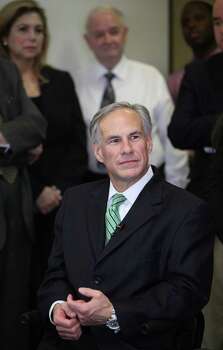
Texas Attorney General Greg Abbott
photo from Wikipedia
They also jabbed him as a “career politician,” which I didn’t think was fair. Abbott was a private practice attorney from 1984-1992. He then served as a trial judge in Houston for three years before being appointed to the Texas Supreme Court by then-Governor George W. Bush. Judges are appointed in Texas only to fill openings, and then they are elected. But it’s not typical to refer to a judge as a career politician. He became Texas Attorney General in 2002—only the second Republican since Reconstruction to have that position—when John Cornyn went on to the Senate.
Abbott is probably best known for successfully arguing the case for displaying the Ten Commandments on the State Capitol grounds. The main argument in that case, as I recall, was about the culturally historic (rather than religious) tradition of the Ten Commandments monument, showing that the display did not “establish” a religion, nor a specific religious preference. It was an argument that worked, even though I personally didn’t believe it was the right argument—which is that we the people have a right to display whatever we want, religious or otherwise, on our own state property, without any interference from the federal government—so get out of our faces and leave us alone! Nevertheless, Abbott knew the practical argument that would win the day in the particular court where he was arguing. I don’t know of another time I’ve disagreed with him.
I’ve heard him speak a number of times—first time at the state GOP convention in 2004. He’s one of my favorites. From what I’ve seen, he’s a man of exceptional integrity. I want to hear more from him as a candidate for governor, but knocking him as a “career politician” because he’s the most prominent law advocate for Texas looks to me like there’s nothing else to knock him with.
That doesn’t mean I don’t appreciate other candidates stepping up and giving it a good try, and taking the opportunity to spread the conservative message in the meantime. Let’s all keep doing that.

Friday, November 1, 2013

Texas Abortion Ruling


In Texas this week, some of the news included a federal judge ruling on the changes in abortion law voted on by the Texas Legislature in special session this summer. The ruling was mixed. [Entire ruling here.]
There was nothing related to prohibiting abortions after 20 weeks that was found problematic. This part is consistent with many other states, and is in line with recent scientific evidence of pain in the fetus after that gestational age. That part of the bill is set to go into effect September 1, 2014.
Monday’s ruling mainly focused on the requirement that abortion doctors have admitting privileges at a hospital within 30 miles of the clinic. If doctors do not seek and receive such privileges, then 13 abortion clinics in the state could be closed—and that was set to be enforced this past Tuesday, so the judge’s ruling agreed with an injunction against enforcement.
As the Houston Chronicle reported, US Federal District Judge Lee Yeakel “said the requirement for admitting privileges was unconstitutional because it poses an undue burden on women seeking an abortion and has no ‘rational relationship to improved patient care.’”
My son Political Sphere is looking at the case from a lawyerly point of view. It appears the case was ruled on using the wrong basis—strict scrutiny rather than undue burden, and probably based on burden on the wrong person. I don’t understand the terms as well as he does, but I’m going to attempt to describe the ruling and what went wrong, in lay terms that I understand.
A finding of lack of rationale does not necessarily lead to an undue burden ruling. But if there is a rationale, the law must be considered constitutional unless there is a significant and certain undue burden. In this case, the judge ignored rationale and decided that any burden was “undue.”
Texas AG Greg Abbott
defendant in the case
photo from Houston Chronicle
There was no actual citation of a case, no plaintiff, where a woman was caused an undue burden; the law had yet to go into effect. But the law itself imposed no burden directly on women; it imposed a requirement on doctors. Yet there was also no case of a doctor attempting to meet the requirements of the law and being unable; that may have happened, but there is no such plaintiff in this case. The plaintiff is Planned Parenthood and affiliates against the State of Texas (technically against Attorney General Greg Abbott), simply claiming the law could conceivably cause an undue burden on women seeking an otherwise legal procedure.
All of this was discussed during the legislative hearings, but one of the main points of the legislation is that currently there is an exemption for abortion clinics that is not available for all other ambulatory surgical centers, which do require doctors to have hospital admitting privileges. For the sake of women’s health, is there a reason for exempting only abortion clinics? The legislature could not find such a reason. On the other hand, the legislature could see a rationale for upgrading abortion clinics to bring them in line with similar medical providers.
For comparison, let’s say a surgical center that specializes in hand surgery has a problem with a patient during the procedure. Let’s say it’s something like unexpected bleeding where a transfusion is needed, or a negative reaction to anesthetic causing cardiac arrest or breathing difficulties. The doctor would rush the patient to the nearest hospital, where he would continue as the primary doctor, get the patient admitted without stopping for paperwork (because the doctor has all the information on the patient), and the doctor continues to treat the patient with the additional help of equipment and specialists available at the hospital.
Note that there is no handoff at the hospital door at which time the patient ceases to be that doctor’s patient and is now a new emergency patient at the hospital, with new doctors quickly having to familiarize themselves with the patient, assessing what has happened and what should be done. Continuity with the doctor is a plus for the patient in these rare circumstances, and that is why it is required of ambulatory surgeons.
It’s similar also to a regular OB-GYN, who sees the patient repeatedly at an office or clinic during the pregnancy and then meets the patient at the hospital they’ve agreed upon when it’s time for the delivery. Some OB-GYNs have birthing centers, where most deliveries can be done. But if there is a rare but severe emergency, the hospital where the doctor has admitting privileges is the backup plan. The doctor who knows the patient continues as the primary physician—with the additional help the hospital offers. Again, continuity with the doctor is a plus for the patient, and that is why admitting privileges are required.
It’s different for paramedics, who give limited emergency medical care and then turn the patient over to a hospital emergency team. The paramedics have a preliminary job—to care for the patient until the hospital can take over. They are likely to go to whichever hospital is most convenient. The paramedic doesn’t need admitting privileges, because the paramedic will not serve as the primary physician once the patient has been turned over to the hospital for care. Nor was the paramedic a doctor engaging in a surgical procedure the led to the emergency need for care.
In the abortion ruling, Judge Yeakel seems to have based his decision on testimony from an emergency room doctor from Houston:
Jennifer Carnell, an emergency room physician at Ben Taub Hospital in Houston, Texas, testified that she has never had an occasion to consider whether an incoming patient’s physician has admitting privileges at the hospital. Additionally, she would not have treated any patient differently if she were aware of that fact. [ruling, p. 11]
What this testimony described was a handoff—as in the case of a paramedic, rather than an admission as in the case of an ambulatory surgical emergency. The testimony is irrelevant—unless you’re questioning the legitimacy of asking any ambulatory surgeon to have admitting privileges, which was certainly beyond the scope of the case. All the other types of doctors continue caring for their patient after admittance to the hospital. Abortion doctors do not. There is no reason given for why they are not expected to continue care for their patient. Why are they the exception to the rule? Is it better for the woman’s health to have the care of their doctor cut off when they reach the hospital? The judge’s ruling says yes.
On the radio, after the ruling, the top of the hour news kept repeating the statement that the injunction against implementing the law was given because it was found that doctor admitting privileges “weren’t shown to improve health for the mother and the baby.” That’s right—the statement included the health of the baby. Let’s be clear: the purpose of the abortion was to kill the baby, but the ruling was reportedly partially based on whether the baby’s “health” would be improved by having doctor admitting privileges.
Ironically, if the abortion doctor were to continue care of mother and child in the hospital, that could lead to worse health outcomes for the child than being handed over to an emergency room—because the doctor’s purpose is to see to the death of the child.
Note, however, that the ruling itself does not include any mention about the health of the fetus, baby, or child—only mention of the mother’s health. So that was just a reporting error.
Back to strict scrutiny as opposed to undue burden. If I understand correctly, strict scrutiny is a higher standard, and it is being required of the state, rather than the plaintiff, to prove not only that there is rationale for the requirement, but also to prove that there are no cases in which a single person could be deprived of a legal right. The undue burden level would be lower; the state could simply show that there is a rational reason for the requirement, and that alternatives remain for those seeking abortion services.
When there is no case of any actual person being harmed, making the ruling the way Judge Yeakel did is probably both the wrong approach and the wrong standard.
The next step is the 5th Circuit Court of Appeals; they previously overturned Yeakel’s ruling against Texas’s requirement for a sonogram to be shown prior to an abortion. AG Greg Abbott believes, however the 5th Circuit rules, the case will be appealed to the US Supreme Court.
My opinion is that Texas did not overstep its bounds by requiring abortion clinic doctors to comply with the same rules as other ambulatory surgical centers; there is a rationale, and not all options are eliminated.
While hospitals set their own standards about who gets admitting privileges—and therefore it is possible some abortion doctors could be prevented from meeting the requirement—there is no evidence yet of a doctor trying to comply and being unable. There is only the hue and cry that the law might make getting care less convenient for some hypothetical abortion seeker.
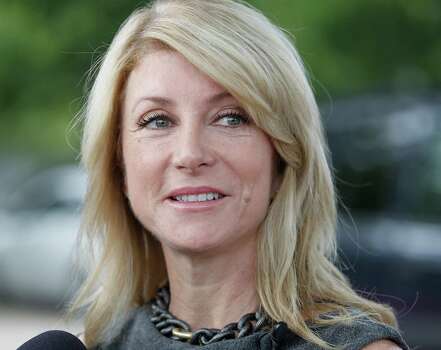
Sen. Wendy Davis, from Houston Chronicle
State Sen. Wendy Davis, who filibustered the bill in the first special session back in June, which led to its easy passage in a second special session, carefully avoided mention of “abortion” in her response. She said, “Texas families are stronger and healthier when women across the state have access to quality health care.” That is liberal-speak. Women, particularly women in families, have many many options for health care.
Women seeking abortions are rarely in families, and since families include children but abortions snuff out the life of children, Davis’s statement is pretty much a lie to cover up the ugly baby-killing facts of abortion. She also went on to say, “I would rather see our tax dollars spent on improving our kids’ schools than defending this law”—completely missing the irony that, if the law hadn’t been attacked, no money would have to be spent defending it, so she ought to connect Planned Parenthood with unnecessarily using up state funds, because the state is required to defend its laws.
Davis is running for governor—based solely on her notoriety following the abortion filibuster. She has no other experience to recommend her to the top executive job in one of the biggest states. Yet she is afraid to say the word. In an odd way, I find that comforting after a bad day in the courts.

Friday, March 16, 2012

Follow-ups

Texas Voter ID
Wednesday’s post was concerned with the Texas Voter ID law going up against the DOJ, with the suggestion that the approach should include the unconstitutionality of section 5 of the 1964 Voting Rights Act.
J. Christian Adams followed up later Wednesday with the news that Attorney General Greg Abbott had indeed used this approach, by amending the complaint to aim it directly at the unconstitutionality of the law. Good news.
list provided by Townhall.com
Delegate Count
On March 7th I commented on the actual result of Super Tuesday compared to the negative media about Mitt Romney—even though he increased his lead. I was amused to see that Rick Santorum has been complaining about Fox News being a shill for Romney, and that the media is all in the Romney camp. You can hear the clip here.
Santorum seems to believe that mentioning the delegate count (fact) while also spending a disproportionately large amount of coverage on Santorum’s wins is “shilling” for Romney. It’s not true, and the interviewer called him on it.
One thing this extended campaign has done: show us more of who the candidates really are. Here is my new assessment: Rick Santorum complains about unfair treatment even when he has been treated disproportionately positively. What is he likely to do against the Chicago machine? Plus, he’s aware that there is no way (barring Romney dropping out, which isn’t going to happen) for him to earn enough delegates to get the nomination—but he is staying in the race based on the fantasy that all those Romney voters were wrong, and their delegates will gladly flee to him during a brokered convention just 2 ½ months before the final election.
Then there is Gingrich. We have learned (if we didn’t know it), that he is vindictive and delusional. He has no path to the nomination; his only reason for remaining in the contest is to do whatever it takes to deny Romney the nomination. (Think about the dirty tricks of Huckabee last time around, but expanded to the entire national convention, instead of just a state caucus or two.) Gingrich continues to put out ads that are clearly false and damagingly negative against Romney—because in Iowa Romney PACs put out accurate but negative ads against Gingrich. Does this man have the best interests of the nation in mind? Or is he using followers and their money for his own misplaced passions?
In case you missed it (because, even though it has been covered, the most reported story has been Santorum’s “big wins,” here are the delegate increases since Super Tuesday (during which Romney won 276, Santorum won 90, Gingrich won 81, and Paul won 21):
·         Romney 80[*]
·         Santorum 70
·         Gingrich 24
·         Paul 4
Gingrich and Santorum both claim that Romney isn’t a strong front runner, because he hasn’t sealed the deal. Yet it was a similar situation four years ago. The difference then was that Romney looked at the odds, and at what was best for the country, and stepped out of the race. Then he worked to get the GOP nominee elected—and as many conservative candidates around the country as he could help. It would be better for our country if Santorum and Gingrich were more interested in making sure Obama is defeated than following their personal dreams. 

One More Thing

Santorum has portrayed himself as the social conservative. While Romney has portrayed himself as the fiscal conservative—and economic turnaround expert—it might turn out to be a pleasant surprise to those Santorum devotees once they come to learn about the real Romney. There was an opinion piece in the Deseret News (the more conservative of the two newspapers in Salt Lake City), identifying Romney as much more conservative on all fronts than his opponents and the media have portrayed him. If you want to read something positive today, read this one.


[*] This list comes from the Romney campaign and coincides with Real Clear Politics. There are discrepancies in counts from one news source to another, because each state has its own formula for allotting delegates. One difference is accounted for because Wyoming was separated into two days (primary and caucus, one before Super Tuesday, and one after—both of which Romney won), plus the assignment of unpledged RNC delegates, which went up another 9 for Romney this week.