Monday, September 22, 2014

Monuments and Memorials, Part II


I’m traveloguing last week’s trip to Washington, DC, going by way of the great people worth revering. Monday was on Thomas Jefferson. Today we honor Abraham Lincoln. I expect there will be at least two more parts to come.
We had a few minutes before our tour trolley arrived Monday morning, so we quickly walked through the Ford Theater—yes, that Ford Theater—which was just across the street from our starting place. They have memorialized the box in which President Lincoln was assassinated, and have a more general museum downstairs as well.
President Lincoln's box at the Ford Theater
 
There was a section of the museum on the various generals of the Civil War, which was interesting. And there was a fair amount on the Lincoln family in the White House. Other than what George Washington went through that winter at Valley Forge, well before his presidency, I don’t know if a US president ever went through a more stressful and precarious time than Lincoln did during his presidency. It is hard to imagine what would have happened without his resolute leadership in getting disagreeing sides to come together. Such circumstances with our current president would have meant total dissolution. God blessed us with Lincoln at that time. Praying that God has prepared such a person for our immediate future. (I wrote about Lincoln, in relation to "Ultimate Right and Wrong," September 14, 2011.)
The Lincoln Memorial is built to look something like a Greek Parthenon.
Lincoln Memorial, approaching from the left side
 
This larger-than-life statue sits looking out.
 
The way the monuments are set up, the Lincoln memorial is at one end. There is the reflecting pond straight ahead of him, toward the Washington Monument, with the White House beyond, and the Capitol building at the far end. There’s a word for such a view—the aspect. It is stunning, the symmetry and beauty of this aspect, referred to as the Washington Mall. It says civilization in every tree and stone in the arrangement.
View from the Lincoln Memorial
 
Lincoln was both brilliant and brief in words. The walls to his left and right have immortalized in stone his Gettysburg Address—which daughter Social Sphere and I memorized as part of her homeschooling—and also his Second Inaugural Address. These are words worth immortalizing, along with a man worth remembering through the ages.
The Gettysburg Address, at the Lincoln Memorial
 
Lincoln's 2nd Inaugural Address, at the Lincoln Memorial


Friday, September 19, 2014

Monuments and Memorials, Part I


I just spent the week in Washington, DC—my first trip there. We played tourist and took hundreds photos (800, to be exact). The Constitution was signed September 17th, and we saw the actual document in the National Archives on the 16th. I geeked out a little.
So, if you’ve ever wondered why some things are called monuments, and others are memorials, here’s the difference: A memorial is for someone after they have died—to remember them. A monument is to honor a person still living. So…the Washington Monument was begun to honor our first US President, George Washington, while he was still alive.
If there was a theme for this trip, it was reverence. As the children in our church sing, “Reverence is more than just quietly sitting.” In our case it involved walking, briskly, about eight miles a day. That is normal for a vacation with Mr. Spherical Model, as the kids can attest. I am stiff and sore, and will take some days to recover. But, there were so many places where it was natural to be reverent.
A sign at Arlington Cemetery says it directly: “Silence and Respect.” During the changing of the guard at the Tomb of the Unknown Soldier, the sergeant directed that it is expected we will be silent—and stand—throughout the entirety of the ceremony. There was no listing of “or else” and consequences. There was simply the statement and the expectation. For those who love liberty and civilization, that is sufficient.
There is much I want to share, and I’m not sure how to organize it all yet. For now I’m thinking of going with a main founder per post, more or less in the order we encountered them. Several things they had in common: personal character and decency, honor toward God, skill and learning, and appreciation for all things beautiful and civilized.
 
First we’ll go to the Jefferson Memorial. This great renaissance man of the 18th Century stands in the center of a circular open building (with museum on the lower floors), an imposing 19 feet tall. He looks toward the Capitol and White House, to keep an eye on things.
 
My personal quote collection already holds a share of Thomas Jefferson’s words, but they were even more striking carved in stone on marble walls. I attempted to photograph them to bring that sense of awe back for myself.
To summarize, Jefferson knew God as his guide, he knew God as the source of our rights and liberties, and he knew learning becomes wisdom under God's guidance.  I’ll share a few of the quotes in photos. These first four are from the walls of the memorial, surrounding him. You'll recognize this first one from the Declaration of Independence, which he had the skill to put into words and to pen.
in the Jefferson Memorial,
from the Declaration of Independence
 
Freedom of religion is essential.
 
Keep the Constitution sacred, and unchanged as much as possible.
 
Liberties are a gift from God.
 
Overhead, around the bottom of the dome, it reads, “I have sworn upon the altar of God eternal hostility against every form of tyranny over the mind of man.” It took four photos to capture it, so I’ll spare you.
Inside the museum, this is above the door; he knew, even then, what we clearly see today.


And this is a replica (with some actual artifacts) from his study.
 
God knew when we needed Thomas Jefferson, and prepared him for that particular time. I pray God is preparing another Thomas Jefferson-quality person for our day.

In Part II we'll consider Lincoln, among other notable memorials.

Monday, September 15, 2014

The I Stands for ...


The president has spent the last two 9/11s giving speeches tepidly jumping into the Middle East chaos. In 2013, he suggested we maybe support Syrian rebels against Assad. He didn’t really build the case for it (and, as we see now, going his way would have just put ISIS in power sooner, with our blessing). This year he announced that we would be solving the ISIS problem (he called it ISIL—which we will discuss henceforth). He said it would be a broad coalition—of yet-to-be-contacted world leaders and their countries. We would not, he emphasized, send boots on the ground, except for 475, which would be added to the 450 put there the last couple of months—who would be doing unidentified non-soldierly things, maybe training, maybe handing out food and water? Not sure.
In short, this year’s speech was as inconsequential as last year’s. Not sure what we were supposed to notice, but I noticed another one of those things where the president says things differently. And maybe he has a reason. Not sure.
ISIS stands for Islamic State in Iraq and Syria, which is the terrorist organization that has gained ground in mainly Iraq and Syria, well-funded, growing, and savage. ISIS is the term adopted by most news outlets to refer to this self-described “state.” *
Beyond other non-content of the speech, one of the oddest things the president said was, "ISIL is not Islamic." Um. Yes. Yes, it is.

He uses the acronym--one of them--that starts with "I is for Islamic." But he defines it as something else. Here's the statement in context from the transcript: "Now let's make two things clear: ISIL is not Islamic. No religion condones the killing of innocents, and the vast majority of ISIL's victims have been Muslim. And ISIL is certainly not a state."

He is wrong about the definition of religion. Historically many have killed, beheaded, sacrificed and enslaved innocents. Those aren't civilized organizations, but they are organizations that use religious beliefs to justify their savagery. You don't stop them by defining their beliefs as not religious. They won't turn 180 degrees and say, "You mean we weren't doing these atrocities because of our beliefs about our god? Our bad. Oops. Sorry." More likely they either ignore the blather or set out to prove their beliefs in bigger and uglier ways.

And I might agree they aren't a recognized state, but they are declaring themselves one, and the president is using an acronym acknowledging their declaration.

The use of ISIL instead of ISIS avoids reference to Syria. The L refers to Levant, a way of saying "and the surrounding general area." He may be refusing to say the problem has spread significantly into Syria, but the word he uses actually gives greater area to the terrorist enemy, rather than less. With this president, we never know whether he knows what he'says saying and means it or is just awkwardly incoherent. But he is consistent.

I would like to give an attempt to possibly understand the "not religious" assertion.

I belong to a religion with many detractors, and some splinter groups. Several years ago a group calling themselves FLDS (fundamentalist latter-day saints) showed up in rural Texas. This group did not ever associate with The Church of Jesus Christ of Latter-day Saints. It's members had not previously been members of my church. They hijacked the name just a few decades ago and have beliefs nothing like mine. It made sense to make it clear these were not fundamentalist Mormons or any other word for Mormon. I knew it. I preferred that others knew it. Media was not particularly helpful.

Here's the comparison. It may be that these ISIS terrorists are simply hijacking the name of Islam, thus maligning the millions of peaceful Muslims who want it known they don't believe the same things at all. I hope it is a situation like that, and that real Muslims will be successful in declaring the differences.


Glenn Foden editorial cartoon

This past Saturday, Mr. Spherical Model had breakfast with a client visiting from Iraq. He assured that the people of Iraq want ISIS gone. They did see that the previous regime was too corrupt, into cronyism. The president needed replacing. But with someone who would ensure freedom and prosperity, not another tyranny. One oddity was having to fly over ISIS held territory to get to a consulate that would grant his visa for this trip, because the one in Bagdad was closed down from the danger.

Rick McKee political cartoon 9-11-2014

A Mormon friend posted the above cartoon on Facebook and added, “Hey, we do have a lot in common. When someone mocks our sacred scriptures, such as by creating a satirical Broadway play, we too decide that we must riot in the streets, burn flags, and kill all of the infidels. Oh, wait...”

What actually happened? The Church bought up advertising space in the program that said, “You’ve seen the play. Now read the book.” Genius. You might even say God inspired that reaction.

---------------------------------------------
* Good explanation here: http://www.mediaite.com/tv/chuck-todd-knows-why-obama-prefers-isil-to-isis/

Thursday, September 11, 2014

We Still Remember


It’s always good to wake up on a 9/11 anniversary and find the world continues. That is a blessing. Two years ago it was a blessing we didn’t get; that was the Benghazi attack, along with the administration’s lying about it not being perpetrated by Muslim extremists, for reasons still not clear.
There is plenty of unrest today, in the Middle East and elsewhere. But, so far today, no attack on America has hit the news.
So I’ll take the day to share some images of remembrance.
My favorite continues to be “Out of the Ashes,” painted by Ken Turner.


"Out of the Ashes" by Ken Turner

And next to that is the photo of responders posting a flag among the rubble.
photo by 2001 The Record/Getty Images

Today I’m adding a few favorites I found posted on Facebook. My apologies if I can’t find original sources; my intent is simply to pass along the honor intended by those who posted.

from my friend Janet's Instagram, posted on Facebook

posted by Gov. Rick Perry on Facebook

posted by Sen. Ted Cruz on Facebook

posted by Bryan Preston of PJ Media on Facebook
with the comment "still angry"

logo for the day for Not on This Watch Facebook page

another image from Not on This Watch on Facebook
 
from my friend LaDonna's Facebook
I love the simplicity of this one

One young friend posted this less familiar verse of our national anthem, which is worth repeating:  
Oh! thus be it ever, when freemen shall stand
 Between their loved homes and the war's desolation!
 Blest with victory and peace, may the heaven-rescued land
 Praise the Power that hath made and preserved us a nation.
 Then conquer we must, when our cause it is just,
 And this be our motto: "In God is our trust."
 And the star-spangled banner in triumph shall wave
 O'er the land of the free and the home of the brave!


I flew the flag today. This is not a holiday, but it has become a holy day—because we make it so. It is a day we remember who we are as Americans, as civilized people, standing up against tyranny and savagery. Giving up, giving in—is not an option. We will not rest from fighting that war until the Savior returns to reign personally upon the earth.

Monday, September 8, 2014

Agency

There’s a word you might not be in the habit of using, at least in this particular way—that will help in understanding direction, either up toward civilization or down toward savagery.

Agency, sometimes combined with the word free, as in free agency, is our word for the day. You’ve probably encountered it when sports professionals leave a team and become free agents, open to a contract with another team. That might be the limit of how you've used it. Unless you’re Mormon. We talk about the word a lot, to mean “the ability and privilege God gives us to choose and ‘to act for [ourselves] and not to be acted upon.’”[i]
There’s a story—the oldest story—behind the concept of agency, from before the world was made. It’s the story John Milton refers to in Paradise Lost. It’s in the Bible, in Jude; Revelation 12; Job 38; Isaiah 14; as well as some additional Mormon scripture: Doctrine and Covenants 29 and 76; Pearl of Great Price books of Moses and Abraham.
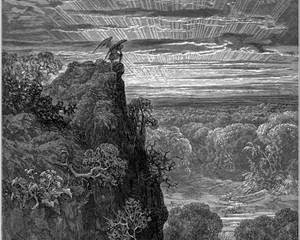
Satan, banished from Heaven, to the earth
Paradise Lost illustration by Gustave Dore
That is to say, I am not coming up with this out of whole cloth. With that prelude, here’s my retelling.
Long ago, before the world was, God the Father met in heaven with his spirit children to present His plan. He would create a world for His children, where they could receive a body, learn to choose right from wrong, and progress as His children. The plan included choosing to go to the earth, which would be separated from God’s presence, where the children would be tested and tried. And because they would make errors, and be no longer perfectly clean, they would need a way back, so there would be a Savior provided, who would live a perfect life and then suffer for the sins of the world, overcoming death and opening the way for all who repented to return to heaven, to their Father.
Father asked who would be willing to become our Savior. There were two responses.
One was from the spirit brother we called Lucifer, who said, “Send me. I will make sure no children are lost. I will take from them their agency—their free will—so they will make no mistakes and can all return unchanged. But I insist that, for my success, I be given all the glory.”
Another said, “Send me. I will follow Thy plan, and the glory be Thine.” This was the spirit brother we call Jesus Christ. The Father chose the Son who would follow His plan. It was essential to His plan that His children be given their agency, so that they would learn to choose good over evil. That is the only way they could become more than they were in the beginning. God would force no one back to Heaven.
Lucifer was angry that Father did not forego His original plan and go with Lucifer’s pointless, no-growth plan. And Lucifer rebelled against the Father. It may be that, because he was unwilling to suffer for the sins of others, he assumed no one would do such a thing—so the only workable way was to take away free will, to coerce. Or it may be simply that he was looking for a way to gain glory without sacrifice—the first con, trying to get something for nothing.[ii]
He used his persuasion to gain many followers—one third of the hosts of heaven. These chose never to be born to the earth, and to rebel against God. For this they were cast out of heaven. They are the cause of evil we face on this earth—trying to make us miserable like unto themselves. Their leader, Lucifer, is called Satan here. He continues to try to take away our agency—convincing us we have no control over our passions, no control over any good coming in our lives, no control over addictive substances and behaviors.
He is subtle and cunning. But he can only gain our free agency if we give it up to him.

So, how does this relate to the Spherical Model? Coercion is a southern hemisphere quality. You can’t use coercion to get to the northern hemisphere. Coercion is used by people who either aren’t aware there is a northern hemisphere, and think the only options are between chaotic tyranny and statist tyranny; or who crave to be the controllers and therefore want to stay in the southern hemisphere of tyranny, widespread poverty (except for the elite controllers), and savagery.
For the northern hemisphere, where you find prosperity and civilization, people have to choose to rule themselves. Never in history has a nonreligious or anti-religious people succeeded in self-rule. Individuals, a critical mass of them, have to choose to govern themselves. Government that is granted only limited powers—to protect the God-given rights of the self-governing people—is useful. But, as with fire, requires careful control.
Freedom is required in order to choose goodness. Chosen goodness is required for prosperity to spread and grow. Chosen goodness is required for civilization to develop and spread.
Where there is coercion, there is savagery. No religion or government that coerces adherence can be God’s way; that is Satan’s way. Existence of coercion is a way to tell whether a way of thinking fits in the southern or northern hemisphere.
The most powerful disciplinary tool of a religion should be excommunication, so that the religion can determine its consistent doctrines. But a religion shouldn’t have the right to inflict physical punishment or imprisonment, and certainly not death.
So, the Inquisition, as far as we can tell from history, which used torture to coerce adherence, was savage. Enslaving the nonbelievers in ancient Egypt was savage. Burning nonbelievers to death, like Shadrach, Meshach, and Abednego in ancient Babylon, is proof of wrongness.[iii] Throwing Daniel in the lion’s den for his difference in belief is an example of savagery. The Extermination Order allowing for the murder of Mormons in Missouri in the mid-1800s was savage.
Beheading nonbelievers in Iraq is proof that ISIS is savage. It’s ironic that the people trying to coerce the world into thinking as they do call us the Great Satan, while using Satan’s plan to accomplish their savage ends. This is not simply a difference of belief that we should respect; this is an attack upon our agency—a continuation of the War in Heaven, between Lucifer’s plan to gain power and control over us for his personal glory, and Heavenly Father’s plan for our happiness through allowing us to choose good.
Choosing Satan’s way always leads to the misery of coercion, poverty, savagery—and ultimate death. Choosing Father’s way always leads to the happiness of freedom, prosperity, civilization—and ultimate eternal life.
I choose happiness and life.


[i] This definition comes from Robert D. Hales, “Agency: Essential to the Plan of Life,” speech at LDS General Conference, October 2010. He is quoting from the Book of Mormon, 2 Nephi 2:26.
[ii] I first heard the “something for nothing” version of this story from David A. Bednar in a conference in Houston in 2010. A similar talk was given by Robert D. Hales in the worldwide General Conference of October of that year (linked in footnote i). I found that the concept of agency is something of a theme for Elder Hales; he has been speaking on that subject for decades.
[iii] The account of the three brothers thrown in the fiery furnace, and saved by angelic help, is found in Daniel 3. Besides various historical evidences of this practice, such as the Salem witch trials, or Joan of Arc, additional incidents of mass execution for difference of belief are recorded in the Book of Mormon: Alma 14; 3 Nephi 1.

Thursday, September 4, 2014

Barbaric or Savage


In the Spherical Model, I use the word savage as the negative, southern hemisphere quality of the social sphere. There are a number of examples in the news these days: i.e., the beheadings of journalists, the execution of non-Muslims who refuse to convert.
Sometimes the news stories and commentary use the word barbaric, and sometimes savage. So I’m spending a day quibbling over word choice while horrendous things are happening—in hopes that greater understanding will help move the world in the right direction.
The words savage and barbaric are essentially synonyms. In my thesaurus, the first synonym for savage is barbarous. And under barbarous/barbaric, savage is listed in the mix. There may be differences, but they’re somewhat subtle. Still, I chose one over the other.
The word barbaric is a word that historically meant, in the ancient world, someone from some culture other than Greek, Roman, or Christian. It could mean less civilized, less technologically advanced, less developed—because much of the world beyond the empires was often backward, or primitive, in those ways. But not always; sometimes it just referred to something foreign or strange, not the way of the culture doing the naming.
Sometimes (often today) the word barbaric is used to refer to behavior: crude, uncouth, boorish, unmannerly, wild, unrestrained—but also brutal or cruel.
The word savage can also refer to a culture that is primitive: lacking in technology and education, possibly lacking in writing. In some circles there’s the idea of the “noble savage,” someone from a primitive culture who is nevertheless more “civilized,” more wise about nature and living a good life, than the supposedly civilized person. But this is pretty much a myth. There may be people within primitive societies who live in a civilized way; they are, then, by definition, civilized, not savage. The mythologized ones are more likely to be looked at through a lens focused on a specific thing, with much else left purposely out of focus.
This is part of an agenda to equate all cultures as equally valid. It’s a lie. You can have a lot of differences between cultures that may be equally valid—food, music, dance, language. But you still only get civilization when you have a religious people, who recognize that their rights come from God, who live a code of behavior essentially equivalent to the Ten Commandments—valuing God, family, life, honesty, and doing good to others.
I chose the word savage, in the Spherical Model, because the behavior description is more accurate. Also, there’s no confusion with the Barbary Coast, an area known for piracy—definitely a barbaric, or savage, behavior—where the word is not actually related to barbarian, but to Berbers, the north African peoples.
So, while barbaric is also the antipathy of civilization, the important contrast is between the bad behavior and our goal: civilization.
I’ve been reading a novel in which the comparison between civilization and barbarians keeps coming up. I’m not sure whether to recommend this book/series—The Kingkiller Chronicles, by Patrick Rothfuss. I read the first one for book club last month, The Name of the Wind. It was an interesting read, a slightly magical world something like our Middle Ages Europe, but not really that. It’s a quest story, with a young man coming of age. But in the near 700 pages of book one, he makes almost no progress on the stated quest. I am now almost 800 pages into the second book, The Wise Man’s Fear, and other than a sentence or two, there’s still been no progress toward the stated quest. [I don’t think book 3 is written yet, so who knows if the quest will be completed, or whether how Kvothe got where he is will be explained.] Nevertheless, some interesting stuff happens.
I had been warned about book two, because there are some rather ridiculous prurient parts with a fairy—going on for at least a hundred pages. Not too explicit, fortunately, but still evidence that the author doesn’t really understand civilization.
But I am tuned in to pick up little conversations about civilization. And this second book has some of that. At one point the main character, Kvothe, is sent on a quest by the Maer (minor king) to get rid of thieves who have been making the roads dangerous, interfering with trade, and confiscating tax money that has to be replaced. One of the mercenaries sent with him is from a different culture, the Adem. The descriptions of the look of the people is what we’d consider northern European—all seem to have sandy colored hair and gray eyes. But their culture seems to be a pretty good replication of some Asian cultures.

Tempi is mostly silent, but dangerous in a fight. Like a ninja. He has trouble with the language, foreign to him. But eventually Kvothe begins to communicate better with him, and learn from him. Chapter 82 (starting on page 545) is called “Barbarians,” referring to those outside of Tempi’s native culture. The differences include how they speak. Tempi’s people, use fewer words and more subtle hand signals And they try to follow some inexplicable guidance from within called Lethani. They also have many layers of meaning, like you might find in Korean, and tonality, like you might find in Mandarin. So it’s not a direct correlation with something specific in the nonfictional world.
Kvothe is telling the story here:
  I nodded slowly, trying to imagine what it must be like for Tempi, constantly assaulted by people too rude to keep their expressions to themselves. People whose hands constantly made gestures that were nonsense. “It must be very hard for you, out here.”
  “Not so hard.” Understatement. “When I leave Ademre, I know this. Not civilization. Barbarians are rude.”
  “Barbarians?’
  He made a wide gesture, encompassing our clearing, the forest, all of Vintas. “Everyone here like dogs.” He made a grotesquely exaggerated expression of rage showing all his teeth, snarling and rolling his eyes madly. “That is all you know.” He shrugged nonchalant acceptance, as if to say he didn’t hold it against us.
  “What of children?” I asked. “Children smile before they talk. Is that wrong?”
  Tempi shook his head. “All children barbarians. All smile with face. All children rude. But they go old. Watch. Learn.” He paused thoughtfully. Choosing his words. “Barbarians have no woman to teach them civilization. Barbarians cannot learn.” 

That detail, of women needed to teach civilization, caught my attention. 
Later in the book, Kvothe travels with Tempi to his home town of Haert, and begins to learn from the people there. Their school teaches “Lethani,” which is unknowable, maybe like chi, and fighting skills—very much like Asian martial arts, including patterns of practice called Ketan, which sound a lot like katas, or my Tai Chi routine (but performed perfectly, at the slow pace of honey spilled on a table, which I have not accomplished).
Women do the teaching, and are considered the better fighters. Kvothe is surprised by that:
  Vashet [his teacher] nodded, pleased [at what he had noticed in a spar between two young boys]. “They fight like puppies. They are young, and boys. They are full of anger and impatience. Women have less trouble with these things. It’s part of what makes us better fighters.”
            I was more than slightly surprised to hear her say that. “Women are better fighters?” I asked carefully, not wanting to contradict her.
            “Generally speaking,” she said matter-of-factly. “There are exceptions, of course, but as a whole women are better.”
            “But men are stronger,” I said. “Taller. They have better reach.”
            She turned to look at me, slightly amused. “Are you stronger and taller than me then?”
            I smiled. “Obviously not. But as a whole, you have to admit, men are bigger and stronger.”
            Vashet shrugged. “And that would matter if fighting were the same as splitting wood or hauling hay. That is like saying a sword is better the longer and heavier it is. Foolishness. Perhaps for thugs this is true. But after taking the red [refers to the uniform color, becoming a traveling guardian, called mercenary for lack of a better translation], the key is knowing when to fight. Men are full of anger, so they have trouble with this. Women less so” [p. 763].

It’s an interesting view. In our culture, I think it is assumed emotion is female, and logic is male—even though that is stereotypical and right only about 50% of the time for either sex. It’s probably right only about as often in their fictional world as well.
Unless you assume, not emotions, but specific emotions. Females are less likely to fly to anger, to enjoy harming physically in retaliation for offense; females are more likely to care for and nurture others. Females are less likely to seek to conquer, and more likely to seek reconciliation and collaboration. Some emotions are more civilized than others. And, in general, women tend toward those emotions more than men do.
Maybe that is why God designed the family to have women in the position to civilize the next generation. Men are needed too—to teach hard work, honesty, honor, courage, and being gentle even when you have the strength to be coercive. Those are important in civilization too. But men are more likely to exhibit those characteristics if they were raised by a good woman and have committed in marriage to a good woman.
Children benefit from the civilizing nurturing of mothers as well as the example of a civilized father. Both. In the family, the microcosm of civilization. Parents, “Raise up a child in the way he should go: and when he is old, he will not depart from it” (Proverbs 22:6).
There is so much ugly savagery in today’s world. There is news that we can’t even bear to view—because you can’t unview such things. But in the sacred family home, there can be civilization. And from there it can spread.

Monday, September 1, 2014

Bench Slap Needed


The Texas abortion law HB2 is in the news again, and again the Houston Chronicle has a difficult time not coloring the story with their pro-abortion position. Here’s how the Saturday, August 29, front page story begins:
For the second time in 10 months, a federal judge has struck down a key piece of Texas’ tough new abortion law just before its implementation was expected to force clinics across the state to close.
The facts are basically there, sort of. But, if you’re not up on this story, you might think that various judges are consistently finding this “tough new abortion law” too onerous to be legal.  What’s really happening is that one judge, Federal District Judge Lee Yeakel, keeps ignoring the criteria for judging and keeps ruling according to an outcome he wants. He stayed the law’s implementation last fall, and the stay was lifted in three days; then his ruling was reversed entirely in April.
Earlier in August opponents went before the same judge again, saying they shouldn’t have to comply.  I wrote about the admitting privileges part of the law August 7, and son Political Sphere followed up about what’s going on in Mississippi and Alabama with similar laws. [“Admitting Bias, part I, part II”]
Judge Yeakel’s first  ruling claimed the law didn’t pass the “undue burden” requirement, based on the number of clinics that did not have doctors with admitting privileges. At issue before the hearing this past month were again the admitting privileges and also the required upgrades to be as other surgical centers—which were set to take effect September 1st. He used the upgrade argument to claim undue burden this time.
For both reasons, a number of clinics have chosen to close rather than meet the law. Judge Yeakel is equating the choice of the clinics not to meet the law with undue burden placed on women seeking abortions. But that is not the standard he should be using. The state is not required to adopt laws to make sure clinics choose to do business in the state; the state is merely required to make its regulations meet standards set by the Supreme Court (as if SCOTUS had authority to set such laws in the first place, but I digress).
As the judge was instructed last spring, the law only causes an undue burden if the requirements have no reasonable purpose (health and safety are a reasonable purpose here, particularly in the wake of the Gosnell case and cases similar that have shown up in Texas), and that the law prevents reasonably regulated clinics from operating. The state is not required to “sponsor” such businesses, nor adapt laws to ease the financial costs to entice such businesses.
Nothing has changed. Judge Yeakel is imposing his viewpoint again, rather than judging according to the law. The clinics involved may have shown that fewer clinics are operating, but they have not shown that the law prevented them.
Additionally in Friday’s ruling, Judge Yeakel exempted the El Paso and McAllen areas from the law’s requirements, because no doctors got admitting privileges, and no clinics would remain open. That would mean women seeking abortions in that part of the state would have a longer drive—if they chose to stay in Texas. But they were within 15 miles of a clinic in New Mexico. The out-of-state clinic would not necessarily conform to health and safety rules required in Texas, but the judge just said Texas clinics in those areas would fail compliance as well, and that’s OK—because it’s more important to have abortion clinics in Texas than to have safe and reliable medical facilities. Somehow that shows how caring he is about El Paso women.
The distance rule set by SCOTUS is 150 miles. If the law is fully implemented, with any existing clinics refusing to meet the new standards and therefore closing, it still so happens that 86% of Texas women live within 150 miles of such a clinic. And there is nothing the state is doing to prevent additional clinics from meeting the higher standards to locate near the other 14%. The clinics that are closing are refusing to put their financial resources into health and safety upgrades; they prefer to close rather than to raise the cost of doing their grisly business.
What I expect will happen (and what the state expects to happen) is that the 5th Circuit will rule quickly, reversing AGAIN Judge Yeakel’s imposition of his personal opinion, rather than following the law. If this happens, it is what in casual legal circles would be called a “bench slap.” The judge is being put in his place for failing to apply the law and instead imposing his opinion of what he wants to be the outcome.
Bench slapping happens to the 9th Circuit (particularly any three-judge panel operating in California) pretty regularly, when its decisions are vacated by the Supreme Court. And it is becoming something of a habit for the pro-abortion-under-any-circumstances Judge Yeakel. Let’s hope the 5th Circuit takes care of him again promptly.