Showing posts with label Studio C. Show all posts

Thursday, June 6, 2019

Pride Isn't Worth Celebrating


When I was young, my Church leaders defined pride in the scriptural way. As President Ezra Taft Benson said in 1989, “In the scriptures there is no such thing as righteous pride—it is always considered a sin. Therefore, no matter how the world uses the term, we must understand how God uses the term so we can understand the language of holy writ and profit thereby.”[i] This talk led us to try to change our language. It became awkward for some time to say we were proud of our children when what we really meant was, as scriptures would say, “my son, in whom I am well pleased.”

Latter-day Saints are not the only ones who have the idea pride is a bad thing. In Catholic philosophy, pride ranks up there alongside greed, lust, envy, gluttony, wrath, and sloth, which make up the “seven deadly sins,” which together are opposite the “seven heavenly virtues”: prudence, justice, temperance, and courage (the four cardinal virtues) plus faith, hope and charity (the three theological virtues).[ii]
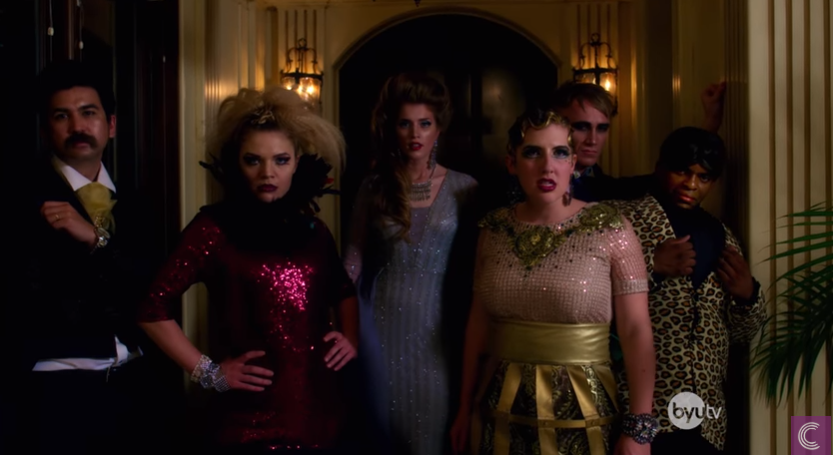
Studio C skit "7 Deadly Sins," a safely clean presentation of the sins,
(plus adorable sloth), screenshot from here

Yet it still seems like a good thing to tell your child, “I’m proud of you for getting good grades” or “for sticking up for your little brother,” or for some similar good reason.

My dictionary offers both the scriptural term—always negative—and the worldly term, which can be somewhat positive, depending.

1.     a. an overhigh opinion of oneself; exaggerated self-esteem; conceit
b. haughty behavior resulting from this; arrogance
That first definition is pretty negative. That’s what "cometh before the fall.” It leads to nowhere good.

But there are these additional definitions that are pretty common outside of scripture:

2.       proper respect for oneself; sense of one’s own dignity or worth; self-respect
3.       delight or satisfaction in one’s own or another’s achievements, in associations, etc.
4.       a person or thing in which pride is taken
5.       the best of a class, group, society, etc.
I’ve been trying to figure out how it’s used in the celebration called “gay pride,” for which June is supposed to be the month.

In April the valedictorian’s speech at my alma mater, Brigham Young University, got some notoriety, because Matt Easton came out publicly as gay during that speech. In his announcement, he said, “I stand before my family, friends, and graduating class today to say that I am proud to be a gay son of God.”

I don’t know the young man. But the assumption is that he has been abiding by the honor code, which requires, among other moral requirements, no sexual relations outside of marriage. He hasn’t been living a typical gay lifestyle; he has been living a typical Latter-day Saint lifestyle. As long as he continues to obey God’s commandments concerning chastity, he is as welcome and integrated in the Church as any other member.

I’m glad he was able to achieve the significant honor of valedictorian at a school where that really means something. He must be very bright and very hard working—along with being very civilized in his behavior.

I hope he can continue to live a good life. But I am concerned for him.

Shortly afterward he did an interview on Ellen. I like Ellen DeGeneres. She’s funny and personable, and only rarely brings up her sexual orientation. But it was somewhat pertinent in her interview with Easton.

Matt Easton with Ellen DeGeneres
screenshot from here
The interview appeared to give the impression that, now that he’s graduated, he’s free of the somewhat draconian behavior controls of the Church-owned school’s honor code and its fear-inducing threat of expulsion over any perception of misbehavior.

There has been some criticism of the department that deals with honor code issues at the university lately, leading to some adjustments. Those seem to me more related to procedures than with the actual honor code itself. Expulsion is occasionally necessary, but mainly for flagrant violations with little intention of repentance. Temporary suspension, possibly leading to a semester being repeated, would be more likely for serious lapses. Every Latter-day Saint student is assigned to a congregation, with a bishop who has an honest desire to help any young person with spiritual struggles—of which an honor code violation of any kind would be a signal.

In the Ellen interview, Easton seemed to be expressing his fear that, if he had so much as hugged a team member after a win in sports, he could have been reported to the office and expelled. That is so far away from the intent of the honor code that I can only assume his was a self-imposed fear. Two heterosexual young men who hug under that same condition would feel no fear—because the behavior and intent are both innocent, even positive.

Easton says that, now that he has graduated, he intends to participate more fully in the LGBT community up north in Salt Lake City. He does not say that he intends to break his covenants to God. And I hope, for his sake, that he can maintain his faith and his behavior as he has done thus far. But I think Ellen’s audience will think otherwise—that he will “be authentic” by pursuing same-sex relationships, since that’s “who he is.”

How does this relate to pride? He said he was a “proud gay son of God.” He might mean that he’s proud—i.e., has a sense of his own dignity and worth—to know he is a son of God, even though he happens to have same-sex attraction. But I think the more common understanding is that he’s proud of his gay-ness while also being a son of God.

When we’re talking about the positive reasons to be proud—because of accomplishments, achievements, or things to take delight or satisfaction in—I’m not seeing gay-ness as such a reason. 

Is it an accomplishment? If it is an inborn trait, as so many claim, then no. That would be like being proud of being born in a particular year—a matter of chance, not personal accomplishment. If it is not inborn, then what is accomplished by choosing it, or failing to overcome the tendency? Sterility? Having only 2-3% of the population to share attraction with?

While the world might be better because of the contributions of people who happen to have same-sex attraction—and there are significant such contributions in the arts and most spheres of accomplishment—I fail to see how homosexuality itself is part of those contributions. Wouldn’t it make more sense to say, “I’m proud of this accomplishment despite the challenges I face because of my homosexuality?” Or to leave out the sexuality part entirely?

Remember, if pride isn’t tied to accomplishment of something good, it’s that negative definition: an overhigh opinion of oneself; exaggerated self-esteem; conceit.

Pride month seems to require the rest of society to “signal” their “virtue” by also being proud of people with LGBTQ issues. But for what?

I suggest that the subject is intended to resist deeper thought. Instead, there’s supposed to be a gut-level response, a society-wide understanding that there’s this entire demographic of people who have been oppressed, and forced to hide “who they are.” And so, in a stand of solidarity with them, we’re supposed to tell them to shout their proclivities from the rooftops and cheer them on as they do so.

But why? So we can feel better about ourselves for no longer having that prejudice against them? When we never did? When we have believed in fairness, kindness, and respect for all people all along? But now we’re required to not only want those basic human rights for them, but to support special rights for them. And if we don’t, we’re subjected to being made pariahs, and having our basic freedoms taken away. We’re supposed to signal that capitulation by waving rainbow flags and honoring them as though they’ve accomplished something akin to—an accomplishment.

I was first introduced to a gay pride parade several decades ago, when I was working not far from San Francisco. A co-worker had been downtown during one of these events and shared some snapshots. I can’t un-see those images. Naked butts, and other near nudity, wrapping around light poles and simply being publicly lewd. There wasn’t anything remotely wholesome or civilized about it. There’s good reason for civilized people not to want their families exposed to anything like that.

Is my finding their lewdness repulsive supposed to make me “homophobic”? I don’t think so. I would think the same thing of lewdness by heterosexuals.

And if that’s how they’re showing “pride” in themselves, can we just be clear that it’s not the righteous kind of pride; it’s the deadly sin kind.

What is the pride for? What are they saying? I’m trying to understand. But I think they’re saying, “I’m presenting myself as good for having urges that I give into, and I’ve suffered horribly because of your disapproval—so now you have to support my in-your-face lewdness as I flaunt my aberrant lifestyle—or else.”

I’m not willing to go along.

an actual rainbow worth celebrating
Mostly I’ll just avoid any such pride events (my preference anyway). But I’m sad at some losses. One is the rainbow symbol. Back in the early 80s, the rainbow was one of those things that started showing up everywhere—on notebooks, T-shirts, pencils. I had a plastic rainbow keychain. Rainbows are colorful and pretty. I’m sad at the loss of them any time I’m not specifically referring to a natural phenomenon following rain, or to the story of Noah and the ark.


I’m also sad at the takeover of the word “gay.” It used to simply mean happy, and it was a useful rhyming word. Now we’ve had to rewrite the lyrics to a number of old songs to avoid accidentally referring to sodomy while singing with our children.

I’m not proud of homosexuals for giving in to same-sex attraction. Why should I be? I benefit not at all from their doing so; neither does civilization.

I’m proud of (pleased with) any human being who lives a good and righteous life, and makes whatever contributions they can to our world. I’d like to see more actual virtue and a whole lot less virtue signaling.


[i] Ezra Taft Benson, “Beware of Pride,” General Conference April 1989. President Benson’s address asked Gordon B. Hinckley to read the address for him, for reasons of health incident to age. 
[ii] Info from Wikipedia

Monday, September 18, 2017

Revering the Constitution

Constitution Day—the anniversary of the signing of the US Constitution—was September 17, yesterday. But I’m going to continue celebrating for a few days.
The US Constitution
from the National Archives


The Constitution is the basic law of the land. It is NOT what grants us rights; it is the tool we use to protect our rights, which God gave us. If we could identify that difference, it would make a huge difference in how people approach public policy.

The Constitution is a legal document, not a philosophical statement—after the preamble. So it’s not poetic or exciting. But it is profound. If you don’t admire it, you either don’t understand the Constitution’s meaning, or you don’t understand the principles that lead to freedom, prosperity, and civilization.

So let’s take this day to honor and better understand the Constitution.

Here’s the basic outline: Preamble, Articles, and Amendments.

The Preamble, which lays out the proper role of national government, is short, and beautiful, so here’s the whole thing:

We the People of the United States, in Order to form a more perfect Union, establish Justice, insure domestic Tranquility, provide for the common defence, promote the general Welfare, and secure the Blessings of Liberty to ourselves and our Posterity, do ordain and establish this Constitution for the United States of America.
The body of the Constitution is made up of seven articles, most of which are divided into several sections. Here’s a brief summary.

Article 1 lays out the powers of the legislative branch. There are 9 sections, vesting all legislative powers for our federal (national) government in Congress, which is divided into a Senate and House of Representatives, outlining who can serve in the House and Senate, and such things as elections, revenue bills, and other legal details.

Article 2 lays out the executive powers vested in the President. It has four sections, talking about how the president will be elected (the Electoral College), the president’s powers concerning the military, making treaties, and representing our country on the international stage; informing Congress of the State of the Union, and impeachment (removal from office) of the president or vice-president.

Article 3 lays out the judicial powers in the Supreme Court and inferior courts. There are three sections, detailing their powers and the kinds of cases they will cover.

Article 4 covers interstate rules, and guarantees for citizens going state to state. There are four sections, including information about how new states may be admitted, and how the federal government guarantees protection to each of the states.

Article 5 offers ways to amend the Constitution: amendments can be proposed by either two-thirds of both Houses, or two-thirds of the state legislatures can propose an amendment. This option has been talked of more in the past few years, and about a dozen states so far have voted to go ahead (including my state of Texas).

Article 6 talks about paying debts incurred by the national government, and that the federal government shall be the supreme law of the land.

Article 7 talks about ratification of the Constitution, and signatures from representative of the states at the Constitutional Convention, where the document was written and revised.

Then come the Amendments. There are 27. But the Constitution wasn’t ratified until the first ten were included. These are what we call the Bill of Rights. They weren’t originally included, because they were understood by all as a given. But there were those—Virginia led in this—who were afraid if at least some of these rights weren’t spelled out, later generations might try to abridge them (violate them, pretend they didn’t exist).

They were prescient. Not only did that forgetting happen, but even with these rights spelled out, people argue whether or not the government should grant those rights—forgetting that government doesn’t grant them; it only protects them. Think about current riots, from people claiming no one should be allowed to speak things they find offensive, or that they do not approve of. Or claims that religious freedom should be subjugated to popular beliefs about sexuality.

And there has been a great deal of government overreach—taking on authority that is not granted in the Constitution.

We need to return to our Constitution. That is the path back to freedom, prosperity, and civilization. We need all good people to learn the truths our founders knew, and then stand up as our founders did.
We’ll need to start with learning.

I came across a video (see it here) over the weekend, meant for students—probably aimed at upper elementary through middle school. But it’s worth a watch with the kids. The hosts, which include a 10-year-old girl, touring the capitol, and interviewing two senators from the judicial sub-committee on the Constitution: Ted Cruz and and Richard Blumenthal.

If you want something aimed at a little higher education level, try testing your knowledge with Hillsdale College’s quiz on the US Constitution: (here). 

And maybe that will lead you to take their Constitution 101 course, which I’ve recommended before. High school students shouldn’t be scared off by the college label; it’s what everyone graduating from high school should know and understand. In fact, every voter ought to know what’s in this course.

Hillsdale College also has an annual Constitution Day celebration going on, with live streaming on various topics, starting tonight and going through tomorrow. [Schedule here.] I’m especially interested in the “Roundtable on The Political Theory of the American Founding: Natural Rights, Public Policy, and the Moral Conditions of Freedom,” at 9:00 AM EDT Tuesday.
available here


If you’re not ready to dive into a college level course, but could handle something about the length of a movie, I recommend A More Perfect Union, produced by Brigham Young University. It’s a beautifully done dramatization of that hot summer of 1786, and the extraordinary men who came together to create our Constitution.


After you’ve done a bit of study, you might want to reward yourself with a bit of humor. Here is Studio C’s frat house version of the founders.


Thursday, October 20, 2016

Good Clean Fun

Sometimes life is about looking at the really good things, and tuning out some of the not so good or really bad.

I’ve learned that in eating. (Someday maybe I’ll do a food blog.) My limitations, because of food sensitivities, are extreme. Way beyond paleo. Social eating is troublesome; it usually consists of me doing some preventive eating beforehand (so I won’t starve), and then me standing around while others eat in front of me. Sometimes I get to eat a dry carrot stick or plain strawberry.

And yet, I find my food delicious, colorful, and usually satisfying. And I’ve been doing this long enough that my illness situation is what you’d call under control. I do a lot, mostly in private, to maintain my health. But because I do it, I am more free, and in many ways more healthy, than many people my age (upper 50s). I’m not overweight. My blood pressure hangs out around 110/70. And I’m mostly pain free. I was playing volleyball until three years ago (not especially well, but as a contributing player on the team). And I can get a lot done in the hours I’m awake and active.

There are additional restrictions in my life. We’re Mormon. We don’t drink alcohol, do drugs, smoke tobacco, or even drink coffee and tea. We don’t go to R-rated movies (provisos here; the movie rating system doesn’t determine our obedience, but that’s a guideline that describes our limitations relatively well). We don’t hang out at bars. We do a lot of family friendly stuff—even when the kids are not around.

The question used to come up a lot, with our teens and their friends, about this dichotomy between being good and having fun. And it was our goal to show them that being good is fun—more fun than being bad.

That’s the point of today’s post. Civilization isn’t a matter of restricting ourselves from a lot of normal behavior that we disapprove of. It is a matter of choosing—and making/keeping normal—a lot of behavior that fills our lives in better ways—giving us more happiness, more joy, even more fun.
A couple of examples showed up recently, in entertainment.

One is a new sitcom called Kevin Can Wait. It’s the story of Kevin Gable (played by Kevin James), who has just retired after 20 years on the police force—along with three of his buddies who also just retired. His attempts at enjoying retirement present comic situations—as do his interactions with his family.

I’m a long-time Kevin James fan. He’s funny, human, and generally clean, in an entertainment world that is typically otherwise. This show impressed me the first week. There’s something the college-age daughter wants to tell her father, and the mom advises her to wait until after church on Sunday, because then she’s got a few hours while her dad is trying really hard to be a better person.

It’s a casual mention—as though going to church on Sunday is a totally normal part of life. It is, for a majority of Americans, but these normal churchgoers are rarely portrayed in Hollywood entertainment, and even more rarely as normal people. So that was a plus.

The college-age daughter, Kendra, announces that she is engaged, and dropping out of school to support her future husband. The parents intervene and find a better solution. She can move back home, work part-time, and attend the local college. And the fiancé, Chale (a British-accented sensitive type very unlike Kevin), is invited to live in the garage and pursue his goals as well. It’s a sacrifice for Kevin, who was going to use that garage apartment as a rental to supplement their income, and he ends up having to do some security work.

I wasn’t sure at first whether the engaged couple was moving into the garage, or just the fiancé. But in a later episode, Kendra is complaining about sharing a room with her younger sister, and suggests that, because they’re engaged, it would make sense for her to move into the garage. Her dad says no. They’re engaged, not married. His house; his rules. And no one even thinks to argue further.

This is normal. More normal, more typical, than what is portrayed in most of our entertainment.

And the typical things that happen in the show are funny. In the second episode, Kevin has a shoulder pain that causes him to have to sleep on a different side, so that he’s facing his wife. She’s sleeping with her eyes partly open and only the white showing. She’s a very attractive wife (so maybe one detail not quite as realistic as the rest of us), but she looks pretty frightening that way. It was a funny moment in a show of one funny moment after another. It’s on Monday nights on CBS.

Another of my favorite shows is Studio C, which just started its seventh season. This is a comedy sketch show, similar to Saturday Night Live, with an ensemble cast. But absolutely clean. It’s available on BYUTV, if you get that in your TV lineup, or online at BYUTV.org. And their sketches are also available individually on their YouTube channel.

They started as an on-campus improv group. (Daughter Social Sphere knew one of them, when they were resident assistants the same year.) Then Matt Meese approached BYU Studios and pitched the idea of a sketch comedy show. And it turned out they could make a living doing this thing they did for fun.

Several of their sketches have gone viral online. One was soccer goalie Scott Sterling, whose face is what hits the ball—again and again. (That’s Matt Meese playing Scott Sterling.)


Another of their viral series was the three-part Hunger Games videos:

·         Peeta’s Song
·         Gale’s Song
·         Katniss’s Song

Can we all just admit, the Hunger Games world was very much in need of some comic relief?
In the comedy world, a couple of other options are BrianRegan, and Jim Gaffigan.

The question most often asked of comedians who do clean stuff is why? What makes them determined to do it that way? And they have to explain what ought to be obvious—there’s an awful lot of humor out there, in our normal lives, our family lives, among us human beings, that doesn’t require profanity, sexual innuendo (or explicitness), or anything degrading.

We can live in a civilized world and enjoy it. Who knew? Not only is it possible, it’s more probable to live happy, fun, joy-filled lives in the Civilization Zone than in the Savagery Zone.


And we don’t want to keep it a secret. As they say as a theme on BYUTV, let’s “share the good in the world.”

Monday, October 28, 2013

Beanie Baby Economics


I have long maintained that Economics is the fun science (for example, 8-29-2011, 8-30-2011, 11-4-2011, 3-21-2012, 3-21-2013).  And I thought we needed a little fun on a Monday. We'll be reviewing how Beanie Babies fit in to the economic picture.
This was part of the lecture for last Monday’s Hillsdale College Economics 101 online course. The title for lecture 5 is “The Role of Profit.” [These courses are free, but you may need to sign up for a course to get access.]
Before we get to the economics of Beanie Babies, we need to cover a few preliminary concepts.
·         Profit is revenue minus costs.
·         Economic profit includes opportunity costs when subtracting costs from profit.
Our teacher, Gary Wolfram, describes economic profits this way:

We want to include all the opportunity costs of all the resources that are being used up. Now, generally the opportunity cost of a resource is its price, but for some things it might not be included. So, for example, suppose you’re running a t-shirt shop in Hillsdale, and at the end of the year your accountant says, wow, you made $20,000. You might think that you earned economic profits of $20,000, but an economist would say, “Wait a minute. You might’ve earned $30,000 being the manager of the local Burger King.” So you have to include your opportunity cost of $30,000 when looking at total cost. So, to an economist your economic profit would actually be negative because, although you earned $20,000 in your revenue minus your cost in your t-shirt business, you could have made $30,000 being the manager at the Burger King.
So we often hear that firms make zero economic profit in a competitive market, at least whenever we take a Principles of Economics class, and you might say, well, gee, why is it that the firms are still making things if they’re making no profit? It’s because when we say they’re making zero economic profit, it means that they’re making exactly what those resources could have made in their next best alternative. You couldn’t have been doing better somewhere else. And so, economic profit just includes in the total cost all the cost including the opportunity cost of the people that are running the firm and all the labor and other inputs that are being used up.
Professor Wolfram explains that economic profit affects attraction to the market. When economic profits are positive, more firms are willing to enter that industry in hopes of making good use of their resources. He uses the e-reader market as an example.  First there was an innovator. Then others see high prices and growing demand, so they enter the industry. Soon you have Kindle, iPad, Nook, and others, providing choice as well as lower prices for consumers.
What’ll eventually happen is the price will fall and more will be produced. So, economic profit attracts new firms into that industry. Shifting the supply curve to the right, driving prices down, increasing the quantity, and we generally observe that. If we observe a firm that’s making economic profit because it introduced a new product, the price is generally high, not too many are sold, other firms enter, compete against them, driving that supply curve out, driving down prices, increasing quantity.
The opposite can also happen. Once demand is low enough that economic profits become negative, firms leave the industry. This is where the Beanie Babies example comes in, when there’s a loss of consumer demand at any price. Here’s the slightly technical part that makes sense with the chalkboard chart:
Gary Wolfram teaching Hillsdale's Econ 101 class, lecture 5
If firms are making economic losses, they’ll exit the industry. As they exit the industry, because an economic loss says they’re making less with those resources than they could be making somewhere else. As those firms exit, we get a shift in the supply curve now to the left: price will rise to P2, and quantity will fall to Q2.
He makes several other good points in this half hour lecture. Here are some samples (some are paraphrased rather than exact quotes):
·        Now, there are a number of things to observe about economic profit. First is that economic profit is a celebration. Firms must be doing what? They must be producing something of greater value than what the opportunity costs of those resources were.

·        So, the net of this is that we don’t have a minister of culture, or we don’t have a production czar that says, “Producers, you need to do something because consumers’ demand has changed, increasing or decreasing.” The price system and the attraction of profits moves the resources from those industries where consumer demand is declining to those industries where consumer demand is increasing. That’s why markets are so dynamic. That’s why it instantly responds to changes in what your preferences might be.

·        Economic profit is a celebration. Firms must be producing something of greater value than what the opportunity costs of those resources were. Rather than thinking of profit as a sign of exploitation, we should think of profit as a celebration, as saying that this firm made more with those resources than any other way of using those resources.

·        Monopoly is only a problem when it’s something you are forced to buy (very few things—electricity, phone, for example) and there’s a barrier to entry into the industry. Usually a barrier to entry is caused by government regulation, or government choosing how many (often one) entities may be in the market. “Normally when we look at a barrier to entry, it’s because government created that barrier to entry.”

·        Innovation is someone is thinking about what we are going to want three years from now—when we don’t even know yet that we’re going to want that—but when the time comes and we want it, the product will be there. Not good enough to do unto others what you want others to do unto you. You have to do unto others what they have no idea yet they will want done for them.

·        Innovation requires risk; profit is incentive to take the risk.

So, what happened with Beanie Babies? Demand at any price decreased, such that it was no longer a profitable industry, and the product stopped being made. In some cases, such as vinyl records, demand increases to a point that the product gets made. But in some cases, demand never resurfaces (8-track tape players, for example), and we don’t get the product anymore.
This is an ongoing problem for me, because I tend to like specific products and lack enough fellow consumers to keep companies making them. Mr. Spherical Model requests that I stop insisting that this is the entire consumer industry pinpointing what I like so they can purposely stop production of those things just to spite me.
But I do not feel that way about Beanie Babies. We had a few, back in the day. Mostly the tiny ones given away with kids’ meals, plus a few received as gifts. I didn’t understand how a toy could be valuable only if you left the tag on it and didn’t play with it. Eventually the rest of the world caught on.
Now that you understand the economic profit concepts behind Beanie Baby, you’re ready to more fully enjoy this “real life” Beanie Baby scene. Studio C started as a college campus improv group that developed into a TV comedy sketch show—in its third season on BYUtv (available on various television services) and also online, a sketch at a time. Enjoy.