Showing posts with label Gordon B. Hinckley. Show all posts

Monday, March 19, 2018

The Virtue Signaling Religion


Back around the beginning of this century, Gordon B. Hinckley, our beloved prophet at the time, wrote a book titled Standing for Something: 10 Neglected Virtues That Will Heal Our Hearts and Homes. The “Standing for Something” part refers to a saying: “If you don’t stand for something, you’ll fall for anything.”
I own the book, but I
got the image here


The book is about our need to return from the secularization of our culture. In the introduction he says,

People who carry in their hearts a strong conviction concerning the living reality of the Almighty and their accountability to Him for what they do with their lives are far less likely to become enmeshed in problems that inevitably weaken society. The loss of this conviction, the almost total secularizing of our public attitudes, has been largely responsible for the terrible social illnesses now running rampant among us (p. xix).
I think there’s a connection between this loss of God and a movement toward a whole long list of alternative “virtues” that don’t qualify as ultimately good, because ultimate good is defined by God. In short, when people stop relying on God, they fall for all kinds of substitutes.

People like to be able to think well of themselves. A traditional way of measuring your own goodness has been through religion. And that has been effective. Religious people tend to think about things bigger than themselves, related to pleasing God and effecting good for the rest of the human family. This leads to stronger intact families, celebrating life and protecting the lives of others, honesty, respect of property ownership, service, sharing, helping, kindness, and other things we typically think of as virtuous.

People who fail to believe in God still want to think well of themselves, but they don’t have the same source of guidance. They may still adhere to many of the behaviors in the above list. Or their secular religion might come up with another whole list of “virtues.”

They might shun some of the traditional virtues—particularly sexual purity. And then, in an effort to let those around them know that they have reason to think well of themselves, they do outward behaviors to signal their perceived virtue. They virtue signal. To themselves as much as to others.

And along with virtue-signaling, they might also shame anyone who doesn’t join them in their “religious” behavior. 

That’s where we have problems. It’s hard to find common ground when one person is shaming another—either direction. Sometimes these very people shove their beliefs down the throats of everyone around them while shouting, “Stop shoving your beliefs down our throats.” And they do this completely without self-awareness.

People might not be aware these days of some ancient history patterns. We think we’ve grown beyond the pagan, or the superstitious. But some of the virtues being signaled today are the same, with some wording differences and technological updates, as ancient pagan practices.
We can categorize some of these anti-religion’s tenets.


Worship of Environment and Animals above Human Life

I wrote this last year, after the US stepped away from the Paris Accords:

Climatism (not climate-related science, but the thing you’re not allowed to question) looks to me like a pagan religion. The sacrifices being required of us in the essentially vain hope that such sacrifices will appease the climate gods look eerily similar to throwing people into the volcano. It might make people feel like they have some control over something out of their power, but it doesn’t actually affect an eruption—and it’s really bad for the ones who get thrown into the volcano.
Are there reasons to be concerned about clean atmosphere and water? Of course. We’re better off with clean air and water. But the more advanced technologically a country gets—much of that from fossil fuels—the better air and water quality. In fact, we have made so much progress that way that there was a sudden shift from worrying about carbon monoxide to worrying about the very natural and positive carbon dioxide.

Should we be concerned because of climate models? Maybe, but they’ve been so consistently wrong so far that changing our entire lifestyle seems extreme.

And saving water is a good idea, especially if you’re in a drought area, because getting enough potable water for a large population is a challenge. But, the world is not running out of water. I saw a documentary in the IMAX theater of a museum once that showed a very dry part of the US, and talked about the worry of running out of water. I was puzzled, because they didn’t say “here”; they said it as though the world is losing water.

But, if you were taught the water cycle in grade school, then you know that water from the atmosphere comes down as rain, and makes its way into groundwater or into streams and rivers that eventually flow into the ocean. When something wet dries, that water goes into the atmosphere. And sun shining on lakes and oceans causes water to evaporate into the atmosphere. That’s how it gets there to come down as rain or snow. And the cycle goes on.

Water molecules are made up of two hydrogen atoms and an oxygen atom. Those are elements. They don’t disappear. Even if you disconnect the hydrogen and oxygen, you don’t lose them; they stay here as part of our earth, and they can be reconnected. (“Sciencing” was used in the novel The Martian, about an astronaut trapped on Mars, explaining how to “make” water.)

Example of virtue signaling found here


Should we be concerned because of climate models? Maybe, but they’ve been so consistently wrong so far that changing our entire lifestyle seems extreme.

Another aspect of ancient pagan religions is to honor animals above humans. No other species would sacrifice its entire species out of guilt that its existence fails to always positively impact some other species. Species are designed to perpetuate themselves. It isn’t virtuous to feel guilty for being human; it’s unnatural and ungrateful.

So, if you’ve been virtue signaling in one of the following ways, you might want to ask yourself how you know what you do is virtuous. And then, if you can’t explain it so clearly, logically, and unemotionally to a nonbeliever that you convert with persuasion, maybe you’d better stop the shaming as well:

·         Feeling panicked about global warming.
·         Driving a Prius or other electric status vehicle.
·         Pushing for alternative energy sources—except not nuclear.
·         Eating vegetarian or vegan, not just for your health, but because you believe your species has no right to eat other species.
   

Sexual Depravity and Human Sacrifice

Related to valuing other species above humans also shows up as human sacrifice in pagan, savage societies. Certainly we ought to be beyond that. And yet that is a pretty good description of abortion.
Some ancient societies do away with the old and infirm. That is what euthanasia is.

Savage societies typically fail to honor monogamy. This leads to a lot of social failures we’ve known about for a long time, as described by Vico and Unwin. (I’ve written a fuller discussion here.)

A side issue related to failing on monogamy is the spread of what have always been considered deviant behaviors: homosexuality and gender confusion. Finding better ways to treat people with these issues has to be a more humane approach. But tolerating and embracing deviancy isn’t enlightened; it’s very old and very pagan.

So, if you’ve been approving of the following things in an attempt to virtue signal, you might also want to ask yourself how you know what you do is virtuous. And again, if you can’t explain your reasoning so clearly, logically, and unemotionally to a nonbeliever that you convert with persuasion, maybe you’d better stop the shaming as well:

·         Alternative sexual lifestyles
·         Promiscuity
·         Homosexuality
·         Same-sex “marriage”
·         Transgenderism
·         Sexual freedom (promiscuity) for minors
·         Abortion
o   Favoring government funding and approval
o   Refusing any limits to abortion
·         Divorce for any reason
·         Benefits to couples whether married or not
·         Pro-masculinity for women
·         Anti-masculinity for men

Ruler as God

Another tactic of ancient potentates—kings, emperors, pharaohs, etc.—was to replace the people’s religion, setting themselves up as god incarnate, or perhaps an idol that they create as the object of the ruler's new religion. Then the people had to be loyal to him or be prosecuted (and usually executed) for heresy. The people were instructed to bow down to their god/ruler, pay him whatever assessment he charged, and then he, their god/ruler, would look on them favorably.

I don’t know if the ancient king who set up a fiery furnace for Shadrach, Meshach, and Abednego offered amenities that some “subjects” expect of their government today. Life was brutal, so maybe just less imposed brutality was enough to buy their subjects’ worship. But today, in exchange for “worship” of the government/ruler, people speak as though government is doing the divvying out of good things so that the “subjects” can be absolved from needing to give.

So it becomes something virtue-signalers do when they “take care of the poor and less fortunate” by having government confiscate wealth from some to give to others. And they feel charitable doing this—even though it was coerced, and therefore not charitable giving by them or anyone else.

And anyone who even mentions that government interference actually makes things worse (look at welfare recipients since the War on Poverty began in the 1960s) is shamed as cold and hateful—even if that person is personally giving a tithe and more in actual charity and the virtue-signaling shamer has given nothing.

As we say here at the Spherical Model pretty often, 

If the government wants to implement something beyond the proper role of government, not only will government fail to achieve the stated goals; it will likely do exactly opposite of the stated goal.
So, if you’ve been approving of the following things in an attempt to virtue signal—you’re getting the idea—ask yourself how you know what you do is virtuous. And once again, if you can’t explain your reasoning so clearly, logically, and unemotionally to a nonbeliever that you convert with persuasion, maybe you’d better stop the shaming as well:

·         Socialism

·         Anti-capitalism
·         More government regulation
·         Infringing on First Amendment rights: religion, speech, assembly,
·         Gun control
·         Welfare unrelated to work or ways to get off welfare
·         Ignore or reimagine the Constitution
·         Public school monopoly of education
·         Socialized medicine


The list could go on. The point is that our disagreements go deep—as deep as religious beliefs. If we are ever to have peace, we need to learn to respect people with different beliefs, stop assigning them epithets—racist, homophobic, transphobic, hateful, bigoted, science denier, etc.—simply for not following a new, unpersuasive list of virtues.

And if we want more civilization and less savagery, we need a religious people who recognize virtue in honoring God, life, family, truth,and property.


Monday, September 28, 2015

The Family Proclamation Turns Twenty

It was the last full weekend of September of 1995. For women in my church, that meant there was a worldwide broadcast, coming out of the Tabernacle in Salt Lake City, which we could watch by satellite at our various church buildings around the world. So I had an evening out with friends, leaving the kids at home with our husbands. A similar evening took place this last Saturday as well.

The Family: A Proclamation to the World 
On September 23, 1995, President Gordon B. Hinckley had been the 15th President and Prophet of The Church of Jesus Christ of Latter-day Saints for only a little more than half a year. We had heard from several women leaders, all uplifting and encouraging. And then the final speaker was President Hinckley. He also spoke in that context of love and encouragement, and inspiration, building us up. And then he dedicated a large portion of his talk to reading to us this proclamation, called, “The Family: A Proclamation to theWorld.”

A proclamation is not exactly a common thing. There were three in the 1800s. There were two in the 1900s. “The Family” is the second. Because it is such an unusual thing, we church members were surprised that it seemed so simple, and a repetition of what had been basic doctrine all our lives. But now, two decades later, we can see that it was declaring God’s word ahead of each concept being subject to disbelief and even attack.

I’ve written about it before. The first was recounting an experience Constitutional law professor and leader in defending the family, and my friend, Richard Wilkins had with it at the first international conference on family that he attended:

He told me that he spoke about the Proclamation on the Family, issued shortly before that by The Church of Jesus Christ of Latter-day Saints, to which he was a devout member (as I am). At the time it came out, the issues in the Proclamation were such standard doctrine to us that he said he wondered at the reasoning. Since that time, he says he sees it as prophetic; every line in it is challenged in the world today. But in 1996 he happened to take a brochure of the Proclamation with him and had it in his pocket. When he shared those ideas, the opponents to the family (the previous speakers) hissed their disapproval, but the room at large gave him a standing ovation. They came up to him afterward to thank him for speaking what so many of them believed, and they formed long-standing alliances to work toward protecting the natural family from the international onslaught.
At last year’s Humanum Summit at the Vatican, one of the speakers, a Muslim, quoted two paragraphs from our Family Proclamation, as reported by Elder L. Tom Perry, one of two apostles who attended.

It is not a proclamation to all the Mormons in the world; it is a proclamation to all people in the world. It is our belief that it is the word of God through his prophets on the earth today—and that it what it is even to those who do not believe in God, or that these men speak His words.

To those of us who know what it is, we might have a framed copy in our homes (I do). We might carry a copy with us (I do). We might have parts or all of it memorized (I’m working on that). Sometimes we refer to it as The Family Proclamation. For anyone, it is worth reading and considering.

It is and always will be true that civilization is built upon strong families. So when so much of the world fails to understand this basic truth, The Family Proclamation is what God is telling us. You’ll want to read the whole thing, but I’m summarizing here, in bullet points, to bring out the specific points:

·         Marriage is between a man and a woman, and is central to God’s eternal plan for His children.
·         All human beings—male and female—are created in God’s image, and gender is part of who we are from before life on earth and into eternity.
·         Family relationships can be perpetuated beyond the grave; families are intended to be united eternally.
·         The first commandment, to Adam and Eve, to multiply and replenish the earth remains in force; procreative powers are only to be employed between lawfully wedded husband and wife (no sex outside of marriage).
·         The means by which mortal life is created (sexual intercourse) is divinely appointed, and we affirm the sanctity of life.
·         Husband and wife have a solemn responsibility to love and care for each other and for their children, to raise them in love and righteousness.
·         The family is ordained of God; children are entitled to birth within the bonds of matrimony, and to be reared by a father and mother who honor marital vows with complete fidelity.
·         Happiness in family life is most likely to come from living the teachings of Jesus Christ, by maintaining principles of faith, prayer, repentance, forgiveness, respect, love, compassion, work, and wholesome recreational activities.
·         By divine design, fathers preside in love and are responsible to provide the necessities of life and protection for the families, while mothers are responsible for the nurture of their children; fathers and mothers help one another as equal partners.
·         Warning: those who violate covenants of chastity, abuse spouse or offspring, or fail to fulfill family responsibilities will stand accountable before God.
·         Warning: disintegration of the family will bring upon individuals, communities, and nations the calamities foretold by ancient and modern prophets.
·         Responsible citizens and officers of government everywhere should promote measures designed to maintain and strengthen the family as the fundamental unit of society.

Back in 1995 everyone (almost everyone) knew that marriage was defined as between a man and a woman. Certainly everyone sensible knew that male and female was basic to who a person was, and was not open to a whim or mental choice. People still knew that children were entitled to two parents—a mother and a father—who should be married. “For the sake of the children” was something people thought about and knew what was best, rather than fuzzily thinking maybe government ought to accommodate any adult desire, regardless of the child’s needs.

We can witness, already, wherever the family breaks down, or where marriage is denigrated to something akin to “whatever people engaged in a sexual relationship want it to be for the time being,” children do not get what they are entitled to, and their lives tend to be troubled. Such children grow up to populate our prisons and welfare rolls. Failure is not a certainty, but the odds against children raised without the stability of two married parents is a heavy handicap to overcome.

How do we get thriving civilization? Start with a religious, self-governing people. Base the structure on strong families. These are things we know. And yet, in a very short time, knowing it is less common, and is being labeled as evil and bigotry.

But there is no other way to civilization. And without civilization, we have the misery of savagery, which we are seeing, in all its horror, in news around the world and around our own country.

“The Family: A Proclamation to the World” is even more remarkable today, because we can see how true it is, by contrast with the counterfeits being pushed on us by the uncivilized. Those of us with clear vision can see that following this proclamation would repair our world.

You can watch President Hinckley read the Proclamation here.
   
His daughter, Virginia Pearce, wrote a blog post of her memories of that evening, worth reading, here


Monday, November 3, 2014

That Decision Mothers Make

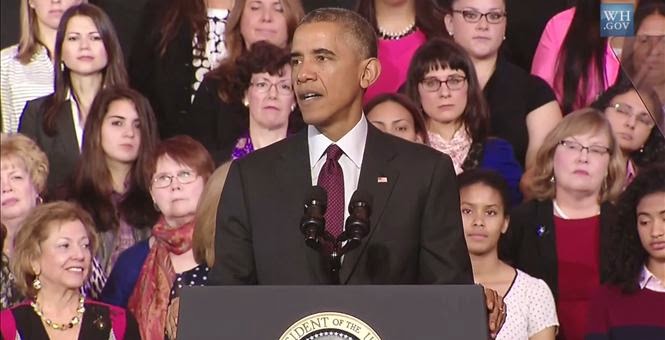
Our president said something better not said—no surprise. But sometimes these misspeaks (accidentally) reveal what he truly believes, so they’re worth looking at. Here’s what he said last week at Rhode Island College on women and the economy: 

Obama speech on women and the economy
at Rhode Island College


Sometimes, someone, usually Mom, leaves the workplace to stay home with the kids, which then leaves her earning a lower wage for the rest of her life as a result. That’s not a choice we want Americans to make. [full speech here]
We could get rid of some of the indignation here if we assume he misspoke and meant to say, “That’s not a choice we want Americans to have to make.” In other words, if you take some years off to care for children, you face the reality of a lower wage, and he thinks that’s unfair.

That does in fact seem to be what he means, because he goes on to offer the solution of governmental institutional daycare—to solve the problem of women having to leave the workforce at all, which leads to what looks like uneven pay.

But he is, in fact, saying it’s a bad decision to choose to stay home and raise your kids. It’s bad because it could cost you the wage level rise you would presumably get if you didn’t take time off to raise those bothersome children. He doesn’t want you to make that wrong choice. That’s revealing.

We might be better off if we had a president who offered this in a speech instead:

The homemaker has the ultimate career. All other careers exist for one purpose only—and that is to support the ultimate career.—C. S. Lewis
Or there’s this, from the last paragraph of historians Will and Ariel Durant’s The Lessons of History about perpetuating civilization:

If a man is fortunate he will, before he dies, gather up as much as he can of his civilized heritage and transmit it to his children. And to his final breath he will be grateful for this inexhaustible legacy, knowing that it is our nourishing mother and our lasting life.
And let’s add this bit of wisdom:

Women who make a house a home make a far greater contribution to society than those who command large armies or stand at the head of impressive corporations.—Gordon B. Hinckley
The president seems to misunderstand what life is about. Certainly he misunderstands what civilization is and how to get there and then stay there.

The purpose of life is not to achieve some arbitrarily defined world equity by earning money for yourself that is equal to whatever anyone else can earn. It is not even to earn a valuable life by doing paid work. A mother, who dedicated her career years to raising children who have grown into successful contributing members of society and gone onto provide her with grandchildren to love—can you imagine this woman, in the wisdom of age, on her deathbed saying, “If only I’d spent more time at the office! If only I hadn’t wasted my career years on children—the government could have handled them, and then I would have made an equivalent amount to the men in my career!”

Life is bigger than that. We want to live a life we can enjoy with those we love and want to be with, through the good times and trials. There isn’t a better way to live than in a marriage and family, raising children in love. Family is the basic unit of civilization—in which people thrive, and in which social capital is built and passed on. It is possible to live a life otherwise, but civilization only happens when a critical mass live in functional families.

There is an interrelated economic component. We need income for housing, food, shelter, and all the other things needed for raising and educating our children. But the most economically sound way for that to happen is in a family with a mother and a father. No government program works as well. It isn’t a matter of tweaking policy, or getting the right leaders. It is a matter of allowing families to do the work of caring, providing, and civilizing—work that families are brilliantly designed by God to do.

If you care about civilization, you will consider the value of a parent, probably the mother, doing the long-term daily work of caring for them. Anyone who has done it knows it’s a lot more than feeding, clothing, and managing the children in a way that keeps them from wandering into the street or other dangers. It’s about loving them, responding to them as valuable human beings with their own personalities, gifts, and potentials. No daycare—no matter how well run—can offer a child what an abundance of time with a loving mother offers.

Not all women get to offer that. Some can’t make it financially without working. Some feel called to do a specific life’s work in addition, and choose to balance the mothering and other career. I do not want to demean any woman who makes a choice to work when she has children. But it is absolutely unconscionable to shame women for choosing to mother at home. It is especially wrongheaded to demean her choice by turning it into a math equation about earnings she’s expected by the state to work for.

It’s also wrong to blame natural economic laws that reward continuous years of work in a particular career more than fewer disconnected years in that career. And it’s more than wrong to claim government can or should override this economic natural consequence by taxing people more to institutionalize our children at younger and younger ages.

Did the president make yet another speaking gaffe? Yes. But we can make good progress even with a president who lacks speaking skills. Moses lacked speaking skills and still managed to free the Israelites from enslavement. Speaking skills are helpful (see Reagan for many examples). But what is better is good thinking—and believing the right and true things.

What we need is not a president who manipulates power to control women’s choices. We need a president, along with the rest of government, who appreciates the value of mothers and fathers working together to raise their own children—and gets out of their way.


Stop holding us down with variations of tyranny, poverty, and savagery. And let us move up to freedom, prosperity, and civilization.