Showing posts with label Will and Ariel Durant. Show all posts

Monday, August 22, 2016

Religious Ties to Civilization

One of the concepts of the Spherical Model related to the Social Sphere is that a critical mass of religious people is a requirement for Civilization.

So what do we mean by religious people? There’s a Spherical Model definition. But we’ll add to that today.

There was a talk this past week by Jeffrey R. Holland of the Quorum of the Twelve Apostles of The Church of Jesus Christ of Latter-day Saints. He gave his remarks at Education Week, a conference for learning all kinds of things, which happens annually, between semesters at Brigham Young University. I’ve been traveling near there this week, but for different purposes. Several people had mentioned this talk on Facebook, so I took time to listen to a recording Sunday evening.
Elder Jeffrey R. Holland
giving Education Week address

The title is “Bound by Loving Ties.” He talks about the etymology of the word religion. It has to do with binding—related to the Latin word religare, meaning “to tie,” as in the word ligature. And the re- prefix means again. So religion is about re-binding, or reconnecting ourselves to God our Creator. As Elder Holland says,

So, for our purpose today, “religion” is that which unites what was separated or holds together that which might be torn apart, an obvious need for us, individually and collectively, given trials and tribulations we all experience here in mortality.
He then goes on to introduce the importance of religion today:

What is equally obvious is that the great conflict between good and evil, right and wrong, the moral and the immoral—conflict which the world’s great faiths and devoted religious believers have historically tried to address—is being intensified in our time and is affecting an ever-wider segment of our culture.
Near the end he says,

[T]he core landscape of history has been sketched by the pen and brush and words of those who invoke a divine creator’s involvement in our lives and who count on the ligatures of religion to bind up our wounds and help us hold things together.
The talk is given to a mostly Mormon audience, but is broader than that. It is broader than just to Christians or currently religious people. It is about having a moral sensibility, and his references are mainly from classic literature and music, which may be why it speaks to me. (I often get the sense that Elder Holland is speaking to me.) It’s for all people who understand and value Civilization.

I’m going to share the whole video below. But he began and ended the meat of the talk with quotes from historians Will and Ariel Durrant. The first quote is from their book The Lessons of History, which is one of my project books. I’ve quoted from it occasionally, searching through it for particular sections. But I’ve been reading it through completely for a year or so, as a Kindle book I can read on my phone while waiting in doctors’ offices or various other waiting places. I tend to highlight something on every page.

So, first I’ll share those two quotes, which relate to religion’s effect on civilization. And then I recommend taking the time to listen to the whole talk. (Or you can read it here.)

“There is no significant example in history of [any] society successfully maintaining moral life without the aid of religion.”[i]

“These church steeples, everywhere pointing upward, ignoring despair and lifting hope, these lofty city spires, or simple chapels in the hills—they rise at every step from the earth toward the sky; in every village of every nation they challenge doubt and invite weary hearts to consolation. Is it all a vain delusion? Is there nothing beyond life but death, and nothing beyond death but decay? We cannot know,” they say, “but as long as man suffers, these steeples will remain.”[ii]

The talk begins following a 2 ½-minute introduction, and the total video is 41 minutes.

<iframe width="560" height="315" src="https://www.youtube.com/embed/j6NiqxfLDbs" frameborder="0" allowfullscreen></iframe>


[i] Will and Ariel Durant, The Lessons of History (1996), p. 51.
[ii] Will Durant, The Pleasures of Philosophy: A Survey of Human Life and Destiny (1953), p. 407.

Monday, November 3, 2014

That Decision Mothers Make

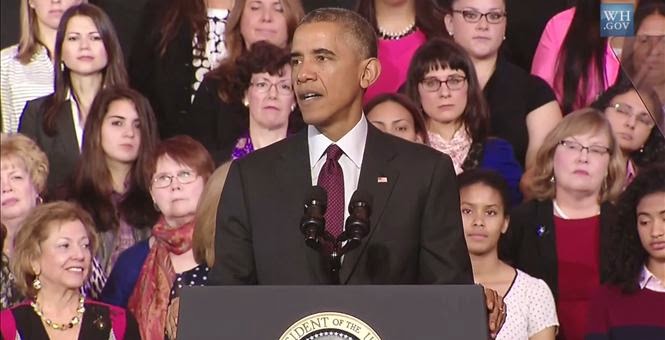
Our president said something better not said—no surprise. But sometimes these misspeaks (accidentally) reveal what he truly believes, so they’re worth looking at. Here’s what he said last week at Rhode Island College on women and the economy: 

Obama speech on women and the economy
at Rhode Island College


Sometimes, someone, usually Mom, leaves the workplace to stay home with the kids, which then leaves her earning a lower wage for the rest of her life as a result. That’s not a choice we want Americans to make. [full speech here]
We could get rid of some of the indignation here if we assume he misspoke and meant to say, “That’s not a choice we want Americans to have to make.” In other words, if you take some years off to care for children, you face the reality of a lower wage, and he thinks that’s unfair.

That does in fact seem to be what he means, because he goes on to offer the solution of governmental institutional daycare—to solve the problem of women having to leave the workforce at all, which leads to what looks like uneven pay.

But he is, in fact, saying it’s a bad decision to choose to stay home and raise your kids. It’s bad because it could cost you the wage level rise you would presumably get if you didn’t take time off to raise those bothersome children. He doesn’t want you to make that wrong choice. That’s revealing.

We might be better off if we had a president who offered this in a speech instead:

The homemaker has the ultimate career. All other careers exist for one purpose only—and that is to support the ultimate career.—C. S. Lewis
Or there’s this, from the last paragraph of historians Will and Ariel Durant’s The Lessons of History about perpetuating civilization:

If a man is fortunate he will, before he dies, gather up as much as he can of his civilized heritage and transmit it to his children. And to his final breath he will be grateful for this inexhaustible legacy, knowing that it is our nourishing mother and our lasting life.
And let’s add this bit of wisdom:

Women who make a house a home make a far greater contribution to society than those who command large armies or stand at the head of impressive corporations.—Gordon B. Hinckley
The president seems to misunderstand what life is about. Certainly he misunderstands what civilization is and how to get there and then stay there.

The purpose of life is not to achieve some arbitrarily defined world equity by earning money for yourself that is equal to whatever anyone else can earn. It is not even to earn a valuable life by doing paid work. A mother, who dedicated her career years to raising children who have grown into successful contributing members of society and gone onto provide her with grandchildren to love—can you imagine this woman, in the wisdom of age, on her deathbed saying, “If only I’d spent more time at the office! If only I hadn’t wasted my career years on children—the government could have handled them, and then I would have made an equivalent amount to the men in my career!”

Life is bigger than that. We want to live a life we can enjoy with those we love and want to be with, through the good times and trials. There isn’t a better way to live than in a marriage and family, raising children in love. Family is the basic unit of civilization—in which people thrive, and in which social capital is built and passed on. It is possible to live a life otherwise, but civilization only happens when a critical mass live in functional families.

There is an interrelated economic component. We need income for housing, food, shelter, and all the other things needed for raising and educating our children. But the most economically sound way for that to happen is in a family with a mother and a father. No government program works as well. It isn’t a matter of tweaking policy, or getting the right leaders. It is a matter of allowing families to do the work of caring, providing, and civilizing—work that families are brilliantly designed by God to do.

If you care about civilization, you will consider the value of a parent, probably the mother, doing the long-term daily work of caring for them. Anyone who has done it knows it’s a lot more than feeding, clothing, and managing the children in a way that keeps them from wandering into the street or other dangers. It’s about loving them, responding to them as valuable human beings with their own personalities, gifts, and potentials. No daycare—no matter how well run—can offer a child what an abundance of time with a loving mother offers.

Not all women get to offer that. Some can’t make it financially without working. Some feel called to do a specific life’s work in addition, and choose to balance the mothering and other career. I do not want to demean any woman who makes a choice to work when she has children. But it is absolutely unconscionable to shame women for choosing to mother at home. It is especially wrongheaded to demean her choice by turning it into a math equation about earnings she’s expected by the state to work for.

It’s also wrong to blame natural economic laws that reward continuous years of work in a particular career more than fewer disconnected years in that career. And it’s more than wrong to claim government can or should override this economic natural consequence by taxing people more to institutionalize our children at younger and younger ages.

Did the president make yet another speaking gaffe? Yes. But we can make good progress even with a president who lacks speaking skills. Moses lacked speaking skills and still managed to free the Israelites from enslavement. Speaking skills are helpful (see Reagan for many examples). But what is better is good thinking—and believing the right and true things.

What we need is not a president who manipulates power to control women’s choices. We need a president, along with the rest of government, who appreciates the value of mothers and fathers working together to raise their own children—and gets out of their way.


Stop holding us down with variations of tyranny, poverty, and savagery. And let us move up to freedom, prosperity, and civilization.