Wednesday, October 10, 2012

Questionable Data


I’d like to be able to give a full explanation for the suddenly lower unemployment rate that came out in the Bureau of Labor Statistics (BLS) report last Friday. But there are too many unanswered questions.
Here’s the summary: Instead of the 113,000 jobs economists expected, US employers hired 114,000 workers. And then, for reasons not explained well enough so I can re-explain, jobs numbers for July and August were adjusted upward (from 96,000 to 142,000 for August, plus from 141,000 to 181,000 for July, a total upward adjustment of 86,000 jobs, which is nearly as many total new jobs counted for August).
In August the workforce participation rate fell to 63.5%, the lowest since September 1981, near the end of the final Carter budget. There are about 3 million fewer people employed today than in 2007, before the downturn in the economy hit. But, low and behold, in September the rate ticked up to 63.6%. The difference isn’t an actual rise, however, since it’s statistically insignificant. It’s a non-factor, which means that this time the unemployment drop theoretically can’t be due to fewer workers competing for jobs (which lowers the unemployment percentage even though fewer people are employed). The 114,000 new hires is less than enough to keep pace with population growth, so it’s not a stunning number.
The Commerce Department adjusted down 2nd quarter GDP growth to 1.3% and indicated that the third quarter was on track to remain approximately flat. There are no economic indicators that the economy is heating up.
But there’s this other number that BLS reports: 602,000 new employees hired by federal, state, and local governments (despite universal budget shortfalls at all those levels) for the combined August-September months. It’s the largest 2-month increase in 20 years. And, when you add it all up, that makes 873,000 new workers for the month of September. (I’m not sure what they’re adding all up; I can’t get that number from any of the data I’ve read summarized.)
As Jack Welch has been criticized for pointing out, isn’t it a coincidence that there’s a record low labor force participation rate, a record high government employment growth, and a record high job growth (using the 873,000 figure)—records spanning decades in all three categories, and the convergence all in the same reporting period? The result is unemployment at a new relative low, after remaining above 8% for 43 straight months (since January 2009, when Obama took office, coincidentally). And the report comes out just the month before the presidential election. That’s a lot of coincidences.
But it leads me to even more questions:
·        What has this president done to be trusted enough for the public to believe these numbers?

·        If the president has had any control over actual unemployment, such that he could suddenly make the rate drop now, why did he wait 43 months to do it?

·        If we’re supposed to believe the president is to be credited with this monumental control over unemployment rates, why does he stop at 7.8%, which is higher than any other president since Carter had to deal with? In Texas we’ve been under this rate for a while (around 7.1%), and compared to full employment of 3-5%, this still feels pretty bad.

·        If the administration has managed to “cook the books,” (a phrase Austan Goolsbee used against the Bush administration in 2003 under much less suspicious circumstances), why do it so pathetically poorly and also so obviously timed for political gain?
It’s these unanswered (unanswerable?) questions that explain why there’s not more talk this week about the booming economy.
 
In unrelated news, I read that the President was quite satisfied with his debate performance, thought he’d done well, and is disappointed to learn that, while he assumed only substance would matter, it turns out the public was paying more attention to style. I did not make this up.

Monday, October 8, 2012

Debate Dancing

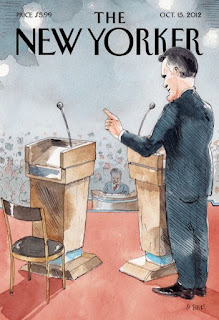
actual New Yorker Magazine cover
In this debate season, it might be helpful to do a little to define the “sport.” We sometimes refer to these debates as if they were the competitive sport used to train speakers, usually high school or college students. But besides “a formal contest of argumentation in which two opposing teams defend and attack a given proposition,” a debate can be “a discussion involving opposing points,” or, as a verb, “to engage in a formal discussion or argument.” These presidential debates aren’t really much like the college sport of debate, and yet we talk about winners, as if there were formal rules and scoring. Since there aren’t, what we’re looking at is how persuasive and effective either debater was at communicating his viewpoint. In the case of presidential debates, it also includes revealing personality, and predictors about how such a person would conduct himself in the role of president. People ask, “Did he appear presidential?”

Debates are risky. You have to be good at remembering a great many details without notes. You have to be good at assessing the question and determining underlying agenda and possibly spin that could fall out from an answer. And you have to be good at expressing your viewpoint in a persuasive and positive way. And you need to appear relaxed and confident while accomplishing all this.
More people fear public speaking than death. I don’t know if the question has also been asked about debating, but it seems to me, fear of this type of debate ought to be astronomically higher than fear of simply giving a speech. Given the difficulty of the event, while a success can be a positive, failure, which seems much more likely, can hurt a lot more. President Obama will be thinking about that, and fearing possible failure in a second and third debate. He is to be pitied.
How do you meet such a challenge? It helps to be Mitt Romney: super smart, with a grasp of concepts combined with detailed memory of numbers and figures; confident and comfortable in leadership roles through long years of experience; a really nice guy with a positive approach to just about everything. He may not be the most elegant speaker we’ve seen run for office, but he’s plenty good with words, and has mostly been writing his own speeches for years. Add to that, he’s experienced and formidable in presenting his point of view.
His debate performance last Wednesday came as a surprise to many, but it shouldn’t have. He’s been this person all along. Obama’s excuse that it was a faux Romney at the debate, instead of the one on the campaign trail, is exactly opposite of true. Obama’s team, including help from fawning media, portrayed Romney as out of touch with hard working Americans, gaffe prone, stiff, dim, and uncool. And then they believed themselves, rather than, as a winning basketball coach would do, watching films of the opposing team. How ridiculous is it to claim that Romney was comfortable, articulate, relaxed, powerful, in touch with working people and their plight, and with a full grasp of the facts—because he somehow faked it? Maybe with crib notes on a handkerchief? Really?
Let’s take a look at some of the better moments, a pattern that seems to work: defend strongly but briefly, and then go on the offensive with your position. I learned of the backward-step-pivot-forward move during last winter’s primary debates, and I think that’s what we’re looking at again. Sometimes there are some other steps going on, that I don’t have terms for, but they’re working too.
Romney took his opening statement second. He dispelled the myth that he has no sense of humor when he quipped that, on the President’s anniversary, “I'm sure this was the most romantic place you could imagine here—here with me.” Then, while the President missed the opportunity, Romney quickly laid out the five points of his plan, belying Obama’s claim that Romney has no plan:
·         One, get us energy independent, North American energy independent. That creates about four million jobs.
·         Number two, open up more trade, particularly in Latin America; crack down on China if and when they cheat.
·         Number three, make sure our people have the skills they need to succeed and the best schools in the world. We're far away from that now.
·         Number four, get us to a balanced budget.
·         Number five, champion small business.
Moderator Jim Lehrer then gave the President a chance to respond. He changed the order and twisted specifics toward the left, but his list was almost copycat:
·         First, we've got to improve our education system….
·         When it comes to our tax code, Governor Romney and I both agree that our corporate tax rate is too high. So I want to lower it, particularly for manufacturing, taking it down to 25 percent. But I also want to close those loopholes that are giving incentives for companies that are shipping jobs overseas.
·         On energy, Governor Romney and I, we both agree that we've got to boost American energy production. And oil and natural gas production are higher than they've been in years. But I also believe that we've got to look at the energy source of the future, like wind and solar and biofuels, and make those investments.
·         Now, in order for us to do it, we do have to close our deficit.
The closest he comes to “championing small business” is to “make those investments” in solar and biofuels. But then he makes an attack that gives Romney a beautiful opportunity to set the record straight. And he does it repeatedly:
Governor Romney's central economic plan calls for a $5 trillion tax cut, on top of the extension of the Bush tax cuts, so that's another $2 trillion, and $2 trillion in additional military spending that the military hasn't asked for. That's $8 trillion.
The problem is, not only is that not Romney’s “central economic plan,” it bears no resemblance to his plan at all. It’s a fabrication of Romney’s plan invented by leftist think tanks and spouted repeatedly by the Obama campaign. So now there’s an opportunity for Romney to clear up this misconception before 60 million interested viewers.
First of all, I don't have a $5 trillion tax cut. I don't have a tax cut of a scale that you're talking about. My view is that we ought to provide tax relief to people in the middle class. But I'm not going to reduce the share of taxes paid by high- income people. High-income people are doing just fine in this economy. They'll do fine whether you're president or I am.
This is the brief, strong defense, the backward-step. Then comes the pivot to turn the topic in the direction of his choice:
The people who are having the hard time right now are middle- income Americans. Under the president's policies, middle-income Americans have been buried. They're — they're just being crushed. Middle-income Americans have seen their income come down by $4,300. This is a — this is a tax in and of itself. I'll call it the economy tax. It's been crushing. The same time, gasoline prices have doubled under the president, electric rates are up, food prices are up, health care costs have gone up by $2,500 a family.
Middle-income families are being crushed. And so the question is how to get them going again, and I've described it. It's energy and trade, the right kind of training programs, balancing our budget and helping small business. Those are the — the cornerstones of my plan.
He has even managed to sneak in Biden’s phrase about the middle-class being “buried,” skillfully done without rancor or even apparent irony. He follows this with another list, including more detail contrasting his plan with Obama’s record:
·         First, education. I agree, education is key, particularly the future of our economy. But our training programs right now, we got 47 of them housed in the federal government, reporting to eight different agencies. Overhead is overwhelming. We got to get those dollars back to the states and go to the workers so they can create their own pathways to getting the training they need for jobs that will really help them.
·         The second area: taxation. We agree; we ought to bring the tax rates down, and I do, both for corporations and for individuals. But in order for us not to lose revenue, have the government run out of money, I also lower deductions and credits and exemptions so that we keep taking in the same money when you also account for growth.
·         The third area: energy. Energy is critical, and the president pointed out correctly that production of oil and gas in the U.S. is up. But not due to his policies. In spite of his policies. Mr. President, all of the increase in natural gas and oil has happened on private land, not on government land. On government land, your administration has cut the number of permits and licenses in half. If I'm president, I'll double them. And also get the—the oil from offshore and Alaska. And I'll bring that pipeline in from Canada.
It’s almost as if he could end this exchange with, “Thank you, Mr. President, for allowing me to clear up so many wrong assertions about me.” He championed states’ rights as a better way to improve education. He clarified the misconception that lower taxes result in lower revenue—in about as brief a lesson as can be done. And he took away the President’s claims about energy simply by pointing out the facts. Wow!
This was a stinging beginning.
In the very next exchange, Obama repeats the “$5 trillion tax cut on top of $2 trillion of additional spending for our military” claim. Mr. Lehrer begins to interrupt, possibly to give Romney a chance to respond, or possibly to point out that this was already answered. I don’t know. But the President stops the interruption and claims he’s about to make an important point. And then he repeats the same claim—again.
Romney answers this repeated charge with one of the best segments of the debate.
Virtually everything he just said about my tax plan is inaccurate…. If the tax plan he described were a tax plan I was asked to support, I'd say absolutely not. I'm not looking for a $5 trillion tax cut. What I've said is I won't put in place a tax cut that adds to the deficit. That's part one. So there's no economist can say Mitt Romney's tax plan adds $5 trillion if I say I will not add to the deficit with my tax plan.
Number two, I will not reduce the share paid by high-income individuals. I—I know that you and your running mate keep saying that, and I know it's a popular thing to say with a lot of people, but it's just not the case. Look, I got five boys. I'm used to people saying something that's not always true, but just keep on repeating it and ultimately hoping I'll believe it—(scattered laughter)—but that—that is not the case, all right? I will not reduce the taxes paid by high-income Americans.
And number three, I will not, under any circumstances, raise taxes on middle-income families. I will lower taxes on middle-income families. Now, you cite a study. There are six other studies that looked at the study you describe and say it's completely wrong. I saw a study that came out today that said you're going to raise taxes by $3,000 to $4,000 on—on middle-income families. There are all these studies out there.
But let's get to the bottom line. That is, I want to bring down rates. I want to bring down the rates down, at the same time lower deductions and exemptions and credits and so forth so we keep getting the revenue we need.
And you think, well, then why lower the rates? And the reason is because small business pays that individual rate. Fifty-four percent of America's workers work in businesses that are taxed not at the corporate tax rate but at the individual tax rate. And if we lower that rate, they will be able to hire more people.
For me, this is about jobs.
Just for the record, the Obama campaign, when pressed, had to admit in the days following the debate that Romney was correct; his plan never included anything like a $5 Trillion tax cut (plus all the additions the President kept adding on). Romney has the opportunity—again—to defend himself briefly, and then go on offense by laying out his actual plan: backward-step-pivot-forward.
But there’s more! I highlighted a section there. Without having to say anything offensive or negative (no, “You dirty, rotten liar!”) he is able to show that Obama’s insistence on repeating the lie, even after it’s been answered, is juvenile. Everyone can see it. There’s a grown-up on the stage and a whiny little boy-man. It’s a devastating blow. It’s delivered without anger or negatives. It’s unanswerable.
How does the President answer it? By scuffing his foot and saying, “Nuh uh; I’m right.”: “Well, for 18 months he's been running on this tax plan. And now, five weeks before the election, he's saying that his big, bold idea is ‘never mind.’"
There’s so much to enjoy in this debate. But we’ve probably done enough for now. There’s just this one little exchange, between Romney and the moderator, that I find amusing:
Mr. Lehrer: Excuse me. Just so everybody understands—we're way over our first 15 minutes.
Mr. Romney: It's fun, isn't it?
Mr. Lehrer: It's OK. It's great. 

Mitt Romney does this for fun. I’d find that impossible to believe, except that we have similar “fun” at our dinner table and family gatherings—but without the high stakes and millions of viewers.  

One thing is certain: we saw the real Romney in that first debate. And I think we also saw at least a glimpse of the real Obama.

Friday, October 5, 2012

Great Game

You know that experience you have the day after a big game, one everyone you know was watching, and your team won? Big! Everyone relives it, relishes it, the next day and beyond. That’s how I spent the day after the first Presidential Debate.

If you’ve been reading here a while, you’re already aware that I think Mitt Romney is an especially skilled debater, as well as a perfect fit to lead us through the problems we’re facing today, economic and otherwise. And you probably also know that I scratch my head in puzzlement at the very description of Obama as a good orator, or wise and principle-based in anything he does as President.
So I am not surprised that Romney debated the socks of the President the other night; I’m surprised that everyone else saw what I saw. I’m not used to that. The camaraderie has been great fun. I collected some favorite comments.
·         “That was the most brutal, one-sided presidential debate I have ever watched.”—Bryan Preston of PJMedia (wall post with link to his article)
·         “Memo to young GOPers: Savor the moment. You will likely never experience so comprehensive a debate win again.”—Hugh Hewitt
·         “Obama said it himself, Romney's ‘gonna have a busy first day [as President.]’”—comment on Texas State Senator Dan Patrick’s Facebook wall
·         "That wasn't a debate so much as Mitt Romney just took Obama for a cross country drive strapped to the roof of his car."—tweet attributed to @clasicaliberal, quoted on a friend’s Facebook wall
Image found on Leah Christie's Facebook wall
origin uncertain
·         “MSNBC is bringing in grief counselors.”—Leah Christie, of Not On This Watch and MittRomneyRadio
·         “Press saying Obama didn't bring his 'A game.' I argue that he did."—tweet attributed to @GregGutfeld, posted on Leah Christie’s Facebook wall
·         “In addition to his intelligence briefings, Obama apparently missed his debate briefings.”—Ann Coulter
·         “If Romney keeps this up Obama’s gonna vote for him.”—Dennis Miller
·         “Obama better hope a Kicked A** is covered under Obamacare.”—Dennis Miller
·         “Obama is being owned, refinanced and owned again!”—Dennis Miller
·         “Obama’s performance was so bad, I’m starting to think it must be some kind of strategy.”—S. E. Cupp
·         “Maybe debate commission should add that little league rule—when the other team is that far ahead, you just call it a day.”—Dana Perino
·         “It was delicious.”—Glenn Beck, on his radio show next day
I need to add just a few from very unlikely sources. This is the opposing team bemoaning their misfortune, not just at a single loss, but the loss of hope for the rest of the season:
·         “I can’t believe I’m saying this, but Obama looks like he DOES need a teleprompter.”—Bill Maher
·         “Obama made a lot of great points tonight. Unfortunately, most of them were for Romney.”—Bill Maher
·         “This is what happens when u pick John Kerry as your debate coach.”—Michael Moore
I thought that last one was just a joke, but I heard it verified on radio this morning; Obama actually did have John Kerry as a debate coach—apparently because he wanted to come across as a man of the people instead of an arrogant, rich pedant? So, again, that verifies my assertion that, no matter the question at hand, Obama is likely to use the wrong judgment criteria and make the wrong decision—far more than you’d except from sheer dumb luck.
One online friend has taken to referring to him as GHEP, meaning, “the greatest hoax ever perpetrated on the American people, with a nod to Clint Eastwood and the empty chair speech. I saw a couple of amusing visuals. One was a cartoon with Romney at the podium debating against an empty chair. Another was a photo of an empty chair, with the caption that Romney had taken care of things.
Let me add that I, and I believe others who strongly push to replace Obama in the White House, still have respect for the office of President. Disrespect is what this person has for the office, as well as the nation he represents and the people who are entitled to liberty. Honor within the office is something that must be earned.
What I have been hoping for is clarity—that the American people would be able to see who Obama really is and what his intentions are for our country, and who Romney really is and what his intentions are for our country. I think we got clarity, and the glare of it was a bit shocking to the Obama team (media included).
Twitter photo from dgjackson
There’s a photo that was tweeted after the event, in the green room where the Romney family gathered. With Mitt Romney looking on, along with a granddaughter, Romney’s son Josh is making peanut butter and honey sandwiches, using a plastic fork, for the family. No caterer. No servants. Nothing gourmet. Just practical family people doing family things together. The Obama-campaign-designed image of Romney as too rich and out of touch is so very wrong. I have been seeing this Romney for a long time, because I have known so many people like him (but at different levels of overall talent), so I find Romney caring about people out of work totally believable. The opposition was foolish enough to believe the image of Romney they had invented. Obama excused his pathetic performance by claiming the Romney at the debate was a fake, and went ahead campaigning against the invented version.
We need to thank moderator Jim Lehrer who mostly stayed out of the way and let that happen. (Granted, there were times he tried prompting the President to stop wandering and make a point—check about 20 minutes in—and he tried unsuccessfully to interrupt Romney numerous times but still managed to give the President several minutes more time.) We’re used to the odds against us. At least the questions were not useless repetitions of the anti-Romney campaign. I especially like the question about the proper role of government.
The debate was informative in many ways, and I’ve taken some time to go over the transcript and mark it up. I think I’m getting better at identifying that backward-step-pivot-forward move Romney is so skilled at (I wrote about it here and here). The technique enhances our view of the contrast between the two and their basic beliefs. The debate content, I think, will remain pertinent throughout the remainder of the campaign, and beyond. So I want to spend some time on that in the next post.

Wednesday, October 3, 2012

The Priorities Question: School Board Part II


This is part II of information about a local school board election. I hope the thought process is valuable beyond the very local area.
I left off part I with this question for school board trustee candidates, about priorities: You have three constituencies in your elected position as school board trustee: taxpayers, students, and teachers. How do you prioritize these constituencies, and why?
I’ll introduce each of the three candidates, along with their order of priorities. I do think there’s a right answer, but almost no one ever gives it. I’ll cover my reasoning below.
Darcy Mingoia is the PAC candidate, running in tandem with Kevin Hoffman for the other open position (we didn’t hear from candidates for that position yet). She sees herself as conservative. She works in fundraising for the community college system, and even worked with the local chamber of commerce some years back to start the community college system. She has lived in the district for 34 years. She has been a small business owner, and served as president of the chamber of commerce for ten years. She went through school on scholarship (from a private foundation) and believes the community needs to help students get through school. Her kids went into engineering. She worked as a PTO and library volunteer, and then stayed connected as a volunteer representing the business community. She was instrumental in getting the access channel on cable so the community could view school board meetings.
She has a good resume. However, reaction to questions about the PAC showed her bristling, feeling adversarial to us Tea Partiers. I learned more about the PAC at this meeting, and I feel less knee-jerk rejection of anyone they put forward. Still, what I see is that the PAC has been detrimental to our district, regardless of their possibly well-meant intentions.
·         She answers the priorities question in this order: students first, then teachers, then taxpayers.

Bill Morris is the incumbent, and is probably best known for his vote against that big pay raise (discussed in part I). He’s been targeted for removal based simply on that vote, but he has fairly frequently stood alone or nearly alone against the rest of the board. He says he frequently puts forward ideas, but they do not get brought up for discussion, let alone for vote. It’s a tough position to be in. For a while, he was undecided about whether to run again, but in the end decided that he needed to keep standing firm; we needed someone who would.
He works for food services in HISD (Houston Independent School District), so his work lets him handle large portions of school budget, but without a conflict of interest within our district.
He is a man of few words. I would have liked to hear more details from him, more positive. He seems frustrated by the situation and mentioned a number of negatives. For example, a controversial issue has been the use and upkeep of a huge facility the district built (pretty much against the will of the people), with a football stadium, basketball arena, and theater areas. It is shared by various high schools in the district, but the rest of the time should be rented out to the community to mitigate costs. Some of that does happen, but there has been discussion about “thinking outside the box.” Renting out for events that would like to serve alcohol, such as weddings or some conventions, have been prohibited. Bill Morris is against that particular type of use; it is, after all, a high school facility. If alcohol were allowed, even under these specific circumstances, it would be the only such facility in the state to allow it. Not a good precedent to set. So, whether you agree or not, he is clear and firm in his position.
He pointed out that the head of the PAC had a school named after her, after the PAC got a particular candidate elected to the board. There’s an appearance of cronyism. Again, an apparent complaint. But, as a positive, he did give us an update on the efforts to push for parity among funding per student. Nearby Tomball district, for example, gets several hundred more per student than CFISD students. There has been pressure on the legislature, without effect. So now there is hope that pressure through the courts will have success. That case is coming up October 22nd.
·         He answers the priorities question in this order: students first, then taxpayers, then teachers.

Lillian Wanjagi is a young mom, involved in higher education for 16 years, previously at Rice, and now at University of Houston Clear Lake. She has a third grade daughter at a school not far from me, who is her inspiration to get involved. She is working on her PhD, and her research topic is related to student success. I probably learned most from her during the Tea Party meeting (and conversation afterward). She grew up in Kenya, going through a British school system, so she at least has views beyond what has always been done here. I have seen school function better than here, so I like that there’s an outside view.
Her main points included giving choice to parents, who are “the main stakeholders in a child’s education,” and in setting priorities within a budget that will best affect quality for the student. She brought some interesting data. For example, of the $5000 per student spent in this district, $403 goes to ESL (English as a second language). That is the highest per student cost for a program. (Making sure you understand, this isn’t $403 per ESL student; it is $403 per student in the district in order to have an ESL program for those that need it.) For comparison, $82 per student goes to having sports programs; $55 goes to gifted and talented programs. (I can attest that the GT program is sub-par, as you’d expect if you’re spending seven-to-eight times more for ESL.)
Someone asked if we know how much of our budget goes to paying to educate and provide food and other services for children of illegal immigrants; we don’t have that data, although there were efforts in the last legislative session to try and obtain the data. The ESL program is, in theory, intended as a way to give a start to new immigrants (and schools don’t ask if the immigrants are legal or not) to get educated while learning the language. Many of these are certainly legal. But all the children of illegals will fall in this group as well. As Wanjagi said, we are required to educate all students, including illegals, but we’re not required to spend more on them than on our own students. So it’s about how you prioritize the spending per child, so that you get the quality we all want.
·        She answers the priorities question in this order: students first, then teachers, then taxpayers. However, more than once she said, “Parents are the most important stakeholders.” That comes very close to being a better answer.
In reality, the school board is hired for a specific purpose by the taxpayers and are not accountable to either the students or the teachers. But people hear a different question than I’m asking: “Who is most important to you?” Anyone involved in education who doesn’t answer that the students are most important is in the wrong place. But believing you’re accountable to students isn’t helpful. Students are likely want easy grades and fun classes—not necessarily things we know will lead to the outcome of best educated students. So saying you’re “for the children” isn’t very informative. So sometimes you have to look at the priority order between teachers and taxpayers.
In very fact, the trustees’ job is to carry out the mission of educating our children to the level we taxpayers request and expect, for the money we have contracted to provide. If they can’t do the job to the satisfaction of the taxpayers, they should be replaced with someone who can. What the students and teachers think of the trustees is irrelevant.  If they are faithful in their stewardship to the taxpaying community, the students will receive a good education—better than we’re seeing. And I don’t mean to imply that teachers are irrelevant. It is important to hire, retain, and compensate the best teachers we can get, in order to meet the mission. If trustees are being accountable to the taxpaying community that hires them, they will do what it takes to meet the mission. Teacher skill and satisfaction will be the result.
When a trustee mistakenly bows to the will of teachers (teacher unions/organizations), they may be betraying the taxpayers who hired them. That we have such resistance to merit-based pay and other performance related issues means someone is protecting ineffective teachers—which benefits neither the students nor the good teachers, and certainly not the taxpayers in their educational mission.
All three of our candidates were glad Texas has refused to accept federal money that came with strings attached. Texas is a rarity in this decision. But we believe we’re better off without submitting to yet more federal mandates.
All three of our candidates said they were in favor of keeping control as local as possible.
The priorities question is an indicator to me about how a person will decide issues. I’d have to look at my past notes, but I believe every PAC member has placed teachers ahead of taxpayers.
Which means we have to rule out Darcy Mingoia, even though she would probably not be a disastrous choice. But we have two candidates who seem to understand better than she does about the commitments being made to the people doing the hiring. It is parents, and broader than that, all taxpayers, who are paying for a particular outcome. We don’t want loyalties to some other constituency standing between us and the people we’ve hired.
Between Bill Morris and Lillian Wanjagi, I’ll let you choose. If I’m valuing fresh ideas, I’d probably go with Ms. Wanjagi. If I’m looking for ability to stand strong against difficult opposition, I’d go with Bill Morris. While I’m technically still undecided, I think I’m leaning toward the incumbent, because we need a guarantee right now that this one position on the board will stand firm.

Tuesday, October 2, 2012

Local, Local, Local


At our most recent local Tea Party meeting, we heard from candidates for one of the positions on the local school board of trustees: position #3 of Cypress-Fairbanks Independent School District (CFISD). This is in a relatively conservative area, in Harris County, northwest of Houston, mostly suburbs. It is the third largest district in the state.
Darcy Mingoia CFISD Board candidate
photo: David Wilson, Cypress Tea Party
The specifics of this post will probably only help local readers. But the larger question is probably worth thinking about. In this government entity probably closest to affecting our lives, lifestyle, and future, how do we know what we need to know as voters, and how can we influence our leaders in the best direction?
I, like about 70% of taxpayers in this district, do not have a student in the school system. We did our first two years here, and despite the district’s reputation as one of the best around, our schools were woefully incapable of meeting our family’s needs. We ended up homeschooling and moving our kids into dual-credit community college courses by age 16. Leaving them in these public schools was not an option we were willing to risk. We paid the full taxes, plus the personal costs of our kids’ alternative education route. That is what we felt we had to do.
So, in the spirit of full disclosure, I don’t have a romantic idea that public schools are the sacred source of our nation’s future. I understand the concept that all children should be given the opportunity for an education. But I’m not convinced that taxing and forcing everyone to use the public institution, unless they’re wealthy enough to pay additionally for alternatives, is the proper role of government. I would rather see a paradigm of a full gamut of private options, with philanthropy (mostly from businesses who have a stake in hiring an educated workforce) offering scholarships/grants for those who can’t afford their own. But I also recognize that will not be the paradigm in my lifetime, so the goal is to make schools as effective and cost-effective as possible.
Bill Morris, CFISD Trustee
photo: David Wilson, Cypress Tea Party
We have an eight-member board of trustees in CFISD, with different positions coming up in different years. This year two positions are up for election, with one incumbent on the ballot.
It has only been a few years that I’ve been paying much attention to local school board elections. Before that I didn’t know how to learn more, until I heard about a candidate forum. These have apparently been going on for a long time, but the audiences are filled with teachers, who get notified and encouraged to go, and the public who happened to hear about it, possibly through a teacher. (Besides our Tea Party opportunity, there is a scheduled forum to get to know these candidates, on October 16th.)
I am not anti-teacher; I know the value of a good teacher in a student's life. I probably qualify as anti-teacher union, however. I believe unions stand in the way of connecting incentives and quality teaching; I think they prevent outcomes that good teachers, parents, and students want. What I see at this local level is a board that is controlled by the teachers’ organizations. This is a non-partisan election, so we aren’t provided information about the political party of the candidates. All of them claim to be conservative, because they must be perceived as conservative to get elected in this area. However, because of the basic anonymity involved at this level, if you say you’re for the best education of the students and are fiscally conservative, who knows otherwise?
Lillian Wanjagi, CFISD Board candidate
Photo: David Wilson, Cypress Tea Party
But what I perceive is that there’s one current board member, definitely a democrat by all reports, who runs the meetings, decides the agenda, and dismisses the ideas put forward by any board member he doesn’t favor. (The teachers’ groups adore him.) And he is supported by fellow board members that mostly vote as a bloc. Interestingly, this voting bloc results from a PAC that seems somewhat controversial among our Tea Party members. There are members of the PAC who come to our Tea Party. It may be that many in that group see themselves as conservative. But the result is that there has been a lot of money put together to put onto the board a slate of candidates. Since this PAC started combining money and efforts, essentially every candidate they put forth has been elected. We were down to what looked like two actual conservative board members, both up for election this year. One chose not to run again.
These two conservatives had a “black mark” against them. It related to a vote on teacher raises a couple of years ago. At that time, with the turndown in the economy, the district faced some difficult decisions. Teachers hadn’t had a raise for three years, so there was a lot of sympathy for them to get something.
CFISD, everyone enjoys pointing out, is honored as one of the most efficient districts in the state. But since the district is given less money per student (decided by a formula set up by the legislature) and is simultaneously required by law to balance its budget, efficiency is the only possible outcome. Then the question becomes a matter of priorities. The year in question, in a year when the public was suffering pretty severely, the board voted for a teacher raise of 5 ½%, as well as an administrator raise of 5 ½%. It was either this whole massive raise or nothing. To the two dissenting votes (Bill Morris and Larry Youngblood), during that particular year’s budget shortfalls, giving such a raise seemed unconscionable. I agree. I think a smaller raise for the teachers, and possibly nothing for administrators, would have been acceptable. (The superintendent, and possibly other higher administrators, make nearly $100,000 more a year than the governor. And it is my opinion that there are far too many administrators, sucking resources that could otherwise go to the classrooms.)
Compromise was not allowed as an option. So, with that outgo for teacher and administrator salaries, cuts had to come to other budget segments, including programs like special education. At one meeting, a mother of a special ed student asked about this effect, and she was booed. This is not what you’d call open dialog with the constituents.
The three candidates for position #3 are Darcy Mingoia, Bill Morris, and Lillian Wanjagi. Ms. Mingoia is the PAC candidate (running on a slate with Kevin Hoffman for position #2, whom I know nothing about yet other than the PAC affiliation). Mr. Morris is the incumbent. Ms. Wanjagi is a newcomer that I found interesting; this is her first foray into politics.
During the two hours we had with them, I had the opportunity to ask the candidates this question about priorities: You have three constituencies that you’re accountable to in your elected position as school board trustee: taxpayers, students, and teachers. How do you prioritize these constituencies, and why?
Since the full report on these three is too long for a single post, I’m leaving off today; in the next post I’ll let you know how they responded, and what I think that tells us.

Friday, September 28, 2012

Marriage: Anti-Poverty Weapon

I heard something that sparked a connect-the-dots moment the other day. First, while unemployment rates are unacceptably high for everyone, they have been even more shockingly high for blacks. I know the numbers differ based on whether you’re counting those who have stopped seeking work, or have accepted low-paying part-time work rather than nothing. Rates typically are counted just by those seeking unemployment benefits, which means they are undercounted. So these numbers could be higher.
The highest unemployment rate is listed at 37.9% for black teens, compared to 22.8% for white teens. But looking at adults, blacks deal with 14.3% for men and 12% for women, compared to an overall rate around 8%. The storyline is that there must be some racism going on. But what if you add in a few other questions, like:
·         Education level?
·         Family structure?
·         Location?
·         Legal history?
I don’t have it all spelled out, but there is some evidence that some specific behaviors and choices are playing a part much more than racism.
What I heard that piqued my interest was that, with this apparent racial economic disparity, there’s a more-or-less apples-to-apples comparison that tells a different story. (All this is spelled out, with charts, in this piece by Robert Rector at The Heritage Foundation, including the charts below.)  
Economic poverty is high among black families, but among black married households, the poverty rate is only 7%. That is about double the poverty rate of married white families, but it is only half the poverty rate (13.2%) among married Hispanic families. Meanwhile, among non-married black families the poverty rate is 35.6%, very close to the rate for non-married Hispanic families: 37.9%. (I’m assuming these families are defined as an unmarried parent, usually the mother, and at least one child under 18.) For non-married whites, poverty hovers around 22%.
 
Married black families have a poverty rate of less than a third of non-married whites. And that is before we take into account education level and other factors.  Just for perspective, combining all races and education levels, non-married families have a poverty rate of 37.1%, and among married families that rate is 6.8%.
I don’t have data that separates out education level by race. But the data combining education levels and marital status is informative.
Single parents who are high school dropouts (of any age, so this averages in those who are 10 to 15 years into parenthood and may be gaining some employment experience) have a poverty rate of 58.8%. Being married brings that down to 24%—meaning you’re less than half as likely to be in poverty, even as a high school dropout, if you’re married—even to another high school dropout.
For high school graduates, non-married families are likely to be in poverty 38.8% of the time (just above the overall poverty rate for non-married families of any race or education level). But families with only a high school diploma and no other education, if they’re married are in poverty only 8.9% of the time. Married high school graduates have a better than 91% chance of avoiding poverty, just because they remain married.
 
Greater education improves things. Single parents can decrease their poverty rate to 27.8% with some college, and down to 10.6% if they graduate from college. Note that non-married educated parents don’t quite measure up to the chances of avoiding poverty that married high school graduates have, but clearly education helps. But these last two groups, if they’re married, have poverty rates of only 4.6% and 1.8% respectively.
So clearly college and marriage help. But marriage helps more than education. Add marriage to a college education, and you’ve improved your chances of avoiding poverty about 6-fold. You’ve virtually guaranteed rising to the middle class or better.
There is a formula for avoiding poverty that we’ve known about for quite a while. I wrote about it back in February, and first came across the data a decade ago. The more data we get, the more the basic truth becomes evident.
  1. Don’t have sex before age 20.
  2. Don’t have sex until after marriage.
  3. Stay married.
  4. Obtain at least a high school diploma.
No anti-poverty program will work long-term if it doesn’t spell out this formula and encourage ways for people to follow it, especially for those who don’t see the example of strong families all around them.

My guess is that homes, churches, and private schools are going to be much better at inculcating this formula than government. Government is woefully ill equipped to educate, especially when the subject matter looks religious. But, religious looking or not, the data is simply factual.  

Here at Spherical Model we’re aware that living a civilized life is much more likely to lead to financial prosperity than living an uncivilized life (savage, southern hemisphere on the spherical model). The political, economic, and civilization spheres overlay one another. That’s how we know that taking money from productive people and giving it to people in poverty will not and cannot lift those people out of poverty. Poverty can be solved—for an extremely high percentage of people from every race and gender—within a generation by following the formula. This will become even more evident if government gets out of the way of the country’s economic prosperity. 

There may still be a percentage in poverty, even among those who try to do everything right. But already, among those who live the formula, the problem is so small, it would easily be solved by private philanthropy. 

There are other, big, daunting problems worldwide. But if strong families praying together can, in a relatively short time historically speaking, solve poverty, then strong families praying about the other problems might yield the other solutions we hope for as well. 

This election matters. It matters monumentally. It determines whether we continue in a direction that leads inevitably down to tyranny, poverty, and savagery, or in a direction back up toward the thriving our nation’s founders tried to make possible and permanent for us—“if you can keep it,” Benjamin Franklin added. So the election is something we must pay attention to. 

But after the election, once our direction is determined (hopefully northward on the Spherical Model), then we have a lot of work to do, starting with our own homes and radiating out from there.

Wednesday, September 26, 2012

What "Invest in Opportunity" Means

I’ve been going back to something in my mind for the last few weeks. Sometimes something sticks because it has larger implications than it seemed to have at the moment. Nobody’s really talking about this anymore, but I’m still thinking about what I heard at the DNC convention last month.

Julian Castro, Mayor of San Antonio
photo from Wikipedia
There was a talk by San Antonio Mayor Julian Castro, the keynote address on Tuesday of that week. He and his twin brother, a candidate for congress, are a success story, and he told it fairly well. His grandmother Victoria came to this country from Mexico as an orphan, to live with relatives who were willing to take her in. She had to drop out of school after fourth grade to help contribute to the family income. But she worked hard all her life to give her only child, the Castro twins’ mother, a better life.
He does not mention a father or grandfather, so I turned to Wikipedia. No mention of a grandfather, and their grandmother apparently raised their mother alone. Their mother, Rosie, made a living as a political activist, helping to establish the radically leftist pro-Hispanic group La Raza. She ran unsuccessfully for city council three years before the birth of the boys. She separated from their father when the boys were eight. The father, Jessie Guzman, is described as a political activist and retired math teacher. The story in the keynote address has these two hardworking women raising the boys on their own, working heroically to give them a better chance at success.
Both graduated from Stanford, through affirmative action, and then Harvard Law (presumably also through affirmative action).
Some of the story sounds like it could have been delivered at the RNC convention, maybe by Ted Cruz (except for that somewhat glaring absence of fathers in the family story).  Castro says this:
My grandmother's generation and generations before always saw beyond the horizons of their own lives and their own circumstances. They believed that opportunity created today would lead to prosperity tomorrow. That's the country they envisioned, and that's the country they helped build. The roads and bridges they built, the schools and universities they created, the rights they fought for and won—these opened the doors to a decent job, a secure retirement, the chance for your children to do better than you did.
And that's the middle class—the engine of our economic growth. With hard work, everybody ought to be able to get there. And with hard work, everybody ought to be able to stay there—and go beyond. The dream of raising a family in a place where hard work is rewarded is not unique to Americans. It's a human dream, one that calls across oceans and borders. The dream is universal, but America makes it possible. And our investment in opportunity makes it a reality.
Now, in Texas, we believe in the rugged individual. Texas may be the one place where people actually still have bootstraps, and we expect folks to pull themselves up by them. But we also recognize there are some things we can't do alone. We have to come together and invest in opportunity today for prosperity tomorrow.
The highlights are mine; they identify the Obama “you didn’t build that” message couched within the American Dream message. Some of it, like expecting people to pull themselves up by their bootstraps, we can agree with. “Investment in opportunity,” however, is a phrase he uses for some other purpose. In the next minute or so he says opportunity two more times and some form of invest two more times. And he repeats the theme later in the speech.
Then he turns on the Republicans, particularly Romney, referring to a speech he’d given where he opened up possibilities for paying for college beyond government grants, and included borrowing from parents, where that was possible. I found it a positive message, but Castro mocked it:
Some people are lucky enough to borrow money from their parents, but that shouldn't determine whether you can pursue your dreams. I don't think Governor Romney meant any harm. I think he's a good guy. He just has no idea how good he's had it.
Hmm. Romney doesn’t know how good he’s had it. And how did he have it? His father immigrated to the US from Mexico, during ravaging war there, in abject poverty. His father never had the opportunity to go to college, but he worked hard and eventually became head of GM, and then was elected governor of Michigan. So by the time Mitt Romney came along, his parents did see to it that he got a good education through a private prep school.
Mitt Romney got accepted to Stanford on his merits, without any kind of affirmative action. Then, after a church mission to France, that he paid for, he transferred to Brigham Young University (to be with Ann) and graduated from there, again on his own merits and his own dime. Then, with a wife and two children, he graduated with honors from a dual program of Harvard Law and MBA.
Mitt Romney didn’t need affirmative action, because he prospered on smarts and hard work—smarts and hard work that were significant enough that having a father who never went to college and couldn’t grease the skids didn’t stand in his way.
Mitt Romney, just like Julian Castro, is just a generation or two from immigrant poverty. Castro says he values his grandmother’s hard work and effort that would lead to their success, if not her own. And while his own smarts would have given him scholarship opportunity at many good schools (granted, not Stanford and Harvard, but maybe University of Texas or Rice), he thinks affirmative action was necessary for his success, regardless of hard work or smarts. Yet somehow Romney’s success without affirmative action is because of privilege.
Castro says his San Antonio high school was full of students just as bright and hard-working as he and his brother, who could have succeeded except they lacked the opportunity. This was the early 1990s, in Texas, where Hispanics are plentiful and successful in every walk of life. And he’s claiming affirmative action gave the Castro brothers their opportunity but did not give it to all those other bright, hard-working friends. Why? What made the Castro brothers the recipients and not their friends? Their mother’s activism, possibly? I don’t know; I just don’t understand what he’s trying to sell. That everyone is smart and hard-working and deserves to go to Stanford and Harvard, and therefore everyone should receive that opportunity?
Let me get this straight: the real belief is that if someone succeeds, it may have involved hard work and brains, but it couldn’t have happened without some intervention to grant opportunity. In Romney’s case, just having a father with wealth, whom he could have turned to had the need arisen, disqualifies him as a regular person. But Castro, receiving the deus ex machina of government affirmative actionwhen equally deserving friends did not, is somehow virtuous.
He claims that it is government’s obligation to “invest in opportunity,” meaning take money from some earners to give largesse to favored others—that this is virtuous, even the very purpose of government.
Who decides who receives the “investment in opportunity”? Some bureaucrat? Hmm. Doesn’t inspire confidence, at least for me.
Here’s the reality I see. I have three very bright children, but let’s look at Political Sphere, as a comparison, since I’ve mentioned him before. He worked through college on his own, graduated with honors—and huge debt—from a state school where he was considered out-of-state for three years (while illegal aliens were given in-state tuition rates). He has the same color skin, the same dark hair and eyes, that Julian Castro has. But he has the disadvantage of coming from married parents descended from currently non-favored northern European heritage. (My grandfather immigrated in poverty as well, and found relative success in a single generation. A story for another day.) We gave Political Sphere the best education our middle-middle-class income could provide (including gifted schools in public education, and then homeschooling). He chose the university based on its program, but it turned out there was no placement program, and no one in his graduating class got a job in the field. Some went on to a graduate program at that time, but the debt load made that impossible for our son.
As a family, we stepped in and did what we could: PS and family lived with us for 3 ¼ years, rent free, while he worked two jobs that were much lower paying than he was qualified for. Now he has begun law school—not Harvard, but at a very good private school, that he got accepted to on merit, including some scholarship money. We are so proud of him.
But, since government isn’t “investing” in his “opportunity,” must we assume that “he didn’t build that success”? We’re just not admitting how good he had it?
I don’t feel angry that his opportunities are less than Mitt Romney had; they are enough. They would have been more easily obtained if government interference hadn’t brought down the economy at a crucial point. We’ll persevere, but we’re really hoping for better times following this election. What we really don’t need is government deciding we don’t give enough toward the education of the next generation, so government should tax us higher and disperse that money to those it deems deserving. The very idea seems ridiculous under the circumstances.
There’s something I noticed during the Castro speech.  At about the 11-minute point, his facial expression changes. Suddenly, he’s no longer positive; suddenly he’s angry and attacking. It reminded me (don’t laugh) of the moment in Ghostbusters when we see the monstrous Stay Puft Marshmallow Man suddenly turn from benign to menacing. Castro is angry and aggressive, possibly forgetting that it’s his party and his candidate that has brought us this ongoing mess. He attacks as though the GOP, and Romney in particular, has been purposely dismantling the economy, with especial efforts to prevent people, and maybe particularly people from his ethnic group, from getting educated. It’s a malicious lie.
So let’s be honest about what “invest in opportunity” means. Government doesn’t invest; government doesn’t produce; it taxes to acquire revenue and then spends it. So referring to the process of government taxing producers and then spending on those the government deems fit to “invest” in is nothing more than saying, “Government should have access to your money and decide how to spend it.” That’s how you know you’re listening to a Castro at the DNC convention rather than a Ted Cruz at the RNC convention. That’s the difference between democrats and republicans right now, and coincidentally the difference between socialists and constitutional conservatives.