Thursday, June 6, 2019

Pride Isn't Worth Celebrating


When I was young, my Church leaders defined pride in the scriptural way. As President Ezra Taft Benson said in 1989, “In the scriptures there is no such thing as righteous pride—it is always considered a sin. Therefore, no matter how the world uses the term, we must understand how God uses the term so we can understand the language of holy writ and profit thereby.”[i] This talk led us to try to change our language. It became awkward for some time to say we were proud of our children when what we really meant was, as scriptures would say, “my son, in whom I am well pleased.”

Latter-day Saints are not the only ones who have the idea pride is a bad thing. In Catholic philosophy, pride ranks up there alongside greed, lust, envy, gluttony, wrath, and sloth, which make up the “seven deadly sins,” which together are opposite the “seven heavenly virtues”: prudence, justice, temperance, and courage (the four cardinal virtues) plus faith, hope and charity (the three theological virtues).[ii]
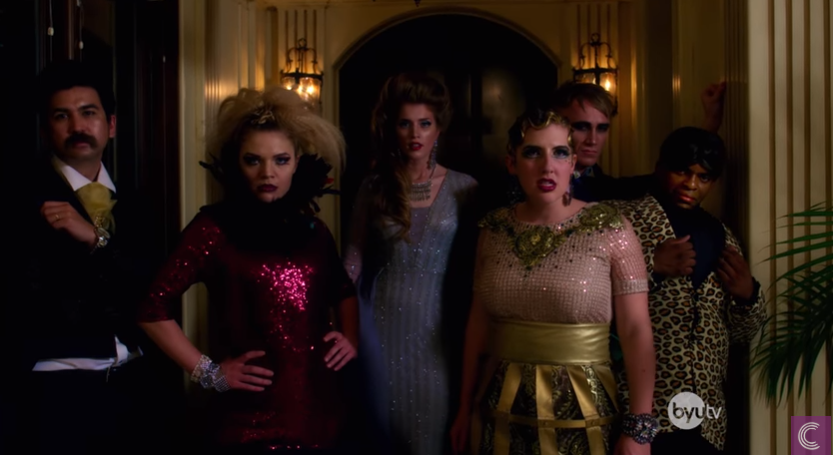
Studio C skit "7 Deadly Sins," a safely clean presentation of the sins,
(plus adorable sloth), screenshot from here

Yet it still seems like a good thing to tell your child, “I’m proud of you for getting good grades” or “for sticking up for your little brother,” or for some similar good reason.

My dictionary offers both the scriptural term—always negative—and the worldly term, which can be somewhat positive, depending.

1.     a. an overhigh opinion of oneself; exaggerated self-esteem; conceit
b. haughty behavior resulting from this; arrogance
That first definition is pretty negative. That’s what "cometh before the fall.” It leads to nowhere good.

But there are these additional definitions that are pretty common outside of scripture:

2.       proper respect for oneself; sense of one’s own dignity or worth; self-respect
3.       delight or satisfaction in one’s own or another’s achievements, in associations, etc.
4.       a person or thing in which pride is taken
5.       the best of a class, group, society, etc.
I’ve been trying to figure out how it’s used in the celebration called “gay pride,” for which June is supposed to be the month.

In April the valedictorian’s speech at my alma mater, Brigham Young University, got some notoriety, because Matt Easton came out publicly as gay during that speech. In his announcement, he said, “I stand before my family, friends, and graduating class today to say that I am proud to be a gay son of God.”

I don’t know the young man. But the assumption is that he has been abiding by the honor code, which requires, among other moral requirements, no sexual relations outside of marriage. He hasn’t been living a typical gay lifestyle; he has been living a typical Latter-day Saint lifestyle. As long as he continues to obey God’s commandments concerning chastity, he is as welcome and integrated in the Church as any other member.

I’m glad he was able to achieve the significant honor of valedictorian at a school where that really means something. He must be very bright and very hard working—along with being very civilized in his behavior.

I hope he can continue to live a good life. But I am concerned for him.

Shortly afterward he did an interview on Ellen. I like Ellen DeGeneres. She’s funny and personable, and only rarely brings up her sexual orientation. But it was somewhat pertinent in her interview with Easton.

Matt Easton with Ellen DeGeneres
screenshot from here
The interview appeared to give the impression that, now that he’s graduated, he’s free of the somewhat draconian behavior controls of the Church-owned school’s honor code and its fear-inducing threat of expulsion over any perception of misbehavior.

There has been some criticism of the department that deals with honor code issues at the university lately, leading to some adjustments. Those seem to me more related to procedures than with the actual honor code itself. Expulsion is occasionally necessary, but mainly for flagrant violations with little intention of repentance. Temporary suspension, possibly leading to a semester being repeated, would be more likely for serious lapses. Every Latter-day Saint student is assigned to a congregation, with a bishop who has an honest desire to help any young person with spiritual struggles—of which an honor code violation of any kind would be a signal.

In the Ellen interview, Easton seemed to be expressing his fear that, if he had so much as hugged a team member after a win in sports, he could have been reported to the office and expelled. That is so far away from the intent of the honor code that I can only assume his was a self-imposed fear. Two heterosexual young men who hug under that same condition would feel no fear—because the behavior and intent are both innocent, even positive.

Easton says that, now that he has graduated, he intends to participate more fully in the LGBT community up north in Salt Lake City. He does not say that he intends to break his covenants to God. And I hope, for his sake, that he can maintain his faith and his behavior as he has done thus far. But I think Ellen’s audience will think otherwise—that he will “be authentic” by pursuing same-sex relationships, since that’s “who he is.”

How does this relate to pride? He said he was a “proud gay son of God.” He might mean that he’s proud—i.e., has a sense of his own dignity and worth—to know he is a son of God, even though he happens to have same-sex attraction. But I think the more common understanding is that he’s proud of his gay-ness while also being a son of God.

When we’re talking about the positive reasons to be proud—because of accomplishments, achievements, or things to take delight or satisfaction in—I’m not seeing gay-ness as such a reason. 

Is it an accomplishment? If it is an inborn trait, as so many claim, then no. That would be like being proud of being born in a particular year—a matter of chance, not personal accomplishment. If it is not inborn, then what is accomplished by choosing it, or failing to overcome the tendency? Sterility? Having only 2-3% of the population to share attraction with?

While the world might be better because of the contributions of people who happen to have same-sex attraction—and there are significant such contributions in the arts and most spheres of accomplishment—I fail to see how homosexuality itself is part of those contributions. Wouldn’t it make more sense to say, “I’m proud of this accomplishment despite the challenges I face because of my homosexuality?” Or to leave out the sexuality part entirely?

Remember, if pride isn’t tied to accomplishment of something good, it’s that negative definition: an overhigh opinion of oneself; exaggerated self-esteem; conceit.

Pride month seems to require the rest of society to “signal” their “virtue” by also being proud of people with LGBTQ issues. But for what?

I suggest that the subject is intended to resist deeper thought. Instead, there’s supposed to be a gut-level response, a society-wide understanding that there’s this entire demographic of people who have been oppressed, and forced to hide “who they are.” And so, in a stand of solidarity with them, we’re supposed to tell them to shout their proclivities from the rooftops and cheer them on as they do so.

But why? So we can feel better about ourselves for no longer having that prejudice against them? When we never did? When we have believed in fairness, kindness, and respect for all people all along? But now we’re required to not only want those basic human rights for them, but to support special rights for them. And if we don’t, we’re subjected to being made pariahs, and having our basic freedoms taken away. We’re supposed to signal that capitulation by waving rainbow flags and honoring them as though they’ve accomplished something akin to—an accomplishment.

I was first introduced to a gay pride parade several decades ago, when I was working not far from San Francisco. A co-worker had been downtown during one of these events and shared some snapshots. I can’t un-see those images. Naked butts, and other near nudity, wrapping around light poles and simply being publicly lewd. There wasn’t anything remotely wholesome or civilized about it. There’s good reason for civilized people not to want their families exposed to anything like that.

Is my finding their lewdness repulsive supposed to make me “homophobic”? I don’t think so. I would think the same thing of lewdness by heterosexuals.

And if that’s how they’re showing “pride” in themselves, can we just be clear that it’s not the righteous kind of pride; it’s the deadly sin kind.

What is the pride for? What are they saying? I’m trying to understand. But I think they’re saying, “I’m presenting myself as good for having urges that I give into, and I’ve suffered horribly because of your disapproval—so now you have to support my in-your-face lewdness as I flaunt my aberrant lifestyle—or else.”

I’m not willing to go along.

an actual rainbow worth celebrating
Mostly I’ll just avoid any such pride events (my preference anyway). But I’m sad at some losses. One is the rainbow symbol. Back in the early 80s, the rainbow was one of those things that started showing up everywhere—on notebooks, T-shirts, pencils. I had a plastic rainbow keychain. Rainbows are colorful and pretty. I’m sad at the loss of them any time I’m not specifically referring to a natural phenomenon following rain, or to the story of Noah and the ark.


I’m also sad at the takeover of the word “gay.” It used to simply mean happy, and it was a useful rhyming word. Now we’ve had to rewrite the lyrics to a number of old songs to avoid accidentally referring to sodomy while singing with our children.

I’m not proud of homosexuals for giving in to same-sex attraction. Why should I be? I benefit not at all from their doing so; neither does civilization.

I’m proud of (pleased with) any human being who lives a good and righteous life, and makes whatever contributions they can to our world. I’d like to see more actual virtue and a whole lot less virtue signaling.


[i] Ezra Taft Benson, “Beware of Pride,” General Conference April 1989. President Benson’s address asked Gordon B. Hinckley to read the address for him, for reasons of health incident to age. 
[ii] Info from Wikipedia

Monday, June 3, 2019

Essentials of Freedom


The purpose of government is to protect our inherent rights to life, liberty, and property.

Life, because each human life has value. This is different from many societies throughout history that have seen some lives as more valuable than others, and some classes as sub-human and disposable.

Liberty, because that means we determine how we spend our lives—working at overcoming the natural state of poverty and ignorance. This means no slavery, no servitude without just compensation. No class is entitled to the services of people in another class simply based on their class.

Property, because it is the result of our labor, so it represents the exchange of a portion of our life—work that resulted in something useful to us. In the Declaration of Independence, we broaden this idea to the “pursuit of happiness,” which encompasses property as well as our choices in how we spend our lives to accumulate property, or wealth, or work toward any end important to us.

It is tyranny to take the life of the innocent, or to take the life of the guilty without due process of law. It is tyranny to coerce behavior, to require a person to work, not for that person’s own benefit, but for the benefit of the coercer. It is tyranny to take the property of a person without a free, fair exchange for that property.

These are the basic ideas behind the formation of our United States.

"Scene at the Signing of the Constitution of the United States"
by Howard Chandler Christy, image from Wikipedia


Setting up a government to protect life, liberty, and property—without taking on other powers that would be tyrannical—was the careful purpose of the writers of the Constitution.

The Preamble to the Constitution outlines these purposes for the Constitution of the United States of America:
·         To establish Justice.
·         To insure domestic Tranquility.
·         To provide for the common defence.
·         To promote the general Welfare.
·         To secure the Blessings of Liberty to ourselves and our Posterity.
When there are disputes that infringe—or could infringe—on one person’s life, liberty, or property, the government can help justly settle that dispute. If there are problems between one region and another—a trade issue, for example—the government sets up standards of exchange and regular trade routes. When there are threats from beyond our nation, the government can protect our borders and sovereignty. When there are issues that benefit the people as a whole, such as certain infrastructure projects, the government can promote those projects. And having all this written and codified in law brought these things about for those who wrote the Constitution as well as for each generation that has followed.

Section I, Article 8 of the US Constitutiion
Article I, Section 8

This federal government, created by the founders and ratified by the people in the individual states, has powers strictly and carefully limited to what will specifically protect life, liberty, and property. And these powers are enumerated—spelled out. They’re all in Article I, Section 8 (plus a couple of additions by amendment). That means they all come under powers of Congress—where laws are made.

The judicial branch is to adjudicate laws duly created by Congress; the judiciary—including the Supreme Court of the United States—has not been granted power to make laws.

The executive branch is to execute the laws, to enforce them, to use the budget for those purposes assigned by the lawmakers. This will include common defense functions, such as directing the military as Commander in Chief, and arguably protecting our sovereignty with and domestic tranquility functions such as the FBI. But the executive branch does not have power to create laws.

The Enumerated Powers

We’ve listed the enumerated powers before [here and here], but it’s a good idea to repeat them from time to time, because it simplifies conversations about our government. It may not simply politics, which is about persuading people to allow assertion of power—whether an enumerated power or not, unfortunately.

Here’s the list:

1.       Lay and collect taxes, duties, imposts, and excises—uniformly throughout the US, for purposes of paying debts and for the general welfare (for the good of the country as a whole).
2.       Borrow money on the credit of the US.
3.       Regulate commerce (make it possible and regular) with foreign nations, among the states, and with the Native America tribes.
4.       Establish uniform rule of naturalization (allowing people to become citizens).
5.       Establish uniform laws on bankruptcies.
6.       Coin money, regulate the value of US coined/printed money, and regulate the value of foreign money.
7.       Fix the standard of weights and measures.
8.       Provide for the punishment of counterfeiters.
9.       Establish post offices and post roads (mail system).
10.   Secure copyright and patent rights, to promote the progress of science, arts, writings, and discoveries.
11.   Constitute tribunals (courts) inferior to the Supreme Court.
12.   Define and punish piracies and felonies committed on the high seas, and offenses against the law of nations.
13.   Declare war, grant letters of marque and reprisal (license to act on the seas that would otherwise be considered piracy), and make rules concerning captures on land and water.
14.   Raise and support armies—but no appropriation of money to that use shall be for a longer term than two years.
15.   Provide and maintain a navy.
16.   Make rules for the government and regulation of the land and naval forces (military bases).
17.   Provide for calling forth the militia (National Guard) to execute the laws of the union, suppress insurrections, and repel invasions.
18.   Provide for organizing, arming, and disciplining, the militia (National Guard), and for governing any part that is in service to the US—reserving to the respective states the power to appoint officers and the authority to train the militia according to discipline prescribed by Congress.
19.   Exercise governing authority over the District (Washington, DC, an area not exceeding 10 square miles) as the seat of the government of the United States.
20.   Exercise governing authority over places purchased (by consent of the legislature of the state in which located) for erection of forts, magazines, arsenals, dockyards, and other needful buildings.
21.   Make al laws which shall be necessary and proper for carrying into execution the foregoing powers, and all other powers vested by this Constitution in the government of the US or in any department or officer thereof.
22.   Outlaw slavery and involuntary servitude (except as a punishment for crime), and enforcement of this prohibition.
23.   Sixteenth Amendment: Lay and collect taxes on income.
24.   Fifteenth, Twenty-fourth, and Twenty-sixth Amendments: Enforce equal voting rights laws across all the states.
Listed Limitations

The limitations are not enumerated. However, just for the sake of security, some of the limitations are spelled out in the Bill of Rights—the first ten amendments. So here’s a list of specifically mentioned things the government cannot do:

·         Establish a state-favored religion
·         Limit the free exercise of religion
·         Limit freedom of speech
·         Limit freedom of the press
·         Limit the right to freely assemble
·         Limit the right to petition for redress of grievances (file lawsuits over government wrongdoing)
·         Infringe on individual right to bear arms
·         Force citizens to quarter soldiers
·         Search or seize property without probably cause shown by warrant
·         Put person on trial for felony without indictment by Grand Jury
·         Put person on trial for same offence again after being found not guilty (double jeopardy)
·         Force person to testify against themselves
·         Fail to provide an accused with swift justice (speedy and public trial by jury)
·         Right to jury trial for property disputes over a certain threshold
·         Inflict excessive bail or cruel and unusual punishments
·         Construe anything in the Constitution to take any additional rights from the people
·         Assume any power not spelled out in the Constitution is left to the states and the people.
Usurpations

There are some powers that the federal government has been dabbling in—or outright taking over—that are not among the enumerated powers granted by law. This list of usurpations is not exhaustive:

·         Power to govern education.
·         Power to offer charitable services (welfare).
·         Power to force purchase of a service or product (such as health insurance).
·         Power to require payment into a retirement supplement (Social Security).
·         Power to interfere with commerce that doesn’t cross state lines.
·         Power to redefine marriage in a way that is contrary to long-standing law and tradition, and to enforce acceptance of the new definition, even when it violates personal religious beliefs.
·         Power to subsidize any industry (alternative energy, for example).
·         Power to target industries in accordance with a social agenda (gun manufacturing, automobile manufacturing, nuclear energy, oil and gas, fast food or sugary drinks).
·         Power to use taxpayer funds to support abortion.
·         Power to subsidize or control student loans.
·         Power to take over any industry (as when the Obama administration temporarily took over GM and banks).
·         Power to favor or disfavor individuals or groups for hiring, educational opportunities, or other purposes based on their race or religion.
We’ve offered this list before. Let’s add these:

·         Power to limit speech based on government’s approval or disapproval (interference with social media).
·         Power to gather data and use passive surveillance of innocent citizens in their private places.
All of these usurpations have happened because there was enough persuasion (lobbying of legislators, media manipulation of public opinion) claiming that there was a need, and that a good government would do these things for its people.

Proper Role of Government

But government isn’t intended to parent its people, nor to grant favors to subjects as a monarch would do. Government is only to protect life, liberty, and property, which will then allow the people to thrive according to their circumstances—which includes helping one another by charitable choice.

We know this:

Whenever government attempts something beyond the proper role of government (protection of life, liberty, and property), it causes unintended consequences—usually exactly opposite to the stated goals of the interference.
If people want the poor to have their dire circumstances relieved, or the people want an educated populace, or they want affordable and available healthcare—government attempts will cause the situation to get worse. It’s a given.

If you really want a problem solved that is beyond the proper role of government, the best way is to allow a free and righteous people to thrive in a free market and figure out how to help one another.

The political, economic, and social spheres are interrelated. Limiting the people’s freedom also limits their prosperity and civilization.

Thursday, May 30, 2019

It's Called Grooming


A few weeks ago I shared some information for parents to protect their children. The issue was human sex trafficking. We were made aware of warning signs that a child is being groomed, to be led into the hands of the traffickers. There are steps in recruitment, what we could call grooming:

1.       Befriend—to get the target to see the groomer as someone to trust.
2.       Intoxicate—to cause inability to think clearly combined with causing friction at home.
3.       Alienate—to drive a wedge between target and family and their core values.
4.       Isolate—to separate the target from old friends who held their original core values.
5.       Desensitize—to confuse the target’s moral compass, making the previously unthinkable seem common or even normal.
6.       Capitalize—to take the target into control by the groomer, and subject to sex slavery.

Image from here
link from this story
As a follow-up, here’s a piece warning parents of the apps the predators are using. 

This is a scary scenario, and pretty horrifying for a parent. I think we do need to be vigilant. But I think the danger is larger than recruitment into human trafficking, which, while unbelievably too common, is still comparatively rare.

I don’t mean to diminish the meaning. But I believe the methodology—grooming—is being used in a broader attempt to recruit a generation into an alternate reality, with an alternate morality and behaviors.

These things are so serious, it helps to be able to keep a sense of humor. So let’s start with yesterday’s Andrew Klavan Show intro. He begins each episode with a monologue in the form of a news report parody, like this:

Leftist scientists working around the clock have developed powerful new tools for altering reality. In a speech to the Society for the Promulgation of Irrational Hysteria, left-wing physicist Dr. Geraldo Von Zippity-Noodle told the gathering of empty chairs he can now confirm that writing a statement five times over in all capital letters and posting it on Twitter transforms that statement, no matter how absurd, into the truth.
In an experiment that has been reduplicated in multiple peer-reviewed imaginations, scientists posted the words “TRANS-WOMEN ARE WOMEN” five times in all caps on their Twitter feeds, and discovered from that time forth men who wore dresses not only became real women, but were actually able to conceive and bear children, if no one looked too closely.
In a transcript of the speech, released through UCLA’s office of Collecting Undeserved Paychecks by Repeatedly Using the Word Diversity, Dr. Von Zippety-Noodle said, “The key to changing reality through repetitive Twitter capitalization, or RTC, is to ensure that no one damages the results by demanding proof or using such phrases as ‘nonsense’ or ‘applesauce’ or uttering ‘complete horse manure of the purest ray serene.’[i] If people using such words can be banned from Twitter, or silenced through intimidation, then the proper reality change can take place undisturbed. Or, if not, who is there to say?”
Andrew Klavan,
screenshot from episode 710

That's somewhere around step 5, desensitizing. Disorienting. Claiming an alternate truth so often and so firmly that sensible people begin to question their long-held grasp on reality.

This disorienting comes easier if there’s already been some unmooring from the family and the core beliefs inculcated within (step 3, alienating), and from friends who went along with those core values (step 4, isolating).

This step has been underway for quite a while. Things that seemed unthinkable in 1950 or 1960 were mainstreamed—in media, academia, and then in politics, which is downstream from culture.

Consider a few recent stories.

In this one, a British priest/teacher at a school in Essex was castigated for considering the feelings of any child but the boy/girl with gender dysphoria: “Priest Resigned Post Over Children Being ‘Sacrificed on the Altar of Trans-Ideology’ 

The school in Essex, which has not been named in reports to protect the privacy of the children and families, had a pupil who, at just eight years old, was looking to transition from a boy to a girl, British newspaper the Mail on Sunday reported. Reverend Parker said he supported the child’s transition but wanted to inform parents of other pupils in order to ensure the safety of everyone at the school and to address any concerns about the child using the girls’ toilets.
It was not enough that he supported the transitioning child; he had to also dismiss any concerns surrounding the situation. The school’s governor and church leaders told him to shut up. So he left.
In Brazil—as attempted in the US with the recent Equality Act, which passed in the House—disagreeing with the LGBT agenda is being made a crime: “Brazil's supreme court votes to make homophobia and transphobia crimes.”  

Racism was made a crime in Brazil in 1989 with prison sentences of up to five years. The court's judges ruled that homophobia should be framed within the racism law until the country's congress approves legislation specifically covering LGBT discrimination.
Brazil's Senate is dealing with a bill to criminalize discrimination based on sexual orientation or gender with sentences of up to five years.
Meanwhile, as women and girls express their fears—not necessarily of transgenders, but of predators using the opportunity to victimize—actual cases continue appearing: “Man who says he’s ‘female’ enters women’s bathroom, sexually assaults 10-year-old girl.” The story offers this commentary:

Decades after feminism swept the West, transgender rights have now formally replaced women’s rights as the emerging ideology of gender fluidity wipes out any formal conception of what a “woman” is to begin with.
Women and girls who feel unsafe when biological males enter spaces once reserved for females only are being essentially told that they are transphobic and that they should shut up.
And this:

Any discomfort expressed by women themselves is condemned as bigotry. And this system is impervious to questioning: It is not only transphobic to ask whether some spaces should be limited to biological females for the purposes of safety, it is also transphobic to ask any follow-up questions about this. The transgender community, apparently, is a uniformly perfect group, utterly without sin and lacking any nefarious members whatsoever. I suppose if you can believe a woman has a penis, you can believe anything.
If you’re recruiting, why not start young? It’s hard to know whether this next story is about a really, really stupid teacher or a purposeful groomer: “'He Feels Confused': Parents Sue After Teacher Repeatedly Asks 8-Year-Old if He's Trans.” In this case, an 8-year-old had digestive problems, which were accommodated by allowing him to use a different restroom (I think I read in a related story was the teachers’). His teacher, instead of asking why this arrangement had been made, surmised that he had gender dysphoria, and singled him out multiple times to ask him if he thought he was really a girl, and gave him books to read that would lead to that conclusion. The books in his backpack were how the parents found out. The boy was very confused, and required some to deal with the trauma the teacher caused him. The family sued, rightfully.

Note here that the boy wasn’t confused before the teacher repeatedly and somewhat forcefully implanted the idea of gender dysphoria. In other words, the pressure to put this information in early grades, supposedly to get kids used to the existence of people with gender dysphoria so that there will be greater understanding and acceptance, is really recruiting, or grooming: separating the child from the parents’ core values, making shocking abnormalities seem normal, claiming a lie loudly and boldly enough that sane people begin to question reality. It’s a horrible thing to do to vulnerable children.

There was a story a few months ago, from here in Houston, about drag queens reading to small children in Houston city libraries. Here's additional commentary on that story: “DragQueen Who Read to Kids at Houston Library Is Convicted Pedophile.” Eventually, a second sexual predator was found reading to kids. The library said, “Sorry,” but not really sorry. After all, it was for the greater good of indoctrinating kids to be more tolerant and accepting. Chris Sevier, of MassResistance, the parent group that did their own research, leading to the discoveries, when the city refused to, said, 

“It’s not about acceptance, love and tolerance. It’s really about indoctrinating children to the ideals of secular humanism.”
A week ago, Jordan Peterson, on his weekly podcast, interviewed provocateur Milo Yiannopoulos. I didn’t know much about Yiannopoulos before. I remember a couple of years ago he was invited to speak at C-PAC. But I don’t give a lot of heed to people who say something anti-leftist and are suddenly given a platform as a conservative. Let time settle any questions.
Milo Yiannopoulos,
screenshot from Jordan Peterson podcast

It was an interesting interview. He’s unpleasantly in-your-face accusatory at times, and overly certain of his own brilliance and talent. OK. Anyway, I knew so little about him that I didn’t know he was gay or that he had suffered a media downfall because of a comment he made about younger gay males being brought in by older gay males; that had happened to him, but he said it was consensual, which he said he believed it often is. What he realizes now, slightly older, is that for him at his age to do the same to a young teen male would be predatory and wrong. It happens; everyone in the gay community knows it and recognizes it. But he only now, with a little more maturity, sees that he had been preyed upon. He was punished for saying what he said, but I think a sensible onlooker would have looked at the scenario and thought, “Oh, he doesn’t yet realize what happened to him.”

Another piece I came upon makes the pedophile/homosexuality connection: "Pedophilia and homosexuality–an undeniable connection." This is an opinion piece, originally written in Croatian, I believe, so there are syntax issues. But I’ve done the math before and gotten similar results. The author (I can’t find an author or date on the piece) posits that many gay men prey upon boys who were the age of their own first encounter.

The LGBT agenda isn’t the whole story. But it’s a good example of grooming. Review this piece on the Yogyakarta Principles: “Ten Years of International Sexual Orientation and Gender Identity Laws: Lessons Learned,” by Daniel Moody.

You can add abortion to the list of disorienting realities being called good. We need to end with something a little light-hearted, to give us strength. Thanks again to The Babylon Bee, for their “news” story: “DisneyCEO: 'To Avoid Filming Among Depraved, Immoral People, We Are Moving All OurGeorgia Operations Back To Hollywood.'” Because Georgia passed anti-abortion laws:

"To avoid filming among depraved, immoral people, we are moving all our Georgia operations back to Hollywood," [Disney CEO Bob Iger] said in a press conference, wagging his finger sternly. "The people of Georgia can't pass immoral, unjust laws like this and expect us righteous elites in Hollywood to stand by and let it happen. Morality is very important to us in the film industry. That's why we film a lot of our stuff here in Hollywood, where we can rest easy knowing that the money from our production is going to support moral, upright people."
"It's the right thing to do," he added.
Iger also pointed out that California's lax abortion laws come in handy in Hollywood quite often.
Questions I have at this point are, who is doing the grooming, and what is their goal?

In a religious context, the simplest answer is that Satan is grooming as many people as possible—and concentrating on the young—to accept as “real” and “good” things that are false and evil, so that he can ruin as many lives as he can. Science and natural law are on the side of real and good. That’s why the “groomers” make sure the real and good are shouted down—in all caps. With claims of being “for tolerance and against bigotry,” while being intolerant and bigoted—adding force of law whenever possible.

Keep your children close. Don’t trust them to schools, entertainments, academia, or anyone who has already fallen prey to the false and evil; those people are patiently doing their work as groomers.


[i] I looked this up so you don’t have to. It’s from stanza 14 of Thomas Gray’s poem “Elegy Written in a Country Churchyard.”

Monday, May 27, 2019

We Must Never Forget


It’s a Memorial Day, which is always worth noting here, where we seek freedom, prosperity, and civilization. Freedom isn’t free.

I’m mostly sharing what other people have posted to celebrate this day.
First, a reminder of what this day is:

·         Armed Forces Day, for those currently serving, is celebrated the third Saturday in May
·         Veterans’ Day, for living former servicemen/women, is celebrated November 11.
·         Memorial Day, for those who died while serving, is celebrated the last Monday in May.

       
Image from Military Families United, found on Facebook.


Here are some images that remind us of the reverent spirit of the day.

Quote from Ronald Reagan,
image found on Facebook, from Founding Principles


Tomb of the Unknown Soldier, in the rain,
imaged shared on Facebook in 2015 by Randy Baughn


Here are some reminders of what our freedoms cost.

Image shared on Facebook by Newsradio 740 KTRH

 
Image found on Facebook, shared by Until Every Troop Comes Home


This next section is the Memorial Day post from my US Representative, Dan Crenshaw, former Navy Seal who lost his right eye in Afghanistan, specifically honoring those he lost from his Seal Team. The words and photos are his:

Enjoy your Memorial Day and let us remember why we celebrate. We celebrate the lives of the heroes we have lost. Never Forget.
Please read the entire post.
Brendan Looney. Did our first deployment together at SEAL Team 3. One of the best and most respected leaders on the Team. Husband, son, and brother. “Be Strong. Be accountable. Never complain.”

Pat Feeks. One of the best JTACs out there. Best story teller I ever met (those who knew him will understand!). Loyal friend, husband, brother, and son. He always showed up when you asked him to.

Dave Warsen. All American. Spent a lot of time together on our deployment to Afghanistan. When not on missions, we’d hit the volleyball court (half sand, half rocks). Strongest guy in the platoon, and also the happiest. Truly loved and missed.

Kevin Ebbert. My roommate in BUD/S. One of the smartest, most capable, kindest SEALs I ever knew. Skilled medic, loving husband. Missed dearly.

Brad Cavner. Cool, collected, and a great operator. Brad taught me to shoot left-handed after I lost my right eye, and spent countless hours getting my CQC skills back up to speed. “It’s about the Brotherhood.”

Tom Fouke. My old roommate. Dear friend. The gentlest big guy I ever knew. He raised an Argentine Horned frog named Lester when we lived together. Loved life, loved Metallica. World would be a better place with him in it.

Brett Marihugh. The most motivating and entertaining guy in our BUD/S class. Told stories for hours about his time as a cop before he joined. He pretended to be a doctor so he could visit my hospital room in Afghanistan and check up on me after I got hit by an IED.

Charles Keating IV. “Chuck Heavy”. His laugh was contagious. Life of the party. He was killed placing himself in danger so that his Team wouldn’t have to. Navy Cross recipient. Epic hero, husband, son, brother.

Another story of loss is Jennie Taylor's, mother of seven whose husband was killed in Afghanistan on his fourth deployment in fifteen years. She is now faced with carrying on their life dreams in his absence, with God’s help.

Jennie Taylor with her husband and kids
image from here

Finally, below is a brief speech from President Ronald Reagan on a past Memorial Day. There’s this memorable quote in the middle:

Our first obligation to them and ourselves is plain enough: The United States, and the freedom for which it stands, the freedom for which they died, must endure and prosper. Their lives remind us that freedom is not bought cheaply. It has a cost. It imposes a burden. And just as they whom we’re grateful were willing to sacrifice, so too must we, in a less final, less heroic way, be willing to give of ourselves.
And it ends with this good summary for today:

As we honor their memory today, let us pledge that their lives, their sacrifices, their valor shall be justified and remembered for as long as God gives life to this nation.