Showing posts with label slavery. Show all posts

Monday, February 25, 2019

What Is Property?


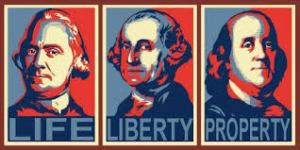
What is property? And why does it rank up there in importance with life and liberty?

image from here

First, we start with the premise that we value life. If there’s one entitlement we can agree on, it should be that we are each entitled to our right to life. The only way to forfeit that is voluntarily, as in war, or stepping in to protect someone being harmed. Or, if we take some other innocent person’s life, then the law can allow society to take our life. So we start with valuing life.

If we can’t agree to the right to life, then it’s hard to find any common ground. As I write, there’s a bill in Congress to protect the life of children born alive—particularly in a failed abortion procedure (failure to kill the infant before birth). [The bill failed. All Democrat presidential candidates and other likely candidates just voted that murdering newborns is fine with them. Remember that when it’s time to vote and someone tries to tell you Trump is the worst president ever.] The anti-life people, who like to euphemistically call themselves pro-choice, are finally admitting that there’s no difference between a baby just before birth and just after—and if they’re willing to kill just before birth, then they have no reason not to extend that willingness to kill a child after birth. What ought to go without saying—that an innocent baby is a life worth protecting from murder—is something we now have to spell out.

If we were to exemplify savagery, killing innocent babies would be on the poster.

So, let’s start with valuing life.

And then we can move on to how we spend our life. Freedom, or liberty, means we get to choose how we go about living, which will include doing work to sustain ourselves. Because we’re all born naked, shelterless, and ignorant—so much so that we really need a family to provide the necessities until we grow and learn to provide them for ourselves, which can take close to a couple of decades. Once we’ve become capable, liberty is how we pursue overcoming our original state of poverty and ignorance, and then enjoy the fruits of those endeavors.

In short, liberty is freedom to spend our lives, portion by portion. We may exchange our time and energy in exchange for money, which is a symbol for exchange of labor—or for a portion of our lives. Money makes it easier to exchange a piece of our labor that results in, say, a chair we built, with a person who fished for some food for dinner, if we have a common rate of exchange. Then you can get fish for dinner—or the several dinners a chair would be worth—from someone who doesn’t need another chair, but who does want something someone else produced, who does need a new chair. It’s just an easier means of exchanging our work for what we could use beyond simply the fruits of our own labors.

It’s a free exchange.

What is it when your work is required, but it’s not a free exchange? That’s slavery. Someone uses your time and energy—a portion of your life—and takes the fruits of your labor, instead of leaving you those fruits for your use. If you value life, you can see that stealing a portion of a person’s life is also wrong.

image from here
That covers life and liberty. Then, what is property? It is the result of your labor, above and beyond what you need to survive, that you can continue using. It’s another word for wealth, which simply means the accumulation of the results of your labor beyond what you need to subsist.

There’s another word for that: capital. It means that you have acquired wealth—results of labor beyond subsistence, that you can then use to invest in tools or other ways of creating more wealth. Or just keep it on hand until such an opportunity arises. It’s not evil; it exists only from successful work—or successful spending of a portion of your life.

Capital isn’t bad. Property isn’t bad. In fact, your property is just a way to enjoy the fruits of your labor over time—and possibly to help produce more fruits of labor. It’s evidence of a life well spent.
What happens when someone acquires far more property than someone else? That’s evidence that the person has offered something other people value enough to exchange the fruits of their work for. That person has benefited a lot of people. He then has an opportunity to spend that money, to the benefit of other workers. Or he might invest it in ways that provide work—and income wealth—to multiple workers. Or he might stuff a mattress with it so it benefits no one. But it’s his choice, because it’s his property.

Owning more property than someone else, then, isn’t wrong; it’s just evidence of serving society in a way that society appreciates.

What about those whose work doesn’t result in enough to subsist? That’s a social issue we can choose to care about, and do something about. It might be that we have enough surplus to offer a portion to the needy. That’s called charity. On a larger scale we might call it philanthropy. It’s a voluntary gift. Or, you could say it’s the exchange of the results of our labor—or wealth—for the sense of well being that comes from helping out another human being.

A righteous, caring people will want to do enough for a needy person to meet their needs without discouraging them from trying to get themselves to a more self-reliant state. You don’t want to create dependence. You don’t want to discourage someone from trying. You’ll want a person to feel valued and encouraged to contribute as much as they can to society. That takes actual caring, and often close acquaintance with a person’s situation, such as in a church community.

As long as a person in need is helped out by caring people, it simply doesn’t matter that there are large differences in property ownership.

If you think you’re entitled to the fruits of someone else’s labor, you’re a thief at heart. And let’s spell that out even more clearly: you’re a slaver. To take the fruits of someone else’s labor is to take the portion of their life that went to producing that wealth.

When government takes the fruits of your labor to “redistribute” it to someone who didn’t work for it, then government is the slaveholder and you’re the slave. This is true of anything government does beyond the proper role of government: protection of life, liberty, and property.

The way things are right now, government enslaves us for a pretty large chunk of the year. 

Entitlements—the euphemism for redistributing wealth, or pretending to do charity by coercive theft—make up a larger part of the federal budget, and most state and local budgets, than the necessities of protection.

And, as we know here at the Spherical Model,

Whenever government attempts something beyond the proper role of government (protection of life, liberty, and property), it causes unintended consequences—usually exactly opposite to the stated goals of the interference.
We make better use of our money—our property—than government can.

If there’s any person thinking about leaning toward socialism, ask, sincerely, who has the right to enslave you by taking away the fruits of your labor? It doesn’t matter if other countries, or other states, do it. Taking property away from those who paid for it with the fruits of their labor is taking a portion of their life. It isn’t fair. It’s wrong. As wrong as slavery has always been.


Monday, March 13, 2017

A World Too Savage

There’s a series of somewhat related items I came across the past few days. Some of them heartbreaking for a lover of civilization.

This first is from December, but it came to my awareness this week. The piece begins, “Nearly 400 children have been rescued and 348 adults arrested following an “extraordinary” international child pornography investigation in Canada.” This was the result of a three-year undercover project. It wasn’t limited to Canada:

What they eventually found was a full blown child porn production and distribution company in Toronto that was distributing their content online. The site was run by 42-year old Brian Way and sold and distributed images of child exploitation to people across the world.
The head of Toronto’s Sex Crimes Unit said they enlisted the help of the United States Postal Inspection Service since many of the videos were being exported to the U.S. and began a joint investigation. After a seven-month long investigation, officers executed search warrants across the city of Toronto including at the business of Brian Way.
It is hard for a civilized person to understand the demand—the market—for obscene violence to children. There are actual people, among us, who choose this evil.

This next story is about a man, a hero, named Tim Ballard, who has dedicated his life to rescuing children enslaved in sex trafficking. After 12 years working for the government as a special agent, he used his skills to create a private organization, Operation Underground Railroad. They recently had a successful sting operation surrounding a Super Bowl party. On February 5 O.U.R. led to the arrest of 9 traffickers and rescued 29 girls.  Since its founding four years ago, O.U.R. “has successfully completed 73 operations, rescued 643 victims, and aided in 273 arrests.”

Tim Ballard, screen shot from here

I’ve seen Tim Ballard talk about his operations on the Glenn Beck show. It is eye-opening to realize how much slavery—and much of it sex slavery—exists. Estimates are that there is far more slavery in the world today than there ever was during legal slavery.

Much of Ballard’s work is in Haiti, which the 3rd highest rate of sex trafficking in the world, mainly because of severe poverty there. He says, “If you just painted orphanage on the side of the wall, people would bring children to you, and then the kids would go out the backdoor in a deal."

But he adds that the US is the highest producer and consumer of child pornography in the world. His operation is successful by posing as American buyers, because they seem plausible to the dealers.

Again, it is beyond shocking that there are people among us who would purchase sex with children, or purchase child slaves for the purpose of using them for sex. This seems beyond the imagination of a dystopian novel.

Closer to home, I came across a third piece, about a woman named Tracie Mann, who spoke to a women’s group in Montgomery County, just north of the Greater Houston Area. Mann is the founder of Phoenix Charity, in which
Tracie Mann
photo from here

she oversees every aspect of the rescue and recovery operations and with a team of at least 30. Her team increases to about 100 with partners on the streets and from various levels of local and state law enforcement agencies in Montgomery and Harris counties, as well as federal agencies such as the FBI, DPS, and ICE.
She is working to provide hope and positively reprogram the mindset of the recovering children who on average are raped in excess of 100 times within 24 hours, beaten, drugged, and branded. As the owner of Body Restore Med Spa and Laser Center, which funds her recovery operations, her work allows her to remove the brand marks, tattoos, burns, and scars the children carry once rescued.
She has been involved in this work, on her own, since 2004. She is trying to raise awareness. She says it happens in front of us, and we don’t notice—at doctors’ offices, at fast food restaurants, through social media and phone apps.

She said, "We watched the sale and purchase outside a McDonald's in Montgomery County. It happens. It happens in plain site because we all live in our own little bubbles."

I admit that I am in something of a bubble. This is a hard thing to think about. Especially close to home. I wrote about a sting operation, in Waco, a couple of years ago. There were 29 arrests, 9 of them for human trafficking. The shock there was that one was a Ft. Hood sergeant. Another was a law school acquaintance of son Political Sphere, who reports that the guy had seemed normal.

That’s what I’m finding puzzling. People among us, enjoying the benefits of civilization that come from a preponderance of people living basically decent lives, yet who willingly engage in heinous acts against fellow human beings—often the young and most vulnerable.

In the Spherical Model I offer a chart of behavior relative to family, showing the ideal on down to the savage, marking where civilization has decayed and the culture sinks. Since we’re talking about the savage behavior, we’ll travel that chart from the bottom up, in hopes of gaining understanding.

Starting at the bottom, my experience is close to nil. I might not have ever met someone who would engage in any aspect of human trafficking. OK—I just thought of an exception, because I grew up on the same street as the kidnapper of Elizabeth Smart. But I’m unaware of ever meeting anyone who would buy or sell people.

Moving up the scale, I can’t imagine anyone I know engaging in child porn (although the less violent versions of porn have affected people I know). I have never met anyone who would admit to participating in prostitution, as either the prostitute or the buyer. But Mr. Spherical Model has come across both in regular business-related circumstances. So it may be shockingly common for people on business trips to pay for that degradation.

Going further up, I have known a very few people I would consider promiscuous, but none that expected approval from me, although in the celebrity world that appears common. And I’ve known a few more who were adulterous; most were ashamed, and recognized it as a causal factor in their divorce.

Further up still, I’ve known quite a number of people who consider sex outside of marriage a normal part of a relationship, and many live together before marriage as if that is an expected step in a relationship. This is where much of our culture is today.

I attended a women’s interfaith event where we discussed various belief questions at our tables. At mine, out of about eight religious people, only two of us clearly believed that sex outside of marriage is sinful and goes against our religions. The other was a Christian immigrant from Iran. Since the scriptures are clear, I wondered why the other Christians were so vague on the subject.

Going up further, we find people who believe as I do, that sex outside of marriage is unwise and wrong, but fail to live true to that belief, but then turn their lives around and work in their future toward a strong family. This is the minimum level for civilization. If we don’t get back up to this level, and work to sustain this belief and behavior, we sink further.

There are a couple of other things I came across this week. One is a quote from the Prophet and leader of my Church, President Thomas S. Monson. He said, “Today, we are encamped against the greatest array of sin, vice, and evil ever assembled before our eyes.” The thing is, he said it 50 years ago. There has been some serious sinking since then.

But not all of society sinks, and many individuals rise. And that is reason to be hopeful.

The other thing I came across was a piece in my local section of the Houston Chronicle last week, by Rick Brown. He was talking about the history of cultures that believe, as ours does today, that sex is “to be enjoyed recreationally and that best happens outside of marriage.”

He made the comparison to the apostle Paul’s Greco-Roman culture. As he put it,

There was a lot of sex in the city of Thessalonica. Many—if not most—of the Christians that Paul is writing to came out of a pagan background where sexual promiscuity was the norm and widely tolerated. They had to learn a new way to walk.
The interesting thing is that they did find the new way—the way that had been taught by God from Adam and Eve onward, but was new to the Christian converts. That recovered truth eventually became the accepted and understood way in most of the Western world for the next 1900 years.

It can be done. People can change. People can go against the common culture and toward civilization.

The way—the only way—to civilization is a righteous people honoring God, family, life, truth, and property. We know this. I guess we need to do some Paul-style spreading the word.


Thursday, September 15, 2016

Aims and Intentions of Socialism

Mr. Spherical Model has collected, over time, old talks to listen to during workouts or long commutes. We were listening to some of those during a road trip last month, and one of those I knew I’d want to come back to, to share here. It has me thinking about socialism, what that is, and how that contrasts with what we want as free human beings.

We’ll start with a few portions of this speech. It’s Marion G. Romney, in March 1966, in a speech at Brigham Young University. He was at that time one of the Twelve Apostles of The Church of Jesus Christ of Latter-day Saints. [Yes, he is related to Mitt Romney, but I’m not sure of the exact relationship, probably cousins.]
Marion G. Romney


The title of the speech is “Socialism and the United Order.” We’ll mostly deal with the definition of socialism here. But, simply, the United Order is a way of caring for the poor, the way it was done in the days of Enoch. In today’s terms, it will suffice to understand that in our Church, we pay a tithe (a tenth), plus fast offerings (approximately the cost of meals we miss while fasting), plus welfare activities.

I’ve said before, sometimes it helps to use definitions from older dictionaries, and that’s what he provides for us, along with a few other references giving us background and history:

Webster defines socialism as a political and economic theory of social organization based on collective or governmental ownership, and democratic management of the essential means for the production and distribution of goods. Also a policy or practice based on this theory.
George Bernard Shaw, the noted Fabian socialist, said that socialism, reduced to its simplest legal and practical expression, means the complete discarding of the institution of private property by transforming it into public property, and the division of the resultant income equally and indiscriminately among the entire population.
George Douglas Howard Cole, noted author and university reader in Economics at Oxford, defining socialism for the Encyclopedia Britannica, says that “because of the shifting sense in which the word has been used, a short and comprehensive definition of socialism is impossible. We can only say,” he concludes, “that socialism is essentially a doctrine and a movement aiming at the collective organization of the community in the interests of the mass of the people by means of the common ownership and collective control of the means of production and exchange.”
Socialism arose out of the economic division in society. During the 19th Century, its growth was accelerated as a protest against the appalling conditions prevailing in the workshops and factories, and the unchristian spirit of the spreading industrial system.
The Communist Manifesto, drafted by Karl Marx and Friedrich Engels for the Communist League in 1848, is generally regarded as the starting point of modern socialism. The distinction between socialism, as represented by the various socialist and labor parties of Europe and the New World, and communism, as represented by the Russians, is one of tactics and strategy, rather than of objective. Communism is only socialism pursued by revolutionary means and making its revolutionary method a canon of faith.
Communists, like other socialists, believe in the collective control and ownership of the vital means of production and seek to achieve, through state action, the coordinated control of the economic forces of society. They differ from other socialists in believing that this control can be secured and its use in the interests of the workers insured only by revolutionary action, leading to the dictatorship of the proletariat and the creation of a new proletarian state as the instrument of change.
A major rift between so-called orthodox socialism and communist socialism occurred in 1875 when the German Social Democratic Party set forth its objective of winning power by taking over control of the Bourgeois state, rather than by overthrowing it. In effect, the German Social Democratic Party became a parliamentary party, aiming at the assumption of political power by constitutional means.
In the 1880s, a small group of intellectuals set up in England the Fabian Society, which has had a major influence on the development of modern orthodox socialism. Fabianism stands for the evolutionary concept of socialism, endeavoring by progressive reforms and the nationalization of industries to turn the existing state into a welfare state. Somewhat on the order of the Social Democrats in Germany, Fabians aim at permeating the existing parties with socialistic ideas, rather than by creating a definitely socialistic party. They appeal to the electorate, not as revolutionaries, but as constitutional reformers seeking a peaceful transformation of the system.
The difference in forms and policies of socialism occur principally in the manner in which they seek to implement their theories. They all advocate the same things, in this respect at least. First, that private ownership of the vital means of production be abolished, and that all such property pass under some form of coordinated public control. Second, that the power of the state be used to achieve their aims. And third, they all claim that with the change in the control of industry will go to a change in the motives which operate in the industrial system.
I highlighted the summary there at the end. Let’s put them in bullet points, to see them clearer:

1.       Private ownership abolished, all property under public control.
2.       State coercive power used to accomplish its aims.
3.       The change in control of industry will bring about a change in motives for productivity.
What are the aims and intentions? The purported aim is to even things out, to do away with poverty. The way they're going about it will never hit that target. But, should we, as a good people, want to do away with poverty? Yes. In the Spherical Model, the economic goal is prosperity—the polar opposite of poverty. But you don’t get north by going south, or east.

I came across a quote from economist Walter Williams yesterday:

Prior to capitalism, the way people amassed wealth was by looting, plundering and enslaving their fellow man. Capitalism made it possible to become wealthy by serving your fellow man.
Capitalism is essentially never evil; it is about using the fruits of your own labor. Capitalism requires private property. It comes down to the contrast between freedom and slavery. A free man lives his life, and pursues his goals without coercion. What he accumulates, his wealth—the surplus beyond what he needs to get by right now—is the fruit of his life. To take that takes away that part of his life he spent accumulating that wealth. To force a person to work to accumulate someone else’s wealth is slavery.

We need clearer ways to say things. Bernie Sanders appealed to many young voters this year by telling them they deserve things like free college tuition, free health care, much high minimum wages, and less difference between them and the rich. Donald Trump this week is promising six weeks of paid maternity leave.

So let’s translate these a little more accurately:

·         If government gives you free college tuition, government enslaves some other worker(s) to pay for your tuition.
·         If government gives you free health care, government enslaves some other worker(s) to pay for your health care.
·         If government guarantees you a minimum wage, government outlaws jobs worth less than that minimum amount. If a business owner is forced to pay more for a worker than the worker provides to the business, the business owner is enslaved to work without his due income—he is enslaved.
·         If government promises you six weeks of paid maternity leave, government either outlaws jobs that don’t bring in to the business enough surplus to pay for the leave, or government enslaves the business owner to provide that leave, even if it causes the bankruptcy of the business.
·      As Margaret Thatcher so aptly put it, “The problem with socialism is that you eventually run out of other people's money.” She also said,

People want to live in peace…real, lasting peace…the peace that comes from independence of the state and being able to run your own life, spend your own money, and make your own choices (1925—April 8, 2013).
Marion G. Romney acknowledges that, even in 1966, America had already gone a long way toward socialism. He says,

We have also gone a long way on the road to public ownership and management of the vital means of production. In both of these areas the free agency of Americans has been greatly abridged. Some argue that we have voluntarily surrendered this power to the government. Well, be this as it may, the fact remains that the loss of freedom with the consent of the enslaved, or even at their request, is nonetheless slavery.
Socialism claims to be for equality, and for freedom from poverty. But socialism is really about slavery: coercing some people to work for the benefit of other people. And there will be slaveholders—those who want to rule. The power-mongers. The tyrants.


Whatever socialism claims to intend, it can’t get anywhere positive by taking away our God-given freedom. Freedom, prosperity, and civilization are better alternatives every time than slavery, poverty, and savagery.

Monday, March 16, 2015

Savage World Too Close to Home

I live mainly in a civilized world. Occasionally I face awareness of the savage world—or at least more savage than acceptable to me. But I’m relatively insulated. Beheadings are tragically going on in the insanely savage world of ISIS territory. Far away.

So sometimes it shocks me when the savage world shows up close to home.
Waco sting yields 29 arrests
photo from WacoTrib.com
The story out of Waco, Texas, last week, was the arrest of 29 individuals in a sex sting operation. The highest offenses are conspiracy to commit human trafficking. There were nine of those. Lesser charges included underage prostitution (seeking to pay for sex with a child), prostitution, and online solicitation. Among the were a couple that got media attention:, a Ft. Hood sergeant on the human trafficking charge, and a McClennan County deputy on underage prostitution.
Another of the human trafficking conspirators was a third year law student at Baylor. This is a classmate of son Political Sphere. Not a friend, but someone who seemed pretty normal among the class. The guy was specializing in criminal law, ironically.
I’m trying to understand why someone with a livelihood depending on reputation, such as these three, would risk everything to do something so clearly evil.
I think the sergeant is likely to suffer the full force of the law, as well as a dishonorable discharge. He is 48, so nearing completion of a full career in the military—now losing the retirement he had earned. There’s nothing but prison and ignominy ahead. The deputy sheriff will be prosecuted and will never work in law enforcement again. All of these, when/if they get out of jail, will spend the rest of their lives as registered sex offenders. A number of the arrested were already registered sex offenders, so that designation does too little to protect the public.
I’m feeling the most shock about the law student. Law school is a huge sacrifice. Only A students with excellent LSAT scores get into Baylor. Baylor has the highest bar pass rate in the state—in a state with one of the most challenging bar exams. Baylor is a private religious institution. Ethics are required, with a background check, for anyone going into law. Such a background check is required for any law graduate. But Baylor, because of its religious mission, probably more fully emphasizes ethics. A person doesn’t normally go to Baylor if the higher religious standards contrast too deeply with his beliefs. If a person aims to become a sleazy lawyer, why wouldn’t he go somewhere less rigorous?
Law school is expensive. It’s typical to get a scholarship for half tuition. The other half, plus all living expenses, come from student loans, which would be somewhat less for a single person than a married person with family, but can still approach $200,000 by the time they get out. The Baylor law student has already worked hard for an undergraduate degree, and has since gone through nearly three years of long hours, little sleep, heavy reading and work, and probably unpaid summer internships.
The third year includes what is called Practice Court. The first two terms are preparing for and going through simulations of real court situations. It’s hard, challenging, time consuming, and kind of scary, since the future depends on figuring out how to do it well. The third term of the final year is still hard for the normal person, but feels like coasting for the post-Practice Court student.
Graduation is just a month and a half away. Then comes studying for the bar.
This student who got arrested will not graduate. He will not be allowed to sit for the bar. He will have no future after prison likely to pay off those student loans—which cannot disappear with bankruptcy. It’s all wasted.
Why? Why would someone risk so much for a purpose so putrid? What does such a person tell himself? I’m imaging a few things:
·         I am the source of what I determine is moral.
·         If I want to make money by enslaving gullible children and forcing them to do sex, for which I will get paid, it’s my valid lifestyle choice.
·         I am above the law.
·         I am too smart, so I won’t get caught and punished by those who disagree with my valid choices.
·         Other people are insignificant, except for what I can get from them.
·         Other people don’t deserve freedom or safety as much as I deserve money any way I can get it.
·         Sex is just sex; no big deal. If I can benefit because some people are willing to pay for it, I should go for it.
I’m thinking about what I wrote last week, about the latest generation being taught that there are no moral truths. If you teach young people that morality is just a matter of personal opinion, and one person’s opinion is as good as anyone else’s, you produce a generation of moral relativists—which means immorality on a grand scale.
As shocking as this Waco sting case is, it’s not uncommon. There was a similar sting in the same county, with 20 arrests, just last November. After the dust settles from this one, the undercover team will set up again, and catch the next network of miscreants. The goal is about 20 arrests per sting, every few months. Other counties, in other states as well, are doing the same.
There are rumors that there is more slavery today than before the Emancipation Proclamation—between 21 and 36 million worldwide. Some of the victims are immigrants seeking a better life, putting their trust in people who betray them and enslave them, either for slave labor or forced prostitution.
Additional victims in this country result from reckless young people taking chances online—most of those in this sting. Typical would be a young girl making risky connections online with someone posing possibly as a teenage boy who wants to meet her, and it sounds exciting and enticing. But when she turns up to meet the person, she is kidnapped and victimized. It’s the kind of storyline that shows up on episodes of Criminal Minds.
Mental illness, the kind that results in psychopaths who victimize young innocents, isn’t widespread enough to explain the extent of human trafficking. This multi-billion-dollar-a-year savage evil is the result of a lack of morality. If no one was willing to “buy” sex with another person—and, worse, an enslaved captive child—then prostitution would disappear.
Every person involved in the buying and selling of sex, ever, anywhere, at any time in history, is a savage. But they don’t always look like savages. They may dress in suits or casual wear. Maybe they drive a nice car, have a job in the offices where we work, shop at the same stores we do. Maybe they go to the same law schools we do.
I have never knowingly met or associated with anyone who has gone to a prostitute, let alone anyone who thought human trafficking was just another business choice. But the numbers seem to reveal that I’ve probably met a few slimeballs unknowingly.
 “These people come from all walks of life,” McClennan County Sheriff McNamara said. “No socioeconomic class is immune. It seems to cross all barriers.”
If we want to live in a civilized world, this evil cannot be tolerated. It’s already against the law. We can praise the skill of the law enforcement officers who continue to capture dozens of the guilty. We must continue to seek the wrongdoers and hold them accountable, and put more resources there. Protecting life and liberty is the proper role of government.
Sheriff McNamara said, “These creeps love to prey on our young people. And we’re going to do everything we can to stop it.”
There are organizations working to bring attention to the issue, and to help the victims recover their lives after regaining their freedom. UnBound was invited to the Sheriff’s press conference following last week’s sting. Assistant National Director Natalie Garnett said, “It’s so exciting for us to see these people arrested because we work with the victims. When they see things like this, it will make them feel more hopeful.” The victims will need to heal, to learn that not all the world is the savagery they have suffered. They can choose and experience a better, civilized future.
Elizabeth Smart talked about work on the issue last week, on Glenn Beck’s show. And Beck has had other advocates on as well, from Operation Underground Railroad. They do heroic work.
As for the rest of us, what needs to happen is a change in culture. The rules of civilization work. Civilization requires that we honor God, and keep His commandments: honor family, value life, value truth, value virtue. Live moral lives—according to what God’s word tells us is moral. There may be specific belief differences, but the basics are clear. Protect life, liberty, and property. Have everyone equal before the law.
Civilization starts in our individual hearts. From there we extend civilization to the family in the home. And to the extended family and community as opportunities arise.
Never tolerate savagery. Spread civilization.
Darkness cannot exist where bright light shines.

Friday, February 28, 2014

Being Anti-Slavery, Part II

I started Part I of this post yesterday talking about the need to defend religious freedom. And then discussed the Arizona bill to protect business owners from being forced to engage in services against their religious beliefs, which Governor Brewer had just vetoed. Not surprisingly, the Houston Chronicle headlined that story as, “Arizona governor vetoes anti-gay bill,” even though there was no mention of homosexuality, “same-sex marriage,” or anything related in the bill—only a strengthening of existing religious protections to include private business owners in private transactions.

And then, the top front page story was headlined, “Texas gay marriage ban struck down.” So much to cover, so little time. Texas never “banned” “gay marriage.” To ban something, it must first exist and then be discontinued. Texas law has always defined marriage as a contract between a man and a woman. With encroaching threats to that long-standing (forever) definition, the Texas legislature passed DOMA legislation in 2003, which was immediately made irrelevant by the badly worded Lawrence v. Texas ruling. So in 2005 (the next available opportunity), Texas passed, by an overwhelming three-quarters of voters, a state constitutional amendment reiterating the long-standing definition. That is what is being struck down—and in doing so, a single judge is telling the state of Texas it has no right to determine its own legal definitions. That is a serious infringement of state sovereignty.
I could do another whole post on that, but the judge is not changing what happens for now, pending this and similar cases being ruled on by the US Supreme Court. So, for now I’ll set that aside and get back to the attack on religious freedom we were already in the middle of.
Let’s do this as something of a game: “Who Decides?” We’ll look at various scenarios related to business exchanges, and you take each case and say who decides—the service provider or the service requester.
Lawyer
1)      There’s a lawyer, asked to represent an embezzler, who admits he did it but wants to get off. The lawyer doesn’t want to take the case, because, while everyone deserves good representation, an embezzler doesn’t deserve to avoid punishment, and it seems immoral to the lawyer to work toward that end. Should the lawyer be allowed to make that choice, or should he be forced to represent the embezzler simply because the request was made?
If you say the lawyer can choose, you’re in agreement with the law. In theory, a lawyer who knows his client is guilty can’t represent him as innocent; he would have to encourage the accused to plead guilty. If the accused client claims innocence, the lawyer can choose whether to take the case based on many personal decisions—unless he’s assigned by the courts to represent the client, because everyone is entitled to legal counsel. But even then, he can only represent the client as innocent if the client claims to be innocent (theoretically).
2)      What if the lawyer is asked to represent an environmentalist group that is working to keep a large area of farmland from being irrigated? What if the lawyer feels strongly (not religiously, but personal belief) that the environmentalists are wrong? Is he nevertheless required to represent their cause simply because they came into his law firm and made the request? Conversely, suppose a pro-environmentalist lawyer is asked to represent a clear-cutting logging company?
If you say the lawyer can choose, you’re in agreement with the law, again. A lawyer/client relationship is considered intimate enough that either party can choose not to work together.
3)      The Attorney General is required to represent the state (nation) and its laws, so if the law of the land defines marriage as a contract between one man and one woman, a definition used in thousands of places in US laws and regulations, is the AG required to defend a law, even if he personally finds it objectionable?
If you said yes, you would be in agreement with the law. If you said no, you would be in agreement with our current law-defying AG, who also encourages state AGs to personally nullify any law they disagree with, in violation of their oaths of office. The difference between the AG and a private practice lawyer is that oath of office. The lawyer is a free citizen, who can enter into an agreement with a client or not. The AG takes on the specific job of representing a specific client—the federal government—and is breaking the contract already entered into when he refuses to keep his oath. He could, if there is a personal distaste, assign an individual working under him to do the job, rather than doing it himself where he doesn’t have the heart or mind to make a good defense. But he is required to give the country the best defense of the law possible.
 
Artist
1)      An artist paints landscapes and historical pieces, and often religious works. He also makes a living taking on commissioned works, including family portraits. Suppose someone requests that he paint the family portrait with the subjects all nude (it’s unclear whether the subjects would actually be nude during a sitting session)? If he finds this objectionable, whether for religious reasons or just distaste, is he required to take on the commission?

2)      Suppose an artist is ethnically black and feels strongly against diluting the race by intermarriage, and a client is a black man and Asian woman couple getting married? He feels angry, and sees only ugliness in the couple. So, since his motivation is racist, should he be forced to take on the commission regardless of his strongly held (but non-religious) beliefs?

3)      Suppose an artist is ethnically white but feels strong antipathy toward people of other races, and a client is a black man and woman and their two children. He sees only ugliness in the client family. So, since his motivation is racist, should he be forced to take on the commission regardless of his strongly held (but non-religious) beliefs?

4)      Suppose an artist is religious, and believes in the sanctity of the natural family—married mother and father raising their children. Suppose a married client comes in to commission a portrait of himself and his mistress? The artist feels a strong sense of indignation against the glorifying of an adulterous relationship, and sees only ugliness in the client couple. Since the artist is engaging in commerce, is he required to take on the commission, even when the client is asking him to go against his strongly held religious beliefs?

5)      Suppose an artist is religious, and believes in the sanctity of the natural family. And suppose a client couple, two men (or two women), come in and ask for a painting of them in the act of kissing. The artist is uncomfortable with the request, sees only ugliness in the commission being requested. So, since his motivation is religious, but could be labeled homophobic, is he required to take the commission and create the artwork regardless of his strongly held beliefs?
If you said no, you’re in agreement with the law. Either side can decide whether to contract the commission. An artist spends a good amount of skill, time, and part of himself into a work of art. If, for any reason, he feels he can’t do the work in a way that would either please the client or make him feel proud to have the piece of art represented in his body of work, he can turn it down. Life is just too short for an artist to spend time on something he doesn’t have the heart to create. It would be very unlikely that anyone would sue an artist for refusing to take on a commission. Much more likely would be after-the-fact contract difficulties, based on whether the artist completed the work to the client’s satisfaction. Because of the time and money involved, almost everyone agrees the artist can’t be forced to create a work of art he doesn’t want to create and never contracted to create.

Photographer
1)      A professional photographer makes a living doing portraits, family groups, weddings, and other special events. Suppose a client requests semi-nude portraits, intended as a gift to a spouse. If the photographer finds this distasteful, whether for religious reasons or just discomfort, is she required to take on the commission?

2)      As with the artist, a black artist with strong anti-miscegenation beliefs is asked to photograph a black/Asian couple’s wedding. Since the motivation is racist, and the request is clearly for a legally sanctioned wedding, is the photographer required to take on the client?

3)      What about a photographer who simply hates people of other races? Is the photographer required to go against her strongly held racist beliefs and take on a portrait session with an ethnically different family?

4)      Is the photographer with strong religious convictions required to take as a client an adulterer and his mistress?

5)      Is the photographer with strong religious convictions required to take as a client a “same-sex marriage” celebration?
Is the photographer different from the artist? Why? Maybe because of the time involved. But photography also requires skill, equipment, time, and an artist’s sense. There’s a story I heard this week about a skilled photographer who was asked at one point to photograph President George W. Bush, and he refused because he so strongly disagreed with the president that he said he couldn’t do him justice, and they’d be better off getting a different photographer. His honesty most likely led to a better portrait outcome than that skilled photographer would have been able to create.
Is there a point at which you can say, “No, that photographer has gone too far; they’re beliefs are wrong, so they should be required to act against their beliefs”? If so, at what point, and how do you—or some entity—decide where that point is?

Restaurateur
1)      Suppose a restaurateur has an irrational sense of hatred toward redheaded women—because of a past unrequited love. Suppose this restaurateur sees every redheaded woman as the embodiment of evil, and he refuses to serve such a person. Is he required to serve redheaded women against his strongly held (albeit irrational) beliefs?

2)      Suppose a restaurateur has a room often rented out for special events, including wedding receptions. Photos are taken identifying the special location that is his restaurant. Food served represents the reputation of the restaurant. Is the restaurateur required to rent the room for a “same-sex marriage” celebration, even if such a celebration goes against his strongly held religious belief that marriage is between a man and a woman?
The concept of public access comes up here. Generally speaking, a restaurant open to the public is required to serve whoever walks in—unless the person’s behavior, dress, or something else is in violation of the stated requirements of the place (“no shoes, no shirt, no service” for example, or “men required to wear tie and jacket”). Usually public access includes requirements for wheelchair access. Discrimination on the basis of hair color would be very bad for business, whether or not it’s illegal to act on such an irrational belief. It might be best if other employees simply distract their crazy boss when redheads come in—no government intervention needed. Otherwise, word gets out, and the business closes from lack of patrons.
Use of a special room is an additional service, subject to scheduling and other decisions at the discretion of the restaurateur. It would be hard to say the restaurateur must provide this special service any more than requiring him to provide something off the menu, or purposely burnt. He might choose to oblige, or he might decide it wouldn’t be worth the risk to his reputation, or simply not worth the bother.
If this freedom should be removed when the motivation of the restaurateur is considered “anti-gay,” how is that different from other beliefs? Who decides what the motivation of the restaurateur is, and when it crosses a line that disallows him the freedom to serve or not serve?
Some confusion has arisen based on whether a business is “public.” A public business is a government owned entity, such as a public utility company or transportation company (subway line, bus line). A business that serves the public is still a private business; it depends on ownership, not on who is served. A public business pretty well must serve all the public, because the people own it. A private business is owned by private citizens, even in the form of a corporation. It provides goods or services in exchange for money, in free and open trade.
But some states have identified a difference based on location: a baker with a storefront must do what anyone walking in requests. While a baker working out of her home is not held to that requirement, because her cottage business is not “public.” What if there’s a little storefront at the house? Do you lose the right to decide what services you provide when you put out a sign?

Landlords
1)      Suppose a landlord owns a building renting out medical office space. Is this landlord required to rent space for an abortion clinic, even if the building owner has strongly held religious objections to abortion?

2)      Suppose a woman runs a boarding house, where she provides one or two meals a day, and roomers share bathroom facilities. Can she insist that boarders be either male or female and refuse whichever she’d rather not have?

3)      Suppose a man advertises for a man to share the rent in his two-bedroom apartment. A respondent to the ad is a homosexual male. Is the man required to accept this respondent, even if he’s uncomfortable living with someone who might view him sexually?

4)      In the above scenario, is a person required to rent to someone who has different moral standards—uses drugs or alcohol that the renter disapproves of, or is promiscuous (even if agreed to keep it outside the apartment)?

5)      Is a landlord or apartment complex manager allowed to discriminate against homosexual renters? How about discriminating based on other moral objections?
Laws related to property renting differ, mostly related to intimacy. A person has a lot of control over sharing their own living space. There are rental anti-discrimination laws on the books. But, depending on location and stated purpose of the place, some restrictions may be allowed. For example, renters can discriminate against families with children, if they’re set up to accommodate older couples and/or singles. Many renters discriminate against pet owners. 

So, here’s the simple answer: requiring someone to perform a service against their strongly held beliefs is slavery. If we’re against slavery, we’re against such coercion.
Does that mean we should even do away with anti-racial discrimination laws? I’m not ready to completely go there, because I didn’t live in a place where people actually oppressed based on race, while the idea was supported by the community. The real answer is changing people’s hearts.
But pretending that the coercion to celebrate whatever the homosexual agenda says we must is a particular threat to our freedom. They aren’t logically comparing themselves to former slaves and subjects of racial discrimination. They are insisting on the power to enslave free citizens to do their will. Homosexual activists (a small subset of homosexuals and their allies) are the pro-slavery lobby of our day.
Thursday, February 27, 2014

Being Anti-Slavery among Willing Enslavers


Just for background, in 1995 The Church of Jesus Christ of Latter-day Saints put out The Family: A Proclamation to the World (sometimes shortened to The Family Proclamation). It seemed straightforward, the same things we’d heard all our lives, beliefs practically everyone we ran into still held. Many of us wondered, why the proclamation? But within a year practically every line in it was challenged, in public discussion, in courts, in international organizations and UN non-governmental organizational treaty proposals. Now, two decades into the onslaught on family, we can see it was a prophetic document.
Recently the (less formal) proclamation I keep hearing from these Church leaders is that all believers need to stand up for religious liberty. (This speech at BYU-Idaho is one example.) Even if we don’t feel the attacks directly yet, my expectation based on experience with such prophetic proclamations leads me to believe this is an increasing real threat. We've dealt with it in part recently, as we watch the Supreme Court cases with Hobby Lobby and others.
So it is with that background that I am looking at the current issue. Specifically, what happened yesterday was Arizona Governor Jan Brewer’s veto of a law spelling out the right of business owners to refuse to provide services that go against their religious beliefs. I haven’t read the law itself. What I understand is that Arizona already had a religious rights restoration law, patterned quite literally after the same federal law for that purpose signed by Pres. Clinton in the 1990s, shortly prior, and has been in place without fuss since then. The addition was to clarify that private business owners had the protection even when there was no government entity involved in the case (suits brought by private citizens against private business owners).
The reason was based on a growing list of cases, mostly related to small business owners being asked to perform services related to same-sex “weddings,” including in states where laws do not recognize such “marriages” as lawful, which would be the case for Arizona. The list includes bakers, photographers, wedding planners, florists, and others you might turn to for services at a wedding. Another was a t-shirt printer who wouldn’t print t-shirts for a gay pride festival. In none of the cases were the plaintiffs refused all services; in each case, the small business owner suggested the limits of services they would provide, and offered alternative sources, including less expensive alternatives. Nevertheless, the “offended” plaintiffs, rather than going to someone willing to take their money and provide the services they requested, took the small business owners to court—to force them to provide the service against their will.
It is my assumption that the majority of these cases (and possibly every one) is a purposeful act to use courts to force the homosexual agenda on the portions of society that haven’t succumbed to their pressure already, with religious people in the crosshairs. Courts have been helping by going along with that agenda, rather than abiding by the law.
In what universe would we expect to see an American forced to do work he finds religiously objectionable? In the slave-owning antebellum South, maybe. But it has been a century and a half since we fought the Civil War to do away with that ugly injustice.
Yet we have judges now who say, “I don’t like your religious belief, so I say you have to do as I say, or your alterative is a fine that will have the effect of closing down your business.” The judge decides that the baker’s life, liberty, and pursuit of happiness (the way he chooses to make a livelihood and provide himself with property) are the judge’s to allow or disallow at whim. That is slavery.
As for yesterday’s ruling, I think Jan Brewer was wrong. She is generally conservative, but this was a political decision. It wasn’t based on the merits of the law; it was, as she claimed, because people were concerned about vagueness in the law (issues not brought up during the discussion in the legislature), and because this wasn’t a focus of her current agenda. Hmm. So, if the legislature varies from her agenda, she vetoes their work? Not usually. What followed the passage of the legislation was a hue and cry from some well-funded homosexual agenda promoters, and they threatened Arizona with a boycott, which frightened Arizona tourist industry businesses, including principally a threat from the NFL about taking away the Superbowl. And the governor caved to pressure from the bullies. She has my sympathy, but not my admiration. 
My non-expert legal opinion is that the law would have been useful, but would not have gone far enough. I believe a business owner has the right to refuse service to anyone for any reason. Every business exchange is an agreement between seller and buyer. It has to be coercion free.
I am not saying it’s a good idea to refuse service for stupid reasons—like racism, which is what comes to mind. I think, along with the overwhelming majority of civilized people, that racism is a stupid way of thinking—but I think business owners have the same right everyone has to be stupid. And you as a consumer have the choice to go to a service provider of your choice. You are free to avoid going to someone who declares himself to be a stupid bigot. The free market makes it naturally hard—without any government interference—for a known bigot to discriminate against customers without civilized people knowing about it and going elsewhere, affecting his profitability.
The Civil Rights movement—people changing people’s minds--makes sense to me. The Civil Rights legislation, not so much. Again, I didn’t grow up in a place that ever had Jim Crow laws. They were despicable. But the forgotten problem was that those laws often forced businesses to segregate. Change came when people stepped up and said, “That’s not right,” crossed lines and tested them. Change didn’t come from government suddenly getting noble and spreading noble ideas to the people.
The repeal of those laws could have said, “Government is getting out of your business; you can get back to free exchange with anyone you choose,” and let the movement of opinion lead naturally to free-choice interracial business. Instead, government stepped in and enforced desegregation, and probably lengthening continued resentment and prejudice.
Government can’t change people’s beliefs, or change their hearts from evil to good; government can only force. So if we don’t limit government, we simply get a change of target.
Some of the commentary yesterday, from the other side, said (paraphrased), “We can’t allow people to hide behind so-called religious beliefs to get away with offensive discrimination against gays.” [Good discussion from both sides here.] Really? So, some government entity, maybe a court, should have the power to examine a person’s religious beliefs, to determine whether they’re heartfelt, and also to determine whether those beliefs should be accepted, heartfelt or not, if someone else feels offended by them? And said government should have the power to coerce a free citizen business owner to offer a service or create a product he doesn’t want to create—for religious or any other reason?
People (including judges) who knee-jerk react based on their unwillingness to appear insensitive to the current loudest crying “victim” of being offended, ought to learn how to think through an issue. Saying, “I don’t like your reason for not baking a certain cake, so I’m not buying from you anymore” is a huge chasm away from “I don’t like your reason for not baking a certain cake, so I’m using the force of government to coerce you to do what I say or else lose your ability to do business at all.”
Who is most harmed? The people who got their feelings hurt because they were pointed to some other bakery that would willingly provide the service they wanted; or the business owner who has his business shut down if he doesn’t use his skills in a celebration that goes against his beliefs? Isn’t it obvious that the business owner is the one being harmed?
There are so many related hypotheticals we can use to examine the question of slavery. I thought we’d get to such a list in a single post, but that will have to be a starting place for part II.
In the meantime, you might want to check out some additional commentary: blogger Matt Walsh spent two days this week dealing with this idea. (I’m regularly following his blog now. He’s insightful and logical, and as in this case writes what I was planning to cover before I get to it.) The two pieces are:

And it was while listening to the Hugh Hewitt show that I heard Governor Brewer’s announcement, followed by discussion. If you have access to his archive, I particularly liked the second half of the third hour on Wednesday, February 26.

Wednesday, September 14, 2011

Ultimate Right and Wrong

During the conference I attended last month, I came across a quote by Lincoln that I hadn’t encountered before: 

“This, and this only (will satisfy the South): cease to call slavery wrong, and join them in calling it right…. Holding, as they do, that slavery is morally right, and socially elevating, they cannot cease to demand a full national recognition of it, as a legal right, and a social blessing…. Let us be diverted by none of these sophistical contrivances….such as groping for some middle ground between the right and the wrong….” –Lincoln

In short, either slavery is wrong or it is right. It isn’t possible for it to be both. It isn’t possible for it to be right sometimes, or right for some people. The concept of calling slavery wrong is an ultimate truth.  

In the class on culture wars I attended, where this quote was used, the teacher, Brett Latimer (an American Heritage professor) pointed out that, according to Lincoln, “If slavery is not wrong, nothing is wrong,”[1] and if you couldn’t judge by what was right and wrong, then it was only a matter of who had the power. 

Prof. Latimer shared so many things that I’d like to pass along. But here is the beginning in a nutshell, that on other days we may refer to with specific topics. 

There is ultimate Good (big G). While we recognize that there is ultimate Good, it is a human tendency to define, moralize, and specify how to get there. In other words, there is dogma (little g). 

Those who don't believe in ultimate Good believe instead in relativism, the assumption that there is no big G, and that dogma therefore is always wrong, because all beliefs are equally true and relevant (b=b=b). 

But if you take away the big G, then you leave a vacuum that must be filled by something. It is one thing to say that individuals are entitled to their own beliefs, and that we respect their right to their beliefs. It is something else to say that the beliefs are all equivalent. As soon as someone is in a position to make policy (law, rules, education standards, etc.), then that someone’s belief is being imposed. If there is no standard big G to go by, then the relativistic belief of the person(s) in power becomes the enforced belief. In other words, without God-given ultimate truth, the standard becomes man-made truth.

        The Good (G)
        Dogmatization (g)
        Relativism (b=b)
        Man-Made “good” (B) 

As a society we will either be supporting the ultimate Good (G), or we will be supporting the mad-made “good,” or enforced belief (B). 

One of the basic truths I talk about in the Civilization section of the Spherical Model, is that Family Is the Basic Unit of Civilization. If indeed that is an ultimate truth, then several additional truths hang on that, among them the meaning of marriage. 

Marriage cannot be “the sexual union of a man and a woman, exclusively and permanently bound to one another, benefitting the offspring they produce” and also be “the current sexual attachment of any two beings without regard to exclusivity, permanence, or possibility of offspring.” It isn’t possible for “b” to equal “b.” They aren’t the same thing; they do not offer the same thing either to the persons involved or to society as a whole. 

We can’t say, “For the sake of getting along, let’s just call marriage and homosexuality the same thing,” any more than we can say, “For the sake of getting along, let’s just say that ‘slavery is wrong’ and ‘slavery is right’ are equally and simultaneously true.”  

It isn’t possible for the law to remain neutral. Either slavery is against the law or it is supported as lawful. Either marriage is the permanent and exclusive union of one man and one woman, or it is something other than that. Either religion is an appropriate subject in schools, or it is not.  

It is not possible for government policy to be neutral. If schools are “secular” to avoid teaching “someone’s dogma,” then the dogma that will be taught will be secularism—i.e., that God is not allowed as part of the teaching. 

During the coming fourteen months of election season, there is some movement to “focus on the economy,” or “focus on the war on terror” as the issues that should be getting our full attention. Personally I do give attention to these big issues. But I cannot agree that protecting marriage or the right to religious expression are merely distractions.  

What we need to know from our candidates is, “What is your worldview?” “Do you believe in ultimate Good?” “What do you view as ultimate Good?” Because the answers to these questions will tell us whether this person can lead us economically (we will know whether they believe in the sanctity of life, liberty and property, which leads to economic thriving), politically (we will know whether they believe in the proper role of government to protect life, liberty and property, but not to engage in coercive “charity,” which always limits our freedom), and toward civilization (with a moral people committed to personal responsibility, strong families, and voluntarily helping one another).

These ultimate questions aren't distractions; they are the central questions we need to keep asking.

[1] Lincoln statement on March 26, 1864, to former Senator Archibald Dixon, Governor Thomas E. Bramlette, and Albert G. Hodges, editor of the Frankfort, KY, Commonwealth, later put in writing per Hodges’ request. See more here: http://www.loc.gov/exhibits/treasures/trt027.html