Showing posts with label economic bubbles. Show all posts

Friday, July 13, 2012

Low Taxes Don't Cause Recessions: Part II


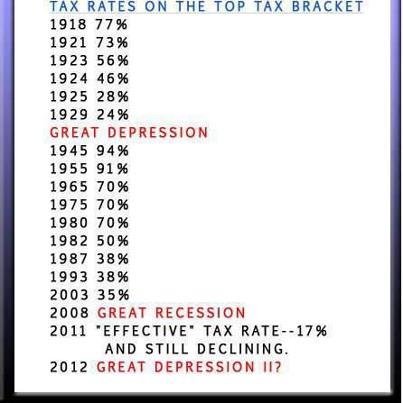
We were previously talking about the comparison between this politically manipulated chart (above) and this more complete one (below), along with some relevant history.

http://www.taxpolicycenter.org/taxfacts/displayafact.cfm?Docid=213

We had gotten to pretty much the middle of the Great Depression—the big blank part on the propaganda chart. What we know about that time was that taxes were high and wages were kept artificially high—both contributing to extended high unemployment and a sluggish economy stuck in a trough, instead of bouncing back. Added to this were seemingly arbitrary regulations interfering with various sectors of the economy. Unpredictability is another factor that prevents investment and job growth.
These things look familiar because we’re seeing them, close up, right now. And the administration just scratches its collective head and says, “We just need to keep doing more of the same until it works.” Please insert definition of insanity here.
Back to the timeline. Some people assume that the Great Depression ended with the outbreak of WWII in 1941. What happened then was that FDR stopped some of the micromanaging of the economy to focus on the safety of the nation in a dangerous world. (We can thank him for that; at least he valued the nation enough.) Resources had to go to military. Many workers, including the unemployed, went into the military, leaving openings in manufacturing and elsewhere that needed filling. So by some definitions, the Depression did end.
Are you familiar with the broken glass example? A vandal comes and breaks a baker’s window. The baker then employs a glazier to replace the window, so the glazier has more income, which he spends to by a suit. And so on, implying that the economy is better off because of the broken window. But this looks only at what is seen, not what is unseen. The baker was building up capital to buy a larger oven and hire more workers. But he had to use the capital on the window, which he wouldn’t have had to do without the breakage. So there was a loss in the economy to the baker, to his possible employees that didn’t get hired, and to the manufacturer of the new oven that didn’t get purchased. Those losses are unseen. The economy is actually worse off because of the unnecessary glass breakage. Thomas Sowell describes seen vs. unseen in his piece this week called “Jobs Versus Net Jobs.”  
The point here is that, while there was visible economic activity caused by WWII, the capital spending didn’t really grow the economy. Spending for the war was necessary, just as repairing the window would be once it was broken. But what helped the economy was getting FDR to stop getting in the way of it.
Progressives being what they are, they were merely more dormant during the war. What you have following the war is still extremely high marginal tax rates and more government interference. This is the period where people used the phrase, “To err is Truman.”
Right after the war the top marginal rates were dropped slightly, from an insane 94% to 86.45%, and then to 82.13%. Let’s be honest; a drop to 82.13%, while better than 94%, is still so confiscatory that no one capable of making the top level of income would pay it. Such a person would find the numerous loopholes placed there specifically for the purpose of avoiding payment. (Lobbying for specific favors was pretty much as described in the fictional version, Atlas Shrugged.) Or that person would set aside money in places that would not be considered income (trusts, investments, or just a jar buried in the yard), rather than keep earning income without getting to enjoy it.
The rate bounded up again to 91% and stayed there for a decade. There’s something to be said for stability. But, again, no one paid this rate. It brought in essentially no revenue. The data missing from the chart is what the rates were for the next couple of tiers lower, and how those near top earners responded to them; also missing is information about other government interference affecting stability in the market. As a rule, the more profit an earner can count on using, the more the earner is likely to risk it as capital investment—leading to economic growth.
You can see a steady and slightly lower 70% marginal tax rate from 1965 through the last Carter budget of 1981. (Back in the 73-74 recession, in those Republican years before Carter, unemployment was a painful 4-6%; yes, that was considered high back then, before Carter suggested we get used to a different version of normal.) Steadiness is a good thing. But, again, high rates mean high avoidance. And other government interference, such as price controls and regulation in chosen sectors, equals economic drag.
Then, under Reagan, despite a Democrat Senate and House, we see a drop in marginal tax to 50% then 38%, and further under Bush 41 to 28%. Recovery and economic growth ensued, disrupted only when Bush reneged on the “no new taxes” pledge. Revenues also went up, even with the much lower rates, offering evidence that Laffer is right. (Read about the Laffer Curve here and my piece on it here.) Rates went up under Clinton, but then they steadied with the coming of the election of a Republican House in 1994 (first time in 40+ years).
We had some recessions, and burst bubbles, during the last three post-Carter decades. But there is no evidence of any recession taking place because top marginal tax rates were too low. In fact, it is harder for Federal Reserve interference and federal government over-regulation to do their damage when the rates are kept low enough. That’s why it took until after 2006, when Democrats took control of Congress, before the build-up of meddling in the housing sector finally resulted in that bubble bursting.
Higher education costs are extremely high right now, without an equivalent payoff to consumers (students). Government interference has led to both the higher costs and the lower quality and value. Health care costs rise the more government interferes as well—which is why we must repeal the monstrosity so untruthfully titled the Patient Protection and Affordable Care Act. Both of these are likely to become bubble bursts rippling into recession conditions. No level of top tax rates, either high or low, would prevent the eventual bursts of any bubbles.
It comes down to this: if someone thinks low taxes cause recessions and high taxes are good for the economy, would you want such a person to get near any sector of the economy that you care about? Smart people just say no.

Thursday, September 15, 2011

Bubbles

A few evenings ago I had the opportunity to hear BobWiedemer (eventually available here), one of the authors of Aftershock, a bestselling book on the economy. His main point is that, rather than the usual image of business cycles, it is more accurate to view America’s economy, at least during the last couple of decades, as a series of bubbles. While being diametrically opposed to the supposed experts, Wiedemer’s group identified and predicted the dot.com bubble, the housing bubble, the rise in the value of gold, and others. One of his main points was that, unlike cycles, where things eventually turn around and get better again, after a bubble pops, it’s not coming back. 

He warns that it is a mistake to assume that because things have always been a certain way means they always will be. Experts assumed housing prices would always rise. But when Wiedemer saw an unusually sharp rise in housing prices, that was a clue that something wasn’t right. Turns out that, as it often does, the bubble happened because of interference with the market. Mortgage standards were forced lower, with the goal of putting more people into their own homes (particularly those previously identified as not financially ready to take on a mortgage). More buyers meant more demand, which meant higher prices, which meant attracting more builders to the booming market, which meant oversupply—and combine that with much higher default rates causing insecurity in a previously safe investment, and housing prices suddenly plummeted. The bubble popped. 
When the government sees a bubble that threatens to pop, its tendency is to avoid (postpone) failure by propping up the industry—purposely allotting greater resources where there capital has obviously been ineffectually used. This is what they did with the bailout of GM and various other entities back in 2009. A better way would be to pop a bubble quickly, when it’s still small. Then the capital becomes available for more promising purposes.  

Serious trouble lurks on the horizon when the economy is a series of interwoven bubbles, so that the outcome is likely to be a domino effect once they start to pop. 

Wiedemer’s group identifies the bubbles, and, when possible, predicts when they will pop. He says the current bubbles are government debt and the dollar. We’ve seen the charts. Debt slowly creeps up over the previous century, and then spikes during Bush’s term, followed by approaching the asymptote as soon as Obama takes over.  

When there is debt, one way government deals with it is printing money to pay for it. (This is something counterfeiters do too, but when government does it, we don’t jail them. Maybe that’s the problem.) Sometimes money isn’t actually printed, just electronically produced by selling treasury bonds, where numbers change on computers, but no actual money gets hefted from place to place. But this “printed” money doesn’t represent wealth (surplus representing work completed that society is willing to pay for). It’s like monopoly money. Well, technically monopoly money has the value of functioning in a certain way for the purpose of playing the game, which is something people are willing to pay for. But, anyway, this printed money isn’t “real,” in the sense we regular mortals think of real wealth. 

The usefulness of printing money to pay your debts is that it doesn’t take as much of that tedious work and wealth building to pay things off. Instead, you use the wealth you’ve already created and call it double that amount (or whatever increase). Your creditor might not be happy about receiving $1Trillion that represents only the work of $500 Billion or so. They will feel cheated. Not as cheated as if they get stiffed for the whole amount, but at some point they’re going to say, “You’re not worth lending to.” When they say things like that, it translates as, “Your Triple-A rating is being downgraded,” which happened last month. And that means, as a higher risk, we don’t get the lowest interest rates when we turn over the debt, but we pay something higher that is still adequate to persuade creditors to take the risk. And then we go ahead and pay with even-lower-value dollars, so they downgrade further and eventually refuse to lend to us at all. At which point any current debt isn’t payable—unless we drastically increase our dollar printing to pay off the debts with paper that doesn’t represent actual wealth.

So, what happens when government presses its luck and prints so much that the value of each dollar shrinks to something infinitesimally small? Hyperinflation. What are the signs that this could be on the horizon? Other countries don’t want to use the dollar as their base currency anymore—they don’t trust its value. (Although, so many countries have inflated their currencies that there isn’t an obvious replacement—which has been propping up the dollar for a while already.)  

Another signal is the price of gold. When we were on the gold standard, in theory you could go to your local bank and turn in your dollars (bank notes) in exchange for that value in gold. When that got too limiting for government experts (back in the 1960s), we left the gold standard, and the dollars are just backed by the federal government’s promise that the dollar has worth. So when we know the dollar represents a lower value, it buys less. So prices rise. Inflation.  

Gold is more stable. If you look at the amount of gold it takes to purchase a home, for example, it would stay relatively stable. But the dollars you would exchange for gold change as trust in the dollar changes. So, right now, while the value of the dollar is drastically shrinking, gold prices are drastically rising.  

He didn’t say this, but I think gold is a bubble. If you’re trying to protect the value of your savings, doing it with gold is a good way. If you started doing that at $300 an ounce, instead of now, even better. It looks like you’ve made huge profits. But actually the profits are in less valuable dollars. At some point you’ll need a wheelbarrow full of dollars in exchange for an ounce of gold. This “bubble” will continue as long as distrust of the dollar continues.  

But even gold has its limits. There is the following exchange about the value of gold in Terry Pratchett’s Making Money (I talked about it here). Moist von Lipwig is talking with journalist Sacharissa Cripslock. 

Moist: “What are we, magpies? Is it all about the gleam? Good heavens, potatoes are worth more than gold!”
Sacharissa: “Surely not!”
Moist: "If you were shipwrecked on a desert island, what would you prefer, a bag of potatoes or a bag of gold?”
Sacharissa: “Yes, but a desert island isn’t Ankh-Morpork!”
Moist: "And that proves gold is only valuable because we agree it is, right? It’s just a dream. But a potato is always worth a potato, anywhere. Add a knob of butter and a pinch of salt and you’ve got a meal, anywhere. Bury gold in the ground and you’ll be worrying about thieves forever. Bury a potato and in due season you could be looking at a dividend of a thousand percent.” (p. 108) 

In other words, even gold’s value is limited to either its usefulness or to whatever we decide to call its value. You can’t eat it. So in famine, when food is scarce, it will take more gold to buy a sack of flour. But it’s traditionally the best we’ve got for being a stable money base value. Certainly better than a piece of paper (or digital message) that the government no longer even claims to represent a given amount of work. 

What is going to happen? I don’t know. I’m just beginning to read the book. Maybe before it’s too late we will elect an administration that will stop the insane rise in debt and government spending. Then maybe trust will continue so that getting out of the bubble will be less painful than if it continues to grow before popping. Maybe we can keep enough trust in the dollar that hyperinflation and collapse won’t be the inevitable only way to stop the current practice. 

One thing in our favor is that we are used to being a free, hard-working, inventive and entrepreneurial people. Our behavior has always created real wealth. The system of exchanging that wealth is the problem—and it’s a big problem. But it’s not as big a problem as many countries face: a growing entitlement mentality. OK, we have that problem too. But maybe it’s not too late to pop that bubble quickly and move along with a better allocation of resources.