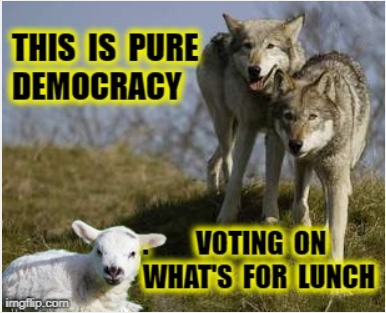
We’re going to cover three pieces of news, all related to
that election that happened three months ago, and yet are newly relevant:
·
There was a cabal that successfully affected
the election.
·
The proof of voter fraud, both of the
traditional corrupt type and the newer corrupt digital type, is now available.
·
Courts are finally beginning to consider
the evidence in voter fraud lawsuits, and a 2/3 majority are ruled in favor of
Trump or Republicans.
The TIME
Story
That news about the cabal isn’t from some conspiracy theory source;
it is from TIME Magazine, documenting what happened, as told by those
who did it, because they’re so proud of what they accomplished.
The TIME piece is called “The Secret History of the Shadow Campaign That Saved the 2020 Election,” by Molly Ball, with reporting by
Leslie Dickstein, Mariah Espada and Simmone Shah. It appeared online February 4th, and the print version is set to
appear February 15th. As the piece describes it,
This is the inside story of the conspiracy to save the 2020
election, based on access to the group’s inner workings, never-before-seen
documents and interviews with dozens of those involved from across the
political spectrum.
By “save,” they mean prevent Trump from winning. And by “across
the political spectrum,” they mean leftist/progressive Democrats along with some anarchists, with a few
never-Trumpers added in. They also say,
[T]he participants want the secret history of the 2020
election told, even though it sounds like a paranoid fever dream—a well-funded
cabal of powerful people, ranging across industries and ideologies, working
together behind the scenes to influence perceptions, change rules and laws,
steer media coverage and control the flow of information.
It runs close to 7,000 words, so a review here can’t cover
everything. But we can highlight what they’re so proud of. While I’ve
summarized, I’ve taken the info pretty much directly from the story; I’ve
highlighted my comments to differentiate them:
Overview
of What They Did
·
There was an informal alliance between left-wing
activists and business titans.
o It
stretched to Congress, Silicon Valley, and the nation’s statehouses.
·
They got states to change voting systems and
laws [to remove rules meant to prevent fraudulent votes].
·
They helped secure hundreds of millions in
public and private funding used to promote the voting changes, particularly mail-in
voting.
·
They recruited armies of poll workers.
·
They got millions of people to vote by mail for
the first time.
·
They successfully pressured social media
companies to take a harder line against disinformation [i.e., opposing
views] and used data-driven strategies to fight viral smears [i.e.,
opposing views, again].
Who Are
They?
·
The architect of the cabal is Mike Podhorzer,
senior adviser to the president of the AFL-CIO.
o He
brought together a group of liberal strategists in the early 2000s, which led
to the creation of the Analyst Institute, a secretive firm that applies
scientific methods to political campaigns.
o He
was also involved in the founding of the progressive data company Catalist.
·
Among the participants were the US Chamber of
Commerce and the AFL-CIO; and Maurice Mitchell, national director of the
Working Families Party. They also partnered with the Movement for Black Lives
and the Working Families Party.
·
Other actors included The Fight Back Table, a
coalition of “resistance” organizations.
o Many
leaders of the summer’s racial-justice protests were a key part of the liberal
alliance.
o They
did scenario-planning around the potential for a contested election, gathering
liberal activists at the local and national level into what they called the
Democracy Defense Coalition.
·
On March 3rd, Podhorzer drafted a
three-page confidential memo titled “Threats to the 2020 Election.” [By
threats to the election, or to democracy itself, they always mean a Trump win.]
The memo laid out four categories of challenges:
o Attacks
on voters [i.e., voters who commit fraud].
o Attacks
on election administration [i.e., election officials who commit fraud].
o Attacks
on Trump’s political opponents.
o “Efforts
to reverse the results of the election.”
The
Activities
·
Podhorzer began coordinating in October 2019. He
began hosting weekly 2½-hour Zoom meetings in April 2020, talking about which
ads were working, what messaging to use, and legal strategy, aiding
communication among various leftist groups who normally didn’t communicate.
·
Taking advantage of COVID-19 as a crisis, in
March the Leadership Conference on Civil and Human Rights led 150 organizations
to pressure Congress to steer COVID-19 relief to election administration,
including postcards encouraging mail-in voting and other alternatives.
o Private
philanthropy joined in this COVID-19 response effort on elections. The Chan
Zuckerberg Initiative chipped in $300 million.
o Amber
McReynolds, a former Denver election official who heads the nonpartisan
National Vote at Home Institute, which advised 37 secretaries of state plus DC
on such things as which vendors to use and where to locate drop boxes.
o McReynolds
also provided press materials used to convince the public on the importance of
absentee ballots for shortening lines at polling places and preventing an
election crisis [ meaning a Trump win].
·
The Voter Participation Center, instead of doing
get-out-the-vote canvassing, focused on getting people to vote by mail and
overcoming resistance, particularly by black communities that didn’t trust mail-in
voting.
o In August and September, it sent ballot
applications to 15 million people in key states, 4.6 million of whom returned
them.
·
Democrat lawyers fought pre-election lawsuits
contesting law changes and rule changes. [Note: many lawsuits were
dismissed for lack of standing, because damage had not yet been suffered by
plaintiffs. However, later lawsuits were dismissed for laches—being filed too
late for remedy, because problems should have been contested before the
election.]
The Media
Campaign
·
Laura Quinn, progressive operative who
co-founded Catalist, piloted a nameless, secret project that tracked
disinformation [i.e., opposing viewpoints] online and tried to
figure out how to combat it.
o Her
solution was to pressure platforms to remove content or accounts that spread
disinformation [i.e., opposing viewpoints] and by more
aggressively policing it in the first place.
·
In November 2019, nine progressive leaders met
with Mark Zuckerberg in his home, pressuring him to act against election-related
“falsehoods.”
o They
weaponized current rules, expanding beyond actual crimes, such as inciting
violence, to include the “dangers” of “false” ideas [i.e., opposing
viewpoints, again].
o Among
those present was Vanita Gupta, president and CEO of the Leadership Conference
on Civil and Human Rights, who also pressured Twitter CEO Jack Dorsey and
others.
·
They had a media message campaign to convince
voters:
o That
mail-in voting wasn’t susceptible to fraud.
o That
failure to finish the count on election night was to be expected.
o The
Voting Rights Lab and IntoAction created state-specific memes and graphics,
spread by email, text, Twitter, Facebook, Instagram and TikTok, urging that
every vote be counted [they mean every vote, not merely every legal vote].
Together, they were viewed more than 1 billion times.
o By
late October over 70% of Americans did not expect to get election results on
election night.
Hair-Trigger
Timed Riots
·
Activists prepared to reprise the summer’s demonstrations
if Trump claimed to win the election.
o This
included 150 liberal groups: the Women’s March, the Sierra Club, Color of
Change, Democrats.com, the Democratic Socialists of America, all joined the
“Protect the Results” coalition.
o The group’s now defunct website had a map listing 400 planned
postelection demonstrations, to be activated via text message as early as November
4th. [I highlighted this, because it shows their
control over mob violence, which they intended to launch as needed. Meanwhile,
they’re impeaching Trump for violence at the capitol that he did not cause.]
o The
summer’s racial-justice protests had sent a signal to business owners about the
potential for economy-disrupting civil disorder, which led to the US Chamber of
Commerce’s connection about a week before the election. [Notice the
similarity to mafia protectionist racketeers: “It would be sad if something
happened to your place; we’ll protect you—in exchange for a little something.”]
·
Podhorzer held an 11:00 PM Zoom call election
night. He knew that polls had underestimated Trump’s support but promised that
election-day voting would be overcome with mail-in votes.
o Those
on the call carefully prepared timing of planned protests.
o Protect
the Results announced that it would “not be activating the entire national mobilization
network today, but remains ready to activate if necessary.”
o Twitter
continued to allow upset progressives to converse about how to stop the Trump “coup”
[i.e., win of the count at that early point, or challenge of the
irregularities]. They wanted violence.
o Protect
the Results altered protests into a weekend of celebration. “Counter their
disinfo with our confidence & get ready to celebrate.”
Post-Election
Day
·
Biden victory was declared by the media on November
7th. After that came:
o
Winning the count.
o
Winning the certification.
o
Winning the Electoral College.
o
Winning the transition.
·
At 10 PM on Election Night, poll watchers
arrived at the TCF Center in Detroit. Within 45 minutes progressive reinforcements
arrived and were added to email chain for updated instructions.
o Reinforcements
included racial-justice activists from Detroit Will Breathe and Fems for Dems,
working alongside local elected officials.
o The
media strategy messaged “the people’s right to decide, demanding their voices
be heard and calling attention to the racial implications of disenfranchising
Black Detroiters.”
·
When President Trump invited GOP state house
leaders to the White House to talk, Protect Democracy’s local contacts
researched pressure points to keep the lawmakers’ from being persuaded to act
on fraud and irregularities.
o Activists
scanned flight schedules and flocked to the airports on both ends of Michigan lawmaker
Shirkey’s journey to DC. Michigan was key to preventing other states from
failing to certify questioned election results.
o A
street artist projected the state lawmakers’ images onto the outside of the Trump
Hotel building on Pennsylvania Avenue, along with the words “THE WORLD IS WATCHING.”
o Activists
flooded the livestream of the canvassing board meeting, using the Twitter hashtag
#AllEyesOnMI.
·
According to the TIME story, all
progressive activists were told to scrupulously stand down on January 6th.
That meant any mayhem would be blamed on Trump supporters.
o Business
leaders denounced the Jan. 6th attack and vilified the lawmakers who
refused to certify Biden’s victory.
And Now
·
Podhorzer and his allies are still holding their
Zoom strategy sessions, gauging voters’ views and developing new messages.
Media and social media censorship continue.
·
Trump is in Florida, about to face his second
impeachment trial, deplatformed from his Twitter and Facebook accounts.
The piece ends with this:
Democracy won in the end. The will of the people prevailed.
But it’s crazy, in retrospect, that this is what it took to put on an election
in the United States of America.
The “will of the people” does not mean what you think it
means; it means the will of these people. And this is where we’d better
define terms, in order to translate.
Democracy, at the time Tocqueville wrote Democracy
in America, in the 1820s, wasn’t referring to a form of government, but to
an egalitarianism—no elite ruling over the plebians. Anyone was equal to anyone
else, and was just as entitled to rise to the top of his business or other
sector of influence.
When these people refer to democracy today, it is clearly
not that; they mean forcing the plebians (us deplorables) to submit to the ruling
elites in government, media, academia, and business.
We know it isn’t even rule by the majority, which they claim
they favor, because they want to ensure than only the elites’ choices are made,
regardless of the voting will of the people. But they do put a fair amount of
effort into persuading the plebians to go along with the elites’ choices—by preventing
any opposing viewpoints from getting through.
What they claim to have done was save America from “an
autocratically inclined President,” ironically failing to see the fascistic,
totalitarian thought control and corruption they use to do it. Also ironically
failing to notice that Trump’s actions throughout his four years were decidedly
not autocratic or authoritarian. But it helps their narrative to paint him as
Hitler, without letting little things like facts get in the way.
They claim their efforts were “dedicated not to winning the
vote but to ensuring it would be free and fair, credible and uncorrupted.” But
their admissions actually show that they were about “winning the vote” at all
costs, particularly at the cost of free and fair elections—and at the cost of
trust in the election process going forward. Ironically, they blame Trump for
the lack of trust they could have solved simply by being trustworthy.
Joshua Philipp, on his January 7th Crossroads
episode, talked about this weird story:
You have conspiracy here. And what do you call it when groups
working together for more than a year in a conspiracy to change the outcome of an
election, have been found to have coordinated on it—again, what do you call
that? That’s a coup. That’s sedition. It’s what they’re accusing Trump of doing
right now.
Something about a cabal, a secret conspiracy, a secret pact,
and totalitarian censorship just doesn’t give off the “credible and uncorrupted”
vibe they say it does. They are so out of touch that they think their collusion
admission is noble.
Rather, it corroborates what Trump voters already knew, but non-cabal-participating
Biden voters did not. Maybe you should tell them.
Here are a couple of good legal discussions of this TIME
story:
·
“Time Magazine Releases Information About the Secret 2020 Election Shadow Campaign” Robert H. Gruler, Feb. 5, 2021.
·
“The Times Elections Exposé is STUNNING” Viva
Frei Vlawg, Feb. 6, 2021.
Absolute Proof
Already I’m writing too long. I hate when that happens. One
of the big news stories of the week was the excellent documentary put out by
Mike Lindell, called Absolute Proof. It is a little under two hours.
It has been banned from YouTube and Vimeo, but not before
getting 10 million views. And it continues to spread better than any previous
collection of voter fraud evidence. You should be able to get it directly at
MichaelJLindell.com.
The first portion goes over the more-or-less traditional election
fraud, which is mainly what the cabal of the TIME story was involved in.
There’s plenty of that. The following screenshots show the known fraudulent
votes totals of those types in the six battleground states. Notice that each state far exceeds the margin of victory.
Arizona
 |
Arizona voter fraud and irregularities
screenshot from here |
Michigan
 |
Michigan voter fraud and irregularities
screenshot from here |
Nevada
 |
Nevada voter fraud and irregularities
screenshot from here |
Pennsylvania
 |
Pennsylvania voter fraud and irregularities
screenshot from here |
Wisconsin
 |
Wisconsin voter fraud and irregularities
screenshot from here |
Georgia
 |
Georgia voter fraud and irregularities
screenshot from here |
Those of us who have been paying attention have seen this evidence.
It has also been catalogued by the Navarro Report, the Epoch Times documentary,
and various other places we’ve referred to before. In normal times, this
evidence would have prevented those six states from certifying until the
questions could be cleared up and the actual outcome known, if it is possible to know. But
these are not normal times.
Later in the documentary there is additional proof, of the more
technical type of voter fraud. The other sources have mentioned this as well.
People keep claiming it’s a conspiracy theory, and that, “you haven’t provided a
shred of evidence.”
OK. Challenge taken. Lindell brings in the experts to lay it
out.
They demonstrate that they have every instance of information
exchange catalogued. They can show what IP address (what individual computer)
made what contact to an election system, even down to the precinct level, what
changes were made, whether they were attempted only or whether they succeeded
in making the change.
And they have mapped each individual incidence of that interference
on a global map. An outsized amount comes from China, but there are plenty of
other locations involved.
 |
map showing real time election interference from global locations
screenshot from here |
They explain pretty carefully how they got the information,
and how they know it is accurate. It would very likely hold up in a court of
law.
Mike Lindell says that, now that the evidence is out—where he
believes even the nine Supreme Court Justices have by now had a chance to view
it, as well as the general public—the obvious need to clean up our elections is
something we can unite behind. (I think he's overly optimistic, but I like that in a person.)
He doesn’t call for Biden’s ouster and Trump’s
reinstatement. He is simply about putting the evidence out there, in the hands
of the public.
Of course, then he’s censored. I suggest you view it
directly from his site. And download it as a historical record.
The Court
Cases
I was listening to a Jordan Peterson podcast of his
conversation with Douglas Murray, recorded in January.
During their far-ranging discussion, they talked about the US Presidential
election, from their Canadian and British outside views. Jordan Peterson said
that the biggest evidence that Trump was wrong about election fraud was the
mass of cases thrown out of court. So many of them—all thrown out. That's what the media has told them.
If you’re paying attention here in America, you might know
that those cases that were thrown out were on lack of standing or some other
technicality—without looking at the evidence. That has been frustrating. But, failure
to look at evidence does not equal lack of evidence. (See Lindell’s movie,
referenced above.)
Justice tends to be slow and not always satisfying. But
there has been some progress.
Citizen journalist John Droz, Jr., described as a physicist
and environmental advocate from North Carolina, has been tracking the 2020 Presidential
Election lawsuits, on his publicly available spreadsheet, updated as of
February 6th.
According to an Epoch Times story,
Of the 81 cases, 11 were withdrawn or consolidated and 23
were dismissed for lack of standing or on other grounds. Both the cohort of 11
and of 23 should not be considered “wins or losses for either side,” Droz says,
because they “have nothing to do with the merits of the case.”
This leaves 47 cases. Of those 47, 22 have been finalized
after the court heard arguments, considered evidence, and then issued a ruling.
Of those 22, Trump or Republicans won 15 and lost 7,
according to the analysis.
This leaves 25 lawsuits that have yet to be finally disposed
of.
Winning two out of three isn’t a bad start. I’m guessing
that’s not what you’re hearing in the uncensored news.
Included in those 25 remaining lawsuits, the Supreme Court on
Friday announced they had scheduled hearing several of the highest profile
cases on February 19th. These are Sidney Powell’s Michigan case, Linn Wood’s Georgia case, and Rep. Mike Kelly’s Pennsylvania case, plus a couple of others. (Read this Epoch Times piece on them.)
These specific cases all allege illegalities that affected
the outcome, such as expanding mail-in ballots against state law, failure to
provide adequate security measures around mail ballots, issues with machine
vote tabulation, and denial of meaningful access to poll watchers. I don’t know
whether the “machine vote tabulation” part will include the evidence shown in
Mike Lindell’s video. Regardless, the Court is not likely to actually hear the
cases before October 2021. That means not until the next session, which ends around June 2022.
Conclusions
So, what have we learned today? Things we knew, but now with
more certainty:
·
Truth comes out.
·
Justice is not swift.
·
If the enemies of the Constitution are accusing
our side of something, they’re doing it.