Showing posts with label words have meaning. Show all posts

Thursday, September 7, 2023

Democracy—It Doesn’t Mean What You Think It Means

Control of words is control of a whole lot more—thought, communication, and often action as well.


"How strangely will the Tools of a Tyrant pervert the plain Meaning of Words!"

~ Samuel Adams


There are plenty of examples of the tyrants among us controlling us with words. One technique is to change the meaning of words while allowing the masses of us to keep the old definition in our heads, because that is to the tyrants’ advantage. A recent example is the word vaccine. [Don’t worry; that’s not today’s topic, just this paragraph’s example.] Originally, it was a preparation, a medical intervention, that would create immunity by exposing the body to a milder form of the pathogen. It was intended to be a “safe” way of experiencing the disease with the intent that the person receiving the intervention would develop antibodies without having to suffer the actual disease, and this would also prevent contracting the disease in the future—typically for many years. What was imposed upon us in late 2020 did not prevent contracting the disease. It’s hard to say those who got it suffered a milder version than they would have—because it’s not possible to compare current life to a hypothetical alternate life. Additionally, it turned out that it was neither safe, effective, nor in actuality a vaccine. But they used the word vaccine so that you would respond as if it were the traditional definition.

OK, that’s an example of the change-the-definition-without-telling-anyone technique. Now, the word being controlled by the tyrants that I’d like to look at today is democracy.

It comes from Greek. Demos means municipality, or the populous. The -cracy part of the word means government. So, it’s government by the people.

The online dictionary translates the Greek for democracy as republic. In other words, the idea of a democracy is a state or entity ruled by the people, either directly or through elected representatives, according to my 1982 dictionary.


from Webster's New World Dictionary, Second College Edition, (c) 1982

 During most of my life, I personally thought of the words republic and democracy as essentially interchangeable, although the Republican and Democrat Parties were always clearly different. But historians, particularly conservative ones, are more vocal today in pointing out the differences between the two types of government. A democracy, meaning direct vote of the people and the majority rules, is quite different from a republic, in which the people vote for representatives, who theoretically do the necessary deep dive into issues to determine how to vote on behalf of their constituents.

The thing that sets a republic apart is the rule of law. Particularly in the United States, neither representatives nor people directly can vote for government to do something that has not been granted as a power to the government. The law is a limit.

In a pure democracy, whatever the majority decides is what government does. There are various metaphors to explain the folly of this. One is that democracy is when you have two wolves and a sheep voting on what’s for lunch.
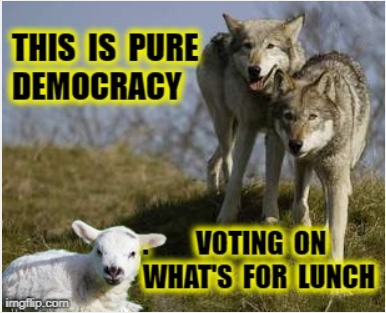

image found here

Here’s a quote from my files: 

“Democracy cannot exist as a permanent form of government. It can only exist until the voters discover they can vote themselves largesse out of the public treasure. From that moment on, the majority always votes for the candidate promising the most benefit from the public treasury, with the result that democracy always collapses over a loose fiscal policy, always to be followed by a dictatorship, and then a monarchy.”—Alexander Fraser Tytler

 So, there’s a difference between a republic—particularly a constitutional republic—and a democracy.

However, here is what has been happening to the word democracy.

1.      The public has the idea that democracy is interchangeable with republic; it just means the power comes from the people, who express their views by voting, mainly, and also by contacting their representatives.

2.      The ruling elites—who happen to be associated with the Democrat Party, mostly, but not fully limited to them—use the term to mean our system of government, or our country as we know it.

3.      The ruling elites separate our system of government from the Constitution and the rule of law, and have it mean the way things are done by us. But they do not yet explicitly change the definition for the people.

4.      The ruling elites start using the term our democracy to mean our regime. They are counting on the public retaining the definition as our system of government, but they do not mean that.

It would be concerning enough if this is where they stopped. But the way we—and everybody else in the world, practically speaking—have a people voice their will to government is through voting. This has always been to the advantage of the democracy advocates. Think of them as the wolves, rather than the sheep in the metaphor. If they can control the message that gets to the voters, then they control the outcome. That is why controlling the message has been so important to them—through censorship and the other many ways we’ve seen, particularly in the last half decade.

But the ruling elites have been facing difficulty in totally controlling the message they want the voters to hear—because of pesky alternative platforms and means of communicating with one another. They censor more vigorously. And they deride all those alternative voices as “extremists” and “conspiracy theorists.” But still, they can’t control the message well enough to determine the outcome of an election. Voters who have found their way to alternative opinions are not controllable in the way “sheeple” are.

And let’s just add here that the ruling elites have tried controlling the outcome of elections by disregarding the actual will of the people—through fraud in varied forms and myriad locations. That’s a topic for another day.

But they cannot count on a people who would not vote them out of their positions of power—no matter how often they cry out that any disturbance to their power means “the end of our democracy.”

So the next step is to discount voting as the means to maintaining “our democracy.”

Coincidentally (and there are likely no coincidences in these things) two major publications had opinion pieces on the same day, August 21, saying that voting isn’t all it’s cracked up to be; maybe we ought to find another way. [In case you’re blocked by paywalls, both pieces are summarized here.] 

The New York Times piece, by Adam Grant, was originally titled, “Elections Are Bad for Democracy.”  After much online scorn, it was changed to “The Worst People Run for Office. It’s Time for a Better Way.” But the first title is really what was intended, especially if democracy means our regime. He suggests that choosing random leaders would give us better results than choosing from among the multiple bad choices of those who run for office. So let’s come up with a better way. He suggests maybe a lottery.

There are times, I admit, when I’ve thought selecting out of the phonebook (assuming there still is such a thing somewhere) would yield better leaders than we get through elections. But the solution isn’t less voting; it’s more informed voting. We need less censorship and more open debate.

There’s a clue in the wording of the end of the piece:

"As we prepare for America to turn 250 years old, it may be time to rethink and renew our approach to choosing officials. The lifeblood of a democracy is the active participation of the people. There is nothing more democratic than offering each and every citizen an equal opportunity to lead."

Our way of doing things is archaic, he implies. But offering every citizen an equal opportunity to lead is democracy; not everyone having an equal vote. Hmm.


illustration found with The Atlantic piece

The other piece, “Americans Vote Too Much,” by Jerusalem Demsas, for The Atlantic, tells us that all those pesky local jurisdiction elections are low turnout anyway. People just can’t be bothered. In fact, our form of government expects too much of us. It’s a full-time job to stay informed, and most people do the sensible thing and tune out.

I do agree that there are too many separate elections. Sometimes the ruling elites (even the local ones) insist on off years and odd dates—so that they can control the outcome more easily, because fewer people are paying attention. But I think putting the elections on normal voting days makes sense. We already have a long ballot here in Harris County—the biggest in the country, I think. But we do tune in and try to get information, fill out our sample ballot and all, before we go to vote. Many people just don’t notice when there’s some special early May election at some odd place.

Demsas ends his piece with this:

"Giving power to the people is sometimes conflated with giving people more access to government decision making through, say, community meetings or ballot measures. But if only a small, unrepresentative group of people are willing to be full-time democrats, then that extra ballot measure, election, or public meeting isn’t more democracy; it’s less."

Ok, so his assertion is that more is less, and less is more. “Giving power to the people” isn’t something government has the right to do; the people inherently have the power, which they delegate in limited ways to government. In that phrase, who is giving the power? Democracy—or the ruling elite, as we would do well to define it? I don’t see that as a better option.

I don’t have a solution. I try to do my part, educating myself, and then sharing what I’ve learned so others will be better informed after reading my research. I guess that makes me part of “a small, unrepresentative group of people willing to be full-time democrats/republicans.”

When Demsas argues that more participation by people willing to be vigilant “isn’t more democracy; it’s less,” what does he mean there by democracy? It’s not really the will of the people. He may want you to think that, but what I think he means is the ruling elite. I think there’s a subtext saying, “You plebians ought to get out of the way of the ruling elite. It’s too much for you. Let us make all your decisions for you.”

It's not your grandmother’s democracy anymore.

Watch the words. That’s the tyrants’ means of attack.

Monday, May 24, 2021

Words Have Power

Words are the things we use to convey ideas. Words have meaning. If you have command of language, that’s a kind of power. But we don’t usually think about the dictionary writers as powerful. Mostly we don’t think about them at all.

Mr. Spherical Model and I watched a movie the other night about the creators of the Oxford English Dictionary. I’m undecided about recommending it, called The Professor and the Madman., with Mel Gibson as Professor James Murray, and Sean Penn as the madman, Dr. William Chester Minor. It was well done as a film, but because Dr. Minor (apparently in real life, according to the end credits) was seriously deranged, some scenes were hard to stomach. Anyway, Professor Murray was a Scottish autodidact, fluent in so many languages and dialects I couldn’t count them. And he happened to be kind of obsessive about tracking down the changes in the use of each word. It was a herculean task.


OED lexicographer James Murray (left)
and OED contributor Dr. William Minor
images from Wikipedia, here and here

One approach was to enlist the reading public. He had a note placed inside books sold in bookshops, asking people to note words and their usage, identifying quotes where they were used, and send them in. One of these notes ended up in the hands of a man in an insane asylum, who was very smart (a former surgeon) with plenty of time on his hands. So he made huge contributions to the work.

If you go ahead and watch it, you’ll notice that, when a word skipped a century or so and then reappeared, that didn’t mean the word actually disappeared; they just hadn’t discovered how/where it was used during those centuries. Professor Murray wouldn’t let go; he just kept up the search until they found the links they needed.

The end credits mentioned that they were putting out about 750 pages a year, moving through the alphabet. I think they got up to around M by the time Murray died in 1915. Dr. Minor, out of the asylum and returned to America, continued to contribute until his death in 1920, when the project was up to about T (I’m going by memory, so I may be off by several letters for each of them). Begun in 1879, it took until 1928 to complete.

This was the unabridged version—everything there is to know or ever was known about each word; it ran twelve volumes, and defined 414,825 words. Most dictionaries are abridged. They’re about giving you a quick answer to the basic question, “What does this word mean?” There’s minimal history, pronunciation guide, parts of speech, and useful meanings.

I don’t know who decides what gets into a dictionary and what gets abridged (left out). Lexicographers are the people getting paid to do the tasks, and I assume there’s some sort of hierarchy of decision-making as in most fields.

But what you would not expect is for a dictionary to delete a definition that is still fully in use—and is in fact the standard meaning most speakers of the language assume when they hear the word.

But that is what has happened with this word: racism.

Joshua Philipp brought this up on his Crossroads Q&A[i] last Thursday. He brought up a screenshot of the current 2021 online Merriam-Webster Dictionary for the word racism. It shows three main definitions:

1.    a belief that race is a fundamental determinant of human traits and capacities and that racial differences produce an inherent superiority of a particular race.

2.    a. the systemic oppression of a racial group to the social, economic, and political advantage of another.

2.    b. a political or social system founded on racism and designed to execute its principles.

If you think about it, what you’ll find missing is the most common understanding of the word: racial prejudice or discrimination—essentially pre-judging someone negatively based on their skin color or race.

I often pull out my older dictionary for historical perspective: Webster’s New World Dictionary, Second College Edition, printed in 1982. In that one racism’s first meaning refers us to the variant racialism, which has given way over the years to racism. But the main definition there says:

1.    a doctrine or teaching without scientific support, that claims to find racial differences in character, intelligence, etc., that asserts the superiority of one race over another or others, and that seeks to maintain the supposed purity of a race or the races.

Then there’s a second meaning only under racism:

2.    any program or practice of racial discrimination, segregation, etc. based on racialism.


from the Webster’s New World Dictionary, Second College Edition, 1982


1.    Why does the deletion of this basic meaning matter? It’s a bait and switch. They can’t implement policies against people based on their skin color and not be racist—unless they delete that definition and pretend the word means some systemic societal flaw. As Joshua Philipp puts it:

Why did they have to remove that? Again, in order to frame these new narratives. Because, folks, they are conducting racial prejudice and discrimination through these policies. And, as a reminder, the way they altered it, they removed that, the way they altered it is by saying it includes now, instead of that, systemic oppression of a racial group to the social, economic, and political advantage of another.

They’re talking specifically here about the social systems that they could say creates oppression—socially, economically, and politically. Political disadvantage, meaning that any kind of system of lacking equity—equality of outcome—could be defined as racism.

In other words, folks, they’re saying that anything that’s not socialism is racist. Anything that does not create absolute equality—equity, equality of outcome—is racist.

They’ve defined racism by removing the actual definition of the word: racial prejudice or discrimination. They altered it to make it so that anything other than equality of outcome is racist. To make it so, again, that anything other than socialism is called racist.

You might recall that, in my last post, we saw a similar bait and switch with the term white supremacy. In the minds of most people, it’s still a fringe group of people who hate anyone not of their race—a fringe so tiny most of us have never met one. Yet we’re told, with alarm, that white supremacy is everywhere and affects everything. But the definition being thrown at us is, “related to a society that historically had a majority of white-skinned people.” That means liking Shakespeare is white supremacy. Admiring the teachings of Aristotle and Plato is white supremacy. They’ve rendered the term meaningless, but throw it around hoping the stigma of the original definition will stick.

Racism is yet another term that uses the stigma attached to the tiny subset—in this case people who practice prejudice or discrimination based on race—and smear a whole group with it: all whites. And since people don’t want to be thought of with that horrible stigma, they do whatever the word-wielders say they must do. And that’s getting pretty extreme. After all, if your whole system is built on something as vile as racism (not on prejudice or discrimination really, but on a system that may produce unequal outcomes, yet with the stigma of the former), then you tear the whole system down and replace it.

Marxism was set up to malign the system based on class hatred. Oddly, that’s a hard sell in America—since we’re based on the idea that all of us humans are created equal, without a nobility, aristocracy, or monarchy, and also no bourgeoisie or plebeians. And it couldn’t merely be about economic class hatred, because economic class mobility is the expectation in America. So the replacement for class and wealth hatred is race hatred—often extended lately to other minorities, in a Venn diagram showing where they intersect, because intersection means more power, but we’ll leave those for another day.

I took a screenshot of the BLM website “What We Believe” page last August,


when everyone was using Black Lives Matter as a way of saying, “I’m not prejudiced or discriminatory based on race,” when its real intent was the destruction of society and replacement with Marxist tyranny placing them in the ruling positions. Among the word salad of things that may not mean what you think they mean was the deadly serious declaration that they intended to do away with the nuclear family structure—disregarding all the calamities that happen when the family is damaged—and replace it with a communal structure. On other pages of their website they openly revealed their Marxist and socialist philosophy and intentions. It was not about declaring you weren't prejudiced or discriminatory toward blacks, as many protestors thought.

Marxism has always been about tearing down the existing society and forcing on it a tyranny that they call equitable, but is really just more power and money for the very few at the top and much less for all the others. That’s why they don’t flinch when a leader who declares herself a trained Marxist has multi-million-dollar mansions.

The thing about language is, you can’t actually change it just by including or excluding a word in a dictionary. Language is made up of the words people use to represent ideas.

But what you can do, if you have ways of pulling the strings, is use a different definition while you know the person you’re talking to is using the well-understood definition, and you attach additional baggage to the word. And eventually, when someone gets confused and goes to the dictionary, which you’ve manipulated, you say, “See, this is what it meant all along; you were just mistaken.”

The lie, this time, had to include people in power over the dictionary—at least a particular dictionary. I don’t know how they managed that. But if they—whoever they are—can change the language at their bidding, that should give us pause.

There’s a scripture I think applies. This is from the book of Jacob, in the Book of Mormon, the first time those ancient people encounter an anti-Christ:

And he was learned, that he had a perfect knowledge of the language of the people; wherefore, he could use much flattery, and much power of speech, according to the power of the devil.—Jacob 7:4

the story of Sherem the anti-Christ from Jacob 7
screenshot from this video portrayal

I’ve often thought about this verse, since words are my minor superpower. I think it’s a good thing to have skill in use of language—for telling the truth. But the enemy of truth, maybe especially in our day, uses power of speech as a weapon.

I’m still thinking through how to fight that weapon. Notice it. Call it out. Require definitions. Ask sincerely, “Why do you think that?” But do not concede. Do not give up words and their truthful meanings.


[i] The link is for EpochTV.com. While a large part of the program is available on YouTube, this segment was toward the end, saved for the membership site.

Monday, January 11, 2021

Words Have Meaning

Words are important to me. They are a tool I work with. They also happen to be useful in conveying what is in one person’s mind to another person’s mind. Words are closely connected with thoughts. So when someone controls words in an attempt to control thoughts, that is a very intrusive and serious form of tyranny.

There are various ways of resisting thought/word control. Logic—which will include dictionaries, word histories, and modern usage. Refusal—which includes ignoring attempts at control and maybe rebellious increase in the condemned word. And humor—including mocking.

I’m not comfortable with mocking—particularly of individuals. But there are certainly ideas ridiculous enough to be worth mocking. And maybe humor is a better response to the ridiculous than many other ways. I wish I were better at responding with humor. (New Year’s goal, maybe.)


Cartoon found on Facebook


Let’s start this discussion with a personal story. We have a relative, someone rather tangentially connected by marriage for now, who has changed her name. She didn’t have an ugly name. The claim was it was to avoid stalking by a family member of hers, but she afterward reconnected with the very person who had always given away her location in the past. So—that was stupid.

I’m altering her name in a way that allows me to talk about the idea without giving any identifying info. Let’s say she changed her first name from Amanda to Ivorson—no, not spelled like that. Her soon-to-be-ex accidentally spelled it that way and got a chewing out. It’s Ivorsen—because she doesn’t want the male word “son” in there, because men are horrible.

When I was told this, I said, “So she wants her name to mean ‘son of Ivor’ in Norwegian instead of ‘son of Ivor’ in Swedish?” Because that is the difference between "-sen" and "-son." If you don’t want the name to mean “son of” the father, then you use the suffix “dotter.” As in Ivorsdotter (sometimes spelled dotr, depending on the country). The names are literal that way. I have in my family files a woman whose surname is Andersdotter; she is the daughter of Anders Jonson—who of course is the son of Jon something. That’s how it works in Scandinavian family history.

So Amanda/Ivorsen went to the trouble of legally changing her name and had no idea what the name she was choosing meant. (She also changed her last name, but I literally can’t even remember to what, because it also had no particular heritage or meaning.) The irony is that she insisted some years ago that the family leave a nice home and steady career in Texas, because she couldn’t stand the lack of intellectuals here (including us, apparently).

Next story. A week ago the representative, a former pastor, who opened the 117th Congress with prayer ended it with “Amen and Awomen.” Seriously. You can’t make this stuff up.

Urban Dictionary: Awomen

A bastardized English-Hebrew term that translates to "I am an idiot," commonly used in the Hebrew phrase "amen, and awomen," which translates to "I am an idiot, and so be it." It is also used colloquially, to express strong ignorance of Judeo-Christianity.

The term “Amen,” as you may be familiar, is a common way to close a prayer or as a term of agreement, meaning in Hebrew “let it be so.” It is unrelated in every way to the English word men, which is the plural of man, which can mean a male of the human species, or sometimes more broadly to mankind, or humankind, including both males and females.


found on Facebook

Doing stupid things tends to bring about unintended un“woke”consequences. This made me laugh:

Meme found on Facebook

In that spirit of humor, I thought it might be fun to point out how ridiculous altering “men,” “man,” “him,” “his,” “son,” and other word parts from the language would be.


Word unrelated to maleness

Femalized version of the word

Meaning of the femalized version of the word

Abdomen

Abdowomen

I am an idiot and don't understand how to use words.

Abridgement

Abridgewoment

I am an idiot and don't understand how to use words.

Acumen

Acuwomen

I am an idiot and don't understand how to use words.

Amanda (name)

Awomanda

I am an idiot and don't understand how to use words.

Bison

Bidaughter

I am an idiot and don't understand how to use words.

Boson

Bodaughter

I am an idiot and don't understand how to use words.

Commensurate

Comwomensurate

I am an idiot and don't understand how to use words.

Consonant

Condaughterant

I am an idiot and don't understand how to use words.

Demand

Dewomand

I am an idiot and don't understand how to use words.

Frisson

Frisdaughter

I am an idiot and don't understand how to use words.

History

Herstory

I am an idiot and don't understand how to use words.

Histrionics

Herstrionics

I am an idiot and don't understand how to use words.

Humanitarian

Huwomanitarian

I am an idiot and don't understand how to use words.

Hymen

Hywomen

I am an idiot and don't understand how to use words.

Hymn

Hermn

I am an idiot and don't understand how to use words.

Judgment

Judgwoment

I am an idiot and don't understand how to use words.

Maneuverable

Womaneuverable

I am an idiot and don't understand how to use words.

Manilla

Womanilla

I am an idiot and don't understand how to use words.

Mansion

Womansion

I am an idiot and don't understand how to use words.

Mantel

Womantel

I am an idiot and don't understand how to use words.

Manual

Womanual

I am an idiot and don't understand how to use words.

Manufactured

Womanufactured

I am an idiot and don't understand how to use words.

Mensch

Womensch

I am an idiot and don't understand how to use words.

Mental

Womental

I am an idiot and don't understand how to use words.

Mention

Womention

I am an idiot and don't understand how to use words.

Necromancy

Necrowomancy

I am an idiot and don't understand how to use words.

Nomenclature

Nowomenclature

I am an idiot and don't understand how to use words.

Permanent

Perwomanent

I am an idiot and don't understand how to use words.

Roman

Rowoman

I am an idiot and don't understand how to use words.

Romantic

Rowomantic

I am an idiot and don't understand how to use words.

Semantics

Sewomantics

I am an idiot and don't understand how to use words.

Sonar

Daughterar

I am an idiot and don't understand how to use words.

Sonic

Daughteric

I am an idiot and don't understand how to use words.

This

Thers

I am an idiot and don't understand how to use words.


Thank you, Babylon Bee, for playing the game:


from The Babylon Bee, found here


It turns out, if you’re playing Scrabble, you can go online and search for words that contain certain letters. Depending on your source, there are around 6525 words that contain “man” and 5883 that contain “men.” The vast majority of these words have nothing to do with maleness.

In many languages, nouns have gender, which determines the article that goes with them. Some nouns apply to men and logically have a masculine gender, like “el hombre,” which means “the man” and has the masculine article “el.” Some have nothing to do with who uses them, but are simply a result of the way the language developed, like “la mesa,” which means “the table,” with a feminine article for reasons that have nothing to do with the femininity of tables in general. There is not a numerical preference for either male or female gendered nouns; they’re about equally distributed.

If you’re going to go about your life looking to be offended by a set of letters, and you assign a meaning to those letters that the rest of humanity does not share, you not only fail to communicate, you simply have a stupid way of going through life, making yourself and those around you miserable.

But this is all part of a larger issue: freedom of speech. The representative who gave the “woke” prayer and is being ridiculed for his stupid misuse of the language will not be censored for it; by other would-be "woke" folk, he is admired. But if I say the un“woke” truth that there are only two sexes for human beings, I could get censored, deplatformed, doxed, and prevented from making a living. That more serious issue is something we’re likely to encounter more and more in upcoming days—if we can keep finding a place to talk about it.