Showing posts with label business success. Show all posts

Friday, July 20, 2012

Still Dancing the Backward-Step-Pivot-Forward

One thing we learned about Romney during the primary debate season was that he was good under attack. Better than when he’s not under attack. When everybody starts to worry that he can’t handle it, something magical happens, and he comes out ahead and stronger.

We talked about this back in January. Somebody who knows a lot more about debate than I do described it as the Backward-Step-Pivot-Forward move. He defends himself (the backward step), then turns (pivots) and makes what looked like a weakness into an offense on his own terms (forward). I think that’s what we saw this week. (Jennifer Rubin used the word “pivot” in this piece Tuesday, which clued me in to what we were seeing.)
Everyone was so concerned about Romney under attack for being rich and successful. How was he going to defend against the onslaught of “Bain Capital outsourced jobs” and “Why doesn’t he give us several decades of tax returns? What is he hiding?” Then, fortuitously, Obama goes off teleprompter and says the offensive “You didn’t build that” line.

Without even knowing what hit him, Obama was on defense in a big way. Some of it would have happened regardless of the opponent; Obama is just tone deaf about how to talk to actual business builders. But what Romney and campaign have done is point out that, “this wasn’t a gaffe; it’s his ideology.” That is the defense, pivot, and offense answer to "He made money at a capital investment firm."
The problem isn’t, as Obama seems to believe, that he hasn’t been able to “tell the story.” The problem is that his way of thinking, his belief system, is harmful to America and Americans. All that needs to happen for him to be defeated is for his beliefs to be revealed.
Romney hasn’t had to say (as others have with conviction, energy, and accuracy) that Obama is a socialist. As they tell you in writing classes: show, don’t tell. He doesn’t have to use a label when Obama accommodatingly announces that he believes government is the all-powerful grantor of privileges that has allowed some hard workers to become successful, and they should be beholden to him as government’s icon. All Romney has to do is call attention to what Obama admits he believes, while contrasting that with what real American workers believe.
Romney came back with this response: “President Obama attacks success, and therefore under President Obama we have less success. And I will change that.” (A good 4-minute video of his response is here.)
And the message has connected. The Romney campaign has made good use of it with new video ads (like this one, titled “These Hands”) and other materials. But plenty of volunteers are carrying the message widely. People start asking, “If I didn’t build my business, who did?” When the president brushes away all their blood, sweat and tears—all the risk and dedication over years of sacrifice on the way to modest but deserved success—as insignificant compared to the advantage they got from government, they’re not going to take kindly to that.
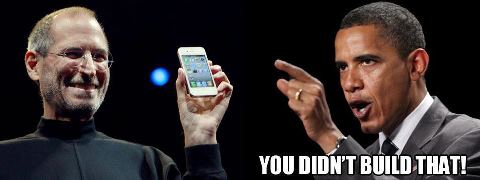
I’ve been entertained by some of the visual representations. I found about two dozen on Facebook in the last couple of days. Below are a few of my favorites. (Some identify sources, but I’m sorry I can’t identify original sources for all of them. The most prolific source was Kevin Jackson’s The Black Sphere page.)




Wednesday, July 18, 2012

The Proper Role of Government--Again

There’s a method used by the opposition to freedom, that we’ve seen examples of this week. It’s about time it stirred up a response. I’m referring specifically to Obama’s lecture last week to small business owners that they didn’t succeed on their own merits.

The way he said it was offensive to hard-working entrepreneurs everywhere (no surprise). But to be fair, the minute-and-a-half clip we keep hearing [linked in Monday’s post] was taken from a larger context that made it clear he was talking mainly about infrastructure. It’s not a new point. Elizabeth Warren, Democrat candidate for senator from Massachusetts, used almost the exact same wording last September:
There is nobody in this country who got rich on his own. Nobody. You built a factory out there. Good for you. But I want to be clear: You moved your goods to market on the roads the rest of us paid for. You hired workers the rest of us paid to educate. You were safe in your factory because of police forces and fire forces that the rest of us paid for. You didn’t have to worry that marauding bands would come and seize everything at your factory, and hire someone to protect against this, because of the work the rest of us did. Now look, you built a factory and it turned into something terrific, or a great idea—God bless. Keep a big hunk of it.
But part of the underlying social contract is you take a hunk of that and pay forward for the next kid who comes along.
There was indeed a social contract; it was that, if we pay taxes, we would receive these particular services from government: roads, protection of property rights, etc. (They also mention using employees who were educated by government—but personally I see that as a hardship to the employer; a privately educated populace would make for better employees. But I digress.) But is there actually a successful entrepreneur in question who got rich but illegally avoided paying those taxes? It seems to me the contract was already kept. But they’re adding on some new “contract,” something called “you couldn’t possibly have exceeded the success of others without some special help, so you therefore owe some special extra payment.”
That, in a nutshell, is why business owners, who put in the risk of time, energy, and money—all on top of paying taxes—resent being told they don’t deserve to enjoy the fruit of their labors.
But there’s another point Obama et al. make: that conservatives are wrong to hate government, because government does all these great things that we enjoy. Here’s the fallacy: conservatives don’t believe in anarchy, or absence of government. Conservatives believe in limited government, with the purpose of protecting our God-given rights. Infrastructure, such as road-building, is often included because it benefits generally—the whole populace, rather than particular special interests. (That’s what “general welfare” means in the Constitution: for the benefit of all at once.)
Whenever statists make this argument, they say, “They’re going to lay off police and firefighters.” Those making the argument are talking about federal government, but the things they say will disappear are not federal responsibilities; they are mostly local, with a few state responsibilities tossed in. What should the federal government be doing? Protecting our borders and our sovereignty, protecting us from enemies foreign and domestic (in other words, from invasion, from foreign criminals on our soil, and from home-grown criminals, particularly those crossing state lines), and interstate infrastructure. There’s not much else.
The Constitution spells out how the federal government will be run, and enumerates the limited powers—reserving all else to the individuals and the states. It’s clear. And if it wasn’t, we have the writings of the founders—volumes, like The Federalist Papers, The Anti-Federalist Papers, and the copious notes kept by James Madison during the constitutional convention. Conservatives (not necessarily Republicans, but those who wish to conserve the freedoms guaranteed in the Constitution) still have the same philosophical underpinnings, still want the same freedoms, still believe God is the source of our rights rather than government. Of course we know there must be government; Constitutionalists were the ones who set it up, to help us protect our life, liberty, and property.
But to equate wanting to limit federal government to its enumerated powers with wanting no government—with the result of society suffering without police, firefighters, or either local or interstate roads—is a sleight of hand that is pretty much an outright lie. And there’s something very disingenuous about claiming that there’s an either/or equation where if you benefit from any level of government at any level, you should therefore submit to anything government wants to impose “for your good.”
Paul Ryan says it well here (the image is from The Heritage Foundation’s Facebook page).