Showing posts with label Obamacare. Show all posts

Monday, June 26, 2017

Opposite to the Stated Goal

Whenever government attempts something beyond the proper role of government (protection of life, liberty, and property), it causes unintended consequences—usually exactly opposite to the stated goals of the interference.
That is an axiom of the Spherical Model. It comes up often when we’re talking about government policies. Today we’ll look at an example from this past week.

This US Senate came out with their version of “repeal and replace,” which, pretty much like the House’s version AHCA (American Health Care Act), doesn’t repeal, and only slightly modifies the original, inaptly named Affordable Care Act.

The ACA—or Obamacare, since it’s on him—claims to want to provide more affordable health insurance for the uninsured. It did so by astronomically raising insurance costs, reducing choice, forcing Americans to make a purchase whether they would choose to or not, and added in forcing companies to pay for practices against their beliefs (which the courts have somewhat corrected after attacks on nuns and others whose religion finds abortion unconscionable). People lost the health insurance they had. People lost their doctors. People found health care scarcer and more expensive. And the whole system is spiraling downward.

Let’s add that the ACA claimed it had the right to force all citizens to purchase health insurance as “a legitimate exercise of its expressly delegated power to regulate commerce among the states. The trouble is that the mandate does not regulate commerce at all. Rather, it forces people into commerce on pain of a financial penalty,” quoting Robert George in the Prager U video "Why We're Losing Liberty." 

Another helpful video on today's topic is "Why Is Healthcare So Expensive?" A good 2 1/2-minute summary:


Meanwhile, since the ACA's partisan late-night scurrilous passage in March 2010, Republicans have been promising to repeal the whole of Obamacare and replace it with free-market reforms.

But now that they are in power, they hesitate—because the Democrats, amplified by the media, which is lopsided in favor of Obama and his ilk, announce that getting rid of the higher costs and less care of Obamacare means they want to kill thousands of people. Lies seem to have an effect on weak seekers of approval.

So, from the House we got the AHCA, American Health Care Act. At least they didn’t call it affordable. But it doesn’t actually provide health care either. It intended to adjust a few minor things. And it certainly wasn’t a repeal of the ACA as promised from 2010 through the election of 2016.

The freshly named BCRA, or Better Care Reconciliation Act, which is what the Senate is calling their version, does nothing to provide better care, or more affordable care—with a few provisos mainly put off until past some other election or decade. Nor would I say it reconciles reality with the pretended goal of more affordable health care for all. (The real goal of government, when it steps beyond its proper role is always to wield power.)

The BCRA will not pass with any help from Democrats. That means it requires all but possibly two Republicans to vote in favor. (There are 52 Republican Senators, plus VP Mike Pence to break a tie.) But Senators Ted Cruz, Rand Paul, Dean Heller, Ron Johnson, and Mike Lee all oppose it as currently written. Senator Heller thinks it needs more money going to Medicaid than any previous version, so let’s set him aside for now. The other four want to keep their promise to repeal the ACA and replace it with free-market ideas.

There are many who think they should just give up on their principles and go along to get along, even people I respect generally as conservative (Hugh Hewitt, for example).

I think it would be instructive to hear what these holdouts have to say. Together, they said this: "There are provisions in this draft that represent an improvement to our current health care system, but it does not appear this draft as written will accomplish the most important promise that we made to Americans: to repeal Obamacare and lower their health care costs."

Senator Cruz said, "Of course I'll compromise, if—and the 'if' is critical—we're moving in the right direction, if we are expanding freedom, if we are improving economic growth, if we are defending our nation."

Senator Lee wrote an op-ed giving his reasoning. I’ll just share parts of it:

No, the Senate healthcare bill released yesterday does not repeal Obamacare. It doesn’t even significantly reform American healthcare.
It cuts taxes. It bails out insurance companies. It props up Obamacare through the next election. It lays out plans to slow Medicaid spending beginning in 2025, but that probably won’t happen. And it leaves in place the ham-fisted federal regulations that have driven up family health insurance premiums by 140 percent since Obamacare was implemented.
As the bill is currently drafted, I won’t vote for it.
He’s not against compromise entirely; he’s been there done that:

[A]s one of the most conservative Republican Senators, I would have to compromise with the least conservative Republican Senators to get something done. And compromise I have!
At the beginning of this process, I wanted a full repeal of Obamacare. Despite campaigning on that very thing for eight years, my Republican colleagues disagreed.
So then I called for a partial repeal, like we passed in 2015—and which conservatives were promised by our leaders in January. A partial repeal would at least force Congress to start over on a new system that could work better.
Again, no.
So then I advocated repealing Obamacare’s regulations, which have been the primary drivers of spiking premiums. I repeated this suggestion at every single meeting of the working group, and at every members’ lunch for several weeks. Yet when the Better Care Reconciliation Act was unveiled yesterday, the core Obamacare regulations were largely untouched.
What would make this clearly bad bill palatable to vote for?

Conservatives have compromised on not repealing, on spending levels, tax credits, subsidies, corporate bailouts, Medicaid, and the Obamacare regulations. That is, on every substantive question in the bill.
Having conceded to my moderate colleagues on all of the above, I now ask only that the bill be amended to include an opt-out provision, for states or even just for individuals.
Here’s his reason:

The only hope for actually solving the deep, challenging problems in our health care system is to let people try out approaches other than the ones a few dozen politicians thought up inside the D.C. bubble.
And so, for all my frustrations about the process and my disagreements with the substance of BCRA, I would still be willing to vote for it if it allowed states and/or individuals to opt-out of the Obamacare system free-and-clear to experiment with different forms of insurance, benefits packages, and care provision options. Liberal states might try single-payer systems, while conservatives might emphasize health savings accounts. Some people embrace association health plans or so-called “medishare” ministry models. My guess is different approaches will work for different people in different places—like everything else in life….
To win my vote, the Republican health care bill must create a little space for states and individuals to sidestep Washington’s arrogant incompetence, and see if they can do better.
Recent history suggests they couldn’t possibly do worse.
Just make a little room for choice. Allow a free market to try to find solutions. It doesn’t seem like that much to ask. And maybe he’ll get it.


I don’t know how to get policy passed that would do what is needed—but I do know what is needed. If we want affordable health care, we need government out of the way. The free market eventually leads to innovation and lower costs. Every time it’s tried. If only we tried it more often.

Tuesday, February 28, 2017

Market Solutions to Health Care Costs

Some of us have been hopeful for a long time (since March 2010 when it was enacted) for the repeal of Obamacare. We don’t even like the idea of “repeal and replace,” because any replacement should not be a different government program; it should be free market solutions. All government needs to do is get the heck out of the way.

But, for those who fall into the pit built by the big government control types, and fear what would happen if you take away the boondoggle that has been foisted upon you, please remember: people had health care before the inaccurately named Affordable Care Act.


Imagine three years ago, when this was being debated, if President Obama said, “I’ve got a great plan. I’m going to take away the healthcare of 5 million Americans in order to cover 100,000. And while I’m at it, I’m going to jeopardize the healthcare of 100 million Americans who have employer-provided plans…. And while I’m at it, I’m going to cost millions of jobs and force millions of people into part-time work, working 29 hours a week.” Is that a good deal for America? People would have laughed at it. If he’d simply been honest, he would have been laughed out of the room…. Because the only way to sell this law was to mislead the American people.
At this point, we also ought to be honest about what the ACA has really cost us. I’ll leave the data to others for now. But here’s a summary from Casey Mulligan, a University of Chicago economics professor, from a couple of years ago:

In summary, the ACA has three major taxes in it. Two are taxes on full-time employment and the other is a tax on income. They may be implicit, they may be hidden, politicians may not call them taxes, but that’s what they are. Their economic impact on workers varies widely, affecting low-skill workers the most. They create all kinds of productivity problems and will have visible and permanent effects on the economy. I have estimated that employment will be three percent less over the long term because of the ACA, and that national income—or GDP, if you like to think of it that way—will be two percent less. If you look at the productivity costs alone—forgetting the fact that there will be a number of people not working anymore—they come to $6,000 per person who gets health insurance because of the law. And I’m not beginning to count the payments needed for health care providers.
In conclusion, I can make you this promise: If you like your weak economy, you can keep your weak economy.
Doing anything but completely repealing Obamacare is to burden people who ought to have the burden relieved.

There are free market options—options people would be more likely to turn to as government stops forcing a bloated, ugly, expensive, coercive plan on them.

To remind us of one of the free market alternatives, libertarian Tom Woods linked to a previous podcast discussing concierge care, or direct primary care. The guest was Dr. Josh Umbehr. I wrote about his practice in 2013, after an interview he did with Mark Levin.
image from Atlas MD blog


Just to remind us that free market options work, and are already possible, I’d like to share some of the interview with Tom Woods. 

Dr. Umbehr is a primary care physician in Kansas. At the time of the interview, his direct primary care practice was five years old. As he described it, the bulk of what most people need is family medicine. At his practice they pay a flat rate per month based on age, like a gym membership.
I looked up his practice, and it’s $10 per child, $50 per adult age 20-44, $75 a month for age 45-64, and $100 for age 65+. He says,

For that membership you get unlimited home visits, work visits, office visits, technology visits. Not limited by what insurance will pay for. No copay at our office visits. Any procedure we can do in the office is included free of charge, because that is what the membership is covering—just like any equipment at the gym is included in the base membership price. So, stitches, biopsies, joint injections, ultrasounds, bone scans, lung scans, urine testing, strep throat testing, minor surgical procedures—all included for free.
He's talking about a lot of savings, because of wholesale medications, labs, imaging, and pathology, that physicians have access to. Here’s an example:

We ordered some blood work. We have our negotiated cash discounts of usually 95%. And a patient’s blood work was accidentally billed through the insurance rate, because of a computer mistake at the lab, and the price that they were quoted was $1028. We ran that back through our system; it cost $39—a 97% savings by just cutting out the middleman.
He describes how they save enough money just on medications to cover the cost of the membership:

We can dispense medications in Kansas, just like a pharmacist. Forty-four states allow physicians to function like this. And so, I can order the medications wholesale from the same places the pharmacies do. But I can get 1000 blood pressure pills for $8.34. Even after my 10% markup, they’re under a penny a pill. Walmart would literally have to give them away to out-compete us. And if they did, great, we still win. It’s not a value that is a revenue generator for us; we’re adding to the value of the membership.
He makes the comparison to Costco membership, or to Walmart or Amazon, who focus on value for the customer.

These savings have been available for at least a couple of decades. It just takes a doctor to look at a new business model and be willing to try it. He said that in medical school they actually taught that dealing with business was beneath them, something they shouldn’t dirty themselves with. But, if they take an oath to “do no harm,” that ought to include no financial harm. If he can save a patient money while providing better health care, that’s giving more and better life. That’s what doctors should be doing.

Some doctors say it’s hard to get patients just to pay a $20 copay; how would they get their patients to pay $50? Dr. Umbehr lays it out like this:

Netflix to Blockbuster. Netflix figured out how to give me 10,000 videos for $7,  when Blockbuster could only give me 1 for $7. So, if we apply that same innovation to health care, it only stands to reason that we can drastically reduce the cost curve.
The Silicon Valley formula is, you have to be 10x better before the barrier to change is overcome. We’re 20x better.
What about the system as a whole? Is this just helping the few individuals who use it but don’t need much beyond basics? He says no, it helps everyone. For example,

The total cost, if you go back to the last year I have data for—I think it was 2011—the cost for all prescription medications in the US was $263 billion. The cost for all cancer care [prescriptions] was $157 billion. So, if we could, with our wholesale changes, and we can get cancer medicines cheaper. Not all of it. Not everything’s cheap. Some of it is just expensive. But if you get that lower…
We had an example where we had a breast cancer chemotherapy pill that was $600 for every two weeks at the pharmacy and $6 or $7 with us—a literal 99% savings. We gave it to her for free just so that we could say now we provided chemotherapy.
So, if we took, let’s just be minimal and say we only save $157 billion out of that $263 billion of prescription for all the things that are expensive—then we pay for all cancer care.
Besides savings through insurance, administrative costs are also much lower:

The average physician would have 7 employees per doctor to run a practice. We have half of a full-time equivalent per physician—because of less regulation, less red tape, less bureaucracy. That would drive down the cost of care.
More savings examples, for the health care system overall:

One of my favorite examples is Imitrex, a migraine medicine, that at the pharmacy, for the name brand, as I pull it up now $565 cash price, anywhere from $447 to $486 with a coupon; the generic is $260 cash price, as well as $101 that I get for $5—my patient gets for $5, because I don’t need to make revenue off the medication.
I’m trying to make them healthier; I’m trying to save them money; I’m trying to show the value of my membership. So, every month they refill that medicine I’m saving them at least $100. Their membership’s $50; their medicine’s $5. I’m giving them $45 of their life back. That’s life—that’s time, that’s energy.
So, when someone says, well this only works well for the rich or the healthy, that’s ridiculous. This works out best for the sick and the poor. Just like any market, I’m reaching the people most likely to benefit from a food service, or a phone service, or a car service. So, people who want to save money on their medicines and are sick enough to need medicines benefit the most from this system.
So, the government is paying $101 for that medicine, instead of the $5 that it should be.
Dr. Umbehr’s practice, in Kansas, is Atlas MD. They also have a blog, and offer free help to other physicians wanting to try this business model.

I looked online for something nearby. Searching “direct primary care” I didn’t get anything closer than Austin. But “concierge care Houston” came up with at least one possibility not too far away with four physicians.

I’m also interested in health savings accounts. In fact, Dr. Umbehr recommends using health savings accounts and a catastrophic high deductible insurance policy in addition to his practice for full coverage at the lowest cost.


If we want everyone to be provided good quality health care at affordable costs, we need to do exactly opposite of the Affordable Care Act: repeal government interference, and replace it with the free market.

Monday, October 24, 2016

Truth Be Told

A week or so ago I spent part of a post talking about Obamacare. Since news on it came out this past week, it might be time to do that in a little more detail.

The challenge I’m looking at is a matter of parallel realities. There are those of us who love truth, and prefer to face the truth and deal with it, even when it’s not ideal, rather than pretend a problem isn’t there.

And then there are those we might call relativists. They don’t like the truth. And they philosophically convince themselves that truth isn’t really a thing; it’s relative. Your truth might not be my truth. We all have our own realities.

If someone wants to live in a fantasy world, that is their choice. The problem comes when they start imposing their fantasy world on the rest of us.

There are stories this week about Obamacare and its serious problems, which show a lot of data, and ring true, because so many of us have been affected, or know many people who have been affected.

And these contrast with other stories about how Obamacare has fulfilled its promises, and has made major steps toward solving everyone’s health care issues in the country—which are at odds with the facts, the data, and the anecdotal stories all of us have encountered.

Let’s start with some facts. Guy Benson comments on a USA Today piece, collecting a lot of the information. This first chart, provided by USA Today, shows the average percentages of rate hikes in the various states.

Image found here

The best off states (all big-government bastions) still have hikes. Which means that Obama was not telling the truth about everyone averaging a rate cut of $2500. That hasn’t happened in any year of Obamacare; rates have always risen. Some states are rising half again as much—just this year.
As Benson describes it,

Based on that chart, only a small handful of states will have the supposed 'good fortune' of experiencing single-digit hikes.  The vast majority will experience cost surges in the double-digits, with roughly half of all states getting slammed with increases of at least 20 percent.  Time magazine reviews the eight states where consumes will suffer the most next year, where regulators have imposed rate jumps of at least 30 percent.  The piece's opening sentence says it all: "The Affordable Care Act is getting a lot less affordable for many Americans."
The reason for the hikes isn’t, in these cases, because insurance companies are greedy; the reason is that the companies are required to stay solvent, because otherwise they shut down and all their customers lose service. Which happens to be a side-effect of Obamacare predicted by the reality-and-data side.

Benson continues,

Meanwhile, many Arizonans find themselves in Obamacare's crosshairs, getting rocked by the double-whammy of soaring costs and dwindling-to-nonexistent choices.
Millions of Americans lost their coverage in 2013, the year it was implemented, contrary to Obama’s pledge. The losses continue. This year an additional million lost their coverage.

If you start with the original premise, the Affordable Care Act was to make sure that some 30 million who, at that time, were estimated to be without insurance could get it. The idea was that those who had coverage could keep it. Costs would be lower. Choices would be greater. And policies would cover more.
People who do math pointed out the impossibility of those claims. People who read the Constitution pointed out the loss of freedom—if your government can force you to buy a product, at ever increasing prices, what can’t they force you to do?

So here we are with this growing mess. The “open enrollment” for this year begins November 1st, so word about the price hikes and loss of choices ought to be front and center in the news.

Instead, Obama gives a speech in which he glowingly reports on his signature “accomplishment,” with mainly lies—or fantasies, if you prefer to believe your nation’s leader is only delusional rather than purposely deceitful.

A fact-checking piece by Melissa Quinn, for The Daily Signal, listed several of the statements that are pretty easily refuted by fact. Quinn lines up each of these statements against the truth. But, as an example, let’s take a look at number 5: “Most people today can find a plan for less than $75 a month at the HealthCare.gov marketplace when you include the tax credits that the government is giving you.”

Here is Quinn’s response:

Earlier this month, Department of Health and Human Services Secretary Sylvia Mathews Burwell said that consumers who purchase plans on the exchange and receive a subsidy may see monthly premiums of less than $75. The president echoed Burwell’s statement Thursday.
However, of the 17.3 million people who purchase plans sold in the individual market in 2015, 7.3 million received subsidies that lowered the cost of their health insurance. Another 10 million consumers did not qualify for financial assistance.
Those consumers, experts say, are going to be hit the hardest by premium increases. In Missouri, for example, one Kansas City resident will see his monthly premiums rise to $716 each month.
It would be nice to be able to compare like to like. How many of the uninsured prior to Obamacare are now insured at rates they can afford? How many who had insurance they were satisfied with before the ACA have lost it? How many now remain without coverage—at risk of the serious fine, which is less a burden to them than the cost of the “affordable” care?

My guess is that the negatives—loss of coverage, loss of their choice of doctors, and skyrocketing costs—affect more than the original number of those the law purported to help.

It is an axiom that when government goes beyond its proper role, there will be negative unintended consequences, and they will likely be the exact opposite of the stated purpose. So, affordable care means less care, and less affordable.

Glenn Beck has been doing a 4-part audio series this week on socialized medicine, calling Obamacare the “Lie of the Year.” This lie that has been spreading across the world and failing for decades.

There is a difference between coverage and care. It was government interference in the first place that caused insurance to become more than coverage for extraordinary expenses, and covered more everyday expenses, separating customer from the cost, and thereby raising costs, until it appeared that only those with insurance could afford basic care.


More government is not the solution. More free market—that is where the solutions are. Free market, combined with philanthropy for those who are truly in need and unable to pay. A good, generous people, with the freedom to be giving because they are in control of spending their own accumulated wealth—that is the way to provide everyone with needed care. 

Limiting freedom, coercion, redistribution—those are all the old, failed solutions that always lead to tyranny, poverty, and savagery. Speaking falsehoods or fantasies does nothing to provide care in the real world.

Monday, March 17, 2014

Logical Leaping Leprechauns

image from here

There’s no purpose in having Leprechauns in the title, except that it is St. Patrick’s Day, and they are dangerous tricksters, with the promise of unearned prosperity that you never get.
I was reading the Outlook (opinion) section of Sunday’s Houston Chronicle, and started reading a piece, by a local physician, that at first struck me as way more conservative than I usually find in that section. Here’s the beginning:
   In high school, I had to memorize the Preamble to the U.S. Constitution. I did not understand why then, but I do now. This is essentially the mission statement for the United States. When I served on the U.S. Senate staff during the initial months of the health care reform debate in 2009, I thought that the Preamble should serve as a touchstone for proposed legislation. Given that health care reform legislation would affect every American and about one-sixth of the economy, it seemed prudent to return to first principles to justify such action.
   The Preamble begins by saying who wrote it and why. The government derives its power from the people. That power should be used continuously to improve the country that the Founders fought to free from foreign control. Establishing and preserving justice, peace, safety, well-being and liberty were all part of the role of the federal government. Implicit in the singling out of “our posterity” is the idea that this was to be a timeless arrangement that would protect us collectively and individually.
This is almost exactly right on track. We want people to do this—read the Constitution, recognize that mission statement in the Preamble, and limit government to its proper role.
But there’s a change he makes, which I didn’t catch until I read further (because I had failed to read the article title). Notice when he’s listing the roles of the federal government, he uses the term “well-being” instead of “general welfare.” He could mean the same thing I do, which I think is what the founders meant. But he doesn’t. I believe it means the federal government is limited to making laws that affect the population as a whole, rather than specific special states or groups. And those laws, according to the enumerated powers of the federal government, are designed to protect life, liberty, and property (and the freedom to pursue property/happiness as one chooses, rather than having government choose one’s profession).
 
So I was surprised at this very next passage in the op-ed: “How does the Preamble support health care for every American?” Um, it doesn’t. Health care is a service that can be purchased. Government’s job is to get out of the way of informed legal transactions. This is an odd question to follow the correct claim that the Preamble is the US government mission statement.
The leap of logic is revealed in the next paragraph:
That there is such inequity in the provision, access, cost and quality of health care in America is inconsistent with a just country.
So, to him, a “just country” is one in which no one can purchase more care than anyone else; they can all purchase exactly the same services regardless of resources. Social justice. Code for socialism.
That bit about “I understand the Constitution” was just a cover for “I think government’s role is really supplying everything we as a majority decide everyone ought to have.” This is FDR’s “positive rights” argument/fallacy. Commodities and services might be nice to have, but they aren’t rights. God gives us rights.
We’re born here naked, impoverished, and inexperienced. We spend our lives working our way out of that condition. But the only “entitlement” involved is the requirement that parents provide their children’s needs, teach them, and prepare them for self-sufficiency.
The government can’t “give” you a commodity or service without requiring a taxpayer to pay for it. Government isn’t allowed by the Constitution to provide any commodity, only services—and only those services that fit in the category of protecting your life (not allowing others to harm you), liberty (not allowing others to enslave you), and property (not allowing others to steal your property).
There’s nothing in there about providing “health care.” If health care were a right, then why would we pay doctors for it? They would have to provide it because it’s our right. But that would be enslaving the doctors, who should be justly compensated for their skilled services. So, in order not to enslave doctors, the government would have to pay them—and the government only gets money by taking it from taxpayers. So the taxpayers would be enslaved (forced to work without being able to keep their income) in order to pay for the health care of someone they don’t even know. Including those who don’t take care of themselves the way that taxpayer has done. Is that fair?
In his piece this doctor does say some things I agree with:
The debate I witnessed in Washington in 2009 was never based on discussing how to fulfill the mission of the United States through a different form of health care delivery. Rather, a deal was concocted that preserved the basic aspects of the system we already had with third-party support of health care payments, despite the third parties (insurers) adding nothing to the health of anyone, but reaping huge profits for bookkeeping and risk management as a means to maximize shareholder value.
 
He’s right; Obamacare proponents have conflated health care with health insurance, even though insurance is simply one way to pay for health services (a way that has been enlarged mainly because of government interference). There are other ways. There are health savings accounts, and concierge medicine, and self-insuring, and paying cash.
He doesn’t look at the “less government interference options,” however; he thinks Obamacare simply doesn’t go far enough. My guess is what he wants is to have the federal government do a total takeover of health care, doling out care “equally.” He hates “inequity” (different outcomes) more than he loves freedom.
If the problem is separation of payer from service receiver, then why would adding government as an additional separator help? It just adds another layer of bureaucracy (the world’s biggest bureaucracy) between service receiver and payer—with all kinds of additional decisions being made by distant bureaucrats rather than patient and doctor.
People who see only the southern hemisphere—the portion on the Spherical Model where you go back and forth between the varied tyrannies of anarchy and government control—look the wrong direction. They have an unsupportable faith in government and its intellectual elites to “do it right the next time.” They never do it right. They can’t know what I and every individual buyer of health care services knows about our particular situations, preferences, and personal finances. But they’re unwilling to trust individuals to make decisions for themselves about what services to buy and how to pay for them.
Government’s lack of trust in individual citizens is an excuse for interference that always leads to further tyranny. We limit government because we know it can’t be trusted, and we trust ourselves with the rest. 

There’s another leap of logic story I came across over the weekend. It was handled well (as usual) by Matt Walsh (“I am afraid of this indisputable pro-choice argument” from March 4, 2014). The “frightening” “irrefutable” pro-choice (pro-abortion) argument is referred to as “bodily autonomy.” A reader calling herself “Rachel” says essentially that, if a person has bodily autonomy, then a woman has a right to stop that parasitic baby’s life at any point in pregnancy. She claims that a woman gestating her own child is equivalent to being forced to be tied up in a hospital bed next to a sick person, for nine months, sharing blood with the sick person, against one’s will.
It’s not a good analogy, and Matt Walsh covers the reasons. But I’m just going to point out the leap of logic from “we have control over our own bodies,” and “after consenting to the presence of a growing child by performing the procreative act, the mother should still be allowed to kill the growing baby at any point she chooses.” That’s quite a leap.
No one forced her (in cases that aren’t rape or incest) to invite the growing baby to grow in her womb. No one forced her to share her body with a stranger; the baby inside is her own offspring. No one forced her to stay confined in a hospital bed for nine months; pregnancy will cause varying levels of limitation, but most of the time the gestating mother just goes about her life as autonomously as ever.
The choice happens before conception. After that, another life is involved, growing where he/she was invited, and where he/she belongs. A closer analogy would be: after you invite someone into your home, at any time you can kill the visitor for breaking into your home. That would not go over well in a court of law.
We’re all pro-choice. But most of us think that choice was made when engaging in the behavior that has been known, for literally thousands of years, to lead to pregnancy—so ignorance can’t be the excuse. Maybe Rachel, like Obama, thinks God was wrong to have pregnancy follow that behavior, when she wants it without consequences. Whatever. She ought to take that up with God, rather than insisting that the rest of us are wrong for wanting to protect innocent human life.
Today's lesson: don't pretend it's logic when it's just a blind leap.

Wednesday, November 13, 2013

Calculating


Have you tried the calculations yet to see what kind of impact Obamacare would have on your finances? I don’t mean have you suffered through the glitchy Healthcare.gov website signup, which wastes your time while collecting your personal data; I suggest you avoid that indefinitely. No, I mean have you used the Kaiser site, just to do the calculations. 

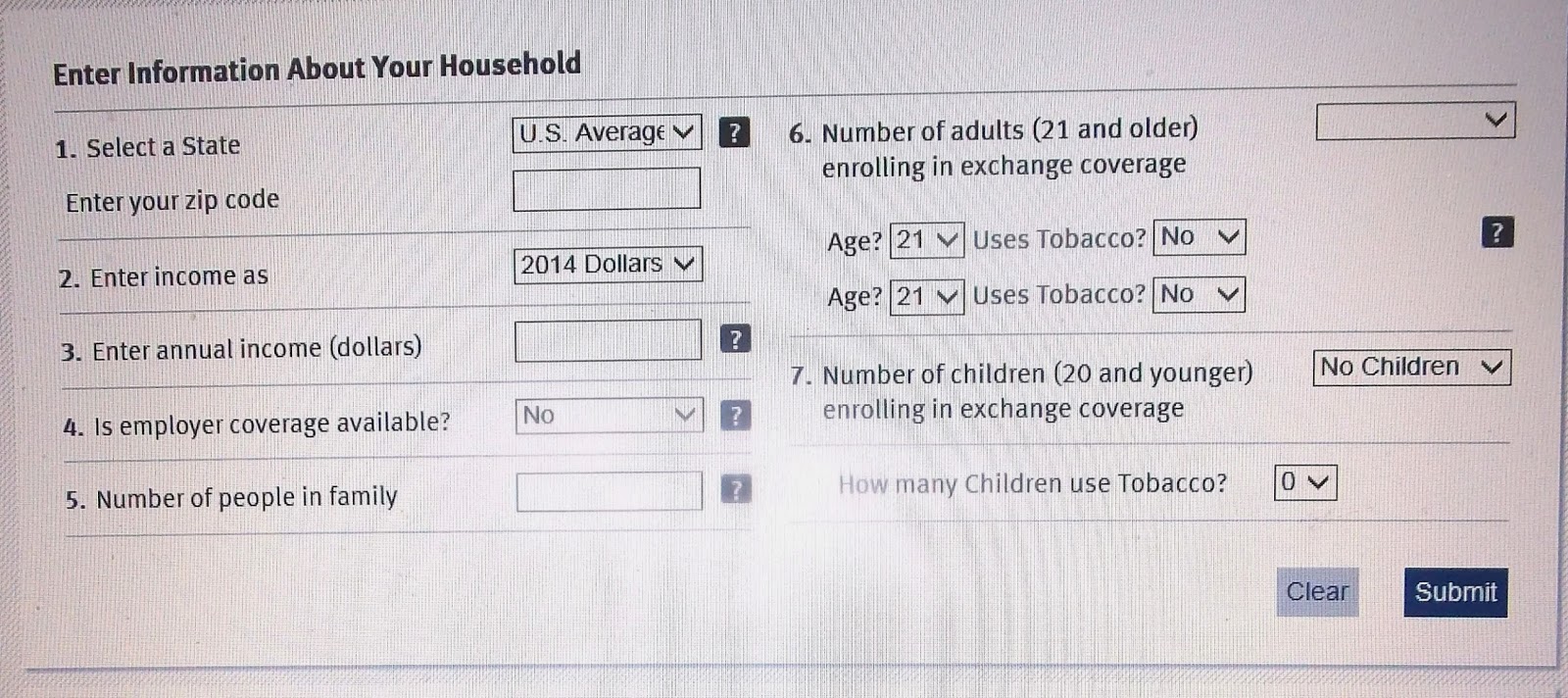
The Kaiser ACA Calculator
My son Political Sphere gave it a try. Actually, he went two place online: both the Kaiser calculator, which has some limitations, and the Healthcare.gov site, but only using the "view plans now" option, rather than actually trying to sign up. So, hopefully, that means no permanent data collection. Anyway, here are the results.
He has been going without health insurance for some time. He and family are that combination of healthy and poor, making up the large majority, I’m guessing, of the purposely uninsured. This does not mean they get no health care; they just pay for it, in cash, when they need it. This included even the birth of Little PS2, with the help of a midwife. (Little PS1 was born with the help of the same midwife, but finances at that time led Mr. Spherical Model to pay that bill out of pocket, so he claims his granddaughter belongs to him—bought and paid for. We humor him.)
Now that Political Sphere is in law school, he is required not to be working. Mrs. Political Sphere works part time at a fast food restaurant and also takes college courses. There’s a scholarship that is covering law school tuition this year, and then there’s a sizable student loan to cover such amenities as school books, rent, food, and clothing for growing children. Things are tight, as you can imagine.
So Political Sphere goes to the calculator websites and inputs that data. It turns out, as you’d expect, their income is so low (well under 50% of the poverty line), they can’t be expected to pay ACA marketplace prices. They are turned over to Medicaid. But then things get kind of ironic.
You know that big student loan for living expenses? The one they’ll be paying interest on for years to come, but was a necessary cost of the schooling investment? Yeah, that counts as “income” according to Medicaid. For Medicaid purposes, taking out a loan that you have to pay for with interest is considered being what you might call “flush with cash.” The federal government agrees they’re way too poor to be buying health care; nevertheless, negative income (debt) makes them too rich to be receiving Medicaid. [Aha moment: government thinks debt is income—that explains a lot.]
So what is the government’s solution? Go to the Healthcare.gov website and find yourself a policy for, oh, say, $272-$432 a month for catastrophic coverage only. (The Kaiser calculator only gives averages by level and does not include catastrophic coverage as an option.). Catastrophic coverage means you pay 100% of the costs of your medical needs except for a list of serious expenses. Or you can go up to $334-$592 for the Bronze level coverage (that price is based on just two parents receiving coverage, assuming the children are already on Medicaid). At the Bronze level, you pay 40% of your medical bills. For additional money (this is general information from the Kaiser site), you can step up to the silver plan, where you pay 30% of your medical costs. All of these, according to a note on the Kaiser site, come with the proviso that out-of-pocket medical expenses (over and above premium costs, if I'm understanding correctly) can top out at $12,700 a year, which may exceed 100% of your annual income. Such a deal!
How do you pay those premiums? Maybe they assume getting additional loans of up to $600 a month is no problem, but it kind of is for people in the real world. So maybe they expect the family to just live on the streets instead of paying rent, which is about an even exchange, cost-wise. They have made it a law that you must buy insurance, but they have not made it a law that you must house your family.
They require everyone to buy insurance, because the whole “even the playing field” idea doesn’t work unless you force young healthy people to pay as much as older unhealthy people pay. And we need to be “fair,” after all.
Or PS and family can be sensible and continue doing what they’re doing—paying cash when they need to take the kids in for checkups, and ignore the mandate. That first year the fine is relatively low. It gets collected out of tax refunds—which you don’t pay when your income is that low. However, the government “returns” several thousand dollars more as a “tax refund” when you’re that poor, so this means they’ll "collect the fines" by paying any poor family that ignores the mandate a little bit less.
The second year fines go up, but by then there’s only one more year until law school is over, and it might be possible to consider buying healthcare coverage. We’ll see.
Still, at that point, wouldn’t a health savings account be a much better deal for a healthy young family than being forced to subsidize someone else during their very early career years? Assume they pay a few hundred a year in medical costs, as they’ve been doing (and paying cash up front does get you the best deals), and they pay $5000 into a health savings account, instead of into a policy. By the next year, that $5000 is earning interest. They do it again; by the end of two years, they have a health savings account with $10,000, plus interest. Just a few years of paying themselves without having to pay out, and they can self-insure. And if they were worried about catastrophic coverage, they could buy that at a free-market rate of around $100 a month (pre-Obamacare market pricing) and still have most of that money left for the health savings account.
On this past Saturday’s Wonderful World of Stu show (Stu Berguiere on The Blaze TV), he went through a list of why Obamacare isn’t the great deal it was said to be. Here are a few:
·        You can’t keep your plan after all—40-67% will have to change, because any tiny change eliminates the “grandfather” protection, and the law forces plans to change. [Political Sphere told me that when Obama said, "You can keep your plan. Period," he actually meant "asterisk." I thought that was clever and I was going to quote him, but he said he heard it on radio and doesn't remember which radio host to credit.]
·        Saying that those in the “individual” market are only a few is disingenuous: government estimates that number at 93 million Americans, with some more accurate estimates saying it’s at least 129 million people. Numbers go higher when people lose their employer coverage by losing their jobs, or when employers find it a better deal to pay a fine than to pay for more expensive plans.
·        The price for the whole of Obamacare was sold to voters as $900 billion over 10 years (without counting the first 4 years). But it’s really more like $1.88 trillion.
·        The average family was supposed to see premiums go down by $2500, but the average family actually has premiums going up by $3000. So the government “misunderestimated” costs to families by $5500 a year--and we could add that Affordable Care Act is a sadly ironic name.
·        Obamacare, according to Pelosi, was to be a great jobs creator—4 million new jobs, with 400,000 of those right away. In real world math, Obamacare will cause a loss of 800,000 jobs.
You get the idea that all those planners involved in this whole ACA mess don’t like to be bothered with details like math (or truth). That’s something third graders might get away with, but it’s really not acceptable from the calculating tyrannists insisting we give up our freedoms, because they claim they know better than we do how to make our personal spending decisions.

Wednesday, October 30, 2013

Redistribution


In the conservative world, we’re fairly used to looking at wealth redistribution, and refuting any arguments for it. Because we believe in the basic economic/freedom principle that the person who earns the money should be the person who decides how to spend that money. (Milton Friedman argued the point decades ago.)
We’re a little less practiced at talking about, or even looking at, other forms of redistribution.
A few years ago there was a story going around about an economics teacher who arranged to “redistribute” grades in the class. The A students would “share” with the lower-grade students, to even things out—to be fair. Everyone would receive the class average. On the first test, everyone got a B. On the second test, everyone got a D. On the final, everyone failed. Why should anyone work, if the result was going to be squandered on those who didn’t put in the work? It was, of course, a comparison to socialism. And the final summary was this:
When half of the people get the idea that they do not have to work because the other half is going to take care of them, and when the other half gets the idea that it does no good to work because somebody else is going to get what they work for, that is the beginning of the end of any nation.
I’m not sure of the origin, whether there actually was such an economics teacher. But the story caught on, and various college students took on the challenge of making videos of people being asked to sign a petition about GPA redistribution. (George Mason and Carthage, for example.)
So that was about equal opportunity for success based on grades. For some reason, hard-working students, even liberal ones, are reluctant to assume it’s unfair to lazy people for them to work hard and thus have greater opportunity to graduate/get good jobs.

Similar assertions about opportunity redistribution are used in affirmative action. The argument is, if there is racism, then there is an unfair advantage to favored races (Asians and whites, typically) and unfair disadvantage to non-favored races (namely African-Americans and Hispanics). If so, the argument goes, then there should be some “redistribution” of opportunity based on race—take from the advantaged races and give to the disadvantaged races, as if people are less individuals and more representatives of groups that share their skin color.
There was an satirical illustration of this concept, in the form of an affirmative action bake sale, done on some college campuses (Bucknell and Berkeley), and followed up in a mall by John Stossel. It got the conversation going, and even those getting the advantage saw the system as demeaning. However, it’s hard to tell whether the point got across, or whether the very subject of race was so taboo that discussion was shut down. But that’s a subject for another day.
I saw a somewhat unbelievable poster online, advertising a panel that would be discussing getting rid of all advantageous opportunities—evening things out. The panel theme is “No More Success Stories.” Why? Because for every 1 in a million success story, there are 999,999 left behind. Not kidding. Pretty sure this is not satire.
So, the question is, should differences in opportunity be evened out? Should opportunities be redistributed?
The concept behind Obamacare answers those questions with a loud yes. It is a simple fact that some people are healthier than others, and true that these healthier people can get by with paying less for health care, sometimes even opting to go without health insurance, or getting only a catastrophic protection policy. Others—the no-longer-young, the elderly, the already ill or injured—don’t have the luxury of going without health insurance coverage, or may have to pay more to get it. They are disadvantaged by less than peak health.
So Obamacare attempts to “redistribute” through financial measures the financial health advantages particularly of the young and healthy demographic, and make them pay more so that the older and less healthy demographics can supposedly pay less than they would. In reality, you’d be hard pressed to find anyone in any demographic paying less for whatever coverage they had before the law, but that’s a discussion for another day. The point today is that the law was designed to “redistribute” good health advantages. And it is true that pretty much every single young healthy person will be required to cough up significant income that they wouldn’t otherwise have spent.
This isn’t a surprise. It was part of the discussion before the Supreme Court; it’s in the transcripts. (I wrote about the ruling before and after.) The law is a tax on healthy people intended to subsidize the less healthy.
One major problem with “redistribution” of any opportunity is that it uses some distant, powerful overseer (tyrant) to make decisions best made by individuals. Most young people are not as financially well off as most older people, nor as well off as they will be later in their lives. They are paying student loan debts, getting started in their careers. If there is a time to risk doing without comprehensive health insurance, they’re at the best time of their lives to do it. Maybe a catastrophic policy would be wise, if they can afford one. But chances are in their favor that their money is better spent on something else—and that’s why so many of this demographic have chosen to spend less on medical coverage.
Obamacare, in essence, forces young healthy people to impoverish themselves for a product they don’t need in order to help pay a subsidy for that product to people at the culmination of their career and lifetime of wealth building who can better afford to pay the higher costs. In the first year or two, paying the penalty/tax is a lower burden than paying for the actual product. It’s just money into a black hole, though—no actual benefit to the young healthy person being extorted.
On top of it all, the failure of the Obamacare website is just a little too much to believe. Here’s the summary: young people are forced to buy a product they don’t want, don’t need, and can't afford to help buy that product for those who are already affording it—and this tech savvy demographic is supposed to voluntarily sign up for this servitude on a website that doesn’t work.
Yes, that is centrally planned “redistribution” at its finest. Welcome to tyranny.

Monday, September 23, 2013

Defund It

Senators Mike Lee and Ted Cruz
image from here
I’m on Team Ted Cruz/Mike Lee/Marco Rubio on defunding Obamacare—even if the other side threatens to shut down the government and blame Republicans for it.

The House, where government funding originates, has done its job and put through a continuing resolution (before the current one expires September 30, since the Senate has refused to pass an actual budget for years) that continues current funding through mid-December, with no changes—except without funding for Obamacare. It’s particularly important to defund NOW, because key provisions kick in October 14. It has to be stopped.
I could spend a very long post enumerating the anti-American, harmful effects to health care and the entire economy, but I’m guessing if you’re reading this, you already have an adequate list of your own. We all know the ironically named Affordable Care Act makes medical care less affordable and less available—while giving all kinds of intimate control over our lives to cold, distant bureaucrats. Nothing about the thousands of pages in the bill, and the hundreds of thousands of additional regulations, can be identified as an improvement over what we had--which had plenty of problems mainly caused by separation from market forces. I don’t think we can even give the bill and regulation writers the assumption that they meant well.
So, since we’re agreed on that—and a solid majority of Americans are agreed that the whole thing needs to be scrapped—the question at hand is how to put a stop to it. Before all our freedom options are done away.
In an ideal world—well, in an ideal world, this would never have been proposed, let along been passed; and in an ideal world the Supreme Court would never have stretched the Constitution beyond breaking point to declare this monstrosity lawful. But in a hypothetical ideal world, what should happen next is that the Senate should agree to the continuing resolution minus Obamacare spending. Let’s say that would happen. Then the spending bill would go to the president for a signature. In an ideal world (so, one with a different president), the president would see that the American people have spoken—loudly—through their representatives, that they do not want this bill, so he would acquiesce and sign the defunded bill. And then he’d go ahead and encourage Congress to vote to repeal (again for the House, but the Senate is the bottleneck).
But since this isn’t an ideal world, what can we expect in the Senate? That depends on how much fight the Republicans have in them—and add to that a little bit of worry among Democrats about the heavy anti-Obamacare majorities among voters. Do they want to kill their careers over this extremely unpopular monstrosity, just because their Democrat president says they have to?
Democrats have the majority. So much is in their hands. As it was, entirely, when the bill passed in 2010.
At this past Saturday’s local Tea Party meeting, one of our speakers was Paul Bettencourt, the Tax Man. He used to be Harris County Tax Assessor. Currently he’s running for Dan Patrick’s state senate seat (the large and conservative District 7) while Dan Patrick runs against David Dewhurst for state Lieutenant Governor. Bettencourt also has a gig on the radio (the Dan Patrick owned AM 700 The Voice in Texas), talking about taxes and politics. We know in Texas we have Ted Cruz on our side. John Cornyn, who is more long-time establishment, was a question. But Bettencourt said they had Senator Cornyn on the radio, pressed him pretty hard, and believe he has now committed to vote for defunding.
I have since seen a fair amount of corroboration from Senator Cornyn. He has made the declaration pretty clearly. This was from his Facebook page this morning: “I intend to support the House bill that defunds Obamacare and will vote against a bill that funds it.” There’s also a piece in the Dallas News on his announcement. A couple of days ago I got a link to sign Cornyn’ petition to defund Obamacare. (I signed it, in addition to the Ted Cruz petition I signed weeks ago, just to make sure Senator Cornyn knew constituents out here back that decision.)
Paul Bettencourt suggested getting hold of friends in other states and encouraging them to contact their senators, to encourage them to vote in favor of the continuing resolution that defunds Obamacare (which, for technical procedural reasons, also includes standing firm against a cloture vote).
If nothing else, one thing that the vote should do is, as Bettencourt put it, “put jerseys on every senator,” so you know what team they’re on. That gives some significant leverage in the next election.
If, by some miracle, we were able to get to the point where there is a choice between defunding Obamacare or shutting down the government—the very thing establishment Republicans fear—that would be a great blessing. The fear comes from what happened in 1995, with the government shutdown during Clinton’s term. It was a public relations nightmare for Republicans. The GOP got blamed for everything from shutting down national parks to starving children.
But PR isn’t everything. We need a reminder of what actually happened back in 1995.
Bettencourt recounted a part of the story I hadn’t known. On Sunday, the 21st day of the shutdown, Senate leader Bob Dole caved. He had been worried about his image, since he was thinking of running for president. What he didn’t know was that Clinton had already decided to fold on Monday, the 22nd day of the strike.
Had Dole waited, the GOP would have won the entire battle. But even as it was, Clinton took on welfare reform—claimed it as his own, but we got it, so that was a win.
Last time around the media portrayed the shutdown as a disaster for the GOP. But it actually wasn’t. In the next election, the GOP won something like six Senate seats and held the House. Clinton kept himself politically afloat only by co-opting GOP policies as his own. Rush Limbaugh reviewed the history a couple of months ago, in anticipation of this week’s showdown--worth reading.
Back then, the media voice for the GOP was very limited. As Rush put it, “In 1995 I was it, as far as conservative media goes. The blogosphere had not come into existence; the Internet was still essentially an infant in this regard. There were no other conservative talk shows. Fox News was still two years away. I was it. It was still a media monopoly: ABC, CBS, NBC, CNN, Washington Post, New York Times, local news, you name it. I was it.”
That’s what I’ve been thinking. The mainstream media will malign conservatives no matter what we do—even if we played for the media audience by praising Obamacare against all the evidence. MSM is a lose-lose black hole for conservatives. There is no changing that. Nor is there getting through to the uninformed voters, who just don’t pay attention. But we have more media outlets now. The internet is, so far, still a free voice. Fox News isn’t as conservative as the MSM portrays it, but it’s at least not the propaganda arm of the administration. The true story will get out—it will be told to every ear willing to listen.
And what is the worst that can happen from a temporary government shutdown? The president will try to make it as painful as possible—just as with the sequester, where he has cut soldier food in Afghanistan to two cooked meals a day (because there’s not enough money with the sequester temporary cuts in the rate of increase, even though there is plenty for him to use Air Force One to transport his dog to wherever he’s vacationing). He will try to make it appear Republicans are trying to starve children and kill old people—same old same old.
But there are other voices now. And it’s possible that, even with the worst case scenario, people will notice little more than occasional irritations at government—nothing new. And with every painful choice the president makes, there will be new voices pointing out that it was his choice, with the purpose of inflicting pain.
If that’s the worst case scenario, maybe it’s worth finally getting past the fear and standing on principle.
The worst-case scenario if this fails is dire. Business and labor already agree that Obamacare is an abomination. Putting off employer mandates was done for two specific reasons: First, employers couldn’t do it, and the effort threatened to pretty much shutting down the economy that is already (still) floundering under this administration. Second, the worst damage was put off until after the 2014 election, because Democrats would have been demolished by the knowledge that Obamacare was the cause of so much pain.
So even the Democrats realize Obamacare is a gross negative for America. Since we all know that, now is the time to act on that truth.

Wednesday, June 27, 2012

Mandate Does Not Equal Freedom

Tomorrow we are expecting to hear the final verdict on Obamacare from the Supreme Court. In the aftermath there will be plenty to time to go over the reasoning. So for now there is either just predicting what’s about to happen, or restating the arguments. There are people better at both of those than I am, so this post will be short, and mostly directly you elsewhere.

My fairly safe prediction is that the mandate will be struck down, stronger than 5-4, more likely 6-3.
The question of whether the whole law will be struck down is less certain. By logic, when there is no severability clause (and in 2000+ pages, there was certainly room for such a clause), then the law cannot stand without the mandate. The debate in oral arguments included  the question of whether it was up to the Court to go through all of those pages and see what could be kept and what couldn’t; the justices were rightly indignant about being expected to do that. That is not going to happen. But some say that meant they should leave the rest of it alone, and others say that meant they should throw it all out and let Congress start from scratch. It will probably be 5-4 whichever way it goes.
If any part of the law remains, that will be incentive for opponents (the majority of Americans) to vote Obama out so it can be repealed ASAP. If none of it is left, there is fear Obama will do his dictator thing and insist on keeping socialized medicine limping along through illegal use of executive order.
So, no matter what decision comes down Thursday, we’re not yet free of this albatross.
In the last hours I’ve read a couple of commentaries worth quoting. Jay Cost talks about the mandate as a method of redistribution of wealth—not for “fairness,” from wealthy to poor.
First, the individual mandate represents an enormous transfer of wealth, completely independent of income or social status. It transfers resources from the healthy to the sick, from the young to the old, without regard to who has more money to begin with….
Second, the mandate itself is the method by which the Democrats have delivered literally billions of dollars’ worth of patronage to the key interests groups that lined up with them during the health care debate. The party sought to apply new layers of regulations upon doctors, nurses, hospitals, retirement care facilities, etc., and they rightfully feared a rebuke from these key “stakeholders,” as the Obama White House called them. What better way to buy their silence than to require 30 million Americans become their customers, whether they want to or not!
In reference to the failed public option, Cost said, “none of those stakeholders whom the mandate bought off wanted to compete with the government!”
This piece byVictor Davis Hanson wasn’t specifically about Obamacare, but more a referendum on the overall failure of the current presidency. The whole thing is probably quotable, but here are just a couple:
In less than 40 months, Obama destroyed the greatest bipartisan good will that any recent president has enjoyed, and has done more to discredit Keynesian neo-socialist politics than have all of talk radio, Fox News, and the internet combined.
And…
The private sector is not doing fine, but shortly will be when it is assured taxes won’t soar, energy will be cheaper, and Obamacare will cease.
One way or another, let’s look forward to the end of this monstrosity.