Showing posts with label government shutdown. Show all posts

Tuesday, July 21, 2020

The Neverending Convention, Part I

I’ve been away from this blog for the last week and a half, doing work associated with the Texas Republican Party state convention. As I did two years ago, I’ve been doing editing work on the platform. At this level, I don’t have input into content, just in how it looks. And even at that, much is beyond my control.

It’s likely to take me a number of blog posts to debrief the whole thing. Today I’ll focus on the overhanging issue: Houston’s Mayor Sylvester Turner invoked the Force Majeur clause of the contract five days before the start of convention—that was Wednesday, July 8th. A week prior to that he had given his “final” word that he would not interfere with the convention because of the pandemic.

There were multiple efforts put into preparing the intended location, the George R. Brown Convention Center (owned by the city, run for the city by an entity called Houston First) to meet any and all guidelines for safe meeting. These included using larger spaces with chairs spread out, larger rooms for caucus meetings and committee meetings, temperature scanners at each entrance. There’s no competition for space right now, and that convention center encompasses 1.8 million square feet indoors, and can accommodate 55,000 people. The typical state GOP convention is around 9,000-10,000 people. It’s typically the largest GOP gathering in the country, even bigger than the national convention. But last time we held the state GOP convention in Houston we shared the space with two or three other conventions.

The convention was originally supposed to take place in May, but it was rescheduled because of the pandemic. City businesses were glad to host, since their usual business clients have been curtailed. The full convention was rescheduled to July 16-18, but committee work actually gets underway on the Monday before.

When Mayor Turner broke the contract just 5 days before committees were to meet, the State Republican Executive Committee (SREC) which is made up of a man and woman from each of the 31 state senatorial districts, met in an online meeting to decide how to proceed. The two options were in person nearby the original plan, or online. A combination is not possible, according to Roberts Rules of Order, because it isn’t possible to know whom to recognize and in what order.

The Marriott Marquis, a large hotel across the street from the convention center, offered to accommodate as needed, so the official meeting would happen on the sidewalk in front of the convention center, as required in the rules, and then temporarily adjourn and reconvene in the hotel. That is the option the SREC chose, in a 40-20 vote. People recognize the value of meeting in person.

Meanwhile, the Republican Party of Texas (RPT) lawsuit against Mayor Turner went forward quickly. On Thursday, a local democratic judge ruled against the RPT, who then appealed directly to the state supreme court for a quick ruling. Those justices met over the weekend and gave their ruling Monday morning.

It was while I was driving downtown Monday morning that I heard on the news that the ruling had gone against the RPT. The committees, already set and able to meet in person, went ahead with the downtown plan, but it meant that on Thursday, once the official convention gaveled in, everything would move to online.

There was one non-negotiable deadline: Monday, July 21st, by the end of the day, the names of those elected as delegates and alternates to the national convention, plus those elected to be electors (the ones who physically vote in the electoral college in December) had to be turned in. If nothing else happened, we could recover, but law required that business to be completed.

There was also a state party chair race, vice chair race, plus election of permanent committee members and State Republican Executive Committee (SREC) races.

It took much of Saturday to accomplish the essentials. Late in the evening permanent committee members got elected. So, we had to be poised and ready all day, but the meetings the committees were to have held did not take place that day.

The Platform Committee Meeting took place Sunday at 9:00 AM, with a tight deadline—originally one hour, but we ended up taking until past noon, with many complaints about not enough testimony time, or time to change anything after the testimony. Maybe I’ll talk more about that another day.

We got through the Legislative Priorities report in a Sunday afternoon general session, but not the Rules or Platform reports. There was an effort to try to reschedule the rest of the business to another time and place. That discussion took up more than an hour that could have been spent accomplishing business. And the proposal included a request to develop a committee from among the body to come up with a plan. Suggestions were open, electronically. They came in and didn’t stop. There were more than 5,000 suggestions the last time I heard it announced. This was a DDOS attack (denial of service). It’s a purposeful disturbance. A hack. And DDOS attacks explain much of the difficulty of Friday through Monday with credentialed delegates being unable to get electronic credentials to join meetings and have voting rights.

People were patient much longer than in an in-person convention, probably because they were in their kitchens and living rooms with creature comforts available—albeit little sleep. But the fact is, Mayor Turner indeed deprived people of rights. My senatorial district didn’t manage to convene for its final caucus until Monday morning—after the state party chair and vice chair races were a done deal.

US District Judge Lynn N. Hughes ruled
July 17, 2020, in Hotze v. Abbott
image from here

While the Texas Supreme Court ruled against the RPT’s lawsuit, there was an additional personal lawsuit filed in federal court from individual delegates who can show harm caused to them. RPT has since joined in that suit. But it went to Federal District Judge Lynn R. Hughes, who ruled against Mayor Turner on Friday, July 17th. The case is Hotze v. Abbott (because it was Governor Abbott’s limited lockdown order GA-29, supplementing GA-28, which led to the Force Majeur). The 7-page ruling is a thing of beauty to read. 

Son Political Sphere tells me it’s more of a great op-ed, but legally it isn’t likely to stand up on appeal. Nevertheless, I want to pull out a couple of points.

One is about standards. This relates to letters from Dr. David Persse, director of Houston’s Emergency Medical Service, who served as the Mayor’s chosen medical “expert.” Judge Hughes writes:

In court, high standards restrict technical data offered in evidence. That kind of opinion testimony must have rigorous science applied to precise data in a recognized method. Persse’s letter abounds with emotion and assumptions. His letter uses the phrase “clear and present danger.”
…He presented no dispassionate analysis; he only recast odd pieces of what is in the papers.
I’ve been looking at numbers. The horrendous spike in cases, the way the press talks about it, you’d think bodies were lined up in the street. In reality, the 7-day rolling average for Harris County, where Houston is located, a population of over 4 million, reached 12 and hovered there for about a week, but was lower than that by a couple of deaths per day when Mayor Turner broke the contract. That is a total of 12 per day. The total for the county to date (as of today) is 560. That’s a lot of people. But New York city has had 18,800, with an additional 4,624 probable COVID-19 deaths that weren’t verified by testing. Their population is 8.3 million, roughly double Harris County. Their number of deaths is 34-42 times the number of deaths in Harris County.

Let me say that another way, for each death to date in Harris County over the entire time since the disease caused its first death in Texas, 34-42 people died in New York City. From first death to today (so, not counting the many zero death days prior to that first Texas death on May 18th, that’s 128 days, an average of 4 per day in Harris County. Regrettable, painful to those experiencing the loss, but not an all-out emergency.

Getting data is still a challenge. The Houston Chronicle had been providing daily deaths in Texas, so I could continue to chart that. The paper used to show deaths in the Houston region, including surrounding counties. They stopped doing that on June 23rd and started emphasizing new cases by county, not 8 counties together, plus positive test rate and hospitalizations. But no county death info. So I started going daily to the county public health site. I don’t know how to get anything there but the current day’s data, so I have taken a snapshot every day to build up some data to draw a picture from.

Daily deaths in Texas, over the entire length of the pandemic, shows there has indeed been a recent rise (7-day rolling average):

Deaths in Texas, rolling average, as of July 21, 2020


Starting when I began charting the data, daily deaths in Harris County, starting June 24th, look like this:

Deaths in Harris County, rolling average, as of July 21, 2020


It's not an exponential curve. It's not a reason for panic. Or for cancelling contracts.

Out of curiosity, I look at data for my zip code. We have a population of a little over 37,000. So far we have had 3 deaths. I couldn’t pinpoint on which days each of those were reported, but I do know we had had 2 by June 10th, and we had had 3 by June 25th, when I started looking daily. So we have gone essentially a month or more since the last COVID death in my zip code. The 7-day rolling average is a flat line.

I’m here, alive, to let you know that those several hundred of us who met for committee meetings downtown: it has been a week, and so far we have a spike of—wait for it—zero. Zero cases. So zero deaths.

The next point in the lawsuit is about what qualifies as essential. The ruling says,

The meeting is not a classic-car show nor a quilting exhibition. The Texas Election Code requires it—and requires it now. This convention is the source of a party’s officers for the next two years and delegates to this year’s presidential convention among other administration.
The governor’s orders frequently use the word essential to specify exclusions from the full impact of the limits. In GA-29 [Governor Abbott’s order], for example, the rules do not apply to election-related gatherings nor the mask rule to someone giving a speech. Department and grocery stores are open and excluded as essential. The individual stores in some cases will exceed the few thousand delegates expected at the convention. It exceeds their essentialness, because critically it is a single event—not repeated every day.
And he adds that our founders did what they did because of arbitrary government. Further down he notes that the Texas Attorney General wrote a letter May 29, 2020, instructing “the secretary of state that political conventions are excluded from the strictures of the executive orders.” That seems pretty clear.

Then the judge describes the mayor’s actions the way a prosecutor might. After the Republican Party of Texas had already agreed to all the precautions, the mayor piled on:

The contractor was told [by the mayor] to require a cluster of additional precautions. The Party agreed. Frustrated, four hours after he imposed conditions that he thought would cause the Party to abandon its plans, Turner told the contractor to cancel the event. The city doctor furnished defective smoke-screen letters.
The contractual clause allowing First to cancel the use of the building says exactly what First and the mayor say it does. What it does not mean is that the cancellation may be based on reasons extrinsic to the virus rules and, instead, be based on raw political sabotage.
As for fear of risk to the city, he says,

Allowing the Republican Party to meet its responsibilities does not cost the city. All it has to do is stop interfering. Comparable numbers of people will patronize many places as the Party meets. Its contribution to viral risk is no more than another large grocery store.
In case anyone missed the mayor’s intent, the judge says,

Sylvester Turner worked to get First to cancel the license to the Republican Party after 18-odd months of preparation and cooperation under the guise of public safety based off twisted readings of the governor’s orders.
I don’t know how this will all play out. But one thing is very clear: Democrats are underhanded and untrustworthy, and they’ll go to great ends to thwart the will of good, America-loving citizens.

We cannot let such people win their war in what they see as a right to rule over us.

Thursday, May 7, 2020

Civil Disobedience—Under What Circumstances?


Is there ever a time for civil disobedience?
Dallas salon owner Shelley Luther
AP Photo/LM Otero, found here

I’m not really a rebellious sort. My Church teaches us to be law-abiding, good citizens, and has had some marvelous worldwide successes by being scrupulously law-abiding even in countries with unfair laws.

But I admit that my reaction a couple of weeks ago to County Judge Lina Hidalgo’s executive order that everyone in the county had to wear a mask whenever they left their homes was an immediate and declarative “No!” that sort of startled Mr. Spherical Model.

That order is still in effect—although Hidalgo was slapped down by the governor right away and had to back off the punishments. So, while I’m willing to wear a face mask when it makes sense, I’m engaging in very minor civil disobedience when I brazenly walk down the road to my mailbox. But, truthfully, I didn’t believe I’d ever get arrested for something so pointless.

Fortunately, we have a reasonable and rational governor. But what if we didn’t?

Michigan doesn’t. California doesn’t. Virginia’s has been unreasonable. Even Kentucky’s. New York’s is pretty questionable, but at least Andrew Cuomo admitted his puzzlement yesterday over the findings that the large majority of new cases in NY State were people who had been staying home, avoiding mass transit and all the other things they thought they needed to avoid, and still new cases come.

sources of new Covid-19 cases in New York
graphic found here

I ended my post a week ago with a standard—the questions officials should now be required to answer when they ask something of us. Here’s what I said we need to know:

·         What exactly is being required of us.
·         How much that requirement will limit the spread of the disease (show the data).
·         Why it is imperative to limit the spread of the disease:
o   At this particular place (city, county, state).
o   At this particular time (until a particular date or a particular outcome).
We were asked to shut down our economy for this specific reason: to slow the spread of the virus enough to avoid overwhelming the healthcare system—hospital beds, ventilators, equipment. That was something we could temporarily agree to do.

So, once all measures show we have done that, requirements are lifted, right? Why hasn’t that happened? It isn’t because the virus is worse than we had thought at first.

I think there is probably a stew of reasons, or rationalizations. These could include a desire for power. They could also include the officials’ fear of litigation or political blame. They could include a preference for a bad economy if that can be blamed on Trump in an election year. It could be confusion over the science; epidemiologists tend to think in terms of their job of eradicating a pathogen and preventing spread or loss of life, without considering the costs; but officials need to weigh the risks of taking one action against the risks of taking another action, which depends on a lot more than whether or not a particular virus has been eliminated, albeit at the expense of other healthcare issues as well as overwhelming economic and social costs.

That’s why I think we need a standard. Let’s be sure our officials know what they’re asking, and why, and for how long. And then we’ll know whether those leaders’ orders are worth following.

I don’t think we should engage in civil disobedience lightly. It has to be done on principle. And it has to be done with a willingness to suffer the consequences.

Jordan Peterson gained notoriety, back in 2016, when he spoke out against a Canadian speech law requiring that certain pronouns be used. There had never been, in the history of British common law dating back most of a millennium, a law that required people to use certain words. On principle Peterson was against that law, and he said he would not obey it. He said he recognized that officials would be required to enforce a law that they had passed, so they would have to fine him, and he would not pay the fine. So they would have to imprison him, at which point he would engage in a hunger strike. 

The Canadian government had been trying to get away with saying the law only had to do with treating transgender people with respect and that it wouldn’t affect any decent law-abiding person. But he had read the law; whatever their stated intention, it was a law controlling speech, which is unacceptable to free people.

He thought long and hard—as he is particularly capable of doing—before taking his stand. Eventually his college withdrew requirements for him to stop saying what he’d said about that law and ended up standing by him.

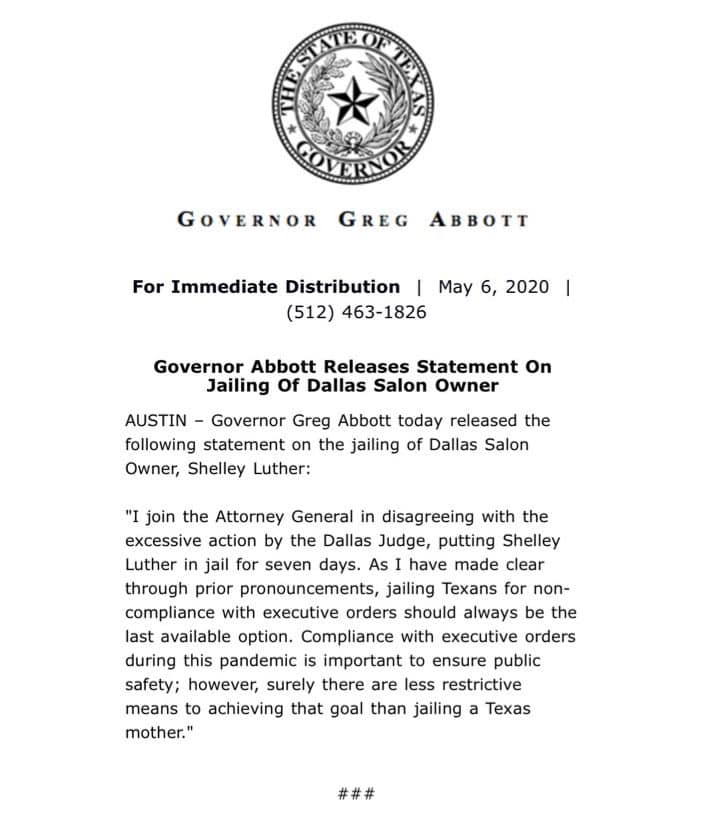
We had another example of civil disobedience here in Texas this week. A salon owner in Dallas, Shelley Luther, had followed shutdown orders since they went into effect in mid-March. She—as well as her employees—were without a source of income for over a month (March 22-April 24). She still had to pay for the shop. She still had to pay for food for her family. So did those employees she wasn’t paying.

Luther had attempted more than 500 times to contact the government for unemployment and never got through.

She had attempted to get a loan for her small business through the government grants, but that didn’t come through until this past Sunday, May 3rd.

The governor announced the state would start opening back up after April 30th, with “nonessential” businesses like hers opening up a week later (tomorrow)—using hygiene requirements that would avoid the spread of the virus. She was willing to make those adjustments.

But the Dallas County Judge (county executive), Clay Jenkins, decided to overrule the governor’s recommendations and require an additional two weeks of shutdown for her type of business, at which point she decided she was done with compliance and went ahead and opened up after April 24th.

Local jurisdictions are allowed to make some judgments for their areas based on their local circumstances. But was this extension because Dallas was on the verge of overwhelming the medical resources? No. As an urban area, the spread of the virus there has been greater than most parts of the state. But as a percent of population, Dallas still rated quite low compared to most urban areas of the country. Medical resources were nowhere near being overwhelmed.

And the local officials were allowing arbitrary openings, such as the dog grooming place next door, even though they weren’t considered essential businesses either. Why can dogs be groomed, but people cannot? People have to bring a dog in, so there aren’t fewer people involved in the exchange of service.

Shelley Luther felt like she’d sacrificed to do her civic duty for long enough. So she defied the executive order and opened her business.

Then came a court order for her to shut down. She defied it. Then she was issued a restraining order preventing her from opening her business, which she tore up. That led to the contempt of court charge.

Shelley Luther speaks in court, screenshot from here
Then they arrested her, fined her $3,500 plus $500 a day, and sentenced her to seven days in jail without bail. Jail for contempt of court is very rare. A fine can be recompensed upon appeal, but jail time cannot be returned to a person’s life. And why no bail? (See the 8th Amendment to the Constitution.)

Did she break the law? Technically, yes. (For discussion of the laws involved in this case, I suggest the Viva Frei law vlog, here and here.) The executive order isn’t exactly a law, but in times of emergency, temporary lawmaking powers are granted to such officials and can have the weight of law—even when they temporarily abridge our God-given rights. And contempt of court is definitely a real thing.

She broke the law—a stupid and arbitrary law—willingly and knowingly. And she was respectfully willing to submit to the sentence. But not without being heard.

There’s the important detail.

And she was heard. If you haven’t heard her words in court, they’re worth hearing as an example.
The judge, State District Judge Eric Moyé, sentenced her. But, in the hearing he told her he would suspend the jail time and simply charge the fine—if she would apologize and admit that she was both wrong and selfish to do what she had done.

She refused. She could get special treatment by submission? By saying something she did not believe, because it would validate the authority of government to take away her business and livelihood for arbitrary reasons? No. 

In the calm and sincere way Southern women say, “Bless your heart,” she said,

Judge, I would like to say that I have much respect for this court and laws. And that I’ve never been in this position before, and it’s not someplace that I want to be. But, I have to disagree with you, sir, when you say that I’m selfish. Because feeding my kids is not selfish. I have hair stylists that are going hungry because they’d rather feed their kids. So, sir, so if you think the law is more important than kids getting fed, then please go ahead with your decision, but I am not going to shut the salon.
Fortunately, these are not normal times. We would not normally have video from the court. It would have been handled in obscurity. She would have been just another lowly citizen who lost trying to fight city hall.

But we did hear her. And so did the world

Texas Lt. Governor Dan Patrick offered to pay her fine and suffer a week of house arrest to take the place of her sentence.

Dan Patrick's tweet, image found here


Governor Abbott's letter
from here
Texas Governor Abbott said, “Throwing Texans in jail who have had their businesses shut down through no fault of their own is nonsensical, and I will not allow it to happen.” He amended his orders to clarify that enforcement options would not entail jail time.


Texas Attorney General Ken Paxton said, “No Texan should face imprisonment for peacefully resisting an order that temporarily closed a lawful business and drastically limited their ability to provide for their family through no fault of their own.”

There were plenty of remedies short of jailing Ms. Luther:

·         a reasonable single fine,
·         a larger fine,
·         a reasonable daily fine until compliance,
·         a temporary suspension of her license,
·         a physical guard preventing entrance to her salon,
·         forgiveness since the shutdown was within days of being lifted anyway and she was following all the hygiene rules.
Imprisonment seems excessive. The Texas Supreme Court thought so too, which were brought in on a request for Habeas Corpus. They quickly ruled in her favor, based on the unreasonableness of the sentence. She was to be released this afternoon.

This does not end her case, just her jail time for being in contempt of court. She will still have to go through the court case based on her defying the executive order and subsequent court order, and any appeals after that.

There’s a GoFundMe account to help her in the upcoming legal battles, and to help her and her employees.

I heard another brave example this morning in an interview on Hugh Hewitt’s show. In his introduction, Hugh Hewitt says, 

It’s been my pleasure over 30 years in broadcast to talk to a lot of very successful people, very powerful people, very courageous people. Rarely do they all combine in one guest like they do in Jimmie Lai.
Jimmie Lai is a billionaire businessman in Hong Kong. He has been working for freedom there, where the Chinese people have had it, but where the Chinese Communist Party is trying to stamp it out. He has been part of demonstrations in Hong Kong the past couple of years asking for freedoms. He and others were recently arrested for not having the paper signed by the police granting them permission to demonstrate—in a way that they had a right to demonstrate, so it was a technicality intended to intimidate.

He’s particularly concerned about freedom of speech. If China had had freedom of speech, he says, then Li Wenliang, the doctor who first discovered the virus causing this pandemic, would have been allowed to put the news out in social media, to warn people. Instead, he got reprimanded. Lai points out that freedom of speech for the Chinese people is therefore in the best interests of the rest of the world.

So he continues to speak out, even at risk of jail or whatever comes, because the Chinese Communist Party is in the wrong. Fortunately, Mr. Lai is well known and able to get his voice heard.

I don’t want to be misunderstood as encouraging civil disobedience. But, among those we can admire who do it, they must:

·        Know clearly the principles they are standing on, what line of natural rights has been crossed that they find untenable.
·        Be certain that they cannot effect the needed change another way.
·        Be willing to suffer whatever consequences come.
·        Stay calm and reasonable in the face of whatever comes.
·        If at all possible, make sure their story and arguments get heard, unfiltered by propaganda.
That’s a high bar. But it’s what Rosa Parks did. It’s what Martin Luther King, Jr., did. It’s what Mahatma Ghandi did. During WWII Germany, it’s what Bonhoeffer  and Hübener did. 

And this week it’s what Texas salon owner Shelley Luther did.

Friday, October 18, 2013

After the Can Kicking


I didn’t really plan on a third day related to the government shutdown. This one, however, is just commentary on the situation, rather than specifically related to contract keeping. So, while this isn’t exactly part III, you might want to first read Contract Keeping Part I and PartII.
One of my favorite responses to the WWII Memorial closure
photo from here
I don’t yet fully comprehend all the details of the bill that ended the shutdown. In short, it looks to me like, in the game of chicken, the GOP veered to the side—just as everyone expected. It was on day 16 of the shutdown. Seventeen years ago, the dreaded shutdown went to day 21, when the GOP caved (a day before President Clinton had planned to end things).
The continuing resolution issue comes up again mid-January. A week into February the debt ceiling issue resurfaces. At both of those moments, the government could shut down again, if there’s no agreement. In other words, the can has been kicked down the road.
But if anyone thinks the Republicans are going to grow a new spine in a quarter year, they’re likely to be disappointed. Our hope may have to be that we elect a few more Ted Cruzes and Mike Lees in every coming election. Meanwhile, it is hoped by the weaker-spined legislators that Obamacare might implode on its own, based on early signs of incompetence. Personally, I don’t trust dumb luck—even when that much “dumb” is involved. I want to see active efforts to remove the albatross from the neck of the free people.
A few people made good observations follow the end of this episode, that I’d like to share, concerning the propagandizing of the shutdown, and some of the things we’ve learned.
My friend Kim quoted something on Facebook, with a few details I hadn’t known (again, this is quoted, so I’m uncertain of origin):
Something I hadn’t thought about. How truckloads of those shutdown signs instantly materialized and were posted.
One of the pre-printed signs
photo from here
How did +21,000 signs (large, detailed, specific) just magically appear overnight at some 620 locations?
I have worked in the government on and off for 42 years. During that time I became completely familiar with requisitions, bidding, awarding contracts etc. It is a time-consuming process dealing with bean-counters and pencil-necked bureaucrats every step of the way. The simplest request takes months.
In less than 8 hours (probably within six hours) of the shutdown announcement professionally printed and painted 3X4 foot signs miraculously and simultaneously appeared all over the country, coast to coast and border to border, in the tens of thousands saying—"This (park, facility, etc. [with the appropriate custom logos for each of the hundreds of parks and monuments]) is closed due to the government shutdown.”
There has not been a government shutdown in 17 years, and it was for a matter of hours and no parks or monuments were closed. [Well, 3 weeks, and some park areas were closed; remember the guy with the sleigh ride concession in Yellowstone Park that was waylaid? But mostly accurate.]
Fact that can not be disputed: These signs were carefully designed, detailed specifications were determined, signs were then requisitioned, bids were posted and vetted, and government contracts were awarded. The materials were then ordered, and the signs were manufactured, then distributed nationwide from their manufacturing point by the U.S. Mail or freight companies.
This shutdown was orchestrated and planned well in advance, at least 6-8 month ago. Millions of tax dollars were appropriated and spent in this process. As usual there is a filthy paper trail a mile long leading directly to the Oval Office.
Americans do not realize just what cesspool-level of pathological lying, Chicago gutter trash, we are dealing with! What juvenile, 100% inept, phony, petty crooks and street hustlers are now running our nation! 

Another Facebook friend, Shawn Rogers, who frequently offers great political commentary, had this to say:
So, boys and girls, what did we learn?
·         We learned that during a "government shutdown" 83% of the government does not shut down.
·         We learned that during the "shutdown" most people are unaware that anything is shut down.
·         We learned that the Obama regime will punish the American people when he is displeased with them.
·         We learned that Obama had to spend money to shut down things which normally aren't shut down during a "shutdown" in order to make sure people are aware of a "shutdown." [I love this one.]
·         We learned that eventually the current Republican establishment will always cave. Well, some of us learned that. Many of us have known that for a long, long, sad time.
·         We learned that the Republican establishment would rather turn on its own than fight the liberal democrat agenda.
·         We learned that John McCain is a liberal sympathizer. We learned that Peter King is a vindictive, petty, and spiteful man. We learned that both of these men are beneath contempt because they put political party power ahead of the Constitution.
·         We learned that people like John Cornyn and Orrin Hatch think the citizenry is stupid and incapable of understanding the machinations and manipulations of the legislative process. [Cornyn did vote right in the end, and the airwaves are full of ads reminding us Texans of what he claims has been his fight against Obamacare; he is doing major damage control after his failure on the cloture vote.]
·         I learned that my ardent support for Senator Ted Cruz was the best political activity I've ever engaged in. I learned that Senator Lee is not one whit behind him in his defense of the Constitution.  [I strongly concur.]
·         We DIDN'T learn that Barack Obama is a tyrannical, spiteful, and evil leader of the country. We've known that for over five years.
That was the same evening the agreement was reached. Shawn had more the next morning: “That awkward (and pathetic) moment when 17% of the government starts back up and nobody notices a bit of difference.”
And he posted a link you might enjoy: “16 Things We Learned from the Government Shutdown.”
Thursday evening he added some hopeful words about Obamacare and the political future:
Prediction: Within 3 months the Regime will delay or otherwise stall the implementation of the Affordable Care Act, partially due to the horrifically incompetent roll-out, but also to the absolutely abysmal numbers of individuals signing up. You heard it here first.
Second Prediction: You will soon start to hear of democrats in the House and those up for re-election in the Senate pushing for some kind of delay or reduction in penalties under the ACA. They have to be getting extremely nervous right now.
Third Prediction: The 2014 mid-terms will be a repeat of 2010. It will be awful for the Democrats due to the failure of their policies.
Keep hope alive, people. We aren't always going to be in this adverse political climate. 

Thank you, Shawn. I appreciate encouragement to keep hope alive.

Wednesday, October 16, 2013

Contract Keeping, Part II


Part I of Contract Keeping covered some of the details of the current complicated situation surrounding debt ceiling, continuing resolutions, and implementation of Obamacare. There’s a contrast between what the president says about the high priority of keeping our contract to pay our debts and the way he disdains contracts and commitments at will.
So it is with thought of contract keeping that we take a look at presidential choices during the government partial (17%) shutdown.
·        He has shut down and refused access to a privately owned hotel and restaurant along the Blue Ridge Parkway—which wasn’t closed. He has used federal money to hire forces to barricade access, losing even the income the private entity would have paid if allowed to operate. I can’t tell from the story whether the inn is on private land or is private property on leased public land. I haven’t read the contract, but I believe this business owner and any others similarly affected have a right to sue over breach of contract, and certainly can sue for government’s seizure of private property.

·        He tried to shut down the parking lot to Mt. Vernon—a privately owned property on private land—because the parking lot is jointly owned between private entities and the federal government. Federal resources were used to blockade the parking lot, but no resources would have been spent to leave the space open. No word on what urgent treasury need was satisfied by this additional expense and intrusion on private property. Again, I haven’t read the contract about the jointly owned parking lot, but I bet there’s nothing in there warning that the government can arbitrarily cut off use without emergency safety cause.

·        He has evicted people from their privately owned homes located on park lands at Lake Mead. He used federal money to make the evictions happen. He didn’t simply say, “You won’t have federal services while in your home, so you’ll need to depend only on state and other jurisdictions.” No, he says you can’t live in your home that you own—on property for which you have a long-term lease contract. The president is saying that, if you have a lease contract with the federal government, it is null and void during a temporary partial shutdown, and you must therefore be prevented from using your personal property until the president gives his express permission. Any other landholder would be taken to court and would lose for this breach of contract. I would like to see a lawsuit against the president personally, since this is his doing.

Mt. Rushmore backside view,
because the front view was closed
·        The president not only shut down national parks, he used taxpayer dollars to pay officials to block views from the road. On the paid-for road leading through Mt. Rushmore National Park, all the viewpoints were barricaded, and officers were stationed to keep cars and buses from stopping to take photos of the very visible mountain. Certainly the only reason the whole Mt. Rushmore wasn’t covered with a curtain was the logistics of hooking up a piece of fabric so large.

·        There were four soldiers recently killed in Afghanistan. What usually happens is that there is a grant of $100,000 within three days, to cover funeral expenses and other immediate needs of the family at the time of crisis, while waiting for other death benefits to be issued. But our president couldn’t keep that promise—because it would hurt the public more if the promises weren’t kept. There was enough outcry over this failure to our troops that Fisher House, a private charity for injured veterans and their families, offered to make the payments as needed during the shutdown. The president accepted the offer, insuring he would have the government repay the debt after the end of the shutdown. Several problems here: first, we have plenty of money in the treasury for the essential government role of the military—including keeping our promises to our soldiers. Choosing to break this contract is despicable. In addition, the president has no power to commit the federal government to additional debt—as he did with Fisher House; only Congress can do that. Meanwhile, the House had two months ago passed a bill to fund the military, and just to be certain, also passed a bill to guarantee these payments to families after military losses be paid. The bill sat on Harry Reid’s desk—with him saying it was moot now that the Fisher House arrangement had been settled. Then, because of bad optics, he had it quietly passed in the dead of night.
There are additional ridiculous measures the president has taken, beyond outright breach of contract, simply to cause pain to the American people.

barricades removed from WWII Memorial
·        The open air Veterans Memorial in Washington, D.C., was closed, by barricade, to prevent aging veterans from visiting. Meanwhile a group of illegal aliens are granted access to the National Mall (where, if reports are true, the federal government built a platform stage for their use) to demonstrate for a path to citizenship. In response, this past weekend there was a peaceful, large gathering on the National Mall, where demonstrators cleaned up the space—including placing the unneeded barricades neatly in front of the White House.

·        In Utah, where 70% of land has been claimed by the federal government, local authorities decided to peacefully remove the barricades to allow people to drive through the people’s park land and look around; it was costing more to keep people out than to let them in. And it was harming the local economy, which is forced to depend on public lands. Eventually the state made a deal to pay for parks to be open during the shutdown, so the federal government couldn’t claim penury as the reason for forbidding access to most of the state.

·        There were public drinking fountains in the Alleghenies and C&O Canal area, where he had faucet handles removed so water could not be accessed. The plumbing was already paid for. The water came from wells. It certainly cost more to remove water access than it could have cost to monitor water contamination for what is expected to be no more than days or weeks. Petty and mean-spirited? Yes.
There are a few clever phrases and appropriate epithets for the president that have come up during this shutdown:
·         The Spite House
·         Campaign of Pain
·         “Make It Hurt”
·         Barrycades
·         Intransigent
 
A couple of good pieces about the “make it hurt” policy are Bill Whittle’s Afterburner video and a piece by John Stossel called “Shutdown Theater.”
It may be that the ridiculousness of the “Spite House’s” “Campaign of Pain” is getting through to the lesser informed. The president’s approval rating is now historically low—lower than George Bush’s ever was, even with a continuous media screed against him. And this president still enjoys a fawning media (with just occasional chinks). An informal poll on a liberal college campus in Colorado showed overwhelming blame for the shutdown going to the president and democrats. I’m sure the president would see that as unexpected.
I am always in favor of clarity and truth. It may be that truth about the president is escaping into the general consciousness. It is possible that standing up to this bully at this moment in history could turn out to be a very worthwhile opportunity for truth to be better understood.

Monday, September 23, 2013

Defund It

Senators Mike Lee and Ted Cruz
image from here
I’m on Team Ted Cruz/Mike Lee/Marco Rubio on defunding Obamacare—even if the other side threatens to shut down the government and blame Republicans for it.

The House, where government funding originates, has done its job and put through a continuing resolution (before the current one expires September 30, since the Senate has refused to pass an actual budget for years) that continues current funding through mid-December, with no changes—except without funding for Obamacare. It’s particularly important to defund NOW, because key provisions kick in October 14. It has to be stopped.
I could spend a very long post enumerating the anti-American, harmful effects to health care and the entire economy, but I’m guessing if you’re reading this, you already have an adequate list of your own. We all know the ironically named Affordable Care Act makes medical care less affordable and less available—while giving all kinds of intimate control over our lives to cold, distant bureaucrats. Nothing about the thousands of pages in the bill, and the hundreds of thousands of additional regulations, can be identified as an improvement over what we had--which had plenty of problems mainly caused by separation from market forces. I don’t think we can even give the bill and regulation writers the assumption that they meant well.
So, since we’re agreed on that—and a solid majority of Americans are agreed that the whole thing needs to be scrapped—the question at hand is how to put a stop to it. Before all our freedom options are done away.
In an ideal world—well, in an ideal world, this would never have been proposed, let along been passed; and in an ideal world the Supreme Court would never have stretched the Constitution beyond breaking point to declare this monstrosity lawful. But in a hypothetical ideal world, what should happen next is that the Senate should agree to the continuing resolution minus Obamacare spending. Let’s say that would happen. Then the spending bill would go to the president for a signature. In an ideal world (so, one with a different president), the president would see that the American people have spoken—loudly—through their representatives, that they do not want this bill, so he would acquiesce and sign the defunded bill. And then he’d go ahead and encourage Congress to vote to repeal (again for the House, but the Senate is the bottleneck).
But since this isn’t an ideal world, what can we expect in the Senate? That depends on how much fight the Republicans have in them—and add to that a little bit of worry among Democrats about the heavy anti-Obamacare majorities among voters. Do they want to kill their careers over this extremely unpopular monstrosity, just because their Democrat president says they have to?
Democrats have the majority. So much is in their hands. As it was, entirely, when the bill passed in 2010.
At this past Saturday’s local Tea Party meeting, one of our speakers was Paul Bettencourt, the Tax Man. He used to be Harris County Tax Assessor. Currently he’s running for Dan Patrick’s state senate seat (the large and conservative District 7) while Dan Patrick runs against David Dewhurst for state Lieutenant Governor. Bettencourt also has a gig on the radio (the Dan Patrick owned AM 700 The Voice in Texas), talking about taxes and politics. We know in Texas we have Ted Cruz on our side. John Cornyn, who is more long-time establishment, was a question. But Bettencourt said they had Senator Cornyn on the radio, pressed him pretty hard, and believe he has now committed to vote for defunding.
I have since seen a fair amount of corroboration from Senator Cornyn. He has made the declaration pretty clearly. This was from his Facebook page this morning: “I intend to support the House bill that defunds Obamacare and will vote against a bill that funds it.” There’s also a piece in the Dallas News on his announcement. A couple of days ago I got a link to sign Cornyn’ petition to defund Obamacare. (I signed it, in addition to the Ted Cruz petition I signed weeks ago, just to make sure Senator Cornyn knew constituents out here back that decision.)
Paul Bettencourt suggested getting hold of friends in other states and encouraging them to contact their senators, to encourage them to vote in favor of the continuing resolution that defunds Obamacare (which, for technical procedural reasons, also includes standing firm against a cloture vote).
If nothing else, one thing that the vote should do is, as Bettencourt put it, “put jerseys on every senator,” so you know what team they’re on. That gives some significant leverage in the next election.
If, by some miracle, we were able to get to the point where there is a choice between defunding Obamacare or shutting down the government—the very thing establishment Republicans fear—that would be a great blessing. The fear comes from what happened in 1995, with the government shutdown during Clinton’s term. It was a public relations nightmare for Republicans. The GOP got blamed for everything from shutting down national parks to starving children.
But PR isn’t everything. We need a reminder of what actually happened back in 1995.
Bettencourt recounted a part of the story I hadn’t known. On Sunday, the 21st day of the shutdown, Senate leader Bob Dole caved. He had been worried about his image, since he was thinking of running for president. What he didn’t know was that Clinton had already decided to fold on Monday, the 22nd day of the strike.
Had Dole waited, the GOP would have won the entire battle. But even as it was, Clinton took on welfare reform—claimed it as his own, but we got it, so that was a win.
Last time around the media portrayed the shutdown as a disaster for the GOP. But it actually wasn’t. In the next election, the GOP won something like six Senate seats and held the House. Clinton kept himself politically afloat only by co-opting GOP policies as his own. Rush Limbaugh reviewed the history a couple of months ago, in anticipation of this week’s showdown--worth reading.
Back then, the media voice for the GOP was very limited. As Rush put it, “In 1995 I was it, as far as conservative media goes. The blogosphere had not come into existence; the Internet was still essentially an infant in this regard. There were no other conservative talk shows. Fox News was still two years away. I was it. It was still a media monopoly: ABC, CBS, NBC, CNN, Washington Post, New York Times, local news, you name it. I was it.”
That’s what I’ve been thinking. The mainstream media will malign conservatives no matter what we do—even if we played for the media audience by praising Obamacare against all the evidence. MSM is a lose-lose black hole for conservatives. There is no changing that. Nor is there getting through to the uninformed voters, who just don’t pay attention. But we have more media outlets now. The internet is, so far, still a free voice. Fox News isn’t as conservative as the MSM portrays it, but it’s at least not the propaganda arm of the administration. The true story will get out—it will be told to every ear willing to listen.
And what is the worst that can happen from a temporary government shutdown? The president will try to make it as painful as possible—just as with the sequester, where he has cut soldier food in Afghanistan to two cooked meals a day (because there’s not enough money with the sequester temporary cuts in the rate of increase, even though there is plenty for him to use Air Force One to transport his dog to wherever he’s vacationing). He will try to make it appear Republicans are trying to starve children and kill old people—same old same old.
But there are other voices now. And it’s possible that, even with the worst case scenario, people will notice little more than occasional irritations at government—nothing new. And with every painful choice the president makes, there will be new voices pointing out that it was his choice, with the purpose of inflicting pain.
If that’s the worst case scenario, maybe it’s worth finally getting past the fear and standing on principle.
The worst-case scenario if this fails is dire. Business and labor already agree that Obamacare is an abomination. Putting off employer mandates was done for two specific reasons: First, employers couldn’t do it, and the effort threatened to pretty much shutting down the economy that is already (still) floundering under this administration. Second, the worst damage was put off until after the 2014 election, because Democrats would have been demolished by the knowledge that Obamacare was the cause of so much pain.
So even the Democrats realize Obamacare is a gross negative for America. Since we all know that, now is the time to act on that truth.