Showing posts with label Stu Berguiere. Show all posts

Thursday, August 11, 2016

Dreaming the Impossible Dream

A couple of weeks ago I read this piece by Stu Burguiere, which I thought was entertaining but impossible. But because I’ve been looking for something to hope for. Stu describes his scenario:

First, don’t try to get to 270 electoral votes. If no candidate gets to 270, then the Constitution dictates that the incoming House of Representatives would vote for President. Each state delegation would get one vote. The good news? Republicans currently hold over 30 of the state delegations, and therefore would select the next President from the top three candidates with electoral votes. You must have at least one electoral vote to be considered.
There are plenty of logistical problems with this, which we can address in a moment. But, let’s address the most pressing first. How does this NOT help Hillary Clinton?
The answer: You have to be very selective. Don’t try to get on the ballots of 50 states, or even 25. The goal is to get on the ballot of a few deep red states that Hillary Clinton has no chance of winning anyway. Essentially, you hurt Trump without helping Hillary.
Again: we never take one vote from Donald Trump in a state that Hillary Clinton can win.
Here are the scenarios that could happen:
1.       If Hillary gets 270, she’s the President. But she wins entirely with electoral votes from states in which our conservative third party candidate is not on the ballot. In other words, we had nothing to do with her victory.
2.       If Trump wins in a convincing way, he’s the President. Even if he loses a few of our small deep red states, he’ll still have more than enough to get 270 electoral votes if he can pull off a decent amount of the purple states where he goes head to head with Hillary.
3.       If Trump wins in a squeaker and would have just cleared 270 electoral votes, our candidate would grab enough electoral votes to throw it to the House. Then the Constitutional magic happens.
Do I think this scenario is likely to play out? No. Is it possible? Maybe.

What matters to me is having a soul-saving alternative for my vote. Of course I could never vote for Hillary; that would be like saying, “I never loved America, and I always thought the Constitution, and even the rule of law, were passé guidelines, and I much prefer corruption and tyranny.” So, no.

And I would never vote for Trump because he is a narcissistic, authoritarian bully—something like we’ve suffered under for the past two terms, but with even more obvious character flaws. So, no.

That means that I need an alternative. That could be a third-party or independent candidate, or a write-in. I’ve been willing to write-in Ted Cruz, even if I’m told I’m not allowed to, if it comes down to that. Or I would leave that race blank—which comes with some risks, because presidential undervote is rare and might look invalid.

So I was willing to hear from Gary Johnson. Some people I respect like him. He was reportedly a good Republican governor of New Mexico. Already he’s better than Hillary or Donald. 

But there are some big flaws. He’s ready to legalize drugs—let the buyer (addict) beware. He’s pro-abortion—because it’s about doing what you want—even though in this case there’s another human life at stake. And his stance on religious freedom is more than troublesome. He sees it as an issue of religions using their beliefs as an excuse for bigotry, so government should step in and coerce service.

The issue at stake here is mainly about same-sex “marriage,” and requiring bakers, photographers, and florists to perform services against their religious beliefs. Johnson, who usually qualifies as a libertarian, thinks government ought to override religious freedom and coerce the services. I’ve heard him explain that position a couple of times; every time his clarification makes me sure I heard him right the first time.

So, Gary Johnson would almost certainly be less bad than the two main party candidates. But if I’’m looking for a soul-saving vote, he’s not it.

Then, on Monday, a new candidate entered the race.

Evan McMullin for President
image from here


His name is Evan McMullin. Chances are you’ve never heard of him before this week. I hadn’t. But if you’re looking for a candidate with national security, economic, and legislative experience, he’s there. He spent a decade as an anti-terrorism specialist with the CIA. Then he got an MBA and worked a few years for Goldman-Sachs. Then he went to work as a policy advisor for the House of Representatives.

He’s a conservative Republican—running as an independent. Normally an independent getting into the race this late would be hardly noticeable, because there would be no chance. Maybe it would be about getting a little attention for a particular issue or point of view. But in this case McMullin might be noteworthy.

He happens to be a Mormon. To us Mormons, or those who know Mormons really well, we know what it takes to live that lifestyle. We’re pretty much the definition of social conservatives. No alcohol or drugs. No sex outside of marriage. Honest. Trustworthy. Kind. Charitable and service oriented.

It’s not something you can easily fake. We’re very connected people. While I don’t yet know anyone who personally knows McMullin, I wouldn’t be surprised if I come across someone who has in the next couple of weeks.

This is important, because there are a lot of Latter-day Saints who love America, are loyal to the Constitution, and despise the idea that either Clinton or Trump might become president. They’ve been looking at Gary Johnson—or any other alternative—to possibly deserve their vote.

McMullin is opening and headquartering his campaign in Utah. It’s actually possible that he could win in Utah. And maybe also Idaho and other Intermountain West states with a significant Mormon population. I don’t know if we’ve got big enough numbers to help in many other states. But if he wins a few states, that might be enough to trigger Stu’s scenario.

McMullin claims he is working to be competitive in all states, that things are underway to get his name on the ballot. We’ll see if he can pull that off.

Since Monday, I’ve heard him interviewed on Hugh Hewitt’s Tuesday morning radio show (might require subscription to hear). Hewitt is conservative, but he doesn’t suffer fools easily. It was respectful, and McMullin presented himself well.

Then I saw a longish Bloomberg interview, from Monday. McMullin had a chance to go over his history and background, his policies, and his reasons for getting into the race. He waited, hoping someone with more name recognition would step up. But, at this nearly last minute, he decided to go for it. He’s had a team looking into the possibilities for some months, because there are some big challenges getting on ballots across the country.

There’s a Monday night ABC News interview where he takes on Clinton and Trump, asserting they are both are "woefully unfit for the responsibilities they seek." While he’s careful about the words he uses, he doesn’t hold back. I think it was in this interview I heard him say, "I've spent my life trying to serve and avoiding the limelight. Trump has spent his life avoiding service and seeking the limelight."

He was interviewed on Glenn Beck Radio this morning, and again presented himself well.    
   
Chances are you’re going to hear more about this quixotic candidacy. You might as well go to the source and see what he says about the issues:

·         National Security
·         Jobs and the Economy
·         Education
·         America’s Role in the World
·         Health Care
·         Energy and the Environment
·         Government Accountability
·         Life
·         Poverty
·         Veterans
·         The Second Amendment
·         Trade
·         Immigration

He’s got a statement on each. I’ve read them. For the most part we’re in agreement. Even where we’re not exactly aligned, I don’t know yet if that is careful speaking on his part. I was for Ted Cruz all the way. Cruz speaks in bold capital letters. McMullin speaks sotto voce but mostly head on. There’s enough here that I want to know more.

This is a little like starting to date someone. You’ve had a really good first date. Wanted to keep talking. Want to get together again really soon. See if this will go somewhere. You want it to. Especially because—as a twist to the story—you’ve got three months to make the commitment or you’ll lose your inheritance. Something like that.


So, I’m not sure I know everything I need to know just three days into the relationship. But I’m hopeful. I’d like to have a country-saving vote. But at the very least, I’m hopeful that in McMullin I’ll have a soul-saving vote.

Wednesday, November 13, 2013

Calculating


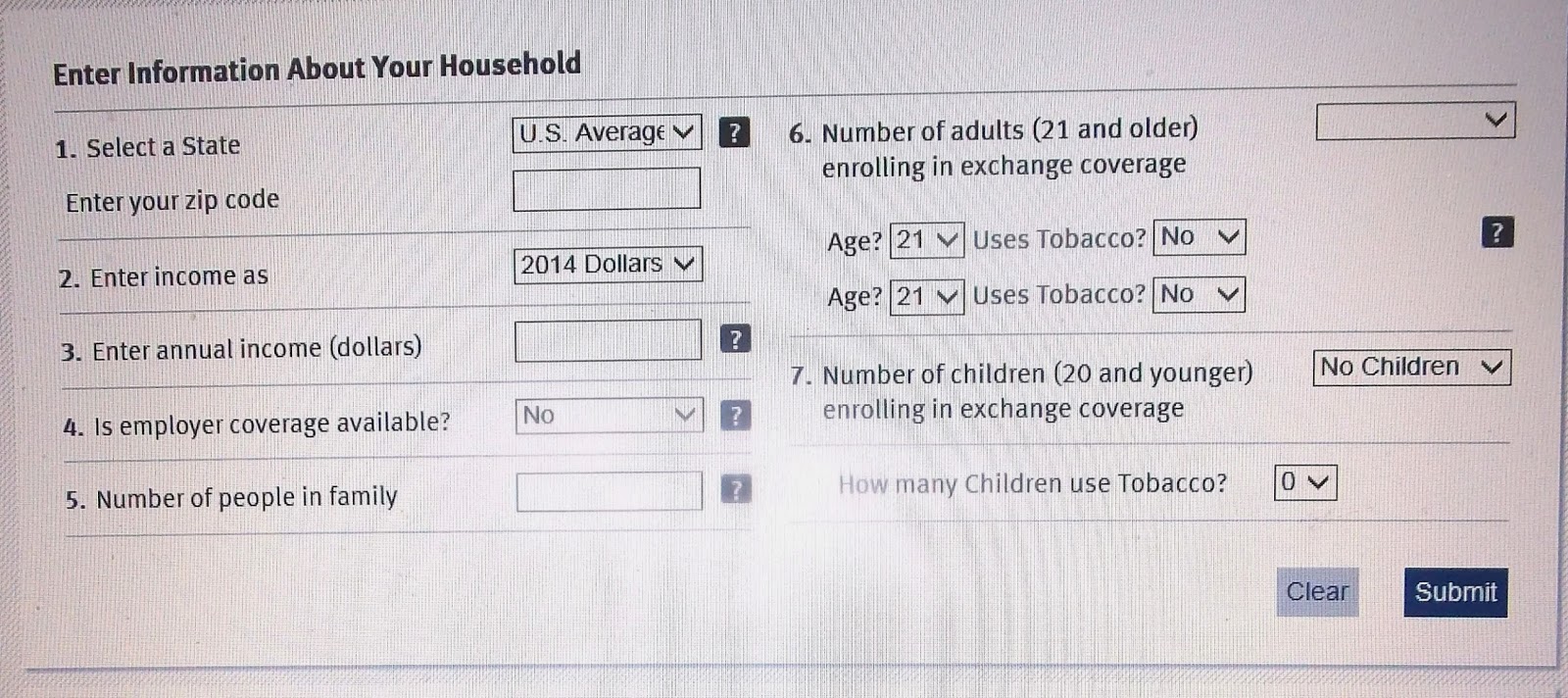
Have you tried the calculations yet to see what kind of impact Obamacare would have on your finances? I don’t mean have you suffered through the glitchy Healthcare.gov website signup, which wastes your time while collecting your personal data; I suggest you avoid that indefinitely. No, I mean have you used the Kaiser site, just to do the calculations. 

The Kaiser ACA Calculator
My son Political Sphere gave it a try. Actually, he went two place online: both the Kaiser calculator, which has some limitations, and the Healthcare.gov site, but only using the "view plans now" option, rather than actually trying to sign up. So, hopefully, that means no permanent data collection. Anyway, here are the results.
He has been going without health insurance for some time. He and family are that combination of healthy and poor, making up the large majority, I’m guessing, of the purposely uninsured. This does not mean they get no health care; they just pay for it, in cash, when they need it. This included even the birth of Little PS2, with the help of a midwife. (Little PS1 was born with the help of the same midwife, but finances at that time led Mr. Spherical Model to pay that bill out of pocket, so he claims his granddaughter belongs to him—bought and paid for. We humor him.)
Now that Political Sphere is in law school, he is required not to be working. Mrs. Political Sphere works part time at a fast food restaurant and also takes college courses. There’s a scholarship that is covering law school tuition this year, and then there’s a sizable student loan to cover such amenities as school books, rent, food, and clothing for growing children. Things are tight, as you can imagine.
So Political Sphere goes to the calculator websites and inputs that data. It turns out, as you’d expect, their income is so low (well under 50% of the poverty line), they can’t be expected to pay ACA marketplace prices. They are turned over to Medicaid. But then things get kind of ironic.
You know that big student loan for living expenses? The one they’ll be paying interest on for years to come, but was a necessary cost of the schooling investment? Yeah, that counts as “income” according to Medicaid. For Medicaid purposes, taking out a loan that you have to pay for with interest is considered being what you might call “flush with cash.” The federal government agrees they’re way too poor to be buying health care; nevertheless, negative income (debt) makes them too rich to be receiving Medicaid. [Aha moment: government thinks debt is income—that explains a lot.]
So what is the government’s solution? Go to the Healthcare.gov website and find yourself a policy for, oh, say, $272-$432 a month for catastrophic coverage only. (The Kaiser calculator only gives averages by level and does not include catastrophic coverage as an option.). Catastrophic coverage means you pay 100% of the costs of your medical needs except for a list of serious expenses. Or you can go up to $334-$592 for the Bronze level coverage (that price is based on just two parents receiving coverage, assuming the children are already on Medicaid). At the Bronze level, you pay 40% of your medical bills. For additional money (this is general information from the Kaiser site), you can step up to the silver plan, where you pay 30% of your medical costs. All of these, according to a note on the Kaiser site, come with the proviso that out-of-pocket medical expenses (over and above premium costs, if I'm understanding correctly) can top out at $12,700 a year, which may exceed 100% of your annual income. Such a deal!
How do you pay those premiums? Maybe they assume getting additional loans of up to $600 a month is no problem, but it kind of is for people in the real world. So maybe they expect the family to just live on the streets instead of paying rent, which is about an even exchange, cost-wise. They have made it a law that you must buy insurance, but they have not made it a law that you must house your family.
They require everyone to buy insurance, because the whole “even the playing field” idea doesn’t work unless you force young healthy people to pay as much as older unhealthy people pay. And we need to be “fair,” after all.
Or PS and family can be sensible and continue doing what they’re doing—paying cash when they need to take the kids in for checkups, and ignore the mandate. That first year the fine is relatively low. It gets collected out of tax refunds—which you don’t pay when your income is that low. However, the government “returns” several thousand dollars more as a “tax refund” when you’re that poor, so this means they’ll "collect the fines" by paying any poor family that ignores the mandate a little bit less.
The second year fines go up, but by then there’s only one more year until law school is over, and it might be possible to consider buying healthcare coverage. We’ll see.
Still, at that point, wouldn’t a health savings account be a much better deal for a healthy young family than being forced to subsidize someone else during their very early career years? Assume they pay a few hundred a year in medical costs, as they’ve been doing (and paying cash up front does get you the best deals), and they pay $5000 into a health savings account, instead of into a policy. By the next year, that $5000 is earning interest. They do it again; by the end of two years, they have a health savings account with $10,000, plus interest. Just a few years of paying themselves without having to pay out, and they can self-insure. And if they were worried about catastrophic coverage, they could buy that at a free-market rate of around $100 a month (pre-Obamacare market pricing) and still have most of that money left for the health savings account.
On this past Saturday’s Wonderful World of Stu show (Stu Berguiere on The Blaze TV), he went through a list of why Obamacare isn’t the great deal it was said to be. Here are a few:
·        You can’t keep your plan after all—40-67% will have to change, because any tiny change eliminates the “grandfather” protection, and the law forces plans to change. [Political Sphere told me that when Obama said, "You can keep your plan. Period," he actually meant "asterisk." I thought that was clever and I was going to quote him, but he said he heard it on radio and doesn't remember which radio host to credit.]
·        Saying that those in the “individual” market are only a few is disingenuous: government estimates that number at 93 million Americans, with some more accurate estimates saying it’s at least 129 million people. Numbers go higher when people lose their employer coverage by losing their jobs, or when employers find it a better deal to pay a fine than to pay for more expensive plans.
·        The price for the whole of Obamacare was sold to voters as $900 billion over 10 years (without counting the first 4 years). But it’s really more like $1.88 trillion.
·        The average family was supposed to see premiums go down by $2500, but the average family actually has premiums going up by $3000. So the government “misunderestimated” costs to families by $5500 a year--and we could add that Affordable Care Act is a sadly ironic name.
·        Obamacare, according to Pelosi, was to be a great jobs creator—4 million new jobs, with 400,000 of those right away. In real world math, Obamacare will cause a loss of 800,000 jobs.
You get the idea that all those planners involved in this whole ACA mess don’t like to be bothered with details like math (or truth). That’s something third graders might get away with, but it’s really not acceptable from the calculating tyrannists insisting we give up our freedoms, because they claim they know better than we do how to make our personal spending decisions.