Showing posts with label Hurricane Harvey. Show all posts

Thursday, August 23, 2018

It's Been a Year


We’re having something of a commemoration this weekend. It has been a year since Houston and beyond was hit with Hurricane Harvey and 50+ inches of rain in about three days. We're still Houston Strong.


During this recovery year, we've learned a lot about goodness, and caring, and sacrifice under those difficult circumstances. As I said back then, there were stages. First, there’s saving lives, and then assessing the situation. Then comes mucking out, which had to be done fairly quickly. A week of standing water in a house can ruin not only everything the water touches, but anything the growing mold reaches. The mucking out includes removing all the flooring, drywall, and furniture out to the curb, and then power washing anything that needs it.

All this time, people are doing this while living without their belongings, in a shelter or a hotel, or with friends, or maybe in a rental if they can get one. And a lot of people going through this with their own homes also went to work to help their neighbors. And many many people who found themselves safe went to work to get the mucking out done for their neighbors.

The next stage was the debris pickup. Places were left looking kind of bleak and blank, with large dead patches on the lawn.

Then came the rebuilding. This is the long stage. Some things had to wait for insurance procedures. Some had to wait for government help. Some had to wait to save up resources. Some, even with ready resources, had to wait for available help. There are only so many remodelers, drywall experts, and cabinet builders in a city. And while we did have some workers move here for the temporary work, there was still a shortage.

The result is that a few people got back into their homes, finished or not, within a couple of months. Many—I’d say an average—took six months. Some longer. And of those moved back in, some are still living with bare walls and floors, waiting their turn for the workers.

A couple of months ago we ran into an older scout troop, age 14+, from several states away. They had come to Houston for their high adventure camp—and spent the week putting up drywall for people in need.

Earlier, during spring break season, a church where I play music one night a week had housed youth groups from several states, spending their week away from school coming to Houston to help with rebuilding.

So that has been quietly going on, during these many months since the media outside Houston stopped talking about our event.

I drove around today, in my neighborhood and nearby, to see the changes. I took a few photos in the same places I did last year, to make the comparison. Most places, on the outside, if you didn’t know about the flood, you wouldn’t know anything had happened. Most trees and plants survived. Grass has grown back.

The entrance to our neighborhood was flooded
for about a week.
The south side of our neighborhood got hit while on the
north we remained dry. This street corner was used
as a rescue boat launch. It's back to normal today.
Anyone who hadn't gotten out before the streets flooded
had to be rescued by boats or large military vehicles.
It was surreal then. It looks totally normal again, at least
on the outside of most houses.
The debris was out one week after the storm. After one month
much of the debris had been scooped up and hauled away.
Today it looks mostly normal. A few houses still have
markings left on them by rescuers.

Here and there you still see a large dumpster parked out front, clearly with work still going on inside. In my neighborhood there were only a couple of those that I saw. In one of the older and harder hit areas, Villages of Bear Creek, those dumpsters were more common. But still, probably 90% of the homes looked OK from the outside.

South end of Villages of Bear Creek,
one of the worst hit areas, looked a lot better today.

I drove through Bear Creek Park, which is essentially part of Addicks Reservoir that is used for picnics, camping, soccer, baseball, and other park amenities whenever there’s no flooding. But when the heavy rains come, the park is intended to fill up with water. We’re used to it. It happens for a portion of most years. This time it was closed for several months. Today it looks mostly unscathed.

Bear Creek Park, near the entrance from Eldridge Parkway,
looking toward the baseball diamonds

The bayou (drainage canal) just down the road from us, which is what overflowed during Harvey, has been undergoing dredging all summer. I think there’s a plan to do that to parts of the park and reservoir as well, since floods have brought in enough debris and silt to lower capacity. And while Harvey was something like a 1000-year flood (not likely to happen again for a millennia), there had been a 500-year flood—the Tax Day Flood—just a year and a few months earlier.

Horsepen Bayou, after dredging

There’s a bond election taking place this Saturday, with nothing on the ballot but the bond. It’s likely to pass. And I believe the county have been good stewards of our resources. They had presentations and took feedback from the community about 20 times over the summer in preparation to know how best to use the resources.

The best case scenario, according to County Commissioner “Cactus” Jack Cagle, would be for the state to use the Rainy Day Fund—and really, if that wasn’t a rainy day, when could we ever use that money?—to pay infrastructure, such as dam improvements and possibly a third reservoir; and then have the county handle the building, because the county is most aware of the needs and priorities; and then have the US Army Corps of Engineers to do maintenance. That way the full burden isn’t on the country, but is shared by the state and by the federal government in ways those entities can be useful.
So, a year out, Houston is still strong. But still in recovery.

One of our church buildings, in the Villages of Bear Creek area, got flooded, along with the post office across the street. The post office is back in business—as is the library, not far away. But that church is still being worked on. When I drove past today, it still had two large dumpsters out back. We have two congregations from that building that have been sharing space with us for a year. We’re told work should be completed this fall, but I haven’t heard word yet on when.

The Cairnway chapel. flooded photo by Melissa Willis
I took the updated photo today.

Meanwhile, the beautiful temple up in the Champions area of Spring, northwest of Houston, flooded and had to be closed for eight months. But we’re happy to be back in there.

The two right photos, from the flood were from media stories.
That's us on the right, late April 2018

My friend Elaine, whose apartment complex was flooded, trapping them upstairs for a week, said this a couple of days ago:

I walked into the lobby of my apartment complex, and we have *flooring*! We haven’t had flooring since Harvey. Then I checked the mail and this was the weekly Kroger circular. Now I’m all emotional. We made it, ya’ll.
Here’s the circular, picturing Kroger workers helping out after the flood.


There were so many who helped. I don’t know if the nation and world is aware of the treasure we have in a furniture salesman we call Mattress Mack, Jim McIngvale. He turned his store—new mattresses and all—into a shelter after the storm, and invited restaurants to bring in food. He was an inspiration to all.

A few months ago, he honored members of my church, the Mormon Helping Hands, for the many hours of service. We appreciate being recognized by someone who has been tireless in his service.


One friend of mine, Derrick Campos, was flooded out of his house until around May, and is still living among the incomplete rebuild. He does a video blog called The Better Way, and this week he did a one-year anniversary of the flood. I love the cheerful way he talks about it. What you don’t see is that this was their third flood—in this house they built several years after we built ours. It’s just north of Villages of Bear Creek, and it’s near a bend in Langham Creek on its way to the reservoir. But it’s a nice, newer neighborhood that wasn’t expected to flood. And what do you do now that it does? Hope you don’t have to face it—yet again—for another thousand years. Anyway, here’s Derrick’s video about having an attitude of gratitude:


One thing you don’t know about yourself until tragedy hits is how much you can handle. And when it happens, you learn what it feels like to be lifted up by other caring people, and by God, whom you can feel with you, keeping you from despair. All Houston appreciated the help and prayers from our neighbors around the country and around the world.

I have a friend, from high school English class, who makes his living as photographer G. Brad Lewis of Volcanoman.com. He has spent decades documenting the Kilauea volcano in Hawaii, which has been active and wiping out neighborhoods of his friends the past couple of months. This photo is from yesterday.
Kilauea Volcano eruption
G. Brad Lewis, August 22, 2018

Yesterday and this morning he sent out a couple of photos of Hurricane Lane, which is about to hit them: he took the photo of the wave; I’m assuming he did not “use his new drone” to get the satellite image.


Anyway, it looks like people continue to be in need of our prayers. But one thing we know, after this year, is that love is felt over distances, and prayers work—both to inspire good people to do caring things, but also just to lift heavy hearts.

Monday, April 23, 2018

Afterward


I want to mention, before the main part of my post, the passing of former First Lady Barbara Bush this past week. She lived here in Houston, and the funeral was here, so we have been especially aware of her life and passing. And the comments are overwhelmingly positive, for good reason.

Barbara Bush
image from CBS News


Funerals at my church tend to be somewhat celebratory, especially when the deceased has lived a good and full life. I watched a recording of Barbara Bush’s funeral and found that it was that kind of event. People told stories—most of them funny, because she had that natural gift—and there were few tears and no regrets. It was lovely. The recording is available on Facebook: here

Facebook was filled with collections video clips showing her humor and caring nature. I especially enjoyed a personal note posted by my friend Leah Christie, founder of Not On This Watch, about the time she wouldn’t accept the then-Vice-President’s wife’s check, and how the great Enforcer handled that. Worth the read: here. 


The other story for today is follow-up to Hurricane Harvey. It has been eight months now. If you don’t live around Houston, maybe you’re not aware, but there are still thousands of people not back in their homes—2160 households still in hotels or temporary housing, according to NPR. And there are thousands more back in homes without all the repairs done, still waiting for flooring, drywall, cabinets, painting, etc.

Last month, during spring breaks around the country, youth groups traveled here to put up drywall and anything else they could do. Some were staying the week, living out of the church I go to one night a week for music jams. It’s touching to see that people still care. The need is less evident now than it was last August and September, but it’s still there.

But this week, one house, symbolic for many of us of the eventual return to normal, the Houston Temple of The Church of Jesus Christ of Latter-day Saints, is ready for our return.


Water at the front door of the Houston Temple
after Hurricane Harvey
image from here

The "lake" in front of the Houston Temple
is actually Champions Forest Drive
photo by Robert Boyd

During the Tax Day Flood of 2016, Cypress Creek, in the Northwest Houston suburb of Spring, flooded the area around the temple. Water came up to the doors of an ancillary building, and it looked like a lake in the front, but the temple—built several feet above ground level—was safe. But there’s a big difference between 15 inches of rain and 60 inches of rain, which we got in Hurricane Harvey. After two steady days of downpour, nearby church members went by kayak to inspect the building, and water was about a foot over the front door level. That meant the interior was flooded.

Oxen in the baptistry
image from the book Gift of Love:
The Houston Texas Temple, p. 88
The baptistry is on that level, and by tradition a baptismal font must be below the ground—to symbolize the death and resurrection of Christ. So there is actually a below ground level in the temple, unusual around here. The whole basement was filled. The twelve Oxen, symbolizing the twelve tribes of Israel, along with the font, like a small pool, were submerged. And there was another foot of water on the whole level. There’s a kitchen/break room on that floor, waiting rooms, changing rooms, rest rooms, the entry desk, security, and a first-aid room. As with so many other buildings, that meant removing all the drywall, any non-permanent flooring, all the furniture, art, equipment—just everything. All needed gutting, mucking out, and rebuilding.

It was about two weeks before people could get inside to inspect and start the recovery process, just like so many other people in their homes. Around that time, one of the temple presidency members talked with us. He and his wife, in their 70s, also had their own home flood. So they managed that move-out, muck-out, and recovery at the same time, and also helped other people in similar circumstances. This dear man told us that he knew for a fact that his wife’s faith is so strong, that it could have prevented the flood waters from breaching the temple. But the Lord seemed to be saying, “I know what you’re going through.” And that sharing of our griefs and carrying our sorrows was part of what needed to happen at this time.

So we’ve been waiting anxiously to return to the Lord's house.

Yesterday the building was rededicated in a small, private ceremony, making it a sacred place yet again following the repairs. Today was a training day for workers. My husband and I volunteer one afternoon a week, so we were there for that today. The temple opens for work again tomorrow.
It's good to be back.


Word to those getting ready to attend for the first time since rededication: there’s a new painting just inside the door of the upstairs women’s dressing room, of baby Moses being discovered in the river, that is so beautiful, it was the most memorable thing I noticed. Just, wow!

When a temple is located in a community, that’s a good thing—not just for the people who go there. Good things just happen. Housing prices rise. Good people are attracted to the community, people who help out in the community. Strong families get stronger. There’s a positive influence that emanates out from the temple.

You might say, when God lives in his house in the neighborhood, the whole neighborhood is better off. He’s a good neighbor to have. Having His house restored now, after eight long months, makes many of us feel like the end is in sight for the Harvey hardships.

I hope people continue to pray for those still in the midst of their recovery. If there was any good that came out of the epic flood, it’s that people care about each other. Their love and sacrifice, often for people they don’t even know, is a true sign of civilization. We Houstonians are grateful.

Thursday, November 2, 2017

Houston Strong


We interrupt our usually scheduled political philosophy blog for this special announcement:

The Houston Astros won the World Series

It’s worth celebrating. It’s hard to gauge from here at the current center of the universe, but my guess is that Houston was a sentimental favorite everywhere this year, because of Hurricane Harvey.

Storm on the left, 'Stros on the right
from a friend's Facebook
One Houston Chronicle headline I read this morning said, “Harvey dropped 51 inches so the Houston Astros dropped the Los Angeles Dodgers 5-1.” It may not be a cause-effect relationship, but it’s important. Several of the players had photos in their lockers of Houston homes underwater. They said that when they had a tough day and felt like slamming their glove into the locker, they’d see that photo and remember it was their fellow Houstonians who really had it rough. And they’d resolve to win this for them.

As the Chronicle story says,

The team wore "Houston Strong" patches on their jerseys, even when some of us felt less than mighty sifting through wet, damaged memories. The team visited flood victims in shelters, bringing a bit of blue and orange light where darkness was the norm.
It has been two months now, plus a week, since Harvey hit. Most of the damage near my neighborhood is no longer visible from the outside. But friends are still out of their homes—maybe for another 4-6 months—while inside repairs are underway.


As the team said last night, if they could just bring four hours of joy on a game night—a little bit of happiness—that’s what they wanted to do.

from a friend's Facebook*
There was a lot of love coming from the team. And it showed in their playing. And there was a lot of love back at them. My Facebook feed is very orange today, with Astros banners. The whole city—and everyone who ever lived here—is celebrating. The way we felt unified in the face of Harvey’s tragedy, we feel unified now celebrating with our team.

I’ve never lived in a championship city before. Maybe other places feel this way with their celebrations too. But, because of what we’ve been through here, it feels especially good.


2017 has been one for the history books.

No place like home.
I almost never wear graphic Ts,
but I want this one.

Springer, who gave us 5 home runs this series,
won MVP. And he gave us the term "Springer Dinger,"
which was yet another of his hits right when it mattered.


Governor Abbott declared Friday Houston Astros Day.
Houston schools are closed.
There will be a parade.

__________________________________________
*The Houston Astros Day image is from Governor Abbott's Facebook page. The T-shirt is a screen shot. All the others came from Facebook posts, and I do not know the origins, but I don't take photo credit for them.


Tuesday, September 26, 2017

One Month Later

Hurricane Harvey made landfall near Corpus Christi on August 25th, and made its way north to Houston August 26th, beginning the biggest flooding event in recorded US history. That was one month ago today. So I took a drive, camera in hand, to see how things look now, compared to that crazy day.

Today’s post is mostly a photo essay.

There aren’t any hills in Houston. We use overpasses and skyscrapers for views. So when you see a little hill like this one, you know it’s not natural. This is the Addicks Reservoir Dam, not far from the spillway. Most of the time, it’s just part of the road.

Clay Road runs over Addicks Reservoir Dam
Addicks Dam south of the spillway


Eldridge Parkway goes through the reservoir. During heavy rain, it floods, and they close it. This has happened maybe a dozen times in the nearly 20 years we’ve lived here. It’s part of the plan. It was closed until a few days ago. There’s still water in the reservoir that hasn’t drained yet.

Eldridge Parkway, running through the reservoir, is finally open,
but there's still a lot of water alongside the road.


Bear Creek Park is the alter ego of the reservoir. Our kids used to play baseball here. There are soccer fields, camping areas, playground equipment, a lot of forest primeval, and other things you’d expect in a park. That’s how we make use of the space between floods. It has probably been out of commission for an entire month several times. We don’t know how much longer it will still be water instead of playground.

The road through Bear Creek Park is closed
while the park is serving as the reservoir.


Bear Creek Village was one of the worst hit neighborhoods. For those who think people shouldn’t be building in flood zones, understand that this neighborhood is 40-60 years old. They probably thought they’d never flood. But it turns out, when the reservoir fills up with 800-year flood waters, they do flood.

It took quite a while to get the water out so the mucking out could be done. Finally now the debris removal is underway. You can see the heavy equipment at work, and some really big trucks.

Debris removal is underway in Bear Creek Villages


There’s still a lot of debris to pick up.


Sometimes you see stacks of furniture, like this, that remind you there was a live family that lost all of this.


The post office I usually use is being rebuilt.

Bear Creek Post office before
(Photo from Melissa Willis)

Bear Creek Post Office
reconstruction underway


Closer to my house, you can see more lawn scars—the places where the debris sat before getting picked up. Some houses are marked with a C or an H. I believe those were put there by rescuers. I haven’t been able to learn what they stand for. Maybe “clear” and “hazard.” I’m not sure. I'm not sure how they remove them either. But that's a minor detail by comparison with rebuilding the home's interior.


In my neighborhood, I was able to do a few side-by-side comparisons.

After the mucking out.

Same corner after debris removal. Dusty, but looking near normal.


The street the boats went down to rescue people is clear and dry again.

Where boats launched to do rescues into the neighborhood.


Dry again, and looking pretty good.


This was our entrance underwater, and back to normal now.

Our entrance, once the heavy rains stopped. It was underwater
for about a week. That means those homes were underwater that long too.


Back to serving as a road again. You can't even tell.

The Mormon Helping Hands were still out this past weekend, but we're reaching the end of mucking out. Unfortunately, homes that haven't been able to do that yet may be a total loss. The church where I play music with friends once a week is back to normal today; a week ago it still had refugees sleeping in the sanctuary, and a dog refugee room somewhere at the back (we could hear them). That was a long time for a church to be used. Schools are open, and students have been reassigned to new schools as needed.

So Houston lives on. The streets were designed to flood, as backup waterways when the bayous are too full. There’s a lot of engineering that helps this city handle massive amounts of rainfall. But when several feet (not just inches) come down all at once, even this system is overwhelmed.

What’s amazing, really, is how well the water was handled, how few lives were lost. And most important was how neighbors, from near and far, helped one another. Which needs to keep happening for some time yet.

There are a few areas that might not be rebuilt. And there are plenty of places still in the midst of cleanup—way before restoration. But what’s surprising is how much has returned to normal for most of Houston, and how much hope there is that most of us will have our lives rebuilt eventually.

We feel blessed here. So many people showed they cared about us.


Meanwhile, we’re watching the devastation in Puerto Rico from Hurricane Maria. We know a missionary there, who was flown out today, along with a hundred or so others. They had been working hard there, but  The island is in desperate need. there wasn't enough food, clean water, or housing for them. They had stayed in the mission office during the storm, packed in together. Most of them were unable to return to their apartments, so they lost all their belongings beyond the change of clothes with them.

There's no electricity. Spotty communication. Transportation difficulties. Prayers and aid need to go their direction next. That's what good people do for one another.

Thursday, September 14, 2017

A Lot of Broken Glass

There’s an economic example often used to illustrate, among other things, how government spending affects the economy. [See here and here.]
From Greg Mankiw's blog

In short, if a vandal breaks the glass display window of a bakery, it stimulates the economy: a glazier gets, say, $500 for the work and materials to replace the window. But what we don’t see is where that $500 would have been spent if the window had remained intact. Maybe the baker could have bought a new suit, and/or hired another worker in his shop. The suit tailor and/or the new employee are out that amount of money.

There is the seen and the unseen.

So, in the aftermath of Hurricane Harvey, here in Houston, we’re looking at an estimated $30-40 billion in metaphorical broken glass, or property damage. What is going to happen next? A lot of renovation and rebuilding. In fact, it will be a boom town for renovators. If they’re mobile enough, it would be prudent for such workers to move to Houston and set up shop for the next year or so. The same is true for drywall and flooring suppliers. And furniture sales. There’s $30-40 billion here, above and beyond what the economy needed before the storm.

Jobs galore! Isn’t this great?

Ask one of those families how they feel about it. Are they better off economically by spending money on flooring, drywall, and furniture replacement—after possibly spending money on hotels or apartment rent during the rebuild, along with clothing replacement and the expense of eating out—or would they have preferred to use their money in ways they had intended before the storm? Things like a new car, education, retirement savings, a vacation?

from the southern section of my neighborhood


Even those with insurance are likely to prefer their own plans for their money, rather than the storm-caused new plans.

People who are charitably giving sense this. They wish to mitigate the damage by volunteering labor, materials, money, or other help so that the cost to the storm victims is less severe.

Let’s take a look at the volunteer labor. The professional cost for mucking out a house—removing flooring, drywall, ruined furniture, and other debris, and then cleaning, drying, and preparing the walls and floor for rebuilding—before any rebuilding is begun, so, separate from those costs—is an estimated $16,000 per house.

Does that charitable giving deprive the economy of money? Technically, it would deprive those particular professionals of money they might have made. But there is a time issue involved. Suddenly there is a shortage of companies that do this service, since in non-storm times such needs are limited to broken pipes or other hit-and-miss personal disasters. And it’s assumed that a home needs to be cleared and aired out as quickly as possible. Any home that remains waterlogged and growing mold for 30 days is likely to be a total loss.

We’re at day 19 today. Some houses are still underwater. But this time issue is why, anywhere the water has receded enough for homeowners to return, you see the debris piles along the streets. They want to give their home the best chance possible for a successful rebuild.

Volunteers are spending their time. But we’re assuming they’re spending out of their surplus. So they’re not short-changing the economy by failing to earn during those volunteer hours. Anyone who would prevent the volunteer neighbor-helping-neighbor work would be doing nothing for the available workers in that field, since they have more work than they can do already. But they would be condemning those homeowners to total loss.

So I think we can agree volunteer work after a disaster is a community good.

While we’re talking about giving, there are plenty of places to give to charity, for anyone who wishes to alleviate some of the pain. Among those that send all donations directly to those in need:

·         Rebuild Texas Fund, which Governor Abbott has endorsed.
·         J. J. Watt Foundation, which has raised $33.5 million, but will be ending fundraising Friday, September 15, at 5:00 PM.
·         LDS Humanitarian Services, which has already provided 22 truckloads of supplies in Houston, including equipment for all those Mormon Helping Hands to use. (We are still housing the generator they provided during Hurricane Ike, for use in our congregation. We shared it with neighbors on both sides during the eight days we were without power.)
Additionally, a number of people have set up GoFundMe sites, to raise money for specific people. In this kind of grassroots arrangement, you know the money you send goes directly to those who need it. I know the people involved in these two:

·         Derrick Campos Family in Houston 
·         Harvey Recovery—Tom Tidwell 
I’ve mentioned Derrick’s story and shared his photos in the past couple of weeks. He lives not far from me. Here'e Derrick talking about coming to be willing to accept this help:


The Tidwells live in Port Arthur. I’ve been friends of their extended family since my first year of college. Both families ended up being rescued by boat and face a long recovery. There are going to be many many others in similar situations. But I know any donation you can afford would be well spent on these families.

Back to our economic discussion. One of the reasons central planning is always a bad idea for economics is that the central planners can’t know what the needs of the individual are. They can’t make better decisions than the people earning the money and deciding how to spend it. They can’t see the unseen—the economic choices that are lost when one choice is made rather than another.

Government has its role: protection of life, liberty, and property. But its economic role is mainly to get out of the way. If only!

One way the private sector has managed disaster recovery in the past is insurance. I read this helpful note earlier today:

Most of the money from previous Texas hurricanes has come from private insurance. And, in some ways, this process of rebuilding restores a balance in the economy. For the past couple of decades, almost all homeowners have paid for insurance but few people make a claim. Most of that money sits on the balance sheet of big insurance companies to pay out future claims, and those companies often invest those dollars on Wall Street and real estate. That’s all fine—good, healthy commerce.
Now the time has come for the flow to go the other way. Big insurance companies will be paying out money to settle insurance claims, and most of that will go to working class Americans who will rebuild damaged property. Demand for labor will rise, as will wages, as the money starts to flow. The tilting of the economy away from physical labor toward the financial sector will reverse – maybe only temporarily, but it will still reverse.
In other words, insurance money has been in the economy all along; this disaster just changes where it is put to work for a while. It has given many homeowners and businesses a chance to get back to their previous economic track more quickly than if they hadn’t been putting money toward insurance all along.

What about government money? If it’s there, we’ll take it. But this same author says something that maybe ought to be obvious but isn’t:

Of course, if the federal government decides to give away money, I suppose people will sign up for it. But this madness eventually needs to end. The federal government is broke, and insisting that folks in Kansas or Vermont pay for a hurricane in Houston is silly on the face of it. This is not an invading army we’re talking about here. It’s a really bad storm. The Constitution doesn’t contain the words “storm,” “weather,” or “insurance.” Why are we continuing to twist its meaning to make Congress and the President look like heroes? If they want to help, let them help with their own time, talent, and treasure. Like the rest of us.
But we also don’t want to be suckers. If Washington DC decides not to help Houston, they should end it for everyone in the future. Which they should, in my opinion.
I’ve had good things to say about Houston Mayor Sylvester Turner during the past few weeks. But earlier this week, he kind of wiped out all that good will. He decided that now is a good time to add an 8.9% property tax hike to all Houston property owners. Rates will be charged at pre-storm property values—even though those values may have plummeted because of storm damage. Why? Because, to a Democrat, paying for government is paramount.

What will the citizens get for this? Not protection from this storm or future storms. Not greater fire and police protection. Not better roads or infrastructure. Nothing but the dubious satisfaction of getting city government fully funded before they even get back into their own damaged homes.

Was there a cost to the city caused by the storm? Yes. It was far less than it would have been without good engineering and planning, based on past storms. But shouldn’t the city economize, as the citizens have to, rather than burdening people who are already suffering financially?

Again, it’s that short-sighted economic view that sees only a chosen segment of society—in this case, city government. If we can get Houston back on its feet, and rebuilt, and economically humming along in its normal healthy way, wouldn’t that benefit the city well enough?

I’ll note that Harris County, a government entity that is larger than any local government entity in the US except possibly the City of Los Angeles, has decided to economize, rather than burden the people.
Fortunately, the mayor must go through the city council, with a final vote in mid-October. It may be that the people can be vocal enough to convince the city that now is not the time to force storm-weary citizens to cough up an additional $100 million in taxes.

So, when there’s proverbial broken glass, that temporarily helps the window repairman. That’s the seen benefit. But unseen are all the lost uses for that money. I hope we can soon get back to letting the people who earned it decide how to spend it.

Monday, September 11, 2017

We Will Rebuild

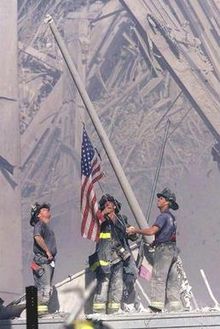
Sixteen years ago enemy-caused disaster happened on American soil. Our lives changed on that day. We dug through the rubble, and helped one another out of the ashes and debris. We were stunned. But we set our jaws and said, “We will rebuild.”

Sixteen days ago nature-caused disaster happened on Texas soil. Our lives changed on that day. We dug through the rubble, and helped one another out of the flood waters and debris. We were stunned. But we set our jaws and said, “We will rebuild.”

One of the images from 9/11/2001 is of an American flag being flown on a pole among the debris.

Raising the Flag at Ground Zero
image from Wikipedia

In honor of that, a friend who has a pile of debris outside his home, posted an American flag among the debris.

Derrick and Gloria Campos fly the American flag
on the debris in front of their flooded home

He is at the stage of mucking out where they could power wash the floors, which he describes as, “One step closer to being one step closer to being one step closer to being clean.” It’s not an easy process.

He’s had a good attitude about this, considering. This is their third flood: Memorial Day Flood 2015, Tax Day Flood 2016, and Hurricane Harvey 2017. All of these were rainfalls beyond expectation, beyond 100-year flood levels (way beyond). They hadn’t built in a foolish place—unless you expect these crazy storms. Odds are there won’t be another for half a millennium. Yet they’ve come three years in a row.

Derrick told their story on the walls. And they had people from each day’s work crew sign a wall. Here’s the collection.

Wall from Derrick Campos's flooded home
The collection was posted on Facebook by Amy Knight

All I can say is, I admire the good attitude and resilience. It’s exemplary of who we are as Texans and Americans. We get to work, and we rebuild.

I spent a week out of town, visiting my son and his family. This was the view of our entrance when I left.


It was still a few days later before water was down to make the roads passable, and people near us were able to get back to their homes and begin the mucking out process, so they can eventually rebuild. On Saturday I drove through those streets. And this was the common sight.


It’s not going to be easy. But the bones of these houses are still good. Sometimes the insides are back to where they were 25-30 years ago, during the original building process—bare concrete floors and wall studs. But a year from now, barring further disaster, the signs of the storm will be hard to see.

This is still my favorite image from 9-11-2001, “Out of the Ashes” by artist Ken Turner. It shows our indomitable America spirit.

"Out of the Ashes" by Ken Turner

There’s no painting or iconic image yet for Hurricane Harvey. But, as a comparison, I’ll use this group of nearly 500 Mormon Helping Hands gathered yesterday morning for a brief church service and then instructions before dividing up into work crews for yet another day of helping their neighbors dig out of the debris. The photo was posted on Facebook by Melissa Willis, and captioned, "Get on your knees and pray, then get on your feet and get to work," quoting Gordon B. Hinckley. 

Mormon Helping Hands from the Bear Creek Stake
Center is Stake President Scott Welch; at the podium
is his counselor, President Dave Hansen


As I’m writing this, we’re waiting for news about how Florida has survived Hurricane Irma. Early reports are that the storm was not as devastating as it might have been; it had been a category 5 hurricane, but by landfall last night was down to a category 1. But that’s still a dangerous storm. So our prayers are with them today. We’re with them in spirit.

I hope the fear of storms doesn’t interfere with our lives. Or the fear of loss. Or the sadness at lost treasures—photos, heirlooms, surroundings. I hope what lasts is the memory of helping one another, of being in this together, rebuilding together.

Because United We Stand.