Showing posts with label Addicks Reservoir. Show all posts

Thursday, August 23, 2018

It's Been a Year


We’re having something of a commemoration this weekend. It has been a year since Houston and beyond was hit with Hurricane Harvey and 50+ inches of rain in about three days. We're still Houston Strong.


During this recovery year, we've learned a lot about goodness, and caring, and sacrifice under those difficult circumstances. As I said back then, there were stages. First, there’s saving lives, and then assessing the situation. Then comes mucking out, which had to be done fairly quickly. A week of standing water in a house can ruin not only everything the water touches, but anything the growing mold reaches. The mucking out includes removing all the flooring, drywall, and furniture out to the curb, and then power washing anything that needs it.

All this time, people are doing this while living without their belongings, in a shelter or a hotel, or with friends, or maybe in a rental if they can get one. And a lot of people going through this with their own homes also went to work to help their neighbors. And many many people who found themselves safe went to work to get the mucking out done for their neighbors.

The next stage was the debris pickup. Places were left looking kind of bleak and blank, with large dead patches on the lawn.

Then came the rebuilding. This is the long stage. Some things had to wait for insurance procedures. Some had to wait for government help. Some had to wait to save up resources. Some, even with ready resources, had to wait for available help. There are only so many remodelers, drywall experts, and cabinet builders in a city. And while we did have some workers move here for the temporary work, there was still a shortage.

The result is that a few people got back into their homes, finished or not, within a couple of months. Many—I’d say an average—took six months. Some longer. And of those moved back in, some are still living with bare walls and floors, waiting their turn for the workers.

A couple of months ago we ran into an older scout troop, age 14+, from several states away. They had come to Houston for their high adventure camp—and spent the week putting up drywall for people in need.

Earlier, during spring break season, a church where I play music one night a week had housed youth groups from several states, spending their week away from school coming to Houston to help with rebuilding.

So that has been quietly going on, during these many months since the media outside Houston stopped talking about our event.

I drove around today, in my neighborhood and nearby, to see the changes. I took a few photos in the same places I did last year, to make the comparison. Most places, on the outside, if you didn’t know about the flood, you wouldn’t know anything had happened. Most trees and plants survived. Grass has grown back.

The entrance to our neighborhood was flooded
for about a week.
The south side of our neighborhood got hit while on the
north we remained dry. This street corner was used
as a rescue boat launch. It's back to normal today.
Anyone who hadn't gotten out before the streets flooded
had to be rescued by boats or large military vehicles.
It was surreal then. It looks totally normal again, at least
on the outside of most houses.
The debris was out one week after the storm. After one month
much of the debris had been scooped up and hauled away.
Today it looks mostly normal. A few houses still have
markings left on them by rescuers.

Here and there you still see a large dumpster parked out front, clearly with work still going on inside. In my neighborhood there were only a couple of those that I saw. In one of the older and harder hit areas, Villages of Bear Creek, those dumpsters were more common. But still, probably 90% of the homes looked OK from the outside.

South end of Villages of Bear Creek,
one of the worst hit areas, looked a lot better today.

I drove through Bear Creek Park, which is essentially part of Addicks Reservoir that is used for picnics, camping, soccer, baseball, and other park amenities whenever there’s no flooding. But when the heavy rains come, the park is intended to fill up with water. We’re used to it. It happens for a portion of most years. This time it was closed for several months. Today it looks mostly unscathed.

Bear Creek Park, near the entrance from Eldridge Parkway,
looking toward the baseball diamonds

The bayou (drainage canal) just down the road from us, which is what overflowed during Harvey, has been undergoing dredging all summer. I think there’s a plan to do that to parts of the park and reservoir as well, since floods have brought in enough debris and silt to lower capacity. And while Harvey was something like a 1000-year flood (not likely to happen again for a millennia), there had been a 500-year flood—the Tax Day Flood—just a year and a few months earlier.

Horsepen Bayou, after dredging

There’s a bond election taking place this Saturday, with nothing on the ballot but the bond. It’s likely to pass. And I believe the county have been good stewards of our resources. They had presentations and took feedback from the community about 20 times over the summer in preparation to know how best to use the resources.

The best case scenario, according to County Commissioner “Cactus” Jack Cagle, would be for the state to use the Rainy Day Fund—and really, if that wasn’t a rainy day, when could we ever use that money?—to pay infrastructure, such as dam improvements and possibly a third reservoir; and then have the county handle the building, because the county is most aware of the needs and priorities; and then have the US Army Corps of Engineers to do maintenance. That way the full burden isn’t on the country, but is shared by the state and by the federal government in ways those entities can be useful.
So, a year out, Houston is still strong. But still in recovery.

One of our church buildings, in the Villages of Bear Creek area, got flooded, along with the post office across the street. The post office is back in business—as is the library, not far away. But that church is still being worked on. When I drove past today, it still had two large dumpsters out back. We have two congregations from that building that have been sharing space with us for a year. We’re told work should be completed this fall, but I haven’t heard word yet on when.

The Cairnway chapel. flooded photo by Melissa Willis
I took the updated photo today.

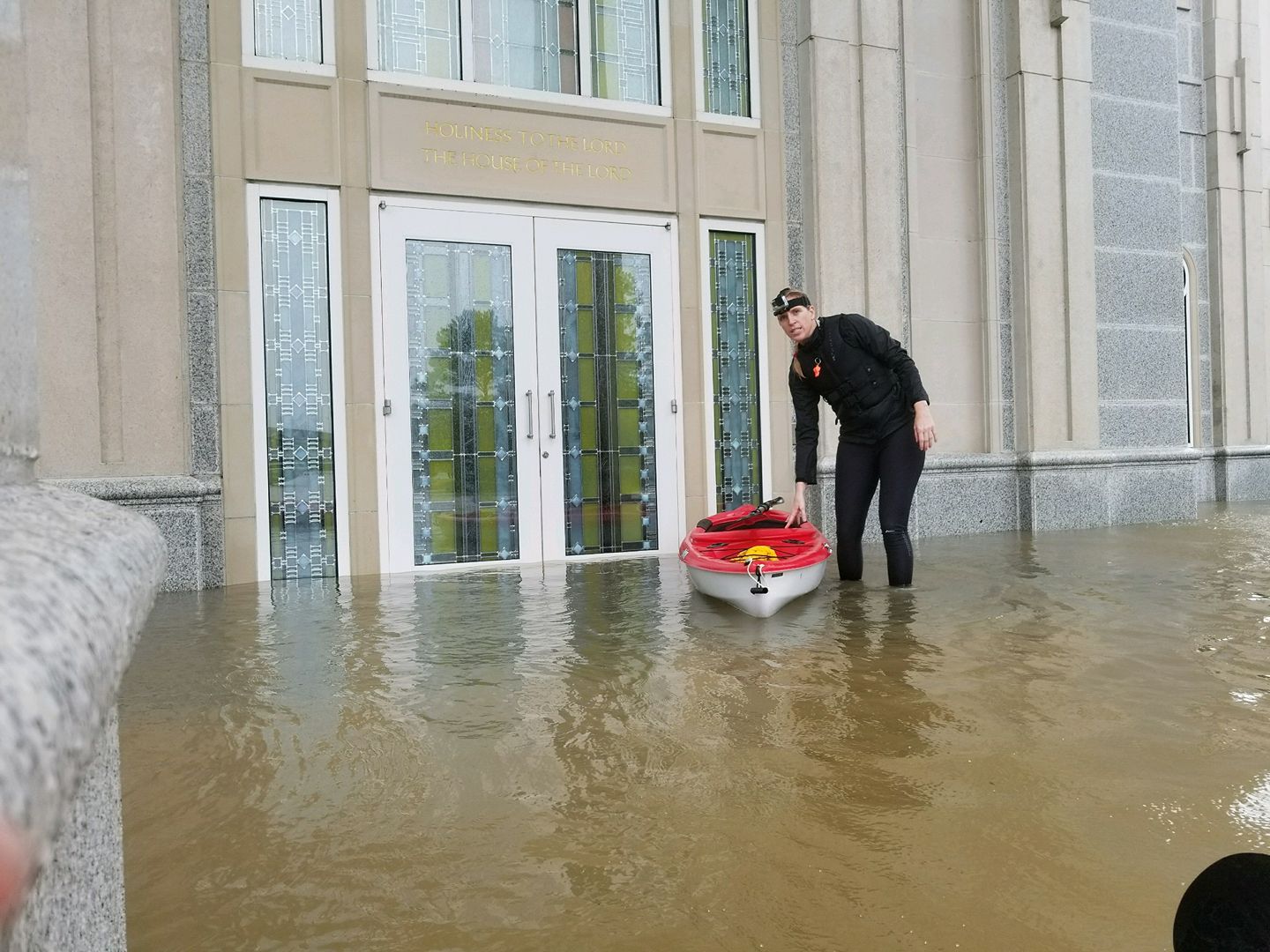
Meanwhile, the beautiful temple up in the Champions area of Spring, northwest of Houston, flooded and had to be closed for eight months. But we’re happy to be back in there.

The two right photos, from the flood were from media stories.
That's us on the right, late April 2018

My friend Elaine, whose apartment complex was flooded, trapping them upstairs for a week, said this a couple of days ago:

I walked into the lobby of my apartment complex, and we have *flooring*! We haven’t had flooring since Harvey. Then I checked the mail and this was the weekly Kroger circular. Now I’m all emotional. We made it, ya’ll.
Here’s the circular, picturing Kroger workers helping out after the flood.


There were so many who helped. I don’t know if the nation and world is aware of the treasure we have in a furniture salesman we call Mattress Mack, Jim McIngvale. He turned his store—new mattresses and all—into a shelter after the storm, and invited restaurants to bring in food. He was an inspiration to all.

A few months ago, he honored members of my church, the Mormon Helping Hands, for the many hours of service. We appreciate being recognized by someone who has been tireless in his service.


One friend of mine, Derrick Campos, was flooded out of his house until around May, and is still living among the incomplete rebuild. He does a video blog called The Better Way, and this week he did a one-year anniversary of the flood. I love the cheerful way he talks about it. What you don’t see is that this was their third flood—in this house they built several years after we built ours. It’s just north of Villages of Bear Creek, and it’s near a bend in Langham Creek on its way to the reservoir. But it’s a nice, newer neighborhood that wasn’t expected to flood. And what do you do now that it does? Hope you don’t have to face it—yet again—for another thousand years. Anyway, here’s Derrick’s video about having an attitude of gratitude:


One thing you don’t know about yourself until tragedy hits is how much you can handle. And when it happens, you learn what it feels like to be lifted up by other caring people, and by God, whom you can feel with you, keeping you from despair. All Houston appreciated the help and prayers from our neighbors around the country and around the world.

I have a friend, from high school English class, who makes his living as photographer G. Brad Lewis of Volcanoman.com. He has spent decades documenting the Kilauea volcano in Hawaii, which has been active and wiping out neighborhoods of his friends the past couple of months. This photo is from yesterday.
Kilauea Volcano eruption
G. Brad Lewis, August 22, 2018

Yesterday and this morning he sent out a couple of photos of Hurricane Lane, which is about to hit them: he took the photo of the wave; I’m assuming he did not “use his new drone” to get the satellite image.


Anyway, it looks like people continue to be in need of our prayers. But one thing we know, after this year, is that love is felt over distances, and prayers work—both to inspire good people to do caring things, but also just to lift heavy hearts.

Thursday, August 31, 2017

One More Little Story of Hurricane Harvey

During Hurricane Harvey, and even since, we have had an outpouring of concern for us. But our home was never in danger. As I talked about Monday, we’re just north of the Addicks Reservoir, which filled fuller than it has ever been. Ever!

We looked at elevations. The spillway was breached about 108 feet. As that happened, and more water just kept coming, there was an estimate that the level would peak just under 110 feet. Our street level drain is at about 109. Our house is another foot or two higher. Maybe three feet. With water already going over the spillway, it couldn’t get as high as we are without filling every part of Houston lower than about 112 feet.

But it was close. Our usual subdivision entrance has been underwater since Saturday night. We were concerned that the other entrance would be closed and leave us on an island with no way out. But that didn’t happen.

This is usually the entrance to our subdivision. Neighbors were putting up
a line of sandbags, trying to keep it from coming up on our side.

They ingeniously filled garbage bags with sand
from our neighborhood volleyball court.

During a storm like this, the first concern is personal. Are we going to be OK? And then comes concern for others. Since we felt fairly secure, we have been very concerned for many others, many we know that had to evacuate or suffer damage to their homes. A third of Harris County was underwater, which is only just today beginning to recede.

We haven’t left home much, because we don’t have rescue equipment, and it was often better to be off the roadways and out of the way of rescue personnel.

This is across the main four-lane road separating the upper and
lower parts of our subdivision. I usually take this route
to go to the neighborhood pool. Only high profile vehicles
could navigate this relatively shallow part of the main road.
The neighborhood roads are for all-terrain military
vehicles or boats only.


These rescuers are launching from the 4-lane road so they
can go down into the neighborhood. By Wednesday, people
who thought they could stay might be ready to get out.
But that idleness leads to a sort of survivors’ guilt anxiety. It is better to be out doing something meaningful. My prayers had included being guided to know what to do to help.

Yesterday we again took a walk to our entrance, and down the main street along our subdivision fence. The water was a bit higher than the day before. And boats and military vehicles were still doing work to get people out. There are people who would have stayed in an upstairs floor, where they’re safe, but then after a day realize they’d better get out.

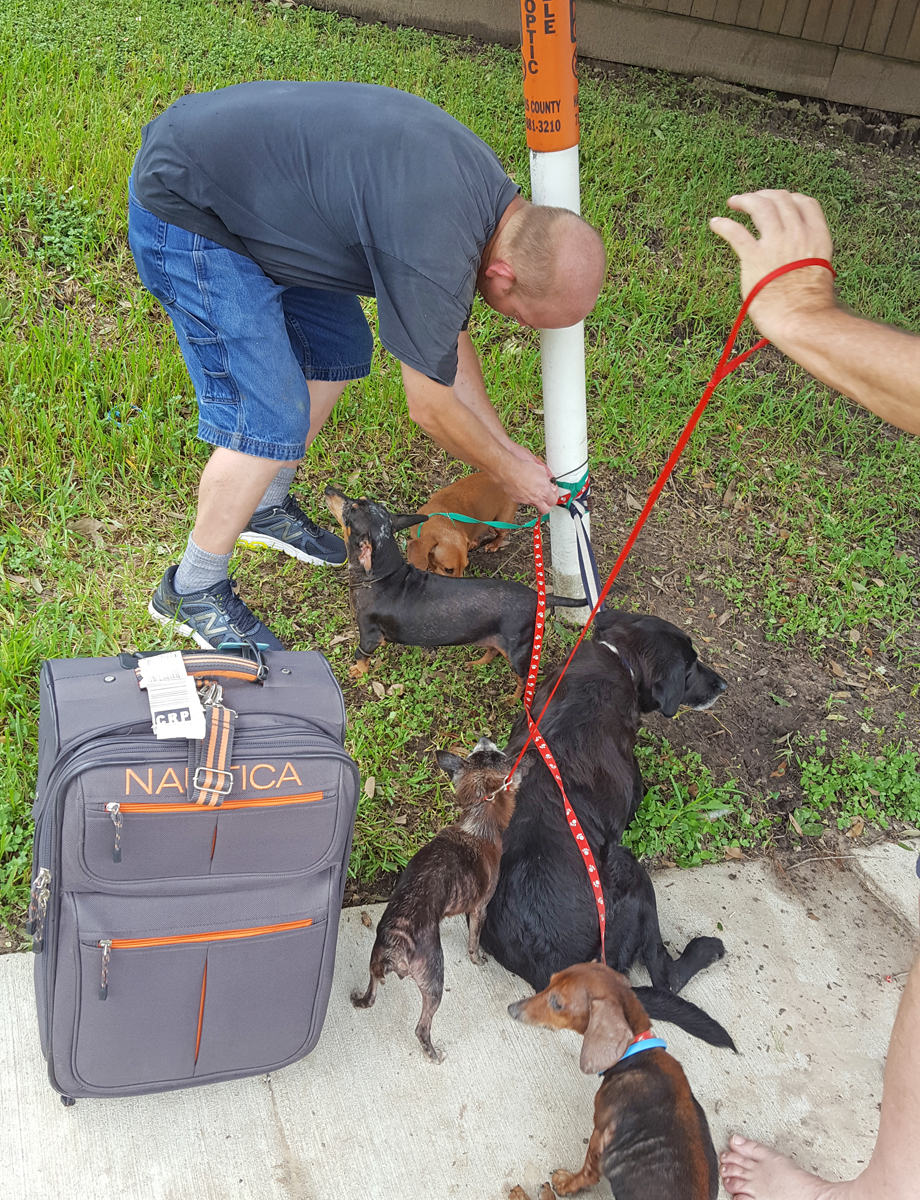
As we were walking, we came upon a man sitting on the grass, with five dogs: a Chihuahua, three Dachshunds, and a Labrador. At first we thought he was just out walking the dogs. But as we talked, we learned he was displaced from one of those flooded houses across the street. We ended up driving him out to Katy, and learned more of his story along the way.
We found Dean and his dogs sitting on
the grass, just up from all that water. They took
a boat ride out just a couple of hours earlier.

His name is Dean. He had spent the night in a shelter at St. Maximillian, a Catholic Church about five miles away, where he reported they treated him very well. The rising waters sort of sneaked up on him, he said. He owns another house in Rockport, where the hurricane landed, and he’d been paying attention to that, and worrying about both the house and his friend who was living there. It’s a 100-year-old house they had just finished renovating. (It survived, by the way, while much of Rockport was completely flattened.)

That would have been how he spent Friday and Saturday. It was Saturday night when the torrents really hit in Houston. He hadn’t been that concerned, because he hadn’t flooded during the Tax Day Flood last year, even when several streets of homes near him had. That was 15 inches of rain. How bad could this be?

Then, all day Sunday the waters rose. Monday, water was still rising. By Tuesday he had water in the house. Who knows how long that water is going to stay there, waiting to drain? His house is, for now, part of the Addicks Reservoir.

Tuesday he saw a military vehicle going down the street, and he realized he’d better take the chance to get out. He had no time to take anything with him. He set up the house so the dogs would have food and water upstairs, and he left for the shelter.

Then on Wednesday he came back to see if he could rescue his animals. On the way in, he had to wade through chest-deep water for about half a mile to get to the house. Inside was a mess, but the dogs were upstairs and safe, just worried. He had to wait for an animal rescue boat to get them out, because there was no way to carry all five, and the water was too deep. The Labrador might have been able to swim, but the little dogs—two of whom were pretty old—couldn’t. So they waited for the boat and got on. Fortunately, he was able to take one small bag with him this time.

But then, once out, he had no transportation. And he realized that he had left his cell phone in his back pocket, so it no longer worked. He had planned to end up in his ex-wife’s and daughter’s house, but he hadn’t memorized the phone number; he always depended on his phone to remember for him.

Dean hesitated to ask, but he ventured to see if we had a vehicle that he could put dogs in. We do. We’re dog people, even though we don’t own one right now. We were going to go back to the house with him, to see if we could find the phone number on a computer. But it was about a mile walk back, and those little dogs have very short legs. By the time we got to the open entrance, Mr. Spherical Model decided he’d leave us there and walk quickly back for the car.

In our haste, we didn’t think to bring water or food. Afterward we learned he had been sitting there with his animals for probably two hours when we came upon him. He hadn’t eaten since breakfast at the shelter. We’re sorry about that, Dean.
I-10, also called the Katy Freeway, was
at a near standstill. This was on a low traffic day.
So glad we hadn't been expected to evacuate
the whole city on this road, even though it's maybe
the world's biggest freeway.

The drive to Katy usually takes about 25-30 minutes in good traffic. We had to go out of our way, since the usual route was right through the reservoir and will be underwater for probably the next couple of months. We went east to Beltway 8, south to I-10, and then west toward Katy. And then hit traffic. There was an accident slowing traffic almost as soon as we got on the freeway. And then traffic slowed because water on the road was taking up a couple of lanes. So it took about half an hour to get past that section. The rest of the way was clear, and we dropped him off safely.

Dean isn’t a neighbor we’d met before, even though we’re within a mile, and are essentially part of the same subdivision. At first he seemed a bit muddled, and was having a hard time explaining things or making decisions. Eventually, though, on our way, we learned about his work (in real estate and related work), and he seemed to be thinking clearer. It helped that the answer of where to go and how to get there were finally answered for him.

I wrote down for him the hotline numbers for the LDS Mormon Helping Hands, Catholic Charities, and others who will work together to do recover volunteer work once people can get back into their homes.

South of the Addicks Resesrvoir, water had covered the much lower
feeder road and, despite all efforts, had taken out a couple of lanes of I-10.


Eventually Dean will be OK. And we felt better because we had found a meaningful way to help. It was only one person (and five dogs), and there are tens of thousands of displaced people. I was reminded of the parable about the starfish left on shore when the tide goes out. You can’t save them all, so why try? Because it will mean something to the one you can save.

On our way home, we stopped by a restaurant where Mr. Spherical Model has been doing performance consulting lately. They had taken on a little water and were replacing a piece of carpet. But they were due to open the bar with limited food today, and a limited dinner menu by Friday night. In the meantime, they were making soup and bread to take to shelters. They’d done that the day before and were just getting ready to provide food for up to 300 people being sheltered at nearby Cy-Fair Lone Star College, where several smaller shelters had been consolidated. The workers were upbeat and willing, and excited to be doing what they do best—feeding people.


It will be a while before Houston and surrounding areas are back on firm ground. But spiritually, Hurricane Harvey showed that so many Texans have been on firm ground all along.

Monday, August 28, 2017

The Rains Came Down and the Floods Came Up

We’re in Houston. We’re still OK. It’s still raining.

It’s the fourth day of Harvey, although we only got sprinkles on most of Friday. The winds of Hurricane Harvey did most of their damage Friday night further south, toward Corpus Christi. Entire towns were laid low. Rockport hardly still exists. But very little human life was lost, because people evacuated.
Hurricane Harvey, photo National Weather Service

Wind has not been an issue here in Houston, with the storm downgraded to a tropical storm, but it is stalled and swirling. It is rain like we haven’t seen here—or anywhere—since, maybe Noah. (I’m thinking it must have been challenging for Noah and family to have this downpour for ten times longer than we have faced so far. Although they were probably occupied enough with the animals not to obsess about it much.)

Houston is built for floods. The city is at about 30 feet above sea level and very flat. So we have a canal system in and around every neighborhood to take care of runoff. It’s called the Bayou City, which sounds better than the Drainage Canal City. Also, there are areas set apart as runoff reservoirs. Just south of us is the Addicks-Barker Reservoir. In normal times, it’s a very large park, with baseball and soccer fields, camp sites, a tiny zoo, and lots of biking trails. When it rains, it becomes a lake. 

Sometimes water flows onto nearby roads, and traffic gets diverted to alternate routes for a while.

This setup handled Tropical Storm Allison in 2001, Hurricane Rita in 2005 (two weeks after Katrina), Hurricane Ike in 2008, the Tax Day Flood of 2016.

Actually, the Tax Day Flood—before hurricane season, just a freak storm—showed us the limits. This is like the Tax Day Flood day after day. 

Addicks and Barker Reservoirs Elevation

Last night Harris County officials decided to open the dams, for a controlled release. It will relieve some of the water rising on homes near the reservoir, but endangers more places downstream. But if the dam were to be breached, an uncontrolled release would affect those downstream locations even worse. During a press conference a newsperson asked about that, because it looks like officials are choosing whom to flood. But the official just looked at him and said, “Downtown is already flooded.”

Downtown Houston before and after the flood
photo found here

It was surprising how quickly we got back to normal after that April 2016 flood. Water drained. Much of the building material was designed to handle that and was quickly cleaned and serviceable. I don’t know how long recovery will take this time. Water is higher. It’s staying longer. Downtown could take longer.

Many of the homes affected last year went through a months-long recovery process, and homeowners have probably felt uneasy this entire hurricane season. Many of the same people are being affected again. As well as many who were a close call last time.


This is the front door of our beloved LDS Houston Temple
photo courtesy the Haines family,
more information here

Usually we worry about areas closer to the coast, in southeast Houston. This storm is big enough to affect the full circle around the Greater Houston Area. And that’s a big area—bigger than Rhode Island, and twice the population of Manhattan. Random places are affected that haven’t been hit before. And it is an unimaginable amount of water. (This Washington Post story tries to give perspective.)

At our home wee’re at 30.12 inches since the storm began. We got 15 inches in the Tax Day Flood. We got more than 15 inches the first 24 hours of Harvey, but we’re only getting about 9 inches a day since. Whoever thought saying “only 9 inches of rain” would make sense? I've been obsessed with the Harris County Flood Warning System site, which is full of useful graphics and data.

What I’m trying to say is, this isn’t in any way the fault of people who have built in high-risk areas, or who have done less than they should to take precautions. We have learned with every storm, and have gotten better at handling floods. I’m very grateful to both government and private citizens who are going out of their way to rescue and care for people.

Loss of life count on this fourth day is at three confirmed, including where the Hurricane made landfall—or maybe five in some reports. [While I was writing this, a family of six was washed away in their car. Surely the count will go up a bit.] Each of these is important and unfortunate. But at this point 2000 people had lost their lives in Katrina. That difference is stunning.

Looting has been minimal. A story I read yesterday reported two shootings of home invaders, one killed. And the story pointed out that there are 22 million guns in Texas. So, unlike New Orleans after Katrina, looting here is not profitable.

There was no panic to evacuate. Those who needed to evacuate have done it orderly, as needed. More evacuations are happening, including long-time friends of ours this very afternoon. This evening evacuation orders came out for subdivisions just across the main road from us, and just to the west of us. (Actually, our subdivision has been mentioned, but as a warning, not mandatory, if I’m understanding correctly.)

Our church doors have been opened to about a dozen families. Downtown, the George R. Brown Convention Center is taking in 4800 refugees. Somewhere around 30,000 (estimates keep rising) have been evacuated. Thousands are being rescued in boats and by Coast Guard and Navy helicopters. I heard about a search and rescue team from Utah that traveled here to find and save people in trouble. And people with boats have answered the County Judge’s request to go out in neighborhoods to collect flood victims and transport them to shelters.

People who are dry in homes are asking how to help [some suggestions here], and where they can take donations of water and other basic needs. We’ll get more of those as people can be certain they’re safe to go out.

We went out to the Kroger one mile from home—our first time out in the car since Thursday. Some water was on the main road, and pretty deep the direction we weren’t going. But we got what we needed—except eggs, which were not to be found. No bread or water on the shelves, but we have enough at home, and we covered the rest of my weekly grocery list. People were orderly and cheerful, including our checker, who was uncertain whether she would have to evacuate later today.

We’re about five miles north of the Addicks-Barker Reservoir area. And our elevation is just above the top of the levee. I think we’re going to ride this out without damage. We’ve had power the whole time (except for a couple of momentary blips this evening). A tornado touched down about five miles west on Saturday, but tornado alerts are much fewer now.

Tornado Saturday in Cypress
photo from here

Social media has been very helpful. We’ve been able to check in on one another, and get word out that we’re safe. We’ve been able to share photos and information.

It is touching how many people are sincerely praying for us here. People have called and texted to check in on us. Our church does that; we try to make sure everyone is accounted for and needs are assessed. And once that is settled, the next question is, “How can we help?” We’re organized that way. But, really, all of Houston has developed that attitude.

Thank you if you are praying. Thank you if you are looking for ways to help. I’m sure there will be the need for help with recovery for some time to come.

Someone posted a comparison to Charlottesville, or Berkeley, saying that Houston, with people rescuing one another, is the real America. It’s full of love and caring. And we can feel God’s spirit with us as we get through this unprecedented disaster.

SWAT team member rescues woman and her 13-month old
photo found here

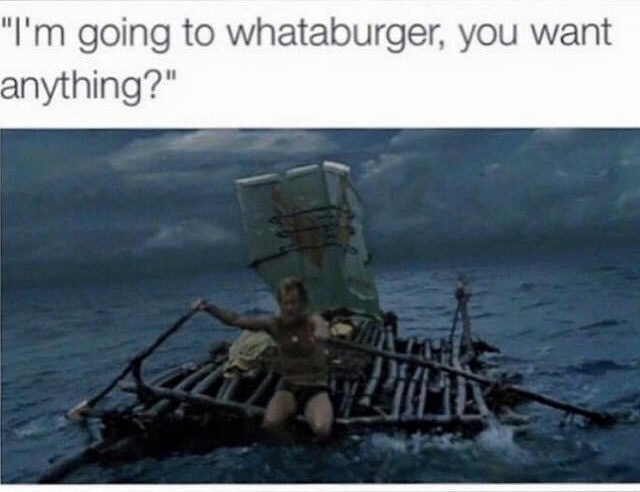
As Houston Mayor Sylvester Turner pointed out, even in this dire situation, people have maintained their sense of humor.

Here’s one example.

I found this on Facebook, but it may have come from here.

And here's another:

I found this on Facebook, but I don't know who to credit.


Again, we personally are among the blessed ones still safe and dry at home, for which we are grateful. We are mindful of our many friends and neighbors who will have some big challenges rebuilding their lives after the rain finally stops. Please keep the prayers coming.