Thursday, May 14, 2020

Secret Acts Shall Be Revealed


These scriptures came to mind as I was thinking about my writing today:

Luke 8:17  For nothing is secret, that shall not be made manifest; neither any thing hid, that shall not be known and come abroad.
Luke 12:3  Therefore whatsoever ye have spoken in darkness shall be heard in the light; and that which ye have spoken in the ear in closets shall be proclaimed upon the housetops.
Doctrine & Covenants 1:3 And the rebellious shall be pierced with much sorrow; for their iniquities shall be spoken upon the housetops, and their secret acts shall be revealed.
I’m pleased when the truth comes out. That is happening, at last, in a couple of places. One is a news story beginning to have the name Obamagate attached to it; I’m going to wait for another day for that.

Instead, I’ll start with a more local story, related to ballot security here in Texas—with lessons, hopefully, to help voters everywhere.

Last Saturday, mid-afternoon, I started seeing notices that our County Clerk, here in Harris County (where Houston is) had resigned. Diane Trautman, who was elected in November 2018, has the main responsibility of handling elections.

Diane Trautman, Harris County Clerk, until May 31, 2020
image from the HarrisVotes.org website


During her relatively short time in office, she made a number of missteps—some from inexperience, some from attitude.

There had been a lawsuit, from 2016, against the county regarding disability accessibility, which had been held off indefinitely by the previous county clerk, Stan Stanart—because there was not a single case of discrimination brought as evidence. No individual had been affected; some activists just went around and speculated where a problem might have been possible, and sued based on that. County Clerk Trautman decided to settle the lawsuit—costing the county taxpayers about a couple million dollars, and requiring hours and hours of tedious training for absolutely every poll worker, regardless of previous experience, regardless of lack of issues at their polling places—but the poll workers were paid for this training, again at county taxpayer expense.

The training could have been done in five minutes: “Remember to treat everyone with respect and courtesy. And if your polling place has issues that need remediation, we provide materials and instructions when you pick up your voting materials.” Done.

The hours and hours of training didn’t totally replace voting judge training, but did replace other poll worker training, including bilingual training.

Also, even though there was an election in November, we were required to get training again (this time shorter and online) before the primary election—after which we learned that we only need the training no more than annually. So, another error at county expense and poll worker inconvenience.
The only change at our polling place was the use of a call buzzer for curbside voting. In November it didn’t work, so we just went back to the usual protocol, having a poll worker watching outside to address needs. While I have seen curbside voting used at a location where I was a poll watcher, we have never, in all our years of running elections at our precinct’s polling place, had a request for curbside. But we were provided a temperamental machine, just in case—plus a technician to make sure it works, or to pack it away if it doesn’t—paid for by the county taxpayers.

Trautman changed the county website quite drastically, from one that worked well and was easy to navigate to one that was quite glorifying of her but was difficult to use. I had occasion to help a friend update her voter registration after a move to a nursing home, which also included needing to change the address on her ID. This involved a phonecall to someone in a state office to help us iron out some detail—because we hadn’t been able to get what we needed on the county website. He tried using the site himself and said, “What have they done to this website? It didn’t used to be this difficult.” So, it’s not just me.

She instituted countywide voting—which has been quite popular for voters, but less so for poll workers, who tend to be people from their own precinct. She tried to cut out precinct chairs from their role of providing judges and workers, so that all would be hired directly by the county for their personal list. They also tried (mostly unsuccessfully because of Republican Party intervention) to eliminate polling places, further cutting off precinct chairs from their ability to reach their voters. And she vowed to throw out the very safe and successful Hart e-Slate voting system, with the new and more secure e-poll books (a tablet dedicated to the purpose), and return to paper only—at the expense of several million dollars and reintroducing many old fraud practices inherent in paper only ballots. So far she hasn’t been successful at this. Also, her system has failed repeatedly to meet requirements for updating in time to prevent a second vote by the same voter, which means it makes in-person voter fraud possible in ways it wasn't before.

Her first night of polling, returning tallies was disastrous. It took more than all night to tally, because she had failed to follow the practices of her predecessor, and thought she’d just send results over an insecure internet line—even though the state had warned her repeatedly that this would not be allowed. So she gathered the tallies from the various locations in person, rather than give an unofficial count by phone followed by a (hopefully matching) official count after everything arrived at the central location and was verified.

For the Primary, the parties gave her estimates for voting machine needs at the various polling places, based on previous elections. But she decided that every polling location needed the same number for each party. So in some heavily Democrat areas, Republicans were given far more machines than they had requested, and Democrats had extremely long lines. Because of countywide voting, locations were harder to predict, and she was afraid of backlash for not being equitable to both parties. Instead, the backlash was from angry mostly Democrats, with Republicans rolling their eyes and trying not to speak aloud, “I told you so.”

Anyway, all of this is to say—hurray! She’s stepping down.

Why is she stepping down just a little over a year into a 4-year term? She says it’s because of her age and the Covid-19 threat. From her statement:

After much deliberation and discussion with my family and physician, I am resigning from my position as Harris County Clerk due to personal health concerns. Because of the COVID-19 pandemic, my age, and underlying health issues, I do not feel I can safely continue to carry out my duties as Harris County Clerk.
I was surprised to learn she is 70; she appears younger. But this comes among more than a pandemic.
She has been pushing for mail-in ballots for all upcoming elections—particularly the primary runoff election, which was postponed until July, and then the presidential general election in November.
There’s a problem with mail-in ballots: getting proof that the person voting is the person entitled to the ballot. The only security Texas has so far is a signature comparison between the application for mail-in ballot and the signature attached to the ballot when it comes in. Someone (of both parties?) has to visually examine each signature to determine if it appears likely that the same person signed both. If there’s a question, then signatures going back several years can be compared. But this is often difficult to determine. And, unless there’s an additional reason to question a ballot, it’s usually just accepted and counted. Once the paper ballot is separated from the envelope it came from, there is no retrieving it. And, as with other paper ballot systems, this is how an additional couple hundred ballots just happen to get added to the stack.

Trautman planned to send ballots, unrequested, to every voter age 65+ in the county. That would mean no original signature to compare to when the ballot was returned. The only security measure would be eliminated.

There’s been a particular problem with ballot harvesting in nursing homes. Activists request ballots for voters at nursing homes—with or without permission of the residents—and they can receive, fill out, and return those ballots sometimes without the residents even seeing their own ballot, possibly not even knowing it was being done in their name. The only way to prevent this fraud is to compare signatures—but, beyond that, to compare multiple signatures from the same place, because, examined individually, since the deceptive activist would have signed both, application and ballot signatures would technically match.

If the same writing style happens to appear on many at the same location, that’s an indicator of fraud.
But who’s going to do that work?

It turns out Colleen Vera is the person.

Colleen Vera's blog, where she detailed her findings
April 22, 2020


She has spent the last two years digging into ballot harvesting in the Harris County. That was her goal, and she was finding it. But she found much more.

She found, for example, a location where it was being done, and the persons requesting the ballots were from a particular consulting company—in other words a name to hide the harvesters names— paid out of campaign funds by, among others, Diane Trautman.

And there’s more. The ballot harvesters in at least three cases were convicted forgers. Forgers being paid to write signatures. What could go wrong?

Other officials who had paid for forgers? US Representative Sheila Jackson Lee, a Justice of the Peace and several District Judges, a Constable, and a Harris County Board Trustee. Vera points out that, while she names names, people are presumed innocent until proven guilty in a court of law.

She details her investigation—with plenty of visual evidence—in her blog, Texas Trash Talk, posted April 22, 2020. It’s thorough, and lays out the evidence and what it means, ready for easy prosecution.

32 handwritten applications for mail-in ballots,
all from different voters, but in the same handwriting.
One of the pieces of evidence Colleen Vera dug up
and presented in her Texas Trash Talk post April 22, 2020

She ends her piece with this:

As a citizen there isn’t much we can do. Texas does not allow us to challenge other voter’s signatures or ballots.  All we can do is:
1. Send a complaint to the Secretary of State and hope (s)he sends it on to the Attorney General for investigation. (Which I’ve already done with this research.)
2. Contact our legislators and insist they tighten security for ballot by mail.
3.  Pray the Democrats don’t succeed in using the courts to expand our currently flawed vote by mail system.
Colleen’s husband, Alan Vera, is our Harris County Republican Party ballot security expert. He helped found True the Vote, and has trained people across the country so other states can improve their ballot security. (He trained me as a poll watcher almost a decade ago.) And he lobbies our legislature for improvements. They’re a handy couple to have on our side.

After Trautman’s resignation the other day, Alan posted this timeline on Facebook:

4/15/20: Colleen Vera files a complaint with the Texas Secretary of State regarding mail ballot harvesting in Harris County. Among the evidence submitted are payments by Dr. Trautman’s campaign directly to a convicted forger.
4/22/20: Colleen Vera publishes her evidence of Harris County ballot harvesting in her blog Texas Trash Talk (www.texastrashtalk.com) The Trautman evidence is included.
4/28/20: Commissioners Court approves $12 Million for Dr Trautman to use to expand mail ballot voting in both the Primary Runoff and the November general election. The budget includes money to send mail ballot applications to every 65+ voter in Harris County.
5/1/20: Texas Attorney General Paxton sends a letter to all Texas county judges and election authorities warning them not to mislead voters about using fear of Covid-19 as a “disability” to vote by mail[i]. His press release on that letter calls out Dr. Trautman and Judge Hidalgo specifically for crossing that line. AG Paxton states that criminal charges could result.
5/4/20 to 5/7/20: Dr. Trautman tries to get “guidance” from the Texas Secretary of State on how to carry out the mass mailing of mail ballot applications without crossing the line laid down by AG Paxton. Reportedly, the SOS does not respond to Dr. Trautman’s requests.
5/7/20: The Texas SOS notifies Colleen Vera that he has found sufficient merit in her ballot harvesting complaint to forward it to the Texas Attorney General with a recommendation to investigate the allegations.
5/7/20: Reporting that she has not received a response from the SOS, in a Zoom conference planning the 7/14/20 Primary Runoff election, Dr. Trautman announces that she will NOT mail absentee ballot applications to every 65+ voter in Harris County. Harris County Democrat Party representatives in the conference demand to know why. Dr. Trautman says she won’t do it in the current environment.
5/9/20: Dr. Trautman resigns for health reasons related to Covid-19 concerns.
So, was the reason for Trautman's resignation worry about getting the virus? Maybe that played into it. But maybe it’s just thinking, at age 70, there might be better ways of using your remaining healthy days (at least those not spent in prison) than doing all you can to manipulate elections for a particular party while you’re being paid to provide free and fair elections.

Alan Vera explained what happens from here. The Commissioners Court will appoint a replacement—which means it will be a Democrat. The office will be on the ballot in November to fill the remainder of the 4-year term. Then it will be on the ballot again in 2022, when the term ends. That means we could get someone with experience and a will to provide free and fair elections by January 2021. I don’t know how this election will be done, since our primaries are already over. Is it done with all comers and then a runoff? Not sure. But I’m so glad we don’t have to spend yet another 2 ½ years trying to block this woman’s attempts to make voter fraud easier for people like herself.

Here's to hoping all the guilty parties get justice.

Thanks go to Colleen Vera for the digging. Our freedoms depend on people like her who take good citizenship to another level.


[i] You can read about that here.  The actual letter is found here

Monday, May 11, 2020

Coming to Be at Peace


Sometimes I do math and fall into something of a rabbit hole. Let me take you with me on such a trip.

There has been news that 40-50% (low estimates) of deaths in the European Union and in California have occurred in nursing homes.

I’d like to know what percentage of deaths in New York City happened in nursing homes—where the governor made a policy requiring that nursing home patients who tested positive for the virus but were not in need of hospitalization be placed back in their nursing homes, rather than quarantined at some other location, essentially saying, “Well, you have to let them go to their own homes, after all. And trust us, we’ll keep everyone else in the nursing homes safe.” This was a monumentally misguided policy. It happened in Pennsylvania and several other states as well.

In a piece on May 6th, Ben Shapiro said:

Had the authorities properly protected nursing homes, the infection fatality rate across the industrialized world could be half of the current rate.
Fatality rates could have been cut in half. That’s an easy number to cut, I thought. Then I could see what the death rate among the rest of the population is. If only I knew what number to start with.

I got some data, but not all I needed.

I started by asking, how many seniors live in nursing homes? One estimate was 3% (according to Senior Living ). But this answer from NursingHomeDiaries.com was a bit higher and a bit more nuanced:

According to the U.S. Bureau of the Census, slightly over 5 percent of the 65+ population occupy nursing homes, congregate care, assisted living, and board-and-care homes, and about 4.2 percent are in nursing homes at any given time. The rate of nursing home use increases with age from 1.4 percent of the young-old to 24.5 percent of the oldest-old. Almost 50 percent of those 95 and older live in nursing homes.
I'd need to dive deeper to find out how to carve out nursing home death rates from population-at-large death rates—and neither death rate is known.

To know the actual death rate, you need to know how many people have been infected, but since so many are asymptomatic or not severe, and mostly only severe cases get tested, we don’t know this number. (I did some math on this here.)

According to the graphic we get in the in the Houston Chronicle, as of today in the state of Texas we’ve had 501,776 total tests, of which there have been 39,783 confirmed cases, and 1099 deaths. Deaths per confirmed cases is 2.76%. And when we’re testing mainly suspected cases, only 7.9% are positive. Does that mean a lot of people wrongly suspect Covid, or a lot of people are getting tested in the general healthy population?

Anyway, deaths per confirmed cases looks much more dire than we think it will once we have a better idea of how many people have been infected without knowing. We don’t yet have broad antibody testing, showing who has successfully faced and defeated the virus. With current antibody tests, because of the high number of false positives, they’re better for population data than for individual use. That means they can’t be used to identify who is safe from getting or spreading the virus.

Always more questions than answers. 

It’s only the first week of opening up in Texas. Things aren’t looking very different yet, nor have we experienced a significant, and expected, increase in cases.

Deaths per population, which I’ve used before, gives us a little more perspective, but it only tells us “deaths so far,” which has a lot to do with how dense the population is and whether social distancing measures have been done. It says nothing about how many of those eventually infected will die.

Again, what I really would like to know is still unknowable. So I’m climbing back out of that rabbit hole.

But there is enough that we do know to give us some perspective.

Most people, including me, don’t understand risk. When I was taught about germs as a child, I got the impression that, if a single germ got inside me, that meant I would get sick. I think that was a scare tactic to get me to stop biting my nails. Hint: it didn’t work; it made me more nervous, but it did get me to wash my hands a lot. (I finally overcame the nail biting in my 30s; thanks for your concern.) Anyway, with all the hygiene lessons we’re getting everyday, we do seem to be getting told that, if a single microscopic germ of Covid-19 makes its way into our house—like a speck of glitter—on our mail or groceries, we’re sure to get the disease.

And if we get the disease, it’s sure to be bad, or quite possibly deadly.

And that’s why we have to remain locked up for the foreseeable future.

But most of that dread is just unfounded. A glitter spec of virus is easily handled by your immune system; it’s a heavy viral load that leads to infection, like you’d get from being directly coughed on by an infected person. And most infections are not bad.

Still, it’s a bad virus. I think ambient deaths is a good indicator. That means, deaths above and beyond what you’d expect from the normal sources. We’re not imagining the coronavirus deaths. They’re real, and they’re pretty close to the numbers being recorded, despite some probable errors in both overcounting and undercounting.

So that is known; it’s bad. But how bad?

Since we don’t know the actual death rate, we have to do some guessing. It’s more than flu. It’s less than a lot of other things.

This chart[i] shows the typical daily deaths of a whole lot of illnesses. The orange lines show diseases causing a current worldwide outbreak. The other lines are diseases that are endemic—always around.

graphic from InformationIsBeautiful.net Coronavirus Infographic Datapak

My new question is, why do none of these other things make us feel so panicked, so willing to shut down our economy? It’s not because Covid is the most dangerous thing. It’s not even the most dangerous current outbreak.

It is not causing the most deaths. It is not the most likely to cause deaths. While the rate of contagion and rate of death are unknowns, their ranges are higher than some but lower than many others. Contagion range is 1.5 – 3.5 persons spread to from each infected person. Death rate range is somewhere between 0.7 – 3.4%. The rate seems to be going down the more testing we have.

Measles is a whole lot more contagious and just about as likely to cause death. We’ve never shut down the world for a measles outbreak. We didn’t shut down the world for Ebola, which is much more likely to cause death and is in a similar range for spread; we contained and successfully quarantined it. But you can see on that chart that it isn’t eradicated.

There’s one difference between this and every other disease outbreak: media. Total mentions in the media (from inception to today)[ii]:

·         HIV 69.5 million
·         SARS 66.3 million
·         MERS 33.1 million
·         Ebola 16.2 million
·         Covid-19/Coronavirus 2.1 billion

That’s 130 times for every mention of Ebola, 63 times for every mention of MERS, 32 times for ever mention of SARS, and 30 times for every mention of HIV/AIDS.

If we could filter out all the media shouting, what would our reasonable response be?

My son Political Sphere says that people often give him a shocked reaction when he says he expects to get this virus eventually. “You think you’re going to get it?” they ask, as if that’s an entirely new idea they can’t accept. “Of course,” he answers.

Because what we’ve been doing is slowing the spread, not stopping it.

What would it take to stop it? More than you’re willing to go through for this level of risk.

An absolute total lockdown for 3 weeks or so (the longest length of time from exposure to showing symptoms—and after that an additional 3+ weeks of quarantine for those who show symptoms, along with those exposed to those persons). That means no hospitals—unless you keep every hospital worker at the hospital the whole time without allowing them to leave the premises. You don’t have food suppliers. You don’t have workers keeping the electrical grid working. Or water or other utilities; whatever works automatically you can have, but no troubleshooting if you have issues. No one can work outside their homes—including "essential" services. No newspeople. No broadcast media. No police. No firefighters. If you happen to need emergency help during this shutdown, tough luck for you.

The deaths from other causes would likely eclipse the lives saved from Covid-19 during a total shutdown.

It should be obvious that we’re not set up for that kind of shutdown; we’re not willing to submit to it; and there would be no way to enforce it.

And, did I mention it would have to be worldwide? Otherwise, it would still be spreading somewhere; and if it spreads somewhere, it eventually spreads everywhere.

So, no, this CCP[iii] virus is not being eradicated by total quarantine. That means we never had any intention except to slow the spread. It will indeed eventually spread through the population.

Pretending that we’re going to get eradication from our partial measures is a common misperception. But you aren’t saving lives by staying home; you’re postponing inevitable infections. Not only that, you’re expecting “expendable” people to supply your needs while you’re doing your virtuous stay-at-home. It’s not a matter of whether, but when

We can—and should—do what we can to protect nursing homes and other vulnerable people—not by shutting ourselves up, but by quarantining them as much as possible. I don’t know how you can do even that protection with total success, since  workers and suppliers have to come and go. Already we’ve deprived nursing home residents of visitors for two months, which has to be pretty painful.

So, unless you completely isolate yourself, at some point you’re going to get it.

Unless there’s a totally effective vaccine developed before you get it. Doubtful.

So, accept that it’s coming to you. Should you be drawing up your will? Probably—but only because you should do that anyway, well ahead of imminent death.

But, it could be bad, right? Possibly, but what are the odds?

If you get the virus and you’re under 60, you can expect a mild case. Because 80% of all cases are mild—including for the elderly and those with underlying conditions.

According to the data so far, 80.9% of cases are mild—like a cold. You stay home for a day or two (and maybe you should stay home longer just to avoid spreading it to those who can’t afford the risk), and you’ll feel fine. You probably won’t even see a doctor or get a test to know that’s what you had. Some in this group will have a harder bout, but will still not need more than a doctor visit and enough time to recover at home.

Fourteen out of a hundred people (13.8%) who get it will have a bad case—enough to require hospitalization. Like we said, these will probably be older people with multiple underlying conditions, although younger people with multiple underlying conditions might want to protect themselves. If we get successful treatments, some portion of this group will move into the milder case category.

Only five out of a hundred (4.7%) need intensive critical care, such as a ventilator. And 50% of those who need ventilators survive. And, again, if we get more reliable treatments that can be used earlier, we prevent many of these critical cases.

Deaths by age. Graphic from InformationIsBeautiful.net

Age is a factor, but that doesn’t mean this disease kills all old people.

Data from Italy, of people whose average age was 79, shows us that only 1% of those with a serious case of Covid-19 at time of death (i.e., died because of the coronavirus) had no known underlying conditions in addition to their age. All the rest had at least one underlying condition. Nearly half had 3 or more underlying conditions.

Risk factors of deaths of average age 79
Graphic from InformationIsBeautiful.net

That means, if you don’t have the risk factors, you’re not likely to die. Even the vast majority, 85-90%, of those who are in the danger age range and may have one or two risk factors nevertheless survive.

If a vaccine—one that is more effective than the flu vaccine has ever been—becomes available in record time, then maybe you can avoid the risk. But if you’re not willing to stake the livelihoods of hundreds of millions of Americans (and billions of people worldwide) on that unlikely hope, then maybe you need to come to be at peace with the probability that you will get it—but along with the expectation that it will probably not affect you badly.

If enough speak that truth to themselves and re-enter the world, letting the virus spread through the least vulnerable—the healthy, young people—then the virus runs out of available hosts to keep passing it along. It runs its course.

And maybe we can get to that point before the virus gets to our most vulnerable. Maybe that should be our goal.

There are many risks that we have come to be at peace with. We drive. We swim. We fly. Even though it’s a risk, we don’t expect death every time we walk out the door. We weigh the risk against our determination to meet some other goal, and we accept it.

This virus is a new risk laid on top of all those others. We don’t like it, but there it is. If we can’t eradicate it—and thanks to China, that possibility is long gone—then we’ve got to learn to live with it.

Think how you’ve done that with all those other risks. Repeat that process for this big thing.

People who work to overcome phobias find that experiencing the risk a little at a time helps them get over the fear. Tiny steps. But continuous tiny steps toward the goal of facing their fear—and they can handle the snake, or take the cross-country flight, or whatever it is.

So let’s take this time of reopening to overcome our mostly irrational fears so that we can get back to the business of living our lives.

Become at peace with what is. It’s probably a good time to turn to God, rather than government, to help you do that.


[i] This chart and several more I’m sharing today are from InformationIsBeautiful.netcoronavirus infographic datapack
[ii] InformationIsBeautiful.net credits this information to Google News.
[iii] The Epoch Times made an editorial decision to refer to Covid-19/coronavirus as the CCP virus, because the worldwide spread was caused by the actions of the Chinese Communist Party.

Thursday, May 7, 2020

Civil Disobedience—Under What Circumstances?


Is there ever a time for civil disobedience?
Dallas salon owner Shelley Luther
AP Photo/LM Otero, found here

I’m not really a rebellious sort. My Church teaches us to be law-abiding, good citizens, and has had some marvelous worldwide successes by being scrupulously law-abiding even in countries with unfair laws.

But I admit that my reaction a couple of weeks ago to County Judge Lina Hidalgo’s executive order that everyone in the county had to wear a mask whenever they left their homes was an immediate and declarative “No!” that sort of startled Mr. Spherical Model.

That order is still in effect—although Hidalgo was slapped down by the governor right away and had to back off the punishments. So, while I’m willing to wear a face mask when it makes sense, I’m engaging in very minor civil disobedience when I brazenly walk down the road to my mailbox. But, truthfully, I didn’t believe I’d ever get arrested for something so pointless.

Fortunately, we have a reasonable and rational governor. But what if we didn’t?

Michigan doesn’t. California doesn’t. Virginia’s has been unreasonable. Even Kentucky’s. New York’s is pretty questionable, but at least Andrew Cuomo admitted his puzzlement yesterday over the findings that the large majority of new cases in NY State were people who had been staying home, avoiding mass transit and all the other things they thought they needed to avoid, and still new cases come.

sources of new Covid-19 cases in New York
graphic found here

I ended my post a week ago with a standard—the questions officials should now be required to answer when they ask something of us. Here’s what I said we need to know:

·         What exactly is being required of us.
·         How much that requirement will limit the spread of the disease (show the data).
·         Why it is imperative to limit the spread of the disease:
o   At this particular place (city, county, state).
o   At this particular time (until a particular date or a particular outcome).
We were asked to shut down our economy for this specific reason: to slow the spread of the virus enough to avoid overwhelming the healthcare system—hospital beds, ventilators, equipment. That was something we could temporarily agree to do.

So, once all measures show we have done that, requirements are lifted, right? Why hasn’t that happened? It isn’t because the virus is worse than we had thought at first.

I think there is probably a stew of reasons, or rationalizations. These could include a desire for power. They could also include the officials’ fear of litigation or political blame. They could include a preference for a bad economy if that can be blamed on Trump in an election year. It could be confusion over the science; epidemiologists tend to think in terms of their job of eradicating a pathogen and preventing spread or loss of life, without considering the costs; but officials need to weigh the risks of taking one action against the risks of taking another action, which depends on a lot more than whether or not a particular virus has been eliminated, albeit at the expense of other healthcare issues as well as overwhelming economic and social costs.

That’s why I think we need a standard. Let’s be sure our officials know what they’re asking, and why, and for how long. And then we’ll know whether those leaders’ orders are worth following.

I don’t think we should engage in civil disobedience lightly. It has to be done on principle. And it has to be done with a willingness to suffer the consequences.

Jordan Peterson gained notoriety, back in 2016, when he spoke out against a Canadian speech law requiring that certain pronouns be used. There had never been, in the history of British common law dating back most of a millennium, a law that required people to use certain words. On principle Peterson was against that law, and he said he would not obey it. He said he recognized that officials would be required to enforce a law that they had passed, so they would have to fine him, and he would not pay the fine. So they would have to imprison him, at which point he would engage in a hunger strike. 

The Canadian government had been trying to get away with saying the law only had to do with treating transgender people with respect and that it wouldn’t affect any decent law-abiding person. But he had read the law; whatever their stated intention, it was a law controlling speech, which is unacceptable to free people.

He thought long and hard—as he is particularly capable of doing—before taking his stand. Eventually his college withdrew requirements for him to stop saying what he’d said about that law and ended up standing by him.

We had another example of civil disobedience here in Texas this week. A salon owner in Dallas, Shelley Luther, had followed shutdown orders since they went into effect in mid-March. She—as well as her employees—were without a source of income for over a month (March 22-April 24). She still had to pay for the shop. She still had to pay for food for her family. So did those employees she wasn’t paying.

Luther had attempted more than 500 times to contact the government for unemployment and never got through.

She had attempted to get a loan for her small business through the government grants, but that didn’t come through until this past Sunday, May 3rd.

The governor announced the state would start opening back up after April 30th, with “nonessential” businesses like hers opening up a week later (tomorrow)—using hygiene requirements that would avoid the spread of the virus. She was willing to make those adjustments.

But the Dallas County Judge (county executive), Clay Jenkins, decided to overrule the governor’s recommendations and require an additional two weeks of shutdown for her type of business, at which point she decided she was done with compliance and went ahead and opened up after April 24th.

Local jurisdictions are allowed to make some judgments for their areas based on their local circumstances. But was this extension because Dallas was on the verge of overwhelming the medical resources? No. As an urban area, the spread of the virus there has been greater than most parts of the state. But as a percent of population, Dallas still rated quite low compared to most urban areas of the country. Medical resources were nowhere near being overwhelmed.

And the local officials were allowing arbitrary openings, such as the dog grooming place next door, even though they weren’t considered essential businesses either. Why can dogs be groomed, but people cannot? People have to bring a dog in, so there aren’t fewer people involved in the exchange of service.

Shelley Luther felt like she’d sacrificed to do her civic duty for long enough. So she defied the executive order and opened her business.

Then came a court order for her to shut down. She defied it. Then she was issued a restraining order preventing her from opening her business, which she tore up. That led to the contempt of court charge.

Shelley Luther speaks in court, screenshot from here
Then they arrested her, fined her $3,500 plus $500 a day, and sentenced her to seven days in jail without bail. Jail for contempt of court is very rare. A fine can be recompensed upon appeal, but jail time cannot be returned to a person’s life. And why no bail? (See the 8th Amendment to the Constitution.)

Did she break the law? Technically, yes. (For discussion of the laws involved in this case, I suggest the Viva Frei law vlog, here and here.) The executive order isn’t exactly a law, but in times of emergency, temporary lawmaking powers are granted to such officials and can have the weight of law—even when they temporarily abridge our God-given rights. And contempt of court is definitely a real thing.

She broke the law—a stupid and arbitrary law—willingly and knowingly. And she was respectfully willing to submit to the sentence. But not without being heard.

There’s the important detail.

And she was heard. If you haven’t heard her words in court, they’re worth hearing as an example.
The judge, State District Judge Eric Moyé, sentenced her. But, in the hearing he told her he would suspend the jail time and simply charge the fine—if she would apologize and admit that she was both wrong and selfish to do what she had done.

She refused. She could get special treatment by submission? By saying something she did not believe, because it would validate the authority of government to take away her business and livelihood for arbitrary reasons? No. 

In the calm and sincere way Southern women say, “Bless your heart,” she said,

Judge, I would like to say that I have much respect for this court and laws. And that I’ve never been in this position before, and it’s not someplace that I want to be. But, I have to disagree with you, sir, when you say that I’m selfish. Because feeding my kids is not selfish. I have hair stylists that are going hungry because they’d rather feed their kids. So, sir, so if you think the law is more important than kids getting fed, then please go ahead with your decision, but I am not going to shut the salon.
Fortunately, these are not normal times. We would not normally have video from the court. It would have been handled in obscurity. She would have been just another lowly citizen who lost trying to fight city hall.

But we did hear her. And so did the world

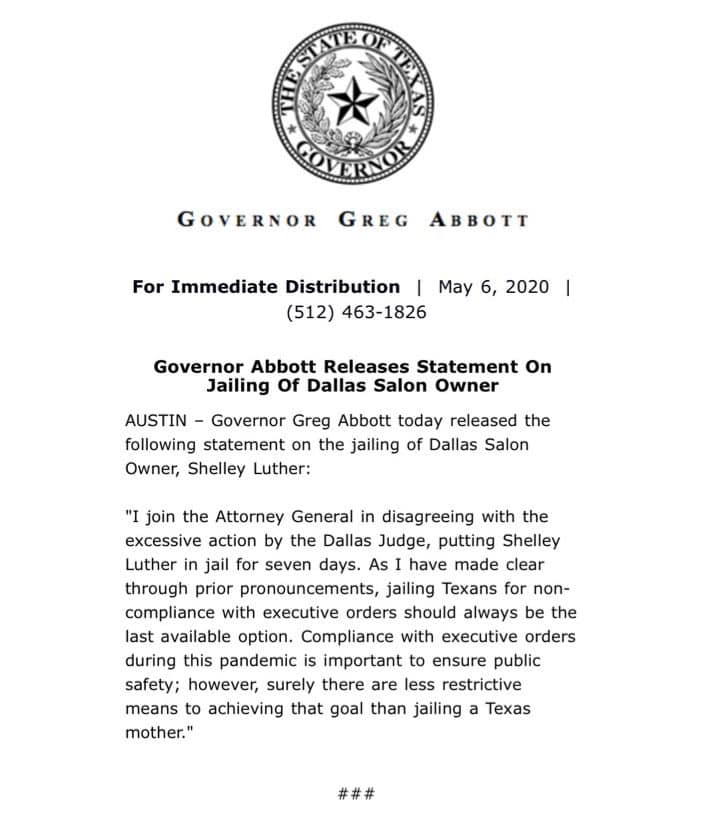
Texas Lt. Governor Dan Patrick offered to pay her fine and suffer a week of house arrest to take the place of her sentence.

Dan Patrick's tweet, image found here


Governor Abbott's letter
from here
Texas Governor Abbott said, “Throwing Texans in jail who have had their businesses shut down through no fault of their own is nonsensical, and I will not allow it to happen.” He amended his orders to clarify that enforcement options would not entail jail time.


Texas Attorney General Ken Paxton said, “No Texan should face imprisonment for peacefully resisting an order that temporarily closed a lawful business and drastically limited their ability to provide for their family through no fault of their own.”

There were plenty of remedies short of jailing Ms. Luther:

·         a reasonable single fine,
·         a larger fine,
·         a reasonable daily fine until compliance,
·         a temporary suspension of her license,
·         a physical guard preventing entrance to her salon,
·         forgiveness since the shutdown was within days of being lifted anyway and she was following all the hygiene rules.
Imprisonment seems excessive. The Texas Supreme Court thought so too, which were brought in on a request for Habeas Corpus. They quickly ruled in her favor, based on the unreasonableness of the sentence. She was to be released this afternoon.

This does not end her case, just her jail time for being in contempt of court. She will still have to go through the court case based on her defying the executive order and subsequent court order, and any appeals after that.

There’s a GoFundMe account to help her in the upcoming legal battles, and to help her and her employees.

I heard another brave example this morning in an interview on Hugh Hewitt’s show. In his introduction, Hugh Hewitt says, 

It’s been my pleasure over 30 years in broadcast to talk to a lot of very successful people, very powerful people, very courageous people. Rarely do they all combine in one guest like they do in Jimmie Lai.
Jimmie Lai is a billionaire businessman in Hong Kong. He has been working for freedom there, where the Chinese people have had it, but where the Chinese Communist Party is trying to stamp it out. He has been part of demonstrations in Hong Kong the past couple of years asking for freedoms. He and others were recently arrested for not having the paper signed by the police granting them permission to demonstrate—in a way that they had a right to demonstrate, so it was a technicality intended to intimidate.

He’s particularly concerned about freedom of speech. If China had had freedom of speech, he says, then Li Wenliang, the doctor who first discovered the virus causing this pandemic, would have been allowed to put the news out in social media, to warn people. Instead, he got reprimanded. Lai points out that freedom of speech for the Chinese people is therefore in the best interests of the rest of the world.

So he continues to speak out, even at risk of jail or whatever comes, because the Chinese Communist Party is in the wrong. Fortunately, Mr. Lai is well known and able to get his voice heard.

I don’t want to be misunderstood as encouraging civil disobedience. But, among those we can admire who do it, they must:

·        Know clearly the principles they are standing on, what line of natural rights has been crossed that they find untenable.
·        Be certain that they cannot effect the needed change another way.
·        Be willing to suffer whatever consequences come.
·        Stay calm and reasonable in the face of whatever comes.
·        If at all possible, make sure their story and arguments get heard, unfiltered by propaganda.
That’s a high bar. But it’s what Rosa Parks did. It’s what Martin Luther King, Jr., did. It’s what Mahatma Ghandi did. During WWII Germany, it’s what Bonhoeffer  and Hübener did. 

And this week it’s what Texas salon owner Shelley Luther did.

Monday, May 4, 2020

Seeing Miracles


Little miracles are going on. But you have to pay attention. And choose to notice.

Meme found on Facebook
I say this even as “murder hornets” were added to the "you survived April; welcome to level May" of Jumani memes over the weekend. And hurricane season is predicted to be bigger than usual.

Nevertheless.

I came across a very good description of faith and choice recently. I finally finished Brandon Sanderson’s Hero of Ages.  I mentioned this book in a post in March, while I was in the middle of it, before I ended up waiting six more weeks to get it back and finish it. (Pay attention when electronic media from the library shows up on your devices, or you might run out of time—is the moral of that story.)

I want to highlight chapter 75, out of 82 chapters plus epilogue, in this third and final part of the original Mistborn trilogy. There’s a character named Sazed, who is a Terrisman, in this magical fantasy world. I’ll try not to include spoilers—other than this small one: Sazed figures out his religious questions.

One of the tropes, the rules, of fantasy literature is that you can’t have the God of the universe show up and manipulate things. Sanderson knows this well. But he manages to talk about religious concepts nevertheless, which is important, since fantasy literature is a way for us to look at humanity from a different perspective.

Sazed--fan art
from Mistborn Wiki

Sazed is a keeper from among the people of Terris. Keepers have the assignment of preserving all knowledge, particularly from before the world changed a thousand years earlier. They specialize in different areas of study, and Sazed’s specialty is religion. He has dutifully gathered and retained information on every single religion ever believed in his world, by every people—except his own, which knowledge has been lost to them.

In a previous book, he lost someone he loved, Tindwyl. And that loss caused a faith crisis for him. He realized that, while he had often shared with others the religious beliefs that he thought might help and comfort them, he didn’t actually believe those teachings himself. With his personal grief, he wants to be assured that there is an afterlife, that he will be able to see her again. That would help him have hope—and even a reason for hoping—to forestall the apparently imminent destruction of the world.

One of the things he has done is run through every single religion, to find one that doesn’t have fallacies or contradictions that prevent him from believing. He has done this systematically, getting down to the last few. And as he completes that research, he’s quite despairing. He finds nothing. But he wants to know: Is there a real God, watching over them? Is there life after death?

At this point of giving in to despair, a character name TenSoon shows up, a non-human. TenSoon needs Sazed to go to his people, the Kandra, and convince them to help the world. And—the Kandra are in a way immortal, and their First Generation were alive before the changes to the world—they hold the knowledge about Sazed’s religion. So Sazed makes the journey to that previously hidden place. He has recently arrived there, and has studied and learned all they have to share with him, as we get to chapter 75.[i]

Here’s what he finds:

The Terris religion, as one might have expected, focused heavily on knowledge and scholarship. The “worldbringers”—their word for “keepers,” were holy men and women who imparted knowledge but also wrote of their god, Terr. It was the ancient Terris word for “to preserve.” A central focus of the religion had been the histories of how Preservation, or Terr, and Ruin had interacted. And these included various prophecies about the Hero of Ages, who was seen as a successor to Preservation.
Aside from the prophecies, however, the worldbringers had taught temperance, faith, and understanding to their people. They had taught that it was better to build than to destroy, a principle at the core of their teachings. Of course, there had been rituals, rites, initiations, and traditions. There were also lesser religious leaders, required offerings, and codes of conduct.
It all seemed good, but hardly original. Even the focus on scholarship was something shared by several dozen other religions Sazed had studied. That, for some reason, depressed him. It was just another religion. What had he expected? Some astounding doctrine that would prove to him once and for all that there was a God?
He felt like a fool. Yet he also felt betrayed. This was what he had ridden across the empire, feeling elated and anticipatory to discover? This is what he’d expected to save them? These were just more words. Pleasant ones, like most in his portfolio, but hardly compelling. Was he supposed to believe just because it was the religion his people had followed?
There were no promises here that Tindwyl still lived. Why was it that people had followed this or any of the religions?
Sazed character concept found here

Instead of giving up at this point, though, he dives back into the research on the many religions. He goes through letters, journals, papers—everything. And this time, instead of looking at the doctrines, he looks at the people who believed. He expects to find evidence that the believers were fools, that they just hadn’t asked the deep questions about their beliefs. “Surely they would have seen the flaws and inconsistencies, if they’d just taken the time to be rational and discerning.” But that is not what he finds. “The people did not seem like fools to him.” He begins to see something important:

In the abstract, those religions were stale. However, as he read the words of the people—really read them—he began to see patterns.
Why did they believe? Because they saw miracles. Things one man took as chance, a man of faith took as a sign: a loved one recovering from a disease, a fortunate business deal, a chance meeting with a long-lost friend. It wasn’t the grand doctrines or the sweeping ideals that seemed to make believers out of men; it was the simple magic in the world around them.
It reminds him of Vin, another character’s, learning to trust the crew they had all belonged to—even after her childhood had taught her never to trust anyone. Trust was necessary in order to work together to accomplish their mutual purpose. Vin had to act on trust, and then the evidence of their trustworthiness became evident to her. For Sazed it was “Trusting that somebody was watching, that somebody would make it all right in the end, even though things looked terrible at the moment.” But how could he trust when he didn’t know whether he could trust? How could he believe when he didn’t believe?

To believe, it seemed, one had to want to believe. It was a conundrum, one Sazed had wrestled with. He wanted some one, some thing, to force him to have faith. He wanted to have to believe because of the proof shown to him. Yet the believers whose words now filled his mind would have said he already had proof. Had he not, in his moment of despair, received an answer? As he had been about to give up, TenSoon had spoken. Sazed had begged for a sign and received it.
Was it chance? Was it providence? In the end, apparently, it was up to him to decide.
This is interesting to me, as a believer. I’ve often been puzzled at nonbelievers who claim there’s no proof. But to me, what they’re ignoring is all the evidence of my personal experience. Because they don’t believe, they don’t see. Because I believe, I see. And I see more and more.

Sazed goes about putting the information away into storage, and is startled by some realizations.

He slowly returned the letters and journals to his metal minds, leaving his specific memory of them empty, yet retaining the feelings they had prompted in him. Which would he be? Believer or skeptic? At that moment, neither seemed a patently foolish path.
“I do want to believe,” he thought. “That’s why I’ve spent so much time searching. I can’t have it both ways. I simply have to decide.”
Which would it be? He sat for a few moments, thinking, feeling, and, most important, remembering.
“I sought help,” Sazed thought. “And something answered.”
Sazed smiled, and everything seemed a little bit brighter.
He realizes he has suddenly become a believer. After a lifetime of searching.

He would believe. Not because something had been proven to him beyond his ability to deny, but because he chose to.
There’s a line in one of our hymns, “God will force no man to heaven.”[ii] What Sazed had been looking for was to be forced—by the sheer weight of incontrovertible evidence—to believe. But what happens when a person has that much evidence and still refuses to act according to God’s known will? Even Satan knows God is real.

What God wants from us is to choose to believe. And with that, to choose God and all His Goodness. In order to make the choice, we need to act on faith, before we have total knowledge.

So, how does that apply to us in our trying times?

If we’re believers, we’re seeing an accumulation of miracles, instead of just an accumulation of hardships.

Here are a few I’ve seen.

·        My husband timed his broken ankle to coincide with the stay-at-home order, which actually made healing less inconvenient, and somewhat eased his usual desire to be out and about.

·        We had a lot of food storage on hand, without any panic buying needed, because our Church has been teaching us my whole life to have food storage for self-reliance.
·        The fresh food I’ve needed (and practically everything I can eat is fresh food) has mostly been available, with only some temporary missing pieces.
·        My husband already had a Zoom account for his business, which has been a great way to have little reunions with our kids. We like this so much, the plan is to keep it up every other Sunday indefinitely.
·        Most of my life our Church has emphasized home-centered, Church-supported gospel learning. But a year ago January our Church started a program that made that more understandable and harder to ignore. And we had a year to practice it. Then, this January, we cut our Sunday meetings from three hours to two—so the learning that would have been covered in weekly classes is expected to be done at home and just enhanced in the twice-a-month Sunday School. So when we were asked in mid-March to do home church during the pandemic, we were prepared and practiced at it already.
·        Because of these crazy times, people are turning to God. This has included a number of new convert baptisms locally (following all the rules to make those happen). And the Facebook group that started with the Worldwide Fast April 10, now called Worldwide Unified, is full of outpourings of little miracles, as well as calls for special prayers for many many reasons, followed by additional outpourings of love and support. Many people have talked about coming back to faith after years away.
·        I’ve had time for gardening—which I’d never really done much before, because Mr. Spherical Model always did that. I love seeing my little seeds grow.
·        I’ve had time for more music here at home, even though I miss playing with my usual group. We’re doing things online to stay connected and to keep playing some of the same music, separately together. And a year ago I learned how to use the software to write tablature, so I'm arranging a number of hymns and other pieces for the mountain dulcimer.
·         My usual fear of getting sick—because a regular cold can hit me pretty hard—is somewhat lessened, because everyone all around is being so careful. And Mr. Spherical Model isn’t going out to get any illnesses to bring home, so I’m actually feeling more safely healthy for the time being.
·        Doctors are making progress at finding treatments, with several promising drugs and procedures quickly making their way through trials. 
·        Researchers have concluded that young children do not spread the virus to adults. That’s pretty remarkable, if accurate. 
There are more, certainly. And plenty more I’m still praying for.


Maybe none of these looks like evidence to a nonbeliever. But at some point we will be able to look back, and I believe we will see the hand of the Lord more clearly in what is happening in His world, and under His control. At least those of us with eyes to see[iii] will see His hand.


[i] While all quotes are from the book Hero of Ages, I had an audiobook version. So I transcribed this portion. That means I may not have reproduced the punctuation and paragraph structure that Sanderson wrote in the book. But I believe I have been faithful in reproducing the words.
[ii] “Know This That Every Soul Is Free,” hymn 240, found here