Friday, November 22, 2013

The Rhetorical Question


On Monday I ended the post about economics in Venezuela with a somewhat rhetorical question:
Does government’s disrespect of property lead to the people’s disrespect of property—the looting? Or does a people who fail to live the rules of civilization naturally end up with a life-controlling government? It may be a chicken/egg question. But my guess is that imposition of tyranny—taking away God-given rights—demoralizes a people, quite literally.

Economist Walter Williams
My son Economic Sphere took on the challenge of responding to the question from the economic point of view. He passed along a piece written in July by economist Walter Williams. Williams’s point is that “political liberty thrives best where there's a large measure of economic liberty.” He shows that some people, essentially the same culture, are different living in different countries. Egyptians do well in the US, but not in Egypt. Nigerians do well in the US, but not in Nigeria. Indians suffer severe poverty in India, but in the US they “start more Silicon Valley companies than any other immigrant group.” And they succeed not just in relatively “red” places like Texas and Florida, but also in Massachusetts, New York, and New Jersey.
It’s something like the economic version of the Bush assertion—“I believe that God has planted in every heart the desire to live in freedom.” Given circumstances that grant economic freedom, a good people will eventually prosper.
Looking more closely at Egypt, Williams emphasizes the need for property rights. They don’t have clear titles to their capital property, so they can’t use it as leverage or investment to grow businesses.
Government is a major employer in Egypt—almost equal to the private sector. Only the underground economy is a bigger employer. Government size means greater government interference, which is another hindrance to prosperity. Williams quotes a Wall Street Journal article by Hernando de Soto:
To open a small bakery, our investigators found, would take more than 500 days. To get legal title to a vacant piece of land would take more than 10 years of dealing with red tape. To do business in Egypt, an aspiring poor entrepreneur would have to deal with 56 government agencies and repetitive government inspections.
There are states in our country where government interference, while not that extreme, feels onerous enough to prevent opening a business, but there are other states where the process is streamline to welcome business.
Williams uses the nation of Chile as a comparison—one of the few modern nations to move from controlled economy to free market economy, rapidly enough that we can see it as a lesson. Chile also helps in answering our question about the influence of economic freedom on political freedom. In 1973 Chile had a military coup—not that uncommon in those decades in Latin American countries. However, the new military dictator, Pinochet, did a surprising thing for a tyrant: he instituted, by edict, free market reforms. Pinochet eliminated “thousands of restrictive laws governing labor, mining, fishing, vineyards, startups and banking.” The economy turned around, and has thrived since—despite some of the expected savagery over the years that you expect in a tyrannical regime. Nevertheless, even decades later Chile rates in the top quartile of nations for economic freedom. Also today, political freedom ratings for Chile are mixed but mostly toward the free end of the scale.

World Economic Freedom Report 2013
Venezuela, which we talked about on Monday, lags at the bottom of the economic freedom scale, along with the least free African nations. The five subjects of economic scrutiny in this report are:
1)      Size of government.
2)      Legal system and property rights.
3)      Sound money.
4)      Freedom to trade internationally.
5)      Regulation.
We could spend a day covering each of these. But we can summarize, by number, what we know:
1)      Bigger government is not better government, but is in most cases worse government.
2)      Government’s main purpose is to protect life, liberty, and property—and almost any additional governmental role is likely to interfere with those rights, rather than protect them.
3)      Messing with the money supply is a hidden form of tax—or “authorized” theft.
4)      Trade tends to improve the economic lifestyle level for both sides of the trade; the only possible exception might be receiving trade from a country that refuses to receive trade the other direction. But sometimes even in those worst cases, being the free-trade country is better than being the trade-protection country.
5)      Regulation is often code for protection of those in an economic sector from competition, preventing entry for starting businesses. Often this is a combination between politicians and the businesses which financially support their security in office. If there is a real need for regulation, it is arguable that every such case would be handled better in the private sector.
Back to the original question, which was not limited to whether political problems led to economic problems—they do. The question is a bit more existential—whether immorality follows from the interference with life, liberty and property rights.
Maslow’s hierarchy probably comes into the question. It’s harder to maintain integrity when hunger is an urgent and ever present need. (Stealing a loaf of bread was the beginning of the miseries for Jean Valjean in Victor Hugo’s epic story.) It’s harder to maintain integrity when surrounded by others who cheat on their taxes or in their businesses, where others do not respect life, liberty, and property rights. It’s harder to maintain marriage and family integrity—among the best predictors of economic prosperity—when divorce and infidelity get normalized around us. Morality is more difficult, but not impossible.

Conversely, communities of healthy families, with stable fair laws protecting life, liberty, and property, thrive culturally—and prosper economically. I think there is an inextricable connection between property rights, along with protection of life and liberty, and living the laws of civilization. Telling the truth, refusing to steal, refusing to lie, and even controlling one’s thoughts to prevent coveting—these are all among the rules for civilization. And they are also essential for economic prosperity. So every effort to make the moral choice adds to the likelihood of prosperity.

Wednesday, November 20, 2013

Sesquicentennial Speech

Yesterday marked 150 years since Abraham Lincoln gave his famous Gettysburg Address.

There was an error in that speech: “The world will little note, nor long remember what we say here.” There are very few speeches more noted and remembered. We could probably name The Sermon on the Mount as more memorable—more memorized, more quoted, more honored. But it’s hard to come up with another. Moments of many other speeches are notable:
photo of Lincoln at Gettysburg
“Mr. Gorbachev, tear down this wall.”—Ronald Reagan
“Ask not what your country can do for you; ask what you can do for your country.”—John F. Kennedy
“Never give in–never, never, never, never, in nothing great or small, large or petty, never give in except to convictions of honour and good sense. Never yield to force; never yield to the apparently overwhelming might of the enemy.”—Winston Churchill
Among modern (since the inception of the United States) speeches by political persons, it may be that Abraham Lincoln’s short speech is unsurpassed.
Because it is blessedly short, it is possible for school children to memorize it—and even to learn the meaning of all the words. Back when I was in school, I memorized the first paragraph, which has always stuck with me. I was tougher as a teacher in our homeschool, where I not only persuaded daughter Social Sphere to memorize the whole thing, but to present it at a gathering of her peers. (I memorized it along with her, which only seemed fair.)
There are several versions of the speech, handwritten by Lincoln, to different people who received them. There are the first draft, the Nicolay copy (his personal secretary); and the second draft, the Hay copy (a White House assistant), but handed over prior to the speech. The other three were all written on request afterward: the Everett copy (the other speaker at Gettysburg, whose unmemorable speech went on for a couple of hours, causing even more notice of the brevity of Lincoln); the Bancroft copy (intended to be reprinted as a fundraiser for soldiers); and the Bliss copy (replacing the Bancroft copy, which had been written on both sides, which prevented lithographic reproduction). The Bliss copy is the most “standard”—the most quoted. It is the one written in stone at the Lincoln Memorial.
Gettysburg Address, Bliss copy as two pages
There are tiny differences from one to another. Without recording devices, it’s difficult to determine exactly which words Lincoln spoke. But the ones he signed and gave as definitive, after the speech, all contain the words “under God.”
Controversy in the news of the day referred to a documentary done by Ken Burns, which included each of the living US presidents reciting Lincoln’s Gettysburg Address. All were given the Bliss copy, the standard version. They were able to read it during the recordings. But our current president chose to edit Lincoln and omit the “under God” phrase. Why? I don’t know. An error? A reading of a different version instead? Without mindreading, it’s hard to know. But it’s unfortunate that this president uses such a moment to give even more evidence of his opposition to the culture of civilization.
It is nevertheless my hope, along with Lincoln, that what we face now will not be an end to this freedom experiment: “that this nation shall have a new birth of freedom; and that this government of the people, by the people, for the people, shall not perish from the earth.”
If you didn’t take a moment yesterday (or even if you did), take this opportunity to reread Lincoln’s Gettysburg Address.


Four score and seven years ago our fathers brought forth on this continent, a new nation, conceived in Liberty, and dedicated to the proposition that all men are created equal.

Now we are engaged in a great civil war, testing whether that nation, or any nation so conceived and so dedicated, can long endure. We are met on a great battle-field of that war. We have come to dedicate a portion of that field, as a final resting place for those who here gave their lives that that nation might live. It is altogether fitting and proper that we should do this.
But, in a larger sense, we can not dedicate--we can not consecrate—we can not hallow—this ground. The brave men, living and dead, who struggled here, have consecrated it, far above our poor power to add or detract. The world will little note, nor long remember what we say here, but it can never forget what they did here. It is for us the living, rather, to be dedicated here to the unfinished work which they who fought here have thus far so nobly advanced. It is rather for us to be here dedicated to the great task remaining before us—that from these honored dead we take increased devotion to that cause for which they gave the last full measure of devotion—that we here highly resolve that these dead shall not have died in vain—that this nation, under God, shall have a new birth of freedom—and that government of the people, by the people, for the people, shall not perish from the earth.


Monday, November 18, 2013

Chaos Blues

I’ve been worried lately about our friend Farida, who is working in Venezuela. Things have been rough there lately. It hasn’t shown up a lot in our news, but things are pretty chaotic. The root of the economic issues seems to be the government being low on cash (despite taking in $750 billion in oil revenue since taking over that segment of the economy in 1999).  So the government has been taking on debt, mostly from China. Inflation rates are around 54%.

When inflation is high, prices are high—or, rather, the money buys less. President Nicolas Maduro (successor to Chavez) doesn’t like the high prices. So he has declared that certain items—such as appliances—must cut their prices in half.
Venezuelan President Nicolas Maduro
photo from here
Some of the chaos is from crowds forming outside appliance stores, waiting to get in to make the lower cost purchases. But in addition, there has been a fair amount of looting. Crowds think, “The pries are too high; that means the store owner is trying to gouge us; since the store owner is evil, we have a right to take from him.” So they break in and walk off with flat screen TVs—in a country where toilet paper and one in four food items are considered scarce.
The thought of the chaotic mobs is not a far stretch from what government thinks—what we want, we take. These store owners had to purchase the goods ahead, with pre-inflated Bolivars (the currency). If they sell at pre-inflated prices, they cannot replace their costs, let alone purchase more goods for future sale.
Is it possible that some store owners are price gouging? Possibly. But in a free market, if a seller asks a price too high, demand drops, so he has to lower prices in order to make sales. It’s not a problem requiring the incarceration of the “bourgeois” businessmen.
Let’s put it in simple numbers, as an example. Suppose it costs the store owner $100 to purchase a TV wholesale. Between the time of his order and the time he puts it out for sale in his store, inflation has kicked in. The $100 he spent is now equivalent to $154. He has to take in at least $154 to cover his wholesale purchase, to be able to buy another TV to sell in the future. That’s without profit. He also needs enough to cover overhead: cost of his building, cost of his employees, cost of transportation of the goods, and other basics business costs (including taxes on everything sold). But when he puts $154 on the price tag, that looks so high. The president doesn’t like the look of high prices—caused by his inflation-inducing monetary policies—so he blames the store owner and mandates a 50% price cut. That means the price is $77. That’s only going to cover half the cost of the item to the store owner. The government has just taken $77 from the store owner, and demonized him, adding insult to injury.
The store owner has just had his business destroyed, permanently. And crowds are suspicious that the evil store owner might be holding back goods in some back room, so they’re prowling to make sure that can’t happen.
Farida sent me links to videos of the looting. Here’s one, and here’s another. (One more was immediately deleted; I don’t know how paranoid to be about that.) She also said she had been essentially under house arrest for a week (that was her term, but I think she meant the company she works for was insisting she stay inside her home for her safety). She’s trying to get a Christmas break trip to meet family in Europe, but she keeps getting told there are no airline tickets available. However, she was able to spend a recent weekend in the nearby Caribbean, which is better than house arrest with no toilet paper or food. She was scheduled to work in Venezuela for 18 months; this coming February will be the one-year mark. But she says conditions are so bad, she’s going to be relieved from that contract and will be transferred in January. Living in socialist Venezuela has been rough for a young single female engineer; I hope the next opportunity is opposite of tyranny. Farida is a person made for living in civilization.
I am looking at the connection between respecting property rights and civilization. Does government’s disrespect of property lead to the people’s disrespect of property—the looting? Or does a people who fail to live the rules of civilization naturally end up with a life-controlling government? It may be a chicken/egg question. But my guess is that imposition of tyranny—taking away God-given rights—demoralizes a people, quite literally.
On the other hand, the way out of tyranny, and the accompanying savagery and economic desperation, is people choosing to live the laws of civilization, which include respect for property, life, and truth. It’s one of those life problems with a simple but not easy solution.

Friday, November 15, 2013

Alternatives

There’s a lot of talk (justifiably so) these days about how bad Obamacare is. Which brings up a couple of questions:

·        If we get rid of it, doesn’t that put us back in the same mess we were in before Obamacare was put out there as a solution?
·        Instead of just being negative about the mess that is Obamacare, why not offer some positive alternatives?
The best starting point is often principle. The economic principle behind the problem of high health care costs is—something has interfered with the natural market price. Get rid of the interference, and prices reach an equilibrium point with demand.
We went through some of this in the November 6th post, showing the history of government interference leading to separation of who gets services from who pays for services. I remember a student paper I edited back in college on socialized medicine. My purpose as a writing tutor was to help the student make his/her point clearly. But this one I had to say just wasn’t convincing. And it was with a fellow tutor, so I was allowed to be tougher than on a regular student. His point was that medicine isn’t like other free market services, because you never know when you’re going to need the service—so the solution is for government to step in. I argued that, while I might not know all the solutions, the pricing problem would be better solved by getting closer to the market rather than further away.
I did have to think, though, about whether medical care was different in some way from all other goods and services. It can be unexpected and unplanned for.
But so can car care. Even with an aging car, there are some things you can predict. You can, for relatively low cost, do some basic maintenance that will help the car’s longevity: change the oil, check the fluids, clean whatever needs cleaning, replace whatever needs replacing. You can budget in for those things. As the car reaches a certain age, you start expecting bigger things to need repair or replacement—like transmissions. If you own an aging car, a good rule of thumb is to expect to pay in repair close to what you’d be paying in payments on a new car—and then if you get lucky enough not to have that many problems, you’ve got savings in your budget.
Most of us do typically get insurance for accidents—to help pay for our own repairs, if necessary, and, even more important, to pay for repairs of anyone we cause damage to. We can try to avoid accidents with all kinds of safe driving, but, still, accidents happen. So insurance coverage for those car versions of catastrophic illnesses is probably worth putting in the household budget.
We don’t buy insurance to cover basic car maintenance, because the basic principle is to insure against the unpredictable, not against the expected. You can, of course, buy maintenance plans, if that helps even out your budget—but you can be certain the seller of those extended warranty plans is doing it as a money maker, not as a service-out-of-the-kindness-of-their-hearts.
Is health care different? Most medical services are basic maintenance and repair. The costs would have been responsive to market pricing, if the payer had stayed in touch with the cost. Some people have pointed out how responsive veterinary medical care still is—because the pet owner, not a distant insurer, is directly paying the cost.
Would it be a good idea to also budget for unforeseen catastrophe? Yes, that is what insurance actually is.
The point is, medical care is still like other things we address through the marketplace. It just looks impossibly expensive—it is. Because the connection between the service receiver and the payer has been broken. Any solution has to move in the direction of the market, so that prices can realign.
Are there any such solutions?
Yes. Yes, actually, some of these have been on the table since long before Obamacare. The standard list includes: allow insurers to offer policies across state lines, increase use of health savings accounts, encourage low-cost clinic care for the uninsured rather than emergency rooms.
The list was repeated by Senator Ted Cruz on Tuesday’s Mark Levin radio show. Cruz suggests we repeal the entire Obamacare bill and start over. And what then? I transcribed a few paragraphs:
[At 5-minute mark]: We ought to enact real healthcare reform, that allows people to purchase health insurance across state lines…. Economics 101: if you want to expand access, cost is the biggest barrier, and ideally we should see a marketplace where cost goes down and people have a lot more choices…. We ought to empower patients so that insurance is personal, it’s portable, it’s affordable. Like your car insurance, it goes with you from job to job and you own it. And you can buy it across state lines. That would do far more to improve healthcare than anything in Obamacare.
[At 7-minute mark]:  If we would simply allow people to purchase health insurance across state lines, what we would see is a 50-state marketplace—real competition—so that, for example, young healthy people, many of whom don’t have health insurance now; if they had the access to low-cost catastrophic policies, they may well choose to buy it. But if a 22-year-old single man has to buy a comprehensive plan that covers everything, including a hip replacement, which he’s not going to need for 50 years, he’s not going to buy the insurance, because no one wants to spend the money that Obamacare is trying to get people, to use to subsidize other folks. It’s a totally misguided policy.
[At 14-minute mark]:  Imagine three years ago, when this was being debated, if President Obama said, “I’ve got a great plan. I’m going to take away the healthcare of 5 million Americans in order to cover 100,000. And while I’m at it, I’m going to jeopardize the healthcare of 100 million Americans who have employer-provided plans…. And while I’m at it, I’m going to cost millions of jobs and force millions of people into part-time work, working 29 hours a week.” Is that a good deal for America? People would have laughed at it. If he’d simply been honest, he would have been laughed out of the room…. [When he said you could keep your plan] He “misspoke”? He said it 28 times, unambiguously. Because the only way to sell this law was to mislead the American people.

There are a few out-of-the-box ideas as well—as you’d expect from a real free market. I’ve heard a couple of interesting interviews recently on radio, with doctors who suggest a new model for basic medical care. A few days ago I wrote down a name to look it up later. I found an article about the model presented by Dr. Josh Umbehr. He has a practice in Kansas, along with two other doctors and one nurse.
Dr. Qamar of MedLion Direct Primary Care
on Fox Business News
He calls it a concierge model. It’s also called direct primary care practice. Families pay a set fee, something like $50 per month per person, and get access to their primary care doctor as needed—by phone, in office, whatever is needed. Like having your doctor on retainer.
Prescriptions can be filled at very low wholesale rates. Many tests can be done at minimal costs as well. Off the bat, there’s an overhead savings of 40% just by avoiding insurance paperwork. This type of service covers the basic maintenance issues that you need to budget for, not hedge your bets against with insurance. They encourage people to additionally get a low-cost catastrophic policy, or self-insure with a health savings account if they can.
When I was searching for more information about this idea, I came across an interview on Fox Business News on November 13, with Dr. Samir Qamar, of MedLion Clinics. His plan seems similar to Dr. Umbehr’s. It’s a model that can be picked up by primary care doctors across the country—to save money for themselves and their patients.
When there are pricing problems, there are always market solutions. Even when the product is medical care.

Wednesday, November 13, 2013

Calculating


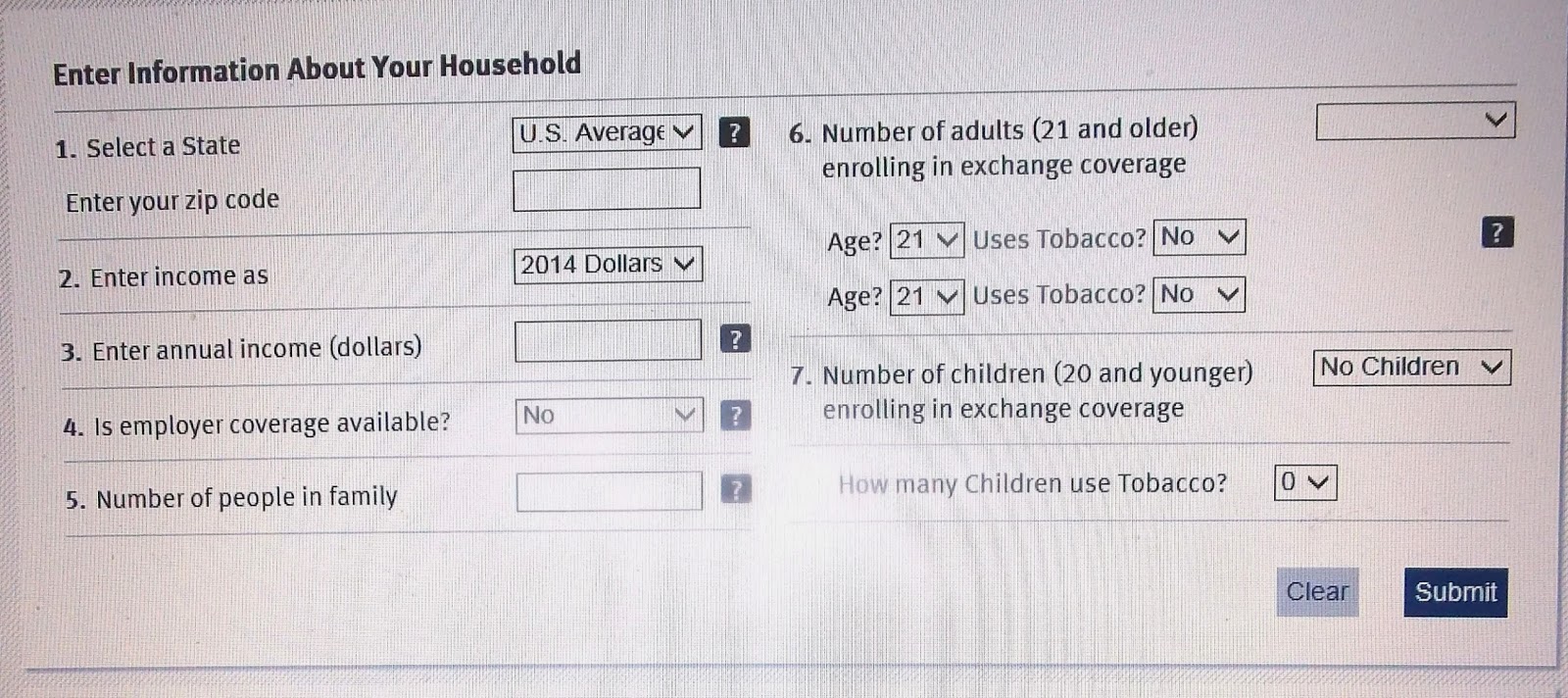
Have you tried the calculations yet to see what kind of impact Obamacare would have on your finances? I don’t mean have you suffered through the glitchy Healthcare.gov website signup, which wastes your time while collecting your personal data; I suggest you avoid that indefinitely. No, I mean have you used the Kaiser site, just to do the calculations. 

The Kaiser ACA Calculator
My son Political Sphere gave it a try. Actually, he went two place online: both the Kaiser calculator, which has some limitations, and the Healthcare.gov site, but only using the "view plans now" option, rather than actually trying to sign up. So, hopefully, that means no permanent data collection. Anyway, here are the results.
He has been going without health insurance for some time. He and family are that combination of healthy and poor, making up the large majority, I’m guessing, of the purposely uninsured. This does not mean they get no health care; they just pay for it, in cash, when they need it. This included even the birth of Little PS2, with the help of a midwife. (Little PS1 was born with the help of the same midwife, but finances at that time led Mr. Spherical Model to pay that bill out of pocket, so he claims his granddaughter belongs to him—bought and paid for. We humor him.)
Now that Political Sphere is in law school, he is required not to be working. Mrs. Political Sphere works part time at a fast food restaurant and also takes college courses. There’s a scholarship that is covering law school tuition this year, and then there’s a sizable student loan to cover such amenities as school books, rent, food, and clothing for growing children. Things are tight, as you can imagine.
So Political Sphere goes to the calculator websites and inputs that data. It turns out, as you’d expect, their income is so low (well under 50% of the poverty line), they can’t be expected to pay ACA marketplace prices. They are turned over to Medicaid. But then things get kind of ironic.
You know that big student loan for living expenses? The one they’ll be paying interest on for years to come, but was a necessary cost of the schooling investment? Yeah, that counts as “income” according to Medicaid. For Medicaid purposes, taking out a loan that you have to pay for with interest is considered being what you might call “flush with cash.” The federal government agrees they’re way too poor to be buying health care; nevertheless, negative income (debt) makes them too rich to be receiving Medicaid. [Aha moment: government thinks debt is income—that explains a lot.]
So what is the government’s solution? Go to the Healthcare.gov website and find yourself a policy for, oh, say, $272-$432 a month for catastrophic coverage only. (The Kaiser calculator only gives averages by level and does not include catastrophic coverage as an option.). Catastrophic coverage means you pay 100% of the costs of your medical needs except for a list of serious expenses. Or you can go up to $334-$592 for the Bronze level coverage (that price is based on just two parents receiving coverage, assuming the children are already on Medicaid). At the Bronze level, you pay 40% of your medical bills. For additional money (this is general information from the Kaiser site), you can step up to the silver plan, where you pay 30% of your medical costs. All of these, according to a note on the Kaiser site, come with the proviso that out-of-pocket medical expenses (over and above premium costs, if I'm understanding correctly) can top out at $12,700 a year, which may exceed 100% of your annual income. Such a deal!
How do you pay those premiums? Maybe they assume getting additional loans of up to $600 a month is no problem, but it kind of is for people in the real world. So maybe they expect the family to just live on the streets instead of paying rent, which is about an even exchange, cost-wise. They have made it a law that you must buy insurance, but they have not made it a law that you must house your family.
They require everyone to buy insurance, because the whole “even the playing field” idea doesn’t work unless you force young healthy people to pay as much as older unhealthy people pay. And we need to be “fair,” after all.
Or PS and family can be sensible and continue doing what they’re doing—paying cash when they need to take the kids in for checkups, and ignore the mandate. That first year the fine is relatively low. It gets collected out of tax refunds—which you don’t pay when your income is that low. However, the government “returns” several thousand dollars more as a “tax refund” when you’re that poor, so this means they’ll "collect the fines" by paying any poor family that ignores the mandate a little bit less.
The second year fines go up, but by then there’s only one more year until law school is over, and it might be possible to consider buying healthcare coverage. We’ll see.
Still, at that point, wouldn’t a health savings account be a much better deal for a healthy young family than being forced to subsidize someone else during their very early career years? Assume they pay a few hundred a year in medical costs, as they’ve been doing (and paying cash up front does get you the best deals), and they pay $5000 into a health savings account, instead of into a policy. By the next year, that $5000 is earning interest. They do it again; by the end of two years, they have a health savings account with $10,000, plus interest. Just a few years of paying themselves without having to pay out, and they can self-insure. And if they were worried about catastrophic coverage, they could buy that at a free-market rate of around $100 a month (pre-Obamacare market pricing) and still have most of that money left for the health savings account.
On this past Saturday’s Wonderful World of Stu show (Stu Berguiere on The Blaze TV), he went through a list of why Obamacare isn’t the great deal it was said to be. Here are a few:
·        You can’t keep your plan after all—40-67% will have to change, because any tiny change eliminates the “grandfather” protection, and the law forces plans to change. [Political Sphere told me that when Obama said, "You can keep your plan. Period," he actually meant "asterisk." I thought that was clever and I was going to quote him, but he said he heard it on radio and doesn't remember which radio host to credit.]
·        Saying that those in the “individual” market are only a few is disingenuous: government estimates that number at 93 million Americans, with some more accurate estimates saying it’s at least 129 million people. Numbers go higher when people lose their employer coverage by losing their jobs, or when employers find it a better deal to pay a fine than to pay for more expensive plans.
·        The price for the whole of Obamacare was sold to voters as $900 billion over 10 years (without counting the first 4 years). But it’s really more like $1.88 trillion.
·        The average family was supposed to see premiums go down by $2500, but the average family actually has premiums going up by $3000. So the government “misunderestimated” costs to families by $5500 a year--and we could add that Affordable Care Act is a sadly ironic name.
·        Obamacare, according to Pelosi, was to be a great jobs creator—4 million new jobs, with 400,000 of those right away. In real world math, Obamacare will cause a loss of 800,000 jobs.
You get the idea that all those planners involved in this whole ACA mess don’t like to be bothered with details like math (or truth). That’s something third graders might get away with, but it’s really not acceptable from the calculating tyrannists insisting we give up our freedoms, because they claim they know better than we do how to make our personal spending decisions.

Monday, November 11, 2013

Big Thanks


Today is Veterans Day in America. It’s a day to thank those who have served in the military. We owe them big thanks. We honor them.
My mother's father served in WWI
Several friends have honored their military connections with photos of parents, uncles, brothers, themselves—any loved one who has served--on their online profiles.
I’d like to add mine here.

Veterans Day began at the end of World War I, the “war to end all wars.” I have a grandfather who served in that war, my mother’s father. He was serving in the Army at the time he married my grandmother. The story is, he had to go AWOL briefly for the wedding. Everyone had traveled to town for the wedding, and suddenly and unexpectedly his leave did not come through to leave base. This was not quite before phones, but it was certainly before a convenient way to reach people by phone. The options were to leave his bride waiting at the altar without information, or to get there in person. He consulted a superior officer, someone who couldn’t give the leave but who could advise that this was a time to bend the rules. So he left base briefly for the wedding and then had to hurry back.
Fortunately for me, his service did not require losing his life. He and my grandmother had eight children, with my mother as the sixth. My grandmother died before I was born (at about the age I am now), but my grandfather lived until I was in my late teens, and we enjoyed his visits, and enjoyed visiting him on his Idaho farm, with a huge garden he managed up until his final years.
My dad served in WWII
My dad served in World War II. I wrote in more detail a couple of years ago. It was nearly a decade after the war by the time he met my mother, so his military service was kind of ancient history to us. Still, I like the photo of him in uniform and I’m proud of his service.
My son Economic Sphere is currently serving in the US Army. I wrote about his recent accomplishments last month. He does not like his photo to show up online, so I’m living with that. However, I found one that I think he will approve. This was taken after his DLI graduation, when the teachers were getting photos with his class.
My son, currently serving
in the US Army
We get him home for Christmas, and I have warned him that we will be doing family photos—since we have added a grandson and son-in-law since the last time we were together for photos. I probably won’t post that one either, but I will have it on my wall to glory in.
I have no trouble remembering the military in my family.
Beyond that, I hope we all will remember, with gratitude, the service of our military—and always offer gratitude and honor for their service.

Friday, November 8, 2013

Cultural Death Wish


Back in early February 2012 I wrote a three-part piece on Why Civilizations Die. The short version is: Civilizations die when the culture no longer has a will to survive.
Civilization—with a capital C—is an ideal. It may be neglected, ignored, left alone. But the concept itself is eternal and undying. So when we say civilization is dying, we’re saying a particular culture, or group of people, that may have qualified as civilized relatively recently, is dying out and disappearing.
In September I mentioned some reasons for considering Russia’s Slavic culture as dying. Some of the data came from the author of a book called Implosion: The End of Russia and What It Means for America, by Ilan Berman. At that point, I was writing from information from a radio interview with the author. The book finally showed up at my local library, so I’m adding to that discussion with a few more details from the book.
Here’s a summary of the decline:
Russia is dying. Russia is undergoing a catastrophic post-Soviet societal decline due to abysmal health standards, runaway drug addiction, and an AIDS crisis that officials have termed an “epidemic.” The population of the Russian Federation is declining by close to half a million souls every year due to death and emigration. At this rate, the once-mighty Russian state could lose a quarter of its population by the middle of this century. And according to some projections, if Russia’s demographic trajectory does not change, its population could plummet to as little as fifty-two million people by 2080. It’s a phenomenon demographers have described as “the emptying of Russia”—a wholesale implosion of Russia’s human capital and a collapse of its prospects as a viable modern state (pp. 10-11).
There’s a rather short three-generation pattern for civilization demise. If you’ll recall the words of J. D. Unwin, who studied the role of monogamy in civilizations throughout world history:
If, during or just after a period of [cultural] expansion, a society modifies its sexual regulations, and a new generation is born into a less rigorous [less monogamous] tradition, its energy decreases…. If it comes into contact with a more vigorous society, it is deprived of its sovereignty, and possibly conquered in its turn…. The results should begin to emerge in the third generation.[i]
That does seem to be happening in Russia. Simultaneous with the severe demographic decline is the ethnic and religious transformation from Slavic Christian to Muslim. According to Berman, “Muslims are on track to account for a fifth of the country’s population by the end of this decade [by 2020], and a majority by mid-century (p. 11).” Compounding this demographic change is a xenophobic effort to keep the growing minority as an underclass, which pretty much guarantees separation rather than assimilation (p. 33).
The collapse of the Russian family is at the core of the decline:
In 1958, divorces in the USSR were virtually nonexistent—just 0.9 per one thousand citizens. By the end of the 1970s, that rate had risen slightly to 3.6 per one thousand. But Soviet-era restrictions on individual mobility, coupled with widespread economic hardship, helped keep most families together.
By contrast, the past two decades of freewheeling capitalism and post-Communist disorder have coincided with a collapse of the Russian family. According to the UN’s 2011 Demographic Yearbook, Russia now has the highest divorce rate in the world, with half of all unions ending in divorce (and 60 percent of those dissolving within the first decade.)… Nuclear families with multiple children are quickly becoming an endangered species in Russia (p. 19).
What does “freewheeling capitalism” mean, and why is that a negative thing? In Russia, corruption is rampant. There’s the kind of uncertainty you find in the Spherical Model southwestern quadrant—chaos of organized crime, economic takeover by the biggest and strongest. Freedom to enjoy the fruits of your work requires limited government that protects property rights. (See Wednesday’s post.) Russia, by contrast, has “organized corruption on a staggering scale”:
According to a February 2013 study by research group Global Financial Integrity (GFI), Russia lost more than $200 billion in illicit financial outflows stemming from crime, corruption, and tax evasion between 1994 and 2011. All told, the study estimates “the size of Russia’s underground economy—which includes, among other things, drug smuggling, arms trafficking, and human trafficking—are a massive 46% of GDP” over that period (p. 72).
On the surface, Putin’s regime is attacking this corruption, but that doesn’t reflect a systemic, internal change: “Indeed, the very foundations of Putin’s state—and, by extension, his hold on power—rely on loyalty that is secured through informal dealings and graft. Without them, the Putin government’s hold on power would quickly loosen” (p. 73).
These are not random factors; they’re all cultural factors. On the Spherical Model, we can see what leads to thriving civilization: living God’s laws, starting with the Ten Commandments—with honesty, honoring family, including honoring parents and fidelity to spouse, and valuing life standing out.
It might be that Russia is already in its death throes. But with God nothing is impossible. I don’t know how the nation can solve all of its problems (other than massive personal religious conversion). But I am certain that no authoritarian regime can do it—attempts to encourage marriage and childbearing notwithstanding (p. 24 mentions the “mother’s capital” program to encourage childbearing). Living the principles of civilization by individuals, and individual families, in large enough numbers to become a critical mass, is the only cure for the cancer.
Russia is something like a failing uncle in the European family—aging, addicted to alcohol, often non-functional, with such depression and despair that he seems unwilling to take the action necessary to prevent an early death. Only that internal willingness to change—eschewing the self-harming behaviors—can move this enfeebled uncle to get his life back. Many of us are shaking our heads and thinking, it doesn’t look likely.
One concern for us in America, upon the possibly imminent demise of this uncle (this Slavic people), is what happens to his assets (nuclear weapons material), which look like they’ll be taken over by whoever moves into his tenement (people, probably Muslim, that are gaining prominence in the region), especially if that new occupant has radical ill will?
That’s a big question. Another reason for concern about Russia’s imminent demise is as a cautionary tale for us. The US divorce rate, while not quite as high, is too high (70% remain married for life, but the near 50% divorce rate shows a high number of serial divorcers). The abortion rate here, while not as high, is too high. Our birthrate is right at replacement level of 2.1—but that depends mainly on higher birth rates among active religious people and immigrants; much of the rest of the population mirrors below-replacement rates of other decaying civilizations. Our level of corruption is lower, but is growing under this administration, which functions with a southern (on the Sphere) tyranny mentality.
We know what leads to cultural death. And we know what leads to thriving civilization. We need to consciously choose life.


[i] Joseph Daniel Unwin, Ph.D., “Sexual Regulations and Cultural Behavior,” address given to the Medical Section of the British Psychological Society. (Library of Congress No., HQ12.U52)