Wednesday, September 14, 2011

Ultimate Right and Wrong

During the conference I attended last month, I came across a quote by Lincoln that I hadn’t encountered before: 

“This, and this only (will satisfy the South): cease to call slavery wrong, and join them in calling it right…. Holding, as they do, that slavery is morally right, and socially elevating, they cannot cease to demand a full national recognition of it, as a legal right, and a social blessing…. Let us be diverted by none of these sophistical contrivances….such as groping for some middle ground between the right and the wrong….” –Lincoln

In short, either slavery is wrong or it is right. It isn’t possible for it to be both. It isn’t possible for it to be right sometimes, or right for some people. The concept of calling slavery wrong is an ultimate truth.  

In the class on culture wars I attended, where this quote was used, the teacher, Brett Latimer (an American Heritage professor) pointed out that, according to Lincoln, “If slavery is not wrong, nothing is wrong,”[1] and if you couldn’t judge by what was right and wrong, then it was only a matter of who had the power. 

Prof. Latimer shared so many things that I’d like to pass along. But here is the beginning in a nutshell, that on other days we may refer to with specific topics. 

There is ultimate Good (big G). While we recognize that there is ultimate Good, it is a human tendency to define, moralize, and specify how to get there. In other words, there is dogma (little g). 

Those who don't believe in ultimate Good believe instead in relativism, the assumption that there is no big G, and that dogma therefore is always wrong, because all beliefs are equally true and relevant (b=b=b). 

But if you take away the big G, then you leave a vacuum that must be filled by something. It is one thing to say that individuals are entitled to their own beliefs, and that we respect their right to their beliefs. It is something else to say that the beliefs are all equivalent. As soon as someone is in a position to make policy (law, rules, education standards, etc.), then that someone’s belief is being imposed. If there is no standard big G to go by, then the relativistic belief of the person(s) in power becomes the enforced belief. In other words, without God-given ultimate truth, the standard becomes man-made truth.

        The Good (G)
        Dogmatization (g)
        Relativism (b=b)
        Man-Made “good” (B) 

As a society we will either be supporting the ultimate Good (G), or we will be supporting the mad-made “good,” or enforced belief (B). 

One of the basic truths I talk about in the Civilization section of the Spherical Model, is that Family Is the Basic Unit of Civilization. If indeed that is an ultimate truth, then several additional truths hang on that, among them the meaning of marriage. 

Marriage cannot be “the sexual union of a man and a woman, exclusively and permanently bound to one another, benefitting the offspring they produce” and also be “the current sexual attachment of any two beings without regard to exclusivity, permanence, or possibility of offspring.” It isn’t possible for “b” to equal “b.” They aren’t the same thing; they do not offer the same thing either to the persons involved or to society as a whole. 

We can’t say, “For the sake of getting along, let’s just call marriage and homosexuality the same thing,” any more than we can say, “For the sake of getting along, let’s just say that ‘slavery is wrong’ and ‘slavery is right’ are equally and simultaneously true.”  

It isn’t possible for the law to remain neutral. Either slavery is against the law or it is supported as lawful. Either marriage is the permanent and exclusive union of one man and one woman, or it is something other than that. Either religion is an appropriate subject in schools, or it is not.  

It is not possible for government policy to be neutral. If schools are “secular” to avoid teaching “someone’s dogma,” then the dogma that will be taught will be secularism—i.e., that God is not allowed as part of the teaching. 

During the coming fourteen months of election season, there is some movement to “focus on the economy,” or “focus on the war on terror” as the issues that should be getting our full attention. Personally I do give attention to these big issues. But I cannot agree that protecting marriage or the right to religious expression are merely distractions.  

What we need to know from our candidates is, “What is your worldview?” “Do you believe in ultimate Good?” “What do you view as ultimate Good?” Because the answers to these questions will tell us whether this person can lead us economically (we will know whether they believe in the sanctity of life, liberty and property, which leads to economic thriving), politically (we will know whether they believe in the proper role of government to protect life, liberty and property, but not to engage in coercive “charity,” which always limits our freedom), and toward civilization (with a moral people committed to personal responsibility, strong families, and voluntarily helping one another).

These ultimate questions aren't distractions; they are the central questions we need to keep asking.

[1] Lincoln statement on March 26, 1864, to former Senator Archibald Dixon, Governor Thomas E. Bramlette, and Albert G. Hodges, editor of the Frankfort, KY, Commonwealth, later put in writing per Hodges’ request. See more here: http://www.loc.gov/exhibits/treasures/trt027.html

Tuesday, September 13, 2011

Political Commentary from Gulliver's Travels

It is a second Tuesday, which means I’ve just finished reading and discussing a book with my local book club. This month it was Gulliver’s Travels. I hadn’t read it since college, and this time I was more attuned to politics than I was then. So I marked a few passages that give us Jonathan Swift’s English perspective from half a century before our Declaration of Independence. Some things are still true. 

Among the Lilliputians (the tiny people he encounters on his first voyage), he finds some good, as well as some small-mindedness. 

Compare to our image of “blind justice:

The image of Justice, in their courts of judicature, is formed with six eyes, two before, as many behind, and on each side one, to signify circumspection; with a bag of gold open in her right hand, and a sword sheathed in her left, to show she is more disposed to reward [for doing good] than to punish.   

About politics and politicians:

Providence never intended to make the management of public affairs a mystery to be comprehended only by a few persons of sublime genius, of which there seldom are three born in an age: but they suppose truth, justice temperance, and the like, to be in every man’s power; the practice of which virtues, assisted by experience and good intention, would qualify any man for the service of his country, except where a course of study is required. But they thought the want of moral virtues was so far from being supplied by superior endowments of the mind, that employments could never be put into such dangerous hands as those of persons so qualified; and, at least, that the mistakes committed by ignorance, in a virtuous disposition, would never be of such fatal consequence to the public weal, as the practices of a man, whose inclinations led him to be corrupt, and who had great abilities to manage, to multiply, and defend his corruptions. 

In like, manner, the disbelief of a Divine Providence renders a man incapable of holding any public station; for, since kings avow themselves to be the deputies of Providence, the Lilliputians think nothing can be more absurd than for a prince to employ such men as disown the authority under which he acts.


Among the Brobdingnagians, where Gulliver is as small by comparison as the Lilliputians were to him, he expects brutishness because of their large size. Instead we see (whether Gulliver does or not) a gentle and reasonable race, by which Gulliver makes his people seem small-minded. When talking with the king, he discusses deficit spending:

But, if what I told him were true, he was still at a loss how a kingdom could run out of its estate, like a private person.” He asked me, “who were our creditors; and where we found money to pay them?” 

The king makes this comment about politicians:

You have clearly proved, that ignorance, idleness, and vice, are the proper ingredients for qualifying a legislator; that laws are best explained, interpreted, and applied, by those whose interest and abilities lie in perverting, confounding, and eluding them.  

Gulliver has told the king about gunpowder, cannons, and other weapons of mass destruction of his day, offering to share this science with the king. The king is horror struck and refuses to learn any such secrets. Gulliver sees this as short-sightedness:

I take this defect among them to have risen from their ignorance, by not having hitherto reduced politics into a science, as the more acute wits of Europe have done. 

Here is a good summary of politicians, that perhaps isn’t dated yet at all:

And he gave it for his opinion, “that whoever could make two ears of corn, or two blades of grass, to grow upon a spot of ground where only one grew before, would deserve better of mankind, and do more essential service to his country, than the whole race of politicians put together.”  

After the monstrosity that is Obamacare, this next Brobdingnagian practice is one we might want to adopt:

No law in that country must exceed in words the number of letters in their alphabet, which consists only of two and twenty. But indeed few of them extend even to that length. They are expressed in the most plain and simple terms, wherein those people are not mercurial enough to discover above one interpretation: and to write a comment upon any law, is a capital crime.  

Even among these noble, sensible people, their history shows the usual struggles of humankind:

In the course of many ages, they have been troubled with the same disease to which the whole race of mankind is subject; the nobility often contending for power, the people for liberty, and the king for absolute dominion.


In recalling Gulliver’s Travels, the section where he visits the Laputians (floating island people) and others is often skipped. But there were a couple of notable suggestions in there. One was that, when the various political parties disagree violently, a solution would be to pair them off and transplant half of each other’s brains into the other. “It seems indeed to be a work that requires some exactness, but the professor assured us, that if it were dexterously performed, the cure would be infallible.” 

Gulliver also received this advice:

…that every senator in the great council of a nation, after he had delivered his opinion, and argued in the defence of it, should be obliged to give his vote directly contrary; because if that were done, the result would infallibly terminate in the good of the public.


In his last voyage, among the Houyhnhnms, the horse-like race of perfect reason and virtue, Gulliver learns to appreciate his human folly. But he fails to recognize human virtue where it is right before him, in the form of a patient Portuguese captain who rescues him, and in his very patient wife and family back home. So I’m never sure of what Swift, the author, recognizes that Gulliver, the character, does not. 

Here’s one quote I think I will find useful more than once: “There is nothing so extravagant and irrational, which some philosophers have not maintained for truth.”  

We don’t, over time, change very much as a human race. Where there is progress, it is by adhering to the same ancient virtues Gulliver wished the Houyhnhmns would teach the Europeans to civilize them: “honour, justice, truth, temperance, public spirit, fortitude, chastity, friendship, benevolence, and fidelity.”

Sunday, September 11, 2011

Out of the Ashes

"Out of the Ashes," by Ken Turner
It has been a decade already. I expect you also remember where you were when you heard. I was at a homeschool family camp, about five hours from home, in an idyllic setting along the Frio River in central Texas. In that little valley we had no television or radio. Some people drove to the top of the hill (this required driving out through a river and up a mile of steep dirt road) to get cell phone reception or listen to the news on a car radio. 

Mr. Spherical Model and our oldest, Political Sphere, were planning to join us the next day. Mr. Spherical Model got sent home from work, and they checked in with us later in the day. And they and other latecomers brought newspapers with them when they arrived. 

So I had the rare experience of being shocked slowly by that event. I couldn’t sit glued to the television and fret, which I’m sure I would have done at home. News filtered in piecemeal. There were newspaper photos of bodies falling from the towers, which have stayed burned into memory. But by the time I got home most of a week later, television news was no longer repeating the footage of the buildings falling, or the second plane hitting its target. Today I would simply get online and look up the info and video, but that wasn’t something I was in the habit of doing a decade ago. It wasn’t until the summer of 2004, at a state GOP convention, when they did a montage of the tragedy and what had happened since, that I actually saw the footage. It was stunning even then. I don’t expect to ever not have this event in memory in my lifetime. 

I have a couple of favorite images following 9/11. One is of the flag rescuers mounted on the rubble, looking a bit like the Iwo Jima moment. The other is the painting above, by Ken Turner, “Out of the Ashes.” It was begun in November 2001. There are several versions, hanging in the George H. Bush Presidential Library in Texas, the NY Governor’s Office, NYPD, FDNY, and Port Authority Police Department New York and New Jersey Headquarters. In each version, there are real portraits of the heroes in the painting. Additionally, there are “ghost” portraits, faintly visible people in the painting, of real persons lost in the tragedy. I love how the image makes me feel—that there is still light, and we are walking strong out of the darkness of that rubble into the light—surviving together. I very much remember how we all felt our lives touch one another during that time. 

Ken Turner is a Texas artist, born on the 4th of July, 1948. My daughter-in-law grew up going to the same church he attended. So a few years ago I took a group of homeschool teens on a field trip to his studio. It was in a historic old building in Columbus, about an hour toward San Antonio from Houston. He is known for historic paintings, from both US and Texas history, and also religious works. He was working on one at that time of the Last Supper. I was interested in how he went about the painting. The first layer or two was fairly plain, just color blocks. Then he added detailed layers over time. He said he kept at it until he couldn’t make it any better. By then it would be lifelike and rich in detail. 

He had postcard sized prints of “Out of the Ashes” that he gave to each of us. I have carried it with me ever since.  

If you’re interested in Ken Turner art, I suggest you contact him online at the Turner/Chapman Gallery. I believe he has moved his studio to his home, in even more rural Texas, so don’t run out there for a field trip without contacting him. I saw this video of him recently, explaining the giclee reproduction process of “Out of the Ashes.” 

I don’t normally post on Sunday. I’m actually writing this on Saturday, setting it to post automatically Sunday morning, and plan to keep it up in place of Monday’s post. The moment of realizing we would survive after 9/11 was worth remembering on the tenth anniversary; and this image of that moment was worth seeing for an extra day.

Friday, September 9, 2011

Just Another Empty Speech

Do you remember just a month ago when we had a standoff about raising the debt ceiling? It was raised, along with a half-hearted promise to lower spending sometime about a decade down the road. And then, of course, our AAA credit rating was lowered to AA+, which means when we borrow, it will be at a higher interest rate, costing us even more over time. 

So when it was announced that 2 ½ years into his presidency Obama would finally give us a plan to improve the economy—specifically to help correct the lingering high unemployment rate—even the skeptical among us had “hope” that he was going to “change” to something that would work. Something other than “Let’s gouge the rich some more,” which is really getting old. And something other than “Let’s spend lots more money so that the private sector won’t misspend it, no matter how much that causes the recession/depression to linger.” We also wanted something other than, “What Bush left us was a much bigger mess than we had anticipated.” 

So what did we get? “Let’s spend nearly another nearly half trillion that we’ve already clearly shown that we don’t have. It will be paid for, not additional debt, which I’ll explain later, but you can assume it will be by making the rich finally pay their fair share [i.e., gouge the evil rich who already pay most of our revenue]. And Congress has to pass it, or I will go around the country blaming them for all our nation’s ills, since blaming Bush is getting unbelievable.” That about summarizes it.

It turns out I am still capable of being shocked. Obama had the “audacity of hope” to order the Congress to blow off a long-scheduled presidential candidate debate for this earth-shaking speech, almost the very moment Congress returned to session after the August break. We were to assume that he had used his own Martha’s Vineyard golf vacation to prepare, perfect, and hone this most important plan. And we are to assume he was just more than gracious for consenting to put it off till the next day, and further, to speak early so as not to interfere with the opening of football season. 

Imagine if he had actually pre-empted either the debate or the ballgame—on the pretext that his message was so urgent that the world must stop for it! He did not actually present a plan. At Whitehouse.gov it is possible to get a bare outline of the supposed plan, but it’s blissfully free of details [my cursory view of it looked like the bare details repeated a couple of times]. The speech itself presented almost nothing. Just a promise of another speech, a week from Monday, in which he will detail how it will be paid for. In the meantime, let it be known, Congress must pass this undefined plan. 

Did he mention that Congress must pass this plan? Why yes, yes he did. Seventeen times, by my count. [I downloaded the transcript, used find and highlight commands for the word “pass,” left out the few that didn’t relate to this meaning, and counted 17. You can do it yourself.] 

A 44-second montage of the many times he said to pass the plan can be found here: http://bcove.me/8hlvri6g  

Among a few responses I came across after the speech was Kevin Jackson of Blacksphere, which made me laugh out loud, a good thing in bad times:  

Apparently we only got half the speech. The second half of the speech supposedly contains the actual meat of Obama’s program, but that part of the speech is on layaway. It seems America couldn’t afford to hear both parts of the speech together, thus the installment plan. 

The speech may be on layaway, but Obama says that his job-creating ideas of which we will be blessed to hear soon are funded. The new round of blood-letting will cost the taxpayers around $500B, which in government-speak means $1T+. We can spend our way into more jobs.  

Obama has yet again grabbed America by the wallet and said, “Cough.” 

Just like he promised when he was running for office, Obama will create more jobs. Just not in America. 

Speaking of creating jobs, Ford, that all-American force of innovation, announced this week that it will be opening up another factory in India. Are they suddenly anti-American? Or are they trying to find a way to keep their head above water in the face of outrageous union labor and regulations that presumably even Obama is now in favor of scaling back (as long as there’s no loss in safety)? Or maybe it’s just part of doing business worldwide and has no political ramifications at all. Maybe.


Here we are at Friday, and I haven’t tackled the other two charts referred to in Monday’s number-crunching piece. Still considering spelling it out, but here are some basic economic premises Obama seems to be ignoring. 

  • When government spends money, that means the private sector has less money to spend on basic economic purposes, including hiring workers. “Stimulus spending” does not “stimulate” the economy; it uses money that would otherwise have been used more efficiently and effectively by private enterprise. The only thing “new” about more stimulus is facing a higher interest rate on the resulting debt.
  • When you raise taxes, you don’t necessarily raise revenue, because people change their behavior based on whether they receive less benefit (hold money instead of spending it on capital projects, hold it in forms subject to lower tax rates, or hold it in offshore accounts not subject to the taxes—see the Laffer Curve). So having a plan “paid for” by raising taxes will not guarantee raising revenue. Revenue is more likely to rise with lower taxes that result in growth in GDP.
  • Whenever federal spending goes to projects that are not part of the Constitutionally delineated powers, negative unanticipated consequences result. 

So, should Congress consider the plan (once it appears), rather than dismiss it out of hand? Sure. And then, unless it is a plan of significant federal spending cuts from areas where the federal government shouldn’t be involved, and unless it releases money to the private sector rather than raising taxes, Congress should stand firm and refuse to pass it. They have offered alternatives, dismissed out-of-hand by this president. So let this ineffectual man travel around and blame them to his heart’s content. Blaming Republicans, who hold only one-half of one branch, for what he did wrong during two full years of total control will simply not satisfy as a substitute for a plan to get Americans back to work.

Thursday, September 8, 2011

Fires and Debates—Not Fiery Debates

I’m having trouble settling on a single fully thought through topic for the day, so I’ll do a few random thoughts.


More Fires
Subdivision in Montgomery County after fire
The fires around us are still taking up much of our attention. So far I don’t personally know any evacuees, but I have friends who know evacuees, including some who have lost homes. My daughter Social Sphere called from far away at college, with some concern that her house might not still be here when she gets back. I could be pretty reassuring about that, but she did make certain we knew what to grab if we had to evacuate. She visited with a friend from San Antonio who had to evacuate a few days ago, driving out of the neighborhood with flames on either side. But their house survived. 

The odd thing is how little Social Sphere can find in the media about the Texas fires. It made her angry and suspicious that they are trying to cover up what’s happening. Local/state media are of course covering it. We can all see and smell smoke everywhere around us, so we need answers. The devastation is significant enough, though, that we'd expect national coverage.  

When I wrote a couple of days ago, the hot spots included Montgomery County, with areas about 45 minutes northwest of us. In the past day it has been Waller County, just to the west of us about 30 minutes. We know people there and are unsure about their status. From the freeway nearest us, smoke is visible. 

We continue to pray for rain. The temperature is down, topping out at 90 or a little below. After a summer of 100+ degree days, this feels like some relief. But this drought—rain is the much-needed answer.


Debate
We recorded the debate and watched it late last night (me and Political Sphere and wife). While I have leanings, I am undecided. Some of the reason is that the field as a whole is light-years better than the incumbent. (Someone on facebook said, “A pet rock would make a better president.”)  

A highlight for me was when Newt Gingritch took the moderator to task for a not-well-disguised attempt to cause contention among the candidates. Fireworks get ratings; I guess that was the purpose of the questions. Also, they tend to provide sound bites for later post-primary use, as Newt knows. I am a fan of Newt’s ability to speak. It is such a contrast to Obama. No teleprompter needed. That’s true of all of them, but Newt is just so quick and at ease. I don’t particularly want him as president (loss of trust issues), nor do I think he has much chance. But I’m glad he’s there; the debates benefit. 

We wanted to see Perry perform. Despite a news media theme that he is a Bush clone, and as prone to misspeaking, I have never found that to be so. However, he does sound very Texan. You’re not at all surprised to learn, for instance, that when a coyote attacked while he was out jogging, he pulled out his gun and shot it. Don’t all Texans carry guns while jogging? No big deal. I thought he did OK. I’m not totally convinced by him; I’ve seen some things in Texas that don’t settle well. I’ve seen other things that I’m rather pleased with. Nothing happened in the debate to move me either direction. 

Mitt has been “accused” lately of courting the Tea Parties. Again, this is a media constructed issue. I read almost everything he said from the last campaign, and try to keep up this time; he’s consistent, and he speaks pretty clearly in agreement with many Tea Party themes, particularly economic ones. I liked how he fielded the question [my paraphrase]: “I don’t think you have to carry a membership card. But if they’re for smaller government, lower taxes, free enterprise, less burden on businesses who create jobs, then I guess we agree.” I’m currently going through his 50-point plan for the economy, that came out a couple of days ago. It was free to download to my Kindle, with read-aloud feature activated, so I can listen in the car or doing other things. So I’ll give it a fair look. [I'll try to be fair to the incumbent's economic "solution" tonight as well, but the leak that it centers on yet another $300 B stimulus gives little hope in any upcoming change.]

I would have liked to hear more from Michelle Bachmann; she was good when we heard her, but she wasn’t in the spotlight. Rick Santorum didn’t have a particularly good evening either. He seemed tense. I hope he stays longer in the race. I read his book, It Takes a Family: Conservatism and the Common Good several years ago and very much liked what he had to say. I even thought, “Maybe when he’s older he’d make a good president.” But if that is so, I don’t think this time around is it. 

Herman Cain and Ron Paul didn’t change my opinions. I like limited things about them. I think Cain needs broader experience, but I like him on economic issues. Ron Paul is always interesting to have in the debate, even though he’s not persuasive. I think he shows that the debate actually should be between Republicans and Libertarians. At least then the discussion would be about the Constitution, what it means, how we preserve it--instead of the Democrat idea of “totally transforming” our nation; i.e., ignoring the Constitution and the freedoms it ensures. In a more ideal world, the socialist ideologues would simply move to purposely socialist countries and stop trying to steal our freedoms from us here.

Huntsman lost me when he thought serving Obama in China was more important than serving out his term as governor in Utah, and hasn’t won me back. I’d be interested if someone can share information to persuade me otherwise. But so far I find him unimpressive in this particular field. Still, better than the incumbent.

There was a Mitt moment I appreciated last night. Perry had answered the Gardasil question, fairly well, although I’ve never been satisfied with his behavior on that issue. I was very angry about it at the time. But Mitt graciously pointed out [again my paraphrase], “The Governor said he would like to have handled it differently, looking back; he would have gone through the legislature. We all have those things, looking back, that we’d rather have approached differently. I don’t think there’s any reason to keep dwelling on that issue.” It may be that this was a subtle attempt to say, “So you can stop harping on the Romneycare thing as well,” but I think it’s just his innate niceness. Sometimes I would like him to be a little more “Texan,” for want of a better image. But smooth and gracious are simply in his nature. His polish comes from experience and a genuine gentility, not from a “slick politician” kind of niceness. I know this from watching a long time, but I know it’s hard for people new to him to fathom. I know people like him: good, clean family man, hard-working, strong in his faith. So I don’t have too much trouble believing it’s real in him. While I’m not yet fully persuaded to dive in as a total supporter, if he turns out to be the nominee, I will be glad to help him defeat the incumbent. 


AdSense
I hope you are not too annoyed by the little ads that appear with this blog. I “monetized” with the modest goal of paying toward my Spherical Model website. The information said they use technology to “read” my material and match ads that fit the content. So I’m very puzzled about an ad I’ve seen the last couple of days suggesting I click through to learn how I can connect with others in Houston to help re-elect Obama. Really? Is there anything in this blog that could be construed by anyone to believe I would want to do that? Actually, I can’t click through anyway; it’s against the rules, so that I can’t artificially inflate numbers in an attempt to get myself more money. But why do they think my readers are likely to be interested in that ad?  

I suppose in my own self-interest I should encourage readers to support my “sponsors,” but in this case, I totally appreciate that that’s not going to happen. Today when I brought up the page, there was a poll about whether to vote for Perry as president; that seems at least plausibly relevant.
____________________________
* The photos were sent to me in a forwarded email; sorry I don't know who to credit.

Wednesday, September 7, 2011

Ablaze

Texas is on fire. We’re what we like to think of as used to disasters. Usually they’re water and wind related: hurricanes, tornadoes, floods. But we’ve been having a drought for many months, and that means something we’re not used to. 

Here at the Spherical Model household we feel fairly safe in a neighborhood not right next to any forest. The fires grabbed our attention a week ago when a wildfire started in a reservoir about four miles down the road (across a couple of wide roads and didn’t reach subdivisions nearby). Usually this reservoir has water, or recently had water, or will fill up again any day. It’s land set aside never to be built, so that when the heavy rains come, as they commonly do here, we have a quick runoff place. Some of it is just forest primeval, and some is used as park land. Back when the boys played league baseball, we missed a few games a year because the fields were underwater.  

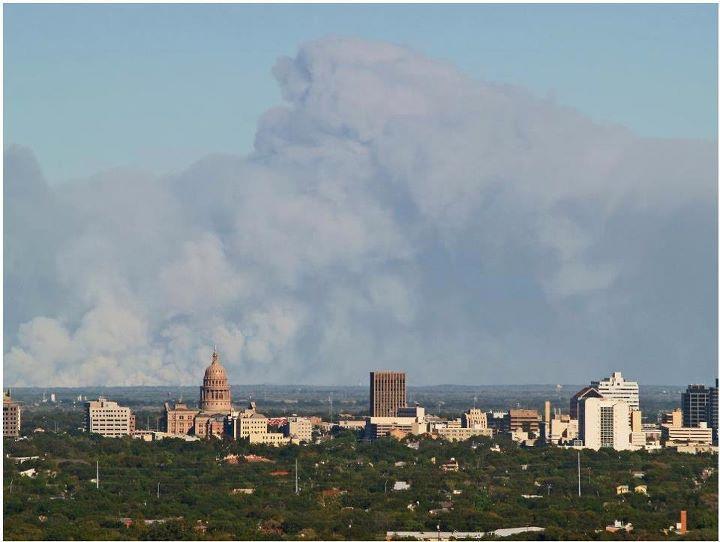
Bastrop fire beyond capitol in Austin
So when areas that are used to water and are full of undergrowth have a long dry season, there’s a lot of dry fuel. Combine that with a populous that isn’t used to needing to worry about flicking a cigarette out a car window or causing an engine spark, and add in the dry winds, which were the tailings we got from Tropical Storm Lee, and we get wildfires like this area hasn’t seen since the 1950s. 

In more rural areas the wildfires have been much more severe than our immediate area. Entire counties have been evacuated. Hundred, possibly thousands, of homes have been lost. 

I do not think we, as a people, are being punished for general wickedness. Far from it. One thing I believe about disasters in this area is that they bring out the desire to help one another. Facebook and emails have kept me somewhat apprised. Below are (slightly redacted for privacy’s sake) posts I saw from facebook friends and email lists.  

“We had to evacuate last night…. My husband and father-in-law are doing some recon right now to see what’s going on. We are staying with friend, and thank God for good friends!  We took our two dogs and two kitties, but had to leave our chickens. :-( 

“We can smell smoke here, but it appears we are out of danger right now. If there is someone/family needing shelter, please call. We will gladly help.” 

“Hey you! I am headed out in the AM to take supplies to the firefighters… wanna join forces?” 

“The high school has enough donations. They are asking people to take bottled water, Gatorade and snacks for the firefighters to the fire station…” 

“I you need safe pasture for your horses due to wildfires in Texas, call Mr. M- D- at (phone number). He has pasture to shelter 60 horses and has trucks and trailers ready to go. He can move 10 horses at a time. Please repost.” 

“M- West Command Center is in need of LARGE ice chests or an upright freezer! Ice is melting!” 

Command Center is in need of lunch meat and deli sliced cheese. We do NOT need bread. Deliver all donations to the Fire Department on R- Road.” 

“I found this website that shows active fires in Texas and U.S. Thought it might help someone looking for a visual.  http://www.wunderground.com/wundermap/?lat=31.48489
<http://www.wunderground.com/wundermap/?lat=31.48489&lon=-100.41504&zoom=6&t "
 

“This may be a repeat post, but I found this site which has a lot of useful links and info related to the wildfires, including maps, advisories, daily situation reports, what to do, etc.: http://texashelp.tamu.edu/004-natural/fires.php "


I did indeed check those links. Several times. Another positive source was one of the local news channels (probably all of them, but I saw this online). More video keeps appearing, but this one (http://www.click2houston.com/video/29100810/index.html ) talks about what’s happening with the evacuees. And they recognize people coming to help. A mother, along with her kids who were out of school because of the evacuations, showed up at the shelter so she could teach her kids how to serve. They gave food and water to first responders, and just looked for ways to be useful. I think that is normal behavior here.

The drought started a chain of wildfires late last year, mostly in West Texas. Governor Perry had asked for a disaster declaration, to get aid, but that went to deaf ears for several months. If I’m remembering right, fires were popping up in April near the time we drove through Odessa, and no disaster declaration was yet forthcoming. But that has happened since then. Resources are being provided. And there does seem to be a fair amount of cooperation between local citizens, volunteer help, trained first responders, and government disaster response teams. 

I saw one brief article (http://montgomerycountypolicereporter.com/?p=31987) expressing concern about federal interference, or pulling rank. It may just be a lot of people under severe pressure trying to do what they think needs to be done. 

In the aftermath, I trust that what we’ll see is a lot of people in various stages of grief, who are nevertheless grateful for those who ran to their aid in their time of need. And until then, people everywhere are praying for rain.


* The photos are all from the Texas Storm Chasers facebook page.

Tuesday, September 6, 2011

Ultimate Questions

At the conference I attended last month, a couple of the classes served up a fair amount more philosophy than I had expected. I liked that, but it has me thinking of ways to share the information despite both my lack of formal philosophical training (that doesn’t stop me from talking economics, obviously) and the limitations of length I have here. Plus, there’s the hope that I can make this interesting. 

Turtles All the Way Down*
A couple of year’s ago, I read a book called Plato and a Platypus Walk into a Bar, by Thomas Cathcart and Daniel Klein (preview here). It’s a fun little book, making the point that philosophy teases the brain in the same way a joke does. So they explain the various philosophies mainly through jokes. It’s a quick read too, and not a bad way to overview philosophical points of view. It starts out with this introduction: 

Dimitri: If Atlas holds up the world, what holds up Atlas?
Tasso: Atlas stands on the back of a turtle.
Dimitri: But what does the turtle stand on?
Tasso: Another turtle.
Dimitri: And what does that turtle stand on?
Tasso: My dear Dimitri, it’s turtles all the way down! 

Terry Pratchett’s Discworld series (Going Postal and Making Money, that I’ve mentioned lately are from this series) has his semi-magical world resting on the back of a giant turtle, so the cosmic depth of turtles does seem to arise here and there. 

I attended a four-day class on psychology, specifically on spiritual therapy in a secular psychology world. The first 3 ½ days were philosophy, and the last half day covered what I expected (but rather more brilliantly than I had expected). At one point, the teacher said, “It’s turtles all the way down!” and I knew what he was referring to. 

The question being asked is in this little exchange is, what is ultimate? Much of the class covered the more or less competing ideas of Plato (father of philosophy) and Aristotle (the father of science), loosely comparing metaphysics and materialism. What do they each define as “the Good life,” or ultimate Good? And is there an alternative view? Another four-day class I attended was on the culture wars, also much of it dealing with the ultimate Good. 

Is there an ultimate Good? What are the implications if your worldview says yes as opposed to no? 

In the psychology class, one of the lines of thought was whether psychological egoism is true. If it is, then there is no difference between people and a Snickers bar: both are a source of either gratification or frustration. If not gratifying, then why not discard and get another?  

One example was a man faced with the choice of whether or not to have an affair with his secretary. If his wife and the secretary are both considered possible sources of his gratification, then he simply weighs which one is more likely to satisfy and discards the other. But if he views both the wife and the secretary as human beings, created by the same God who created and loves him, then his decision is likely to be different—and more meaningful. 

If you are a “meat machine,” simply a sum total of chemicals and computer-like inputs, with no moral agency, then you will raise your children differently than if you believe you and your children are part of God’s family for always. Worldview matters. 

Do we believe there is ultimate Good, and ultimate Truth? If so, we go about our lives differently from those who think, “That’s your truth, but mine is different. Don’t you dare impose yours on me!” 

I’m an ultimate Good believer, as you’ve no doubt guessed. As a believer, I’d like to propose a list (certainly incomplete) of ultimates, moral Good things, that exist and are true whether we believe or perceive them or not: 

  • God exists.
  • Truth exists and is usually ascertainable.
  • Our existence matters.
  • Life is valuable.
  • Human life is more valuable than animal life or plant life.
  • Liberty is basic—no one has the right to own another person.
  • Property is an outcome of life and liberty, so taking another’s property is wrong, just as taking someone’s life or liberty is wrong.
  • Family (married parents raising their children) is the basic unit of civilization and should be honored and protected.
  • Sexual morality is essential for protecting family.
  • Modesty (wearing clothing that covers our nakedness) is a hallmark of civilization; it helps to honor and maintain sexual morality.
  • Caring about your neighbor as you care about your self is a way to make decisions that civilize (allow people to thrive while living together).
If you hold a worldview similar to mine, you probably agree with all (or nearly all) of these statements, even though we may have various ideas of what our behavior must be based on these beliefs. If we share this basic worldview, then we can overlook differences of manner much more easily than if you’re a relativist who refuses to allow that any of these things are true. 

The discussion here at Spherical Model may sometimes look political or economic, but underlying any such discussions is a worldview that there is ultimate Good. Questions about politics and economics can’t help but relate to how we thing about the ultimate Goods of Life, Liberty, and Property. 

One thing about our founders: they were, on the whole, strong believers in ultimate Good, which is why their ideas resound with us today.
_________________________
*I don't know the origin of this art, but I found it here.