Friday, September 15, 2023

Not Exactly a Jury of Peers

I’ve spent the last two weeks listening in on the Texas Senate impeachment trial of Attorney General Ken Paxton.

To review, at the tail end of the legislative session in May 2023, the House suddenly, without warning, held a four-hour hearing in which they heard allegations and then voted to impeach on 20 counts. No witnesses were heard. No hard evidence was presented. No interviews leading up to that point had been under oath. We were told this was like a grand jury; they just have to decide whether there is enough there to hold a trial.

So that is what the Texas House did; they passed off any actual trial work to the Senate, where all the evidence would be presented.


Lt. Governor Dan Patrick presides as judge in the Paxton Impeachment Trial.
screenshot from here


The Senate Impeachment Trial Process

This is similar to a court trial, but with significant differences. The jurors are the Senate members. They do not have to reach consensus, but must have 21 of 31 voting members vote to remove the Attorney General from his duly elected position. In this case, it will be 21 of 30, because one of the state senators is Angela Paxton, wife of the attorney general, who has been attending all the sessions but is recused from voting. We should note that one of the charges, bribery, reflects on her as well. The accusers claimed the Paxtons had received home renovations as a bribe to do political favors.

Earlier in the week a friend of mine commented on social media that what he’s observing is, whatever anyone believed going into this trial, they still believe. That’s probably accurate.

There are plenty of sources for information and commentary. I’ll list some of those below. But for this piece, I’m just giving my impressions—having listened to almost every part of the two weeks, including closing arguments this morning. This isn’t intended to persuade either side. There’s no time to do that. The Senate is now deliberating, and they could come up with a decision by tonight—likely before you could read this—or in a few days, depending on how long they take.

I won’t go through each of the 20 charges. But I’ll note, the case offered somewhere around 15 hours per side to present their case. That is less than an hour per charge. Cross-examination of the other side’s witnesses counted as time on the countdown clock. [Note that, as of today they are dealing only with 16 of the charges. The four related to securities fraud are pending in courts, I believe. They can deal with those later, depending on other outcomes. If they remove Paxton permanently from office, those charges won’t need to be dealt with. If they do not remove him, they could either dismiss those charges or deal with them separately.]


Impressions on the Various Counts

one of a series of texts pushing 
the anti-Paxton agenda
As long as the trial was, some of the issues were barely touched on. For example, as per the texts I keep getting from some entity unknown to me, they’re pushing two main things: an affair Ken Paxton has admitted to, but they claim he got the woman a job at Paxton’s friend Nate Paul’s company as a political favor; and the renovation of Ken Paxton’s house after water damage, which had upgrades they claim were provided by Nate Paul in exchange for favors.

We learned that the investigative team presenting the case to the House back in May made these allegations based on suspicions of the so-called whistleblowers. They did not interview Nate Paul, nor the woman who was hired by his company, nor the contractor who did work on the Paxtons’ home. In the intervening months they still didn’t do those things. There was nearly an opportunity to hear from “the other woman,” but, rather than subpoena her and schedule her testimony, the prosecution noticed her presence and thought they could call her, but couldn’t give the 24-hour notice that was required, before their time was running out. Seems kind of too little too late. They couldn’t have deposed her in June, July, or August?

Here’s what they missed, which was provided to us by the Paxton defense team: the woman in question applied and was hired according to normal process, continues to work there, pays for her own apartment in Austin, has not continued a relationship with Paxton, nor is there any evidence of this hiring being a cover for a favor to Paxton in exchange for—something unnamed.

The Paxtons had a general contractor to do the remediation work. He wasn’t contacted. The only connection made to Nate Paul was the mention of the name Nate during a discussion about possible upgrades, overheard by Paxton’s aide, who was concerned about it but was relieved, visibly, on the stand, to be convinced his concerns were unfounded. There is no evidence Nate Paul paid for anything; the receipts and bank records are in hand, showing Paxton paid for the renovation work. And the defense provided photo evidence (it was in the news weeks ago, so the prosecution could have verified at any time) showing that the Paxtons never upgraded to granite countertops and new cabinets as alleged. They still have the same kitchen witnesses recognized from before the repairs.

What the prosecution did was to bring in the people who reported the claims initially. They laid out their suspicions—and they did this well. What they saw, if you make assumptions about motive, looked like possible favoritism toward a particular client.

But repeatedly their claims fell apart on the stand. Under oath, one after another, the first few days admitted that, when they went to the FBI to report their boss, Attorney General Ken Paxton, they brought no evidence with them. By the second week they thought they had remedied this. Their reports, they claimed, were evidence. They brought their observations and beliefs and interpretations. So there!

Their stories might have been corroborating evidence, had there been any material evidence. There wasn’t. There was only these persons’ interpretation of Paxton’s motivations, missing quite often a fuller picture that they hadn’t sought. And neither had any other investigators.

Another oddity was that, when they went together, as a group, to the FBI on October 1, 2020, they sat around a table, together, recounting their observations. Had the FBI assumed their testimony validated any actual crime, the witnesses would have been interviewed separately, so that they did not know what the others were saying, thus coloring each others’ stories. Also note that the FBI, with all the “evidence” these five brought to them, in the ensuing three years have brought no charges.

This is not to say the FBI is spotless—although they may be in relation to this case. But it was suspicion about the FBI that led to some of the allegations. Nate Paul had had his home and storage unit searched. He believed that the original search warrant, of his home, was for drugs and guns, I think was the story. But when they of course didn’t find anything, they changed the search warrant to look for some kind of white collar crime, which entailed going through the storage unit for records. Nate Paul and his counsel, Wynne, believed they had metadata evidence showing that had happened. Note: eventual forensic work showed this to be inconclusive—not disproven.

The whistleblowers and others involved thought this was baseless, because the FBI and other federal officials never do anything wrong. Ken Paxton, however, asked for a fuller investigation. There’s more to recognize here. Paxton had been hounded and, he believed, badly dealt with by federal investigators, so he didn’t have blanket trust of them. Add to that, there were, at the time (and more since) multiple instances of federal officials playing fast and loose with citizen rights.


Former Travis County DA Margaret Moore testifies Monday.
screenshot from here

It was a rather satisfying moment in the trial when the defense Tony Buzbee was cross-examining the former Travis County District Attorney Margaret Moore, who claimed the state could never so much as suspect a federal investigator. The defense listed one after another of FBI crimes. Here’s some of that exchange:

Buzbee: I mean, there’s a lot of them. But, did you hear about the FBI admitted fraud forensic testimony in 32 death penalty cases?

Moore: No.

Buzbee: How about when the FBI conducted improper searches of US officials using a foreign database?

Moore: I don’t know about that.

Buzbee: How about when the FBI improperly spied on activists?

Moore: I don’t recall reading about that either.

Buzbee: How about when the FBI misused an intelligence database and performed 278,000 searches?

Moore: I didn’t hear about that.

Buzbee: And the reason I keep asking you about these repeated alleged FBI abuses is because, when you first heard about this alleged FBI abuse, the first thing you thought was, “Ridiculous.” Correct?

Moore: No. That’s not correct. That’s not what I said.

Buzbee: You knew that a federal judge had ruled that FBI agents had conducted illegal searches of businesses?

Moore: I don’t know what you’re alluding to.

Buzbee: How the FBI violated the privacy rights of tens of thousands of Americans?

Moore: Mr. Buzbee, I’m not aware of that article.

This lifetime law enforcement expert had never heard of any of them. Her claim to know the Nate Paul claim was false, without investigating it, rang hollow. My personal suspicion is that she didn’t want to investigate federal agencies she had to maintain a good working relationship with. That does not bode well for the people subject to the violations, though.

A similar line of questioning happened with the former Texas Ranger near-superhero David Maxwell, in the OAG, who was handed that case by Moore. He did a quick Google search on Nate Paul, concluded that he was a crook. So when he heard out Nate Paul and his counsel, with this suspicion they had about the search warrant, he thought it was ludicrous. He didn’t say so to them, but he never intended to do any investigation whatsoever.


The Whistleblowers

Paxton’s difficulty was that, despite his assignment to his subordinates to do an investigation, they admitted they “slow-walked” it, and in essence refused to do the investigation. When he followed up, they said they would get on it, but they didn’t. They didn’t so much as open a file on it.

Finally, Paxton hired outside counsel. He signed a contract with a young lawyer named Cammack, who was interested and willing in doing the investigation. Cammack said Paxton instructed him to just find out the truth.


Cammack was derisively dubbed "the kid" by the whistleblowers.
screenshot from here

Cammack started that investigation, and he also started another referral given to him, which the prosecutors had been unaware of and had assumed he was issuing grand jury subpoenas related to the Paul case, which he was not doing. He was thwarted at every turn by the “whistleblowers.” They derisively called him “the kid” in their conversations and correspondence. And they took it upon themselves to deny his contract, give him a cease and desist letter, and left him unpaid—claiming the Attorney General didn’t have the rights of the office given to him by the voters, which he could delegate to them but still held.

And these whistleblowers did worse. They got or made (it was disputed) official OAG stationery without the Attorney General’s name on it, and they hired, without permission, outside counsel for $50,000 to investigate/prosecute/persecute Attorney General Paxton. And then they claimed the AG was out of line in firing them.

It may be hard to know exactly what was in AG Paxton’s mind at every turn. But his communications show interest in the people of the state in general, not the single friend they insisted he was working for. He had worked hard to stop foreclosures from going through—before the first Tuesday of the month, during this time of COVID when a stay on foreclosures was about to end. This ended up having no affect on Nate Paul, as they insisted it did. But what AG Paxton had expressed to his team was that they may have kept some elderly grandmother from losing her home. And his policy became national policy by executive order a couple of weeks later.

There’s a question about whether the whistleblower laws affected these high-level appointees in the Office of Attorney General. Courts have ruled that it does, but that is pending appeal. What we might be seeing is something of a mutiny—and then, because of bad feelings, jumping to conclusions and accusations to convince themselves and others that their failure to do the work assigned to them was not what led to the loss of their jobs.

One of them, Brickman, I think it was, insisted that he was not interested and would never take the settlement—the $3 million that was brought to the legislature, which supposedly triggered the investigation during the legislative session last March. Except, when the settlement was finally agreed upon, he took it. He testified that he required the AG to apologize to them for calling them rogue employees (which, obviously, they were). He didn’t get that. So far the money hasn’t been appropriated to pay them, but when it does, it’s because he signed on to receive it. Hmm.

In closing arguments, the prosecutors urged the jury (the Senate) to believe that they didn’t have to remove all doubt. They just needed to do what they thought was right. Isn’t that convenient—when the rules and the law say they must acquit if the evidence hasn’t taken them beyond a reasonable doubt standard.

The biggest difference between this and a regular case is that it is political. Sad to say, it is highly unlikely that any of the eleven Democrats in the Senate will vote to acquit. It’s a team sport. They’re not really on either team in this one; they’re the handicap. The two teams are: the ones trying to oust the duly elected Republican official and the ones trying to restore him to his office to do the people’s work. There are 18 total Republicans allowed to vote (excluding Senator Angela Paxton).

We can identify the ones very likely to acquit. These are the ones who voted to dismiss before the trial: Bettencourt (my state senator), Campbell, Creighton, Hall, Kolkhorst, Parker, Perry, Schwertner, and Sparks. However, Sparks, Schwertner, and Perry did not vote to dismiss on all counts. So there are a solid six. If as many as ten senators vote to acquit after hearing the case, then Paxton is acquitted and returns to work.

There are six identified as pushing to convict: Huffman, Hughes, Hancock, Middleton, Birdwell, Nichols. With the eleven Democrats, that puts their count at 17. They would need four more to convict.

There are several considered “swing” voters on this issue: besides possibly Perry, Schwertner, and Sparks, who were willing to dismiss on several counts, there are unknowns Springer, Flores, and King. So the question is, where will four of them go?


The Senate Trial Players

Unlike other Senate votes, Lt. Governor Dan Patrick does not cast a tiebreaking vote. He was the judge. And I have to say, I appreciated his work. It was done with humility, good humor, and professional respect. I do not know what his opinion is. There were times when the defense seemed to be saying “Objection. Hearsay” every other sentence. I didn’t keep track, but as the umpire I couldn’t see that he gave more to one team than another. He had some expertise on hand to help him answer questions he had about it. And generally he seemed fair.

I had definite responses to the two legal teams. There’s a particular style of Texas lawyer, where he talks with a slow drawl and doesn’t appear too bright—but that is an act that surprises the opposition when the bite happens. The slow Texas drawl and fumbling described the prosecution team, particularly their lead lawyer. But there was no bite. It was fumbling to the end—including when Rusty Hardin rested his case before cross-examine and redirect of the last witness. Not knowing page numbers was a problem. Not putting exhibits into evidence was another.

The defense, on the other hand, was quick, organized, strategic. Tony Buzbee is probably an acquired taste, but he was passionate and capable, as were the others on his team.


My Conclusion

As my friend said, you probably saw what you expected from the trial. I had been appalled at the lack of evidence presented at the House hearing, and the last-minute push to do that dirty deed. But people kept saying the evidence would come with the real trial in the Senate. I was open to that. I’ve been disappointed by way too many politicians in the past. I’m disappointed that Ken Paxton was guilty of the affair. Where can public virtue be found where there is not private virtue? Or, as John Adams put it: "Public virtue cannot exist in a nation without private, and public virtue is the only foundation of republics.” I am willing to accept that he is repentant; his wife has accepted that. And, as they quipped during trial, if we impeached for infidelity in Austin, we’d be holding impeachments for a long long time.

I was willing to see the evidence. Each time the prosecution laid out the things that looked bad, I could see why a person might have thought that. But then, each time, the defense got up and displayed how flimsy that was. Innuendo. Suspicion. Hearsay. Assumption. No proof. Not any.

I believe I know what should happen. Whether I am right or not, I pray that the Lord, who knows all, will grant our state what is right for the people of Texas, that justice may be done.


Resources

Texas Senate provided livestreaming and archived recordings. The archived segments were not always up the same day, but I believe there are all up now. When the Senate convenes to vote, that should be livestreamed as well. (If you search YouTube you will also find some livestreaming by various local news outlets, which was helpful when the Senate website delayed posting after livestreaming ended.)

Texas Scorecard has several resources, in addition to daily news coverage.

·        Luke Macias, daily emails up through day five and weekly podcast. 

·        Brandon Waltens, daily headlines.  You can also look for Brandon Waltens on X (Twitter).

·        The Texas Heist documentary 


Houston Conservative Forum—Don Hooper. This source was new to me. As with Texas Scorecard, there is a bias toward defending AG Paxton. Know that going in, but the coverage is good, and squares with what I saw in the hearings, but adding some inside baseball I didn’t know. Video clips are sourced from Brandon Waltens.

·        Day 1 Prior Election Doctrine (vote on whether to dismiss each count) 

·        Day 2—Beginning of Trial 

·        Day 3 

·        Day 4 

·        Day 5 

·        Day 6 

·        Day 7 

·        Day 8 

·        Elements of Articles of Impeachment

Thursday, September 7, 2023

Democracy—It Doesn’t Mean What You Think It Means

Control of words is control of a whole lot more—thought, communication, and often action as well.


"How strangely will the Tools of a Tyrant pervert the plain Meaning of Words!"

~ Samuel Adams


There are plenty of examples of the tyrants among us controlling us with words. One technique is to change the meaning of words while allowing the masses of us to keep the old definition in our heads, because that is to the tyrants’ advantage. A recent example is the word vaccine. [Don’t worry; that’s not today’s topic, just this paragraph’s example.] Originally, it was a preparation, a medical intervention, that would create immunity by exposing the body to a milder form of the pathogen. It was intended to be a “safe” way of experiencing the disease with the intent that the person receiving the intervention would develop antibodies without having to suffer the actual disease, and this would also prevent contracting the disease in the future—typically for many years. What was imposed upon us in late 2020 did not prevent contracting the disease. It’s hard to say those who got it suffered a milder version than they would have—because it’s not possible to compare current life to a hypothetical alternate life. Additionally, it turned out that it was neither safe, effective, nor in actuality a vaccine. But they used the word vaccine so that you would respond as if it were the traditional definition.

OK, that’s an example of the change-the-definition-without-telling-anyone technique. Now, the word being controlled by the tyrants that I’d like to look at today is democracy.

It comes from Greek. Demos means municipality, or the populous. The -cracy part of the word means government. So, it’s government by the people.

The online dictionary translates the Greek for democracy as republic. In other words, the idea of a democracy is a state or entity ruled by the people, either directly or through elected representatives, according to my 1982 dictionary.


from Webster's New World Dictionary, Second College Edition, (c) 1982

 During most of my life, I personally thought of the words republic and democracy as essentially interchangeable, although the Republican and Democrat Parties were always clearly different. But historians, particularly conservative ones, are more vocal today in pointing out the differences between the two types of government. A democracy, meaning direct vote of the people and the majority rules, is quite different from a republic, in which the people vote for representatives, who theoretically do the necessary deep dive into issues to determine how to vote on behalf of their constituents.

The thing that sets a republic apart is the rule of law. Particularly in the United States, neither representatives nor people directly can vote for government to do something that has not been granted as a power to the government. The law is a limit.

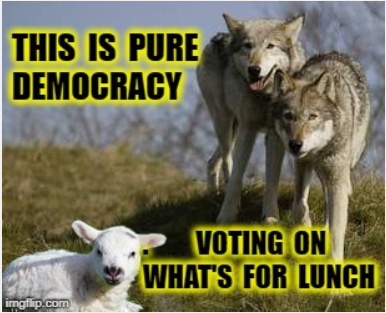
In a pure democracy, whatever the majority decides is what government does. There are various metaphors to explain the folly of this. One is that democracy is when you have two wolves and a sheep voting on what’s for lunch.


image found here

Here’s a quote from my files: 

“Democracy cannot exist as a permanent form of government. It can only exist until the voters discover they can vote themselves largesse out of the public treasure. From that moment on, the majority always votes for the candidate promising the most benefit from the public treasury, with the result that democracy always collapses over a loose fiscal policy, always to be followed by a dictatorship, and then a monarchy.”—Alexander Fraser Tytler

 So, there’s a difference between a republic—particularly a constitutional republic—and a democracy.

However, here is what has been happening to the word democracy.

1.      The public has the idea that democracy is interchangeable with republic; it just means the power comes from the people, who express their views by voting, mainly, and also by contacting their representatives.

2.      The ruling elites—who happen to be associated with the Democrat Party, mostly, but not fully limited to them—use the term to mean our system of government, or our country as we know it.

3.      The ruling elites separate our system of government from the Constitution and the rule of law, and have it mean the way things are done by us. But they do not yet explicitly change the definition for the people.

4.      The ruling elites start using the term our democracy to mean our regime. They are counting on the public retaining the definition as our system of government, but they do not mean that.

It would be concerning enough if this is where they stopped. But the way we—and everybody else in the world, practically speaking—have a people voice their will to government is through voting. This has always been to the advantage of the democracy advocates. Think of them as the wolves, rather than the sheep in the metaphor. If they can control the message that gets to the voters, then they control the outcome. That is why controlling the message has been so important to them—through censorship and the other many ways we’ve seen, particularly in the last half decade.

But the ruling elites have been facing difficulty in totally controlling the message they want the voters to hear—because of pesky alternative platforms and means of communicating with one another. They censor more vigorously. And they deride all those alternative voices as “extremists” and “conspiracy theorists.” But still, they can’t control the message well enough to determine the outcome of an election. Voters who have found their way to alternative opinions are not controllable in the way “sheeple” are.

And let’s just add here that the ruling elites have tried controlling the outcome of elections by disregarding the actual will of the people—through fraud in varied forms and myriad locations. That’s a topic for another day.

But they cannot count on a people who would not vote them out of their positions of power—no matter how often they cry out that any disturbance to their power means “the end of our democracy.”

So the next step is to discount voting as the means to maintaining “our democracy.”

Coincidentally (and there are likely no coincidences in these things) two major publications had opinion pieces on the same day, August 21, saying that voting isn’t all it’s cracked up to be; maybe we ought to find another way. [In case you’re blocked by paywalls, both pieces are summarized here.] 

The New York Times piece, by Adam Grant, was originally titled, “Elections Are Bad for Democracy.”  After much online scorn, it was changed to “The Worst People Run for Office. It’s Time for a Better Way.” But the first title is really what was intended, especially if democracy means our regime. He suggests that choosing random leaders would give us better results than choosing from among the multiple bad choices of those who run for office. So let’s come up with a better way. He suggests maybe a lottery.

There are times, I admit, when I’ve thought selecting out of the phonebook (assuming there still is such a thing somewhere) would yield better leaders than we get through elections. But the solution isn’t less voting; it’s more informed voting. We need less censorship and more open debate.

There’s a clue in the wording of the end of the piece:

"As we prepare for America to turn 250 years old, it may be time to rethink and renew our approach to choosing officials. The lifeblood of a democracy is the active participation of the people. There is nothing more democratic than offering each and every citizen an equal opportunity to lead."

Our way of doing things is archaic, he implies. But offering every citizen an equal opportunity to lead is democracy; not everyone having an equal vote. Hmm.


illustration found with The Atlantic piece

The other piece, “Americans Vote Too Much,” by Jerusalem Demsas, for The Atlantic, tells us that all those pesky local jurisdiction elections are low turnout anyway. People just can’t be bothered. In fact, our form of government expects too much of us. It’s a full-time job to stay informed, and most people do the sensible thing and tune out.

I do agree that there are too many separate elections. Sometimes the ruling elites (even the local ones) insist on off years and odd dates—so that they can control the outcome more easily, because fewer people are paying attention. But I think putting the elections on normal voting days makes sense. We already have a long ballot here in Harris County—the biggest in the country, I think. But we do tune in and try to get information, fill out our sample ballot and all, before we go to vote. Many people just don’t notice when there’s some special early May election at some odd place.

Demsas ends his piece with this:

"Giving power to the people is sometimes conflated with giving people more access to government decision making through, say, community meetings or ballot measures. But if only a small, unrepresentative group of people are willing to be full-time democrats, then that extra ballot measure, election, or public meeting isn’t more democracy; it’s less."

Ok, so his assertion is that more is less, and less is more. “Giving power to the people” isn’t something government has the right to do; the people inherently have the power, which they delegate in limited ways to government. In that phrase, who is giving the power? Democracy—or the ruling elite, as we would do well to define it? I don’t see that as a better option.

I don’t have a solution. I try to do my part, educating myself, and then sharing what I’ve learned so others will be better informed after reading my research. I guess that makes me part of “a small, unrepresentative group of people willing to be full-time democrats/republicans.”

When Demsas argues that more participation by people willing to be vigilant “isn’t more democracy; it’s less,” what does he mean there by democracy? It’s not really the will of the people. He may want you to think that, but what I think he means is the ruling elite. I think there’s a subtext saying, “You plebians ought to get out of the way of the ruling elite. It’s too much for you. Let us make all your decisions for you.”

It's not your grandmother’s democracy anymore.

Watch the words. That’s the tyrants’ means of attack.

Friday, September 1, 2023

Fascism Isn’t Right or Left; It’s South

Earlier this week Ben Shapiro wrote a piece called “Fascism Isn’t Right-Wing.” It's in response to a typical question from media, this one from Jake Tapper to Chris Christie, asking whether support of Trump is a sign of authoritarianism. Shapiro explains a few things rather clearly, which I’ll share. But, as with many attempts to explain fascism and other ideologies, I think, “This is clearer on the Spherical Model.” Every now and then it’s worth re-sharing that model—after all, it’s what the blog is about—so I’ll do some of that today, after what Shapiro brings up in his piece:

Authoritarianism is not what people in the media think it is. They think authoritarianism is Donald Trump tweeting. But there are many forms of authoritarianism. In fact, fascism is an element of both Left and Right. It is not merely a Right-wing action. Authoritarianism can just as easily be implemented by a series of executive orders that go outside the Constitution, that radically re-shift the balance between people in the government, something Joe Biden does with alacrity.


It's likely Churchill didn't actually say this, but the
quote will do for today's post. Found here.

So, fascism = authoritarianism. The error is in assuming it’s always right-wing authoritarianism and that the left wing could never be that. Later in the piece, he says this:

The truth is that fascism as an ideology is closer to the American Left than it is to the American Right. Fascism is an ideology that was generalized in response to communism, but it drew from Marxism, Hegelian politics, and progressive-era ideas, which is why many of the early supporters of Mussolini were members of the Left, including people who had worked in Woodrow Wilson’s administration who went on to work in the FDR administration.

So we know that fascism means authoritarianism. And it’s related to Marxism, which spawned communism and socialism, also progressivism and probably a few more -isms as well—each one authoritarian, meaning coercion and top-down control.

But what do we mean by Right and Left?

Common belief says that fascism is right. Far right. So, to stay as far away from that as you can, you go left. Maybe all the way to communism.

Is communism as far as you can get from fascism? Because communism is authoritarian. And, didn’t we say earlier, fascism = authoritarianism?

On August 29 Glenn Beck was talking about authoritarianism as well. First he quoted the entirety of a piece by Emma-Jo Morris, the political editor for Breitbart: “Morris: The 2024 Election Is Going to Be a Vote of Defiance.” Here’s the first paragraph of that piece:

Leading up to the 2024 election, there are a number of pressing issues Americans will consider—rampant illegal immigration, skyrocketing inflation and price of living, violent crime marring cities—but those issues are now against the backdrop of a palpable shift toward authoritarianism. And a vote for Trump in 2024 will be a vote of defiance.

Her assertion is that people will be voting against the authoritarian regime that has been imposed on them. And she offers plenty of examples of that authoritarianism—that tyranny that we’ve been tolerating, hoping it was just something that would pass, but that we can no longer tolerate.

Then Glenn Beck responds, with a warning about an overreaction.

Now, I think that there are real ways that can be done constitutionally. But I warn you, there is going to come a time where, even on our side, many will say, “Screw the Constitution. There are things we have to do.” That is always trouble. Always a sign you don’t want to be in that group.

Please, be aware of this. There are forces, on many fronts: on the left, who wants to destroy the Constitution; and those now posing as the right, but they’re not the right. They’re the fascistic left.

In America the choice is not right or left. It is either anarchy or complete control.

I’ve heard him use that last line before, changing the left/right model from communism to fascism, and instead labeling the far extremes as either anarchy or complete control.

I’m not saying he’s wrong. And neither is Ben Shapiro. I’m saying the Spherical Model can clarify. It offers more perspective on the relative closeness or distance of various political ideas, or ways of governing. I’ll just review it quickly (repeated from here, and from the website).


Political conversations tend to describe the far ends as extreme, assuming there’s some virtue in being balanced in the middle. And we refer to our nation as center right—just a little more conservative than exactly center.


But what are the extremes? Do we assume communism or socialism at the extreme left, and fascism at the extreme right?

That can’t be right, because communism and fascism are both totalitarian statist tyrannies, just slightly different flavors. Nazi means “national socialist party” and the communist Soviet Union’s name was Union of Soviet Socialist Republics.

So if Nazism and communism aren’t diametric opposites, then what are the logical extremes?

How about total government control, or tyranny, versus total lack of government control, or anarchy?


That’s better. Then freedom is that perfect balance in the middle.

But wait; there’s a problem with this model too: It’s common in history for people suffering in anarchy to turn for relief to total government control—anything for security. But in this model, as a people move to the left, they have to pass through that balanced freedom section. You’d think that it would be very common for someone to stop and say, “Hey, this freedom is good. Let’s stop going leftward and stay here.” Yet that pretty much never happens. But going directly from chaos to state control is historically common.

Plus, notice that there’s not that much difference between the tyranny of the state and the tyranny of anarchy. Total government control means the state has all the power—the police, the military. The state can do what it wants, and the mere citizen is without any rights except what the state decides to grant.

Anarchy, on the other hand, means that power belongs to whoever is stronger and meaner than the next guy. If you threaten to beat people up (or kill them) if they don’t give you all their belongings, and you’re strong enough to mean it, then you have power. If someone else is stronger or better armed than you are, then you have to yield power to them.

In other words, anarchy, while less organized, is power in the hands of the strongest and best armed—just like a tyrannical government.

So maybe government tyranny and anarchic tyranny are pretty close to the same thing. When I show this, I use a ribbon, labeled at the ends, and fold it in half, so it looks something like this:


Tyranny and freedom are really the opposite extremes.

Not bad. But it puts all those different kinds of tyrannies in the same location, and maybe there are differences.

A simple line doesn’t give us the dimensions we need.

So, how about if we use three dimensions—a sphere? If we draw a line at the equator, we can separate freedom (northern hemisphere) from tyranny (southern hemisphere). And then we can draw a longitudinal dividing line, with more local interests in the western hemisphere and larger interests—from state to nation, to international, in the eastern hemisphere.

I call this the Spherical Model.


The Political Sphere


Down in the south, you can see that one side of tyranny is the chaos of anarchy, and the other side is the totalitarian control of government tyranny. It’s easy to get from one to the other—which is what much of world history has shown us. You can have communism, socialism, and Nazism as separate patches in their quartersphere, based on how much control they exert on their people (southern direction), or how far they plan to expand (toward the eastward extreme of world domination).

Up north in the freedom zone, location is mostly a matter of whose interest. Free people don’t yield power to a governing authority beyond the appropriate interest. Families make their own decisions about the care, upbringing, and education of their children. Communities on up to cities and counties decide on local law enforcement and protection needs. States (or provinces) deal with their particular infrastructure and laws. Only very limited powers are granted to a nation—as are enumerated in the US Constitution. And that sovereignty would never yield to an international power, but would cooperate with other free sovereignties concerning international issues.


OK, so, you find Nazism/fascism, communism, and socialism all in the south—toward tyranny and away from freedom. And they’re all in the bottom section we call statist tyranny, because the tyrants are the government, rather than simply mob bosses, as you’d see in chaotic tyranny. Either way, you have coercion of people by those in charge—and they’re in charge because they have the power to force their will on others.


Fascism, Socialism, and Communism are all statist tyrannies.

Why does this matter today? Because authoritarianism—that is, tyranny—is not Donald Trump tweets (or Xs, or Truths, depending on what you call the platform he uses). A tweet doesn’t coerce anyone to do anything against their will. It’s just an expression of a few words. They may or may not represent an idea that you like. But, unless they come from a person in power with commanding force behind them, they’re just words.

But there’s been a consistent mislabeling of Trump as a fascist—because he’s “a right-wing extremist”; i.e., a Republican. And we know the worst fascist was Hitler; ergo, Trump = Hitler. And, they think, we have to do anything to stop today’s Hitler from getting power.

What do they mean by anything? Keeping your vote for him from counting. Stopping you from expressing your opinions in the marketplace of ideas. Using lawfare. Suing him—and anyone supporting him. Lying about him. Covering up crimes of those he opposes. Instigating powers over the people, particularly over the people supporting him. In fact, anything includes any fascist and/or corrupt anti-Constitutional thing you can think of. (See examples here, from a couple of years ago, before we were seeing this year’s attacks.) 

So, if you put the opponents of Trump on the sphere, they’re definitely in the southern hemisphere of tyranny. And they’re mainly on the statist side of the tyranny hemisphere.

Meanwhile, the one they call the authoritarian: in reality, his ideas, and his followers resemble a lot of ideas you find in the northern hemisphere—the freedom hemisphere.

How do you know? You ask questions about the ideas, rather than throw out epithets about the person. You find out if those ideas coincide with freedom. And a good gauge is whether they adhere to the US Constitution.

I was surprised as anyone to find Trump’s presidency mainly up in the freedom zone. His stated positions during his campaign said he would be, but I hadn’t believed him. Not everything got fixed. But, as you’d expect in a freedom society, economic security went up—for all demographics. That was after a decade of statist tyranny had tried to convince us America was in decline and all we could do was manage the decline.

I was never sure—I’m still not—that Trump fully understands and embraces the US Constitution, which is based on God-given rights. But I know the Constitution is up in the freedom zone. And he adhered to it better than we’d seen, at least since Reagan. The contrast between Trump and the current White House resident is stark—as different as north from south.

So what are the questions? What are the principles of freedom? I’ve provided a few lists over the years, depending on purpose. Here’s a list I quoted in 2016, from Benjamin Constant in 1816. I used only Benjamin Constant’s words, but I turned it into a bullet-point list to make it easier to grasp:

First ask yourselves, Gentlemen, what an Englishman, a French-man, and a citizen of the United States of America understand today by the word “liberty.” For each of them

·        it is the right to be subjected only to the laws,

·        and to be neither arrested, detained, put to death or maltreated in any way by the arbitrary will of one or more individuals.

·        It is the right of everyone to express their opinion,

·        choose a profession and practice it,

·        to dispose of property, and even to abuse it;

·        to come and go without permission, and without having to account for their motives or undertakings.

·        It is everyone’s right to associate with other individuals, either to discuss their interests, or to profess the religion which they and their associates prefer,

·        or even simply to occupy their days or hours in a way which is most compatible with their inclinations or whims.

·        Finally it is everyone’s right to exercise some influence on the administration of the government, either by electing all or particular officials, or through representations, petitions, demands to which the authorities are more or less compelled to pay heed.


That’s what it looks like to have freedom. If you’re considering policy—or the policies supported by a candidate that you’re vetting—then you might find this list useful:

·        Is the policy being debated something that an individual has the right to do, and therefore has the right to delegate to his/her government? For example, a person has the right to protect his own life and property. He can, therefore, combine resources with his neighbors and hire a government entity, such as a sheriff, to do that job for him. Similarly, the several states can combine to delegate the power of defending the nation to a national government entity. Conversely, a person does not have the right to take his neighbor’s excess grain production, for example, and bestow it on himself, because his neighbor was more prosperous in a particular season. He can, of course, ask his neighbor for charity, but he cannot coerce the neighbor to give. That would rightfully be considered theft. Therefore the person cannot delegate the redistribution of wealth to the government to do for him—that would place him too far south on the sphere.

·        Does the policy infringe in any way on God-given natural rights, such as those enumerated in the Bill of Rights? Does the policy infringe on the free exercise of religion or try to establish a particular sect as a state religion? Is political speech hindered? Does the policy infringe on the right of citizens to bear arms? Does the policy constitute an illegal search or seizure? Does the policy deprive a person of life, liberty, or property when the person has not committed a crime for which that deprivation is the just sentence? Does the policy try to claim for government a power that was not specifically granted in the Constitution? etc. If the policy infringes on the God-given rights, then government cannot take that power without usurping power from the people—which is too far south on the sphere.

·        Is the idea being debated a proper role of government: some aspect of protection (including national defense, protection from interstate crime, enabling international and interstate commerce, standardized weights and measures and currency to protect the value of wealth, the judiciary that guarantees the protective laws), as enumerated in the Constitution? If not, then accepting the idea is outside the Constitution—and is too far south on the sphere.

·        Is the perspective appropriately local? It is important that any issue be handled at the most local level possible. Parents should decide the means, methods, and curriculum for educating their children, for example. An issue that affects a state should be handled at the state level, not the national level. National decisions should not be ceded to some international body. An inappropriate interest level is too far south on the sphere.

We’ve only talked here today about the Political Sphere. There are two other spheres that overlie the political sphere: the Economic Sphere and the Social Sphere. For the Economic Sphere, the polar opposites are north/prosperity and south/poverty, with the same east/west lines. For the Social Sphere, north is civilization and south is savagery, again with the same east/west lines. 


There are additional questions for these. You can read them here. 

Pending a theoretical book someday, the largest explanation of the Spherical Model is the website: SphericalModel.com. While I don’t have the illusion that this obscure website and blog will change people from thinking with the right/left model, I nevertheless think it would be a better way for people to understand abstract ideas that they only think they understand.