Tuesday, May 11, 2021

Hesitancy Might Be a Good Thing This Time

Asking the Questions

Tucker Carlson recently reported on his Fox News program that, according VAERS, the Vaccine Adverse Effects Reporting System, managed by the CDC and the FDA, from late December of 2020 and April 23 of this year 3362 deaths had been reported following taking the COVID-19 vaccine.


Tucker Carlson asks questions about the vaccine.
screenshot from here

Tucker was pretty clear to say that the VAERS reporting system does not necessarily mean these deaths were caused by the vaccine; they could be deaths that coincidentally happened after the person received the vaccine. The purpose for VAERS is to alert officials to possible problems, so that when apparent problems arise, they can be investigated.

The problem is, you can’t even state the government data without being taken down from YouTube, Facebook, Twitter, or any other platform that abides by the censorship policy against their position.

I checked. Tucker Carlson’s video has been removed from YouTube, with this notice:

Checked by PolitiFact • 3 days ago

Tucker Carlson's misleading claim about deaths after COVID-19 vaccine

Claim: “Between late December of 2020 and last month, a total of 3,362 people apparently died after getting the COVID vaccine in the United States … The...

Rating: False

It will send you to a rebuttal story here. You might also see a short video here

Both of these claim Carlson’s story is false, because VAERS reporting does not verify that those deaths were caused by the vaccine, only that they were reported as happening after the person took the vaccine. Which is what Carlson said. The difference, they seem to claim, is that, unless the investigation has already taken place and proven causality, then you shouldn’t question the efficacy or safety of the vaccine.

But when the numbers of “coincidental” deaths is as high as it is, why hasn’t there been an investigation? Why hasn’t an independent safety board been impaneled to do such an investigation so that, if the deaths are 100% not caused by the vaccine, we can be reassured? That is the question Carlson asks. And that is the question being censored.

Incidentally, according to the VAERS website, they estimate that only 1% of vaccine reaction incidents are reported. When you multiply the 3362 deaths by 100, you have 336,200. These are deaths that just happened to occur shortly after a vaccine was given; nothing to see here. And, by the way, as of yesterday the number was 3837.

Typically a treatment, such as a vaccine or a medication, gets a “black box” warning with 5 deaths or serious reactions, and at 50 the use is discontinued. So Carlson’s question seems appropriate with such a high number of deaths. Note that it’s still a small percentage, because so many have taken the vaccine. But can’t we even see the numbers to gauge whether the risk of taking the vaccine is higher than the risk of getting the virus?


Approaches to the Health Crisis

Dr. Peter McCullough
screenshot from here
Another video not available on YouTube is an interview with Dr. Peter McCullough, a medical doctor with a master’s in public health, who treats COVID-19 patients, and who has dedicated the last year to finding treatments that would avoid the bad end results of hospitalization and death. He put together a team of doctors, who worked out a protocol by April or May or 2020, which he has published and testified about multiple times. He has a treatment guide you can download here. And he suggests that the Association of American Physicians and Surgeons website is the most up-to-date resource for treatment, and can help you inform your doctor or connect with telemedicine for treatment.

Dr. McCullough explains that there are four pillars of dealing with a public health event, such as a virus:

The Covid Patient Treatment Guide, p. 12

The first pillar, to prevent spread, is things like mask wearing, social distancing, and quarantining the ill. Early on I think these could include contact tracing. But by the time we had it in this country, we were probably already beyond the efficacy of that.

The second pillar is the neglected one, which Dr. McCullough has been dealing with. Early on, when successful treatments were just being found, he estimated about 50% of deaths were preventable. But with more time and development of protocols for early treatment, that has risen to 85%. All but maybe 15% of the 3.3 million deaths worldwide, or the 582,420 US deaths could have been prevented. And there would have been hundreds of thousands, maybe millions fewer hospitalizations and sufferers of long-term effects. This could have made the biggest difference.

The third is for late-stage in-hospital treatment. If you get to that point, you have a rather high likelihood of death, or at least a long recovery, which could have been avoided if effective treatment had been done early.

The fourth somehow became the agreed-upon approach. So this is where energy and resources were placed, with the masking and shutting down of the economy meant to keep people on hold until this  solution appeared.

We talked here a few weeks ago about why the push for a vaccine had to include a lack of treatment; you can’t get emergency use approval for a vaccine that is for a virus that is treatable. So those who wanted to push vaccines by all means had to lie to say there were no treatments.

Dr. McCullough mentioned that, additionally, on November 10, 2020, there was a Trusted News Initiative, which would not allow anything negative to be said about the vaccines, because that might cause vaccine hesitancy. This included the BBC, Reuters, Facebook, Google/YouTube, and Twitter. BBC Director Tim Davie says it this way: “The project would not prevent ‘legitimate concerns’ about vaccines being aired, but would attempt to stop ‘harmful disinformation myths.’” Except, note Tucker Carlson’s story above, for example.

Maybe there should be some vaccine hesitancy.


Reasons for Vaccine Hesitancy

On March 8 there was a report from the CDC stating that 1600 cases of death possibly caused by or affected by taking a COVID-19 vaccine were reviewed by FDA doctors, who found that absolutely none of the deaths, zero, were related to the vaccine. Oddly, the doctors are left anonymous, and, according to Dr. McCullough, normally such an investigation would take months, to go over medical records, death certificates, and relevant data surrounding each case. So, we are to believe that a EUA (emergency use authorization) vaccine, which means the government makes no guarantee of either safety or efficacy, has zero incidents of death out of the 1600 suspected—following a propaganda initiative designed to prevent any negative information from being published about the vaccines.

Maybe Tucker Carlson is right; maybe there ought to be an independent safety board impaneled to look into the possibility that the vaccine is doing harm—a board whose membership we can know, whose credentials we can see and review, and whose membership actually treats COVID-19 patients.

Dr. McCullough points out that preliminary vaccine trials specifically excluded the COVID-19-recovered, pregnant women, and women of childbearing potential. That means there is no testing to show whether the vaccines could harm such individuals. If the vaccines were to become FDA-approved, they would have to notify that the vaccines have not been tested for those groups, and the vaccine is therefore not recommended.

What we know now—or at least some doctors know—is that COVID-19-recovered likely have full immunity lasting at least 17 years, based on estimates from experience with earlier SARS. There is absolutely no reason for someone who had the disease to receive the vaccine. There is only risk of adverse reaction for them, no benefit. And they seem to be reacting at 2-3 times the rates of other people receiving the vaccines.

Concerning pregnant women, I remember early on (December?) hearing it was not recommended for pregnant women. A woman had reported a miscarriage following receiving the vaccine, and the response was, “She should have known better. They said it wasn’t recommended for pregnant women.” Then there’s a long silence on that. The next I heard was in a talk by Dr. Ryan Cole, in which he reported serious risk for pregnant women. He knew a woman who, just the day before, had miscarried right after getting the vaccine. He was warning about the vaccine for pregnant women, but the CDC was no longer doing that. They had quietly slipped into encouraging pregnant women to get vaccinated, despite the total lack of testing. Maybe warning pregnant women qualifies as causing vaccine hesitancy, and that is not allowed.

Last week a young woman I know lost her baby. Shortly, though not immediately, after being vaccinated. She was one of the most frightened-of-COVID people I know; she wore a mask in our home, and around family. She was thrilled there was finally a vaccine. She was far enough along that they had had a gender reveal ultrasound and were getting the baby’s room ready in a new home. The pregnancy seemed healthy. Is it possible this miscarriage was unrelated to the vaccine? Of course. But the coincidence of timing means that it probably should be reported to VAERS. I suggested to her sister that she do that. But I’m not close enough to say any more, or make her feel like she should have known better than to get the vaccine—when the government and media were lying to her.

If wading through the VAERS website is daunting for you, and you just want some basic info about COVID-19 vaccines, Dr. McCullough suggests OpenVAERS.com. You can click on the sections of information and get more details, such as particular vaccines and the breakdown of incidents with them. That site lists only 213 miscarriages following the vaccines. But if it did not occur to my friend to report, there are likely others who didn’t report. Again, VAERS suggests only 1% report. That would mean an estimated 21,300 miscarriages following taking the vaccine. All merely coincidental? With a vaccine that has been propagandized in ways no previous vaccine set has?

data from the OpenVAERS.com website on May 10, 2021

The Challenge of Getting Accurate Information

This past week Mikhaila Peterson (Jordan Peterson’s daughter) did one of her podcasts  where she has two guests with opposing views and gets their answers to similar questions. It’s not easy to get guests to come on her podcast under such circumstances. She got Dr. Joseph Mercola and Dr. Jeremy Kamil. They did not see each other; she interviewed them separately and then made the podcast with them one after the other.

Dr. Mercola speaks very fast, trying to get out more information than can fit in the time frame. But he expressed a suspicion that the virus—and the lockdown, and the refusal to allow treatment options, and the push for vaccines—is an actual conspiracy with those forces who want what you might call “The Great Reset,” which means a shutdown of the current economy and the replacement with a socialized, controlled oligarchy worldwide.

I’ve heard stranger things. In fact, I think he’s as likely on track as anything to explain what we’ve been experiencing—quarantining the healthy and least susceptible, fearmongering, refusal to allow information about treatments, pushing a vaccine that is not guaranteed either safe or effective, pushing a vaccine on the recovered who have natural immunity, refusing to allow negative vaccine information to be published, continuing controls over people even after vaccination, and using pressure such as “vaccine passports” to force people to comply.

Peterson was fairly well matched with Dr. Mercola, because she willingly lives a rather drastically healthy lifestyle just to survive her autoimmune illness, and he is all about careful eating and getting the right nutrients to avoid medicine when possible. But she didn’t seem to know the questions to ask Dr. Kamil—like what about recent studies that show that mask wearing is actually ineffective. She was busy taking care of family last year (much of it spent in Serbia) while I was here learning all I could about this disease that was only marginally more dangerous than the flu but was keeping us all trapped at home, and I wanted to know why. I had multiple questions to ask Dr. Kamil, based on my reading and the contradictions I’ve come across.

So, I suggest you hear him as well. But then ask those questions. And ponder why a doctor who doesn’t treat patients has such different views from a doctor who does treat patients.

It has been especially difficult to get accurate information about COVID-19—because of the now-known propaganda campaign to favor vaccines, to empower governments to impose tyranny on citizens, and to quash information about treatments.

One meme tells you not to take advice from your Facebook friend who still builds dollhouses and sells them online. I don’t actually do that (although I admit it sounds interesting), but they mean people like me. The thing is, I’m never putting myself out there as an expert; I’m suggesting that I’m a regular thinking person on the hunt for truth. I say what I think I’ve found, and here’s why I think this—which links to experts, most often doctors actually treating patients with success. Sometimes I link to articles and videos, and you can decide for yourself—assuming you can get to them before they’re taken down. The people sharing this meme don’t explain why you should ignore people like me but you should pay attention to people like them sharing memes.

There was another post reminding you not to listen to wacko doctors and other “experts” online. They had a list. There was not a single one I had referred to, and I’ve had a pretty long list. I’m guessing they were just building another straw man.

I continue to keep daily records—based on what the county public health site provides. They provide daily numbers, but I have to make the comparisons to the day before and do the 7-day rolling averages. It has been a couple of months, so here are the charts for where I live.

The daily average of COVID-19 deaths in Texas is hovering around 41, in a population of nearly 29.5 million.


The daily average of COVID-19 deaths in Harris County is currently at 19. It has been at or under 20 since September. The county judge still claims we are in the red zone. For a while our proportion of deaths compared to the state of Texas was too low to be believable; I wondered (and never found out) where all those Texas deaths were happening. Now, without much change in the county death numbers, we’re at just under half of the state’s COVID deaths, which is a bit out of proportion in the other direction. We’re about 14% of the state’s population.


The only place I keep case data is in my zip code. I’m looking at new cases per day compared to change in active cases per day. New cases average 2 a day. Average active cases is at -3; that means more people are recovering per day than are getting the disease. Active cases are 0.15% of the population, or 1.5 cases per thousand people. Assuming the active cases are not wandering around the grocery store, your chances of running into someone who’s spreading the virus are pretty slim—unless you’re caring for someone who has the illness.


There have been a total of 24 deaths in my zip code, which is sad. I haven’t known any of them. I’ve wondered how many days between new deaths. So I did the math. It’s about 15 days, on average, over the time that I kept records (since last June, at which point we already had 2 deaths).

Thursday, May 6, 2021

What Matters Most

I spent a chunk of time this week listening to testimony in the Texas legislature. It’s all streamed live online, and archived later. We’re in the final week for bills to be heard in committee hearings and still have any chance at all of getting through the remaining bill stages.

Wednesday I was listening to testimony on a couple of abortion bills. One was a heartbeat bill, similar to those already passed in other states. It would make abortion illegal after a heartbeat is detected—around 8 weeks gestation. It doesn’t, however, acknowledge that the baby growing in the womb was human life before that heartbeat-detecting moment. I also learned recently that it is fairly easy for an abortion technician—getting paid to be part of the abortion-performing act—to either find a heartbeat or fail to find a heartbeat at will. So, while the supporters of this bill are well-meaning, I don’t think it goes far enough.

Another bill in the hearing conferred personhood on the unborn, which I think is the appropriate way to go. There were plenty of opponents, of course. One of them struck me, this week coming up on Mother’s Day, as dystopian.

The woman told her story. Several years ago, she was running for her seat (I think in the Texas Senate, but it might be in the House), and hadn’t announced yet that she was pregnant. But she was ghastly sick with “morning sickness,” which wasn’t confined to morning; it was all day every day. She had a condition called “hyperemesis gravidarum,” which is severe nausea and could be life-threatening because of loss of fluids. As she tells it, people used to die from that condition. I’ve actually known a couple of people who went through this. Both were hospitalized for significant portions of their pregnancies. Fluids may need to be given intravenously. Antiemetics may help, but not enough.

I don’t know what this woman had to do to survive throwing up twelve times a day. But she not only survived; she was able to successfully run for office.

She claims that, knowing she had options—and she means the option to kill her baby, whom she now claims to love and be grateful for—was what got her through. Just knowing that, if it got too rough, she could kill the baby. Now, the bill in question has an exception when the life of the mother is at stake; if the attempt to save both lives is not possible, the doctor prioritizes saving the life of the mother. The subtext of what she’s saying then is, if it’s harder than she bargained for, she wanted to have the “right” to kill the other human being experiencing that pregnancy.

She told of another woman who had a similar condition and already had a toddler running around. She made the choice to abort, because she wasn’t physically able to care for her existing child otherwise. I wonder if, in later years, she will lovingly say, “I killed your baby brother, because you were too hard to care for.”

I know I sound unsympathetic. But I’ve been through some pretty challenging pregnancies—none of which I could have survived while running for office.

I’ve lost a child born premature. I’ve spent months bedridden (three months with my oldest, six with each of the other two). I’ve done it with a toddler running around, and I couldn’t get up to manage him. My husband was gone all day to work. I managed part of days, with a little one bringing me diapers so I could change them from the couch where I lay. I was a huge burden on friends and church congregations—who amazingly seemed to love me more because I needed their help.


That's me, mothering from the couch, for most of 1987

When you can't get up to feed your 2-year-old,
he will somehow find a way.

It wasn’t convenient. It wasn’t easy. The last one, I came to a point I thought I couldn’t endure, when I’d gone several months unable to sleep more than 3-4 hours before waking for the next miserable 24-36 hours before I needed to try to sleep again. You get close to hallucination when that sleep deprived. At the point I thought I couldn’t go on, about nine weeks early, I was asking when we might need to induce so I would survive. But I had a spiritual blessing at that time that eased my burden from that day onward, and I endured. She was born on her due date, a beautiful, healthy 9 lb. 14 oz., 22 ½-inch baby. And I learned that God is there for me, to carry me through when I’m not strong enough on my own.

For me, abortion was never an option, because I always knew I was dealing with a beautiful, innocent, human life.

Last week Andrew Klavan spent much of his podcast talking about dystopian stories. He went through parts of 1984, Brave New World, The Giver, The Stepford Wives, and a story called “Those Who Walk Away from Omelas.” And he drew some conclusions. First, this short observation about The Stepford Wives:

What’s really interesting is the children in Stepford become happy when the women are dedicated to them. One of the points of it is—it’s not a totally feminist book. It’s sort of saying, “Yes, homemaking is a sacrificial act.” Being a homemaker is, in some sense, a sacrificial act. You’re pouring yourself into other people. That is what—that’s to me what makes it so beautiful.  

In this story, of course, if women don’t want to do it, they turn them into robots. So, about dystopian societies in general, he says,

The dystopian novel, the dystopian story, in order to be a story, depends on you having those values. It depends on your having the moral understanding that, in order to achieve this perfect world, something terrible has been done.

He illustrates with The Giver, the scene where The Giver, the older man mentoring the boy, Jonas, who is the main character, shows the boy his father euthanizing an infant. Here’s the dialogue from the clip:

Jonas: That’s death.

The Giver: He doesn’t know what he’s doing.

Jonas: Doesn’t know what he’s doing? He killed him.

The Giver: But he doesn’t know what it means….

Jonas: How can he not see the baby isn’t moving? Doesn’t that tell him something is wrong?

The Giver: The young and the old are killed. Your friend Fiona—she will soon be trained to release as well.

Jonas: That’s a lie. She’d never do that. If Fiona understood—

The Giver: We are the only ones who understand it.

Jonas: Then it’s our fault—you and me, and all the receivers back and back and back and back and back. There has to be a way to show them, to give them the memory so they can understand. Because, if you can’t feel, what’s the point?


Scene from The Giver
screenshot from Andrew Klavan's podcast

Klavan’s response to this is,

It’s only a dystopia to the people who understand what they are doing. The people who “know not what they do,” like the people who kill Christ, think they’re doing the right thing. They think they’re living in utopia. It’s only a dystopia because of our moral impulses. Right?

It’s just like abortion. Abortion works. Abortion frees women of the responsibilities of the—and the consequences of having sex. Abortion does make their life easier. Abortion does make it so that they don’t, you know, get raped or make a stupid decision and wind up with a baby for life. It works. The only reason it doesn’t work is if you have the moral sense to know that it’s killing. If they can talk us out of our morality, dystopia becomes utopia. You can slaughter your way to perfection.

Someone has been doing the lying, telling people not to value that human life. Not to value motherhood, or parenting, or nurturing, or self-sacrificing at all.

We ought to be telling young people—young women in particular—the truth, that there is nothing she can do that will be more meaningful than giving life and nurturing that child. (If she knew how important it was, she wouldn’t be risking it for sex with a man who isn’t committed to her in marriage. But we’ll save that for another day.)

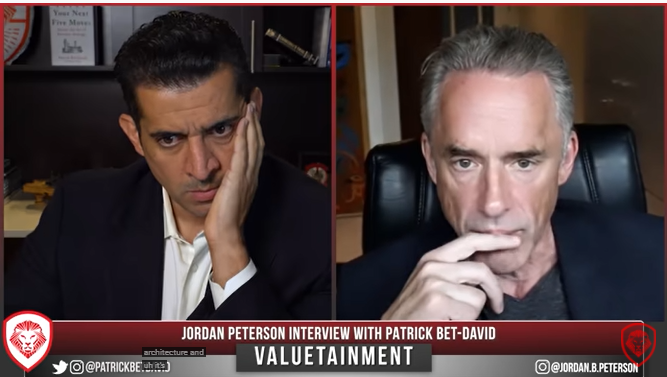
Jordan Peterson had a conversation with Patrick Bet-David on his Valuetainment podcast. Bet-David showed a clip from a conversation they had together in July of 2019, and then asked him about it. This is Jordan Peterson from that clip:

Little children pay you back immensely, if you have a good relationship with them, you know, if you’re on their side and encourage them, because they’re an unconditional source of joy and love. [long standing ovation]

You know, the other thing I noticed that you should all know is that, as you get older, your family—the family you’ve produced—becomes more and more important.

We teach young women in particular that the fundamental goal of their life is going to be their career. And, you know, first of all, most people don’t have careers; they have jobs. And those are very different things. But you’re not a very happy camper, so to speak, if you’re 45 and you have no one, and it doesn’t go upwards after that.


Patrick Bet-David, left, and Jordan Peterson
screenshot from here

Later in the podcast Peterson refers back to this clip, and shares some more about what makes him happy. He talks about the joy he’s had from touring and talking with people. And then this:

You know, what makes me most happy right now is when my family gets together. So that’s my immediate family: my wife, my kids, and their spouses. And there’s no— There’s nothing buried underneath the rugs. And everyone’s joking and laughing and playing. And that’s— And it’s peaceful. It’s truly peaceful. And that does happen.

He talks about spending time with his son’s family—who live just up the street, and with whom they have a deep and rich relationship, and they have a peace-filled home. And there’s a grandson there.

Their little boy is laughing. He’s playing with laughing. We had some people over for Easter dinner, my son and his wife and a couple of friends of theirs. And they had a little baby named Florence, and she was also the same age, and she was playing with laughing. So she would go “Ha ha ha!” And then this little—my grandson Elliot, would go “Ha ha ha!” And then all the adults would laugh, because these two infants were actually having a conversation with each other—a proto-conversation with laughter. That lasted for about 10 minutes, and everyone was laughing about it. And, well, there isn’t anything better than that.

C. S. Lewis quote image found on Pinterest
Why don’t we tell young people? There isn’t anything better than that. There’s a lot to life, to using our interests and talents and abilities, and making a living. But that making a living, it has a purpose beyond itself. As C. S. Lewis put it,

Homemaking is surely in reality the most important work in the world. What do ships, railways, mines, cars, government, etc. exist for except that people may be fed, warmed, and safe in their own homes?... The homemaker’s job is one for which all others exist.

This is not to say you can’t be happy if you can’t have children. But to think that children are a burden, instead of the very thing that nurtures you into adulthood and gives you reason for living beyond yourself—you simply don’t understand what life is for. All creatures take joy in “filling the measure of their creation” and take joy in their offspring. But only humans have the capacity to understand what that means. When we forget that, we are less human.

It’s not easy. And while I’ve seen some friends who appear to me to be perfect at it, no one actually is. But with God’s help, what you do as a mother can be enough.

One of my favorite speakers, who speaks so many words of encouragement, is Jeffrey R. Holland. He was President of Brigham Young University when I was working on campus many years ago, and I used to pass him and wave hello on my way to my office as he was walking to his. Anyway, he said this:


If I’ve passed on any message to my children, I hope it is that they know I love them and think they were worth any sacrifice I could manage. And, even though I was imperfect at it, I trust that God filled in the differences. He does that in our lives, because He is the ultimate loving parent.

Happy Mother’s Day to all those who know what that means.

Thursday, April 29, 2021

Lies Become the Narrative

Andrew Klavan, the other day, was talking about what happens when you face continual lies. He started with an example of a young woman he encountered many years ago who kept lying. After long hours of continual lies, he faced a sort of warped sense of reality:


Andrew Klavan, Episode 1028
screenshot from here

I found that I was living inside her lies. So, it’s not exactly that I was starting to believe her; it’s that I was starting to react as if what she said was true, because I was debating with her what disease she had when she had no disease.

And the reason for that is, I’m not insane. It takes an insane person to think that every single thing he’s being told is a lie. Right? To think that you’re living in the matrix, or a simulation, you know, is the kind of thing a crazy person believes. And yet, right now we are effectively living in a simulation—created by this massive telecommunications media empire that the left has assembled; the woke businesses that have taken on being part of the oligarchy the government wants to form; and the government officials were being backed up by the media.

So we’re kind of living in this matrix. And you have to be insane to think that that’s true—and yet it is true.

I spend a certain amount of energy trying to understand people who believe things I know to be lies. I don’t think I’m better at discerning outright lies in normal life situations than the next person. Maybe I’m less skilled. As a truth teller, I tend to go into a situation with the assumption someone is telling me the truth face-to-face. When that isn’t true, it kind of twists my gut, and I have to puzzle it out, maybe re-prove what I know to be true.

I’ve been fascinated for a couple of years by people who “read body language,” for lack of a better way of saying that. There’s this website, and this group on YouTube for example. They aren’t exactly lie detectors, but they can tell better than most of us what someone’s body is telling about what that person is thinking or feeling. These places teach their skills; next time I’m ready to put in about enough time to learn a new language, I may have to dive in, instead of just observe and marvel at what they do.

But Andrew Klavan’s explanation struck me. People aren’t exactly crazy for believing the crazy things they believe; they’re acting like a sane person acts when they have been repeatedly lied to by someone in authority.

One example he showed was a clip of a congresswoman in California, commenting about her nine-year-old daughter, whose thought about climate change was, “The earth is on fire, and we’re all going to die soon.” Why does the nine-year-old believe the earth is on fire when, other than the occasional brush fire or forest fire (which, granted, do significant damage in California every year or two), the earth is not on fire? Why does she assume the entire population of the earth, all of us, are going to die soon? For a nine-year-old, I’m assuming “soon” means maybe before she gets to enjoy adulthood. Let’s say twelve years—since that has been a repeated time frame of impending doom since the 1960s. This girl wasn’t even alive to hear Al Gore predict it various times—all over 12 years ago. But she may have heard AOC or Greta Thunberg—another young girl who only believes it because she has been told to believe it. Most likely she had her mother and teachers lie to her.

Is that nine-year-old girl crazy? No. Klavan says,

In order for her nine-year-old to say, “All the adults around me are lying and making stuff up,” that would be nuts. That would actually be a mentally disturbed child. But this is a sane child, so she believes all the lies she’s being told.

But here’s what happens, Klavan says, every time we have to address a lie:

Fighting back against these lies makes the lie the narrative…. If you have to defend the fact that police shootings aren’t a problem, police shootings become the narrative.

Klavan showed a Fox News clip of a professor, Eric Kaufman, who had done a university-funded survey in which they had asked people, “Which is the more likely cause of death for young black men in America? Is it car accident? Or is it to be shot by police?” The actual verifiable statistics show that death by car accident is 10-fold more likely. But he mentioned these groups of people who believe death by police bullet is more likely:

·         80% of African-American Biden voters.

·         70% of whites who believe Republicans are racist.

Klavan follow up with:

The lies become the narrative. And the narrative distorts the way you look at things. And then the way you look at things distorts your politics.

I took occasion to read the Democrat platform once, a few years ago. I expected—and of course found—multiple things where I simply didn’t agree, because, as we know, government interference tends to bring about unintended consequences that are likely to be the exact opposite of the stated objective. But what surprised me was how many policies were based on verifiable lies: about climate change being the biggest existential problem, about racism being a systemic problem with no evidence of improvement, about abortion being about a woman’s bodily autonomy and not about the additional living human being they cheer about snuffing out, about tribal victimization—such as skin color, sex, LGBTQ status—being the determining factor in who should control others.

In fact,

·       Women do not make $.70 for every $1.00 a man makes—once you take into account multiple variables, not least of which is women’s choices.

·       A minimum wage is not expected to be a living wage; it is entry level, to give experience—a contractual agreement made illegal by a minimum wage law, thus eliminating work for those who can’t yet bring in that high minimum of value to the employer.

·       Blacks do not need to live in fear of murder by police. Even the handful of annual cases where blacks suffer death by police show causes other than racism—even when the officer is at fault. Note that the Derek Chauvin case did not even bring evidence of racism to the courtroom—because the prosecution had no such evidence—even though that was the supposed basis for months of rioting in Minneapolis and around the country.

·       Blacks do not suffer systemic racism from everyone else in society; they suffer much less than during Democrat-caused Jim Crow laws; they suffer far, far less than under Democrat slave owners. Only racists care about race anymore; the rest of us care about character.

·       Black Lives Matter is an international Marxist organization, bent on the overthrow of self-governing people and any pillars of civilization those people have built—in particular the intact mother-father family, the destruction of which has caused more damage to black communities than any other.

·       America was not founded on slavery; it was founded on “all men are created equal,” and then began the task of living up to that ideal after millennia of slavery, including a few hundred years of whites enslaving blacks.

·       Climates change. No amount of draconian de-industrialization will change that in any measurable way. But a single volcanic eruption could wipe out a half century’s worth of lowered carbon emissions. (Note: If you read scriptures, dire world-ending events are much more likely to result from rebellion against God than from driving a gasoline fueled vehicle. But if you really have faith in lowered CO2, then, be my guest and show your faith by going back to horse-drawn transportation.)

·       Abortion isn’t healthcare, and it isn’t about a woman’s choices concerning her own body; it is killing living, human offspring.

·       Men and women are biologically different.

·       Married mother and father give children a better chance to grow up safe, protected, educated, and nurtured than any other institution or program could possibly do.

·       Criminals do not obey gun laws. And self-defense is a God-given right. Guns in the hands of law-abiding citizens prevent crimes.

The list could go on. You get the idea. Let’s add a couple we’ve learned this past year:

·       Virus spread isn’t prevented by wearing a cloth mask, wearing a mask outside, wearing a mask while also social distancing, wearing a mask when you have immunity from having the virus or getting vaccinated. And viruses don’t magically stop spreading once you’re eating or “protesting.”

·       Treatments have been available for over a year now to reduce and relieve symptoms: hydroxychloroquine along with zinc and zithromycin; ivermectin; increased amounts of Vitamin D and probably Vitamin C and other immune system boosters—all of which you weren’t allowed to say on social media, and many doctors were prevented from sharing.

·       Science does not say schools should close, or businesses should be forced to shutter, or churches should be disallowed—even outside in parking lots. And we now have reliable evidence that some scientists are just as capable of lying as other humans. We also have evidence that scientists have no business forming public policy.

·       Our God-given rights should never be infringed. Any time they are, that is tyranny—even during an “emergency.” If all it took was an emergency to take away our God-given rights, governments would simply declare perpetual emergencies.     

Who is doing all this lying? People we were raised to believe we could believe: elected officials, their appointees, academia. “NBC lies to them. The New York Times, the Washington Post, Coca-Cola, Delta, Disney.”

And why are they lying? Klavan speculates that it’s to cover up for their failed policies. He’s likely right about that:

You know what it’s like, it’s like a cigarette maker telling us the crisis we have in this country is not enough cough drops. You know, “Oh, you’re coughing up blood? Dammit, you know, it’s the cough drop companies. We have got to do something about the cough drop companies. Have a cigarette, and I’ll get right on it.” That’s what this is like. An entire power structure, we’re surrounded by an entire power structure whose policy failures, and whose incredible debt, and whose moral failures have made it necessary for them to distract us from their increasing power and wealth by turning us against one another. We are living inside their lies.

One question that ought to come up is, how do I know they’re lying and I’m not just wrong? Evidence is one thing. And once evidence of lying comes up a time or two from a particular source, you start looking skeptically at everything that source says. Sometimes it’s worth digging up the actual facts—when you can find reliable sources. (Fact checkers can be liars too, and most are.) Sometimes the liars ought to just be disregarded.

Except that you have to fight them, because they’re trying to brainwash our children, and they’re trying to take away our ability to get and share actual facts, and they’re trying to do damage to our ability to make a living and buy and sell and associate—the things people do in a thriving civilization. So we have to fight the lies, and not just ignore them.

image found here
But, if combatting the lies puts us in the position of making their lies the narrative, the real question is, how do you combat the lies—and the narrative they engender?

Klavan suggests living in truth. Embody the truth. He doesn’t mean just shouting truth louder. He doesn’t even mean run for school board or attend school board meetings—although you should do that too. It comes down to treating others truthfully—being who you really are. Be kind. Be wise. Be generous. Be caring. So that the lies they tell about you don’t ring true to anyone who knows you personally.

I’ll add, if you feel the need to point to your black friends to show you’re not racist, you’re doing it wrong. Your denials won’t prove who you are; rather, it validates the accusation. But the way you actually treat people, all the time, just might prove who you are.

And also speak the truth. After all, the people you’re speaking truth to aren’t demented; they’re deceived. And for many of them, at some point they will question that matrix they’re in; then they’ll step out of the lies and into truth—where we welcome them.

Monday, April 26, 2021

Constant Vigilance

One of the purposes for our representative government is so that we can go on with our lives without having to study out each and every issue—and have it decided on by whatever the media persuades the majority to believe. But going on with our lives—leaving the elected officials unmonitored—is too dangerous today. Constant vigilance is required of us.


floor of the Texas Senate
from a tour in 2018

Today’s post is Texas legislation information. But it may be of instructive interest to others. Here are just a few issues I’ve been paying attention to this session.

Just to remind, the Texas Legislature meets mid-January through May every other year. We’re approaching 3 ½ months in. A rule of thumb is, if a bill can’t get voted out of committee in its originating chamber by the end of April, it’s dead. There’s not enough time to get through the remaining steps before the end of the session. So there’s a lot that really needs to happen immediately.


School Choice


I’ve been working, along with many others, to pass a bill in the Texas Legislature on school choice. The bill is titled the Family Educational Relief Act. I wrote about it here, and did a shorter op-ed published here.

This bill takes no money away from public schooling; in fact, it adds funding sources. But it is a way for low-income families to escape failing schools.

Opponents will do practically anything to keep kids in failing schools. One tactic, last Thursday, was to put the following amendment in the budget bill (the budget is pretty much the only requirement of the legislature during the session):

Prohibition on Use of Appropriated Money for School Choice Programs. Money appropriated by this Act may not be used to pay for or support a school voucher, education savings account, or tax credit scholarship program or a similar program through which a child may use state money for nonpublic primary or secondary education.

The amendment (slightly longer) was pre-introduced by Republican Rep. VanDeaver, then removed on a point of order, but replaced by this one by Democrat Rep. Herrero.

Beside the basic fact that I disagree with the intent, there are some major problems. This is a policy issue; putting it in the budget does a skirt around the committee process and prevents public discussion. For that reason it is likely to be stripped back out during reconciliation with the Senate. (The bill, SB 1,  originated in the Senate, got loaded up with amendments in the House, and then has to go back to the Senate, where changes will be made until there is agreement on what should be in the budget bill.)

When you talk with opponents of our school choice bill, they say they could never take money away from public schooling—which shows you they have not read the bill.

The vote was 115 in favor of the amendment; 29 opposed (5 not voting, including the speaker during the vote). All of the Democrats voted for the amendment, of course. The problem is, of the 83 Republicans, only 29 voted against it. Two were absent, so that means 52 Republicans voted to keep children in failing schools without a way out under any circumstances.

The Texas Constitution (Article VII, Sec. 1) requires that students be educated:

A general diffusion of knowledge being essential to the preservation of the liberties and rights of the people, it shall be the duty of the Legislature of the State to establish and make suitable provision for the support and maintenance of an efficient system of public free schools.

The Republican Party platform has some 340 planks, including unequivocal support of school choice, but the platform starts with 10 constant principles—which Republican officeholders are required to agree with. Principle 7 is We believe in:

Having an educated population, with parents having the freedom of choice for the education of their children.

In addition, at the Texas GOP Convention, the delegates voted on 8 top legislative priorities, and one of these is school choice:

School Choice for All: Empower parents and guardians to choose from public, private, charter, or homeschool options for their children’s education using tax credits or exemptions without government restraint or intrusion.

In speaking against the amendment, Rep. Toth presented the polling data: all over Texas, among every demographic and party, no less than 70% approve of school choice.

In Florida, a voting bloc of black mothers who wanted school choice made the deciding difference in electing Gov. DeSantis.

Someone wryly said to me, “If only we could get a Republican majority next session—Oh, wait!”

We’ve had a Republican majority in the House and Senate, plus the governor, since 2002. And yet we can’t seem to get the will of the people done.

Here is the vote count on that amendment:


My representative, Hull, voted against the amendment (so, on the side of school choice), as did local representatives Swanson, Oliverson, and Murphy. Schofield, who is usually very reliable, was absent, so at least he wasn’t a wrong vote. Rep. Harless voted in favor of the amendment. I have been thinking he’s more conservative than his wife was, who held the seat before him and was frequently unreliable, what we call “squishy.” Maybe he isn't better. His constituents ought to call him and ask what he was thinking.

Where does the opposition come from? Teachers’ unions. Teachers unions are not about better education for students. They are not even about better pay or conditions for teachers. They are about power for teacher’s unions. And they’ve been accruing that power for a long time. They control the message—in the media, among teachers. Politicians are afraid of them. We need to let the politicians know we are the voices they should be listening to.

Call to Action

We believe we have enough support among Republicans in the State Senate. So here’s an immediate call to action for anyone in Texas:

Call the following and ask for an immediate public hearing for the Family Educational Relief Program, SB 1968, as well as a vote in committee followed by a floor vote so it can be sent to the House:

·         Governor Greg Abbott: 512-463-1782, email https://gov.texas.gov/contact.

·         Lt. Governor Dan Patrick: 512-463-0001, and email ltgov@senate.texas.gov,  info@danpatrick.org or here.

·         Senate Education Committee Chair Larry Taylor, phone: 512-463-0111, and email here    


Constitutional Carry (permitless carry)

screenshot from here

Another legislative priority worth discussing is Constitutional Carry. I think when people use that term, they’re talking about the US Constitutional 2nd Amendment right to self defense “shall not be infringed,” which means people ought to have the right to carry a firearm without government interference. Texas—while very pro-gun—has allowed concealed carry only with a license. A concealed weapon would be a handgun, so handguns were handled differently from hunting rifles or shotguns.

What this bill is really about is permitless carry. That is, as long as you’re following all the rules a concealed carry permitholder would abide by, you can carry a concealed handgun without a permit.

There are multiple bills trying to accomplish this. As always in the messy legislative process, some get enough attention to move, and others don’t. Thursday, April 15, the House held a hearing on two of these: HB 1927 and HB 1911. HB 1911 was left pending in committee (no vote was taken), but HB 1927 passed out of committee and passed on the House floor, so it was sent to on to the Senate.

The problem is, HB 1927 is not a good bill. I heard from my son shortly afterward it passed the House. He’s a prosecutor and has been working on a case for quite some time now of a gang leader who was charged with illegally carrying a firearm. It is possible to have a permit and still be illegal—because violent gang members are not legally allowed to carry, for obvious reasons. This bill removes the ability to charge violent gang members with illegally carrying a firearm; it facilitates their use of firearms as they carry and deal their drugs through the Texas corridor.

Political Sphere had contacted his representative before the bill’s hearing, but got no response. So I contacted my state senator’s office to see if there was something they could do by way of an amendment during the Senate hearing on the bill. I had met with my senator’s district director in early February. She’s new with the senator this session. She has a background in police work and told me to contact her on issues related to criminal justice. She and the senator had already noticed that problem with the bill. She asked for contact info for my son, and he reports they had a good, long conversation.

Meanwhile, there’s a huge pressure campaign to get HB 1927  passed in the Senate. Any resistance is dealt with as being outright anti-2nd-Amendment.

Stuff is happening. HB 1927 was referred to the Constitutional Issues special committee, with a public hearing on April 29. Meanwhile, a new bill, SB 2224, was given special permission to be filed (way past the deadline for filing, which was March 12). It has been referred to Administration, which isn’t a normal committee. I believe it is intended to replace HB 1927. It was long, and time was short, but Political Sphere plowed through it, and he’s very pleased. Here’s what he wrote to his state senator:

As a big proponent of Constitutional Carry, I have been following the various bills that have been presented. Unfortunately, the House, in HB 1927 has passed what seems to be an impossibly broken attempt at Constitutional Carry. It is rife with contradictory sections and a completely unworkable framework. As a lawyer who will have to deal with these if it passes, I cannot support this version of Constitutional Carry.

While HB 1911 dealt with many of these issues, I was much more impressed with SB 2224. I was worried that such a rushed bill would have some major problems, but, while there were still a few things missing from my ultimate wish list, I did not find any major problems.

I want to express my utmost support for SB 2224. Please do what you can to see this version of SB 2224 passed by the Senate. Please do not pass HB 1927. As much as I want Constitutional Carry, I want it to have a framework that will hold up through court. That means it would be best to have SB 2224 pass, but would, unfortunately, be better to go without Constitutional Carry than to pass HB 1927. Thank you for your consideration.

Go ahead and use what he says as a pattern, and contact your state senator.

If SB 2224 passes, I think it will then have to go through the House, from scratch, since it’s not just an amended existing bill. People think this is game playing to keep “constitutional carry” from passing. But it isn’t. It is an attempt to keep a self-contradictory and badly written bill from becoming law and affecting criminal justice in ways the public would not intend.

Call to Action

·         Contact your state senator and ask him to support SB 2224, to replace SB 1927. Find contact info here

·         Submit testimony for Thursday’s hearing on SB 1927 to oppose it, so that you can support real Constitutional Carry in SB 2224.

o   To testify in person, follow these instructions.

o   To submit written testimony, use this form.      


Electric Grid

image from here

After the disastrous freeze we had in February, there was a flurry of legislation attempting to prevent future power failures. Some of these are:

·         HB 14: Creating the Texas Electricity Supply Chain Security and Mapping Committee, which will be activated to improve coordination and flow of energy during power disasters.

·         HB 1520: Authorizing the Railroad Commission to obtain securitization bonds during power disasters to protect consumers from being saddled with high electric bills.

·         HB 1572: Closing a regulatory loophole to ensure that facilities purchasing temporary emergency generators are not subject to power generation facility regulations.

·         HB 3648: Directing the Railroad Commission to designate "critical natural gas facilities" during disasters, exempting them from load-shedding requirements and ensuring a consistent flow of natural gas.        

These all look to be good and useful bills. All of them passed the House on April 20, and were moved along to the Senate but have not yet been assigned to committee. But they’re at a good stage so far for the session.

I asked a friend, Fred Reitman, who is usually up on electric grid issues, what news he had for me. While he approves of the bills above, he is looking at what he refers to as “pre-February grid issues.”

We’ve been working on the electric grid since long before the freeze. Multiple legislative sessions. The concern is a solar flare (natural) or EMP strike (terrorism or war attack), which could take down the electric grid. (Read here—better yet read this book.) Fortifying it is a relatively inexpensive solution to prevent utter long-term disaster, and could be passed along to consumers fairly painlessly, without undue burden on electricity providers.

So, on that kind of electric grid issue, here’s Fred’s update:

The most important bill is Sen. [Bob] Hall's SB 1606, and [Rep. Matt] Shaheen's companion bill HB 3792. Those are getting nowhere.

SB 1606 has 23 authors, five of whom are on the Business and Commerce Committee. The problem, once again, is Committee Chair Hancock. The committee needs to vote. Hancock is holding that up. And over on the House side similarly Shaheen's bill was assigned to committee a month ago but no hearing yet scheduled. Go figure.

The Senate Business & Commerce Committee Chair is Sen. Kelly Hancock. In his bio he claims all kinds of conservative bona fides. While this ought to be a bi-partisan issue, it’s a wonder yet again why these elected officials aren’t listening to the people.

Call to Action

·         Call and ask for the SB 1606 to be voted on in committee and sent on for a floor vote:

o    Senate Business & Commerce Committee Chair Kelly Hancock, 512-463-0109, email 

·         Call the Business & Commerce Committee members and request that they vote to pass SB 1606 and move it to a floor vote.

o   Committee members listed here. Find their names, and then go to their member page for contact info.


That’s a good day’s work you’ve just been assigned. Do what you can. Get better at it. And then learn to do more. Because, for those of us who love freedom, free market, and civilization, the odds of getting and/or keeping those things are against us—even in a Republican/conservative-led state like Texas.