Monday, November 5, 2018

Words to Inspire Wise Voting


Here it is the day before Voting Day in America. There’s a great deal of interest for a midterm election. Other than 2010, when there was a backlash against the underhanded, unilateral imposition of Obamacare on us, I don’t remember interest being so high for such an election. It could be that I’m just paying more attention, but I think a lot of us recognize there’s a lot at stake.

There has been record amounts of early voting in many states, including my own. We don’t actually know the results of those early votes, but when those particular voters have voted in a primary, we have their party affiliation as an indicator. Right now, that data tells us there’s more Republican interest than Democrat, and more rural and suburban interest in most places—with my state as an exception, where urban voting has surged. I don’t know how they measure that, because Houston is definitely urban, but it’s also huge and made up more of suburban areas than urban. So we'll see.

chart from NBC News


There’s a lot at stake. After a very long near decade of economic malaise and social decay, we’ve been getting our hopes up that improving freedom and prosperity are more than just temporary. But that’s at risk.

A lot of our future depends on how we and the people around us vote.

So, maybe this is a day for inspiring words, pulled from my ever growing Spherical Model quote file, about this experiment in self-rule called the United States of America. Remind yourself how vital it is to vote wisely. Then go forth and do your duty tomorrow.


Samuel Adams
painting by J. S. Copley
Here therefore is the truest friend to the liberty of his country who tries most to promote its virtue, who, so far as his power and influence extend, will not suffer a man to be chosen into any office of power and trust who is not a wise and virtuous man.—Samuel Adams (The Life of Samuel Adams, 1:22)


What country can preserve its liberty if their rulers are not warned from time to time that their people preserve the spirit of resistance? —Thomas Jefferson, November 13, 1787


I go on this great republican principle, that the people will have virtue and intelligence to select men of virtue and wisdom.—James Madison, Federalist Paper 11:163, June 20, 1788


The power under the Constitution will always be in the people. It is entrusted for certain defined purposes, and for a certain limited period, to representatives of their own choosing; and whenever it is executed contrary to their interest, or not agreeable to their wishes, their servants can, and undoubtedly will, be recalled.—George Washington


Let it be told to the future world, that in the depth of winter, when nothing but hope and virtue could survive, that the city and the country, alarmed at one common danger, came forth to meet and to repulse it.—Thomas Paine, “The American Crisis”


Benjamin Franklin
painting by Joseph Duplessis, 1778
In the beginning of the contest with Great Britain, when we were sensible of danger, we had daily prayers in this room for divine protection. Our prayers, sir, were heard; and they were graciously answered. All of us who were engaged in this struggle must have observed frequent instances of a superintending Providence in our favor. To that kind Providence we owe this happy opportunity of consulting in peace on the means of establishing our future national felicity. And have we now forgotten that powerful Friend? Or do we imagine that we no longer need His assistance? I have lived, sir, a long time; and the longer I live the more convincing proofs I see of this truth—that God governs in the affairs of men; and if a sparrow cannot fall to the ground without his notice, is it probable that an empire can rise without His aid? We have been assured, sir, in sacred writings, that except the Lord build the house they labor in vain that build it I firmly believe this; and I also believe that without his concurring aid we shall succeed in this political building no better than the builders of Babel.—Benjamin Franklin, Debates in the Congress of the Confederation, from February 19, 1787, to April 25, 1787, p. 984


[T]he framers of the Constitution probably assumed that religious freedom would establish religion as a watchdog over government, and believed that free churches would inevitably stand and speak against immoral and corrupt legislation. All churches not only have the right to speak out on public moral issues, but they have the solemn obligation to do so.—M. Russell Ballard, Ensign, October 1992


Men can exercise freedom only if they possess the following:
(1) life, (2) liberty (the absence of restraint), (3) property, and (4) knowledge.
When men become wicked, they act to destroy these necessary elements rather than preserve them, and freedom becomes impossible to maintain no matter what the form of government. There is an inexorable law of nature in operation which decrees that no man can act with the purpose of destroying another’s freedom without losing his own. The operation of this divine law of retribution is easily observed in a society of self-governing people.
Selfish, needful man is restrained from forcibly taking the life, liberty or property of his neighbor by these considerations:
(1) conscience, (2) fear of retaliation (3) fear of condemnation of others.
When men act through government, they do so without fear of retaliation or condemnation, and conscience alone remains to curb the propensity to abuse power.
Therefore, when a nation of people who have had the power of government placed in their hands become evil and without conscience, they will use that power to plunder and enslave one another until freedom is destroyed. It is a truism taught by the sages and prophets and proved repeatedly in the history of nations that wickedness and liberty cannot exist side by side.
Equally fatal to freedom is the ignorance or indifference of the voting majority. Unless they perceive with clarity that line which divides right from wrong in government action, and resist with firmness any attempt to cross it, the natural tendency of men to abuse power will cause those in office to enlarge their functions until liberty is crushed under the weight of bureaucratic despotism.
Therefore a nation must not only remain moral to remain free, but it must also be alert and informed. Furthermore the people must have a standard by which to distinguish with precision those functions which preserve freedom from those which destroy it. The standard which is used must be widely known, universally acceptable to moral people, and easily applied.—H. Verlan Andersen, Many Are Called, But Few Are Chosen, Ezra Taft Benson Society, special re-printing: 2017, ch. 1


Take Social Justice. Justice means getting what you deserve without favor. Social justice means getting what you don’t deserve because you are favored.
—Michael Knowles, “Control the Words, Control the Culture,” PragerU


We need to become more tolerant of the imperfections that come with freedom, and we need to give up the illusion that somehow putting government in charge of anything is going to improve its workings, much less bring on utopia.—Ron Paul


No people can be bound to acknowledge and adore the Invisible Hand which conducts the affairs of men more than those of the United States. Every step by which they have advanced to the character of an independent nation seems to have been distinguished by some token of providential agency.—George Washington, First Inaugural Address


The hand of Heaven appears to have led us on to be, perhaps, humble instruments and means in the great Providential dispensation which is completing. We have fled from the political Sodom; let us not look back, lest we perish and become a monument of infamy and derision to the world!—Samuel Adams, speech at Philadelphia state house, August 1, 1776


Government, even in its best state, is but a necessary evil; in its worst state, an intolerable one.
—Thomas Paine


The powers delegated by the proposed Constitution to the federal government are few and defined…[and] will be exercised principally on external objects, as war, peace, negotiation, and foreign commerce.
—James Madison, Federalist Paper 45


Albert Einstein
image from here

I am not bound to win, but I am bound to be true. I am not bound to succeed, but I am bound to live by the light that I have. I must stand with anybody that stands right, and stand with him while he is right, and part with him when he goes wrong.
—Abraham Lincoln


The strength of the Constitution lies entirely in the determination of each citizen to defend it.—Albert Einstein

Thursday, November 1, 2018

What Does the 14th Amendment Really Say?


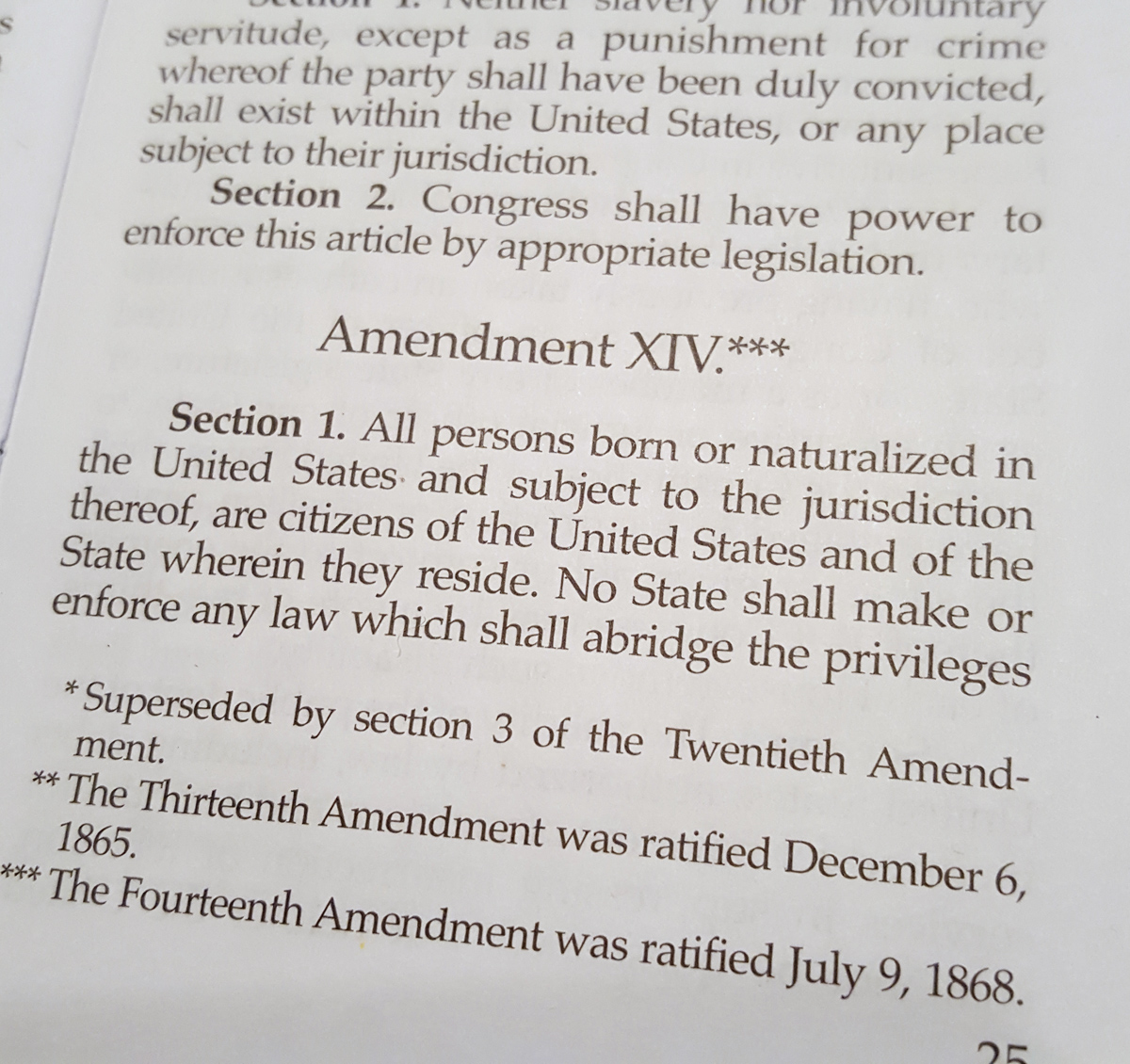
Sometimes grammar is the solution to understanding. So I’m in my element. That’s the case today for our discussion about the 14th Amendment. Here’s the first, and most pertinent paragraph:

All persons born or naturalized in the United States and subject to the jurisdiction thereof, are citizens of the United States and of the State wherein they reside. No State shall make or enforce any law which shall abridge the privileges or immunities of citizens of the United States; nor shall any State deprive any person of life, liberty, or property, without due process of law; nor deny to any person within its jurisdiction the equal protection of the laws.


This amendment was ratified July 9, 1868. To understand it, it helps to know it followed what was called the Civil Rights Act of 1866, the purpose of which was to give citizenship to freed slaves. This legislation was pushed through Congress by a bloc of—of course—Republicans. Radical Republicans, they called themselves. That legislation said:

all persons born in the United States and not subject to any foreign power, excluding Indians not taxed, are hereby declared to be citizens of the United States; and such citizens, of every race and color, without regard to any previous condition of slavery or involuntary servitude, except as a punishment for crime whereof the party shall have been duly convicted, shall have the same right, in every State and Territory in the United States, to make and enforce contracts, to sue, be parties, and give evidence, to inherit, purchase, lease, sell, hold, and convey real and personal property, and to full and equal benefit of all laws and proceedings for the security of person and property, as is enjoyed by white citizens….
Putting the two together, we can see that “subject to the jurisdiction” means “subject to any foreign power.” It’s about allegiance. Aren’t visitors subject to our laws? Yes, and they also benefit from them—as people, but not as citizens. Citizens get additional privileges: the right to vote, and to receive government benefits, such as military protection from invasion, plus maybe education, welfare, or Social Security. There’s a distinct difference between being an American and simply being in America.

Let’s assume, then, the meaning of “subject to any foreign power” is not at issue. That means you must be born in the US and not subject to any foreign power, or be naturalized in the US and no longer subject to any foreign power. You don’t have to take my word for it. One of the drafters of the amendment, Senator Lyman Trumbull of Illinois defined “subject to the jurisdiction” as “not owing allegiance to anybody else.”

Why the amendment when there was already a law? There had been a prior decision by the Supreme Court, the Dred Scott case, in which SCOTUS ruled that a slave who was living in a state that prohibited slavery was nevertheless a slave and Americans were required to return him to his owner; furthermore, the case ruled that people who were racially black could never be US citizens.

In other words, it was already clear that you couldn’t trust the courts to rule correctly. Nevertheless, SCOTUS can rule a law unconstitutional, but it can’t rule an amendment to the Constitution unconstitutional; it is part of the constitution. So that is the reason the Civil Rights Act of 1866 was followed up with the 14th Amendment. They’re actually even closer than they appear. The amendment was drafted just two months after the legislation became law; the additional two years was the time for the states to ratify the amendment.

The debate about the 14th Amendment was never about granting citizenship to babies born here who were children of foreigners, visitors, or anyone whose allegiance was to some other nation (jurisdiction). That issue didn’t come up, because nobody thought, “Hey, you know what we ought to do? We ought to magically make any child of someone in the country, on vacation, say—or even illegally—a citizen. Then we can give that child of foreigners all the rights and benefits of citizenship, even if the child never assimilates or feels allegiance to our country with its principles of freedom.” Because that would have been stupid, for one thing. And for another, it had nothing to do with the purpose of the legislation and follow-up constitutional amendment.

So how did the idea of birthright citizenship come out of that pretty clear granting of citizenship to freed slaves and other black? It took a while, and some purposeful misconstruing.

Wong Kim Ark
image from Wikipedia
The first—and only—relevant Supreme Court case came up about thirty years later (1898), concerning a man born to Chinese immigrants—not naturalized as citizens, both because the Chinese Emperor did not allow renunciation of his rule, and because of the US laws at the time did not allow for Chinese naturalization, based on a belief that they were too foreign to assimilate. Wong Kim Ark took a trip to China (not his first), and when he returned to port in San Francisco, he wasn’t allowed re-entry, because of a hold on allowing entry of Chinese at the time. But he said, “I’m not Chinese. My parents are. But I’m American. I was born here.” While he was held aboard the ship for five months, the case made its way through the courts to the Supreme Court, which eventually ruled that he was a citizen, based on his being born here and his parents being permanent legal residents.


But that is a very different thing from the current interpretation that anyone who happens to be born here, whether to illegal immigrants, temporary residents, visitors, tourists, travelers, etc., would magically be granted citizenship status, with promises of welfare benefits and education. In fact, it’s hard to construe a way to be both an illegal alien and holding allegiance to the United States. The illegal status implies failure of allegiance.

There’s a rather arcane argument, where grammar really comes in, based on the precursor to the Congressional record, during the debate about the 14th Amendment. Michigan Republican Jacob Howard, who had introduced the 14th Amendment, is recorded as saying this:

This amendment which I have offered is simply declaratory of what I regard as the law of the land already, that every person born within the limits of the United States, and subject to their jurisdiction, is by virtue of natural law and national law a citizen of the United States. This will not, of course, include persons born in the United States who are foreigners, aliens, who belong to the families of ambassadors or foreign ministers accredited to the Government of the United States, but will include every other class of persons.
The person who wrote the words, then, insists that the 14th Amendment means essentially the same this that the Civil Rights legislation of 1866 meant. But today people purposely misread, not only the 14th Amendment, but Howard’s statement about it.

Take a look at the highlighted sentence again. The list of those not to be included are children born to foreigners or aliens, or children of ambassadors or foreign ministers. That seems pretty clear to me. But where misreading can occur, it does. The misreaders claim that it isn’t a list, but a restatement of the same thing, meaning that “foreigners and aliens” are just another way of saying “families of ambassadors or foreign ministers,” so everyone not of an ambassadorial or foreign ministerial family is included in “every other class of persons.”

The Congressional Globe, in which this is recorded, is neither an exact quote of the words spoken, nor is it intended to be the final say on punctuation. So, if you go by the full context of what Howard said, among others in the debate, you’ll see that “every other class of persons” cannot include Native Americans living on reservations and subject to tribal sovereignty (they were granted citizenship by legislation in 1924). So we know that the misreaders have it wrong.

So we could clarify (and people do[i]) by adding the word “or” in its appropriate place:

…who are foreigners, aliens, [or] who belong to the families of ambassadors or foreign ministers…
Grammar saves the day for truth once again!

What this means is, the 14th Amendment does not, and has not ever, granted birthright citizenship to children of parents subject to a foreign sovereignty.

Maybe we need a clearer definition of immigrant. Legal immigrants who have entered the country legally and have expressed their intention to be permanent residents—their children born here have always been considered citizens—even if they’re born before the parents become naturalized citizens. This would be different from someone working here on, say, a five-year work assignment but who still considers themselves a citizen of some other nation; their children would have the same citizenship as the parents.

If we as a people believe birthright citizenship is a good thing, we could hold the debate and amend the Constitution to say so. But we’ve never had that opportunity. We have had administrations who, for their own purposes (and those purposes are related to the same purposes that encourage illegal immigration, amnesty, non-citizen voting, and other impediments to sovereignty) granted such citizenship by fiat, but not by law.

So, can Donald Trump end the practice by executive order? Yes.

What would happen? Cases will make their way to the Supreme Court—which now leans originalist. Other than the one case, which doesn’t clearly define the issue, there isn’t reliable or clear court precedence. So they would likely look to the text and intent at the time of the writing of the 14th Amendment. I don’t know for certain how that would go, but it is likely to end the practice of “maternity hotels” and pregnant illegals purposely trying to get on American soil to birth a baby, who will then be a citizen, so they can claim, “But it would be cruel to separate families” as they plead not to be deported—even though this country has of course never forced deportees to leave their children behind simply because of a citizenship technicality; the country they would be returned to would undoubtedly accept their child as a citizen along with the returning parent.

Is this simply some bigoted conservative argument? Not unless you assume former Democrat Senate Majority Leader Harry Reid is a bigoted conservative. He said this:

If making it easy to be an illegal alien isn’t enough, how about offering a reward for being an illegal immigrant? No sane country would do that, right? Guess again. If you break our laws by entering this country without permission and give birth to a child, we reward that child with U.S. citizenship and guarantee a full access to all public and social services this society provides.
Does the United States have the right to decide its own citizenship rules? If it is a sovereign nation, then of course. If we go back to the original meaning of our 14th Amendment and end “birthright citizenship” for illegals or visitors, then we would be in line with the practice of 83% of the world’s nations, and about 6.642 billion of the world’s 7 billion people.

We don’t have to quibble about those currently granted citizenship. We can simply state what we as a nation will do going forward. As Hillsdale College lecturer and research fellow Michael Anton puts it,

Correct the issue going forward. Make clear to the world that the United States will no longer grant birthright citizenship to the children of non-citizen illegal immigrants, birth tourists, or people here on temporary work or student visas. The citizenship of those already born would forever be honored—even enshrined into law if necessary.[ii]
This would put an end to what might be called, in the insurance world, an attractive nuisance. We can stop attracting illegal immigrants, and get much better organized at allowing immigration of those who will value our laws, our freedoms, and the responsibilities of citizens who self-rule, and weed out the applicants who want to take advantage of us without becoming truly American.


[i] Michael Anton used this insertion for clarity in“Citizenship Shouldn’t Be a Birthright,” July 18, 2018, in The Washington Post. Others have used the same insertions, such as in "What Did the 14th Amendment Congress Think about 'Birthright Citizenship'?" by Mark Pulliam, August 21,2015, for Law and Liberty.

[ii] Michael Anton wrote two piece in July 2018 about birthright citizenship. The first is “Citizenship Shouldn’t Be a Birthright,” in The Washington Post. A few days later, in answer to critics, he wrote a much longer piece, “Birthright Citizenship: A Response to My Critics,” in the Claremont Review of Books. I this one he handles the grammar issues in more detail than I have, and also the historical issues. The estimates from the paragraph above about the world’s nations that do not have birthright citizenship come from his longer piece.

Monday, October 29, 2018

Government by Consent or Expertise


I’ve been going through a Hillsdale online course (their newest, I think) called Congress: How It Worked and Why It Doesn’t. In his introduction, Hillsdale President Larry Arnn points out that the title refers to both past tense—“when it worked”—and present tense—“it doesn’t.” There isn’t anything in the title that says, “And how we get it to work again.” I’m halfway through, but I’m hoping there will be something hopeful like that.

Anyway, in our ongoing primer on the Constitution here, it’s appropriate to talk about what has been going awry with Congress over the past century.

According to Article I of the Constitution, legislation happens in the legislature, composed of two houses: the House of Representatives, which is based on population, and the Senate, which provides equal representation for the states. The two houses have to come into agreement on any legislation that they pass along to the president for his signature, before it becomes law.

But the self-proclaimed progressives, such as President Woodrow Wilson, and others of his time—Herbert Croly, John Dewey, both Theodore and Franklin Roosevelt—thought they knew better than the founders about how things should be run.

They set out, rather matter-of-factly, to overturn the US Constitution, and replace it as they saw fit. And they and their followers, over the course of a century, have been far too successful.

The idea, they claimed, was that life in the industrialized world was too complex to be handled by anyone but experts. They liked the idea of using the legislature to express the general will of the people—a desired outcome, like clean water or safer working conditions, for example—and then turning over all the details to some expert administrative body.

They claimed that this would better do the will of the people, and do it more efficiently—and separately from politics.

Dr. Kevin Portteus
screen shot from lecture 5 of
Congress: How It Worked and Why It Doesn't

Dr. Kevin Portteus, the teacher of this Hillsdale course, in Lecture 3: “Politics and Administration,” offers this definition:

Politics is politics in what we might think of as the ordinary sense, the martialing of votes, the changing of public opinion, and the enactment of a political program. Whereas, on the contrary, administration constitutes the implementation of the broad policies laid out in the political process.
It didn’t matter to the progressives that the legislature would be giving up their lawmaking power. Their “progressive” vision was all that mattered.

So Congress would pass vague “laws” requiring a general desired outcome. And they’d turn over the authority to accomplish that to administrative bodies of bureaucrats, with practically unlimited authority to set the rules, enforce them, and adjudicate disputes—all branches of power in one.

So now, besides voters and elected officials, the process has a third party. Dr. Portteus describes these extra-constitutional lawmakers, and three basic characteristics required in order to be one. Pay attention to the second one; there’s a lot there. And then, if you understand the second, how do you square that with the third?

That’s the bureaucrat, the administrator, the official. What does he look like? Well, Croly says, “The experts charged with the administration of these laws would become the official custodians of a certain part of the accepted social program. In other words, they must implement some portion of the progressive social platform. So if you’re put in charge of EPA, your job is to implement clean air and clean water policy. That’s your corner of a just society that’s your responsibility.
But, in order to do that, we need people who have three basic characteristics.
The first one is that they’re experts. They have to be trained experts in their particular fields. And we’ve seen this.
The second attribute of a progressive bureaucrat is that he be independent of the partisan political process. And this was the driving force throughout the Twentieth Century behind the creation of entities like independent regulatory commissions. Get the policymakers out of the electoral process, and get them out from under the control of elected officials, so that the people—public opinion—and the people’s elected representatives don’t get in the way of the application of expertise to solve these social problems.
It’s kind of interesting, when you think about it, because, in the progressive mindset, we’re going to have bureaucrats who are pretty far removed from the political process. And if you follow the logic of this argument, the end result of restricting the people’s ability to control government officials—the end result of that is going to be greater implementation of democracy. That is to say, the goals stated in the people’s legislation are going to be less likely to be subverted, because the people who are implementing them are going to have no interest except serving the public interests.
It sounds kind of naïve to us, but they really believed this. They really believed that you were going to have these people who were not gripped by self-interest in the way that the rest of us were, that somehow they would be outside of the ordinary limitations or foibles of human nature. And they would be responsive only to the public good.
And they really believed this. This was not cynical on their part. They were serious.
But, there was one other characteristic that you could not get around. And that is that these people must be committed progressives. They cannot be anti-progressives. Because, if they’re not committed progressives, then they will not zealously enforce the mission of the agency of the program over which they were put in charge.
Because, the danger in that circumstance is that, if such a person is put in charge of a program or of an agency, he would use that position as a vehicle for circumventing the will of the people as stated in legislation.
To give an example, a while ago, about ’99 or 2000, Bill Clinton had to fill a spot on the Federal Elections Commission, and he chose to fill that spot with a man named Bradley Smith. Now, Brad Smith is the expert in federal campaign finance law. And, so, there’s no doubt that he knows his stuff. And by putting him on the commission, he would be independent of the partisan political process. Now, Smith recounts in his book on free speech that his chief opponent, when he was nominated, was Clinton’s own vice-president, Al Gore. And, as Smith recounts in his book, he says, “The reason that Gore opposed me was not because I didn’t know my stuff, and it’s not because I was going to be a captive tool of special interests, because I had my position on the committee. What he objected to was the fact that I questioned the wisdom and the constitutionality of current and proposed campaign finance restrictions. In other words, that I was not committed to zealous enforcement of federal campaign finance programs and the implementation of new and ever more restrictive programs.”
So, you can’t have someone who doesn’t believe, for instance, in greater restrictions on pollution at the head of the EPA. That person is, by definition, because of ideology, ineligible for the position. He must accept—the progressive administrator must accept the basic progressive impulse of society and of the program he is supposed to run. And, as Croly says, “He qualifies for his work as an administrator quite as much by his general good faith as by his specific competence.” So, in other words, as important as his technical ability is his commitment to progressivism.
So, non-progressives, if you want to call them conservatives, are by definition ineligible to hold any of these administrative positions.
You saw similar dismay over various Trump appointees, but in particular Betsy DeVos over Education. The Department of Education still exists at the federal level after almost two years—which is disappointing to some of us. But the fear from the other party is that she might “gasp!” find something to cut. And the very nature of a federal agency is that it must keep growing. Reagan found similar pushback on his policies as well, even failing to end the then-new Department of Education.

In this and other agencies, some of the difficulty come from within the agency. Perhaps not every employee in an agency is a fully committed progressive (which means Democrat or socialist, but only very rarely a non-conservative Republican). But most are, by definition.

Thomas Sowell
image from here
There’s a story, a pivot point Thomas Sowell talks about his time at the Labor Department, after finishing his PhD in Economics as a Marxist. In short, he was studying the sugar industry of Puerto Rico, and whether the Labor Department’s setting of minimum wages was leading to unemployment. There was a way to test whether this was true, or whether a competing theory about hurricanes harming the crops was the cause. Thomas Sowell figured out they could get data about crops standing in the fields before hurricanes to tell them. That data wasn’t in the Labor Department; it was in the Department of Agriculture. There was huge pressure not to even ask for it, but he filed a request:


That was 1960. I have yet to receive an official reply to my request.
This was more than an isolated incident. It forced me to realize that government agencies have their own self-interest to look after, regardless of the interests of those for whom a program has been set up. Administration of the minimum wage law was a major part of the Labor Department’s budget and employed a significant fraction of all the people who worked there. Whether or not minimum wages benefited workers may have been my overriding question, but it was clearly not theirs. They had reasons to want to believe that it did, but no real incentive to probe too deeply to find out.[i]
Learning that the administrative state had nothing to do with helping people, but only in preserving their own jobs, or putting forward their own ideology—that’s when Thomas Sowell went from Marxist to free-market economist.

In Lecture 5, “Legislation and Regulation,” Dr. Portteus says that government by consent, which we have in the Constitution, and government by expertise, as in the administrative state, are mutually exclusive.

What’s more, any intention of insulating the administrative lawmaker from politics is an abject failure. As Dr. Portteus concludes: 

It does not insulate rule makers from legislative politics. Regulatory agencies are buffeted by all of the political forces that affect legislators and sometimes more so.

It does not base rules on expertise, or even reason. And the CAFE[i] standards example is a wonderful case in point in this regard. And at the end of the day, it doesn’t serve the public interest. That is to say, this process gives undue weight to organized special interests, who influence the regulators and key politicians.
This is why, for instance, it has become so critically important, if you own a business of even modest size, that you have a lobbying operation….
So the regulatory process is something very different from the legislative process…. Over the course of the 20th Century, the regulatory process developed and established in the Administrative Procedure Act is a very different way of making policy from the process established in the Constitution for making laws. The modern one attempts to substitute for, and posit itself as, the parallel legislative process. But it really leads to a transformation of the regime, because it yields a transformation in the way legislation is made.
Another day we can talk about what Congress is doing with its time, if it isn’t making laws. But for now, let’s just remind ourselves of this Spherical Model axiom:

Whenever government attempts something beyond the proper role of government (protection of life, liberty, and property), it causes unintended consequences—usually exactly opposite to the stated goals of the interference.


[i] Thomas Sowell, A Person Odyssey, © 2000, pp. 130-131.
[ii] CAFE is Corporate Average Fuel Economy

Thursday, October 25, 2018

Not All Parties Are Worth Celebrating

Midterm election season is underway. Early voting started in Texas on Monday and runs through next week. Voting day is Tuesday, November 6th. This isn’t a primary election, where you have the opportunity to choose who the candidates will be on the ballot. We did that last spring. Now it’s a matter of choosing to go with your party’s candidates or not.

For people who are paying attention, party choice happened a long time ago. The swing voters, the independents—those are the ones who decide elections. And they’re also the ones who pay the least attention, and make their decisions later, and possibly with less information. And often they’re susceptible to whatever the quick and easily available news tells them.

I write here mainly for people who choose freedom,prosperity, and civilization, rather than the alternatives: tyranny, poverty, and savagery. My effort is to help all of us practice ways of saying things clearly enough that those as yet undecided—or persuadable—can understand and be persuaded.

Democrats probably wouldn’t say they seek tyranny, poverty, and savagery, but since we know what leads in that direction, we can see the connection between their policies and those negative outcomes.
That is not to say that the Republican Party is always the champion of freedom, prosperity, and civilization. But it’s what we have to work with. I am a Republican, a precinct chair. And here in Texas we have pretty good success at directing the party in the right direction, so it’s worth the work I put into that.

I think we’d be a lot better off if the two parties were Republican and Libertarian. Both spend a lot of time above the equator in the freedom zone. Democrats do not. And they get more entrenched in the tyranny zone as we become more polarized.

The solution is not to give in and “compromise” to go just a bit less toward tyranny, rather than run headlong into it. The solution is to be totally clear so that those with ears to hear will hear, and hearken.

Earlier this week Allie Beth Stuckey, a conservative young woman commentator, kindly provided a new three-minute election ad for Democrats. It’s a parody, but as good parody does, it tells a lot of truth about what the Democrats are for:


In contrast, an Austin, TX, group of Beto O’Rourke for Senate cheerleaders put out an ad (watch it here) that is not a parody. Really. Why vote for Hispanic poseur Robert Francis O’Rourke? Because he’s crush-worthy, even though married with kids? Because he used to play in a rock band, like Bernie, but with a tan? If you watch this, think seriously about whether this respects women in any way.

candidate comparison
found on Facebook, source unknown

Which brings us to some other claims of Democrats claims that deny history and reality. Here’s setting some of the record straight:

·       All slave owners at the time of the Civil War were Democrats; no Republicans were ever slave owners. Democrats even in the North supported slavery.
·       Civil Rights legislation was passed by Republicans, while Democrats resisted; but then Democrats (led at the time by LBJ, who was a verified racist) took credit, for political opportunism.
·       Democrats claim to be compassionate, but they mean with your money collected in taxes, to be spent as they see fit. They fail when it comes to charitable giving.[i]
·         Democrats claim they’re the tolerant ones, but they’re the ones running people out of restaurants, or out of business, for the sin of not towing the Democrat line. They treat people of their party this way as well, if they stray from the script. In other words, “tolerance” to them means “you have to believe what I believe, or I will destroy you.”
·       They proved during the trumped up charges against Justice Kavanaugh that the rule of law doesn’t matter; only tribalism matters. And the tribes they hate most are white males, or anyone who disagrees with them about their hierarchy of intersectionality.
·       They’re horrified at capital punishment for the most heinous serial murderers, but they think murdering the innocent unborn is a right some essential that should be funded with taxpayer dollars.
The list goes on. Note that if they are accusing Republicans of something, it’s something they are in fact doing. Their lack of self-awareness is astounding.

So, there’s a huge contrast between Democrat Party ideology and civilized people who love freedom and prosperity. This isn’t an election in which “I vote for the person, not the party” makes sense. Why would you vote for a person who champions tyranny, poverty, and savagery? You’d only do that if you choose evil on purpose, or you don’t know better.

There are occasions when the candidate of my party doesn’t meet my standard either. In those rare cases, I advise a third-party protest vote, or leaving that race blank.

Here’s some inside information about our local Harris County races. For years Democrats have gathered up voters, driven them to the polls, and directed them to vote straight ticket Democrat. That means you press one button, and the whole ballot (of partisan races, which may exclude school boards or city council) gets cast by party. It’s quick and easy and requires no thinking. Straight ticket voting has been ended; but this is the last election in which it still applies.

We’re close to 50% Republican and 50% Democrat in Harris County. Two years ago, the county went Democrat. Some of that had to do with a controversial District Attorney race. While Trump won very red Texas, Hillary Clinton won Harris County. And because of straight ticket voting, that meant that every countywide race on the ballot went Democrat.

We have the longest ballot in the country. It’s because we vote on our judges. There are dozens of them. This county is bigger than several states, with around five million people. So that’s just how it is. Lots of civil, family, and criminal courts. Plus other county races.

Not every race comes up every two years; many are four-year positions. So they alternate. Everything that wasn’t up for election in 2016 is up for election now—with straight-ticket voting still in play. That means it’s very important for Republicans—who resist voting blindly—do their research and vote all the way down the ballot. And get out to vote.

You can vote the easy straight ticket, or vote singly. You can vote straight ticket and then change individual races. But—unless this has changed since the last time I tried it—you cannot vote straight ticket and then change a particular race to blank.

The point is, if you go only partway down the ballot, you are granting uninformed straight-ticket Democrat voters the right to choose for you. And, if that happens again, every countywide position will be filled with a Democrat—someone who believes in legislating from the bench, instead of following the law. And we will have removed all long-standing experienced judges and officials.

Voter integrity nationwide has really flowed out of Harris County. We’ve made great improvements here in efficiency and voter protections. Some thanks should go to Stan Stanart, our County Clerk, for these improvements. Democrats have particularly targeted him—because they like to be able to control voting and counting of votes—for nefarious reasons. His race is way down at the bottom of the ballot. It’s important to vote the whole ballot.

Back to the broader national discussion, it’s an important time to vote Republican all over. I cringe at the possibility of Nancy Pelosi returning to power. Those were not good years. And their plan going forward (backward?) is to impeach the president and obstruct anything that even hints at lower taxes or less regulation.

On the Spherical Model website I wrote about the place of the parties on the sphere. This was in 2010. Still true, but maybe more so. Here’s how I’d still describe the Democrats:

The Democrats are a symbiotic mix of people demanding that government provide for their needs—health care, education, housing, redistribution of wealth, regulating use of resources, even making jobs: the demanding needy, we could call them—along with the elites who are willing to pander to the demanding needy in order to increase their personal power: the would-be dictators.
Republicans tend to think Democrats are uninformed, or motivated by emotion rather than reason. Democrats think Republicans, or all others who disagrees with them, are evil.

We need voters who do better than go with their gut—which is influence by media and academia mischaracterization. Whether you think Republicans are perfect or not (and they’re not, by the way), they are certainly not evil as portrayed by Democrats.


[i] Read Arthur Brooks, Who Really Cares? The Surprising Truth about Compassionate Conservatism, © 2006.

Monday, October 22, 2018

The Enumerated Powers


The Constitution has a two-fold purpose: to set up a government for the nation, and to limit that government to its proper role. Too weak, and it fails to prevent chaotic tyranny; too powerful, and it causes statist tyranny.

The Constitution lays out, in around 500 words, what the federal government is allowed to do. We refer to these as the enumerated powers. Enumerate means to mention one by one. If it’s not enumerated, it’s not a power granted to the federal government. The first ten Amendments, the Bill of Rights, further spell out limits, saying essentially, “And don’t you dare construe anything herein to allow you to mess with these rights.” The Ninth and Tenth Amendments make that even clearer:

Amendment IX: The enumeration in the Constitution of certain rights shall not be construed to deny or disparage others retained by the people.
Amendment X: The powers not delegated to the United States by the Constitution, nor prohibited by it to the States, are reserved to the Sates respectively, or to the people.
So, the Constitution was very clear about its intent to allow only certain, limited powers to a federal government.

What are the enumerated powers? You don’t have to read the whole Constitution to ferret them out. Most of the Constitution is about procedures for each of the three branches of government: Article I: legislative; Article II: executive; Article III: judicial. The enumerated powers are all listed together, in Article I, Section 8, plus a thing or two added as later amendments.

Article I, Section 8 of the Constitution

So, here they are. I’ve numbered them, sometimes separating a clause into two powers, when that made sense to me; and sometimes paraphrasing or clarifying (I hope), since some of the words are either legalistic or are used differently today in common speech. So Article I grants the federal government, through the legislative branch, the power to:

1.      Lay and collect taxes, duties, imposts, and excises—uniformly throughout the US, for purposes of paying debts and for the general welfare (for the good of the country as a whole).
2.      Borrow money on the credit of the US.
3.      Regulate commerce (make it possible and regular) with foreign nations, among the states, and with the Native America tribes.
4.      Establish uniform rule of naturalization (allowing people to become citizens).
5.      Establish uniform laws on bankruptcies.
6.     Coin money, regulate the value of US coined/printed money, and regulate the value of foreign money.
7.      Fix the standard of weights and measures.
8.      Provide for the punishment of counterfeiters.
9.      Establish post offices and post roads (mail system).
10.  Secure copyright and patent rights, to promote the progress of science, arts, writings, and discoveries.
11.  Constitute tribunals (courts) inferior to the Supreme Court.
12.  Define and punish piracies and felonies committed on the high seas, and offenses against the law of nations.
13.  Declare war, grant letters of marque and reprisal (license to act on the seas that would otherwise be considered piracy), and make rules concerning captures on land and water.
14.  Raise and support armies—but no appropriation of money to that use shall be for a longer term than two years.
15.  Provide and maintain a navy.
16.  Make rules for the government and regulation of the land and naval forces (military bases).
17.  Provide for calling forth the militia (National Guard) to execute the laws of the union, suppress insurrections, and repel invasions.
18.  Provide for organizing, arming, and disciplining, the militia (National Guard), and for governing any part that is in service to the US—reserving to the respective states the power to appoint officers and the authority to train the militia according to discipline prescribed by Congress.
19.  Exercise governing authority over the District (Washington, DC, an area not exceeding 10 square miles) as the seat of the government of the United States.
20.  Exercise governing authority over places purchased (by consent of the legislature of the state in which located) for erection of forts, magazines, arsenals, dockyards, and other needful buildings.
21.  Make all laws which shall be necessary and proper for carrying into execution the foregoing powers, and all other powers vested by this Constitution in the government of the US or in any department or officer thereof.
22.  Outlaw slavery and involuntary servitude (except as a punishment for crime), and enforcement of this prohibition.
23.  Sixteenth Amendment: Lay and collect taxes on income.
24.  Fifteenth, Twenty-fourth, ad Twenty-sixth Amendments: Enforce equal voting rights laws across all the states.
That’s the sum total. There aren’t any more powers granted to the federal government. There are some notable things missing:

·         Power to govern education.
·         Power to offer charitable services (welfare).
·         Power to force purchase of a service or product (such as health insurance).
·         Power to require payment into a retirement supplement (Social Security).
·         Power to interfere with commerce that doesn’t cross state lines.
·         Power to redefine marriage in a way that is contrary to long-standing law and tradition, and to enforce acceptance of the new definition, even when it violates personal religious beliefs.
·         Power to subsidize any industry (alternative energy).
·         Power to target industries in accordance with a social agenda (gun manufacturing, automobile manufacturing, nuclear energy, oil and gas, fast food or sugary drinks).
·         Power to use taxpayer funds to support abortion.
·         Power to subsidize or control student loans.
·         Power to take over any industry (as when the Obama administration temporarily took over GM and banks).
·         Power to favor or disfavor individuals or groups for hiring, educational opportunities, or other purposes based on their race or religion.
There are certainly more things the government is doing, or trying to do, that are well beyond the enumerated powers. Some people characterize this desire for limiting government as hating all government, and then claiming we’re hypocritical for wanting a military or border control to protect our sovereignty. That’s a mischaracterization. The pro-Constitutional view favors government—but a limited government. Government must be limited to its proper role: protecting life, liberty, and property. Or, more specifically, as the Preamble to the Constitution says about what a more perfect union is established to do:

Establish Justice, insure domestic Tranquility, provide for the common defence, promote the general Welfare, and secure the Blessings of Liberty to ourselves and our Posterity.
The founders assumed those government responsibilities enumerated in the Constitution could be managed on about $20 a year (in current-day dollars). Imagine how easy it would be to pay off the national debt, in a thriving economy (which happens when government gets out of the way), if government only did what it was allowed to do.

We also know that, whenever government attempts something beyond the proper role of government (protection of life, liberty, and property), it causes unintended consequences—usually exactly opposite to the stated goals of the interference.

Conditions would get better, and the cost would be far more reasonable, if we would just follow the laws of the land by limiting government to the enumerated powers.

How do we get back to those limited, enumerated power only? Good question. We vote in only people who understand and love the Constitution, and show a commitment to strictly limiting government powers.