Thursday, June 8, 2017

Start with the End in Mind, Part II

Mondays post was mainly about education (specifically, educating for accomplished citizenship). But the process of figuring out what and how to teach is something that can be applied in a larger context. So I thought I’d apply it to the Spherical Model today. I’m doing this as an exercise; I can’t say I’m expert at this process. So we’ll find out together whether the exercise is fruitful.

So that we’re on the same page, I’ll start with reminders of what the Spherical Model is, and what human performance expert Joe Harless says is the process for coming up with what to teach.

The Spherical Model is about the interrelationships of the political, economic, and social spheres. In each of these interrelating spheres, the goal is north: freedom, prosperity, and civilization respectively. We want to stay away from—or move up from—the south: tyranny, poverty, and savagery respectively. East/west is neutral, relating to the appropriate interest, from most local ( furthest west longitude) to global (furthest east longitude)—with one proviso: issues should be handled at the most local level possible. When a higher level tries to control a lower level’s issues, the result is movement southward on the sphere.

To review the process outlined by Joe Harless in the book on education, here’s the order:

1.       Identify the results you want.
2.       Identify the measurable outputs/accomplishments that indicate accomplishment of the result.
3.       Identify behaviors/skills that must be used in order to get the outputs.
4.       Teach those behaviors/skills in the context of their purpose.
There’s probably more to it than that, if you’re going to use the process in developing a school system or a training program in the business world. But this will do for our purposes today. I don’t think we can even cover all four steps in a blog post (not sure I’ve covered them fully in the 800+ posts on this blog). But maybe we can identify what we want, plus a few measurable outputs that would show we are getting there.

The Results We Want

We want freedom, prosperity, and civilization. What do each of those look like?

Freedom: I used this definition in “What Is Freedom” a year and a half ago:

The Political Sphere


Absence of hindrance, restraint, confinement, repression. In the political sense, it is ownership of one’s own life and the production of wealth and property that results from one’s use of life and effort. A government should protect the freedoms of life, liberty, and property; it does not grant these things, but protects them from infringement. A government that takes life, liberty, or property unjustly—when the person has not unlawfully infringed on those rights of another person—that is a tyrannical government, which is the opposite of freedom.
Political freedom means living in a society in which our God-given rights are protected rather than infringed. These would include freedoms of belief and expression, such as freedom of religion and freedom of the press, as well as freedoms of property and security, such as freedom from illegal searches and seizures and the right to bear arms.
So, in the language of results, we have freedom when our rights are protected, and government is limited to that protective role of securing life, liberty, and property. The Preamble to the Constitution delineates the limits of government’s role, and the rest of the Constitution enumerates the powers the government is granted to accomplish its role.

Specific measurable outputs might include these:

·         Secure borders.
·         Sovereignty respected; peace with other civilized nations.
·         Effective and disciplined law enforcement and judicial system.
·         Representative government strictly limited to government’s proper role.
·         Adequate infrastructure.
·         No slavery or indentured servitude.
Prosperity: We’re born naked, impoverished, and inexperienced. It is by growth, hard work, and gaining in expertise that we try to overcome this condition throughout our life. Prosperity, then, means having a standard of living in which basic needs of food, clothing, and shelter are met, and opportunities for improved living standard abound. This comes from a free economy, in which we choose how we work, and more particularly how we spend what we have earned. This encourages the incentive to work harder and innovate, so that we can enjoy the fruits of labor.
The Economic Sphere


But one reason “the poor are always with us” is that some are unable, for reasons that are no fault of their own, to take care of themselves, either temporarily or permanently. Some might lack physical or mental capacity to earn enough to care for themselves. Some might be in the position of taking care of a loved one, which prevents them from earning income. Prosperity means that even those incapable of caring for themselves will have their basic needs met.

So let’s try re-wording prosperity goals as somewhat measurable outputs:

·         No death from lack of access to food or shelter.
·         Property ownership is protected.
·         Choices on how to spend earnings in hands of earners.
·         Limited taxes—that pay only for government’s proper role.
·         Fair taxes—same percentage for all income beyond subsistence earnings.
·         Low or non-existent unemployment.
·         Entry-level work opportunities.
·         Skill improvement opportunities.
·         Skilled workers well-match to business needs.
·         Entrepreneurship.
·         Parental responsibilities met (children cared for until adulthood).
·         Philanthropy—source providing basic needs to those who cannot care for themselves.
·         Upward mobility in standard of living.

Civilization: Civilization thrives when we have a critical mass of people who are moral by choice, meaning they honor God the Creator and grantor of life and liberty and definer of ultimate Good. It means they also honor family, which is the basic unit of civilization and the means of perpetuating it. Moral people also honor life, property ownership, and truth.
The Social Sphere

What does it look like? Here’s the description from the Spherical Model:

Civilized people live peaceably among their neighbors, helping rather than taking advantage of one another, abiding by laws enacted to protect property and safety—with honesty and honor. Civilized people live in peace with other civilized people; countries and cultures coexist in appreciation, without fear.
There is a thriving free-enterprise economy. Poverty is meaningless; even though there will always be a lowest earning 10% defined as poor, in a civilized society these lowest earners have comfortable shelter and adequate food and clothing—and there’s the possibility of rising, or at least for future generations to rise.
Creativity abounds; enlightening arts and literature exceed expectations. Architecture and infrastructure improve; innovation and invention are the rule.
People feel free to choose their work, their home, their family practices, their friendships and associations. And they generally self-restrain before they infringe on the rights and freedoms of others. Where there are questions about those limits, laws are in place to help clarify boundaries of civilized behavior. When someone willingly infringes on the rights or safety of another, the law functions to protect that victim as well as society from further uncivilized behavior from the offender.
So, now, for the attempt to re-word into measurable outputs:

·         Law-breaking rates low and easily handled by police.
·         Contracted commitments kept.
·         Businesses with integrity—errors toward consumers or employees corrected voluntarily and quickly.
·         Volunteer offerings of time and money to alleviate suffering of the less fortunate.
·         Thriving churches, charities, and philanthropies—shown by needs of less fortunate being met.
·         Citizen engagement high: voters educate themselves before voting; elected officials legislate no laws beyond the proper role of government.
·         Very low divorce rates.
·         Reproductive rates well above replacement—children are valued
·         Unwed parents rare; adoption is the expected result of the rare unintended pregnancy.
·         Sex outside of marriage unaccepted—not portrayed as normal and accepted in media.
·         Free expression of respectful opinions intended to preserve/repair civilization.
·         Justice that is clear, quick, and fair; creative sentences for law-breaking, including efforts toward repayment and rehabilitation.
·         Abortion and euthanasia near nonexistent.
·         Art, music, and other creative works.

One of the points of Harless’s book is that separating curriculum into discrete subjects doesn’t work. Similarly, separating the political, economic, and social spheres into discrete segments doesn’t work. They interrelate.

As I wrote in “Choosing to Solve Poverty” a year ago,

Prosperity requires a free people engaged in a free market—all of which requires a law-abiding, righteous people. Things are interrelated. There’s something that comes up in all three spheres—political, economic, and social—and that is choice
So this exercise at least lets us examine what we would see in a free, prosperous civilization.


Inculcating the behaviors to get there? That’s the lifelong job of every civilized person. And it’s done most effectively by example in the home. If we started with strengthening families, much of the rest would follow.

Monday, June 5, 2017

Start with the End in Mind

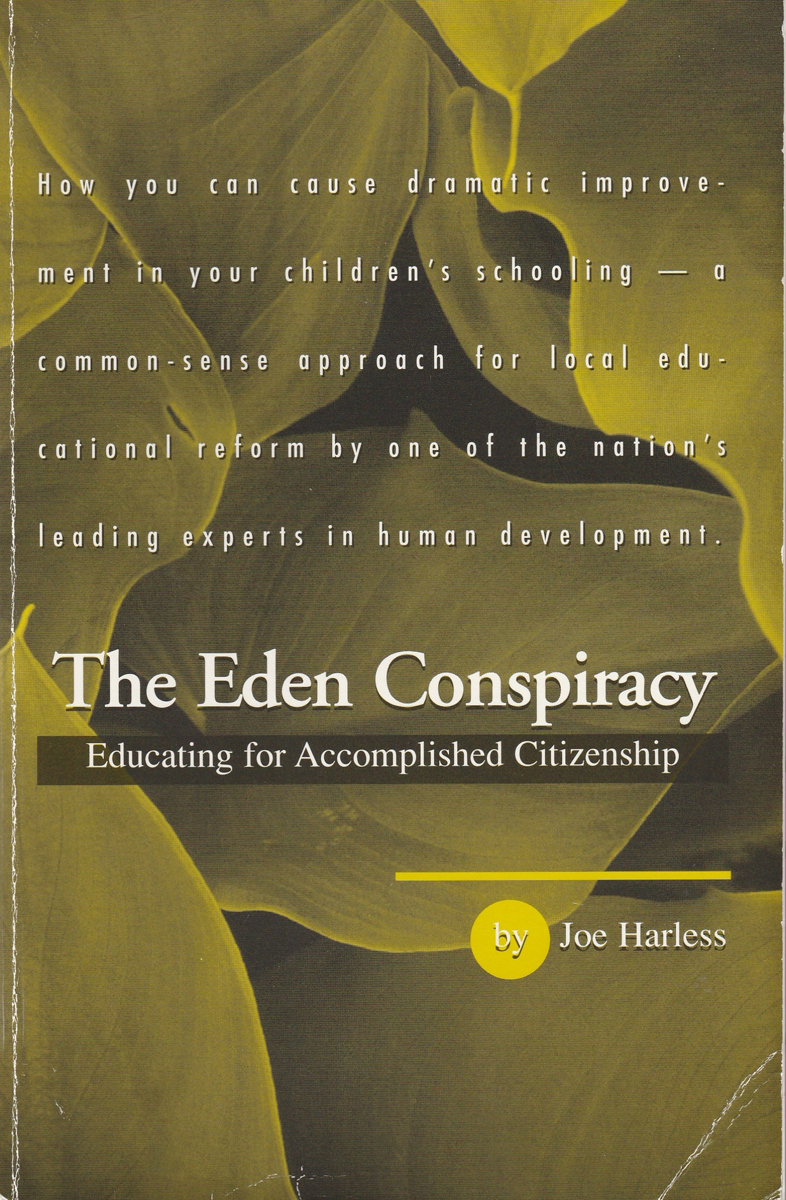
I’ve been reading a book about education reform, called The Eden Conspiracy: Educating for Accomplished Citizenship, by Joe Harless, © 1998. Even though it’s two decades old, much of it is still current.


He compares two fictional communities: Medianville and Eden. As he lays it out,

They are twin in every respect—same size, same state, have comparable industries and businesses. They are the same in economic, racial, and ethnic makeup, and so forth. Eden and Medianville both sought to improved education in their cities, but they took very different approaches to education reform.
Medianville did some typical education reform actions:

1.       Increased teacher salaries.
2.       Reduced teacher-student ratio.
3.       Toughened grading policy.
4.       Grouped students by ability.
5.       Provided more audio-visuals.
6.       Instituted “Teacher of the Year” award.
7.       Encouraged “back-to-basics.”
8.       Formed alliances with local businesses.

The results after a decade and a half?

·         No improvement in reading scores (60% deficient).
·         SAT scores flat, no improvement.
·         36% first-year college students require remedial courses.
·         High school dropout rate 25-30%, no improvement.
·         97% of high school seniors at or below minimal or adequate level.
·         All but a few “A” science students fail to solve basic science problem/question.
·         One third who take Calculus in college drop or fail the course.
·         25% believe the sun rotates around the earth.
·         50% cannot use a bus schedule. 15% cannot address an envelope.
·         Under 10% can compute what borrower pays on $850 loan at 12% interest.
·         30% cannot make change.
·         Under 50% can find New York on a blank map. 75% don’t know when Lincoln was President or in what half century the Civil War occurred, and half fail to know other basic history facts.
·         75% of applicants for entry-level jobs at the largest industry in the area fail basic literacy test.
Cost per student has increased 50% (adjusted for inflation) from pre-intervention period.

There are also social outcomes. Violence has increased. Homicide is the second most frequent cause of death in teens and young adults. One third of young women get pregnant as teens (increase of 200% since 1960). A third use illegal drugs. Among high school dropouts, half end up before a judge in 5 years. Most who go to college fail to get a degree. Employers say the young people they hire are deficient in writing, basic math, oral communications, working with a group, and basic computer skills.

Harless reveals, after introducing these two cities that the data for Medianville is real. The interventions are proven to fail.

I would add that, in the following two decades, the same interventions are being done, to similar effect. The only significant rise is cost per student.

What about the other fictional city, Eden? In short, he uses an accomplishment-based approach, which requires some explanation. And he involves the entire community—a conspiracy of parents, teachers, business owners, and essentially everyone in the community (thus, the book’s title).

I’m still just halfway through reading the book, but I remain unconvinced that his solutions will solve public education. Personally, I believe parental responsibility and free market are the roots to nourish for better outcomes.

But I’m willing to look at the ideas to see what families can use.

He creates a chart contrasting the two education systems [p. 34].


There’s a main principle that I think might be worth further examination. Harless suggests that, rather than brainstorming possible solutions and trying whatever combination some committee chooses, the stakeholders should look first at the desired outcomes. Both cities aim to improve education, but they picture the outcome differently.

It’s near the top of the chart above. Medianville sees the purpose of education as to “provide opportunity for the young to acquire knowledge of traditional subject matter.[i]” Eden sees the purpose as to “produce graduates who have skills, knowledge and attitudes to become accomplished citizens.”

OK. So Harless’s way is more future based, more relevant to the students’ post-school world. We still need to know a definition of “accomplished citizens.” But, once we do that, Harless says, the next step will be to identify what accomplishments are needed for such citizens—what can they do consistently?

Designing instructional programs, he believes, comes from starting with the end in mind.[ii] So, we start with “accomplished citizens,” and work backward from there. What does this result look like?
He offers this list of what characteristics such a society has:

·         Exists under a democratic form of government.
·         Is lawful, orderly, ethical, and safe.
·         Allows freedom for its citizens—within the law.
·         Allows freedom for enterprise—within the law.
·         Provides equal opportunity for its citizens.
·         Values the family as the basic unit of society.
·         In partnership with the family, provides protection and development of the young.
OK. My interest is piqued with those last two. Here at the Spherical Model, we know that the family is the basic unit of society—and that strong families doing their job is necessary for civilization, which is what I think he’s talking about here.

His list isn’t very exact. Those are the ends to have in mind. What are the accomplishments, or outputs? Whatever they are, they need to be concrete, measurable actions. These outputs, he says, must be a noun [p. 52]. The focus must be on an end result, not a process. For example, “Madame Curie won the Nobel Prize.” The prize is an accomplishment, or output. Another example is, “Mary produced the highest number of sales.” The sales, which can be counted, are the output; having more sales than others is a specific measurable output.

I will just mention here that he is not talking about what has been called “outcome-based education.” Some of the words may be used. And we could contrast them fully another day. But outcome-based education mainly means that curriculum should have goals—such as being able to pass a test. Often it has been pretty much just another iteration of the interventions Medianvillle took (see list above).

So, with measurable outputs in mind, he offers these accomplishments of good citizens: [p. 53]

·         Obedience to the law.
·         Informed voting decisions.
·         Contributions to stable environment.
·         Resolution of interpersonal conflict.
·         Contributions to community improvement.

I agree those are desirable behaviors. But I don’t think Harless has given us good examples of measurable, countable nouns; he’s still pretty focused on behaviors. Nevertheless, if you want these outcomes, what goes into them?

Harless says,

Knowledge, skills, information, and student attitudes are inputs in education. Given these, we want the student to be able to perform processes such as problem solving, finding information, and making decisions so that they produce accomplishments of value to the goals [p. 53].
So, there’s the current way: start with subjects, teach what teachers say needs to be known, and then let the student figure out how to make that relevant. And there’s the alternative he suggests: start with what results we want (good citizens, civilized adults), and work back to what outcomes are needed for those results (laws are obeyed, votes are prepared for and cast, interpersonal conflicts are amicably resolved), back to what a person needs to know, or be able to do, in order to accomplish those things—inputs needed to get the results.

That’s what determines curriculum.

Let’s say a contributing adult manages his money—spends less than he earns, pays bills, etc. He would need to know some math—specifically adding and subtracting to balance a checking account. He would make spending decisions based on what he knows is in his account, and whether something fits in a budget—more math.

If he needs a loan for a car or house or other major purchase, he needs to know how interest works—so he’d need enough math for that. There are formulas he can look up, so he might not need to have them memorized, or be able to figure them in his head, but he would need to know how to put his information into a formula to figure the results—and understand the effects. He should know that paying back a loan with interest is more expensive than paying for something up front, so he must be able to weigh the pros and cons.

When the math becomes relevant, the student learns it better. Get a high school boy to figure out how to afford a car, and he’s a lot more motivated than when you say he has to solve so many pages of problems in order to earn a grade.

There’s truth in that—when it’s relevant, students learn more readily. I’m still not sure how we can get there from where we are in a public school system.

In the two decades since the book came out, I think his method has been tried in a number of isolated private schools—but no public school systems. In a private school, you already have committed parents—because they’re paying good money and will insist on seeing results.

If we had real local control in a public school district, maybe some measurable change might be possible. But as long as local school boards are filled with teacher-union-approved candidates, meaningful change can’t happen. Also, as long as federal and state governments keep a tight grip on education, local areas don’t have the freedom to break free from the tried-and-proven-to-fail standard approaches.

Meanwhile, individual families can “conspire” against the system—by educating their own children. When they do, it’s good to have an end in mind.

If I were to brainstorm outcomes for a young adult, I might include,

·         Reads books and articles for interest and enjoyment at least several times a week.
·         Keeps current on world, national, and local news, always attuned to source and bias. Shows this ability in conversation.
·         Forms opinions based on study, and articulates opinions with supportable points, while respectfully hearing and considering opposing arguments. Shows this ability in conversation.
·         Displays good manners—both for social grace and for showing respect and kindness to others.
·         Finds opportunities to work, and serves well in those opportunities. (Has a resume. Fills out job applications. Works in entry-level jobs followed by higher-skilled, better-paying jobs.)
·         Manages time, money, and things—budgets, balances accounts, pays bills, keeps commitments, cares for laundry, buys and cooks healthy meals.
·         Improves skills and increases knowledge base in field of work as well as other interests.
·         Maintains good physical, emotional, and spiritual health—seeking expert help as needed.
·         Spends plenty of quality time with family; makes family a high priority.
“Adulting” is hard—and so is raising children into mature adults. But it’s not rocket science. There’s a lot of curriculum that could lead to these outcomes. There’s also a lot of information/direction/advice—some worthy of college courses—available online, much of it for free. And a lot of this comes pretty naturally from living in families that model and pass along civilized behavior.

What we need is freedom from a system that asks nothing better than “What should students learn in each subject each year?” and spends exorbitant amounts of money repeating failed strategies.

What we need in education is more family, more free market, and more relevance to real life.


[i] It’s interesting to see that top education leader Iceland has recently instituted schools with cross-disciplinary topics, as described in “Finland to Become World’s First Country to Get Rid of All School Subjects,” Nov. 11, 2016.
[ii] This is my rephrasing of what he’s doing, and it may sound familiar as one of Steven Covey’s 7 Habits of Highly Effective People.

Friday, June 2, 2017

In Case of Panic, Breathe

Yesterday President Trump announced the US withdrawal from the Paris Climate Accord, and the world is in turbulence today.

Panic, generally, does not lead to good results. So I thought I’d comment today in an effort to encourage calm.

Because the Spherical Model is about the interrelationships of the political, economic, and social spheres, I’ll try to cover all three aspects (which are somewhat mixed, because of their interrelationships).

Our beautiful world includes climates that change.
This was a normal Utah winter, 2013.


First, the political perspective—the freedom-related issues. The agreement was not your typical international treaty. In December 2015, when then-president Obama signed on, he did something that we Americans don’t give our presidents power to do: he signed onto an international treaty without passing it along to the legislative branch for agreement. It’s not that he signed a treaty, sent it to Congress, and they disagreed with him, so they voted it down. He never sent it—never intended to send it.

Another oddity of the agreement was that it was set up with a 4-year back-out period. Like a major purchase in which you have three days to cancel the contract. He did this a year and a month before a new president would be sworn in. In other words, the whole thing was a PR stunt, not law. He knew it would not stand. He was just posturing before the elites of the world that he wanted to impress.

If he had truly believed that we are in dire straits, and this accord would be the only way to save the world, wouldn’t he have simply made the case? Instead, he, along with other elites, tried to shut down the conversation. Anyone who questions the line we’re being given, or asks for data and evidence and convincing, has been labeled a “climate denier.”

Jeffrey A. Tucker, of the Foundation for Economic Education, offered this explanation:

Let me pause to protest this “denial” language. It attempts to appropriate the widely shared disgust toward “Holocaust denial,” a bizarre and bedraggled movement that belittles or even dismisses the actual history of one of the 20th century’s most egregious mass crimes against human rights and dignity. Using that language to silence questions about an attempt to centrally plan the energy sector is a moral low that debases the language of denial.
This rhetorical trick reveals all you need to know about the desperate manipulation the climate planners are willing to engage in to realize their plot regardless of popular and justified skepticism concerning their regulatory and redistributionist policies.
I’m not an expert, or a scientist. But I have a good enough mind that, if things are explained to me, I can understand them. Here’s what I think I know. Climate changes. All the time. The earth has not always been the way it is now. We’re in a warming cycle—that we’ve been in since the Little Ice Age, which we are still coming out of (it was from 1300-1850, following a warm period from 900-1300). In this rising trend, there are shorter warming and cooling periods, roughly 30 years each. We were in a cooling segment from about 1942 to 1977, and then temperatures rose from about 1977 to 2005. Overall, since then temperatures have been flat or slightly cooling.

Chart citation[i]

This trend has been happening since before the Industrial Revolution. And far before the predominance of gas-powered vehicles and fossil-fuel powered electricity and heating.

I remember being a young woman and hearing scientists convince us we were in a global cooling period—because of pollutants like carbon monoxide in the atmosphere. They were trying to get funding to put particulates into the atmosphere, to create a beneficial greenhouse effect. This was, I believe, before the end of the warming segment.

And then, almost as suddenly as it had started, that talk ended (coinciding, ironically, with the period of stasis or slight cooling that we’re still in); we were in a deadly warming period, because of greenhouse gases—mainly carbon dioxide. I did a double take the first time I heard that. “You mean carbon monoxide, don’t you? Because that’s a poison. But carbon dioxide is just what we breathe out and plants breathe in.” No, we need to disregard the science we thought we knew for this sudden new science.

So, when I ask for data and convincing, there’s good reason.

How much of the atmosphere is greenhouse gases? 1-2%. Mostly it’s nitrogen and oxygen.

How much of the greenhouse gases in the atmosphere is CO2? 19%. Greenhouse gases are 75% water vapor and clouds. In the atmosphere as a whole, C02 is a trace gas, only 4/10,000 molecules.

And the next question is, how much does the trace gas carbon dioxide affect the climate—and is that bad or good? In general, we’re in a lot more danger as humans from cold than we are from warm. A degree or two might mean greater land mass available for growing food, and better plant growth. (I was recently told cannabis growers know this, so they pump in C02 to improve crop yields.) So it’s not necessarily catastrophic, even if true.

But if, for the sake of questioning, we say that C02 has an effect, how much? Haven’t there been fluctuations that appear independent from C02 levels? So we’re not even sure of that cause-effect assumption.

The CO2 line is too thin to show up on the chart.
I developed the chart from information in a book.[ii]

Then, how much of the C02 is manmade? 3%. Nature put more C02 into the atmosphere every day than all of us.

Do humans play a role, then, in climate change? Yes, but only negligibly. Like how, when you jump up, not only are you exerting a force that moves you away from the earth, but you are exerting a force that moves the earth away from you. True. I learned it in a science class. When two bodies have nearly equal mass, you can see the effect better, but when they are very disparate, as between the mass of earth and you, your effect on the earth is so small as to be hard to measure.

There are other parts of the climate change crisis that I question.

Ice has been melting in the Arctic; it’s at a 30-year low. (Polar bear populations, incidentally, have grown from 22,000 in 1960 to 31,000 today, doing better with less ice.) Greenland is losing ice around the edges, but it’s getting thicker in the center, so it’s stable. Ice in Antarctica, which contains 90% of the earth’s ice, is at a 30-year high.

Every computer model has been wrong. Instead of assuming “but now they’re right,” maybe we should go back to find out why they deviated from reality and fix that before we trust them.
The Paris Climate Accord would require that US emissions be limited by 83%[iii]. That would be lowering emissions by 1.5 tons per person—a sacrifice that is countered by nature twenty-fold every day.

If we could return to pre-1870 technology levels, then, by the end of the century, using the most generous of computer models (which include much more severe cutbacks in emissions following 2030 than have yet been agreed to), then we might have a slight effect on only 1% of the assumed greenhouse effect. A century’s worth of worldwide technology dieting could be wiped out by a single major volcanic eruption. In dieting terms, that’s enough to send you to the freezer to drown your frustrations with your own personal gallon of ice cream.

The cutbacks required of the US are much greater than for other nations. Our economy would be drastically affected. Our energy sector would be emasculated. Anyone who thinks we could simply shift to other energy sources, like wind and solar, are mistaken. While I’m in favor of innovation, the cost to the environment for these alternatives is currently greater than that of fossil fuels.

Climatism (not climate-related science, but the thing you’re not allowed to question) looks to me like a pagan religion. The sacrifices being required of us in the essentially vain hope that such sacrifices will appease the climate gods look eerily similar to throwing people into the volcano. It might make people feel like they have some control over something out of their power, but it doesn’t actually affect an eruption—and it’s really bad for the ones who get thrown into the volcano.

So, if you were in favor of the Paris Climate Accord, you were in favor of ceding American sovereignty to foreign sources, allowing them to impose limitations on us that would in the short-term require us to limit ourselves to second-world status, and eventually to third-world conditions, and we would get out of in only the satisfaction that we had appeased the climate panickers.
Our president thought that was a bad deal.

As Tucker sums up:

A global agreement that somehow binds entire countries to centrally plan and regulate the whole of a crucial sector of economic life that supports all economic advances of our time—at the very time when the energy sector is innovating its own solutions to carbon emissions in the cheapest possible way—is certainly going to breed resentment, and for good reason. It is a bad and unworkable idea.
The Paris Climate Accord was bad for freedom, bad for the economy, and bad religion. So, let’s not panic. Let’s breathe—even though you’re going to exhale C02. And maybe do a better job of scientific conversation going forward.


[i] This chart was adapted from Climate4You, www.climate4you.com/ . I found it in The Mad, Mad, Mad World of Climatism, by Steve Goreham, © 2012, p. 67.
[ii] Gorham, pp. 83-83.
[iii] Gorham, p. 18, which takes population data from N. C. Aizenman, “U.S. to Grow Grayer, More Diverse,” Washington Post, Aug. 14, 2008, http://www.washingtonpost.com/wp-dyn/content/article/2008/08/13/AR2008081303524.html

Monday, May 29, 2017

Last Full Measure of Devotion

It’s Memorial Day, and I want to add my tribute to those who paid the “last full measure of devotion.” Mostly I’ll be sharing tributes others have offered that I think are beautiful.

Let’s start with words from Lincoln’s Gettysburg Address:

…that from these honored dead we take increased devotion to that cause for which they gave the last full measure of devotion—that we here highly resolve that these dead shall not have died in vain—that this nation, under God, shall have a new birth of freedom—and that government of the people, by the people, for the people, shall not perish from the earth.—Abraham Lincoln, Gettysburg Address
These words from Lincoln show up at the end of the three-minute video below, Hillsdale College’s Memorial Day tribute from 2016, which includes Ronald Reagan offering tribute, plus the song “Mansions of the Lord.”

Here are some of Reagan's words:

We are a nation under God, and I believe God intended for us to be free. We must realize that nor arsenal or no weapon in the arsenals of the world is so formidable as the will and moral courage of free men and women.
The price for this freedom at times has been high. But we have never been unwilling to pay that price.
Those that say that we’re in a time when there are no heroes, they just don’t know where to look.


President Reagan had a knack for saying the right thing. Here’s another tribute using his words. It comes from Champion Forest Baptist Church, which is in Northwest Houston, from 2014, which includes these words from Pres. Reagan:

The imagination plays a trick. We see these soldiers in our mind as old and wise. We see them as something like the Founding Fathers—grave and gray-haired. But most of them were boys when they died. And they gave up two lives: the one they were living, and the one they would have lived…. They gave up everything for our country, for us. We owe them a debt we can never repay. All we can do is remember them, and what they did, and why they had to be brave for us.


One more. This links to a tweet from 2015 in which Chris Pratt is teaching his son the Pledge of Allegiance. It should make you smile.