Showing posts with label Eden Conspiracy. Show all posts

Thursday, November 21, 2019

The Purpose of Education


I’ve been putting together a presentation for this coming Saturday. At our Tea Party, we’re spending two consecutive meetings on education issues. My part will be on homeschooling. The beginning segment is about the purpose of education, and some history of education. Since that’s where my thoughts are today, I might as well give a preview here.

The purpose of education, according to Aristotle, is to produce a great soul.

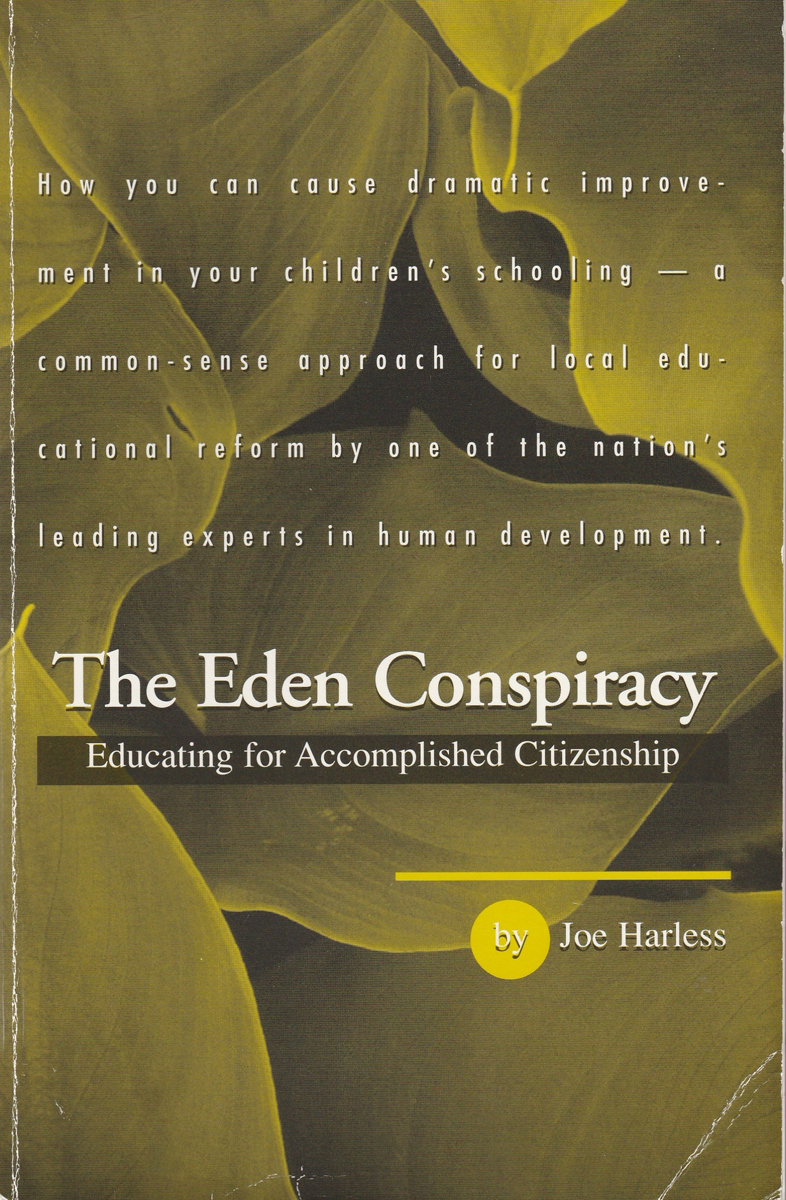
Joe Harless, in his book The Eden Conspiracy, says education should be about producing an accomplished citizen. It should teach the knowledge, skills, and information relevant to becoming accomplished members of society.


What should an accomplished member of society be accomplished at doing—regardless of how the person makes a living?

·         Obedience to the law.
·         Informed voting decisions.
·         Contributions to stability.
·         Resolution of interpersonal conflict.
·         Contributions to community improvement.
The Northwest Ordinance, one of our lesser known founding documents, written in 1787, the same year as our Constitution, says “Religion, morality, and knowledge being necessary to good government and the happiness of mankind, schools and the means of education shall ever be encouraged.”

So the purpose of education, then, is to teach religion, morality, and knowledge so that we can have good government and happiness.

Note that encouraging schools and the means of education did not mean government provided it, only that it would offer a gift of land—after surveying, one 16th of the land would be sold to private owners, and the proceeds would be used “within that township” to help with the building of schools. No state or national oversight. No ongoing support. Simply a one-time grant to encourage building schools.

So far we’re using different words, but we’re pretty much in agreement about what we want schools to do.

According to Oliver Van DeMille, in A Thomas Jefferson Education, there are three types of
education, each with its particular purpose:

·         Public education
·         Professional education
·         Leadership education
We’ll take these in turn.

First, public education. It’s intended to prepare a person for a job, or for servant labor. It teaches what to think. It is implemented in cultures to give opportunities to the poor, to lift them from being a burden on society. The downside—everywhere it had previously been tried—is the deterioration of other education, which can’t complete with “free.”

Second, profession education. It’s intended to prepare for trade, often through apprenticeship, for skilled artisan work, and for law, medical, MBA, or other professional training. It teaches when to think, or under what circumstances to use their specialized training. So, the purpose is to create expertise. It meets this goal, but it is not a substitute for leadership training.

Third, leadership education. It’s intended to produce leaders in home and communities, entrepreneurs in business, statesmen in government. It teaches how to think. So it trains thinkers. It develops character, competence, and capacity to do the right thing—and to do it well—in business, government, church, school, family, and other organizations. It perpetuates freedom.

Historically, for thousands of years, those with resources provided home tutoring, often followed by trade apprenticeship and professional training. Meanwhile the poor got whatever minimum was necessary to make them useful—usually emphasizing physical labor over brain labor.

Public education—that first type, for preparing the poor for service labor—was first tried in America during a time when many immigrants were working in factories, and their children were left to wander the streets. This coincided with the industrial revolution.

In comes Horace Mann, an atheist “progressive.” He said,

What the church has been for medieval man, the public school must become for democratic and rational man. God will be replaced by the concept of the public good…. The common schools… shall create a more far-seeing intelligence and a pure morality than has ever existed among communities of men (quoted in Christopher Klicka, The Right Choice—Home Schooling, p. 32).
Within two generations, Mann's ideas flooded the nation. There was the problem of large numbers of poor students from uneducated families. He offered the factory model. Subjects were separated, rather than integrated. Timing was determined by ringing bells, just like in the factories. Schools were top-down authoritarian. Uniformity was paramount.

Then along came John Dewey—of Dewey Decimal System fame. In 1916 he published Democracy in Education. He’s more or less the father of “progressive” education. He had plans to “revolutionize” child training. “Self-realization” became the goal instead of “learning.” He gave no more than a casual nod to teaching English grammar, ancient history, US history, geography, classics of Western civilization, or science.

He looked upon the schools as a wonderful opportunity to indoctrinate America’s youth in the “virtues” of a glorious age where private property, the free market, open competition, and profits would all be eliminated.

What was his background? He got his PhD from Johns Hopkins, studying under G. Stanley Hall—a disciple of German socialist Wilhelm Wundt. Dewey visited the Soviet Union in the 1920s. He failed to recognize the revolutionary desolation and widespread destruction of human values, and instead described it as “a popular culture impregnated with esthetic quality.”

According to W. Cleon Skousen, in The Freeman’s Digest, May 1984, “Today we are reaping the tragic results of the pedagogical misery that America inherited from Dewey’s misadventure in experimental education.” As he explained Dewey’s history before that Soviet visit,

Long before, in 1904, he had joined the faculty of the Teachers College at Columbia University. He had then teamed up with James Earl Russell, the dean of the Teachers College, who was also a student of Wilhelm Wundt, and together they had worked for a quarter of a century diligently building this branch of Columbia University into the largest institution in the world for the training of teachers. By 1953, about one-third of all the presidents and deans of teacher training schools in America were graduates of Columbia’s Teachers College.
One of his contemporaries, Dr. Robert M. Hutchins, saw through the scheme to its logical consequences:

The disappearance of great books from education and from the reading of adults constitutes a calamity. In this view, education in the West has been steadily deteriorating; the rising generation has been deprived of its birthright; the mess of pottage it has received in exchange has not been nutritious; adults have come to lead lives comparatively rich in material comforts and very poor in moral, intellectual, and spiritual tone (Great Western Books, vol. 1, preface; pp. xii-xiii).
I may have told this story elsewhere, but there’s a segment of To Kill a Mockingbird, where the young protagonist, Scout, describes her disappointment with school. Her description of the first day of first grade (no kindergarten back then) is worth retelling.

Scout’s teacher discovers that she not only knew the alphabet, but she could read all the readers and The Mobile Register (newspaper), which she had learned naturally just by sitting with her father and reading together in the evenings. The teacher says,


“You tell him I’ll take over from here and try to undo the damage—”
“Ma’am?”
“Your father does not know how to teach. You can have a seat now.”
I mumbled that I was sorry and retired meditating upon my crime. I never deliberately learned to read, but somehow I had been wallowing illicitly in the daily papers (p. 22 of my copy).
Apparently John Dewey was to blame. She goes on:

The remainder of my schooldays were no more auspicious than the first. Indeed, they were an endless Project that slowly evolved into a Unit, in which miles of construction paper and wax crayon were expended by the State of Alabama in its well-meaning but fruitless efforts to teach me Group Dynamics. What Jem [her brother] called the Dewey Decimal System was school-wide by the end of my first year, so I had no chance to compare it with other teaching techniques. I could only look around me: Atticus [her father] and my uncle, who went to school at home, knew everything—at least, what one didn’t know the other did. Furthermore, I couldn’t help noticing that my father had served for years in the state legislature, elected each time without opposition, innocent of the adjustments my teacher thought essential to the development of Good Citizenship. Jem, educated on a half-Decimal half-Duncecap basis, seemed to function effectively alone or in a group, but Jem was a poor example: no tutorial system devised by man could have stopped him from getting at books. As for me, I knew nothing except what I gathered from Time magazine and reading everything I could lay hands on at home, but as I inched sluggishly along the treadmill of the Maycomb County school system, I could not help receiving the impression that I was being cheated out of something. Out of what I knew not, yet I did not believe that twelve years of unrelieved boredom was exactly what the state had in mind for me (p. 37).
Maybe it’s time we re-think what is normal.

In six thousand years of human history, children have been brought up and taught by their parents. Turning that responsibility over to the state is a social experiment—an undeniably failing experiment—begun only about a century ago.

While we homeschoolers may look radical to the people around us who don’t know anything different from government institutional factory-like schools they grew up with, we are the ones following the traditional pattern.

We homeschoolers are the ones doing leadership education. We’re the ones teaching how to think.

And insofar as we do well in teaching the knowledge, skills, and information relevant to becoming accomplished members of society, we’re producing great souls.

My kids were worth it.

Thursday, September 21, 2017

In the Mind-Changing Business

I was talking with son Political Sphere the other day, about Ben Shapiro’s speech last week at Berkeley. I watched it live-streamed, and he had watched it replayed later. We had both enjoyed it. We’re Ben Shapiro fans.

The Q&A following the speech was pretty epic. You may have seen a clip of him doing a little debate with an audience member on the issue of abortion. I’ll include it here, because it may be the clearest delineation of the two sides (and the obvious morality of one over the other) that you will see in two minutes.


Ben Shapiro isn’t someone you can safely disagree with; he will win in a debate. He will have the facts in his head, and be able to lay out the argument in a logical way. And, as Political Sphere was pointing out, he never uses an emotional argument.

I am a lover of truth. Sometimes finding truth requires not only laying out the facts and arguments, but also applying conscience, which can be emotional, but is trained toward truth—unless you have practiced overriding your conscience.

When someone uses an emotional appeal—“But what about the children?” “Shouldn’t everyone be allowed to love the person they choose?” “Do you want people to die without health care?”—the emotion is typically irrelevant to the issue.

Do we care about children? Of course. It may be that we care more; we actually want them to be raised in stable families and taught to become productive, civilized adults. A policy that doesn't bring about those results doesn't qualify as actual caring.

Are we against love? Of course not. We’re not even against people committing to the person they choose. What we’re against is being forced to give some other arrangement the imprimatur that God gives to actual marriage.

Do we want people to die without healthcare? Of course not. But forcing people to buy a type of insurance they don’t want and can’t afford, and which does not meet their particular needs, is not providing actual health care. What we see as a better way of getting care to everyone is free market plus philanthropy—both of which are hindered by government interventions.

Those are just examples. Emotional and logical people talk past each other, because one side rushes to place its ladder on the wrong wall and insists that we have to climb, while the other side looks around to determine where is the best wall to place the ladder against, and goes there instead—and then gets yelled at for not climbing the ladder on the wrong wall.

Earlier this week I listened to a Daily Wire Conversation with Ben Shapiro, a full hour of his conservative brand of fun, covering, at breakneck speed, political topics as well as music, movies, and religion. About ten minutes in, the host, Elisha Krauss, asks Shapiro about whether he intended to someday run for president. I’ve never heard him talk about any political aspirations before, and he wasn’t positive about any here either, but he didn’t rule it out. But he said something about his purpose—and the purpose of The Daily Wire, where he is editor-in-chief—that struck me:

Eisha Krauss: What would it take for you to run for president in 2020 or 2024?
Ben Shapiro: So, 2020 is not going to happen. I am old enough—like, right at the cusp. So I turn…  Let’s see, I was born in ’84. So, in 2020 I would turn 37. But the problem is that I wouldn’t want to divide the Republican Party, and whatever happens right now, President Trump is the titular leader of the Republican Party; there are a lot of people that are very loyal to him. The last thing you want to do is sink the candidate of the Republican Party in the primaries and destroy him for a general election. Or, alternatively, alienate half of the people who are big Trump supporters.
So I think it’s Trump of bust for the Republican Party in 2020.
Further down the line, yeah, we’ll see what happens. I don’t really have any intention of doing anything like that right now, but that’s because we’re focused, obviously, right now, on building the company, but in ensuring that the message gets out to the widest variety of people available.
And I’m actually not sure whether you do more good convincing people outside of government, or being in government, trying to convince people. Once you sort of have the patina of government stamped on you, I wonder how many ideas you can actually…how many minds you can change, as opposed to being in the mind-changing business, which is what we do here.
He’s in the mind-changing business. That’s very close to what I do. Maybe that’s why it struck a chord.

It’s an educational mission, changing minds. Mine is more refined as, “Let’s reframe the structure of the ideas, so we can see how they interrelate, and thereby make decisions that will lead us in the right direction—toward freedom, prosperity, and civilization.” Shapiro’s arguments fit well in my framework, but he’s doing more of the nitty-gritty details, issue-by-issue, comparing the two sides and showing clearly which side makes more sense, both morally and economically. While I try to do that too, on certain issues, I don’t tackle as many issues each and every day.

There’s a book I’ve been spending some time on—referred to it beforeThe Eden Conspiracy, by Joe Harless—that is education oriented, with the purpose of producing “graduates who have skills, knowledge, information, and attitudes to become accomplished citizens.” I agree with that goal, but then we have to define what an accomplished citizen is.

The author suggests that a society of accomplished citizens would have these characteristics [p. 47]:

·         Exists under a democratic form of government.
·         Is lawful, orderly, ethical, and safe.
·         Allows freedom for its citizens—within the law.
·         Allows freedom for enterprise—within the law.
·         Provides equal opportunity for its citizens.
·         Values the family as the basic unit of society.
·         In partnership with the family, provides protection and development of the young.
That’s not too different from how I describe civilization in the Spherical Model. But there’s some difficulty, not only in getting schools to teach these values, but even to agree on which values, and what those values mean.

Harless mentions an anecdote from his household: p. 148

This reminds me of the time our four-year-old son was going to a friend’s house. As usual, my wife admonished Be a good boy. With all sincerity he asked, Mom, what IS a good boy? I don’t recall what she then told him, but the question became our family’s response when any of us became too soft [ambiguous] in our speech.
This lack of precision in speech is part of why there is so much strife in society.

For example, can we agree that being tolerant of differences is a necessary value in a non-homogenous, free society? Yes. But what does tolerance mean? One side simultaneously screes, “Don’t shove your beliefs down my throat!” while using the force of dubious law, social shunning, economic boycotting, and even fascist violence to enforce their beliefs on those who disagree.

A non-slave should not be forced to use his artistic talents to portray a message that goes against his religion, for example. It’s not about a couple getting a cake for a gay wedding; they can get that elsewhere; forcing a particular baker to do it is the ultimate intolerance—beyond what slaveholders ever had the power to force their slaves to do.

Tolerance doesn’t mean we must believe or do all the same things; it means we ought to calmly agree to disagree.

Ben Shapiro’s speech at Berkeley is important for several reasons. One is that it became clear to anyone paying attention that his speech was not a threat; those trying to shut down his speech were a threat. Also, he spoke clearly, rationally, and calmly—even respectfully—toward those who disagreed with him. And that civilized decorum allows for an actual conversation.

If there is an actual conversation, in which terms are agreed on for common ground, then there can be mutual understanding. That may or may not lead to changing minds, but at least it gets rid of the hostile assumption that anyone who disagrees with some prevailing viewpoint is evil and must be eliminated.

If an idea is right, if it’s true, it stands up to scrutiny. If you feel so threatened by someone articulating an idea that you don’t agree with that you must resort to violence to forcibly shut down that speech, maybe your idea is weak. Maybe you’re wrong.

On the Spherical Model, shutting down free speech is a southern hemisphere tyrannical behavior. It could be in the statist tyranny quadrant, with government preventing the speech; or it could be in the anarchical tyranny quadrant, with mobs preventing the speech. Either way, it does not lead to the enlightenment necessary for civilization.

What I believe—what I trust about humanity—is that minds can be changed to come to see the truth. I believe that most people want to think of themselves as good and right, and so, if presented the truth clearly, without clouding emotional pressure, they will choose truth. I might be wrong. But I hope I am right.

Truth is worth seeking and finding. And it’s worth finding ways to express it so that minds—and lives—can be changed for the better.

Thursday, June 8, 2017

Start with the End in Mind, Part II

Mondays post was mainly about education (specifically, educating for accomplished citizenship). But the process of figuring out what and how to teach is something that can be applied in a larger context. So I thought I’d apply it to the Spherical Model today. I’m doing this as an exercise; I can’t say I’m expert at this process. So we’ll find out together whether the exercise is fruitful.

So that we’re on the same page, I’ll start with reminders of what the Spherical Model is, and what human performance expert Joe Harless says is the process for coming up with what to teach.

The Spherical Model is about the interrelationships of the political, economic, and social spheres. In each of these interrelating spheres, the goal is north: freedom, prosperity, and civilization respectively. We want to stay away from—or move up from—the south: tyranny, poverty, and savagery respectively. East/west is neutral, relating to the appropriate interest, from most local ( furthest west longitude) to global (furthest east longitude)—with one proviso: issues should be handled at the most local level possible. When a higher level tries to control a lower level’s issues, the result is movement southward on the sphere.

To review the process outlined by Joe Harless in the book on education, here’s the order:

1.       Identify the results you want.
2.       Identify the measurable outputs/accomplishments that indicate accomplishment of the result.
3.       Identify behaviors/skills that must be used in order to get the outputs.
4.       Teach those behaviors/skills in the context of their purpose.
There’s probably more to it than that, if you’re going to use the process in developing a school system or a training program in the business world. But this will do for our purposes today. I don’t think we can even cover all four steps in a blog post (not sure I’ve covered them fully in the 800+ posts on this blog). But maybe we can identify what we want, plus a few measurable outputs that would show we are getting there.

The Results We Want

We want freedom, prosperity, and civilization. What do each of those look like?

Freedom: I used this definition in “What Is Freedom” a year and a half ago:

The Political Sphere


Absence of hindrance, restraint, confinement, repression. In the political sense, it is ownership of one’s own life and the production of wealth and property that results from one’s use of life and effort. A government should protect the freedoms of life, liberty, and property; it does not grant these things, but protects them from infringement. A government that takes life, liberty, or property unjustly—when the person has not unlawfully infringed on those rights of another person—that is a tyrannical government, which is the opposite of freedom.
Political freedom means living in a society in which our God-given rights are protected rather than infringed. These would include freedoms of belief and expression, such as freedom of religion and freedom of the press, as well as freedoms of property and security, such as freedom from illegal searches and seizures and the right to bear arms.
So, in the language of results, we have freedom when our rights are protected, and government is limited to that protective role of securing life, liberty, and property. The Preamble to the Constitution delineates the limits of government’s role, and the rest of the Constitution enumerates the powers the government is granted to accomplish its role.

Specific measurable outputs might include these:

·         Secure borders.
·         Sovereignty respected; peace with other civilized nations.
·         Effective and disciplined law enforcement and judicial system.
·         Representative government strictly limited to government’s proper role.
·         Adequate infrastructure.
·         No slavery or indentured servitude.
Prosperity: We’re born naked, impoverished, and inexperienced. It is by growth, hard work, and gaining in expertise that we try to overcome this condition throughout our life. Prosperity, then, means having a standard of living in which basic needs of food, clothing, and shelter are met, and opportunities for improved living standard abound. This comes from a free economy, in which we choose how we work, and more particularly how we spend what we have earned. This encourages the incentive to work harder and innovate, so that we can enjoy the fruits of labor.
The Economic Sphere


But one reason “the poor are always with us” is that some are unable, for reasons that are no fault of their own, to take care of themselves, either temporarily or permanently. Some might lack physical or mental capacity to earn enough to care for themselves. Some might be in the position of taking care of a loved one, which prevents them from earning income. Prosperity means that even those incapable of caring for themselves will have their basic needs met.

So let’s try re-wording prosperity goals as somewhat measurable outputs:

·         No death from lack of access to food or shelter.
·         Property ownership is protected.
·         Choices on how to spend earnings in hands of earners.
·         Limited taxes—that pay only for government’s proper role.
·         Fair taxes—same percentage for all income beyond subsistence earnings.
·         Low or non-existent unemployment.
·         Entry-level work opportunities.
·         Skill improvement opportunities.
·         Skilled workers well-match to business needs.
·         Entrepreneurship.
·         Parental responsibilities met (children cared for until adulthood).
·         Philanthropy—source providing basic needs to those who cannot care for themselves.
·         Upward mobility in standard of living.

Civilization: Civilization thrives when we have a critical mass of people who are moral by choice, meaning they honor God the Creator and grantor of life and liberty and definer of ultimate Good. It means they also honor family, which is the basic unit of civilization and the means of perpetuating it. Moral people also honor life, property ownership, and truth.
The Social Sphere

What does it look like? Here’s the description from the Spherical Model:

Civilized people live peaceably among their neighbors, helping rather than taking advantage of one another, abiding by laws enacted to protect property and safety—with honesty and honor. Civilized people live in peace with other civilized people; countries and cultures coexist in appreciation, without fear.
There is a thriving free-enterprise economy. Poverty is meaningless; even though there will always be a lowest earning 10% defined as poor, in a civilized society these lowest earners have comfortable shelter and adequate food and clothing—and there’s the possibility of rising, or at least for future generations to rise.
Creativity abounds; enlightening arts and literature exceed expectations. Architecture and infrastructure improve; innovation and invention are the rule.
People feel free to choose their work, their home, their family practices, their friendships and associations. And they generally self-restrain before they infringe on the rights and freedoms of others. Where there are questions about those limits, laws are in place to help clarify boundaries of civilized behavior. When someone willingly infringes on the rights or safety of another, the law functions to protect that victim as well as society from further uncivilized behavior from the offender.
So, now, for the attempt to re-word into measurable outputs:

·         Law-breaking rates low and easily handled by police.
·         Contracted commitments kept.
·         Businesses with integrity—errors toward consumers or employees corrected voluntarily and quickly.
·         Volunteer offerings of time and money to alleviate suffering of the less fortunate.
·         Thriving churches, charities, and philanthropies—shown by needs of less fortunate being met.
·         Citizen engagement high: voters educate themselves before voting; elected officials legislate no laws beyond the proper role of government.
·         Very low divorce rates.
·         Reproductive rates well above replacement—children are valued
·         Unwed parents rare; adoption is the expected result of the rare unintended pregnancy.
·         Sex outside of marriage unaccepted—not portrayed as normal and accepted in media.
·         Free expression of respectful opinions intended to preserve/repair civilization.
·         Justice that is clear, quick, and fair; creative sentences for law-breaking, including efforts toward repayment and rehabilitation.
·         Abortion and euthanasia near nonexistent.
·         Art, music, and other creative works.

One of the points of Harless’s book is that separating curriculum into discrete subjects doesn’t work. Similarly, separating the political, economic, and social spheres into discrete segments doesn’t work. They interrelate.

As I wrote in “Choosing to Solve Poverty” a year ago,

Prosperity requires a free people engaged in a free market—all of which requires a law-abiding, righteous people. Things are interrelated. There’s something that comes up in all three spheres—political, economic, and social—and that is choice
So this exercise at least lets us examine what we would see in a free, prosperous civilization.


Inculcating the behaviors to get there? That’s the lifelong job of every civilized person. And it’s done most effectively by example in the home. If we started with strengthening families, much of the rest would follow.

Monday, June 5, 2017

Start with the End in Mind

I’ve been reading a book about education reform, called The Eden Conspiracy: Educating for Accomplished Citizenship, by Joe Harless, © 1998. Even though it’s two decades old, much of it is still current.


He compares two fictional communities: Medianville and Eden. As he lays it out,

They are twin in every respect—same size, same state, have comparable industries and businesses. They are the same in economic, racial, and ethnic makeup, and so forth. Eden and Medianville both sought to improved education in their cities, but they took very different approaches to education reform.
Medianville did some typical education reform actions:

1.       Increased teacher salaries.
2.       Reduced teacher-student ratio.
3.       Toughened grading policy.
4.       Grouped students by ability.
5.       Provided more audio-visuals.
6.       Instituted “Teacher of the Year” award.
7.       Encouraged “back-to-basics.”
8.       Formed alliances with local businesses.

The results after a decade and a half?

·         No improvement in reading scores (60% deficient).
·         SAT scores flat, no improvement.
·         36% first-year college students require remedial courses.
·         High school dropout rate 25-30%, no improvement.
·         97% of high school seniors at or below minimal or adequate level.
·         All but a few “A” science students fail to solve basic science problem/question.
·         One third who take Calculus in college drop or fail the course.
·         25% believe the sun rotates around the earth.
·         50% cannot use a bus schedule. 15% cannot address an envelope.
·         Under 10% can compute what borrower pays on $850 loan at 12% interest.
·         30% cannot make change.
·         Under 50% can find New York on a blank map. 75% don’t know when Lincoln was President or in what half century the Civil War occurred, and half fail to know other basic history facts.
·         75% of applicants for entry-level jobs at the largest industry in the area fail basic literacy test.
Cost per student has increased 50% (adjusted for inflation) from pre-intervention period.

There are also social outcomes. Violence has increased. Homicide is the second most frequent cause of death in teens and young adults. One third of young women get pregnant as teens (increase of 200% since 1960). A third use illegal drugs. Among high school dropouts, half end up before a judge in 5 years. Most who go to college fail to get a degree. Employers say the young people they hire are deficient in writing, basic math, oral communications, working with a group, and basic computer skills.

Harless reveals, after introducing these two cities that the data for Medianville is real. The interventions are proven to fail.

I would add that, in the following two decades, the same interventions are being done, to similar effect. The only significant rise is cost per student.

What about the other fictional city, Eden? In short, he uses an accomplishment-based approach, which requires some explanation. And he involves the entire community—a conspiracy of parents, teachers, business owners, and essentially everyone in the community (thus, the book’s title).

I’m still just halfway through reading the book, but I remain unconvinced that his solutions will solve public education. Personally, I believe parental responsibility and free market are the roots to nourish for better outcomes.

But I’m willing to look at the ideas to see what families can use.

He creates a chart contrasting the two education systems [p. 34].


There’s a main principle that I think might be worth further examination. Harless suggests that, rather than brainstorming possible solutions and trying whatever combination some committee chooses, the stakeholders should look first at the desired outcomes. Both cities aim to improve education, but they picture the outcome differently.

It’s near the top of the chart above. Medianville sees the purpose of education as to “provide opportunity for the young to acquire knowledge of traditional subject matter.[i]” Eden sees the purpose as to “produce graduates who have skills, knowledge and attitudes to become accomplished citizens.”

OK. So Harless’s way is more future based, more relevant to the students’ post-school world. We still need to know a definition of “accomplished citizens.” But, once we do that, Harless says, the next step will be to identify what accomplishments are needed for such citizens—what can they do consistently?

Designing instructional programs, he believes, comes from starting with the end in mind.[ii] So, we start with “accomplished citizens,” and work backward from there. What does this result look like?
He offers this list of what characteristics such a society has:

·         Exists under a democratic form of government.
·         Is lawful, orderly, ethical, and safe.
·         Allows freedom for its citizens—within the law.
·         Allows freedom for enterprise—within the law.
·         Provides equal opportunity for its citizens.
·         Values the family as the basic unit of society.
·         In partnership with the family, provides protection and development of the young.
OK. My interest is piqued with those last two. Here at the Spherical Model, we know that the family is the basic unit of society—and that strong families doing their job is necessary for civilization, which is what I think he’s talking about here.

His list isn’t very exact. Those are the ends to have in mind. What are the accomplishments, or outputs? Whatever they are, they need to be concrete, measurable actions. These outputs, he says, must be a noun [p. 52]. The focus must be on an end result, not a process. For example, “Madame Curie won the Nobel Prize.” The prize is an accomplishment, or output. Another example is, “Mary produced the highest number of sales.” The sales, which can be counted, are the output; having more sales than others is a specific measurable output.

I will just mention here that he is not talking about what has been called “outcome-based education.” Some of the words may be used. And we could contrast them fully another day. But outcome-based education mainly means that curriculum should have goals—such as being able to pass a test. Often it has been pretty much just another iteration of the interventions Medianvillle took (see list above).

So, with measurable outputs in mind, he offers these accomplishments of good citizens: [p. 53]

·         Obedience to the law.
·         Informed voting decisions.
·         Contributions to stable environment.
·         Resolution of interpersonal conflict.
·         Contributions to community improvement.

I agree those are desirable behaviors. But I don’t think Harless has given us good examples of measurable, countable nouns; he’s still pretty focused on behaviors. Nevertheless, if you want these outcomes, what goes into them?

Harless says,

Knowledge, skills, information, and student attitudes are inputs in education. Given these, we want the student to be able to perform processes such as problem solving, finding information, and making decisions so that they produce accomplishments of value to the goals [p. 53].
So, there’s the current way: start with subjects, teach what teachers say needs to be known, and then let the student figure out how to make that relevant. And there’s the alternative he suggests: start with what results we want (good citizens, civilized adults), and work back to what outcomes are needed for those results (laws are obeyed, votes are prepared for and cast, interpersonal conflicts are amicably resolved), back to what a person needs to know, or be able to do, in order to accomplish those things—inputs needed to get the results.

That’s what determines curriculum.

Let’s say a contributing adult manages his money—spends less than he earns, pays bills, etc. He would need to know some math—specifically adding and subtracting to balance a checking account. He would make spending decisions based on what he knows is in his account, and whether something fits in a budget—more math.

If he needs a loan for a car or house or other major purchase, he needs to know how interest works—so he’d need enough math for that. There are formulas he can look up, so he might not need to have them memorized, or be able to figure them in his head, but he would need to know how to put his information into a formula to figure the results—and understand the effects. He should know that paying back a loan with interest is more expensive than paying for something up front, so he must be able to weigh the pros and cons.

When the math becomes relevant, the student learns it better. Get a high school boy to figure out how to afford a car, and he’s a lot more motivated than when you say he has to solve so many pages of problems in order to earn a grade.

There’s truth in that—when it’s relevant, students learn more readily. I’m still not sure how we can get there from where we are in a public school system.

In the two decades since the book came out, I think his method has been tried in a number of isolated private schools—but no public school systems. In a private school, you already have committed parents—because they’re paying good money and will insist on seeing results.

If we had real local control in a public school district, maybe some measurable change might be possible. But as long as local school boards are filled with teacher-union-approved candidates, meaningful change can’t happen. Also, as long as federal and state governments keep a tight grip on education, local areas don’t have the freedom to break free from the tried-and-proven-to-fail standard approaches.

Meanwhile, individual families can “conspire” against the system—by educating their own children. When they do, it’s good to have an end in mind.

If I were to brainstorm outcomes for a young adult, I might include,

·         Reads books and articles for interest and enjoyment at least several times a week.
·         Keeps current on world, national, and local news, always attuned to source and bias. Shows this ability in conversation.
·         Forms opinions based on study, and articulates opinions with supportable points, while respectfully hearing and considering opposing arguments. Shows this ability in conversation.
·         Displays good manners—both for social grace and for showing respect and kindness to others.
·         Finds opportunities to work, and serves well in those opportunities. (Has a resume. Fills out job applications. Works in entry-level jobs followed by higher-skilled, better-paying jobs.)
·         Manages time, money, and things—budgets, balances accounts, pays bills, keeps commitments, cares for laundry, buys and cooks healthy meals.
·         Improves skills and increases knowledge base in field of work as well as other interests.
·         Maintains good physical, emotional, and spiritual health—seeking expert help as needed.
·         Spends plenty of quality time with family; makes family a high priority.
“Adulting” is hard—and so is raising children into mature adults. But it’s not rocket science. There’s a lot of curriculum that could lead to these outcomes. There’s also a lot of information/direction/advice—some worthy of college courses—available online, much of it for free. And a lot of this comes pretty naturally from living in families that model and pass along civilized behavior.

What we need is freedom from a system that asks nothing better than “What should students learn in each subject each year?” and spends exorbitant amounts of money repeating failed strategies.

What we need in education is more family, more free market, and more relevance to real life.


[i] It’s interesting to see that top education leader Iceland has recently instituted schools with cross-disciplinary topics, as described in “Finland to Become World’s First Country to Get Rid of All School Subjects,” Nov. 11, 2016.
[ii] This is my rephrasing of what he’s doing, and it may sound familiar as one of Steven Covey’s 7 Habits of Highly Effective People.