Monday, October 11, 2021

It’s Not a Class; It’s an Ideology

The National School Boards Association asked for the Biden administration to use the label "domestic terrorist" and have the FBI employ the Patriot Act to investigate parents/citizens/taxpayers who protest at school board meetings—typically because of mask mandates or Critical Race Theory. There’s a sleight-of-hand going on there. They claim, “We want to stop the death threats, threats to family members, and other harassment and acts of intimidation.” Did you notice it? They’re not asking for an investigation into just those who make the rare threat of violence, but those who protest or do anything else they might subjectively call “harassment” or “intimidation.” That could easily include calling them out at a school board meeting, or campaigning against them online or elsewhere, or threatening to sue the district for its failures. Parents can be so intimidating that way (place sarcasm emoji here).

Examples of the heinous acts they’re worried about include someone filming himself while calling the school board, and another man calling a school board “Marxist.” These rate up there with planting bombs, do they?

So, at the risk of getting labeled a domestic terrorist (been there since the Obama administration stretched that label), I’m going to talk smack against our local school board again. I think it might be useful to people in other districts as well.


The Berry Center, where Tuesday's CFISD Candidate Forum will be held
The image is a screenshot from the October 11, 2021 school board meeting video.

A couple of weeks ago I came across a paid ad post on Facebook for the three incumbent members running again for school board. In this post they address Critical Race Theory in a way that they’ve been standardizing for months in hopes that people will buy it. This is the local school board, Cypress-Fairbanks Independent School District (CFISD). I’ve been joining in campaigning against these incumbents, and CRT is one of the reasons—maybe the biggest reason this year.

This explanation of theirs is a repeat of what I have heard them say in school board meetings. They tut-tut at us, as if we’re stupid, while they give this explanation of “nothing to see here,” in the face of parents, students, and even some teachers saying otherwise.

What they seem to be missing—or hoping that everyone misses—is that CRT is an ideology, not a curriculum. As an ideology, it can creep into curriculum, and even into daily habits, practices, and speech. And taxpayers and parents don’t want their students indoctrinated with this ideology.

So I’m going to do an exercise here. I’m going to take what they say about Critical Race Theory and replace it with Christianity, which we think we understand as an ideology, a religion, and see if we can get a better understanding of what’s taking place. The picture is a screenshot of their Facebook post. And below that, I’ve used red letters to show what I’ve replaced.


Facebook post found here

 We have heard much discussion in the community about Christianity and Christian values. These are important issues. We appreciate the community’s interest in these issues and the opinions and passions of all.

Christianity is an academic study, in philosophy departments, at the undergraduate and graduate levels that explores the role of the tenets of the Christian religion in today’s world and the possible ways it has become part of our social fabric. Academics argue the United States has institutionalized a religion-based caste system. Our Texas Legislature has banned the teaching of Christianity in public schools. CFISD schools do not teach Christianity. We agree that Christianity should not be taught in CFISD schools.

Some parents and community members believe that any discussion of religion, forgiveness, doing good to others, kindness, or being no respecter of persons are examples of teaching Christianity. That is simply not true.

Creating opportunity for all and student success drives every decision we make. We believe that our community wants every child to succeed and wants us to provide the necessary resources each child needs. For example, a blind child needs different resources to read than a sighted child. The term being no respecter of persons[i] means we provide the resources needed to assist each child to reach the academic goal. Teaching children to read is our district’s job. It is also our obligation to provide the proper tools for each individual child.

We do not think acknowledging diverse needs and using different strategies and techniques to assist students in accomplishing academic goals hurts any other student or is divisive or harmful. If you are a parent of multiple children, you understand how meeting the needs of each of your children requires different approaches and tactics. Our goal remains to graduate every student prepared to move into the workforce, to seek further education at post-secondary institutions and/or to serve our country in the military.


OK. So what do we learn from this exercise? Well, calling Christianity just a class offered at the college level is disingenuous, to say the least. Every time you mention that it’s wrong to murder, or steal, or lie, or it’s right to treat others as you would like to be treated—that would be inculcating Christianity.

Imagine (and it takes some powerful imagining) if Christianity—and its values, which have been endemic in our culture since our founding—were something that parents didn’t want, but that school board members thought would be best for the children. Should the school board impose it on the children anyway? It would be a challenge not to implement something that the board believes in and swims in; they might not even be aware that they’re doing it.

So, look at our position 5 incumbent, John Ogletree. I’ve mentioned him before. He’s a racist. But the general culture doesn’t call people like him racist—because he’s black. In his view of the world, all whites are white supremacists—including our kindergarteners. He is aligned with the ideology of Critical Race Theory. In that theory, whites should be debased, shamed, and oppressed to make up for the centuries in which whites have been the majority in our society. He also happens to call himself a Christian pastor. But when he sees scriptures like “no respecter of persons,” his mind seems to justify, “See! You whites have been on top too long, and you don’t belong there, so you need to debase yourselves and let others rule over you.” That’s not what the scripture actually means; in fact, in means the opposite of that. But because of that CRT lens he’s looking through, it’s the only way he sees it.

Elias Davis speaking at CFISD board meeting 
October 11, 2021, screenshot from here
In case you don’t want to take my word for it, at tonight’s school board meeting, a citizen participant Elias Davis, who happens to be black, said this:

In years past I was very proud to say that my daughter was a student in this district. As parents, our number one priority is to provide our kids with the best education that tax dollars can buy. We are entrusting our educators and this board to also have the education of our kids as their number one priority. Somewhere along the way, the best interests of all of our kids has shifted. And now the board and educators’ agenda seem to have become priority.

I have listened to the district’s mission statements, but we’re not preparing global leaders if we’re teaching one group of kids that another group of kids are inherently racist, and that the first group of kids have a built-in excuse to be underachievers because they are victims and/or oppressed.

All Cy-Fair ISD students have equal access to learning and educational tools. Life is hard. I know it firsthand. But social engineering and virtue signaling has no place in our school district. If we want to empower kids, prioritize our STEM programs so that all of our kids will be competitive global leaders.

Your job is to approve curriculum that we as parents want, not to implement your personal agendas. If we’re going to make Martin Luther King’s dream a reality, we must at some point take our thumb off the scale and stop creating more division. This board seems to have lost its way.

He got a standing ovation by attendees at the meeting, by the way.

Ogletree has been on the board since 2004. There was at least one term he was president of the board. He wields a lot of influence with other board members. Add to that, his “blackness” makes it difficult for anyone to disagree with him without being labeled racist—because to him anything other than black supremacy is racist.

So that’s how you get a whole board to sign onto the “Resolution Condemning Racism” he wrote last fall, calling for an “equity audit” of the district. [Incidentally, the resolution has quietly disappeared from the CFISD Board page, now that the school board races are underway. Hmm. I did, however, include a copy of it here.] Equity, in CRT-speak, means equal outcomes—very different from equality of opportunity. You get an equity audit to identify areas where you’re not, as a district, getting equal outcomes. And then you implement programs and practices—to keep the low performers from being left behind the high performers.

Burke P. Miller speaking at the CFISD board meeting
October 11, 2021, screenshot from here
During the public comment section of tonight’s meeting, Burke P. Miller, spoke concerning agenda item 10-A, regarding the election, which the Superintendent was going to speak on during the meeting (public comment must apply to the agenda, something the General Counsel defines so narrowly that speakers are often stopped mid-comment, including Mr. Miller). He addressed the three incumbents running for re-election, and gave us some definitions concerning that resolution they signed:

In your "Resolution Condemning Racism," from last September, which you three signed, among others you opposed “systemic racism” and “systemic oppression.” Systemic racism is defined as racism written into America’s laws and institutions. The norms and practices of only white people are what define American culture. All white people are racist and oppressors of everybody else. Systemic oppression says all whites have an unfair advantage because of their white privilege. So, basically, they cheat others out of opportunities. These two terms are key elements of Critical Race Theory.

[multiple interruptions by General Counsel before allowing him to finish]

Some members have expressed ideas that are antithetical to a lot of the regular folks that are in this room. One of the members has five grandchildren. I have five grandchildren. Do the board members really believe that these ten children are little racists, mini oppressors, and young cheaters, just because they’re white? Maybe someone should tell them, and everyone else as well. It’s time for us to get the word out about what is being taught in the district.

The board members seem tone deaf about what they’re doing and saying. Incumbent Don Ryan said it this way in June’s board meeting while assuring us CFISD doesn't teach CRT:

In the school district, ever since I started on the Board in 2000, we’ve talked about educational equity as part of the requirements of No Child Left Behind. As part of No Child Left Behind, and now, whatever the law is called now, as a Board we are required to look at our test scores and other achievement data that is broken down by race and create plans to close any achievement gaps between groups.

So educational equity means looking at gaps in achievement according to race and close up those gaps. If that meant better teaching for the low performers (which he’s implying are of a certain race or races), that would be one thing—because we want better teaching to match the potential of every child. But what it tends to mean is programs upon programs for low performers—at the expense of opportunities for high performers. In other words, No Child Gets Ahead. And let’s especially make sure no white child gets ahead (one of the reasons we pulled our kids out of this district to homeschool all those years ago).

So, when they say, “Creating opportunity for all and student success drives every decision we make,” [and can we, as an aside, be concerned about the poor grammar in a sentence like that from our educators?] do they mean for all, or do they mean especially for black students, and/or especially for students who have some other intersectionality victimhood score? 

From CFISD's Bullying Resources pages 6 and 7
What we’re seeing in the district is the implementation of programs and ideas under the guise of, for example, getting rid of bullying, which might have good elements within, but which allow for this oppressor/oppressed worldview to be inculcated. You can find it in a program called “No Place for Hate.” You can find it in support materials for teachers. You can find it in something called social-emotional learning (SEL). You can find it in videos shared by teachers or clubs. You can find it in history classes that reference anything by the non-scholarly and very biased Howard Zinn[ii], or the ridiculously inaccurate NYT 1619 Project. You might notice it subtly in the emphasis of historical figures to present in the limited time teachers have, de-emphasizing those who made a big contribution and overemphasizing those who might be interesting and black, but who made no real discernible contribution to our founding.

Does the school board have any evidence that actual racism is a major problem in our schools? No. They haven’t shown us any, and we’ve asked, because they’re maligning us, and we deserve to know what that is based on.

We have parents, teachers, and students saying that racism isn’t an issue. We live in a diverse area, racially and ethnically, and the kids have grown up together totally accepting those differences. At one school board meeting I attended, a father of two black sons (his wife is black, so they are bi-racial but appear black) who attend one of the few mostly white schools in the district say they face no day-to-day racial prejudice. It simply isn’t part of their school experience. That kind of story is common. Evidence of systemic racism is remarkably absent. 1960s Mississippi—or even 1960s Texas—is long ago and far away for the kids in our district.

If the school culture encouraged the continuation of integration and racial acceptance that is natural to these kids, that would be great. And maybe we could use some more acceptance across economic divides. But CRT doesn’t do that; it separates by race. It prioritizes by races. It privileges and deprives based on race—exactly the opposite of what we want.

But, because our current board buys into an ideology that says the entire system is and always has been bent on depriving blacks—magnificently unaware that freedom for blacks worldwide stemmed from the spread of the concepts in our founding documents—they can’t see what is right before them. They can’t—won’t—hear the people who put them in their position of authority. And they reject what the parents and other taxpayers want.

Does my divulging the racism of the incumbents on our school board make me a domestic terrorist? No, it makes me a good citizen.

If you’re in my district, you can read my endorsements of candidates Natalie Blasingame, Scott Henry, and Luke Scanlon in two parts: Part I and Part II. These candidates just keep getting better.

If you’d like to read their questionnaire responses to the CCHC (Conservative Coalition of Harris County)—which, by the way, endorsed these three candidates 12-0—you can find them here. (The questionnaires of all candidates who responded are there, so you can read and compare for yourself.

If you'd like to hear from the candidates, here are some videos of forums we've already held, and info about one more Tuesday night:

o   Cypress Texas Tea Party August meeting we heard speeches from 6 candidates, available on our CTTP Facebook page.

o   Recordings of the candidates' two hours of answering questions for precinct chairs:

§  Opening and Initial Question & Answer Session

§  Responses to Republican Platform and Precinct Chair Q&A

o   Recover America hosted a CFISD Candidate Debate forum Thursday, September 30. A recording is available here.

o   There will be a CFISD Candidate Forum on October 12, 6:30 to 8:00 PM, at the Berry Center, 8877 Barker Cypress Rd, Cypress, Tx 77433.

If you’re in another district, don’t assume your area is safe. Get informed. Get the incumbents out. Or get your kids out of those schools.


[ii] I do not exaggerate about Howard Zinn. A good antidote is Mary Graber’s Debunking Howard Zinn: Exposing the Fake History That Turned a Generation against America,  and her new followup, just out, Debunking the 1619 Project: Exposing the Plan to Divide America

Friday, October 8, 2021

So This Is Why People Have Ears That Do Not Hear

One of the things I’ve puzzled over this past year and a half is the amount of information I’ve found easily, related to treatment of the coronavirus, including scientific data, doctors with clinical experience—not some random opinion of someone on social media—and yet how many people, this many months in, have no idea about these same things. I’m aware a lot is being censored. And I’ve puzzled over that as well. But why, when the information is available, do people never encounter it? And why, even when they do come across it, do they dismiss it and keep calling out “Follow the science!” at the rest of us?

I came across a plausible answer this week. Dr. Mattias Desmet is a Professor of Clinical Psychology at Ghent University in Belgium, who also happens have a degree in statistics. He was on a Pandemic Podcast with Dan Astin-Gregory, who was asking the question, “Why do so many still buy into the narrative?”

Dan-Astin-Gregory (left) and Dr. Mattias Desmet
screenshot from here

Dr. Desmet says that, from the beginning, he thought there was something strange about the public narrative. It didn’t match what he was seeing in the data. And he wasn’t alone; he was in the company of world-renowned scientists; he mentioned Ioannidis of Stanford as an example. These scientists tried telling people—and governments—that the coronavirus was likely much less dangerous than early models predicted. But their voices didn’t seem to have an impact.

It took him about four months to recognize that what he was seeing was the phenomenon that he calls mass formation. Some might call it mass hypnosis, and he does describe things that are similar to hypnosis. We’ll get to that, but I think we ought to see how he walks us through the thought process. Dr. Desmet says,

By the end of May 2020, it was proven beyond doubt that the initial mathematical models overestimated the mortality of the virus. For instance, we all know that the mathematical models that had most impact on the corona measures were probably those issued by Imperial College in London, and these models actually predicted that, by the end of May 2020, in a country like Sweden about 80,000 people would die if the country would not go into lockdown. And the country did not go into lockdown, and by the end of May 2020 the virus claimed about 6,000 people in Sweden, and no more than that, which meant that the models actually overestimated the mortality of the virus by a factor of 50, which is huge.

Oddly, he observes, the strategies—the lockdowns, the panic over sanitizing things, the masks—weren’t corrected based on the clear new data. He says,

That was like a turning point for me. I think I started to take a different perspective then. I switched then from the perspective of a statistician to the perspective of a clinical psychologist. And I started to wonder, how is it possible that an entire society, even the world population, is going along with the narrative that shows so many absurd characteristics?

New data, presented by the United Nations, warned of the likelihood that more people would die of starvation or hunger in developing countries because of the lockdowns than the number of coronavirus victims—even if no measures were taken at all. But no one seemed to take notice. Everyone stayed focused on coronavirus victims only, to the exclusion of damage from any other threats.

Despite the warnings, “People were willing to buy into the story and go along with the story,” which was really strange.

So that’s what he could observe in May 2020. But it wasn’t until August 2020 that the light dawned on him:

I suddenly felt that I had really hit the nail, and that I could say what we’re dealing with here is a process of large-scale mass formation. That’s what’s happening. And, looking backward, looking back at that, it really surprised me that it took me so long, because I had been lecturing on mass formation for four years at Ghent University.

So, to begin with, what is mass formation, and what causes it? Then, what does it lead to? And how do we get out of it?


What Mass Formation Looks Like, and What Causes It

Mass formation is a specific phenomenon which emerges in a society if a few conditions are met. There are at least four conditions that have to be fulfilled before a large-scale phenomenon of mass formation can emerge:

1.       a lot of people experiencing a lack of social bonds, a lack of social connectedness.

2.       a lot of people who experience a lack of meaning making.

3.       a lot of people who experience a lot of free-floating anxiety.

4.       a lot of free-floating frustration and aggression.

The first two are related. “Humans are social beings, and if they experience a lack of social connectedness, a lack of social bond, they will probably also experience a lack of meaning making.” And the last two are similar as well. Free-floating anxiety means it’s not connected to something tangible. For instance, he says, if you see and lion and you’re scared of it, then you know what you’re scared of. “Your anxiety in that case is connected to a mental representation.” However, if your anxiety isn’t connected to a mental representation, it’s just something you sense without knowing why, it’s harder to control the anxiety. Similarly, free-floating frustration and aggression is something “you feel inside of yourself, but that you cannot direct or aim at a certain object or cause.” I’m assuming people who come home frustrated, or maybe just tired or hungry, but irritable after work and unsure why might kick their dog, who has done nothing but be convenient to kick. That kind of aggression.

Dr. Desmet explains what happens when all of these four conditions are met:

When these conditions are met, something really typical can happen in a society. When under these conditions, narrative is distributed, through the mass media, indicating an object of anxiety and at the same time providing a strategy to deal with this object of anxiety, then there might be a huge willingness in the population to go along, to participate in the strategy. And why? Because all this free-floating anxiety, which is so hard to control, connects to this object of anxiety in this way. That’s the first advantage. All this free-floating anxiety is not connected to a mental representation; and then, just by participating in the strategy, you can mentally control the object of anxiety.

That explains the extraordinary willingness of people to participate in lockdowns and other compliant behaviors—to battle the enemy virus—even though the strategies in the narrative are absurd. What is most important, he says, is what participants get out of it:

When people start to participate all together in the strategy to deal with the object of anxiety, a new kind of social bond and a new kind of meaning making emerges. Which means that, there is like a new kind of solidarity that emerges. And this makes the people switch from a highly aversive negative mental state of social isolation, interpersonal isolation, to the exact opposite, to the extremely high level of connectedness that exists in a crowd or a mass. So, and then people start a heroic battle with the object of anxiety, which leads to a kind of mental intoxication of connectedness, which is the real reason why people continue to buy into the narrative—even if it’s utterly absurd or blatantly wrong.

He uses the word ritual to describe what people are doing—a sort of sign they’re in the group:

A ritual is a kind of behavior that people participate in to show that they belong to a group—to create a group, to create a collective, to create solidarity. And you can even say about rituals that, the more absurd they are from a practical perspective, the better they function as a ritual. Of course, because then, the more absurd they are, the more purely they become a sign that shows that they belong to a group.

In other words, if you’re a mask wearer, even when you’re outside at the beach or riding a bike, you’re signaling your belonging in the group who are battling the common enemy.

That does seem to describe what we see in people around us. I could add, people who signal that they’ve had the vaccine are doing this—and the less effective the vaccine is known to be, particularly in comparison to natural immunity, the more the mass formation doubles down to insist you are part of the problem if you don’t buy into the narrative.

The host, Dan Astin-Gregory, gives a nice summary at this point:

So, what I understand is that this situation gives people the opportunity essentially to attach. Like, it becomes an object of attachment. So they can therefore transfix their own anxieties onto this external object, which therefore then takes away the need to actually do the inner work, to actually tackle their own anxieties, which perhaps they haven’t really got a handle on.

Yes. They don’t have to deal with the anxiety they were already experiencing, because this coronavirus enemy gives them an object, and that makes them feel sane—even when onlookers see clearly that they are not.

Here’s where Dr. Desmet explains how mass formation is similar to hypnosis:

It leads to a very narrow field of attention. People seem to be only able to be aware, both cognitively and emotionally, of a very small part of reality on which the mass narrative focuses their attention. So that’s something extremely problematic.

Victims only of the coronavirus. All the other victims, children who risk to starve, or people who lost their jobs, or treatments that were delayed. And there was huge collateral damage. But in one way or another it never had the same effects as the damage caused by the coronavirus….

The field of attention is so limited that it seems almost impossible to provide arguments that are in conflict with the narrative. Because all the arguments that you can raise rationally against the narrative, they do not fall into this small field of attention that is really counting for people in the mass.

I didn’t know before that hypnosis was, at least in part, about focusing attention away from one thing and onto another. He explains:

In hypnosis this is very clear. You can—by a simple hypnotic procedure, you can make someone so insensitive to pain that you can cut straight through his flesh, that even you can carry out, perform surgical operations in which you cut straight through the breastbone. It’s very strange. But a simple hypnotic procedure in which the hypnotist focuses the attention on something positive, for instance, will often make people completely insensitive to physical pain.

That’s what’s happening with this mass formation: limited focus, limited field of vision:

People are even not aware of the things that are usually extremely important for them in a normal state, like their psychological and physical health, their wealth, their well-being, and so on, in a condition of hypnosis or mass formation. You can take all these things away from people; they won’t even notice it. It will seem as if they lose a lot of things that are personally important to them. And in the same way, they are also insensitive to psychological pain, because, if their attention remains focused on the solidarity and the shared narrative, they will not notice that they are losing the wealth and the well-being of themselves, even their children.


What Results from Mass Formation

Stalin (upper left), Hitler (upper right),
Mao Zedong (bottom left), Mussolini,
Kim Il-sung; image from Wikipedia


Isn’t this a handy time for a tyrant to step in and take control? That’s what was going on, he says, in the 20th Century, in the Soviet Union and in Nazi Germany.

Dr. Desmet spends some time here delineating the difference between what he calls classic dictatorship and totalitarianism. In a classic dictatorship, the tyrant rules by fear—of him and what he’ll do to the disobedient. People obey because they are coerced to, not because they want to do what he says. And everyone knows this. But, when the people are compliant, the dictator becomes more benevolent, knowing that keeping people somewhat mollified and unwilling to revolt will keep him in power.

A totalitarian ruler is different. This tyrant uses mass formation—facilitated typically with a crisis, maybe one he has invented or caused—to get people to buy into his narrative. People willingly make the sacrifices he requires. They love him. They want to go along. They don’t mind giving up what they’re giving up, because it’s required for the collective, to which they belong

And, a further difference is that, the more compliant the populace, the more sacrifice the totalitarian ruler requires. In the totalitarian’s mass formation, people “are willing to sacrifice all their individual freedom and all their individual advantages in favor of the collective well-being of this new kind of extreme solidarity.”

There are a couple of big problems with getting people to notice the sort of mass hypnosis they’re in:

·       People don’t want to go back to the old normal; that would mean going back to the anxiety and frustration that they had no way to control.

·       Therefore, people become extremely intolerant of dissenting voices; they consider them a threat to the entire society.

Astin-Gregory verifies that he knows people—

who have separated from their loved ones, they’ve fallen out with family members, they’ve lost friends—all because they’re asking different questions. And even if those questions lead to very profound different answers from what we’re seeing in the mainstream media, people are just rationally unwilling to tolerate it.

Dr. Desmet agrees. If you try to show someone that “the narrative” is wrong—with data about the virus, or about mask wearing, or about the vaccines—you make the person feel “he is at risk of waking up.” He doesn’t want to face the initial free-floating anxiety or the lack of social bond.


hypnosis image found here

He says,

It’s far more easy for someone who is in a hypnotized—or grasped in the process of mass formation—to, instead of believing the one who tries to convince him that the story is wrong, it’s far more easy to direct all this free-floating frustration and aggression, that existed before the crisis, to this dissonant voice.

Nevertheless, it is essential that dissonant voices, voices at odds with the mass formation’s narrative, continue to speak out. He says,

Because, if the opposition is silenced, then the hypnosis will become even deeper than it is now, and then the masses will start to commit atrocities. That’s so typical. History has shown it time and time again. It’s quintessential that people continue to speak out. They will not be able to stop the process of mass formation, but they will be able—they will prevent the hypnosis to become so deep that atrocities are committed.

I would say atrocities have already been committed. Hundreds of thousands of people have died because the narrative said there was no treatment—when there has been all along, and the data proving it continues to mount. Thousands have died and tens of thousands injured from a “vaccine” that isn’t really a vaccine, and hasn’t been long tested—a medical intervention that has caused more deaths and serious vaccine injuries than any vaccine in history without being banned—yet it is still called “safe.” And people continue to get the disease, spread it, end up in the hospital, and possibly even die—after they get the vaccine. Yet it is still called “effective.”

All this against it, and people are losing their jobs, or ability to buy and sell and travel and associate—if they do not succumb to take the vaccine—even the ones who have had the disease and therefore have lasting robust natural immunity, and including the ones who have legitimate health and religious reasons to be exempted.


How to Avoid Mass Formation

It’s hard to say exactly why some people succumb to Mass Formation and some do not. Dr. Desmet says that typically about 30% of a population is truly hypnotized, willingly attached to the narrative. Another 40% or so are not fully engaged in the narrative, but the go along and do not resist it. Then there’s another 25% to 30% who clearly see the narrative as false, do not succumb to the mass formation, and resist it. Since that includes me, I wondered why me?

Astin-Gregory questioned whether it had to do with factors like intelligence, education level, or maybe the level of anxiety the person is feeling. Dr. Desmet was uncertain. However, highly educated people are still very likely to be involved in the mass formation. But he does offer an unproven, maybe unprovable theory:

I think in this crisis, whether you buy into the story or not, whether you’re hypnotized or not, has a lot to do with your broader ideological preferences. Like, I feel that most people who really go along with the narrative now, and who are really identifying with the narrative, have no problem at all with a very mechanistic biological reductionist view on man in the world.

I think that most people, for instance, are convinced that vaccines are the best way to boost your immune system and so on. So I think that most of the people who really go along with the narrative now are people who feel good with the broader ideology, the biological reductionist, even the transhumanist ideology that is seizing the population now. Because I’m convinced that, if we, if this process continues, we will end up in a transhumanist society, or they will try to reorganize society according to the ideals and the principles of transhumanism.

As for intelligence level, one thing that happens is that the mass formation levels the population:

Highly educated and highly intelligent people become exactly as intelligent as everybody else in the masses. It is something very typical for mass formation that everybody becomes equally intelligent, which usually means extremely stupid, in the masses. And people—as soon as someone is seized by mass formation, he usually loses all capacity for critical and rational thinking. That’s something, one of the most salient characteristics of an individual that is in mass formation.

That explains a lot. It certainly describes what we resistors see in the hypnotized. And, might I add, the coronavirus narrative is not the only apparent mass formation going on in our society; anything related to “wokeness” says to us actual awake ones that someone is not aware of reality.


How Do We Get Out of This Mess

There is some hopeful news. People do eventually wake up. Totalitarians fear this, because, typically when the people wake up, they get angry and kill the perpetrators, which happen to be the leaders. Let’s hope ours can be more civil.

A lot has to do with totalitarianism being self-destructive.

Totalitarianism and mass formation always ends up destroying itself. So the self-destructive character of mass formation and totalitarianism is something that has been observed and described by all scholars that study the phenomenon.

member of the French Resistance (FFI), 1944
image found here
If you can survive outside, and wait, the totalitarianism will end. But what we can do is continue to speak the truth. Individuals, once they begin to question, will need to have the truth available to them, to help wake them. He says we need to “make our own narrative as strong as possible, as convincing as possible.” As a strategy for us, he suggests,

We should be aware that we are dealing with an extremely strong enemy, but an enemy who will always destroy himself. So, the only thing that we have to do is we have to make sure that our story continues to be present in public space, and that we survive for a few years…. And we never should try to beat the enemy, because the enemy can only be beaten by himself….

And as soon as you realize that, you realize that the only thing you have to do is continue to speak and to make sure that in one way or another you can survive outside of the system. These two things. And then, you can quietly wait until totalitarianism destroys itself….

And you will see the small group, the small group will survive. And that, in one way or another, after the collapse, it will play an important role, I think, in the rebuilding of society according to new and more human, more ethical principles.

Surviving for a few years—while continuing to speak the truth. One of those simple but not easy solutions to world problems. But that’s our lot.

Monday, October 4, 2021

Worship

This past weekend was the semi-annual world conference for my Church. There were three sessions on Saturday and two on Sunday. During the Saturday morning session, President Dallin H. Oaks spoke, and especially the first several minutes were meant for all people, not just members of our church.


Pres. Dallin H. Oaks, speaking during General Conference, Saturday morning,
October 2, 2021; screenshot from here


In another day or two, I expect the talks will be separate for viewing and reading—with footnotes. But today I did things the hard way and transcribed the first few minutes, so any errors are mine. 

President Oaks started with an example quoted by an earlier church leader about a good family who didn’t attend church, and why that is a concern:

Many years ago Elder Mark E. Peterson, a member of the Quorum of the 12 Apostles, began a talk with this hypothetical example: “Kenneth and his wife, Lucille, are good people, honest and upright. They don’t go to church, though. And they feel they can be good enough without it. They teach their children honesty and virtue. And they tell themselves that is about all the church would do for them. And, anyway, they insist that they need their weekends for family recreation, and church going would really get in their way.”

Today my message concerns such good and religious-minded people who have stopped attending or participating in their churches. When I say churches, I include synagogues, mosques, or other religious organizations. We are concerned that attendance at all of these is down significantly nationwide. If we cease valuing our churches for any reason, we threaten our personal spiritual life. And significant numbers separating themselves from God reduces His blessings to our nations.

I’ve been sensing that, despite a long decrease, we’ve had something of a turning back to God recently. That seems to happen when we go through hard times—like hurricanes and floods in the Gulf Coast region. We’ve been going through it with a pandemic and the associated problems caused by the response to it, shutting down schools and businesses. I might only be sensing a regional response, and we’re in the Bible belt where people pretty openly live their religion. But is the turning toward God enough? That has been a question I've had.

There are a great many calamities scheduled for the last days, and maybe we’re in the midst of those, or on the cusp of things to come. But this nation, under God, ought to be protected, right? Unless we do not turn to God.

And maybe one way we need to do that, to show God that we have turned to Him, is to worship Him—in church on the Sabbath.

But, what about those who say they don’t get anything from Church? President Oaks talks about that:

Some say that attending church meetings is not helping them. Some say, “I didn’t learn anything today”; or “No one was friendly to me”; or “I was offended.” Personal disappointment should never keep us from the doctrine of Christ, who taught us to serve, not to be served.

With this in mind, another member described the focus of his church attendance: “Years ago I changed my attitude about going to church. No longer do I go to church for my sake, but to think of others. I make a point of saying hello to people who sit alone, to welcome visitors, to volunteer for an assignment. In short, I go to church each week with the intent of being active, not passive, and making a positive difference in people’s lives.”

I think that emphasis on taking action is important. President Oaks quoted the prophet of my youth, President Spencer W. Kimball, who taught this:

We do not go to sabbath meetings to be entertained or even simply to be instructed. We go to worship the Lord. It is an individual responsibility. If the service is a failure to you, you have failed. No one can worship for you. You must do your own waiting upon the Lord.

I’ve been thinking about that word worship. It has been confusing sometimes, here in the South, where I learned the word is used for church “singing time.” You can of course worship by singing hymns of praise; in fact, I love to do that. But I think of the word as something much larger than that.

Here’s the dictionary definition of the verb, to start us off:

1.     To show religious devotion or reverence for; adore or venerate as a deity

2.     To have intense love or admiration for; adore or idolize

3.     To engage in worship, or perform an act of religious devotion; specifically, to offer prayers, attend church service, etc.1.


from Webster's New World Dictionary, ed. 1982

Jordan Peterson, who thinks about everything deeply, including things that have been so natural to me since childhood that I may not have thought about them that deeply. He has talked about what the word worship means. He starts with what it is not: 

Now, if you’re like me, or if you’re like me when I was a kid, because I haven’t thought about this for a long time, it was never really obvious to me why God would want to be worshipped. You know, you go to church, and you offer up your praise and thanks to God, and think, “Really, does that make a lot of sense?” It’s like, “Why in the world is that what He wants?” It’s almost like you’re kneeling down in front of an ancient Middle Eastern tyrannical emperor and vowing your submission. And that never sat well with me, and I suppose it doesn’t sit well with many people. And I think that’s because it’s not the proper way of conceptualizing it.

So what does it mean to worship? Peterson, in that clip, had been talking about Abraham, and how he changed, or reconstituted himself, becoming a new person. In Abraham’s case, that even included changing his name from Abram, meaning “exalted Father,” to Abraham, meaning “Father of a multitude,” which must have been somewhat frustrating to him as he and his wife neared the end of their first century childless before miraculously having a son. Anyway, Peterson says,

The worship is something like, you know, this is alluding back to my original proposition that it’s how you act that’s the issue. And the worship is the decision to enact the good in whatever form it is that you can conceptualize it, as well as trying to continually re-conceptualize the good in a manner that makes the good that you’re conceptualizing even that much better. Right? Because, when you start aiming, the probability that you’re going to be aiming in the right direction is very low. But hypothetically, as you aim, and as you practice, and as you learn, the target is going to shift in front of your eyes, and you’re going to be able to follow it every more clearly.

To enact the good—that’s an apt definition of worship—assuming you know what the good is. I believe he means ultimate good. I’ve heard him say elsewhere that what we conceptualize as ultimate good is what our God (or god) is to us.

There’s another place where Dr. Peterson talks about the word “sin.” It has an original meaning of something like “missing the mark,” using that archery aiming idea again.

What is it we’re aiming at? And missing, and learning with practice to aim at more accurately? Dr. Peterson goes on here to say,

I suppose it’s akin to the later Christian idea that it’s the imitation of Christ that’s the sacred duty of every Christian. And every human being, I suppose, insofar as that’s an archetypal idea. And the idea is something like, well, it’s the embodiment of the good that’s the issue. And it’s not your stated belief in the good.

We worship Christ by imitating the way He lived His life. If the whole world did that, we’d have people who are (this is Paul’s list from his letter to the I Corinthians 13):

·         Charitable.

·         Long-suffering.

·         Well behaved.

·         Selfless—thinking of others first.

·         Not easily provoked.

·         Thinking good thoughts.

·         Truthful.

·         Hopeful.

·         Believing (not cynical).

·         Enduring and faithful.

·      That’s in addition to the Ten Commandments, which lead us to honor God, family, life, property ownership, and truth. These are all very civilizing things worth aiming at.

We get something out of our worship of God; it transforms us into better human beings. Also, when we do that at church, instead of some vague and not very spiritually intensive nature hike or boat outing, we connect with others who are attempting the same aim. President Oaks said,

Church attendance can open our hearts and sanctify our souls. In a church we don’t just serve alone, or at our own choice or convenience. We usually serve in a team. In service we find heaven-sent opportunities to rise above the individualism of our age. Church-directed service helps us overcome the personal selfishness that can retard our spiritual growth.

One of the problems we have, after a generation or so of decreasing church attendance—i.e., decreasing worship at church—is an upcoming generation that doesn’t understand community service. Some do. But there’s a definite shortage of volunteers for PTOs, or for Scout troop leadership, or even professional society leadership. Why put work into something you’re not getting paid for? Because service to others is a form of worshipping God. We will worship something. And if it isn’t God, it will be something aimed much lower.

There are advantages for us in attending church as well. President Oaks says,

In church we associate with wonderful people striving to serve God. This reminds us that we are not alone in our religious activities. We all need associations with others. And church associations are some of the best we can experience, for us and our companions and children. Without those associations, especially between children and faithful parents, research shows increasing difficulty for parents to raise children in their faith.

At such a time as this, we are greatly in need of children raised with faith. Civilization depends on it. It may be that our liberty here in America depends on it. And I hope we’re not too late.


Bonus: I saw this on a friend’s Facebook post (originally attributed to Sharon Martin), shortly after I’d heard President Oaks’ talk. It’s a message coming to many minds today.


Thursday, September 30, 2021

Texas Ballot Propositions

There are eight propositions on the Texas ballot statewide this November. They come from resolutions passed during the regular legislative session. You can follow the links to find the wording of the actual bills:

·         Prop 1  HJR 143 Geren:– Sports teams charitable raffles

·         Prop 2  HJR 99 Canales, et al.: County to finance development through bonds

·         Prop 3  SJR 27 Hancock: Prohibit limit of a religious service – Hancock

·         Prop 4  SJR 47 Huffman, et al.: Eligibility for Judicial offices – Huffman et.al

·         Prop 5  HJR 165 Jetton: State commission on Judicial conduct regarding candidates

·         Prop 6  SJR 19 Kolkhorst: Essential Care Giver

·         Prop 7  HJR 125 Ellzey, et al.: Exempt from School tax surviving spouse of disabled if 55+

·         Prop 8  SJR 35 Campbell, Bettencourt, et al.: Exempt Ad Valorem tax surviving spouse of armed forces


There’s a tendency for the voting public to either skip the propositions, or vote for all of them, assuming the legislature wouldn’t have passed them if they weren’t good—especially if the legislature’s majority party is the same as the voter’s. When son Political Sphere and I go through propositions, we assume we should vote against them, unless after studying them we are convinced they deserve our vote. That said, these are mostly pretty good.

So let’s go through them one by one. (It’s long, but there’s a summary of my voting recommendations at the end.)

I prepared a presentation for some precinct chairs earlier this week, and was thinking at that time about passing along information more than sources. It is not my intention here to take credit for someone else’s words, so I’m listing sources I used. My starting sources were my SREC Chair (State Republican Executive Committee—a man and a woman from each senatorial district in the state). He let me know the ballot wording, the basic meaning, and a detail here and there. He also passed along a list of arguments for and against, gathered by the Hays County League of Women Voters, which gave me more info about what the different sides were saying than I had seen. I’ve used these two sources mostly intact (I may have done minor editing that I forgot about, but not to change the meaning).

There’s also a summary of the propositions I found later: here. The “what they mean” looks similar to but not exactly what I have used here.

Then I thought through the issues, made my arguments, and then talked through them all with my son, who, among other duties, is legal counsel for the Commissioners’ Court of a small, rural county, which is good added info to our local huge urban/suburban Harris County.

I made an error in my earlier presentation regarding Proposition 8, although it didn’t change my final opinion; I’ve corrected that below.


Houston Livestock Show & Rodeo
image found here
 

Proposition 1 (HJR 143)

What will be on the ballot:

“The constitutional amendment authorizing the professional sports team charitable foundations of organizations sanctioned by the Professional Rodeo Cowboys Association or the Women’s Professional Rodeo Association to conduct charitable raffles at rodeo venues.”


What it means: Allows charitable raffles to be conducted at rodeo events hosted or sanctioned by the Professional Rodeo Cowboys Association.


Here are the LoWV list of arguments:

Arguments for Proposition 1:


·       Many other professional sports charitable foundations (such as those for the NFL, MLB, NBA) are allowed to hold raffles. This proposed amendment broadens the field to include charitable rodeo foundations.

·       Raffles of this type generate revenue for charities such as youth scholarship programs, the YWCA, and the American Cancer Society, among others.


Arguments against Proposition 1:


·       Raffles are another form of gambling, which has negatively affected some Texas families.

·       This form of gambling could eventually be extended beyond professional sports to many other organizations. 


My Conclusion about Proposition 1 :


·       It makes sense to be consistent for the rodeo, when other professional sports charitable foundations can hold these raffles. Why should rodeo—which is very big here in Texas—be excluded?

·       I’m generally against gambling; in general, gambling causes a state more is social spending than it brings in in revenue. But these are not government related. And raffles, I believe, are not a significant temptation for compulsive gamblers, because they are temporary and limited. They are basically a fundraising mechanism for charities, and people tend to participate for that purpose.

·       This is not a very slippery slope. Extending beyond the rodeo would have to be done in another bill passing in the bi-annual legislature and then be voted for by the people in the following November.


VOTE YES for PROPOSITION 1

_______________


Proposition 2 (HJR 99)

Advocate Staff Photo by Patrick Dennis
image found here

What will be on the ballot:


“The constitutional amendment authorizing a county to finance the development or redevelopment of transportation or infrastructure in unproductive, underdeveloped, or blighted areas in the county.”


What it means: Allows a county to issue debt to finance transportation infrastructure, excluding toll roads, in underserved parts of the county.

The arguments:

Arguments For Proposition 2:

·       Cities and towns can already finance infrastructure and transportation projects using bonds and notes. Counties also need the ability to address infrastructure issues.

·       The development or redevelopment of infrastructure or transportation is expected to increase property values. Higher property values would result in higher tax revenues to repay these bonds. 

·       Texas is growing, and infrastructure and transportation development is needed for our future economic prosperity. The proposition would allow counties to use bonds to finance much needed infrastructure projects.


Arguments Against Proposition 2:

·       This proposition could expand debt, which may raise local property taxes. 

·       Texas’s local debt ratio per person is already too high, and issuing these bonds ties up future funds for debt service payments. 

·       These transportation and infrastructure projects could divert revenues that may go to other government services or projects.


My Conclusion about Proposition 2:

I had a question about how county roads are already funded. I reached out to my county commissioner but haven’t yet received an answer.

My son says, in his county, for example they have an annual budget of $20M. $1.5M per precinct goes to road maintenance, or $9M of that $20M total. This allows $2500 per mile for maintenance—only of county roads, not private roads, FMs (farm-to-market roads), or highways. Last year they got 3 miles paved. So, that’s worth considering. Nevertheless, we don’t think another form of debt is the answer. Maybe there’s another way, like allotting more money for county infrastructure in the state budget—or in county budgets where there is enough revenue.

Anyway, here are my conclusions:


·       The terms “unproductive, underdeveloped, or blighted areas” are not defined; this means those pushing for the bond can name declare this of any area they choose.

·       If a minority area is named “blighted,” anyone who opposes the bond—of whatever size and at whatever interest rate—will be labeled racist. This is similar to what happens with school bonds (we passed a $1.2 billion bond in our school district recently, which was ridiculous): you can hardly ask questions about it without being labeled as hating children.

·       Counties are required to balance their budget; this proposition is a workaround to allow Washington-style deficit spending.

·       Counties already have means for funding infrastructure, although we may need to look at additional ways of meeting needs.

·       The SREC voted 62-0 against Proposition 2.

·       Our local representatives, Rep. Oliverson and Rep. Schofield, did not co-author this bill in the legislature.


VOTE NO against PROPOSITION 2

______________


image found here
Proposition 3 (SJR 27)

What will be on the ballot:


“The constitutional amendment to prohibit this state or a political subdivision of this state from prohibiting or limiting religious services of religious organizations.”


What it means: A governmental entity could not limit or prohibit religious services, such as what we saw attempted during the pandemic. In Texas, the Governor only shut down churches for 12 days, and then declared them essential services. But the idea that the Governor can cause a shutdown at all is troubling.


Here are the arguments:


Arguments For Proposition 3:


·       Churches provide important support in a time of crisis. Closing churches reduces access to their services.

·       Closing churches violates religious freedom guaranteed by the Constitution.

·       A government official should not be able to keep anyone from attending religious services.


Arguments Against Proposition 3:


·       It could prevent local governments from enforcing safety measures during natural disasters such as tornadoes, hurricanes or another pandemic.

·       No faith group should have an unqualified right to spread a communicable disease.

·       Existing law and the Texas Constitution adequately protect religious organizations. 


My Conclusion about Proposition 3:

This bill is in reaction to the overstepping of authority by state and local governments

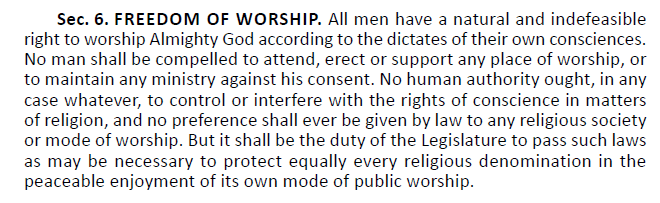
Political Sphere suggested looking at Section 6 of Article 1 of the Texas Constitution.


Thus far, since the pandemic started, challenges have only been done based on the First Amendment of the US Constitution, about laws infringing the freedom of worship. Religious infringements have not yet been challenged based on the Texas Constitution, and such cases would probably prevail. Meaning the amendment isn’t actually necessary. However, we will probably still vote for it. Depending on a court challenge, rather than on the clear word of the law, seems dangerous before the next “crisis.”


My Conclusion for Proposition 3:


·       Government can still manage safety measures during natural disasters such as tornadoes or hurricanes; those are self-evidently short-term problems. And churches tend to meet where they can for the purpose of support and service—no government edict should get in the way of that.

·       When government provides accurate information, churches—as well as businesses and individuals—can develop their own safety measures. Assuming only a governmental edict will prevent people from spreading a disease is tyrannical thinking.

·       Existing law and the Texas Constitution obviously didn’t adequately protect religious organizations in Texas. Only pressure on the Republican governor ended those intrusive measures relatively quickly.


VOTE YES ON PROPOSITION 3

______________


Texas Supreme Court
image found here
Proposition 4 (SJR 47)


What will be on the ballot:


“The constitutional amendment changing the eligibility requirements for a justice of the supreme court, a judge of the court of criminal appeals, a justice of a court of appeals, and a district judge.”


What it means: This would require 10 years of experience as a practicing lawyer in the State of Texas or a practicing lawyer and judge of a state court or county court for a combined total of at least 10 years to be eligible to serve as Chief Justice or Justice of the Supreme Court of Texas.


I made a chart to see the changes more clearly:


So the changes are to require being licensed to practice law in Texas, not just practicing for 10 years. The combination of 10 years of being a lawyer and a judge are intact, but “court of record” is now defined as “a state court or county court established by the Legislature.” And added is the requirement that the license must not have been revoked during the 10 years.


Here are the arguments:


Arguments For Proposition 4:


·       Increasing the required number of years of legal experience for district court judges could result in a better qualified Texas judiciary.

·       The quality and reputation of the Texas judiciary could be enhanced by the requirement that a judge’s license cannot have been revoked or suspended.


Arguments Against Proposition 4:


·       The requirement of additional years of experience as an attorney could adversely impact the diversity (age, race, gender, etc.) of judicial candidates and judges.

·       The amendment could restrict the size of the pool of candidates eligible to run for the judicial positions, which could result in a judiciary that does not reflect the population.

My son’s rural county perspective was that the pool of possible judges would definitely be limited. But he plans to vote Yes anyway.


My Conclusion about Proposition 4:


·       I don’t know whether more years of experience will lead to better judges, although that seems logical. I do like the requirement that they haven’t had their law license suspended.

·       I’m not concerned about the additional requirements adversely impact the diversity. We shouldn’t choose judges based on their intersectionality score; we should choose them based on ability to judge according to the law.


VOTE YES ON PROPOSITION 4

__________________ 


seal of the Texas Commission
on Judicial Conduct,
found here
Proposition 5 (HJR 165)


What will be on the ballot:


“The constitutional amendment providing additional powers to the State Commission on Judicial Conduct with respect to candidates for judicial office.”


What it means: Currently, the State Commission on Judicial Conduct may only handle complaints against existing judges. This amendment would extend the Commission's authority to impose the same standards on all judicial candidates as it does for those who are already judges, therefore leveling the playing field and ensuring all candidates for judicial positions are treated equally.

No fiscal impact.


Arguments For Proposition 5:

·       Allowing misconduct charges against judicial candidates could result in fairer judicial campaigns. Under current law, misconduct charges can be brought against judges currently in office, but not against candidates running for judicial office. 

·       Bringing complaints about judicial candidates, as well as judges in office, to the Commission on Judicial Conduct could ensure that complaints against both candidates and judges are heard and acted on. This could result in better screening of both candidates and judges. 


Arguments Against Proposition 5:

·       Opponents say this amendment is unnecessary. Those who have complaints of misconduct against judicial candidates can file them with other authorities, such as the State Bar, the Attorney General, or the appropriate District Attorney for investigation and action.

·       Adding complaints against judicial candidates to the Commission on Judicial Conduct could overburden the Commission and its staff with new cases.


My son adds that a loophole is closed with this constitutional amendment. It may not have been often used, but theoretically a judge who knew he was going to have a complaint charged against him could step down, so there would be no charge while he ran for office again. Having complaints visible for both a sitting judge and a candidate for judge eliminates that possibility.


My Conclusion about Proposition 5:

·        It makes sense to me to have all judicial candidates on a relatively level playing field (incumbency notwithstanding). The goal is to elect qualified judges, and it is currently harder for the general public to know about complaints against a candidate than complaints against a sitting judge.

·       I’m not concerned about overburdening the Commission on Judicial Conduct; we hire them to do a job. I doubt there will be so many otherwise disqualified candidates running that their burden is much changed.


VOTE YES ON PROPOSITION 5

________________


image found here
Proposition 6 (SJR 19)

What will be on the ballot:


“The constitutional amendment establishing a right for residents of certain facilities to designate an essential caregiver for in-person visitation.”


What it means: This amendment would guarantee residents of long-term care facilities (such as nursing homes) the right to designate someone as an essential caregiver. Though they may put certain guidelines in place, these facilities would not be allowed to prohibit residents from visiting with their designated caregivers, even in situations similar to Covid-19. Those in long-term care need contact with family. This would ensure that family support can be provided at all times.


Here are the arguments:


Arguments For Proposition 6:


·       For Texans in group care, visitation by a loved one can help combat loneliness, anxiety, and depression, and can provide advocacy and emotional support.

·       For residents with no remaining connections, there is comfort in having outside visitors in the facility.


Arguments Against Proposition 6:


·       This amendment takes away the ability of public health and certain government officials to restrict access by outsiders to group care facilities in order to protect the residents and the staff.

·       Even if health and safety protocols are in place, visitation by outsiders could expose other residents and the staff to disease.


Political Sphere notes that the passage of this amendment will allow for a gap in rules. If it passes, it will take effect January 1, 2022, but the legislature won’t meet again until January 2023 to set rules, which then would probably not take effect before September 2023—assuming the Legislature handles making the rules that session. In the meantime, nursing homes could keep their current rules or make their own. Still, having a designated caregiver by the end of this gap is better than not at all.

My Conclusion about  Proposition 6:


·       Making people in nursing homes “safe” by making them miserably lonely was one of the worst things we did during the pandemic. The residents deserve a choice about how to enjoy their last days.

·       This amendment still allows the legislature to set guidelines, so it’s not going to allow relatives with active contagious illness to come in.

·       While visitation by outsiders could expose residents and staff, so can exposure by staff. A nursing home is not an isolated universe. Staff may come into contact with the virus when they are away from work. Why allow staff to enter but not a loving family member of a resident?


VOTE YES ON PROPOSITION 6

_________________


image found here
Proposition 7 (HJR 125)

What will be on the ballot:


The constitutional amendment to allow the surviving spouse of a person who is disabled to receive a limitation on the school district ad valorem taxes on the spouse’s residence homestead if the spouse is 55 years of age or older at the time of the person’s death.”


What it means: Allows the surviving spouse of a disabled person to retain the tax ceiling benefit. 
When one spouse dies, the income is reduced. Maintaining tax at existing rate is helpful. It does not increase tax burden of school since it maintains what was already granted.


Here are the arguments:

Arguments For Proposition 7:

·       This amendment would protect the surviving spouse of a disabled person from losing an important benefit. 

·       The proposition validates a state law already passed and clarifies that the law is to be enforced.

·       The proposed amendment passed with zero “no” votes in both the Texas House and the Texas Senate, indicating broad bipartisan support.


Arguments Against Proposition 7:

·       The passage could reduce tax revenues for school districts and other local taxing authorities.

·       Any lower property values could decrease revenue and affect the state school funding formulas.

·       This could lead to further property tax exemptions, which could have future negative effects on school and other local finances.


Currently, this limitation in the constitution is provided to homeowners over 65 years old and to disabled persons. To be eligible for this limit, the spouse must be at least 55 years old when the disabled person died and must still live in the home.

The proposed amendment is needed because, in 2019, the Tax Code was updated to allow this tax limitation for surviving spouses of disabled persons, but the Legislature failed to authorize a proposed constitutional amendment. Some counties followed the Tax Code and some did not. For those that did not, eligible surviving spouses may be due a refund.


My Conclusion about Proposition 7:

·       This proposition corrects an oversight from the 2019 law. A surviving spouse shouldn’t have to give up the tax rate ceiling they had been counting on when their elderly or disabled spouse was alive.

·       Tax revenues for school districts and other local taxing authorities are the same as they were before the spouse died, so it doesn’t in any way affect the state school funding formulas.

·       The slippery slope argument doesn’t fly; any further property tax exemption would have to go through the rather onerous legislative and voter process based on its own merits.


VOTE YES ON PROPOSITION 7

_____________


image found here
Proposition 8 (SJR 35)

What will be on the ballot:


“The constitutional amendment authorizing the legislature to provide for an exemption from ad valorem taxation of all or part of the market value of the residence homestead of the surviving spouse of a member of the armed services of the United States who is killed or fatally injured in the line of duty.”

What it means: This would allow the surviving spouse of a service member who is killed or fatally injured (rather than killed in action) to receive a property tax exemption. When one spouse dies, the income is reduced. Maintaining tax at the existing rate is helpful. The service member has given his life defending our country. This is the least we can do.


Essentially, Proposition 8 would expand eligibility so that surviving spouses of members of the military who are killed in the line of duty benefit from the same exemption from property taxes that is currently given to spouses of military members killed in action. So, if their death was due to injuries that are not combat related (such as in a training exercise), it would still be considered a result of their military duties. This exemption is for the property tax on the market value of the spouse’s residence homestead if the spouse has not remarried.


Arguments For Proposition 8:


·       This amendment would correct an oversight in current law to include surviving spouses of the military who were killed in the line of duty, rather than only in action.

·       These surviving spouses have suffered the loss of their partner because of their military service and should therefore be provided the same benefit as those whose spouses were killed in action.

·       Death in combat for our country’s soldiers should not be the determining factor on whether we honor their military service by providing relief for their spouse.


Opponents say:


·       This amendment will reduce tax revenues to school districts, counties, cities, and special districts by lowering property value. Many more military are killed in the line of duty than are killed in action. The estimated potential loss of tax revenue could be significant.

·       Second, any lower property values could decrease revenue and affect the state school funding formula. Also, this amendment would expand property tax exemption to another group of people, which could increase the tax burden for other property owners.


My Conclusion for Proposition 8:


·         Similar to Proposition 7, this amendment keeps property tax revenues the same as they were when the military person was alive—rather than increasing it as an additional hardship on the surviving spouse. I misunderstood this when I presented the propositions for a group of precinct chairs earlier this week. The rate doesn’t actually stay the same; it lowers it as it already does for spouses of military killed in action; it isn’t maintaining a lowered rate enjoyed by military while alive. So it is different in that way from Proposition 7. However, I still believe it’s worth doing. If it causes a significant drop in property tax revenues surrounding military bases, maybe we need a different mechanism to make sure those communities don’t bear the entire burden.

·         Military families should not be punished for the “bad luck” of losing a spouse in the line of duty rather than in action. We should honor the service of those who gave their lives in service, regardless of whether that was in battle.


VOTE YES ON PROPOSITION 8


Summary for Ballot Propositions
November 2021

Proposition 1           YES

Proposition 2           NO

Proposition 3           YES

Proposition 4           YES

Proposition 5           YES

Proposition 6           YES

Proposition 7           YES

Proposition 8           YES