Monday, September 3, 2012

Happy Empty Chair Day

I had intentions of writing over the weekend, but enjoying time with family distracted me. The rest can wait. But I did manage to join in with a quiet little protest (along with many thousands of others, I gather), by placing an empty chair under the stars and stripes. The image seems to have struck a chord.

As this blog piece noted, with some understatement, “There is obviously a deep grassroots desire to be heard, and to be heard against Obama.” And I might add, not just the individual by that name, but the ideology that seeks to confiscate the profits from our work, control our personal decisions, limit our God-given freedoms, and denigrate the principles that must be followed in order for civilization to thrive.

Friday, August 31, 2012

Looking Up

Mitt Romney at GOP Convention
photo from Ann Romney's Facebook page
Here at the Spherical Model, instead of a left/right model, we have a three-dimensional model, with the good at the top: civilization, freedom, free enterprise. The southern hemisphere contains the bad: savagery, tyranny, controlled economy. The side-to-side direction is basically neutral, but based on interest, from individual/family at the center west, and expanding outward through local, state, regional, national, on up to  global perspective. The general rule is that the controller of decisions should be left to the most local level possible; otherwise there is usurpation of power, which is a tyrannical position (southern hemisphere).

So when I look at who I should vote for, I look at how well the candidates’ ideas line up with the principles that we know lead to civilization, freedom, and free enterprise. This week at the GOP convention (which I watched from home) has been a good week. A lot of looking up—how to get up to the northern, civilized, freedom zone.
Others may be watching for strategy, or for excitement that will motivate the army of activists to go get out the vote, or for some rhetoric so soaring that it will be remembered and compared in future years. I very much enjoy a brilliant, well-said phrase; I collect the quotable. But I mostly leave that kind of examination to others. I want to know the philosophy and character, to know how well it lines up with what we know will place us in the northern hemisphere of the Spherical Model.
There was much to enjoy in Paul Ryan’ talk, as well as speeches by Marco Rubio, Condoleeza Rice, Mia Love, Chris Christie, and others—and I may take a later post just to enjoy those. But what we need to know is whether we have upper hemisphere hopes from our future president—who will lead the direction of the country. And Romney’s speech did what it needed to for me.
He used the word “optimism” four times, and referred, in various ways, to hope for a better future a few more times. That in itself is upward looking—if it’s tied to the right principles. And I believe it is.
Some of what we need to know about Romney, I have known for a long time; it was a matter of getting the picture out for others, during a time when cynicism is so rampant that a decent family man who wants to serve others seems too good to be true. But he has indeed lived his life that way. Some of the telling had to come from others, and that happened this week. Ann Romney began to introduce this good man to people who hadn’t noticed before, or been willing to believe who he was. And that was followed by a string of actual recipients of his quiet, unpaid, unrecognized service. This must have gotten the story out, because after his speech, the PBS commentators stumbled, trying to come up with descriptors for the speech that clearly didn’t align with their worldview, but they decided to agree Romney is just, really, a decent man.
Does he believe in God, so that he can understand God is the giver of our inalienable rights? Yes. Does he live the Ten Commandments as the basic level of civilization? Yes, and refined with the Sermon on the Mount, I Corinthians 13, and other scriptural directions on how to be the person God wants you to be.
Does he place family as the central civilizing force? Yes.
About Paul Ryan, he said, “I love the way he lights up around his kids and how he's not embarrassed to show the world how much he loves his mom.”
About his parents, and then his and Ann’s family, he said:
My mom and dad gave their kids the greatest gift of all – the gift of unconditional love. They cared deeply about who we would BE, and much less about what we would DO.
Unconditional love is a gift that Ann and I have tried to pass on to our sons and now to our grandchildren. All the laws and legislation in the world will never heal this world like the loving hearts and arms of mothers and fathers. If every child could drift to sleep feeling wrapped in the love of their family--and God's love—this world would be a far more gentle and better place.
The line I highlighted lets us know, maybe more than anything, that this is not someone who believes in taking power to enforce government on minions.  This line, about connecting with his church and community, also tells us he understands how thriving civilization happens:
And that's how it is in America. We look to our communities, our faiths, our families for our joy, our support, in good times and bad. It is both how we live our lives and why we live our lives. The strength and power and goodness of America has always been based on the strength and power and goodness of our communities, our families, our faiths.
A look at Romney’s business record is an example for the world of free enterprise at its best. He told a little of the Bain story—and having it come after the “evil vulture capitalist” claim was revealed as a lie made it clear his success was real success. And that allowed him to say this:
These are American success stories. And yet the centerpiece of the President's entire re-election campaign is attacking success. Is it any wonder that someone who attacks success has led the worst economic recovery since the Great Depression? In America, we celebrate success, we don't apologize for it.
We know he understands and believes in the free enterprise system when he follows his story with this:
It's the genius of the American free enterprise system – to harness the extraordinary creativity and talent and industry of the American people with a system that is dedicated to creating tomorrow's prosperity rather than trying to redistribute today's.
That is why every president since the Great Depression who came before the American people asking for a second term could look back at the last four years and say with satisfaction: "you are better off today than you were four years ago."
Except Jimmy Carter. And except this president.
He didn’t have to be personally negative about President Obama; that would have seemed gratuitous piling on when it is clear to everyone—everyone—that he has failed to provide financial success, American freedom, and social thriving. Obama has failed because he follows the rules that keep people in the southern hemisphere of tyranny. He is literally a tyrant, whether he has the personality of other worldwide tyrants or not. But it isn’t necessary to use that kind of term; all that is necessary is to point out that what we want—personal freedom, economic opportunity, and thriving civilization—can be reached on a path that claims government control is the answer.
This was one of my favorite lines, because what I want during this campaign is to see clearly the truth about the candidates. This shows the contrast:
President Obama promised to begin to slow the rise of the oceans and heal the planet. MY promise...is to help you and your family.
He doesn’t mean he will micromanage your family from Washington; he means he will set an example of a strong family—and how to Dad—but also will help by getting roadblocks out of the way so families can succeed through hard work and helping one another. Economically, things will get better. Freedom will improve with adherence to the Constitution:
That America, that united America, will uphold the constellation of rights that were endowed by our Creator, and codified in our Constitution.
That united America will care for the poor and the sick, will honor and respect the elderly, and will give a helping hand to those in need.
That America is the best within each of us. That America we want for our children.
This is an America we remember, if we’re old enough and from the right places (I am both). And now I feel free to hope we will return to thriving. Things are indeed looking up.

Wednesday, August 29, 2012

Not Just a Mom

Photo source here
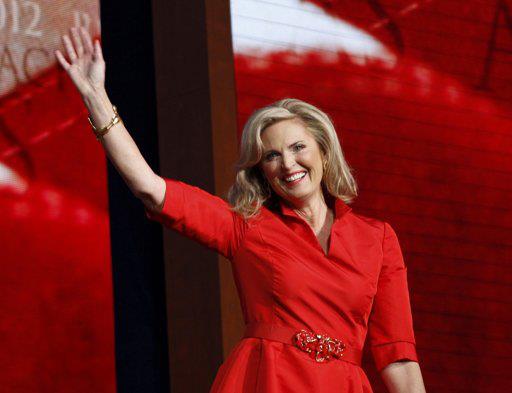
One thing that cannot be assumed about Ann Romney is that she is “just a mom,” implying that she lacks something that could have allowed her more choices. What is really clear is that she is a phenomenal human being: smart, capable, kind, lovely, and particularly supportive of family members, whom she clearly loves.

She is also a survivor of MS and breast cancer. And not just a survivor, but one capable of going on the campaign trail, with all the intensity and interference with real life that that entails. If we have one evidence (and there are many) that Mitt Romney is a brilliant man who makes wise crucial decisions, it is that he chose Ann to marry, back when they were too young to know who they would eventually become. In fact, I think they have become who they are because they chose each other.
At some point I hope to be able to express—especially to women who don’t naturally understand this—that making the choice to stay at home and raise children is a career choice with possibly more benefits to society as a whole than any other career choice. There are many many ways women can contribute; women have the brains, the ideas, the abilities to do almost anything that doesn’t require simply sheer brute force (and even there, some women surpass many men). But when you look at this couple, more than forty years ago, talking it through together, deciding how their family would look, Ann’s volunteering to cover the childbearing and being home tasks must have been an incredible relief to him.
All of their five sons talk about how their dad was very involved in their upbringing—taking them when he did service, teaching them the value of priorities (like the story of losing an anchor, and he left his important guests to go out and dive for it with them, because he needed them to teach them to care for what they had as responsibilities). So it wasn’t so he could give Ann all the dirty work of child rearing. It was that he had in her a helpmeet—the very definition of Eve, when she was given to Adam. And she chose to be the helpmeet from home, because handling five boys without someone always present might have been riskier than they were willing to try. Finding the best way to accomplish something is the Romney way.
I loved her speech Tuesday night at the GOP convention. She said so much about the value of women, totally without the competitive man-hating so prevalent among “feminists.” She also told the human Romney story—as she has been doing all along for years, but this time with a somewhat more attentive and certainly larger audience.
She started out talking about love—love that everyone in the room was feeling together, combined with a love of our country, but also the specific love between Ann and Mitt and their family.
I have often said about Mitt Romney that I have known many men like him, successful, hardworking, and decent. He is not uncommon among Mormons, just more successful than most. Ann Romney is like many Mormon moms I have known—only more so. There was a story this week about media people finally being invited to their vacation home in New Hampshire. The media shows up, and Ann is doing the laundry. They are stunned. The narrative has been that these people are too rich and out of touch with the rest of America. But it also came out that they do their own grocery shopping—and they’re thrilled with the great bargains you can get at Costco.
This is exactly what I have seen. I know many well-off, if not wealthy, Mormons. Everyone does their own laundry and their own shopping. Here in Texas is the only place I’ve been where it is common for people to hire someone to do their lawns (not us—we still mow our own, but we’re not among the wealthy). I’m somewhat distantly acquainted with another very successful Mormon businessman and family, who also used to live in Belmont, Massachusetts, who have raised about as many kids as the Romneys, and the mom suffers MS. Yet I believe she still does her own laundry and shopping. Certainly her own cooking, which is somewhat legendary (as is Ann Romney’s—she ran a little cooking school at one time). I don’t think it ever occurred to them that you don’t do the household “work” just because you can afford help.
If you’re raising kids, and you have an abundance of money, does it help you raise better children if they see you hire help for all the menial tasks, or to do that in front of them and train them to do it? Depends on whether you want them to think they’re better than others and entitled to ease, or whether you want them to value hard work and valuing other people as equals. Could the Romneys have taught their children the best values if Ann had chosen some other career and then hired out the household tasks? Maybe, somehow. But we do know that they could do it the way they chose to do it.
This is not to say that it’s somehow wrong to hire help. It’s just to say that people have made assumptions about the Romneys because of their wealth that simply aren’t true. Their money, as Ann said, allowed them the opportunity to provide for their children’s educations, and opportunities for service. Here’s how she put it:
It allowed us to give our sons the chance at good educations and made all those long hours of book reports and homework worth every minute. It’s given us the deep satisfaction of being able to help others in ways that we could never have imagined. Mitt doesn’t like to talk about how he has helped others because he sees it as a privilege, not a political talking point. And we’re no different than the millions of Americans who quietly help their neighbors, their churches and their communities. They don’t do it so that others will think more of them.
I think we need to believe Ann when she tells us what she knows, as the person who knows Mitt Romney best:
This is the man America needs.
This is the man who will wake up every day with the determination to solve the problems that others say can’t be solved, to fix what others say is beyond repair. This is the man who will work harder than anyone so that we can work a little less hard.
I can’t tell you what will happen over the next four years. But I can only stand here tonight, as a wife, a mother, a grandmother, an American, and make you this solemn commitment:
This man will not fail.

If you didn’t hear the speech, treat yourself to the twenty minutes here:


Monday, August 27, 2012

One Giant Leap

Neil Armstrong, 1969
photo from Wikipedia
I was surprised by the news over the weekend of the death of 82-year-old Neil Armstrong, first man to walk on the moon. I hadn’t heard much about him in a long time—which turns out to be pretty much because of his personality and choices. He became very quiet in retirement, making few public appearances or speeches.

As one of the pieces I read noted, “His walk on the moon wasn’t a personal achievement per se, but an accomplishment for all of humanity.” He didn’t take the honor for himself; he was just the man with the assignment of being the human being to take the step made possible by the work of thousands of engineers, scientists, and workers who had worked over time and throughout this particular mission to make his step possible.
His words were brilliantly apt: “That’s one small step for man, one giant leap for mankind.” (Or possibly “one small step for a man”; there’s debate about whether the “a” just wasn’t heard or remembered. Not important.) Of all the words that could have been spoken at that moment, those were so beautiful. We’re fortunate he wasn’t just some guy who said, “Huh, it’s kind of dry and colorless here,” or “Nice place for a visit, but I wouldn’t want to live here.”
He was respectful, humble, and reverent. And it appears his life following this moment showed him to embody those qualities, rather than to have just portrayed them for a brief important moment. There was a point at which he stopped signing autographs, because he learned that people were selling his signature for profit, and that seemed wrong. It wasn’t about him as hero or celebrity; it was about the historic accomplishment. He kept the moment sacred.
It’s said that those who saw the event will never forget it. Probably so. I’m of an age to verify that for myself. It was a Sunday. This particular Sunday, as almost never happens, we were dismissed early from services, right after the sacrament (communion), to go home and watch TV—because it was important for us to witness the historic event.
I had just turned eleven a few days before. It was a kind of magical summer; we had moved from a house we’d built when I was three, and until buying another home lived in a house my grandparents had built and normally rented out. There was a creek going through the yard, and horses in the field behind. We did some great exploring that summer. We drove to our regular church, not knowing where we would be moving (we ended up moving back to the same neighborhood a few months later), so it was a good half-hour drive, instead of a walk up the street. That may have made the dismissal to go home to our TVs seem even larger.
We had a small black-and-white TV, with a dial to turn to the three available commercial stations—all of which showed the event simultaneously. There were some simulations showing us what was going on, but the actual moon landing was viewed from a camera set up on the lunar module to chronicle the event. It was a fuzzy image, at least on our TV. The astronauts looked kind of ghost-like. At the age I was, it probably wouldn’t have held my interest without the historic meaning everyone placed on it. In grade school back in those days, if there was a NASA launch, we got to bring in a TV to the classroom and cluster around it to watch; it was always a big deal. But this one was more so. I’m glad, after all these decades, that the adults around made it seem significant, because I do indeed remember seeing the images and hearing the words.
It was indeed a giant leap for mankind; history up until July 20, 1969, landing on the moon had been only real in imagination. From that point on it was part of our history.
I don’t know what is in store for our future, but as mankind, and as a country, I don’t think we’re done with greatness yet. My thanks to Neil Armstrong, who was such a good example. Even in death, he reminds us of that magnificent culmination of efforts for mankind. We can always use more heroes who embody respect, humility, and reverence.
Here's a video of the event--worth seeing again: 


Friday, August 24, 2012

Welfare with Dignity


This past week, by illegal (in my opinion) executive order, the president gutted the welfare reform passed in the 1990s and signed (and taken credit for) by Bill Clinton, removing the requirement of working or showing effort to find work. The president wants it to be a pure handout, an entitlement, separated from the idea of work.
I don’t know his motivations precisely, but I do know this about human nature: work brings dignity. Working for wealth is more meaningful to the human soul than a free handout, particularly an expected one received without gratitude. A handout with no strings attached is a disincentive to work—and the result is a depressive effect on the soul, turning an otherwise productive human being into a mere parasite.
Rather than deal with the numbers on and off welfare during this current depression, I’d like to look at an exemplary private program, begun 76 years ago during the last Great Depression. This is the welfare program of The Church of Jesus Christ of Latter-day Saints, the Mormons. The program was highlighted last night in a segment of Rock Center with Brian Williams.

Visit NBCNews.com for breaking news, world news, and news about the economy
 
According to the Church’s website,
The objective of the welfare program is to care for the needy while teaching principles that will help people become self-reliant and retain their self-respect.
That’s the “teach a man to fish” principle, so he can eat for a lifetime, as opposed to the “give a man a fish” strategy, where he eats just for a day.
How does the Church do what it does? By living the principles of civilization: donating time, money, and caring. Every month a Sunday is dedicated to fasting—skipping two meals. The cost of these two meals is donated—above and separate from tithing—as fast offerings. In other words, actual food is given up, voluntarily, to provide food and other needs for the poor. It may be easier for rich people to give up the cost of two meals (and some are much more generous, because they can afford to be), but it helps the soul to feel the hunger for the sacrifice. No one asks or checks up to see who is hungry (and people with health reasons for not fasting, such as diabetics or pregnant moms, are not expected to), and while records are kept for tax deduction purposes, no one is forced or expected to pay any specific amount. There is value in generosity by choice that simply can’t be there with coercion.
The Church’s welfare program has been visited as an example by presidential administrations and other visitors for many decades. It’s kind of mind-boggling. The stores of food and supplies are used worldwide, and are distributed to storehouses around the world. We have one in Houston.
Besides the storehouses, there are also production facilities. Where I grew up, we had fruit farms; that was true when we lived in Washington State as well. My husband grew up in an area with a tuna canning facility (not still in use). Here in Houston we have a peanut butter cannery. [The facilities and equipment were upgraded last year; I wrote about it here. The cannery is also used in a joint project with the Houston Food Bank, to produce about 100,000 jars that go directly into the hands of local families in need.]
There was a month, during graduate school, when a summer internship fell through. I was working part-time, but until a job in his field materialized, we were in dire straits, with a small baby. We had counted on the summer money to get us through not only the summer, but the coming school year. We turned to the local bishop, the lay pastor of the congregation. He got us what we needed. The Relief Society president, the leader of the women’s auxiliary, came and met with me and filled out a “shopping list,” food and supplies we would receive without cost. This included cloth diapers, which I was used to using but needed more of. (Today I think disposable diapers are more likely to be on the list.) Most of the food was produced by voluntary labor of church members, and then some products were purchased by the Church, but not by us.
In exchange, we served where we could. Mr. Spherical Model got assignments on various Saturdays to work, along with some youth and other leaders, on the pig farm an hour away that produced pork products for the storehouse. It was messy, filthy work—that makes me appreciate farmers who do the work all the time. They mucked out barns. They separated the pigs from the bores. They identified the ones due for, uh, removal of reproductive organs. The volunteers didn’t have to perform that surgery, just helped the full-time workers.
It was a hot Indiana summer (90 degrees and 90% humidity that we called 90/90 days), and we had no air conditioning in our little car. There was a traffic stall on the way home from one of these assignments, and Mr. Spherical Model and his cohorts had to spend an extra hour sitting in the heat, smelling one another. Fortunately we had vinyl upholstery, but it took a lot of cleaning and a long time to get the odor out. I refused to let Mr. Spherical Model into our apartment with those filthy clothes. I made him drop all but underwear in the hallway, which I then carried quickly to the laundromat in the next building over. (Fortunately, at that time no one lived in the apartment across the hall, so no indecent exposure took place.)
It was honest labor. If we had not taken the assignment, someone else would have, whether they had received storehouse help or not. Serving is what Mormons do.
We were fortunate that summer work in the department came through, and we had only that single month as receivers of help. But many people are not so fortunate. As with the rest of the population, Mormons are suffering high unemployment today in rates similar to the rest of the population. The Church has an employment specialist in every congregation, to help individuals with their resumes, to practice interview skills, and other employment help. In addition, there is online help, also employment centers—available not just to Mormons, but to anyone in need. It’s helpful that, during these times of extended crisis, there are opportunities to serve—to feel the dignity of being useful—while also gaining work experience.
There’s an anecdote from To Kill a Mockingbird, that I wrote about in one of my first blog posts, that talks about real charity:
The young girl, Scout, learns how her father, Atticus, has helped someone too poor to pay for legal help Scout’s father had done. The man feels his debt, and periodically brings stove wood (because he can’t pay with money, since he doesn’t have enough). And eventually both Scout’s father and the man will know that the debt has been duly paid.
I say it was still charity, in the good sense. Atticus Finch did his work as a lawyer, knowing the client had no money but had a need. He could have gotten stove wood for himself. But he allowed the repayment as a kindness, to show he respected the man’s willingness to work, to show the man wasn’t demanding help he couldn’t pay for. Their good will toward one another is charity (caring), in both directions.
The Rock Center story referenced above says that 600,0000 orders a year are distributed through storehouses, and in addition funds are made available to local leaders, for purchasing goods where storehouses aren’t in close proximity. Additionally, worldwide humanitarian aid is given as disaster relief, as well as long-term help. (Information here). As a hurricane starts threatening the US coastline, trailer trucks full of relief supplies are filled and sent out on the road to be in place in the first hours after the storm—often before either Red Cross or government help arrives. All donations to LDS Humanitarian Aid go 100% to the people in need. Most help is volunteer, but where there is overhead, it is paid for through tithing donations so that no aid donations go to overhead costs.
When people assume that government must supply an economic safety net, I don’t argue that such a net should exist; but I know, because I’ve seen the example, that it can be provided better by private volunteer charity than by government redistribution. 

Wednesday, August 22, 2012

Dave Built That


This past Saturday at the local Cypress Texas Tea Party meeting, after our speaker, time was opened up for general discussion, as usual. A man stood up and told his story. His name is Dave; I didn’t catch the last name. I hope he doesn’t mind my sharing his story here, but it was the kind of story that was beautifully told and ought to be shared again.
Dave is Hispanic (in America since childhood and possibly all his life; he’s a voting citizen). He grew up poor, the oldest of seven children. He worked through his teenage and college years as a migrant farm worker, along with his family, in Michigan. It was in Detroit that he attended school. The migrant farm worker season ran six weeks into the school year, so every year he started school late and had to catch up. And going to school required getting permission from his father; he proved he wanted the education, and he worked hard. Through college, he had to get his father to let him use the money he earned toward his education, instead of toward the support of the family.
Dave wanted to study architecture, and the local college didn’t have a good architectural program, but he got accepted to Texas A&M, which is how he ended up in Texas. He worked his way through, what he considered part-time, which was 40 hours a week (a lot less than the “full-time” work he was used to).
Out of college he got a job with Fluor Daniel, building chemical plants around the world. It was a good job, and he got a lot of good experience. But he had always dreamed of owning his own business. So twenty-one years ago (I think he’d said this was after a couple of decades working for Fluor, but I’m not sure), he left the security of the income, took the risk of putting everything he had into an architectural engineering company, and over time they have been blessed with success.
Then, a few weeks ago he heard President Obama say, “You didn’t build that.” And that made him mad. What part of all that sacrifice should he not get credit for? That was why he decided to come to our Tea Party meeting, to find out what he can do.
Dave has always been conservative. But he knows plenty of Hispanics who aren’t. He talks with them, but many of them don’t even think about their vote. He says when he asks them whether or not they pay taxes—the ones who don’t, the ones who instead receive handouts from government, they’re a lot more likely to vote Democrat. Some just vote Democrat because that’s what everyone around them does; they don’t even know why.
I’d like an answer to Dave’s question: what can we do? As a small, independent Tea Party group, we do several things. We educate one another, on candidates, on issues, on how government works. We meet with candidates and hear speakers from organizations (Saturday’s was from Texans for Fiscal Responsibility, which follows legislation related to taxes and budgets, and helps keep people informed). We share articles with each other, with an email group and a Facebook page. During the state legislative session, we follow legislation on issues that are important to people in our group, and we meet with legislators and/or their staff to let them know our opinions—and we thank them when they vote the way we like. We don’t as a group endorse candidates, but individually we do, and we share that information. Many of us have worked for free and fair elections with True the Vote, as poll workers and poll watchers, and verifying voter information.
I don’t know if participating in our group is enough; it’s a start. But with Dave’s connections to the Hispanic community, I’d like to know ways we could spread our message there. We, as conservatives, have a lot more in common with the values of Hispanics than liberals do. We believe in hard work, strong families, personal responsibility, and getting government out of the way—lower taxes, less unnecessary regulation. We are pro-small business. We’re a lot more likely to say, “Yes, go ahead and build that,” than, “You can’t take credit for that; government made that happen.” And when people are in need, we’re a lot more likely to give personally, through a church or local charity, so our giving doesn’t have to filter through government hands. I think if people in the Hispanic community knew us and knew our message, they’d find themselves comfortably welcome.
Are there better ways, maybe untried ways, to share the conservative message with Hispanic voters? I imagine there are, but I don’t yet know what those avenues will be. For now, we depend on Dave and people like him to keep telling their stories. Yes, life might be tough, but it’s not hopeless. If we can just keep government out of the way, we can work hard and build that dream here in America.

Monday, August 20, 2012

The Lost Majority Part III: Prognostications

If you’re going to delve deep into voting data, you kind of expect that you’ll some hint about what’s going to happen in the future. However, while the data from past elections may be exact, predictions are still dependent on whether or not the data, combined with everything you can know about people’s reasons for their votes, can still be something like meteorology: we look up the forecast, but we’re not surprised when it’s wrong.

Sean Trende’s book, The Lost Majority, isn’t a predictor about the upcoming election; it is a discussion of what has happened, with just a few basic themes:
·        There’s no such thing as a permanent majority—and Obama’s election was certainly not an indicator of a permanent progressive majority.

·        Emerging majorities described by overexcited commentators on both sides are wrong; neither party is headed toward extinction or marginalization.

·        The very idea of cyclical long-term direction changes is a wrong reading of history, which shows alternating victories by either party as more normal than exceptional.
So, his point that 2008 did not indicate a mandate for transformation to “progressive,” rather than “constitutional” government , is encouraging—and was borne out by the outcry against such an assumption in 2010. But the book was written too early (by early 2011, well before a GOP candidate was known) to say anything certain about November 2012.
But there are some pieces of information that can be useful. Much of today we’ll be looking at the limits of Obama’s narrow but deep coalition.
Obama’s coalition consists of:
·         Minorities: blacks, Hispanics, Asians
·         Labor unions
·         Youth (18-29-year-old voters)
·         Welfare recipients
That wasn’t enough to elect him in 2008. That year he received support from many disgruntled Republicans and independents who liked the idea of voting for a black and having racism forever off the table as an issue, many of whom were unhappy with the length of wars in Afghanistan and Iraq, and the suddenly collapsing housing, automobile, and banking industries. They were willing to trust that someone who offered “hope” and “change” meant something remotely close to what they hoped would change.
What we can surmise from current polling data, if we can’t yet guess outcomes, is that essentially no one who voted for McCain in 2008 will vote for Obama in 2012. The question is simply, will Obama maintain enough support from his base to be reelected? He received (conflicting reports of) 90-97% of the black vote in 2008. If he loses 8% of that vote, either from changing their vote to the opponent or staying away (and they had turned out in unprecedented numbers in 2008), that could make a critical difference.
He also had the youth vote that lacks enthusiasm this time. I don’t know the numbers, but the insupportably high unemployment rate for young people, including college graduates returning home to live with parents, is going to have a dampening effect.
Unions still support Obama, but the actual workers, what you might refer to as white non-college educated, didn’t go strongly for Obama even in the primary, and became to him “bitter clingers,” were written off before election, so he’s not getting them back after four years of sustained high unemployment. He still retains a fairly strong following among whites with post-graduate degrees (the elites who assume they will be part of the ruling class), but support for him has collapsed among college-educated whites.
Stanley Kurtz has been talking about Obama’s attacks on this group in a recent book (Spreading the Wealth: How Obama is Robbing the Suburbs to Pay for the Cities), and articles about the attempts to transfer wealth from suburbs to urban areas, which Obama believe is the more moral, authentic place to live. In other words, if you’re a middle-class family person who lives in a house, Obama has written you off.
Hispanics are an interesting demographic for prognosticators. There’s an assumption that, as the Hispanic population grows, support for Democrats grows with it. And while it’s true that Hispanics do lean Democrat, as they integrate into American culture and move into the middle class, they become more conservative. Here is Trende’s summary:
But what of Latinos? If they vote like African Americans, it seems that Republicans would be in very deep demographic trouble. However, if they vote like Anglos, it suggests that as more and more Latinos become wealthier and, presumably, more conservative, they will also become more Republican (see figure 8.7).

            As it turns out, the Latino vote looks a lot more like the non-Hispanic white vote than the African American vote. Latino voters in each group are roughly 10 points more Democratic than white voters, while Latino conservatives are about 50 points more Republican than conservative African Americans. The critical distinction is that there are more Latino liberals than there are white liberals and fewer conservatives (pp. 146-147).

So the question is still out there about the effect of a growing Hispanic population. But here in Texas, on the ground, in Tea Party meetings and political conventions, Hispanics have a very strong and very welcome presence. I know this is anecdotal evidence only, but I still believe it’s just a matter of speaking the message of lower taxes, greater opportunity, and freedom, supported by strong religion and personal responsibility. The message resonates.
Many Hispanics vote Democrat for the same reason as many other Democrats: their parents did, their friends do. They haven’t even thought through ideological reasons; they just do what is expected. If they can be led to think it through, they are very likely to recognize how much the conservative message resonates with their personal values of hard work, strong families, and a desire to improve life for themselves and the next generation.
Obama has made some assumptions about keeping retirees, but he’s been losing that argument in Florida, where retired whites in overwhelming numbers are abandoning the president who “borrowed” $700 Billion from Medicare to fund an extremely unpopular government medical takeover.
He has claimed the women’s vote, and tried to frame that as a GOP war on women, but since there’s no such war, sometimes the arguments just look silly (remember Stephanopoulos’s debate question out of the blue on limiting birth control?) This question comes down to women looking completely incapable of paying for basic care that is available and affordable, up against major religions standing strong for their right not to be forced to fund behaviors against their religious tenants. The only way Obama keeps the female vote is by assuming women are totally reliant on government, and are non-religious—and against living in suburban homes with their families. I wouldn’t count on that. He will probably keep single, post-graduate-educated women and poor non-taxpaying single-mothers.
So he has written off whites, except for a portion of elites and the non-taxpaying largesse recipients. His enthusiastic youth vote (much of which was combined with temporary increase in minority voters) has been deflated. His minority support, while still strong, is less enthusiastic and less monolithic.
As Trende says, “There is nothing inherently wrong with a narrow, deep coalition….  But the real threat with a narrow, deep coalition is that there is not much room for error. The party cannot afford for another portion of the coalition to become dissatisfied with the direction it is taking” (p. 105).
In order to win, he must win all major urban areas—with enough leeway to overcome opposing votes in the non-urban areas in many states. There’s still reason for concern, but it doesn’t look likely. And we have the advantage of a very capable, very appealing alternative.